Against The Odds

. Ramtex, Inc., Ramseur, N.C., is a true pioneer in many ways. The fact is, contrary
to the common opinion that textile manufacturing can only be successful in low-labor-cost
countries, Ramtex proves just the opposite. In 1962, Mr. C.C. Lee, a pioneer in the Hong Kong
textile industry, merged with Jardine, MathesonandCo. Ltd., a major trading company in Hong Kong,
to form Textile Alliance Ltd. (TAL). This was, at that time, the largest vertically integrated
textile organization in Hong Kong. In 1983, TAL was restructured. South China Holdings Ltd. was
formed, made up of the garment division of TAL and investments in spinning, weaving, dyeing and
finishing in Thailand. Ramtex On Its OwnWhen the Asian owners acquired Ramtex from Burlington
Industries in 1988, plant management knew that great challenges would lay ahead. Today, Ramtex is a
fully self-contained U.S. operation. However, to gain success on U.S. soil the company needed a
great strategy, great people and great equipment to fight the odds. Ramtexs Sales Corporation was
founded in March 1988 to act as the exclusive sales agent for Ramtex Inc. Goals from the beginning
were quick response, high-quality products, competitive pricing and great flexibility.On the
product side Ramtex caters to the needs of the home furnishing, apparel and institutional markets.
The main customers are located in the United States, and a certain percentage of the production is
exported to NAFTA countries.  Jim Patterson, Ramtexs executive vice president of Manufacturing
Operations, was with Burlington Industries when the transfer of the plant to the new owners
happened. Patterson said he remembers clearly that the new owners had one subject in mind to
modernize the plant with state-of-the-art machinery.He added that the Asian/foreign ownership has
helped to understand what it takes to compete globally. He feels that this has provided the company
with a lot of positive feed-back.
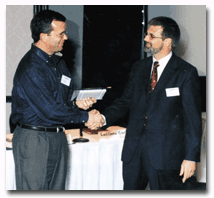
Jim Patterson (l), Ramtex executive vice president of Operations, accepts the Sulzer Textil
Innovation Award from Philip Mosimann, CEO Sulzer Textil AG.The companys mission statement has been
clearly directed towards quality and customer service. We want to provide the best quality
with customer-oriented spinning and weaving, and to compete with anybody in the world, Patterson
said. The sole focus of Ramtex is to satisfy the customer.The company has its production line set
up for high versatility, starting with the different fibers, and ending with many differently woven
styles. With the new machinery Ramtex has prepared itself to shift very quickly.We run whatever the
customer asks us to run to accommodate his needs, Patterson said. We challenge the tradition
running efficient as many styles as we need to. Since the Asian Flu hit, it was certainly much more
challenging, but our customer relationships, the commitment of our employees, as well as our
equipment has helped us to get through, and we really enjoyed some measures of success at the same
time.  Sticking TogetherRamtex has built a very cohesive management team in which everybody
has the same vision. Everybody is supportive, Patterson said. We have a very solid, aggressive, and
calculated risk taking team of managers and employees.Ramtexs philosophy is that no one will be
criticized for mistakes, but individuals will be criticized for the reluctance not to try.
Paradigms are constantly challenged. Once again, Patterson said, the main focus of the teams is on
customer satisfaction and product quality. Ramtex has a stable workforce with little turnover. The
company employs approximately 720 people.Choosing and educating its personnel is an other important
part of Ramtexs success. Several years ago, Ramtex offered educational opportunities for its
personnel. At the same time the standards were raised for certain tasks and positions in the plant,
and a thorough training program was established with the community college. Modern
MonitoringMonitoring is now all over the plant, from fiber to fabric. Some of the monitoring
equipment is bi-directional, which means absolute quality parameters can be set and kept. Recently,
monitoring terminals were put on the production floor so that an employee can see how his/her
particular set of machines is running. Patterson said that this has had a positive effect on
efficiency, and employees make use of it quite frequently. We want the employees to see what is
going on, emphasized Patterson.  Hungry For TechnologyRamtexs manufacturing facility covers
approximately one million square feet and is the companys only manufacturing plant in the United
States. A fascinating part is that it includes a wide variety of different yarn spinning and
weaving technologies that are usually not placed under the same roof of the typical textile
mill.This is certainly proof of an open-minded management style and, at the same time, it documents
the full support which the owners obviously provide to Ramtexs management.Since 1988, Ramtex has
created a modern yarn and weaving operation. With a present investment of approximately $130
million, Ramtex systematically modernized the entire facility.With new equipment, PC-based computer
systems were implemented to monitor and process all manufacturing and administrative data. All
systems and procedures have been upgraded to keep pace with the new manufacturing
equipment. Building RelationshipsRamtex has not only focused its attention on developing
successful partnerships with its customer, but applied this principle also in respect to its
vendors. It seems at Ramtex there is hunger for progress; every possible opportunity is immediately
explored.For example, when Sulzer Ruti (today Sulzer Textil) presented its new M8300 multi-phase
weaving machine at ITMA 95 in Milan, Italy, the Ramtex management team thought that this machine
had to be tried on the companys program.It wasnt Sulzer Ruti who wanted to place a machine or two
in this plant, it was Ramtex who had to convince Sulzer Ruti that they would like to have a small
M8300 pilot installation, making it the first company in the United Sates to have one.To tie all
the different machine manufacturers information systems together, Ramtex decided to use M and Ms
electronic controls (M and M Electric Service, Gastonia, N.C.) for some applications, and
concentrated other information systems onto a PC platform. Patterson said that the older Marzoli
cards and the recently purchased Truetschler cards use M and M electronics, and this is definitely
an advantage for the mill concerning the card room. 
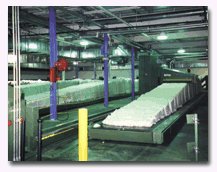
Truetzschler BDT020 incline bale openers deliver first-class fiber blending from the
beginning.In the preparation department, Ramtex has Truetzschler machinery from bale opening to
cards, as well as Marzoli cards that run 100-percent polyester slivers. Ramtex does drawframe
blending on Rieter RSB drawframes, and uses Rieter E70R combers with a new overhead lap transport
system. Combed yarn accounts for about one third of the production.  The companys current
Zinser roving frames are on the list to be replaced at a later date. In spinning, the Murata 802H
air-jet spinning frames have done a great job for the company for 3 to 4 years, as well as the
Toyoda RX-100 ring-spinning machines that are linked to Murata winders. Air-jet yarn and ring-spun
yarn hold about an equal share inn the approximately 650,000 pounds of yarn produced per week. All
air-jet yarn is used internally.In the spinning plant, Ramtex typically runs 50/50 poly/cotton
blends and deviations from the standard 50/50 mix, but also 100-percent cotton, which includes Pima
cotton.Polyester content in Murata air-jet spun yarns is typically 57 percent, while in ring-spun
yarns it is mainly around 40 percent.Ramtex has one R20 open-end spinning frame from Rieter. The
company uses this yarn strictly for internal applications.When Ramtex had a difficult time to find
some special open-end yarn blends from vendors, they just bought one rotor-spinning machine to
fulfill its customers needs.Ramtex also has a great quality control lab, which is used for quality
control for purchased yarns, as well as off-line checking for additional production control. A
majority of the testing equipment was supplied by Zellweger Uster.In the warping department, the
two recently purchased Benninger warpers (Benninger Corp., Spartanburg, S.C.) with the integrated
Ben-Vac overhead vacuum system received high praises from Patterson, Walter Bosch, director of
Manufacturing, Spinning, and Charlie Morgan, director of Manufacturing, Weaving. Everyone agreed
that Benningers warper has contributed greatly to the mills efficiency by preparing quality warps
for all high-speed weaving machines. This is especially related to the reduced fiber fly, fiber
orientation, and dust contamination which the Ben-Vac system tackles.Ramtex is also pleased with
the technology and performance of its Ira Griffin slashers. The Ramtex team feels the slashers are
extremely important to size the warps on a high-quality level for the air-jet and multi-phase
weaving machines. Weaving Into The FutureAs already mentioned, Ramtexs philosophy is to stay
in a close and loyal relationship with its vendors, provided of course that product technology,
performance and service match the vision of the company.Patterson explained that product price is
important, but not essentially the final decision criteria for the purchase of the equipment. It is
the over-all package that must be attractive to Ramtex, the product performance, the after-sales
service and the commitment of a vendor to support the company in technological aspects. Since 1991,
Ramtex has been adding L5200 air-jet weaving machines on a continuous basis and just recently
completed an additional installation which brings the total of the L5200s to 260.The obviously
great relationship with Sulzer Textil led to the purchase of five M8300 multi-phase machines, The
last of which was installed in February. However, Ramtex is also happy with the 60 Picanol PAT-A
double-wide air-jet machines that are used for especially wide styles.At the present time the
M8300s run at 2,400 ppm, and the current styling is the same as on the L5200s. The fabric
appearance and physical characteristics do not show a noticeable difference in the greige fabric,
and after finishing, even the slightest differences are completely diminished. According to the
management, the M8300 requires quite a high level of warp preparation. Even though Ramtexs
management feels that the preparation department did a good job for the L5200 air-jets, the M8300
required an even higher level in warping and slashing.We are constantly taking our warping and
slashing employees into the weaveroom and show them what happens if, explained Patterson.The M8300,
being a double-to-triple fast weaving machine when compared to conventional machinery, also
requires a high level of discipline in reference to any machine stop. The faster a weaving machine
runs, the more critical the aspect of lost production. Time management becomes an extremely
important issue.Patterson admitted that the company is still in a learning curve, every machine
stop is analyzed, and warp and style change times are under critical observation. Also, with the
M8300 a mill has to invest in appropriate materials handling equipment. The cloth beam sits on top
of the machine, while an entire warp-beam module with drop-wires is prepared outside the machine
for quick exchange.At the present time Genkinger and Hubtex are developing new material handling
trucks for M8300 customers around the world.  Advanced InfrastructureThe M8300 machines have
an integrated vacuum and air conditioning system that keeps the vital parts clean and removes
fiber-fly and dust directly from the machine. It is connected to the traditional Pneumafil A/C
system. In the rest of the plant, Ramtex has consistently upgraded the Pneumafil system and every
department is fully air conditioned. This sets the foundation for high efficiencies and comfortable
work environments.By purchasing the M8300s, Ramtex installed another new technology a VRS Video
Response System (Hartness Technologies, Greenville S.C.) that enables the company not only to do
the typical video-conferencing (VC) with the manufacturer, but also includes many additional
features. It has a wireless camera that allows support for on-line machine maintenance, machine
monitoring, remote machine diagnostics and camera macro features that can bring the eye of a remote
observer right on the spot of a troubled area, often better that the human eye might be able to see
details, in any aspect.Patterson mentioned that Sulzer Textil in Spartanburg, S.C., and the R and D
center in Switzerland have the same system. Therefore, on-line research, training and technical
support could be performed 24 hours a day. The on-line connect time is presently still a little too
costly to justify using the system on an extended daily basis, but as high-speed data transfer
connections will become less expensive, the VRS will be used more and more.Ramtex recently
installed the EVS electronic visual inspection system (Elbit Vision System, I-Tex, Greenville,
S.C.) which is a further leap into automated fabric inspection.The EVS system is integrated in a
sophisticated, massive fabric transport module that is manufactured by Intra (Spartanburg, S.C.).
EVS provides the advantage that any visual defect in the fabric will be digitally recorded. Should,
for example, at a later date a fabric dye defect arise, the company can then retrieve its visual
data and literally inspect the fabric once again.
For more information about Ramtex Inc., call (336) 824-5605, or fax at (336) 824-5689.

June 1999
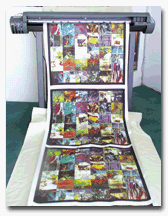
Digital Printing Alchemy

Digital PrintingBy Teri Ross Digital Printing Alchemy
Designers invest in CAD and design their own systems in the name of art. While
pundits claim digital printing to be the most significant technological advancement to the textile
printing industry in over 30 years, the adaptation of these new systems has been much slower than
many had anticipated. Though the technology is gaining ground in the areas of sampling and short
run production, the slower speeds, fabric limitations, image resolution and reduced color gamut on
process color printers have excluded its use for production.This is, of course, for companies who
have a business model of mass production. For a growing number of artists, designers, interior
decorators and entrepreneurs, digital printing technology is providing the tool that allows them to
produce customized products that give them a unique competitive advantage in the new world of
customization.Rachael Scandarion, president of Digital Arts Technology Inc., Hallandale, Fla., has
been custom decorating textiles since the late 80s. For a variety of applications from clothing to
interiors and window fashions, Scandarion was hand painting and dyeing her silks, cottons,
leathers, chiffons, canvas, vinyls and meshes to create custom products with no design repeat
requirements.As her business grew, she realized she needed a printer that would allow her to
produce greater quantities of fabric. With requirements including light fastness and wind
protection on a variety of fabrics, the only equipment available were large format printers used
for outdoor signage and displays. Scandarion found a service bureau running the Nur Outboard
continuous ink-jet printer with MEK solvent-based ink.She invested more than $150,000 in research
and development for fabric testing before discovering that the service bureau was marketing the
results of her efforts to other companies. What the service bureau claimed to be waste goods in
setting up new runs, had actually become sample fabric to potential competitors. Investing For
SuccessIn January of this year, Digital Arts Technology purchased its own printing equipment the
ENCAD TX printer. The company is still pre-treating (a.k.a. padding) its own fabrics with chemicals
that are a combination of soda ash, sodium alginate and urea for fiber reactive dyes used on
cottons and adding citric acid to the mix for silks, nylons and wools.

Digitally printed scarves by Bonnie Lhotka The company pads its own fabrics because
there are no pre-treated fabrics available for the markets it serves. In addition, by controlling
this step of the process, the company feels they have a better handle on quality control and can
maintain the proprietary nature of their unique products.Color matching is also a science for which
there was a development curve. Not only do the different inks react differently to different
fabrics, but the colors also change after a fabric is steamed. As a result, the company has
developed an elaborate array of color formulas and charts on printed fabric for both pre-and post
treatment. Aurora Xynthesis, Fallbrook, Calif., is targeting the hospitality market with its use of
digital printing technology. Marketing to architects and interior designers, the company has begun
intermixing digital with conventional arts to produce lighting fixtures, room dividers, stage
settings, interior settings, window coverings, murals, tile, and wall dr they are creating for
hotels, restaurants, casinos and resorts. It is working on natural fibers, silks and polyesters
using the Go ink set from ENCAD, as well as Ilford archival inks on ENCAD ink-jet printers. The
company is backing all of its own fabrics and mixing many of its own inks to achieve a unique
look. Opportunities For TechnologyWe are experimenting all of the time, said Alyson LeBlanc,
the companys creative director. It staggers my mind when I think of the opportunities with this
technology.Custom Cloths, Lafayette, La., a division of Pixus Digital Printing, offers personalized
silk ties and scarves via its website at www.customcloths.com. It offers custom designs in minimum
quantities of 10 with a delivery time of 2-3 weeks.For customers who want to design their own
products, the company sends them an Adobe Illustrator template on which to create their artwork.
Products are created using the ENCAD NovaJet Pro 50 printer, with inks and fabrics from Jacquard of
Healdsburg, Calif., who offers pre-treated fabric mounted on paper liners. The variables in print
technology, fabrics and inks requires skill sets that included a combination of artist, engineer
and chemist.Jacquard is one of a growing number of companies who are seeking to capture a share of
this burgeoning marketplace by supplying a system of pre-treated fabrics, inks and post-processing
steam equipment that will take a lot of the alchemy out of the process.Jacquard has developed a
hardware independent system that supports reactive, disperse and acid dyes on over 100 different
fabrics available for ink-jet printing; including gauze weight silks, metallic silks, cotton,
linen, Lycra®, woven nylon, wool and poly/cotton blends. All of the fabrics they offer have been
ICC profiled for color management and matched with the proper ink to the proper fabric; fiber
reactive inks for cottons and cellulose fibers, acid dyes for silk, nylon and wool and disperse
dyes for any fabric containing polyester. All color profiling is done after printing on the cloth,
with 1300 patches of color per cloth and ink set. The Art Of DigitalAt Digital Atelier, a
printmaking studio with locations near Boston; Boulder, Colo.; and Seattle, fine artists are
combining traditional studio and media techniques with digital imaging to produce original fine art
and unique editions, including jackets, scarves and tablecloths.Designer Bonnie Lhotka is using the
Jacquard ink-jet system on an ENCAD NovaJet Pro 50 with 100-percent silk. Lhotka has raised the
ink-jet head height on the printer, a practice she does not advocate as it voids the warranty. She
also programmed the RIP to do double strikes for richer coverage and calibrated her monitors to the
output on silks using Adobe Gamma software as well as Apples Color Sync.Chuck Davis of Regal
Computer Graphics, Greeley, Colo., has been experimenting with digital textile printing since 1994.
With a Ph.D. in mechanical engineering, Davis has applied his technical expertise to the
development and marketing of new products that exploit the new market opportunities supplied by
digital printing, including apparel sampling, sailboat sails, home decorating and custom
carpet. Making It PayIn a presentation given at IMIs recent Digital Printing of Textiles
Conference in Atlanta, he offered several suggestions on how to make a buck digitally printing
fabrics.In addition to suggesting that short run printing offers the potential for higher margins
along with higher waste, he stressed the importance of knowing your strengths and weaknesses,
investing in strong technical people, the importance of quality, and the value of good record
keeping.When you are producing custom products and need to repeat the process, the only way to
accomplish this is by referencing every detail as to what you did to get your results, Davis
said.As all of these pioneers have discovered, it is not the digital printing technology itself
that is the competitive advantage, but rather the products they are producing. They are not
allowing current limitations in digital printing technology to limit them creativity.As digital
printing alchemists, these individuals and companies define the market through new products and
applications that exploit the technology in a manner that gives them a unique and timely
competitive advantage.

June 1999

Lectra Systemes Acquires Prima Design Signs Letter Of Intent With Stork

Lectra Systs, Paris, recently announced it has acquired Prima Design Systems Ltd., Hong Kong, as
part of a series of strategic moves Lectra has taken to consolidate its leadership in the global
CAD market for textile-related industries.Prima has more than 3,000 design stations and 1,300
customers worldwide. It is a pioneer in the development of CAD systems for the fashion, apparel and
textile industries.The companys 1998 revenues were $2.8 million, 85 percent of which were from
software sales.Lectra has acquired 100 percent of Prima Designs stock for a total consideration of
$3.1 million in cash and Lectra shares, plus an earn-out of up to $1.5 million designed to retain
the development and marketing talents of Prima founders and managers.Stork AgreementLectra also
announced it has signed a letter of intent with Stork, the Netherlands, to enter into a worldwide
strategic partnership whereby the two companies will jointly develop and market integrated
solutions for textile digital printing.The companies share a common vision of the future revolution
that the association of CAD, digital printing and automated cutting will bring in the
textile-related industries, and of its impact, from design to production, in significantly reducing
time-to-market and cutting production costs.The partnership includes immediate actions and product
offerings for prototypes, samples and small series, printed precisely as they are created on CAD
systems, as well as longer term projects, for which the companies have decided to coordinate their
future research, development, marketing, sales and services organization in order to provide
comprehensive and integrated solution, based on a common technology platform.

June 1999

New Reactive Dyes Produced By BASF

BASF Corp. has introduced PROCION® XL+, a new generation of reactive dyes that are polyfunctional
deactivated dyes with a high tinctorial strength and a high-fixation efficiency. These dyes were
produced for the rapid exhaust dyeing of cellulosic fibers and blends.PROCION XL+ dyes are suitable
for all types of dyeing machines and will reduce water and energy consumption, the company says.
Circle 303.

June 1999

Leveraging Internet Technology

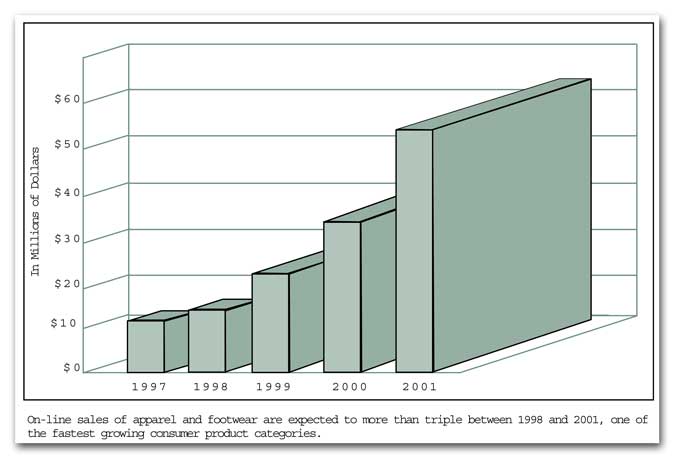
 According to the latest research, apparel sales will be the fastest growing product category
on-line through 2002.Forrester Research sees on-line sales of apparel and footwear growing from $92
million in revenue in 1997 to $514 million by 2001.In 1998, holiday shopping figures through
America On-line support the growing trend of on-line sales with a 350-percent growth over the same
period last year and three-quarters of a million people making on-line purchases for the first
time, at an average of $54 per item.While projections such as these make a compelling argument for
selling your products on-line, doing so can be a tremendous challenge for those companies whose
success is founded in more traditional channels of distribution. One question remains: How do you
market the consumer directly without creating channel conflictAt Liz Claiborne, a $2.5 billion
company with annual earnings growth of 18.6 percent, the solution was to support its existing
channels of distribution by developing a web site that was strictly marketing oriented and not
sales driven.LizClaiborne.com is owned by corporate marketing, and is used strictly as a vehicle
for brand building through product information and store locators.

 Leveraging StrategyThe real internet success story at Claiborne is how it has leveraged
the technology as a business-to-business tool as a part of their overall IT strategy. According to
John R. Thompson, Claibornes chief information officer, customer service and logistics
sophistication have replaced brand equity as the differentiators of the 90s.At the heart of
Claibornes strategy is Liz Link, the companys business-to-business extranet web site and
order-tracking system that is dramatically reducing the 1,500-2,000 calls it receives per day from
buyers simply calling to check on the status of their orders.Instead, buyers are now logging onto
the password protected customer service site, where with the use of their browser they can point
and click their way through open, in-work and shipped orders in either units or dollars.
Information can be viewed by account, season, group summary, group, style or by delivery door.The
operational calendar offers allocation, in-store and confirmation due dates by group. Liz News
keeps buyers current on the latest happenings in the company.According to Kevin Keenan, vice
president, Customer ServiceandElectronic Commerce at Claiborne, the benefits from the customer
service site have been tremendous.Since implementation in January 1998, we have been able to
measurably reduce the length and quantity of customer service calls, while changing the calls we do
receive to be more value added as opposed to quantitative. The system offers real-time information,
seven days a week, 24 hours a day, is available from anywhere and allows us to be more pro-active
with our buyers. To date, 25 of Claibornes top 40 accounts are using the system. According to
Keenan, the company has buyers who will go home and use their personal computer to access the
system because they dont have Internet access at the office.So, as the world of fashion races down
the Internet runway in an attempt to grab a piece of the growing on-line marketplace, keep in mind
that the Internet is not just about selling product.Behind what we see on corporate marketing
websites, is a growing web of Intranets and Extranets that are linking business-to-business
throughout the supply chain and making for more efficient technology driven companies who can
better serve the needs of their existing channels of distribution.For more on Liz Claibornes Liz
Link program, see Teri Rosss article, One Step Ahead, in the April 1999 issue of ATI.
Editor’s Note: Teri Ross is owner and president of Imagine That! Consulting Group, publishers
of the award winning techexchange.com. She can be reached via e-mail at 612/593-0776.

June 1999

Power Performance

Textile mills arent that common in Tennessee. But the Dyersburg Fabrics organization actually has
three plants in Tennessee in Cleveland, Trenton and in Dyersburg. The original Dyersburg plant is
now in its 70th year of operation. The plants outside appearance harkens back to its foundation in
1929. But the outside look belies the effectiveness of manufacturing systems inside.As soon as a
visitor enters the main lobby, he realizes that a very modern heart beats here. Today,
Dyersburg Fabrics is known as a textile industry leader in circular knit fleece fabrics and
performance cotton jerseys.Dyersburg Fabrics was purchased by Wesray in 1986, which fueled the
growth momentum even more, and in 1992 the company went public on the New York Stock Exchange
(NYSE).

The Mario Crosta nappers have become one of the most favored machines in Dyersburg’s
finishing department. The history of Dyersburg is a story of hard work, determination and
enthusiasm. Best of all, it is a story of success written by generations of great cooperation
between management and dedicated employees. That same spirit continues today.  Setting
BenchmarksIn the early years of operation, the first fabrics that shaped Dyersburgs business were
for cotton sweaters, long underwear and fleece gloves. Since then the company had added several
firsts in the market. For example, it introduced:the first knitted fleece fabric (wool blend) in
1935;the first flame retardant fleece (SEF Modacrylic-Monsanto) in 1972;the first post-consumer
recycled E.C.O. (Environmentally Correct Origins) fleece from recycled plastic soda bottles in 1992
and E.C.O. Lite in 1996; andnew fabrics for technical underwear and outerwear (Dyertech
Stratasystem) in 1998.Dyersburg Fabrics joined forces with Patatgonia and Wellman Inc. to pioneer
the first fleece product made entirely of recycled soda bottles, now known as the DyerSport E.C.O.
Fleece. This double-sided technical fleece has been a landmark product as it is part of an on-going
attempt to integrate environmental issues in fabric and apparel manufacturing.The E.C.O. Fleece is
available in Dyersburgs technical and sportswear line. E.C.O. fabrics can be specifically designed
for moisture management, durability, warmth, high CLO ratings, low pill finishes, stretch and other
applications. The versatile fabric offers a lush feel, combined with strength and breathability, as
well as color and shrinkage control.Dyersburg sees this product as being a part of the solution in
managing the huge amount of solid waste that consumers are creating every day. The Dyersburg
company is determined to maintain its leadership position in its core categories by using efficient
and aggressive product development strategies. The company is ready to expand further into
specialty product applications and to develop new niche markets. Also, the company focuses on new
packaging solutions and strives to maintain lowest possible production cost throughout the
operation. To achieve this, Dyersburg has continuously invested in new machinery and processes, and
is still constantly evaluating new capital investment directions. Production RunsWhen walking
through the plant, H. Lee Lundsford III, executive vice president of Operations, made the point
that not every department has been upgraded with the absolute latest machinery.For example, in the
Yarn Department, certain thoughts have been entertained that had put the capital investment
decision on an observation stage, while priority was put on equipment in other areas. However, that
should not indicate that the spinning equipment is old because it is not.The yarn area covers
approximately 85,000 square feet, which includes modern Truetzschler preparatory equipment, Marzoli
Cards, Rieter RSB drawing frames and Schlafhorst SE9 rotor spinning machines.The Dyersburg spinning
facility produces blended yarns made of polyester, nylon, acrylic and cotton fibers. Dyersburg
fills approximately 2/3 of its yarn needs with its spinning operation, while 1/3 of the required
yarn is purchased from outside sources. Quality testing is done on a continuous daily basis. This
includes Sliver Data, on-line testing of cards and drawing equipment, as well as off-line testing
for sliver and yarns. The yarn lab features the newest technology the Zellweger-Uster Tester UT III
is just one of the latest acquisitions.Dyersburgs Knitting Division was relocated in 1994 from the
main building to a new building, approximately 3 miles down the road. The facility has over 153,000
square feet of floor space. All departments are laid out for the most efficient work flow, and also
the infrastructure of the plant, like air-conditioning and lighting, was selected in a way to
provide its highest efficiency. Knit SuccessSince this facility is young, so are the knitting
machines and auxiliary equipment that it houses. Dyersburg has a wide variety of knitting machines,
mainly categorized for specific purposes and applications. The fabric styles that are knitted are
mainly jersey, fleece, rib and terry.Currently, there are more Vanguard knitting machines, followed
by Monarch knitting machinery. Mayers knitting machines are used for microfiber and terry styles of
technical outerwear fabrics. 

The Camber Knitting machines received high praises at Dyersburg for their dynamic performance
and versatile features.The company recently purchased electronically controlled machines from
Camber/Mellor Bromley, Leicester, England (Schloss Griffin Associates Inc., Charlotte
N.C.). Paul B. Agee, plant manager-Knitting Division, and Lee Lunsford agreed that the Cambers
advanced technology has not even been taken to its fullest potential, and that the plant personnel
is still at a learning curve to use its versatility and all technological features. There was a
true enthusiasm for this machine, and Dyersburgs praises are certainly reflected in recent
re-orders. The knitting plant has a capacity of an average one million pounds per week. Dyersburg
adjusts its production schedule between 5 to 7 days per week, depending on actual requirements.An
important part for the knitting operation is the separate R and D department, where strong emphasis
is put on development of new fabric styles. Besides all regular production machine models,
state-of-the-art machinery, like the Camber knitting machine, are 100-percent designated for R and
D purposes.Dyersburg also puts strong emphasis on quality control and physical testing in the
knitting lab. This includes audits of machine changes, physical testing of purchased yarns, dye-cut
and grading and the full data and production preparation of all styles for the knitting
plant. Material ManagementDyersburg is proud of its state-of-the-art greige goods storage
area, where a 212,000-square-foot expansion project was just completed two years ago at a cost of
$7 million. It stores up to 3.5 million pounds of bar-coded fabric in 16,000 individual high-rise
storage positions.The Frazier Industrial rack stores cloth rolls up to 34 feet high. The high-rise
storage area is serviced by six wire-guided Raymond swing-reach trucks that are equipped with radio
frequency equipment.When the batch clerk receives demand instructions from the dyeing operation he
priorities these instructions and relays the information by radio frequency transmission to the
operators on the lift trucks. The information is then electronically stored and displayed directly
to the drivers on the truck.Even though this facility is laid out to operate without any manpower,
due to present speed advantages, a combination of automation and manual operation has been
selected. The system places the pounds required into containers by dye-port. These containers are
transferred to the main plant by semi-trucks. Dyersburgs yarn storage area is 60,000 square feet
and has 3.1 million pounds of storage capacity. The yarns are stored by month in aisles marked by
ceiling-mounted bar codes which can be scanned from the floor. The software for the greige goods
and yarn systems was developed in-house.  Dyeing DepartmentThe total square footage of the
dyehouse is approximately 58,000 square feet. There are several generations of machines in
operation, each machine group is used for a specific task.There are several generations of Gaston
County dyeing machinery, including the Aquavel, Aqualuft and Aquaflow models. Also on the floor are
the Theis Ecosoft and the Scholl Bleachstar.The companys latest addition is a fleet of automated
Then AFS dyeing machines (PSP Marketing, Charlotte N.C.). Quality, repeatability, dye- and
water-consumption have lived up to the promises of the vendor, and the two plant experts feel that
the full potential of the Then machines has not even been reached.The Then AFSs use computerized
batch weighing of dyes and automated dispensing of chemicals. It also allows to drain the machine
at elevated levels and perform direct rinses at high temperatures. The soft-flow characteristics of
the machines protect the fabric surface from abrasion and damage throughout the dyeing process.The
Dyersburg management team explained that the purchase of the new Then equipment has helped to
expanded its product line to satisfy customer needs. While the Then dyeing machines are mainly used
for 100-percent cotton fabrics and high-end cotton fleeces, the other machines are used for
synthetic fabrics and cotton blends. Based on a 7-day schedule the total dye-house capacity is
approximately 78 million pounds per year. Dyersburgs dye lab is in operation 24 hours a day, seven
days a week.In 1998 the lab completed over 7,000 projects for internal and external use. Daily, the
lab can accommodate more than 300 dyeings. The current color library consists of over 6,000 colors.
The latest dye lab equipment includes 12 lab dyeing machines like the Ahiba Polymat, Datacolor
Nuance and Datacolor Spectradye, as well as two Datacolor lab dispensing machines with the
Datacolor Autolab solution maker and two Datacolor SF-600 Spectrophotometers with Smartmatch
software.  The Final TouchIn the finishing department, Dyersburg has a wide variety of
tenters. As with the dying department, different equipment is selected for specific applications.
There is a Krantz pin tenter frame, Kenyon pin tenter and different models of the recently acquired
Santex relax dryers. Management pointed out that there are seven heating zones on this Santex dryer
instead of the usual four zones. This is reflected in a high-quality cloth treatment without
sacrificing production speed. It features a state-of-the-art computer system that can store
individual style programs that control zone temperatures, nozzle heights, fan speeds, line start
speeds, tenter width and all overfeeds.Dyersburg has the capability to fold the fabrics into a box,
or the goods can be routed directly to the finishing room by means of a sophisticated conveyer belt
system.When it comes to cloth finishing, Dyersburg has a wide variety of equipment in its
approximately 150,000-square-foot finishing area. One of the latest additions are Mario Crosta
shearing and napping machines (PSP Marketing, Charlotte N.C.).By being fully computer controlled,
the machines enables Dyersburg to precisely control tension, speed and energy. Furthermore,
computer programming can duplicate settings exactly from batch to batch.According to management,
the finishing department has a weekly production capacity of total 1.3 million yards per
week. Superior Delivery Set-UpDyersburgs modern distribution center is a 147,000-square-foot
facility that contains up to 90,000 pieces of finished fabric. The Frazier Industrial rack system
has 17,000 single-roll and 8,700 pallet positions that reach a height of 38 feet. Finished rolls
are sent to the distribution center by the conveyor system, bar coded and shrink wrapped with a
polyethylene film. The wrappers can handle fabric rolls up to 26 inches in diameter.Shipping orders
can be arranged in various sequences, according to customer requirements. Although order
preparation can be filled around the clock, the actual shipping is done on a 5 day, 8 hour basis.
Up to 7,000 rolls of fabric can be shipped in one day.  SafetyandHousekeepingSafety and
housekeeping is a continuous theme throughout the company. At Dyersburg the philosophy is: It comes
before anything else. This relates directly to modifying job procedures, upgrading to safe and
modern equipment, and to educate all plant personnel on a continuing basis. Ahead Of The
GameIn the development area of Dyersburg, task teams work diligently to meet the needs of the
ever-changing market and to efficiently manage multiple product lines. These teams focus on
Activewear/Sportswear and technical applications.Dyersburgs management emphasized that its status
as a leader and innovator in the industry begins here. Besides specially designated R and D labs,
any of the knitting machines on the production floor are available for new product
development.Dyersburgs philosophy is that putting some of the best technicians into R and D paves
the way for the present leading market position and is certainly the foundation for the companys
future long-term success.
For more information on Dyersburg Fabrics, call them at (901) 285-2323, or fax at (901)
286-3474.

June 1999

Springs Announces Two AFI Plant Purchases

Springs Industries Inc., Fort Mill, S.C., has announced that its wholly owned subsidiary, American
Fiber Industries LLC (AFI), plans to purchase a new 300,000-square-foot facility in Martinsville,
Henry County, Va., with an initial investment of $12.6 million.AFI will also purchase approximately
21 acres adjacent to the site for future expansion of the facility. The company also announced the
likelihood of $2.9 million in additional investments over the next year.According to the company,
the investments are expected to create 250 additional jobs, bringing AFIs Henry County employment
to approximately 675. The company currently employees 425 people at a facility it leases in
Ridgeway, Va.We are pleased to invest in Virginia with our growing AFI business, said Crandall C.
Bowles, Springs chairman and CEO. We thank Henry County and the Commonwealth of Virginia for their
assistance in making this investment possible. AFI represents one of our strongest product lines,
and we anticipate future investment in Henry County.During the initial phase of this expansion, AFI
will consolidate and expand its local manufacturing into the new facility. This phase will begin
immediately and should be completed by the end of the year.AFI also announced it has purchased a
100,000-square-foot facility in Bartlesville, Okla., to manufacture pillows.According to the
company, the initial investment of $3 million will create approximately 200 jobs and could lead to
the creation of more than 360 jobs in the next five years.AFI also plans to purchase approximately
29 adjacent acres for future expansion projects.Adding to our California plant and the newly
announced expansion of our Martinsville, Va., plant, Bartlesville is a strategic location in which
to manufacture and distribute products for our growing AFI business, Bowles said.

June 1999

Ciba Introduces New Reactive Dye

Ciba Specialty Chemicals recently introduced CIBACRON® Orange W-3R, a new reactive dye for warm
applications. It has high fixation, good wash-off, wet fastness and build-up.This dye is for
cellulose fibers and is recommended for cost-effective dark shades. Circle 306.

June 1999

IIMAK Line Includes Foil Option For Printers

IIMAK Inc. (International Imaging Materials) has introduced a product line that includes DC-300
thermal transfer foils with cartridges and refills, along with the DC-100 color heat transfer
cartridge foil for the Gerber Edge® printers.This new product line will give users the option of
purchasing cartridge foils or refill foils at a substantial financial savings. Circle 302.

June 1999

Obituary

William T. Kretzer, former president and CEO of Unifi Inc., Greensboro, N.C., died April 23, 1999.
He was 52 years old.Kretzer joined the company in 1971, working in marketing and sales. He was
named president and CEO in 1985. Under his direction, the company grew from $216 million in sales
in 1985 to $1.4 billion in 1998. He retired from Unifi February 1, 1999.Bill was as honest and
straightforward a fellow as there ever was, said Alan Mebane, Unifi founder, chairman and CEO. He
was a hell of a fine individual. His customers, suppliers and employees here had the highest
respect for him. There was every reason in the world to like Bill.Kretzer played NCAA basketball
for N.C. State University in the late 60s, gaining fame when he held the ball for more than 13
minutes during N.C. States 12-10 semi-final win over Duke in the Atlantic Coast Conference
Championship.Kretzer is survived by his wife, Barbara, his son, William Cannon, his daughter,
Cameron K. Parks, his brother, Michael Kretzer, and his sister, Marcia K. Limbo.

June 1999

Sponsors