Active Assets Announces Latin American Partners

North American companies will soon be able to sell surplus industrial assets and inventory in the
Latin American market through a direct electronic pipeline to established auctioneers and sales
agents in Latin America and Spain, thanks to agreements signed by Miami-based Active
AssetsandAssociates Inc. and several Spanish and Latin American partners in Argentina, Brazil,
Chile, Colombia, Mexico and Venezuela.The hands-on, personalized service we provide customers
through our network will be invaluable, said Richard Clark, president, Active Assets. Our research
has clearly demonstrated that buyers and sellers of big ticket corporate assets want to talk to
real people during the course of their on-line transactions.Provided services will include product
assurances, third-party appraisal and inspection services, freight calculation and forwarding,
customs regulations assistance, financing and escrow.

September 2000

Mount Vernon Mills Recognized For Pollution Prevention

Mount Vernon Mills, Trion, Ga., was recently accepted as a second-year Model level company in
Pollution Prevention Partners (P3), the Georgia Department of Natural Resources Pollution
Prevention Assistance Divisions (P2AD) three-level certification program that honors Georgia
manufacturing, service, governmental and agricultural facilities for continuous pollution
prevention performance and environmental improvement.By reaching the Model level in the P3 program,
Mount Vernon has demonstrated that they are an industry leader in preventing pollution at the
source, said G. Robert Kerr, director, P2AD. Model level P3 facilities such as Mount Vernon have
incorporated pollution prevention into daily business activities, and have promoted pollution
prevention within the industry, with vendors and customers, and within the community.Mount Vernon
Mills has consistently striven to exceed minimum compliance levels in pollution prevention. The
companys efforts include finding environmentally friendly alternatives to hazardous chemicals and
reducing fresh water usage and wastewater discharge by water recycling and reuse. The facilitys
water conservation efforts have reduced its wastewater treatment and fresh-water costs by over
$250,000 a year.

September 2000

EcomTextile Com Escrow Com Form Alliance

EcomTextile Inc., Fullerton, Calif., recently established an alliance between EcomTextile.com, the
companys Internet global marketplace, and Escrow.com, an affiliate of Fidelity National Financial
Corp. and Micro General Corp., Irvine, California.The site will include Escrow.coms transaction
management and escrow services, including its trust accounting technology, and will allow buyers
and sellers of textile-related activities to transact business electronically.Having secured our
alliance with Escrow.com, we are pleased with the high degree of cooperation, said John C. Adams,
CEO, EcomTextile.com. Our strategic alliance with Escrow.com allows us to offer the trust and
security our users demand as well as on-line protection to avoid fraud.As the business-to-business
market continues to expand with new buyers and sellers, secure transaction management is essential,
said Brian Mulford, chief technology officer (CTO), Escrow.com. Our alliance with EcomTextile.com
provides buyers and sellers with secure and reliable escrow solutions and validates the important
role Escrow.com will play in the future of Internet commerce.

September 2000

Celanese And Teijin To Form Asian Joint Venture

New York City-based Celanese AG and Teijin Ltd., Japan, announced that they have signed a
Memorandum of Understanding (MOU) to set up a joint venture that combines both companies Asian
businesses in acetate filament.The joint venture will be both a marketing and manufacturing
company. Acetate filament will be produced at Teijins Matsuyama site in Japan, while Celanese will
supply the venture with acetate-flake raw material and additional acetate filament.Celanese is
excited to join forces with a strong partner like Teijin, said Claudio Sonder, chairman and CEO,
Celanese AG. We see this joint venture as an excellent way to strengthen our position in the very
critical Asian textile market.The joint venture will be equally managed by Celanese and Teijin. The
two companies have set the first quarter of 2001 as the target date for completing the definitive
agreements and beginning operations.By combining Teijin and Celaneses marketing and production
capabilities, we will be able to serve the needs of our customers in Japan and Asia more
effectively, said Shosaku Yasui, president and CEO, Teijin.

September 2000

Zellweger Uster Honors Parkdale Mills For The Installation Of The 30,000th Quantum Clearer

TW Special Report

Zellweger Uster, Charlotte, N.C., honored Parkdale Mills, Gastonia, N.C., in early August for the successful installation of 30,000 Uster® Quantum clearers.

The management of both companies complimented their cooperation in various Parkdale plants, including Parkdale America and Magnolia Manufacturing. Parkdale conducted a plant tour of the George Bloomquist plant in Lexington, N.C., which permitted a glimpse at the companys modern yarn-manufacturing facility. At the same time, it highlighted all installed Zellweger Uster equipment and put the spotlight on the Uster Quantum clearer.

A Walk Through Parkdale’s Plant

Beginning with the first production stage in the mill, invited guests and press were introduced to one of the laydown rooms with automatic bale openers from Truetzschler. John Nims, manufacturing vice president, Parkdale Mills, explained that the cotton comes already perfectly selected as a laydown. USDA data for every bale is re-tested in Parkdales central lab on an HVI line. Also, tests on the AFIS tester deliver further valuable information about the desired quality for the laydown. In this particular plant, a 50-bale laydown is used with Truetzschler BDT019 automatic bale openers. The cotton is mainly Memphis territory cotton. Selected North Carolina and South Carolina cottons are also used by Parkdale.

From bale opening through several cleaning and mixing stages, also using machinery provided by Truetzschler, the cotton fibers are either directly conveyed to carding or diverted to the fiber blending lines. At this particular plant, four blending lines for cotton/polyester are installed. Currently, about 75 percent of the production is 100-percent cotton, and 25 percent of it is cotton/polyester blends. However, the 1.5-million-pound-per-week capacity permits production of a higher percentage of cotton/polyester yarns 550,000 pounds per week of cotton/polyester versus 950,000 pounds of 100-percent cotton yarn.

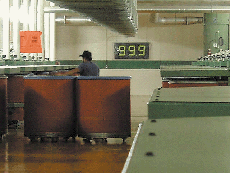
An amazingly high machine efficiency of 99.9 percent was displayed in the cardroom. The cards are the previous generation Truetzschler DK760 models. During the entire visitation period, no red light — which would indicate a machine stop — could be seen.The next stop was the drawing section, where Rieter RSB 851 auto leveler drawframes perform a superior job, according to Parkdale. Based on fundamental trials, the company decided to use only single-stage drawing because of quality and cost issues.

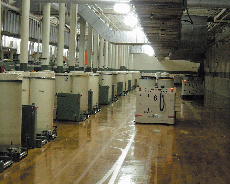
The sliver cans are picked up by automated guided vehicles (AGVs) supplied by the Saurer Group, through Schlafhorst Automation Inc., Holland, Mich. The cans are transported from the drawing section to an elevator, by which they are transferred to the spinning room on the lower floor.

Parkdale also has installed various Zellweger Uster quality control and Expert Systems. These indicate various on-line production CVs, sliver weights and spectrograms to indicate drafting waves and other periodic defects. Zellweger praised Parkdale for doing an outstanding job using Usters Sliverdata to control and correct defects. Both companies worked closely together developing applicable software to avoid long, thick places in the yarn.

Jackie Hill, textile application engineer, Parkdale Mills, demonstrates Zellweger Uster’s Sliverdata and Expert System. “This [the development lab] is the best tool to maintain quality,” Nims said. The spinning room provides a clean and bright view of modern yarn manufacturing.

Parkdale’s goal is to keep its entire manufacturing facility spotlessly clean and to provide the most efficient air conditioning and lighting. All air conditioning is supplied by Industrial Air, Greensboro, N.C. Efficient air handling contributes to high yarn quality levels and provides a comfortable work environment.

At the George Bloomquist plant, which incorporates two yarn-manufacturing facilities in one location, approximately 12,000 Schlafhorst Autocoro rotor spindles are installed. Each spinning position features the Uster Quantum clearer.

The Quantum clearer delivers continuous control of quality for basic yarn defects and eliminates foreign matter contamination. The system installed at Parkdale comes with computer-aided yarn (CAY) engineering and features Expert Data management to perfect the processes. It provides active quality monitoring and precise productivity control for spinning and winding applications. All spinning positions are monitored by means of spectrograms and classimat data, and Usters Expert System is used to detect, analyze, and correct eventual problems. By employing digital yarn clearing with both capacitive and optical sensing capability in one unit, the Uster Quantum clearer has contributed to setting and achieving Parkdale’s quality standards. The parameters can be set precisely to individual customer needs. Cutting out defects is exactly programmed; therefore, there is no unnecessary waste of yarn.

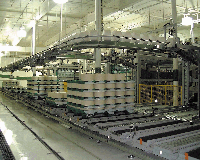
The Quantum clearer was introduced at ITMA 99. Approximately 300,000 clearers have been sold worldwide, and Parkdale has now surpassed the 30,000th installed clearer mark. The final stage of the plant tour went from spinning to yarn storage and, further, to automated yarn palletizing and packing. Parkdale has invested heavily in automation, which seems to be the common theme throughout the whole plant. The entire manufacturing facility is run by only 112 employees.

Appreciative Words

Both sides, customer and vendor, praised each other for the high level of cooperation that was necessary to reach the goal of delivering the highest quality yarns. Anderson Warlick, president and CEO, Parkdale Mills, made the pledge to provide superior quality products for customers. Eddie Bradley, head of the Zellweger Uster Division, and Rudy Kagi, president and CEO, Zellweger Uster Americas, presented Warlick with a 30,001st Quantum clearer in symbolic recognition of Parkdale’s purchase and ongoing commitment to quality in the textile industry.

September 2000

BBA Group Acquires Snow Filtration Co

BBA Group PLC, Old Hickory, Tenn., completed the acquisition of the Snow Filtration Co., West
Chester, Ohio.The acquisition will significantly enhance the sales and distribution arm of the BBA
Nonwovens Filtration Group, while adding a variety of value-added products to BBAs nonwoven
rolled-goods technologies.The Snow Filtration Co. and the BBA Filtration Group will be consolidated
under a single leadership.

September 2000

CBI Good For Synthetic Spinners

he first spinner responding to the Yarn Market this month commented that markets for his mill were
status quo — stabilized. He also said, “There is no room for price hikes in today’s market. We are
running full, but we have to if we want to stay in business.” He further stated that his company’s
home furnishings business remains strong in spite of seasonal slowing, and he expects the fourth
quarter to be “bullish.” One concern for folks in the home furnishings market is that with the
decrease in housing starts, demand for furnishings may decrease as well. Another concern is that
there has been added loomage in the production of home furnishings and, while not as “feverish” as
before, it is still significant. A third concern is, as stated by one spinner, “Cotton. It is
frighteningly close to moving upward in pricing.” We all know why this is of concern to spinners.

Record Cotton Crop Expected

Speaking to this concern, a respondent with expertise in this area said, “Even with the dry
weather, we are expecting a record crop. Cotton already harvested in Texas and the West is being
classed and looks pretty good. Because of the drought, there have been some losses in the South,
specifically South Carolina, Georgia and Alabama, but overall, the harvest will be large.” So it
would seem, with a large expected harvest, prices are not apt to move significantly upward.

Textured Nylon Sock Business Outstanding

Textured nylon markets are reportedly slow, but this is the season for slowness. One
texturizer commented, “Markets will begin picking up as we move into the Fall. Prices will remain
stationary until raw-material pricing increases, and we don’t expect fiber producers to increase
their prices before the first quarter of 2001.

“Our sock business is outstanding and, while sheer (hosiery) business is not as good as we
would like to see it, the third quarter is looking better than the second. We made an inventory
adjustment then, and customers are beginning to buy again. Seamless hosiery markets for both micro
fibers and covered yarns are quite good.”

Weavers Say

A weaver, when asked about the condition of his markets, said, “I feel like a broken record —
markets for cotton and poly/cotton are reasonably good volume-wise, but margins are terrible. Sales
for non-cotton goods are at best day-to-day. There is no long-term business and there seems to be a
lack of interest on the part of our customers. It’s not like the ‘good old days’ when we
continually had long-term orders, repeat business and continuity in the planning of our
operations.”

Customers are not disinterested in the markets – they are just afraid to buy for fear the
price will go down tomorrow. You can be sure prices are not likely to go up in this market.

A synthetic spinner who responded to the Yarn Market was, to date, the most enthusiastic
spinner overall concerning the CBI. He said, “This Caribbean thing will help us in several ways. It
will improve our sales of polyester yarns. Producers in Canada make polyester yarns cheaper because
the government subsidizes their product. With CBI requiring domestically produced yarns, Canadian
yarn cannot be sold for this program. Also, markets for children’s sleepwear are very slow. This
will improve with CBI. I am looking forward to it.”

Markets for synthetic yarns are, to put it mildly, quiet. Of course, this is the quiet
season, with April, May and June historically being the strongest quarter of the year. It is
interesting to note the second quarter of 2000 was better than the same period of 1999.

Some customers plan vacations for late July and August, accounting in part for the current
lack of demand. Others are “between orders,” according to this spinner. He mentioned that air-jet
and plied yarn markets were the strong areas for his products. Even so, operations at several mills
had to be curtailed about one day a week since the conventional July 4th holiday. However, as with
any curtailment, some mills continue to run a full operation.

For those readers who look at plied cotton yarn pricing, the lower price shown in the Yarn
Market price listing is for open-end yarn, while the higher price is carded ring-spun.

Quality Fabric Of The Month: Warmth And Resistance


boy_295P
olartec®’s family of technical fabrics for outdoor apparel includes three categories: next-to-skin, thermal and weather protection. As a thermal fabric with wind-protection properties,Wind Pro™ has been engineered to be used as the middle or outer layer for outdoor apparel worn during climbing, snowboarding, back-country skiing and other high-exertion activities. This versatile outerwear fabric is distinct from Polartec’s other thermal fabrics as well as its other wind-protection fabrics, both in performance and in appearance.
Fleece Vs. Laminates

The technology behind Wind Pro addresses two concerns of outdoor enthusiasts. Traditional fleece is comfortable and provides warmth and breathability, but it does not do an exceptional job of protecting the wearer against the wind. Fabrics can be laminated to make them windproof, but while the laminate may stop the wind from passing through the fabric, it also reduces the breathability of the fabric.

Wind Pro is knitted using proprietary microfiber yarns in a very tight construction that blocks the wind. This provides four times more protection than Polartec’s traditional fleece and improves breathability over Polartec’s other wind-protection fabrics. Better breathability allows
better transfer of perspiration through the fabric to dry on the surface.

The dense, low-pile, suede-look face of the fabric acts as a wind block, preventing 95 percent of the wind from passing through, according to Malden Mills, Lawrence, Mass., manufacturer of Polartec Wind Pro. The surface also repels rain and snow, is quick-drying and resists compression. Air pockets in the pebbled back of the fabric trap body heat, providing lightweight insulation and offering twice the wind-chill protection of traditional fleece. Within the fabric, good air circulation improves breathability and lessens the risk of heat-stress build-up.

The fabric is finished on both sides to provide maximum durability. It is non-pilling and will retain its appearance and insulating properties even after continued use and laundering.

“Each of our wind-protection fabrics is designed to address certain outdoor needs,” said Jeff Bowman, Polartec brand manager. “Together they represent a full range of fabrics for any outdoor pursuit or level.

“We put a high priority on… research and development to ensure we are meeting the needs of the outdoor industry. Our wind-protection line is a dynamic collection that will continue to grow in line with the interests and demands of our customers.”

QFOM_294


For more information about Polartec Wind Pro, contact Anne Tommasi, Malden Mills, at (978)
659-5113.


September 2000

Burlington Textile Machinery Reaches New Agreements

Burlington Textile Machinery Corp. (BTM), Burlington, N.C., has been chosen by Textile Sales
International, Concord, N.C., as representatives in the Eastern Seaboard states, Canada and Mexico
for the advanced TSI Turbojet® dyeing machines and automated control systems.The company has also
agreed to the exclusive marketing of Germany-based Sucker-Muller-Hacobas line of pile finishing,
sueding and corduroy finishing machinery in the United States and Canada.In addition, BTM serves as
a U.S. representative for Aigle, SPA, which offers embossing, coating, laminating and flocking
systems; Effedue, SPA, which manufactures tenter frames, steamers and lint collection systems; and
Testa, SPA, which provides inspection, roll-up and wrapping machinery.

September 2000

September 2000


Zellweger Uster Inc.
, Knoxville, Tenn., named
Austin Cottle area sales manager, responsible for the promotion and sales of
Uster® products in North Carolina, South Carolina and Virginia.

Cottle_91
Cottle


Nelson Griffith
was promoted to senior vice president and controller of
WestPoint Stevens Inc. (WPS), West Point, Ga., while
Tommy Lane, WPS treasurer since 1988, was promoted to senior vice president and
treasurer.
H. Dan Laidlaw was named senior vice president, information technology, and CIO.

KoSa, Charlotte, N.C., appointed
John Hobday marketing manager of its Textile Fibers New Business and Market
Development Group for the United States and Canada.

Speizman Industries Inc., Charlotte, N.C., named
John C. Angelella vice president of finance, CFO, secretary and treasurer.

John F. Vickers retired as chairman of
Benjn. R. Vickers & Sons Ltd., England.
Peter Vickers was appointed chairman and will continue as a non-executive
director.

Vanessa Newton joined the
Synthetic Organic Chemical Manufacturers Association (SOCMA), Washington, D.C., as
communications manager. Newton will be responsible for SOCMA’s publications, website and
advertising.

Jerry Johnson joined the sales team of
Hunter Associates Laboratory Inc., Reston, Va., representing HunterLab products in
Minnesota, North Dakota, South Dakota and Western Wisconsin.

Magnatech International L.P., Sinking Spring, Pa., promoted
Shawn Anderson to CFO, while
Rose Hagy was named director of operations, responsible for all manufacturing
operations and the MIS group.
Scott Lemas was promoted to director of engineering, overseeing all engineering
and technical service concerns.

Batson Yarn and Fabrics Machinery Group Inc., Greenville, S.C., named
William “Pat” Maness field technician for the Yarn and Fabrics Division.

Schwartz_93
Maness

Omnova Solutions, Fairlawn, Ohio, named
Bill Lachenmeyer director, human resources, for its Performance Chemicals business
segment.
Jason Hicks was appointed director, e-business, for the company.

Bernard Terrat, president of ICBT Group and Rieter TSF, was elected president of
CEMATEX for the period 2000-2004.
Evelyne Cholet, general secretary of the French Textile Machinery Manufacturers
Association (UCMTF), was nominated CEMATEX general secretary.

Michelle N. Siegmund, P.E., was named director of engineering for
Dash Multi-Corp., Maryland Heights, Mo.

Daniel E. Nation, Parkdale Mills Inc., Gastonia, N.C., was elected president of
the
Southern Textile Association. Nation succeeds
Lyman W. Hamrick, Hamrick Mills Inc., Gaffney, S.C., who was elevated to chairman
of the Board of Governors.

Los Angeles-based
ClickTex.com appointed
Bob Getto vice president, operations, responsible for fabric, fiber and yarn
product catalog management, customer service and human resources.

Patrick Ayers joined
Datacolor International, Lawrenceville, N.J., as senior account manager.

Israel-based
Elbit Vision Systems Ltd. appointed
Ofer Yuval CEO of the company.

Carl W. Martin was named president and COO of
John D. Hollingsworth On Wheels Inc., Greenville, S.C. Martin, formerly general
manager, sales and marketing, was also elected a director and member of the Board of Directors.

Martin_92
Martin

Cargill Dow, Minnetonka, Minn., named
Vicki Bousman fibers marketing brand manager, responsible for implementing the
NatureWorks™ PLA business plan for fiber applications in North America.

Carroll Turner was promoted to technical services manager for the
Carpet and Rug Institute (CRI), Dalton, Ga., while
Peggy Parks was promoted to office manager.


David Bruner
was promoted to director of research and development for
Textile/Clothing Technology Corp. (TC2), Cary, N.C.

Torry Losch joined
Acordis Industrial Fibers, Scottsboro, Ala., as sales account manager, Industrial
Fibers for Mechanical Rubber Goods (MRG), Broad and Narrow Wovens, and Ropes and Cordage.

Alba-Waldensian Inc., Valdese, N.C., a division of Tefron Ltd., promoted
Sachin R. Palod to plant manager of the company’s new plant in Rutherfordton, N.C.Leslie A. Hodge was promoted to director, quality assurance, while
William T. Neill joined the company as senior systems analyst.

Peter Schwartz, a professor in textiles and apparel at Cornell University, was
appointed head of the Department of Textile Engineering at
Auburn University, Auburn, Ala.

The Algo Group, Montreal, appointed
Raoul Heredia president and CEO.


September 2000

Sponsors