Schlumberger Redesigns Machine Drive Systems

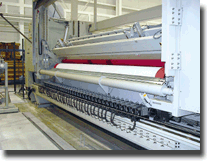
France-based NSC Schlumberger recently introduced ProDyn®, a comprehensive, self-regulation control
system in machine and cross directions applicable to all nonwoven lines that make fiber batts using
a Dynamic card and a Dynamic cross-lapper.By redesigning the drive systems of the card and
cross-lapper, the system facilitates different fiber types, deniers, bonding systems and varying
product specifications. NSC Schlumberger claims the new system will consistently produce a quality
product while providing cost-effective and user-friendly production.

April 2001

New Options Available For Monforts DynAir Dryer

Germany-based Monforts Textilmaschinen has introduced the Pulsetronic technique and Step-by-Step
stretching attachment as enhancements to its DynAir 5000 relaxation dryer for knitted fabrics.The
Pulsetronic technique introduces a tumbler effect to the dryer by creating an impulse airflow
through the systems lower air nozzle. The Pulsetronics impulse frequency can be adjusted to between
one and 30 pulses per minute, activated by a mechanical on/off switch. The resulting tumbler effect
improves fabric relaxation for knitted materials by loosening the fabrics thread-crossing points to
allow free shrinkage of the fabric in the space between the DynAirs upper and lower belts.The
Step-by-Step attachment ensures optimum shrinking results in both the longitudinal and traverse
directions. An oscillating chain guide allows individual left- and right-hand side chains to be
accelerated or slowed accordingly before the fabric enters the dryer, permitting the knitted fabric
to regain its natural shape.

April 2001

No Surfing Required


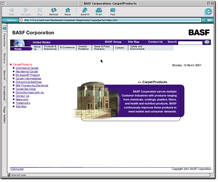
BASF Corp., Mt. Olive, N.J., has launched its new Web portal, CarpetProducts, an Internet
site that is a complete, one-stop shopping and technical information resource. The site, located at
www.basf.com/carpet, can be utilized by both designers and carpet manufacturers when combined with
the special Web-application website myAccount, which gives customers fast, accurate and secure
order placement and information 24 hours a day. In myAccount, customers can place orders; receive
information about order status, shipment history and delivery location; and view Material Safety
Data Sheets (MSDS) for BASF products.This new portal is the corporations first attempt at
cross-divisional efforts, plus it is a complement to the existing commercial website, which was
launched two years ago. According to BASF, the site will help mills, designers, specifiers and
others involved in the industry because it offers such a broad range of products and services
combined with a customized on-line electronic-commerce capability.CarpetProducts, in addition to
product selection and applications, contains an array of technical information. Both the Commercial
Carpet and Carpet Backings sections provide information about maintenance, cleaning and warranties.
BASFs technical experts can be directly accessed by going to the Ask the Expert section. Walter
Hubbard, group vice president, Fiber Products, stated, The creation and launch of this Internet
portal is a clear example of how BASF will employ e-commerce to create and capture value for its
business partners. Customers will benefit because they can go directly to a listing of all BASFs
carpet-related products and easily find everything under one umbrella, including nylon fibers and
polymers, carpet backings, colorants and additives, and wet processing chemicals, as well as
sustainability information. Comprehensive Carpet PortalDuring a recent press conference held
at the BASF Carpet Center in Dalton, Ga., several BASF representatives presented information on
specific ways the firms new web portal can be utilized, stating that it will bring together all
carpet products into one summit providing marketing materials and data sheets. Orders can be placed
and tracked seven days a week using real time, which could be critical this will complement
customer service, not replace it, said Ian Wolstenholme, manager, sales and marketing, carpet
products. 

The portal provides growing access for the design community, said Sandy Lusk, marketing
information director. For instance, a designer can get product specs, visuals, furniture, fabric,
and paint; and build a design board to show to customers in very little time. Plus, she continued,
the specifier can check out the technical data, specs, denier, color, application, color trends,
recycling and warranties. Additional features include the latest in industry trends and events. One
area of the site is dedicated to BASFs mill partners. It presents a profile of the partners and new
products, as well as a direct link into the website. For many, the portal can also be utilized as a
think-tank session.In the area of carpet backings and others, contacts with experts are easily made
on-line with e-mail, and a telephone number is given for voice contact. This portal is complete
with security, both on the consumer and on the business side.Both the commercial and residential
carpet sections in BASFs new web portal provide information about BASFs Nylon 6ix® yarns. Data
needed to select the right Nylon 6ix for any application is shown with details. Plus, the
commercial carpet sections exhibit valuable information on technical support, product innovation
and environmental responsibility.

April 2001

Unifi Embraces Nonwovens

It is no secret that the U.S. textile companies most likely to flourish in coming years are
those, both large and small, that aggressively seek new opportunities and new efficiencies in the
marketplace. As more than one textile leader has maintained, an entrepreneurial spirit is essential
in todays very competitive business climate.
(See Parkdale Positions For Growth, TI, this issue). It was in this spirit that then-vice
president of business development for Unifi Inc., W. Michael Mebane, began looking for a new niche
that would add diversity to the Greensboro, N.C.-based companys highly successful polyester and
nylon yarn business. With 1999 sales of more than $1.2 billion, Unifi is the largest producer and
processor of textile yarns in the United States and one of the largest in the world. Mebanes search
for opportunity resulted in the creation of Unifi Technical Fabrics LLC, a $40-million plant in
Mocksville, N.C., that represents the companys first foray into the nonwovens
market. Exploring OptionsWe began looking for areas of growth areas in which we felt Unifi
would have a lot to add, Mebane said. Especially, we began looking at different polymers and how
they were used. Unifi has a great deal of experience in polyester and nylon, but we had noticed a
steady rise in the use of polypropylene. What really hit our radar screen was meltspun nonwoven
fabrics. When we looked in that direction, we saw a healthy growth curve, healthy and sound end-use
markets, and the opportunity to be among the first to employ a step-level change in technology.The
technology to be used was critical in the determination of the direction Unifi would take with its
new business. We were looking for something new, but which had been deployed long enough to be
proven, but not long enough that a lot of companies had converted to it. We felt we had a specific
window of opportunity to diversify into markets we had not served before. It provided a definite
synergy for us because we could bring all the expertise we had in polyester to the manufacture of
polypropylene. In essence, we would be making products similar to those that we had made in the
past, but for different markets. The opportunity to go directly from polymer to fabric was very,
very interesting to us, as well.Unifi looked at different methods by which it could enter the
meltspun market, including acquisition of an existing business or construction of a new facility.
Ultimately, the company decided to embark upon a new venture and, in July 1999, signed a contract
with Germany-based Reifenher GmbH for delivery and installation of its new Reicofil 3 SSMMS
technology, which allows high-speed manufacturing of spunbond and spunbond/meltblown/spunbond
fabrics. SMS technology enables the manufacture of fabric with a spunbond layer, a meltblown layer
and an additional spunbond layer. The fabric can have different properties on each face.
Meltblowing is a one-step extrusion process for the production of microfiber nonwovens from
thermoplastic resin pellets, hot-melts and raw-material blends.At the same time as the contract was
negotiated with Reifenher, a site search committee located the 120-acre site in Mocksville, a town
near Winston-Salem, N.C. Ground was broken in October 1999. Machinery was delivered in July 2000,
and the first piece of fabric was produced January 9 of this year.It all sounds smooth and easy,
but the accelerated schedule Unifi employed to construct and operate the facility was not without a
glitch here and there. One of the amazing things, said J. Allan Logie, director of operations, was
that the steel got us a little off schedule. The delivery of the steel for the manufacturing area
did not arrive on site until mid-May, and we were building the machine in July. We had a roof and a
concrete slab, but the sides were still off the building when we began construction of the machine.
That was quite a challenging time. It was a very fast-paced project. We ran polymer through the
machine on December 8, three days early according to the schedule we had established with Reifenher
in July 1999. We produced our first fabric on January 9 of this year. Seamless
TransitionDespite the fact that Unifi is new to the production of nonwoven fabrics, Mebane said the
business fits so seamlessly with the companys existing operations that he considers it one of
Unifis core competencies. Unifi produces polyester fiber both in the United States and in Europe,
he said. If you take a look at the suppliers of the critical components, whether they be spinnerets
or other equipment, they are the same vendors we deal with in our fiber business. We are able to
draw upon the experience of long-standing relationships. While it is a different process, much of
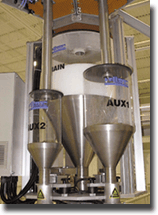
what we do and how we approach it is the same.The Reicofil 3 machine installation in Mocksville is
the largest in North America and among the largest in the world. Filament speed is rated at greater
than 3,000 meters per minute (m/min), and the line-speed cap is 600 m/min. The installation gives
Unifi immediate capacity to be a dominant player in the market. 
Our capacity is much greater than any other in North America at this moment, said Krister
Erlandsson, manager of technical service and product development. We have 20-percent greater output
than any other production line in the Americas. Ultimate capacity for the line exceeds 15,000 tons
per year or the equivalent of more than 1 billion square yards of 0.5 opsy nonwovens.Unifi
Technical Fabrics is targeting three primary markets for its meltspun fabrics hygiene, medical and
industrial. The company will make cover stock for such hygiene end-uses as baby diapers, adult
incontinence products and feminine-hygiene items. Other uses include garment material for the
medical market and substrate fabric for industrial applications, encompassing the furniture,
bedding, agriculture, automotive, filtration and construction industries. Fabrics produced weigh
between 0.4 and 2.75 ounces. The market segments that we are entering have double-digit growth,
very sophisticated customers and a requirement for very technically sophisticated products, Mebane
said. We believe that Unifi is uniquely positioned to meet this high level of customer
expectation.A considerable advantage for Unifi and one that enabled the company to plan and meet an
aggressive start-up schedule was that the Mocksville plant was built specifically to accommodate
the Reifenher line. Its much easier doing it this way than trying to fit machinery into an existing
facility, he said. The plant currently encompasses about 90,000 square feet on the site, but room
has been made for up to 10 modular expansions and, ultimately, 800,000 square feet of manufacturing
space. Before making plans to add another line, though, Unifi officials will analyze the production
and demand for products from the existing installation. We need to see who the customers are, what
the product mix looks like and get some actual results before we move ahead, said Logie. The
Mocksville plant operates four 12-hour shifts with nine people on each shift. Its total workforce
numbers 57. A Formula For SuccessAlthough still a start-up operation, Mebane sees Unifi
Technical Fabrics becoming an integral part of the Unifi portfolio. We will differentiate ourselves
in each market segment in the same fashion as Unifi has in its primary yarn business, he said.
First, we will be the most consistent manufacturer in the marketplace. We will follow the same
mindset that enables our company to produce 800 million pounds of fiber a year that features
excellent consistency day to day, week to week and year to year. Secondly, we will take a systems
approach to the business. The way we conduct business with customers, our knowledge and application
of sound business-to-business practices, will put us well ahead of many other nonwovens producers.
Ultimately, our knowledge and capability, combined with the high quality of our products, will
enable our customers to become more successful as a result of doing business with us.Over the
years, Unifi has transitioned itself from being a domestic manufacturer and supplier to being a
participant in the world marketplace. Today, Unifi maintains manufacturing plants in the United
States and internationally. The U.S. plants are concentrated in North Carolina and Virginia, and
the international plants are in Brazil, Colombia, Ireland and the United Kingdom.The textile yarns
produced and processed by Unifi are found in home furnishings, apparel and industrial fabrics, home
and automotive upholstery, hosiery, and sewing thread. In addition to textile yarns, the company
also produces a portion of its textured polyester raw material and participates in a variety of
other businesses. 
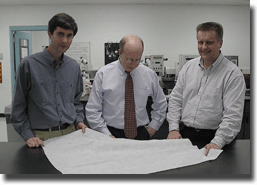
(left to right): Allan Logie, Michael Mebane and Krister Erlandsson inspect fabric in the
Unifi Technical Fabrics lab.

April 2001

Burlington Launches Techno-Natural Fabrics

Synatural, a new family of techno-natural fabrics, has been introduced by Burlington
PerformanceWear (BPW), a division of Burlington Industries, Greensboro, N.C. BPW uses DuPonts
Micromattique natural matte luster polyester yarn in the new fabrics to combine natural fluidity
and drape with easy care and performance. Micromattique delivers cotton-like aesthetics in
synthetic fabrics.With Micromattique, we have been able to combine the superior performance of
polyester with a soft, natural hand, said Tonya Farrow, apparel segment manager for
Micromattique.Garments made with Synatural fabrics are colorfast, and BPW sees the fabrics as a
replacement for casual 100-percent cotton pants.Garments made with Synatural fabrics will be more
suitable for todays more dressed-up casual styles, given their ability to maintain their color and
shape, said Lou DLando, executive vice president, apparel fabrics, BPW.The Synatural fabrics will
utilize Nano-Dry technology (See Quality Fabric Of The Month, ATI, March 2001) to provide
additional comfort and hydrophilic performance properties such as breathability, permanent
wickability and quick-drying capability.

April 2001

Nordson Delivers Universal Slice Applicator

Nordson Corp., Norcross, Ga., has engineered the new Universal Slice applicator, which provides
flexibility of hot-melt adhesive patterns and widths. The applications construction permits quick
changeovers while minimizing space requirements and spare-parts inventory.The Universal Slice
features a quick-change adhesive module, allowing various spray patterns to be achieved by changing
the tip while using the same module. Die slices can be added or removed to provide variable width
capability without replacing the entire assembly.The applicators flexibility is further
demonstrated by the multi-port adhesive architecture, which allows individual pumps to supply
single or multiple adhesives modules or multiple pumps to supply a single adhesive module. The
ability to quickly reconfigure the control air section for individual, group and zoned control
reduces the need for custom manifolds.

April 2001

Cotton Incorporated Assists With Commercially Viable Technologies For Nonwovens

Manufacturers of absorbent, personal-care products have been hesitant to use cotton in the past,
perhaps due to the myth that the fiber is difficult to work with, according to Cotton Incorporated,
Cary, N.C. The upland cotton research and marketing company has been providing technical assistance
to those interested in developing, producing and marketing cotton nonwoven products.For example,
Cotton Incorporated developed a continuous bleaching system that includes several patented
elements, one of which creates a more open fiber that is easier to process for nonwoven materials.
Charlotte, N.C.-based Barnhardt Manufacturing Co. currently licenses this technology, which is
critical to the recent expansion of their bleaching facilities.Since bleaching cotton removes its
natural finish, a lubricating finish must be applied in order to make nonwoven webs. After testing
several different finishes, Cotton Incorporated found that butoxyethyl stearate (BES) is the best
lubricant for bleached cotton processed through the traditional high-production, web-forming
equipment common for synthetic nonwovens.Cotton Incorporated remains committed to pursuing a share
of the nonwoven absorbent market by replacing non-cotton cellulose and synthetic with
performance-oriented, cost-effective cotton alternatives in key product categories such as diapers,
feminine hygiene and wipes, backed by the Absorblend trademark, said Mac McLean, manager, nonwoven
research and implementation.Cotton Incorporated introduced the Absorblend trademark in 1998. It
features the Seal of Cotton and identifies hygiene products that contain at least 60-percent upland
cotton and/or cotton linters in the absorbent core.According to a national study conducted by
Atlanta-based Mills Consulting Group on behalf of Cotton Incorporated, consumers favor cotton for
its purity, hypoallergenic benefits, superior absorbency, durability, softness and overall comfort.

April 2001

Yanoor Corp Purchases Burlingtons Monticello Plant

Yanoor Corp. PurchasesBurlington’s Monticello PlantBurlington Industries Inc., Greensboro, N.C.,
has sold its tufted bath and area rug business located in Monticello, Ark., to the Toronto-based
Yanoor Corp., a holding company owned by Saeid Korhani. The new business will operate under the
name Burlington Rug Corp.Ralph Grogan, president, Burlington House Floor Accents, said, We are very
pleased that this facility will continue as an ongoing operation both serving the marketplace and
providing employment for our associates. Burlington has a long history in Monticello.Burlington had
announced in October 2000 that it would exit the tufted area-rug portion of its Burlington House
Floor Accents business.
April 2001

Springs Industries Receives Proposal

Springs Industries Receives ProposalSprings Industries Inc., Fort Mill, S.C., received a proposal
from the Close family and Heartland Industrial Partners L.P., a private equity firm, to take
Springs private. The Close family, who are descendants of Springs founders, currently own
approximately 41 percent of Springs common stock. The proposed recapitalization transaction would
give public stockholders $44 per share in cash, and the Close family would own 55 percent of
Springs, with the balance held by Heartland.The proposal would be financed with $225 million in
equity from Heartland and borrowings under a senior credit facility for which a commitment has been
received from J.P. Morgan ChaseandCo.The Board of Directors at Springs Industries has created a
special committee comprising all the independent directors of Springs to consider the proposal.
April 2001

New Touch-Screen Technology Introduced

United Kingdom-based William Tatham Ltd., in conjunction with United Kingdom-based Quin Systems,
has developed a touch-screen monitor display for the latest generation of the TMC Crosslapper
machines. The touch-sensitive display monitor has been developed to ensure operators are in control
of the manufacturing process, giving vital site production information in real time at the touch of
a button.The system is equipped with an Ethernet connection, and information can be downloaded to
other computers or networks within the loop. The monitor also features an integrated security
function in which passwords are used to prevent data access by personnel other than system
administrators.

April 2001

Sponsors