Milliken Stages Earth Run 2001Environmental stewardship was the focus of the Second Annual Earth Run, a cross-country race held in March on the corporate grounds of Spartanburg, S.C.-based sponsor, MillikenandCompany. More than 300 local and regional runners participated in the event.People in our company really get excited about environmental stewardship, said Richard Dillard, director, public affairs. Its a culture Mr. [Roger] Milliken has instilled in us, starting with the beautiful grounds and tree plantings. Beyond that, the companys recycling initiatives have resulted in sending only 2 percent of its waste to landfill. It has received numerous awards for its efforts in recycling and sustainable development.The race is part of the Corporate Shield series of competitive races between participating companies and organizations to promote fitness and friendly competition. To highlight the environmental theme of this years race, the company gave a Scarlet Oak seedling to each participant and awarded trophies consisting of cedar slabs cut from a dead tree trunk found on the property. T-shirts made from natural, unbleached cotton also were given out.The 5-kilometer race course is rolling, grassy terrain. It has been the site of numerous collegiate races and was also used for the 1999 Junior Olympic National Cross-Country Championship Race.May 2001
Repositioning For Efficiency
The repositioning of the U.S textile industry is well underway. Companies are streamlining,
downsizing or eliminating some operations, while strategically expanding others. The name of the
game, these days, is to produce a specialized product of superior quality and get it in the
customers hands faster than the competition. A master of this game is Coats American, the U.S.
sewing-threads subsidiary of Coats North America.
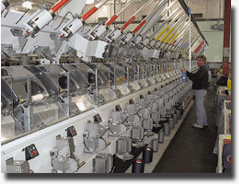
TI visited the companys Sevier Plant in Marion, N.C., in early spring, ostensibly to
update an ATI story published a few years ago about modernization projects underway at the dyeing
facility (See Commitment To Values, ATI, June 1998). Instead, it was discovered, not only has the
plant added new capacity, but Coats American has also restructured its threads business
considerably to accommodate the amalgamation of Barbour Threads, which the company purchased
slightly more than a year ago, into its operations and marketing strategies. As a result, the
mission of the Sevier plant is substantially different than it was just a few years ago.The
sewing-thread plant in the North Carolina mountains has long been a dyeing operation for spun
threads for the apparel market, but, with the recent acquisition of Barbour, it now does continuous
filament dyeing and packaging of products earmarked for industrial applications.We purchased that
group (Barbour) a little more than year ago, said Tom Borland, vice president of manufacturing for
the apparel division and Sevier plant manager. Barbour was the largest supplier in the world of
specialty thread. The company made thread for non-apparel manufacturing, such as mattresses,
furniture and automotive applications, as well as for such unusual applications as thread for the
sewing of baseballs, footballs and that sort of thing. We have significantly enhanced our presence
in these market segments. Restructuring The BusinessAs a consequence of the acquisition of
Barbour, Coats American has restructured its business into three separate business units: apparel
thread; specialty thread; and crafts.Crafts have always been very big at Coats. You walk into
Wal-Mart and you see spools of predominantly CoatsandClark thread, Borland said. The craft side of
the business was already separate from industrial, but now weve taken the industrial segment and
divided it into two distinct units one being specialty and the other being apparel. The Sevier
plant is a plant within a plant concept. We have both the specialty and the apparel lines, which
coexist within this facility.Borland said each of the businesses now has separate executive, sales
and marketing leadership in order to increase focus and efficiency in each of the business units.
Ultimately, this will enable us to better serve our customers. In most of our plants, the total
plant is assigned to one or the other of these businesses. Sevier is almost unique in terms of how
it is capturing both businesses under one roof.As well as restructuring to take advantage of the
supply chain for each respective market segment, Coats is also expanding its manufacturing presence
throughout the Western Hemisphere. We are integrating facilities south of the border with our
facilities in North America, Borland continued. We opened last year a plant in Honduras and have in
our plans this year to open one in the Dominican Republic. In addition to those new facilities, we
have an existing one in Mexico City and have bought land to develop an additional one within
Mexico. The integration of the U.S. facilities with these is based on a strategy of providing
superior service wherever we are located. For example, we will continue to supply the common,
big-volume requirements from the United States, such as white thread. But we can be very nimble,
very agile in the small, specialty orders that customers require and need very quickly.Coats
Mexican, Central American and Caribbean plants have the same three-day turnaround as their U.S.
counterparts, he said, but they realize substantial cost and transportation savings when shipping
to cut-and-sew operations in Mexico and CBI countries. Of course, the specialty customers in the
United States will continue to be serviced by the plants we have here. That is, ultimately, the
reasoning behind the integration. If we want to provide maximum three-day service, no matter where
the customer may be, then we need to have facilities within that three-day cycle a day or two days
to manufacture and a day to ship.With plants in the United States, Canada and Mexico, Borland said
Coats has greatly benefited from NAFTA. The CBI parity legislation will give us, we think, similar
advantages in Central America, South America and the Caribbean. At some time in the future, one has
to assume that NAFTA and CBI will come together, but that is some time in the future, not
now. Software InvestmentsIn addition to offshore expansion and internal restructuring, Coats
American is also investing in i2 software programs that, eventually, will segue into a complete
Enterprise Resource Planning system. This is a new tool, a software package, that can provide much
superior forecasting and planning. In addition, it will be multinational, so we will be able to
integrate all of the demand into our strategic planning with regard to customer service. We have
two distinct groupings within the company: Bulk Production Units (BPU) and Customer Service Units
(CSU). The BPUs manufacture products that have, historically, large demand. The CSUs serve more
specialized, fast-response demands. i2 will help us integrate this whole system, so that we have
capability and service in those areas in which there is demand. White thread, for example, is a
product that we know we are going to sell a certain amount. We may not know exactly who we are
going to sell it to, but we know we will sell it. But other products, the smaller, specialty
orders, you dont want to build inventory in advance, so you want small, agile, highly flexible
plants close to the customer and you want a system (i2) to ensure effective forecasting and
management. i2 is projected to be operational at Coats American by the end of this year.

Borland says Coats has thousands of different SKUs. There is a popular notion that among
sewing threads, you have only a few products. But thats not at all true.From purely a production
point, the Sevier plant recently doubled the number of Rieter/ICBT twisters in the plant to
accommodate the added capacity generated by the Barbour acquisition. The plant operates both the
DT360 and PW360 models. As well, the company uses SSMs Digicone Combiwinder. In the dyehouse,
package dyeing is performed in 40 Gaston County variable-load machines, all of which are controlled
by Gaston Countys SuperTex+SQL computerized control system. The SuperTex+SQL provides supervision
of virtually every dyeing area, including formula management, drug room supervision, boiler-surge
control, automated chemical delivery, process analysis, machine control, dye/chemical inventory and
floor scheduling. An automated system by Color Service provides precise accuracy in weighing,
mixing and dispensing dyes and chemicals.As a company, Coats American, based in Charlotte, N.C.,
produces more than 30,000 combinations of superior thread products and colors to meet the broadest
range of sewing requirements. These products reflect the latest in thread technology and color
science and are distributed throughout the North American continent. As well, the company provides
a broad range of customized purchasing, shipping, and technical support services to suit each
customers business needs.The Sevier Plant, as well as a Coats plant in Bristol, R.I., were the
first U.S.-based thread manufacturers to qualify for the QS-9000 quality certifications awarded by
the Quality Management Institute.
May 2001
Solaractive Threads Change Color In Sunlight
Tarzana, Calif.-based Solaractive has introduced an embroidery thread that changes color when
exposed to sunlight. The colors appear as white when seen indoors, but exposure to sunlight causes
them to change to yellow, orange, red, magenta, purple, blue and green. The thread is available on
200- 3300-yard cones. Starter packs containing all seven colors are available. Solaractive threads
can be used with any backing and bobbin threads.
May 2001
Mr Hayes Goes To Washington

Mr. Hayes Goes To Washington
ATMI elects new officers, sets agenda for coming year. The year 2000 was one of both
triumph and disappointment for the American Textile Manufacturers Institute (ATMI), which held its
annual meeting March 22-24 in Washington. No longer does the organization count among its members
Roger Milliken, the man who, more than any other, has remained the industrys icon for half a
century. ATMI launched a spirited, but ultimately unsuccessful, last-minute campaign against the
normalization of trade relations with China and that countrys entry into the World Trade
Organization (WTO).The organization fought and won major points in marshalling through Congress the
Caribbean Basin Initiative (CBI) and then was caught off-guard by an eleventh-hour push by a subset
of its membership the yarn spinners and their separate trade association for a legislative change
that cast a large shadow of doubt over the future of U.S. dyeing and finishing.And, ultimately, as
has been the trend among its member companies, ATMI had to face the prospect of downsizing as
reduced revenues and an impending lower dues will result in a 25-percent cut in permanent staff.For
2001, with the gavel passed to Charles A. (Chuck) Hayes, the organization will concentrate on
rebuilding the unity of the informal Textile Alliance, a consortium of 13 organizations that share
the common goal of promoting the interests of the fiber/textile/apparel complex. That unity was
shattered last year when the American Yarn Spinners Association (AYSA) broke with ATMI during CBI
negotiations.As well, much attention will be devoted to lobbying both the legislative and executive
branches of government for tariff maintenance and enforcement of existing trade
agreements. New Officers ElectedHayes, chairman of the Board of Guilford Mills Inc.,
Greensboro, N.C., was elected president of ATMI during the annual meeting, succeeding Roger W.
Chastain of Mount Vernon Mills.The ATMI membership also elected Van May, president and CEO of
Plains Cotton Cooperative Association (PCCA), Lubbock, Texas, as first vice president and Joseph L.
(Joe) Gorga, CEO and president of CMI Industries Inc., Greensboro, N.C., as second vice
president.As president, Hayes will be the primary spokesperson for ATMI. In addition to being a
member of ATMIs Board of Directors and its Executive Committee, Hayes, during his term as ATMIs
first vice president, served as chairman of ATMIs Budget and Finance, and Membership Committees.Van
May is a member of the ATMI Board of Directors and its Executive Committee. He is also chairman of
the associations Budget and Finance Committee. In addition, he is a member of the Board of
Directors of American State Bank, Cotton Council International, the National Council for Farmer
Cooperatives and the Texas Agricultural Cooperative Council. Joe Gorga is a member of ATMIs Board
of Directors and its Executive Committee, and is former chairman of ATMIs Communications Committee.
He is also a former chairman of the Northern Textile Association and a member of its Board of
Directors. ATMI Must Accept ChallengesChastain, in his last official duty as ATMI president,
told the membership they must unite and work together to take on the challenges we face and do our
very best to find a strategy for survival and growth. Some companies who came to this annual
meeting just five years ago are no longer in the industry, Chastain said. We all are struggling,
yet we are here today because we are doing everything we can to meet the challenges we are
facing.Chastain noted how ATMI has responded to the challenges by sharpening its focus to promote
our members interests in decisions made in the Congress, by the administration and by international
organizations. Chastain also said that in narrowing its approach and responding to the industrys
economic difficulties, ATMI lowered member dues and reduced its budget by $1.6 million for the
coming year. ATMI Board Of Directors Adopts Plan Of ActionThe Board of Directors, at its March
22 meeting, adopted an action plan that addresses the fundamental unfairness that surrounds most of
world trade in textiles and apparel, Chastain said. We believe that even the staunchest free trader
will come to understand and appreciate our arguments.The plan includes actions to counter imports
dumped into the U.S. market or subsidized by foreign governments; smuggling and other forms of
customs fraud; barriers by foreign countries to keep their own markets closed to U.S. products; and
attempts by foreign governments to accelerate the 2005 phase-out of quotas. We will focus on
convincing our government to find solutions to these issues, he said. When the element of
unfairness is removed, our industry does very well.Chastain said U.S. textile exports to Mexico
grew 306 percent over the past five years under the North American Free Trade Agreement (NAFTA).
U.S. yarn and fabric exports to the Caribbean increased dramatically this past December over
December 1999, he said, the first benefits of the U.S.-Caribbean Basin Trade Partnership Act.In
closing, Chastain focused on the need for the industry to be united in its efforts, stressing that
the lack of unity within the industry will prove extremely damaging as we pursue our
objectives.Also at the annual meeting, the textile industrys highest honor the Samuel Slater Award
was presented to Senators Strom Thurmond (R-S.C.) and Jesse Helms (R-N.C.). The award is named
after Samuel Slater, who established the first U.S. textile mill more than 200 years ago. ATMI
created the Slater Award in 1986 to recognize exceptional contributions to the industry.

Pictured left to right: Carlos Moore, executive vice president, ATMI; Roger Chastain,
outgoing president; Van May, newly elected first vice president; Chuck Hayes, incoming
president. New ATMI Board MembersElected for terms to expire Spring 2004:Allen Barwick,
Shuford Mills Inc., Hickory, N.C.Werner Bieri, Buhler Quality Yarns Corp., Jefferson, Ga.Thomas W.
Dickson, Ruddick Corp., Charlotte, N.C.William Horowitz, The Amerbelle Corp., Vernon, Conn.Carl
Lehner, Leigh Fibers Inc., Spartanburg, S.C.Smyth McKissick, Alice Manufacturing Co. Inc., Easley,
S.C.Howell Newton, Trio Manufacturing Co., Forsyth, Ga.Henry Truslow IV, Sunbury Textile Mills
Inc., New York, N.Y.Elected to fill an unfilled term to expire 2002:James W. Chesnutt, National
Spinning Co. Inc., Washington, N.C.Elected to fill an unfilled term to expire 2003:Arthur C.
Wiener, GaleyandLord Inc., New York, N.Y.Elected to the Executive Committee for a one-year term to
expire March 2002:Roger W. Chastain, Mount Vernon Mills Inc., Greenville, S.C.Doug Ellis, Southern
Mills Inc., Atlanta, Ga.Joseph L Gorga, CMI Industries Inc., Greensboro, N.C.Charles A. Hayes,
Guilford Mills Inc., Greensboro, N.C.George Henderson III, Burlington Industries Inc., Greensboro,
N.C.W. Duke Kimbrell, Parkdale Mills Inc., Gastonia, N.C.Van May, Plains Cotton Cooperative Assoc.,
Lubbock, Texas
May 2001
Valdese Weaves ERP Success Story
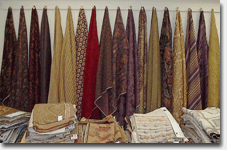
Valdese Weaves ERP Success Story
Jacquard weaver reworks work flow to improve efficiency, response and
control Imagine, if you will, a scenario in which a company is well-respected for the
quality of its work, the efficiencies of its infrastructure, its relationships with customers and
its commitment to on-time delivery.The company is successful in what, under the absolute best of
conditions, is a stressful and highly competitive marketplace. It has spent years developing and
refining its operational philosophy and has honed it to a razor-sharp edge. Yet, something is
missing a final piece that will complete the puzzle and add needed diversity and capacity to its
product capabilities. Then suppose the company finds out that even to be considered for business in
several of the new markets in which it is interested, it must change its whole business
structure.Such was the situation that confronted Valdese Weavers in Valdese, N.C., a jacquard
weaver with an established reputation for excellence in all phases of its contract and consumer
upholstery fabrics business.For Michael Shelton, president and CEO, the solution was simple, just
not very easy. The company would scrap its time-worn but effective method of operation and
re-engineer its approach to business with an Enterprise Resource Planning (ERP) system. The
implementation of the system literally required Valdese to examine every aspect of its methodology.
ERP, properly implemented, allows the synchronization of the entire supply chain throughout the
manufacturing process, from ordering of raw materials through shipment and tracking. Valdese
selected German software supplier SAP AG to supply the software and training for its ERP
system. A Road Fraught With PerilAlthough the solution Shelton and the Valdese management team
selected was simple, its implementation was anything but. As anyone who has been through a similar
experience can attest, the accompanying pain sometimes causes extreme doubt about the sanity of
such an approach. Ultimately, things worked out as planned for Valdese. The company is now,
according to Shelton, completely networked from design all the way through financial
reporting.Shelton and his management team can smile now. But just a few short months ago, while in
the midst of change, anything but smiles would have been evident. Recalling those days, Shelton
shrugged and said, If I had only known . Despite the potential for eventual profit, the road to
change was fraught with peril, much of it totally unanticipated. To get an accurate assessment of
how seemingly overwhelming those problems were at the time, Shelton said if he had multiplied
anticipated difficulties by 10, he would have been close to what the company experienced in the
interruption of its work processes.To the credit of everyone at Valdese, though, not once in the
more than 18 months it took to implement this program did we miss a single delivery, he said. The
commitment by the entire team was astounding.Had Shelton really known what was in store, would he
have stopped the process There were times when I desperately wanted to go back to the reliable way
things had worked in the past. But by that time, we were committed, and we thought the absolute
worst thing would be for us to be stuck halfway between old and new methods.Had they stopped the
process, Valdese would not have been the only company thus caught. More than 70 percent of ERP
installations fail, said Janet Kuck, vice president, information technology. The biggest reason is
that many companies get to the same critical state as Valdese did and then fold. They get trapped
between two radically different ways of doing things.This [ERP] system works, she said, but you
have to know how to work it. It is very gratifying to know that we are one of the 30 percent that
has made it work.Added Shelton: We managed our business very well. People both within and outside
our organization kept asking us why we were undertaking such a radical change. In the end, the
answer is simple to get better. Steady Growth Amid A Sea Of ConsolidationsEstablished in 1935,
Valdese is a weaver of jacquard and multi-purpose fabrics. In an era when many companies are
downsizing and consolidating, Valdese spent much of the 1990s with double-digit growth. Its main
plant has been expanded seven times since 1974 and now encompasses more than 320,000 square feet.
In addition, the company recently opened a second plant a few miles from the first, giving it more
than 500,000 square feet of manufacturing space. Valdese now ranks among the worlds largest weavers
of jacquard upholstery fabrics.The companys 97 Somet and 43 Dornier weaving machines, a mixture of
both air-jet and rapier technology, produce fabric mostly from natural fibers, although some
synthetics are used for certain properties and price points. All the Valdese weaving machines are
equipped with Staubli electronic jacquard heads. The company both package- and beam-dyes yarn in a
dyehouse dominated by the products of International Dyeing Machines. Forty percent of the companys
business is dedicated to fabric for furniture manufacturers such as its sister company, Century
Furniture, and Ethan Allen. Approximately 28 percent goes to fabric distributors such as Kravet
Fabrics and Waverly/ Schumacher. Eighteen percent is for the specialty fabrics market, including
Springs Industries and WestPoint Stevens, and 14 percent goes to the contract business.
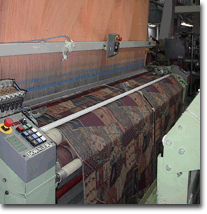
If there is any word that best describes the products of Valdese, that word is creative,
Shelton said. Our pursuit of excellence always begins with the creative touch. Whether using simple
ideas or intricate designs patterned after rich museum classics, our design team seeks inspiration
from all over the world. Creativity, combined with strong marketing knowledge, precise information
about industry trends, and most importantly the taste of our own designers gives our fabrics a look
we believe to be truly singular.Despite the companys success, the management team began noticing
potential cracks that could put a sudden stop its phenomenal growth. We had taxed the limits of the
technology we employed, Shelton said. We had experienced dramatic growth throughout the 1990s. Some
of our systems were homegrown. They were working well, but were pretty much at the limit of their
capabilities. We wanted to implement a platform that would give us the tools to continue the
pattern of growth we had established.Part of the upgrade was also driven by absolute necessity, he
said. Some of the older systems had Y2K compatibility issues, and the decision was made to
implement wholesale change to better position the company in the future.Shelton knew that a proper
re-engineering would require a considerable investment, both in human and financial resources.
Eight key employees were appointed to a committee to recommend, oversee and implement the new
strategy. There were people vital to the success of our operation, Shelton said. It put a
considerable strain on our day-to-day operations to pull them away from their responsibilities, but
we knew that we had to make the commitment to do it right. Sometimes you have to take a step back
in order to take two steps forward.Among those people were Kuck; Carson Copeland, senior vice
president, manufacturing; Wayne Wheeling, director of manufacturing; and Snyder Garrison, senior
vice president, administration. Implementation BeginsThe decision to implement an ERP system
was initially made in 1997. Formal implementation began in February 1998. The process took almost
18 months to complete. Valdese spent $12.2 million on the program, almost 15 percent of the
companys annual sales volume. Shelton anticipates 2001 sales to be approximately $80 million.Even
with all we knew we had to do, everyone still underestimated the magnitude of the project, Copeland
said. It is easy to underestimate the impact. The first order of business is to get the program
live, and then return the business to where it was previously. You dont do that overnight. It took
us a year to get it where we wanted it, and we are just now beginning to understand how to properly
use it.Shelton added, The capabilities of the system are so vast, we are just now beginning to
realize the benefits internally and the benefits to our customers of all the value-added benefits
of doing business with us. Our ERP system is now, at last, an asset to our
business. Integrated FunctionsThe implementation of the program, according to Kuck,
incorporated integration of the following functions: sales and distribution; materials management;
production planning; financial accounting; controlling/costing/budgeting; and product data
management.For sales and distribution, functionality now includes order entry with options for
piece-size variations and finish selection; the automatic inclusion of customer and
material-specific data into the sales order; customized order explosion program; ease of shipping
by either complete orders or individual pieces; full electronic data interchange capabilities; and
a sales information system for comprehensive reports.In materials management, the system
encompasses real-time inventory movements and postings, a standard costing system to valuate
make-to-stock items, and a logistics information system for reporting.Production planning modules
allow the nightly running of material requirements planning on sales orders entered that day,
capacity planning and leveling to maximize efficiencies and throughput of the product, and
forecasting tools to better manage and predict yarn needs.
The financial accounting program enables real-time financial postings integrated with
materials management, production planning, sales and distribution, and
controlling/costing/budgeting, as well as establishing an extensive information system for
monitoring customers and vendors.The controlling/costing/budgeting module of the program provides
for standard costing for make-to-stock items, extensive use of budgeting to facilitate cost
controls, and profitability analysis to allow measurement of margins by each division within the
company.Product data management allows for individual project creation and tracking through a
document management system and creates a workflow that allows project visibility from station to
station.To manage product data, sales and marketing personnel enter special project requests in the
Lotus Notes software program. After approval, these requests are uploaded into the SAP ERP program
every 30 minutes, and the project is automatically created. Fabric open-line items are entered
directly into the SAP workflow. Projects are then tracked from station to station through the SAP
program, with key transactions happening automatically in the background. A material master record
is created, along with a bill of materials and routing records. Sales orders are automatically
generated. The project goes through design workflow, then through the regular manufacturing
processes, and back again into design workflow for completion and the design sign-off. The actual
pattern number to be sold is created, costed and priced in the SAP program directly by the design
engineering team.CAD stations are used for finalizing product designs that have been scanned, Kuck
said. The software allows for a simulation of the product pattern on an Iris printer, which, in
most cases, eliminates the need to weave a sample. Creation of a CAD pattern master file enables
all pattern specifications to be downloaded automatically to the loom via loom monitoring software.
This software allows for running changes in patterns, as well as touch-screen declarations of yarn
and machine needs for the next order to be processed.The SAP system also alerts members of the
product design team when projects are ready for their attention. Custom tracking reports and custom
transactions allow for the constant monitoring of projects. Taking The System LiveSo,
essentially, the entire workflow at Valdese is now one, largely automated, network. All of this, as
Shelton, Copeland and Kuck maintain, was a lengthy labor of love in the crafting. But then the day
came, July 12, 1999, when someone had to pull the switch and take the system live.As the day
approached, Valdese closed its collective eyes and held its collective breath. It actually took
almost a week to effect the changeover from one system to another.Valdese is just beginning,
however, to tap its potential. Aside from managing inventory for both Valdese and its customers the
system also gives the company the entry point into high-end customers who demand sophisticated
entry, tracking, billing and service systems.We have built into this system the capability to
handle the most complex requirements our customers and potential customers might have, Shelton
said. We now understand how to interface with our customers and their systems, and our service
capabilities are now very sophisticated. We can completely ensure a continuous and timely flow of
product and implement Just-in-Time inventory management controls on both our end and the
customers.Adds Copeland: A lot of our customers have asked us to carry inventory for them. We can
now demonstrate how we can accomplish the same objective by throughput. More than 85 percent of our
fabric can be woven, finished and handled internally in less than two weeks. We are able to save
our customers the cost of inventory.Shelton said he is just now beginning to educate customers
about how Valdese saves them money through inventory reduction. A lot of them dont factor in this
cost when they look at product cost. The price of fabric is just one part of that. And until you
really know the cost, every other decision you make is incidental.In the past year, Valdese turned
its inventory almost 12 times and the company has the capability of exceeding that figure this
year.We develop about 5,000 new designs every year, the majority of which are custom-tailored for
our specific customers, Shelton said. We have just gotten through a major rethinking of everything
we do, and weve emerged on the other side a better company. There is no limit to what we can do
now.
May 2001
Triumph International Chooses Colorite From Datacolor
The Asian arm of Germany-based Triumph International has selected Colorite from Datacolor,
Lawrenceville, N.J., to aid in the development, review and approval of color among Triumph and its
suppliers. Colorite is a complete computerized system for accurate digital color communication. It
enables manufacturers and retailers to communicate color standards, lab samples and production lots
digitally without reliance on physical samples.Triumph sought out Colorite technology to address
manufacturing challenges in the color cycle that could be costly, such as the time and expense of
shipping physical samples among suppliers.
May 2001
Surprises In The Marketplace
G
reige goods weaving, as one spinner put it, “is in the tank,” and spinners are feeling
the effects. The sad thing about it is weavers are not at all optimistic about an early recovery.
As one said, “ Business is absolutely horrible. We have been under margin pressure for several
years, but the volume was okay. Nowadays, there is no volume either. We hope and expect
improvement, but not before the third quarter — probably the fourth.” Of course, that means
curtailment — not only in the weaving segment of the industry, but also to all suppliers of that
segment. After the disaster in the 1970s, no one wants to build inventory, so that means
curtailment — big time!
In spite of all the negatives and pessimism, there are always little surprises that give a
person some hope. Commenting on how soft his markets are, one spinner said, “Surprisingly enough,
we have seen a big increase in demand for poly/cotton yarns. We need business to offset the losses
in the home furnishings market. The home furnishings market is so huge that a slowdown in this area
really affects us severely.”
Denim Still Kicking?
Another market area in the surprise category is denim. It was not too many months ago that
people were predicting sad things for denim markets. Fashion trends were changing. Denims were out.
Gabardine twills were going to replace the time-honored fabric of the cowboy. Now, a spinner says, “
Denim markets continue to be good, especially with novelty yarns like slubs, nubs, and the like.”
Only one spinner said he was running full and his markets were satisfactory. He even noted a
slight pick-up in home furnishings, contrary to reports from other spinners. He had this to say
about market recovery, however: “This market is not going to recover rapidly, but neither do I
expect it to deteriorate further — at least not in our markets. But you have to remember that we
are not in the mainstream.” In other words, he is in a niche market.
Now, he is not the only spinner who has plants running full six days. One diversified
spinner said, “The plants running colored yarns, slubs, and nubs are running six days. Others are
curtailing some, especially those running coarse-count yarns for weaving.” Large amounts of coarse
yarns are being imported at twenty or more cents below our best prices, according to another
spinner.
CBI – No; CBI – Yes
Cotton spinners tell the Yarn Market that their markets should be at full strength at this
time of year. The reasons they are not are many! Large inventories at retail; inventories at some
manufacturers; and the constant increase of imports of yarn, fabrics and garments. Some spinners
feel the CBI program is being manipulated — that is, not all fabric returned to the United States
contains domestic yarn, nor is the fabric being produced there. They feel that both yarn and
fabrics are being imported and relabeled for return to the United States. However, a synthetic yarn
spinner said, “I feel the CBI is working as it should. We have seen an improvement in synthetic
yarns for CBI. But when we put NAFTA in, we worried about the wrong border. The cheapest prices for
textile products are coming from Canada.” This same spinner also said, “A fellow told me the other
day that I should cheer up. Things could get worse. So I cheered up, and sure enough, things got
worse!”
To add insult to injury, acrylic fiber prices have recently gone up, causing synthetic
spinners to revise their approach to pricing. Don’t expect a man-made fiber spinner to come off his
quoted price for acrylic yarn any more. What you hear is what you pay. There are also some rumors
about polyester fibers increasing in price. Cotton prices are still coming down, but, as one
spinner said, “No one has any 55-cent cotton. We all made our commitments for the year while prices
were still over 60 cents.
The recent increase in open-end yarn prices is holding and will probably continue to hold
until someone builds an inventory and offers it at bargain-basement prices. Then the downward
spiral begins — again.
Sell Times Three
One respondent said he had to sell every order three times — once to the customer, then to
management, and then to the financial institution. Of course, after it was sold, the plant didn’t
like the price, banks didn’t like the terms, and management didn’t like the fact that it was a
different product. Some days you just can’t please anybody.
May 2001
Jerzees Consolidates Distribution Reopens Facility
Atlanta-based Jerzees Activewear announced the consolidation of distribution for the Jerzees and
Russell brand products sold throught the artwear channel in its Montgomery, Ala., facility.
Shipments of these products to distributors, screen printers and embroiderers, as well as shipments
of Jerzees Internet product orders, will be made from Montgomery.The company will move the
Montgomery-based distribution of its retail products, as well as West Point, Miss.-based
distribution for its Mossy Oak apparel operations, to its Columbus, Ga.-based distribution center,
which has been vacant since late 1998. Displaced employees will have the opportunity to relocate or
receive a severance package based on years of experience.
May 2001
Assets Of Unifi Technical Fabrics To Be Acquired By Avgol Nonwovens
GREENSBORO, N.C. — Unifi, Inc. (NYSE: UFI) announced that it has reached an agreement in principle to sell the assets ofits wholly owned subsidiary Unifi Technical Fabrics, LLC, to Avgol NonwovensIndustries of Holon, Israel. The agreement, which includes Avgol taking possession of Unifi TechnicalFabrics’ (UTF) 125-acre site in Mocksville, N.C., is part of Unifi’s ongoingeffort to focus more closely on its core business as a global leader in theproduction of synthetic fiber and yarns. “While we appreciate the long term growth potential of the nonwovensbusiness, the next phase of the UTF growth plan called for significantadditional capital investment,” said Billy Moore, chief financial officer ofUnifi. “We felt that at present, our company and shareholders would best beserved by focusing our capital resources on our core businesses and using theproceeds from this sale to reduce debt.” “This is a ‘win-win’ situation for both Unifi and Avgol,” continued Moore.”It allows Unifi to stay focused on strengthening the profitability of ourcore fiber and yarn business, while providing Avgol with state-of-the-artcapabilities for North American production of nonwovens. Unifi will continueto expand successful new-products programs that leverage our coremanufacturing and marketing expertise.” The UTF facility is equipped with a five beam Reifenhauser Reicofil 3SSMMS 4.3 meter wide spun melt nonwoven production line, and is capable ofproducing approximately 30 to 35 million pounds per year, or one billionsquare meters of 1/2 ounce fabric annually. Moore stated interest in thefacility was extremely high within the industry given its highly desirableequipment and its ability to produce fabric with outstanding quality anduniformity. Prior to the contemplated transaction, Avgol announced plans to beginproducing spun melt fabrics by the end of 2002. “This acquisition will enableAvgol to fulfill commitments to key North American customers sooner than weoriginally announced, and works well for us in supporting our total Americasstrategy” said Mr. Goldwasser, a principal of Avgol. “We are particularlyexcited by the expansion opportunity that this site offers and this willenable us to add capacity easily as our business flourishes.” Unifi, Inc. is the largest producer and processor of textured yarns in theworld. The company’s primary business is the texturing, dyeing, twisting,covering and beaming of multi-filament polyester and nylon yarns. Unifi’stextured yarns are found in home furnishings, apparel and industrial fabrics,automotive upholstery, hosiery, and sewing thread. Avgol was founded in 1987 and has rapidly grown into a $65 million annualnonwovens business with five production lines in Israel. The company has alarge and growing sales base in the United States and is a recognized leaderin the production of synthetic nonwoven fabrics.CAUTIONARY STATEMENT ON FORWARD-LOOKING STATEMENTS Certain statements included herein are “forward-looking statements” withinthe meaning of the federal securities laws. Management cautions that forward-looking statements are not guarantees and that actual results could differmaterially from those expressed or implied in the forward-looking statements.Important factors that could cause the actual results of operations orfinancial condition of the Company to differ include, but are not necessarilylimited to, sourcing and pricing of raw materials, pressures on sales pricesdue to competition and economic condition, reliance on and financial viabilityof significant customers, technological advancements, employee relations,changes in construction spending and capital expenditures (including thoserelated to unforeseen acquisition opportunities), continued availability offinancial resources through financing arrangements and operations, negotiationof new or modifications of existing contracts for asset management and forproperty and equipment construction and acquisition, regulations governing taxlaws, other governmental and authoritative bodies’ policies and legislation,the continuation and the magnitude of the Company’s common stock repurchaseprogram and proceeds received from the sale of assets held for disposal. Inaddition to these representative factors, forward-looking statements could beimpacted by general domestic and international economic and industryconditions in the markets where the Company competes, such as changes incurrency exchange rates, interest and inflation rates, recession and othereconomic and political factors over which the Company has no control.Investors are also directed to consider the risks and uncertainties discussedin documents filed by the Company with the Securities and Exchange Commission.SOURCE Unifi, Inc.Web Site: http://www.unifi-inc.com Copyright 2001PR Newswire
Hemptex Introduces New Fiber Blends
Hemp Textiles International Corp. (Hemptex), Bellingham, Wash., has introduced two new hemp fiber
blends in its designer wovens for Spring 2002.The HemPop collection includes fabrics in a blend of
Cantiva® true hemp fibers and recycled polyester from PET beverage bottles. Included in the line
are 4.5-ounce supple shirting in bright and iridescent colors, bottom-weight twill and textured
weaves in tone-on-tone cool neutrals and 9-ounce weather-worn slubby denim.”The comfort and raw
beauty of hemp fiber combines with the moisture-wicking and performance of polyester, creating a
strong blend match,” said Nancy Williams, vice president, design and development.The Vision
collection comprises fabrics in 6- to 8-ounce blends of Cantiva hemp and spun silk, including
bouclweeds in a range of colors from acid off-brights to subtle retro melang#44; rustic lightweight
denim and a number of spring basics.”Hemp adds structure and strength to the blend, while the spun
silk adds body and extra softness,” said Williams. “The hand and drape we have achieved is
phenonmenal.”
May 2001