Cematex ReconfirmsITMA 2003 Will Be In BirminghamThe France-based European Committee of Textile Machinery Manufacturers (CEMATEX) issued a statement reconfirming the International Exhibition of Textile Machinery (ITMA) 2003 will be held October 22-29, at the National Exhibition Center (NEC), Birmingham, United Kingdom.The structure of ITMA 2003 organization has been adjusted to include a supervisory committee. Evelyne Cholet, general secretary, CEMATEX, will lead the committee, with assistance from Thomas Waldmann, general secretary, German Engineering Federation (VDMA); Lukas Sigrist, general secretary, Swissmem (Textile Division); and a technical advisor, yet to be named. The supervisory committee will ensure that the CEMATEX rules are observed by the NEC.CEMATEX also announced the addition of the Textile Machinery Association of Sweden (TMAS) as a member of its association.November 2001
Steamy Conditions
Yarn ConditioningBy Eric Vonwiller, Senior Technical Editor Steamy Conditions
U.S. yarn manufacturers share their practical experiences with Xorella yarn-conditioning
equipment.
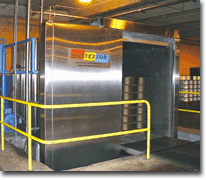
This LTC-S compact unit installed at Four Leaf Textiles, Spindale, N.C. is the
latest-generation Xorella Contexxor yarn-conditioning system. Yarn conditioning is one of
those subjects like flu shots or dental visits that do not elicit a great deal of excitement in
general conversation. Perhaps much of the reason has to do with the fact that a number of textile
people are dubious about the benefits of some systems they say the machines just dont work as
advertised.There is no doubt, however, that the proper yarn-conditioning technology properly
applied can make a big difference in the processability of yarns in weaving and knitting
operations. Such processes as vacuum steam or cold steam yarn conditioning can have significant
benefits for knitters and weavers.The first vacuum steam machines were installed in U.S. mills
about seven or eight years ago and have since become indispensible components of the manufacturing
process. But it was an uphill battle, not only to get textile manufacturers to consider the
technology, but also to get the machinery manufacturers to develop it.Freddy Wanger, founder and
managing director of Xorella AG, discovered this reluctance the hard way. His idea for a vacuum
steam yarn-conditioning process ran against the grain with a former employer. Rather than battle an
established corporate structure, Wanger decided to set up his own business. He founded Xorella AG
in 1971 in Wettingen, Switzerland.The textile mills around the world have finally realized what
great production improvements this system can provide, Wanger told Textile Industries at a
recent textile exhibition, but it took us 20 years to convince them!His painful and patient
persistence, though, has paid off handsomely. Today, the Xorella system is considered to be among
the most effective and consistent yarn-conditioning systems on the market. Years In The Race
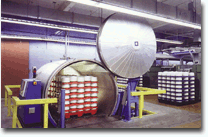
To get a good handle on the evolution of Xorella yarn-conditioning equipment, TI visited
two yarn manufacturers that have the system in place. R.L. Stowe, Belmont, N.C., has the first
generation of the Xorella machinery running at several plants, while Four Leaf Textiles, Shelby,
N.C., operates the latest incarnation of the equipment.The first Xorella Contexxor® LT-O machines
were sold to R.L. Stowes National and Helms plants in the early 1990s and are still in operation.
Age has added some appearance wear, but the machines still function without problems and fulfill
their tasks to full satisfaction everyday. Verner E. Stanley, Jr., executive vice president and
COO, said Xorellas yarn-conditioning process enhances the runability and presentation of the yarn
to weavers and knitters.When asked why Stowe selected Xorella, Stanley explained: Conditioning
cotton yarn in a vacuum at a relatively low temperature has all the attributes of success. This is
achieved by full penetration of the packages and at a condition that does not change the dye index.
Mechanically, the machine is extremely reliable, has excellent electronic controls and is built
with substantial structure.Both Stowe plant managers were positive about the impact of the
Contexxor LT-O machines, which have run continuously with few problems. Stowe conditions all of its
cotton yarns, specifically, plied and twisted yarns, for knitting and weaving customers. Only a few
of the companys hosiery customers request unconditioned yarns.The latest technology from Xorella,
the Contexxor LTC-S, is installed at the Four Leaf Textiles plant in Spindale, N.C. The
space-saving cubical unit was presented for the first time at ITMA 99 in Paris. Xorella received
TIs Innovation Award in 1999 for this technological development.Terry Lee, vice president,
operations, said, Xorella maximizes the yarn conditioning with this machine. Because Four Leaf also
has earlier designs of the Xorella machines in its plants, Lee is able to make a direct comparison
between the older machinery and the LTC-S unit. He pointed out that energy, time and water savings
are significant, especially when compared with conventional machinery on the market. He also
praised the consistency of conditioning the new unit produces. He and his staff consider the effort
for maintenance quite reasonable, as it is basically limited to cleaning door seals and draining
the water every two weeks.At the Spindale plant, Four Leaf produces mainly plied and twisted
man-made yarns from polypropylene/olefin fibers blended with acrylic and some rayon. The majority
of these yarns are conditioned to reduce loops and kinks, set the twist, and enhance knitability
and weaveability. Some single yarns are waxed and conditioned, depending on specific customer
request.Like the executives and managers from Stowe, those from Four Leaf were positive about the
impact of Xorellas Contexxor system. Lee said customer feedback has been very positive. Once
customers have seen the benefits of yarn conditioning, they dont want to be without it.
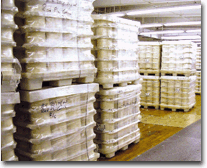
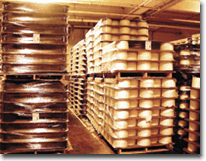
Both R.L. Stowe (left) and Four Leaf Textiles (right) shrink-wrap their yarns immediately after
the conditioning process, retaining moisture and helping fight fiber fly typical of cotton
yarns. Technology With SuccessThe Contexxor vacuum yarn-steaming and conditioning system is
the primary product line of Xorella, which is represented in the United States by PSP Marketing
Inc., Charlotte, N.C. The vacuum and pressure vessels are built according to strictest safety
specifications and are manufactured to conform to each countrys regulations. A process of steam and
vacuum prevents loops in the yarn, sets the twist, humidifies and improves the efficiency of the
machines in the subsequent processes (spooling, winding, knitting, weaving, etc.).Additionally, it
improves yarn strength and elongation of cotton yarns. During a process that takes from 35 to 45
minutes, the initial and intermediate vacuum stages ensure accelerated penetration of the saturated
steam and 100-percent humidity without condensation from a temperature as low as 50ºC (122°F). At
the same time, air and atmospheric oxygen are removed. This saturated steam also penetrates paper
tubes and cardboard boxes without destroying them. A newly developed ECO-System achieves low energy
cost.Xorella offers the more conventionally based Contexxor LT-O with the ECO-System and the
patented overhead door. Its latest technology is the Contexxor Compact LTC-S unit that is designed
to treat especially high pallets up to 13 layers. The new cubical design offers even greater energy
savings, easier maintenance, a water bath cover against fiber fly, shorter processing times, and
full automation. One and two-door versions are available. According to Xorella, the system can be
offered with significant price advantages when compared with other conventional systems on the
market.Many companies in Italy and China use the Xorella equipment for treating silk yarns. Plants
in Europe, South America, Mexico, the United States, Pakistan and Taiwan use it for cotton. Mills
in Australia, England, Germany, Korea and Switzerland use it for wool. The Xorella system is used
for man-made spun and filament yarns in the United States, Russia and the Far East.
November 2001
Rosemount Offers CAT 7D Explosion-Proof Analyzer
Orrville, Ohio-based Rosemount Analytical now offers the CAT 7D Thermal Conductivity Analyzer for
stable measurements of hydrogen, nitrogen and other gases.The analyzer uses Wheatstone Bridge
technology to monitor changes in thermal conductivity between a known value and the thermal
conductivity value of the sample gas.The new design contains a twist-off cover for easy access to
the corrosion-resistant components. The CAT 7D explosion-proof enclosure is suited for hazardous
areas rated Class I Zone I, Group IIB+H2.The analyzer also provides a safety box in which signal
connections are mounted.
October 2001
TTL Becomes Independent Company
Manfred Jaehn, former owner and managing director of Germany-based Technische Textilien Lorrach
GmbHandCo. KG (TTL) has purchased the company from the Nordifa-Group, Sweden. The purchase ends a
period of uncertainty for TTL, after Nordifa had announced its intention to sell all
subsidiaries.The companys core business will continue to be the development and production of
filter media for industrial dust collectors. TTL also produces needlefelts for various technical
applications.
October 2001
Innovo Completes Phase 1 Of Azteca Knit Acquisition
Innovo Group Inc., Knoxville, Tenn., has completed Phase I of its acquisition of certain assets of
Los Angeles-based Azteca Production International Inc.s Knit Apparel Division.Innovos subsidiary,
Innovo Apparel Inc. (IAI), purchased the customer lists, right to manufacture and market all
current products, non-compete and non-solicitation agreements, and other intangible assets from
Aztecas Knit Division. IAI will purchase the inventory under Phase II of the acquisition, and, in
addition, will hire certain employees of the Knit Division to assist in the management of IAI.
October 2001
Polyacryl
POLYACRYLRheology, br300, improves flow and leveling of waterborne inks and adhesives. Additive
also increases thickening efficiency. Product is available in liquid form, 30% active, for
incorporation at various stages in manufacturing processes. Polyacryl (203) 325-2531.
October 2001
Material World Photo Flash Report
Flash Report

A KoSa representative talks with a visitor about the companys products.

The Dominican Republic presented sourcing alternatives.

Material WorldWith the Caribbean Basin Initiative (CBI) and the North American Free Trade
Agreement (NAFTA) center stage, Material World provided attendees with full-package sourcing
solutions.Wilmington, Del.-based DuPont-led LYCRA® ASSURED International Boulevard featured 53
network partners with fiber-to-garment sourcing options for stretch products.North Carolinas
Amerisource Alliance exhibited all aspects of the garment production cycle, providing a blueprint
for full-package products.More than 20 AAPNetwork members exhibited or were on the exhibit floor.
Opening day was very strong for us, added Choice Johnson, Wellman Inc., Charlotte, N.C. We were
especially impressed with the Caribbean contacts we made at the show. As a first-time exhibitor, we
were pleasantly surprised and definitely plan to be back next year.Material World was held in Miami
Beach, Fla., September 10-12.

Steven Frumkin, Philadelphia University, School of Textiles and Material Technology,
participated in Material Worlds seminar series.

Jon Penrice (right), global vice president, ActivewearandOutdoor, DuPont Apparel &Textile
Sciences; Lainie Cantrell,senior account executive, Ketchum

Unifi Inc. exhibited yarns available for sourcing projects.

MillikenandCompany showcased its latest fabric offerings.
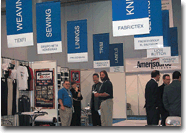
The Amerisource Alliance incorporates U.S. textile partners, U.S. trim partners and CBI
sewing partners to simplify full-package sourcing solutions.
October 2001
Karl Mayer Offers Wider-Width Multiaxial Machine
Germany-based Karl Mayer Malimo Textilmaschinenfabrik GmbH now offers its multiaxial stitch-bonding
machine 14024 in working widths of both 50 and 100 inches.The company states this machinery allows
the manufacture of multiaxial inlaid structures in a cost- effective manner and with high
production rates.
October 2001
Clean And Dry
 S
S
tain resistance and moisture management have come together in a unique new fabric
collection developed for use in uniforms and outdoor apparel. Spartanburg, S.C.-based Milliken
& Company’s Correro® fabrics are the product of a collaborative effort between Milliken; DuPont
Apparel and Textile Sciences, Wilmington, Del.; and Glen Raven Mills, Glen Raven, N.C. The
resulting fabrics, made from DuPont™ CoolMax® polyester and DuPont Cordura® nylon, are woven by
Glen Raven and enhanced and finished using a newly developed DuPont Teflon® hydrophilic
stain-release finish, as well as a proprietary process developed by Milliken.
Correro is the newest offering in Milliken’s Synthetic Woven Apparel Division’s SmartWev™
collection of innovative fabrics that feature the performance attributes of synthetic fibers
combined with natural-fiber aesthetics. The new fabrics were introduced by Milliken and DuPont at
the 2001 Outdoor Retail Summer Market in Salt Lake City. They are available in a variety of colors
in both top and bottom weights.
A Marriage Of Concepts
Yarn and construction improvements give the fabrics a matte finish, and enhanced processing
gives them a softer hand for added comfort. The fabrics are constructed in various twills and
sateens that place CoolMax on the inside to wick moisture away to the fabric’s outer surface.
Cordura on the outside provides durability and abrasion resistance. The Teflon finish is added to
provide resistance to stains and spills by encapsulating each fiber in a molecular shield. Because
the finish is hydrophilic, it does not interfere with the moisture-management and quick-drying
properties of CoolMax, as do most stain-resistant finishes.
In laboratory tests of all performance properties including moisture transport, fabric
pilling, wash-and dry-clean fastness, color retention, abrasion resistance and breathability,
Correro achieved excellent results. Wash- and dry-clean-fastness and color retention earned perfect
scores, and wicking performance rated well above CoolMax Extreme Certification Standards.
Consumers can expect to see the first Correro apparel products in retail stores in time for
the Fall 2002 season.
For more information about Correro®, contact Sam Whitt, Milliken & Company, (864)
503-1169.
October 2001
BASF Introduces Digital Textile Printing Products At European Show
Germany-based BASF AG will introduce its digital printing offerings at the first Flanders Textile
Valley exhibition in Belgium.BASF has developed an appropriate family of inks for every fabric.
With its pigment, reactive and disperse inks, BASF claims it can cover 96 percent of the textile
printing market.The dispersion dye Bafixan® is suitable for polyester fabrics, while the
pigment-based inks in the Helizarin® line can be used on cotton, viscose or blends.BASF has
conducted research and development work to optimize the inks for the ink-jet process. To prevent
the ink from drying and clogging the ink-jets, water-retentive agents and solvents are added to the
ink. Viscosity and surface tension are also carefully controlled for proper formation of the
droplets.
October 2001