Jerzees Consolidates Distribution Reopens Facility

Atlanta-based Jerzees Activewear announced the consolidation of distribution for the Jerzees and
Russell brand products sold throught the artwear channel in its Montgomery, Ala., facility.
Shipments of these products to distributors, screen printers and embroiderers, as well as shipments
of Jerzees Internet product orders, will be made from Montgomery.The company will move the
Montgomery-based distribution of its retail products, as well as West Point, Miss.-based
distribution for its Mossy Oak apparel operations, to its Columbus, Ga.-based distribution center,
which has been vacant since late 1998. Displaced employees will have the opportunity to relocate or
receive a severance package based on years of experience.

May 2001

Assets Of Unifi Technical Fabrics To Be Acquired By Avgol Nonwovens

GREENSBORO, N.C. — Unifi, Inc. (NYSE: UFI) announced that it has reached an agreement in principle to sell the assets ofits wholly owned subsidiary Unifi Technical Fabrics, LLC, to Avgol NonwovensIndustries of Holon, Israel. The agreement, which includes Avgol taking possession of Unifi TechnicalFabrics’ (UTF) 125-acre site in Mocksville, N.C., is part of Unifi’s ongoingeffort to focus more closely on its core business as a global leader in theproduction of synthetic fiber and yarns. “While we appreciate the long term growth potential of the nonwovensbusiness, the next phase of the UTF growth plan called for significantadditional capital investment,” said Billy Moore, chief financial officer ofUnifi. “We felt that at present, our company and shareholders would best beserved by focusing our capital resources on our core businesses and using theproceeds from this sale to reduce debt.” “This is a ‘win-win’ situation for both Unifi and Avgol,” continued Moore.”It allows Unifi to stay focused on strengthening the profitability of ourcore fiber and yarn business, while providing Avgol with state-of-the-artcapabilities for North American production of nonwovens. Unifi will continueto expand successful new-products programs that leverage our coremanufacturing and marketing expertise.” The UTF facility is equipped with a five beam Reifenhauser Reicofil 3SSMMS 4.3 meter wide spun melt nonwoven production line, and is capable ofproducing approximately 30 to 35 million pounds per year, or one billionsquare meters of 1/2 ounce fabric annually. Moore stated interest in thefacility was extremely high within the industry given its highly desirableequipment and its ability to produce fabric with outstanding quality anduniformity. Prior to the contemplated transaction, Avgol announced plans to beginproducing spun melt fabrics by the end of 2002. “This acquisition will enableAvgol to fulfill commitments to key North American customers sooner than weoriginally announced, and works well for us in supporting our total Americasstrategy” said Mr. Goldwasser, a principal of Avgol. “We are particularlyexcited by the expansion opportunity that this site offers and this willenable us to add capacity easily as our business flourishes.” Unifi, Inc. is the largest producer and processor of textured yarns in theworld. The company’s primary business is the texturing, dyeing, twisting,covering and beaming of multi-filament polyester and nylon yarns. Unifi’stextured yarns are found in home furnishings, apparel and industrial fabrics,automotive upholstery, hosiery, and sewing thread. Avgol was founded in 1987 and has rapidly grown into a $65 million annualnonwovens business with five production lines in Israel. The company has alarge and growing sales base in the United States and is a recognized leaderin the production of synthetic nonwoven fabrics.CAUTIONARY STATEMENT ON FORWARD-LOOKING STATEMENTS Certain statements included herein are “forward-looking statements” withinthe meaning of the federal securities laws. Management cautions that forward-looking statements are not guarantees and that actual results could differmaterially from those expressed or implied in the forward-looking statements.Important factors that could cause the actual results of operations orfinancial condition of the Company to differ include, but are not necessarilylimited to, sourcing and pricing of raw materials, pressures on sales pricesdue to competition and economic condition, reliance on and financial viabilityof significant customers, technological advancements, employee relations,changes in construction spending and capital expenditures (including thoserelated to unforeseen acquisition opportunities), continued availability offinancial resources through financing arrangements and operations, negotiationof new or modifications of existing contracts for asset management and forproperty and equipment construction and acquisition, regulations governing taxlaws, other governmental and authoritative bodies’ policies and legislation,the continuation and the magnitude of the Company’s common stock repurchaseprogram and proceeds received from the sale of assets held for disposal. Inaddition to these representative factors, forward-looking statements could beimpacted by general domestic and international economic and industryconditions in the markets where the Company competes, such as changes incurrency exchange rates, interest and inflation rates, recession and othereconomic and political factors over which the Company has no control.Investors are also directed to consider the risks and uncertainties discussedin documents filed by the Company with the Securities and Exchange Commission.SOURCE Unifi, Inc.Web Site: http://www.unifi-inc.com Copyright 2001PR Newswire

Hemptex Introduces New Fiber Blends

Hemp Textiles International Corp. (Hemptex), Bellingham, Wash., has introduced two new hemp fiber
blends in its designer wovens for Spring 2002.The HemPop collection includes fabrics in a blend of
Cantiva® true hemp fibers and recycled polyester from PET beverage bottles. Included in the line
are 4.5-ounce supple shirting in bright and iridescent colors, bottom-weight twill and textured
weaves in tone-on-tone cool neutrals and 9-ounce weather-worn slubby denim.”The comfort and raw
beauty of hemp fiber combines with the moisture-wicking and performance of polyester, creating a
strong blend match,” said Nancy Williams, vice president, design and development.The Vision
collection comprises fabrics in 6- to 8-ounce blends of Cantiva hemp and spun silk, including
bouclweeds in a range of colors from acid off-brights to subtle retro melang#44; rustic lightweight
denim and a number of spring basics.”Hemp adds structure and strength to the blend, while the spun
silk adds body and extra softness,” said Williams. “The hand and drape we have achieved is
phenonmenal.”

May 2001

Federal Reserve Cuts Interest Rate By Another Half Point


Further Rate Cuts Expected


What a difference one year makes. Last year, the Federal Reserve was raising interest rates
to cool off the economy. Higher rates combined with skyrocketing energy prices and the sharp drop
in stock prices to more realistic levels led to a complete reversal in economic trends. With most
of the latest economic barometers indicating the economy is on its way to a recession, the Federal
Reserve cut rates on April 18 by another 1/2 point. Further rate reductions are likely before the
U.S. economy is on safe ground.

Nonfarm payrolls were slashed by 86,000 jobs in March, the largest monthly drop since
November 1991. Factories reduced payrolls by 81,000 jobs and the jobless rate rose to 4.3 percent
in March. Nevertheless, first-quarter nonfarm payrolls rose by 343,000 jobs, up 1.2 percent from a
year ago. With most companies reducing or planning to cut payrolls to improve earnings, the danger
is that the U.S. economy will be pushed into recession despite sharply lower interest rates.

The producer price index for finished goods fell 0.1 percent in March as energy prices
declined by 2.6 percent. Excluding food and energy, the price index rose 0.1 percent in March.

Consumer prices edged up 0.1 percent in March as energy prices retreated 2.1 percent, while
the core index rose 0.2 percent. Obviously, inflation is no longer a concern.

BF_graph_564


Trade Deficit Down Sharply


Industrial production rose 0.4 percent in March, the first increase since September, driven
mainly by a 7.0-percent jump in output for motor vehicles and parts and a 1.1-percent increase in
utilities output. Production was down for most other industries. First-quarter industrial output
plunged 4.7 percent at an annual rate, the largest decline since the first quarter of 1991.

The operating rate edged up to 79.4 percent but was 2.5 percent below the average for
1967-2000.

Housing starts slipped 1.3 percent in March to 1.613 million units. The weakness was in
single family homes, as multi-family units surged 10.3 percent to 0.372 million. Starts soared 23.0
percent at an annual rate in the first quarter.

The nation’s trade deficit fell sharply in February to $26.99 billion from a record $33.25
billion in January. The trade gap was the smallest since November 1999. Exports rose 1.0 percent to
$90.46 billion, up for the second month in a row. Imports plunged 4.4 percent to $117.45 billion,
the largest drop on record. The decline in imports was widespread — another sign that the economy
has fallen in hard times.

Business sales dropped 0.3 percent in February, while business inventories were drawn down
by 0.2 percent. The inventory-to-sales ratio remained unchanged at 1.37 in February.


Producer Price Index Up For Finished Fabrics, Home
Furnishings


It is difficult to be positive about textile and apparel results in the current economic
environment. Textile output dropped 1.3 percent in March following a gain of 0.5 percent in
February. The operating rate for textiles dipped to 75.2 from 76.0 in February.

Sales by textile manufacturers bounced 0.8 percent in February, while inventories were
reduced by 0.7 percent. The inventories-to-sales ratio fell to 1.69 from 1.72 in January.

Industry payrolls decreased by 0.4 percent in March, after plunging 1.3 percent in February.
The jobless rate for textile mill workers lowered to 6.1 percent from 8.5 percent in February.

Retail sales declined 0.2 percent in March. Auto dealers’ sales fell 0.8 percent, and
furniture sales were off 0.7 percent. First-quarter retail sales grew 4.5 percent at an annual
rate. Consumer spending will be the only driving force to keep the economy afloat.

Apparel and accessory store sales retreated 0.7 percent in March, after rising 0.6 percent
in February.

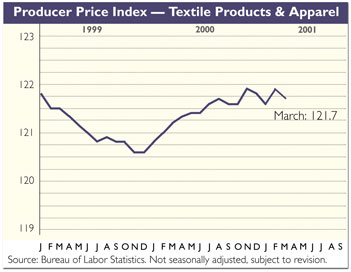
Producer prices of textiles and apparel declined 0.2 percent in March. Prices rose 0.2
percent for finished fabrics and home furnishings. Prices were down 0.1 percent for synthetic
fibers, 0.3 percent for greige fabrics, 0.8 percent for processed yarns and threads, and 3.5
percent for carpets.


May 2001

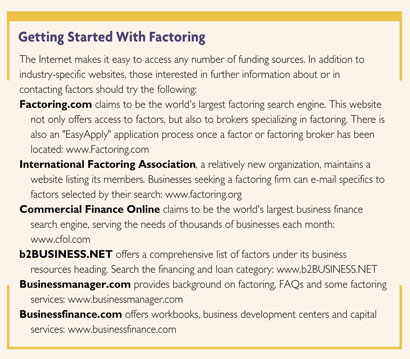
Factoring On-line And Off

Factoring On-Line And Off
Factoring can provide textile companies with cash flow to weather drawn-out cash-flow
cycles.
 Psst! Want to sell your textile or apparel business accounts receivable In return
for your outstanding receivables and potential collection problems, your textile or apparel
operation can receive badly-needed cash. Almost instant cash, no collection hassles, and it can all
be accomplished via your computer.For an industry with a gross volume in this country of between
$85 and $100 billion, factoring remains an often-misunderstood and under- utilized strategy for
increasing any textile or apparel business working capital. At its most basic, factoring is the
process of selling all or a portion of a business accounts receivable at a discounted rate from the
face value, in exchange for cash. Factoring companies exist as divisions within many banks, as
divisions of large financial institutions and as small- to mid-sized independently owned finance
companies, as well as services offered by individuals who may dabble in the business. However,
unlike banking services, factors in the United States are relatively free of government regulation
at both the state and federal levels, which may account for their proliferation on the
Internet. Accounts Receivable FinancingMike Burns, assistant vice president of Feather River
State Bank in Marysville, Calif., claims that factoring infuses new life into cash-starved
companies. The time lag between product sales and received payments often puts the biggest strain
on businesses. Rapidly growing startups; manufacturing firms; and service companies without track
records, collateral or personal resources are often unable to obtain the traditional financing they
need to weather drawn-out cash-flow cycles common to their industries. These businesses, according
to Burns, are prime candidates for factoring.Factors measure the viability of a textile or apparel
business by the strength of its accounts receivable and the quality of its product or service not
by financial ratios, equity, profitability or years in business, as many banks do. In other words,
factors look at what you do, how well you do it and the financial strength of those to whom you
sell.Factoring works this way: the factor purchases the operations invoices, typically advancing
the operation about 80 cents on the dollar while holding 20 cents in reserve. After the factor
collects a receivable payment for its customer, it gives you, the operation/customer an additional
15 cents to 18 cents on the dollar and pockets the two- to five-cent difference.Factoring is not
the most affordable type of financing. Even Ken Trombley, assistant vice president at Butte
Community Bank of Orville, Calif., has wondered why more banks havent entered the field. According
to Trombley, most of my other commercial loans yield about 9.5 percent. Factoring gives us a yield
of about 18.5 percent.Using the services of a factor can best be compared to accepting credit cards
for payments. When a store accepts a credit card purchase, it is essentially selling the account
receivable due from the customer to the credit card company for a discount. The credit card company
immediately wires payment for the purchase to the store and assumes the responsibility of
collection.Factoring is a commercial credit card that gives a company the ability to sell its
receivables to a factor in return for immediate funds, albeit at a bigger discount than that
imposed by credit card companies.When deciding whether factoring is for your textile or apparel
business, you must consider the advantages of having immediate access to the cash tied up in your
accounts receivable.Factoring may make sense for a cash-strapped business or one that can utilize
its tied-up cash for expansion or profit taking.Because there are less expensive methods of
financing your textile or apparel business, you must also assess your ability to obtain financing
from your bank or other sources. If your bank provides sufficient funding at acceptable terms, the
need for and benefits from factoring are severely reduced. Financing, Services At A
PremiumMany textile and apparel business owners use factoring until they can obtain bank financing
because, as mentioned, unlike the bank, a factor places most of its emphasis on the quality of the
business work and the financial stability of its customers.Factoring does have its price, but a
good factor will be able to see an offset of its fees with projections of increased profits. Your
factor should be able to show you the cost benefits of factoring and accept only those clients that
will benefit from an immediate increase in cash flow.Choosing a factoring company that fits your
needs can be confusing. To completely understand the services being offered by the factor, you
should examine its website or question its representative at length. What To Expect From A
FactorFirst and foremost, the factor provides a reliable source of cash flow into your business
with a consistent and quick turnaround on invoices to be funded. But that factor should also be
supplementing the efforts of your operations in-house accounts-receivable department by being a
third-party accounts-receivable management firm. Surprisingly, many factors will allow you to
handle your own collections in order to preserve your relationship with the customer. Others,
particularly banks, use a lockbox system, in which all payments are sent to a box that can only be
opened by the factoring bank. Thus, many of the business customers may be unaware that a third
party is involved in the payment or collection process.Going one step further, many factors verify
shipment arrivals, provide detailed aging and collection reports, make collection calls and process
lockbox collections. In addition, a good factor will provide supplier payment guarantees and
pre-award financial commitment letters and credit reviews on current and potential customers. Once
a business has signed up with a factor, a process that today many executives initiate on-line, it
can expect a turnaround time of as little as 24 hours between the submission of the account
receivable until payment is wired or transferred by the factor to the business.Turnaround time is
generally three to five days for issuing bonds or those financial commitment letters that are often
required in some bidding situations.The sheer volume of services provided by some factors is an
excellent reason for any executive to shop around. What services will best benefit your particular
operation Services offered by factors can include:no or one-time sign-up fee;no minimums or startup
costs;no volume guarantees;fast funding turnaround;extensive customer credit reviews;assumption of
all risk; andassistance obtaining traditional bank financing.Cash-flow management is one of the
most important things any textile and apparel business can do to grow. Funds provided through
factoring create a solid, dependable cash flow.When choosing a factor, remember that your factor
will be an integral part of your company. Working on a weekly and/or daily basis as you arrange
financing, the right factor is more than an invoice discount house for your textile and apparel
operation. It becomes a member of your team, working to improve and grow your business. 

Editors note: Mark E. Battersby is a tax and financial advisor from Ardmore, Pa. He writes a
weekly farm taxes column syndicated in 45 newspapers and a topical tax column carried by several
trade magazines and more than 25 business publications.

May 2001

BASF Launches Textile Products Website

BASF Corp., Mount Olive, N.J., has launched a new website for fabric mills, manufacturers,
retailers, commercial designers and others who work with BASF yarns or the products made from them.
The site, which can be found at www.textiles.basf.com, is organized into three categories: one for
upholstery; one for automotive; and a third for apparel. There is also a section on the companys
ISO-9002- and QS-9000-certified plant, technical service support and manufacturing expertise.Each
category contains information about BASF yarns, including Ultra Touch®, Shimmereen® and Zeftron®
200 nylons. Mill and vendor resource lists help designers and retailers locate fabrics and garments
made from BASF yarns. The the site also offers an assortment of useful literature.

May 2001

Meridian Industries Acquires Astro Dye Works

Meridian Industries Inc., Milwaukee, has acquired Calhoun, Ga.-based Astro Dye Works. Astro, which
specializes in space-dyeing and twisting novelty yarns, will become part of Meridian Dyed Yarn
Group. The Yarn Dyed Group operates two package dye houses with twisting and winding capability
located in Valdese, N.C., and Belmont, N.C.We are very excited about the acquisition of Astro and
believe it will help strengthen and complement our position as the number-one supplier of dyed
yarns to the home furnishings market and increase our share in the apparel market, said Rob
Setliff, president, Meridian Yarn Dyed Group. It also allows us an opportunity to serve the
automotive market that we have not participated in before, he added.

May 2001

New Products From Virkler

The Virkler Co., Charlotte, N.C., has introduced two new products to the wet-processing market.The
first product, Vircoscour CBW-515, is a low-foaming wetter/scour that can be used in continuous,
batch and jet bleaching processes in both peroxide and chlorine bleach systems. According to
Virkler, the product has demonstrated excellent wax- and soil-dispersing properties to minimize
deposits on machinery. It has also consistently produced high-quality whites at economical
processing costs.Vircolene PS-512, a peroxide stabilizer PLUS, is the second new introduction from
Virkler. The company states that this product provides controlled action of peroxide for bleaching,
as well as minimizing wasteful decomposition of peroxide caused by the presence of such metals as
iron, copper and manganese.

May 2001

Quality Fabric Of The Month: Performance Lite


A
t the International Fashion Fabric Exhibition (IFFE) held last month in New York City, Italy-based Nylstar introduced Nexten, the newest member of its Meryl® line of polyamide yarns. The new yarn is being promoted for use in activewear, intimate apparel, hosiery and accessories.QFOM_545 While having all the performance properties found in standard polyamides, including the ability to wick moisture away from the body and dry up to 33 percent faster than cotton or polyester, Meryl Nexten demonstrates other properties due to its unique construction. The new yarn is a hollow-fiber yarn, the first polyamide to be constructed in this way. Such construction makes it extremely lightweight — up to 30 percent lighter than comparable polyamides of the same thickness and about 40 percent lighter than polyester. Yet, comfort and performance are not compromised, according to Nylstar.

“Meryl Nexten is the most dynamic fiber innovation to come along for the activewear, outerwear and fashion industries in quite some time, and is without a doubt the lightest fiber available in the textile industry today,” said Dina Dunn, vice president, marketing, Nylstar USA,
Greensboro, N.C. “Any garment made with Meryl Nexten will provide greater comfort and freedom of movement than its bulky, heavier counterparts.”

At the same time, because of the hollow structure of the fiber, fabrics made with Meryl Nexten exhibit a high resistance to tears and abrasions, said Dunn.

Lightweight Strength And Thermal Protection

While Meryl Nexten is extremely lightweight and strong, it also provides thermal insulation properties. Compared to standard polyamide fabrics of the same weight, it provides a more than
25-percent greater degree of insulation, making it particularly suitable for winter protective garments, such as ski jackets. The combination of lightness and thermal protection in thinner fabrics makes them desirable for thermal underwear applications as well as protective lingerie and hosiery.

The air in the hollow center of the Meryl Nexten fiber also improves the thermal insulation properties of the fabric when wet. Tests simulating an average perspiration situation have shown a temperature perception difference equal to +3°C for Meryl Nexten.

Meryl Nexten is suitable for both woven and knitted fabrics. Nylstar claims it is very soft when mixed with natural fibers, and gives a high-tech, rubbery or shiny effect in knitted garments.


For more information about Meryl Nexten, contact Lisa Bahaw-Thornton, Quixote Group LLC, (336)
544-2424.


May 2001

C A Litzler Acquires Thermovation Engineering

Cleveland-based C.A. Litzler Co. Inc. has added Thermovation Engineering, also based in Cleveland,
to its family of companies.Thermovation specializes in custom-engineered gas and electric infrared
(IR) drying systems for coatings and web materials. These systems complement the convection and
radio frequency dryers currently offered by Litzler, which is now able to offer a complete range of
drying solutions.

May 2001

Sponsors