
Boehme Filatex OffersMulti-Purpose Hipochem CP-OSBoehme Filatex Inc., Reidsville, N.C., has developed Hipochem CP-OS, a low-foaming, nonionic polyester polymer that provides a variety of benefits depending on the application.According to the company, when used during prescouring, Hipochem CP-OS provides oil-scavenging properties, preventing redeposition of removed impurities. If the product is pad- or exhaust-applied to polyester fabrics, it provides soil-release properties. In the dyebath, Hipochem acts as a lubricant for man-made fabrics and also as an anti-redeposition agent for indigo-dyed denim during garment wet-processing.December 2002
DTI Partners With Outlast Technologies
DTI Partners With Outlast TechnologiesWilmington, Del.-based DuPont TextilesandInteriors (DTI) has announced an equity alliance partnership with Outlast Technologies Inc., Boulder, Colo., under which DTI will own a percentage of the company. Terms of the agreement were not disdosed.DTI will work with Outlast to design new products using Outlast’s phase change materials (PCM) technology. End-uses include apparel, home and healthcare products. They will be marketed within DTI’s portfolio of brands.December 2002
DuPont Teijin To Nullify Joint Venture
DuPont, Teijin ToNullify Joint VentureTeijin Ltd. and DuPont K.K., both based in Tokyo, have agreed
to dissolve their 50/50 joint venture, Teijin DuPont Nylon K.K. (tdN). Teijin has taken over
ownership of tdN and will service and supply its customers and markets until December 2003. Teijin
and DuPont continue to cooperate in providing customer support. Following the dissolution, DuPont
will market its products directly through its Textiles and Interiors (DTI) operation in Japan.The
companies cited Japanese market dynamics, affected by global economic factors related to tdNs
products, as factors contributing to the decision to cease operations.
December 2002
AFA Holds Annual Meeting
AFA Holds Annual MeetingThe American Floorcovering Alliance (AFA) recently held its 23rd annual
membership meeting and awards dinner at the NorthWest Georgia TradeandConvention Center, Dalton,
Ga. Bob Kokoszka, Burtco Enterprises, who has served as president for the past two years, turned
over his office to Jim Shaheen, Shaheen Carpet Mills. New members were welcomed, and outgoing
officers and directors were honored for exceptional service and support over the past year. Also on
the agenda was the official launch of AFAs website, www.americanfloor.org.Kokoszka said AFA
continues to be successful and financially sound, with many new things happening or in the planning
stages. He commended Wanda Ellis, executive director, and Stephanie Manis, executive assistant, for
their efforts and hard work. Shaheen echoed Kokoszka’s comments and praised the organization for a
job well-done. He talked about some of the association’s programs and its evolution over the past
23 years. The international marketing programs have been coming along nicely, he said, citing
visits to Domotex in Germany, as well as to China, the United Kingdom and Brazil.Awards were
presented to 20-year and 10-year members. Speakers included Reg Burnett, retired from RBI.AFAs
2002-2003 officers, besides Shaheen, are: Vice President Don Henson, DyeTech Inc.; and
Secretary/Treasurer Bill Cosby, The Sample Works. Directors for the same period are: Bucky McCamy,
Grass-Tex; Carolyn Butler, Carpeton Mills; Greg Brock, Quality Finishing of Georgia; Greely Joiner,
H. Greely Joiner LLC; and Randy Coker, Northwest Carpets.Directors for terms expiring in 2004 are:
Ed Harof, Wilcom America; Sues Alexander, BBandT; Will Robison, Allied Insurance Agency; and Lamar
Brown, LESSCO.By Peggy Whaley,Carpet Editor
December 2002
ATMI Establishes BedandBath Division
ATMI EstablishesBed And Bath DivisionThe Washington-based American Textile Manufacturers Institute
(ATMI) is establishing a BedandBath Division to enable US manufacturers in that sector to address
regulatory matters, standards and other pertinent issues. ATMI members and staff will work with
federal, state and international regulatory agencies to provide input on pending policy issues.ATMI
President Parks D. Shackelford noted pending California and federal regulations that would affect
the production of comforters and other bed products. This could greatly increase our cost of
business and the economic burden on [US consumers], he said.
December 2002
Gore Licenses Gore-Tex Cleanroom Fabric To Vidaro
Gore Licenses Gore-Tex®Cleanroom Fabric To VidaroW.L. GoreandAssociates Inc., Newark, Del., has licensed its Gore-Tex® Cleanroom Garment Fabric to Vidaro Corp., Kent, Ohio, for use in a new line of contamination control wear for critical applications.The fabric features 99.9999 percent filtration efficiency at 0.12 microns, which provides a reliable contamination barrier while allowing the release of body heat and perspiration vapor, according to Gore.Vidaro has the design, fabrication and service capabilities required to meet the customized needs of critical cleanroom applications, said William M. Hanna, product manager, Gore.December 2002
Fleissner Reports Sales In China Europe
Fleissner ReportsSales In China, EuropeWithin the last year, Germany-based Fleissner GmbHandCo. has sold six complete AquaJet Spunlace lines to companies in China. The companies Piaoan, Fujian Nanfang, Hangmin, Hainan Xinlong, Dalian and Xinlong Shanghai will use the equipment to produce a variety of nonwovens, including medical and industrial products and wipes.Fleissner also has received an order in Europe for two spunlace lines. The lines, one of which will be 4,500 millimeters wide, will produce webs of low to medium weights.Customers cite minimum energy consumption and low maintenance requirements among their reasons for selecting AquaJet Spunlace systems.December 2002
Cotton Incorporated Honors Designers
Cotton IncorporatedHonors DesignersTen textile designers and design teams and their products have
received Cary, N.C.-based Cotton Incorporateds 2002 Textile Designer Awards for aesthetic
creativity and functional effectiveness in 100-percent cotton and cotton-rich fabrics for apparel
and home fashions.Apparel winners include: Ge-Ray Fabrics Design Group, Ge-Ray Fabrics Inc. Knits;
Yaakov Shteiyer, jb martin Wovens; Nathalie Dundas, Annebelle Olivier, Mnie Lamothe and Jozien Vet,
J.L. DeBall Canada Inc. Prints; Fractal LLC Novelty; and Ellis Davis and Mike Windham, Burlington
Worldwide Technical Achievement.Home fashions winners are: Kim Grimsley and Allison Hocker, Craftex
Mills Inc. Decorative Fabrics; Mark Eduard Hordyszynski, Michael Miller Fabrics LLC Prints; Ida
Moran, WestPoint Stevens Technical Achievement; The MSI Team, Michele Sinai Inc. Bath Fashions; and
Mary Briggs, Steve Cantrell, Julie Freimuth and Lynn Neulander, Keeco Bed Fashions.Japan-based
Toyobo Co. Ltd. received the Global Recognition award for its technological innovations in cotton
fabrics.
December 2002
Soft Stretch
T
he array of stretch fibers has expanded to include a new product from Dow Fiber Solutions
(DFS), Midland, Mich., a new business within The Dow Chemical Co.’s Polyolefins and Elastomers
portfolio. DFS has introduced DOW XLA™, a cross-linked elastic polyolefin fiber preliminarily
designated by the Federal Trade Commission as “lastol,” a new subclass of olefin fiber. Branded as
The Freedom Fiber™, XLA provides low-elongation stretch to woven fabrics.
DFS has engaged several development partners worldwide to produce the fiber and create new
products. In the United States, spinner R.L. Stowe Mills Inc., Belmont, N.C., is adding it to
cotton and cotton/polyester corespun yarns.
Dan River Inc., Danville, Va., has woven a cotton chambray shirting fabric and is developing
other stretch fabrics using XLA.
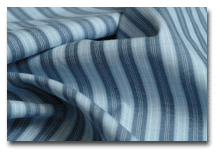
Shirting fabrics are one targeted end-use for DOW XLA™.
Pictured above is a XLA stretch fabric from French weaver Emanuel Lang.
DFS developed XLA using Dow’s polyolefin INSITE™ technology, by which resins can be designed
at the molecular level to offer superior mechanical performance for specific applications. The
combination of catalyst and process capabilities enables development of new polymers for these
applications. For XLA, performance requirements included heat and chemical resistance in an elastic
fiber. These properties make it practical for use with cotton and polyester, which often are
processed under extreme conditions.
“XLA is basically inert to chlorine and caustic,” said Mike Slocumb, vice president of
marketing, R.L. Stowe. “This is particularly significant in processing denim. If a denim
manufacturer wants to distress the fabric, the process won’t degrade the XLA fiber.”
Slocumb said the fiber’s heat tolerance to greater than 220°C makes it suitable for
piece-dyed bottomweight fabrics, such as khaki or poplin, that are thermosol-dyed.
XLA offers comfort stretch rather than power stretch. Slocumb doesn’t see it replacing
spandex, but rather opening up new stretch woven applications, such as workwear. “It provides just
enough give for comfort, and it withstands industrial laundering conditions,” he said.
Linwood Wright, vice president of quality and development, Dan River, concurs. “We’ve got
the potential to do some things with stretch that we’ve not been able to do with spandex — for
different uses of fabric, different styling techniques,” he said. ”For example, I think we’ll be
able to yarn-dye XLA. And with chambray, we can give it a heavy bleach and get the whole plethora
of indigo looks, while maintaining the stretch and recovery. Also, there’s very little, if any,
elasticity if it’s properly conditioned prior to weaving, so it’s easy to handle at the loom.”
Dan River is actively pursuing adding stretch to its “identity” yarn-dyed oxford cloth,
chambray and lightweight denim shirting for uniforms. “We are also looking to put it into
polyester-rich fabrics for uniforms,” said Wright. He anticipates seeing men’s and women’s apparel
containing XLA in retail stores by Fall 2003.
For more information about DOW XLA™, contact Dow Fiber Solutions (800) 441-4369;
www.dowxla.com.
December 2002
OSHA Delays Hearing And Ergonomics Requirements
The Occupational Safety and Health Administration (OSHA) has decided to put off for another year
enforcement of some of its hearing and ergonomics reporting requirements. The requirements were
part of the Occupational Injury and Illness Recording and Reporting Requirements published January
19, 2001. The elements being put off until January 1, 2004, include a definition of musculosketal
disorders and requirement to maintain a log for such disorders that occur in the workplace, and a
requirement for employers to provide certain information about hearing loss. The changes were
contained in a final rule published in the December 17 Federal Register.By James A. Morrissey,
Washington Correspondent
December 2002



