PGI Emerges From BankruptcyNorth Charleston, S.C.-based nonwovens manufacturer Polymer Group Inc.
(PGI) announced its previously confirmed plan of reorganization became effective March 5. All
shares of the companys old common stock have been cancelled. New common stock has been issued, with
96 percent distributed to creditors and 4 percent to existing stockholders pro rata.PGI has reduced
its total debt to approximately $500 million upon emergence from bankruptcy, down from
approximately $1.1 billion when it entered bankruptcy proceedings.We are very pleased to have this
difficult period behind us, said Jerry Zucker, chairman, president and CEO. We have emerged as a
stronger company with a solid future ahead of us.PGI has approximately 4,000 employees and 25
manufacturing facilities worldwide.
May 2003
PGI Emerges From Bankruptcy
Shanghai Awaits The Global Textile Industry
Shanghai Awaits The Global Textile Industry
Machinery manufacturers from around the world converge in China next month for ShanghaiTex.
Read on to see what some of the companies are bringing to the show.Editor’s note: ShanghaiTex 2003
has been rescheduled for December 10-13, 2003. Shanghai, Chinas largest city, has enjoyed
a long, prosperous history as an industrial and financial center with a large concentration of
textile companies. This year, once again, all eyes will be on this cosmopolitan metropolis on the
banks of the Huangpu River as it readies itself for ShanghaiTex, the 10th International Exhibition
on Textile Industry. Billed as the largest show of its kind, this years event will be staged June
2-5 at the Shanghai New International Expo Centre in the Pudong industrial district.As one of the
most significant textile events in China, ShanghaiTex 2003 is supported by 14 of the countrys
provincial textile associations and organizations. According to Adsale Exhibition Services Ltd.,
one of the shows organizers, about 1,000 exhibitors from 22 countries and regions will be showing
their wares in more than 666,000 square feet of show floor space, which represents a 40-percent
increase in area compared to the 2001 show. Moreover, organizers are expecting a record-breaking
attendance of more than 110,000.
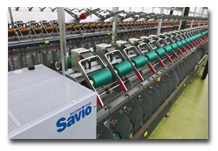
Savio will display its two-for-one twister,the GEMINIS/S, at ShanghaiTex.According to the
Italian Association of Textile Machinery Manufacturers (ACIMIT), in 2002, China exported 11 percent
(about $16 billion) of the textile products consumed globally, making it by far the worlds leading
textile exporter and producer. ACIMITs data show that Chinas installed spinning capacity has
reached 34 million short-staple and 3.6 million long-staple spindles. Such impressive production
rates, its accession to the World Trade Organization and the relatively stagnant markets in the
Western world have made China particularly attractive to machinery manufacturers around the globe.
This is evident in the increased number of international companies exhibiting at
ShanghaiTex.According to Adsale, Germany, Spain, Korea and the United States are among the
countries whose presence at the show has increased most noticeably. In addition, special country
pavilions that group companies from the same country under one unifying banner include the United
States (organized by the American Textile Machinery Association), France (organized by the French
Textile Machinery Manufacturers Association), Italy (organized by ACIMIT), Korea (organized by the
Korea Textile Machinery Association) and Taiwan (organized by the Taiwan Association of Machinery
Industry), among others.Companies exhibiting at this years ShanghaiTex include some of the biggest
names in the global textile industry representing the whole spectrum of manufacturing, from yarn
manufacturing to weaving to knitting to dyeing, printing and finishing. Based on responses to an
informal
TW survey, the following is a sampling of what some companies will be showing at the
event.Yarn ManufacturingRieter Textile Systems, Switzerland, will have several divisions
represented at the show. The Filament Yarn Technologies Business Group, a new division consisting
of the former Rieter ICBT, Rieter-Scragg and Synthetic Fiber Machinery, will be showing equipment
for processing various man-made yarns and fibers. New machinery includes the FTF 12 SDS, a
false-twist texturing machine intended for installation in large-scale polyester (PES) production
plants in the Chinese market. According to Rieter, key features include: improved flexibility that
allows manufacturers to run a wide range of materials including PES, polyamide (PA), microfibers or
polypropylene (PP) without changing heaters; use of a straight yarn path that guarantees the
processing of delicate yarns; and energy savings of up to 15 percent when compared to other
systems.Rieters Spun Yarn Systems Business Group will show a collection of equipment including
blowroom lines, cards, combers, drawframes and spinning machines.Savio Macchine Tessili S.p.A.,
Italy, will have on display a single operating ORION M automatic winding head. The ORION comes with
individually controlled motors and a flexible operating cycle. The ORION M is equipped with manual
bobbin feeding and manual packaging doffing.Savio also will show its latest two-for-one twister
GEMINIS/S 221-B with 32 spindles. The company says the GEMINIS/S offers a high production rate,
top-quality yarn, low twisting cost, reduced maintenance, low energy consumption and operating
ergonomics.Germany-based Spindelfabrik Suessen will show a range of spinning products including a
compact ring spinning system, drafting systems, open-end rotor spinning machines, and parts and
components.The EliTe®CompactSet, a modernized package of Suessens EliTe Compact Spinning System, is
available for existing ring spinning frames for short-staple and worsted spinning. According to the
company, 140,000 EliTeCompactSet spinning positions have been sold in China to date.Other products
that Suessen will show at ShanghaiTex include: the HP-A 310, HP-A 410 and HP-A 510 Top Weighting
Arms; the SC 1-M and SC 2-M Compact SpinBoxes for Autocoro SE 8 and SE 9 rotor spinning machines;
SQ SpinBoxes for Autocoro SE 7 to SE 10 rotor spinning machines; as well as spinning components and
spare parts for Autocoro SE 7 to SE 10 rotor spinning machines.Switzerland-based Saurer Textile
Group will represent its member companies, including Barmag AG, Neumag GmbHandCo. KG, Saurer
Suzhou, Saurer Hamel Ltd., W. Schlafhorst AGandCo. and Zinser Textilmaschinen.Among the equipment
to be shown is Schlafhorsts Autoconer 338 automatic winding machine, which has been specially
outfitted with a Chinese character and language menu.According to Saurer, China is one of the most
important markets for rotor spinning machines. Following the worldwide introduction at ITMA Asia in
2001, Saurer says it has installed more than 200,000 Autocoro 312 spinning positions around the
world, 50,000 of which are in China. The Autocoro 312 will once again be shown to the Chinese
market at ShanghaiTex. Following the show, the machine will be installed in the Suzhou factory for
customer trials.Trutzschler GmbH and Co. KG, Germany, will exhibit technology from its subsidiary,
Trutzschler Textile Machinery (Shanghai) Co. Ltd. It will show the High Production Card DK 903,
which has a WEBFEED system with three lickers-in a unique feature of this machine.Another DK 903 on
display will be shown with the Integrated Draw Frame (IDF), which Trutzschler says represents an
alternative to the normal drawing process because this is the first time the function of an
autoleveler draw frame is integrated in the card.In addition, other yarn-manufacturing machinery
companies that plan to exhibit at ShanghaiTex include Cognetex S.p.A., Italy, Fehrer AG, Austria,
Murata Machinery Ltd., Japan, and Sant Andrea Novara S.p.A., Italy.KnittingGermany-based
MayerandCie. will show two machines at ShanghaiTex. The Relanit 2.4 E is a fully electronic single
jacquard machine that uses the three-way technique. MayerandCie. says any pattern transferred to
the electronic system with individual needle selection at every feeder is processed within seconds
and knitted immediately. The Relanit 2.4 E to be shown has a 34-inch diameter and an E 28 gauge.
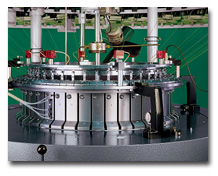
MayerandCie. will show two knitting machines at ShanghaiTex,the Relanit 2.4 E (above) and the
OVJA 1.6 Etr.The second machine to be displayed is the OVJA 1.6 Etr, an electronic double jacquard
machine with transfer and striping attachment that also uses the three-way technique. The OVJA 1.6
Etr at ShanghaiTex will feature a 30-inch diameter and an E 18 gauge.In addition, MayerandCie. will
show, in conjunction with Germany-based Merz Maschinenfabrik GmbH, the computer-controlled CC4-MED
automatic hosiery knitting machine. This four-feed high-performance circular knitting machine with
reciprocating heel device knits two-way stretch compression stockings and tights in various
compression classes, as well as antiembolism stockings and one-to-one support pantyhose with
float.Italy-based Comez S.p.A., which specializes in crochet knitting machines, will show the
CT-16B/600, a crochet machine with 16 electronically driven weft bars designed for complex lace and
flounce production. The vibration of the bars has been eliminated, making it possible to work with
as many as 16 weft bars. The machine comes in gauges of 15 and 20 needles per inch, with both 400-
and 600-millimeter (mm) working widths.Other equipment at the Comez booth will include the
Decortors 1000/EL crochet machine, the CMX needle loom and the Covertwist 2T.
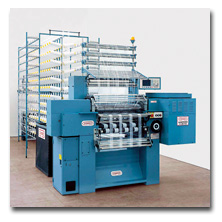
Comez’s CT-16B crochet machine features 16 electronically driven weft bars.Karl Mayer
Textilmaschinenfabrik GmbH, Germany, will showcase its RJPC 4 F-NN, a raschel machine equipped with
a new piezo-jacquard system.The company says the system offers increased production output, high
operational reliability, yarn selection via the piezo-jacquard needle in conjunction with the
microprocessor control, and easy and fast pattern change.WeavingToyota Industries Corp., Japan,
will bring five weaving machines and one ring-spinning frame with compacting system to
ShanghaiTex.The company will display four sets of its JAT710, an air-jet loom whose production
began in February
(See Weaving News, TW, January 2003). The JAT710 is equipped with a new color panel that
corresponds to interactive Internet functions.
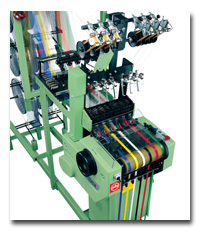
Jakob Muller’s Varitex V5Ni is builtin China and India.Narrow fabrics specialist Jakob Muller
AG, Switzerland, will showcase equipment for narrow fabric production, including the VARITEX V5Ni
narrow fabric needle loom for light elastic and non-elastic tapes and belts, the NF53 6/42 s narrow
fabric needle loom for elastic and non-elastic velvet ribbons, the MDR 42 fully electronic and RD3
620 warp crochet knitting machines with weft insertion for patterned elastic and non-elastic narrow
fabrics and lace articles, and the MBJL2S air-jet weaving machine for label pictures and scarves.As
the worlds only projectile weaving machine manufacturer, Sultex Ltd., Switzerland, will provide
live demonstrations of the P7300 projectile weaving machine and the M8300 multi-phase weaving
machine.According to Sultex, the P7300 features: leading-edge machine control hardware and
software; new machine design with mature geometry; a browser-ready terminal for direct Internet
access; 15- or 35-mm-wide tucked selvages; and new lubrication and maintenance systems for maximum
availability.The M8300 system for standard fabrics has a weft insertion rate of up to 5,500 meters
per minute. Sultex says that even at the top end of its performance range, the weft is inserted at
a constant, uniform yarn velocity of just 22 meters per second with minimal weft loading.Stli AG,
Switzerland, will have a presence in two halls at ShanghaiTex. On display in the Chinese pavilion
will be two jacquard machines the LX 1600 and the CX 160. The LX 1600 is a universal and high-speed
machine with reduced mass and fewer moving parts. According to Stli, it has a wide application
range on air-jet and rapier weaving machines and allows heavier loads on the hooks. The CX 160s
most typical application is for ribbon fabrics.Other Stli exhibits at the Chinese pavilion include
the dobby type 2650. Designed mainly for Chinese weaving machine manufacturers, the positive rotary
dobby 2650 is completely assembled at the companys plant in Hangzhou.Meanwhile, Stlis automatic
drawing-in machine the DELTA 110 will be on display at the Swiss pavilion. It will demonstrate
drawing-in a harness of a fancy cotton warp.Belgian company Picanol NV will introduce its new
GamMax rapier weaving machine for the first time in the Far East. The regions textile companies
requirements, such as increased productivity, the ability to weave a wider variety of textiles,
more flexibility in switching from one article to another and lower weaving cost, were considered
in the design of the machine.
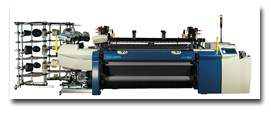
Innovations of the GamMax include optimized insertion cycle for industrial speeds; insertion
of up to 12 colors; 10 reed widths; an interactive display with Ethernet connection, USB memory
stick, PDA or key tag interface; standard sumo main motor with direct machine drive; electronic
setting of shed crossing; and ELSY selvage motions. The demonstration unit at ShanghaiTex will be
equipped with a dobby and will be weaving a shirting material.Picanol will also show the OMNIplus
air-jet weaving machine.Other weaving machine suppliers expected at ShanghaiTex include Promatech
S.p.A., Italy, Tsudakoma Corp., Japan, Smit S.p.A., Italy, and NV Michel Van de Wiele,
Belgium.Dyeing, PrintingandFinishingAmong suppliers of dyeing, printing and finishing equipment,
Bruckner Trockentechnik GmbHandCo. KG, Germany, which has more than 500 lines operating in China,
will show its finishing products. The POWERLINE tenter generation has a patented air circulation
concept. Benefits, according to the company, include increased surface touched by air circulation,
higher performance and more homogenous air circulation on the fabric web.Other products at the show
will include OPTI-SHRINK compressive shrinking lines for the treatment of woven and knitted
fabrics, and the OPTI-COMPACT compacting calender for knitted open-width fabric.Hong Kong-based
Fongs National Engineering Co. Ltd. will show the ECOTECH series of dyeing machines and a range of
finishing machinery. The SCN24ST is an open-width stretcher combined compactor that was jointly
developed by Fongs and Monforts. The stretcher has up to 50 percent of overfeed and a V-shape steam
box that can wet fabric evenly. The compactor is made up of two closely aligned compacting units,
one of which is a pressing roll and the other a circulated blanket.Italy-based Loris Bellini S.p.A.
will show its RBNV 1400/1320 vertical high-temperature, high-pressure machine for dyeing and
bleaching. It operates at 5.0 bar of pressure and at temperatures of up to 140C. Its capacity,
based on cotton packages, is about 300 kilograms. In addition, it features either automatic or
robotized operation.Loris Bellini also will display the APPC 115-LV cabinet-type skein-dyeing
system for the dyeing of mercerized cotton; acrylic, wool and blends; and worsted knitting yarns.
It features a patented variable-loading design; operates at pressures of 0.4 bar and at
temperatures of up to 108C; and has a capacity of about 200 kilograms (based on mercerized
cotton).Brazzoli S.p.A., Italy, will present Innodye, a new dyeing machine unveiled at the
beginning of this year. An Innodye 600 kg with three channels will be on display in Shanghai. After
the show, the machine will be delivered to a customer.Argelich, Termes y Cia S.A., Spain, will show
two new high-temperature jet-dyeing machines the RAPIDStrETCH RS-2 CCI + RAPID SYSTEM and the
TECHNODYE HT-2 CCI + RAPID SYSTEM. Both are fitted with the new CCI and RS systems, reducing dyeing
cycles by 30 percent compared to conventional dyeing machines.Besides the two new machines, the
company also will display fabric-dyeing machinery; package-dyeing and drying machinery; and
dyehouse automation systems.
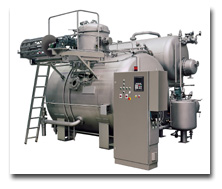
ATYC’s TECHNODYE HT-2jet-dyeing machineIn addition to these companies, other exhibiting
machinery suppliers involved in dyeing, printing and finishing include Bianco S.p.A., Biancalani
S.p.A., MCS Group, Reggiani Macchine S.p.A., Tecnorama S.r.l., Sperotto Rimar S.r.l., all based in
Italy; and J. Zimmer Maschinenbau GmbH, Austria.Other ExhibitorsElectro-Jet S.A., Spain, will show
its traveling cleaners for textile machinery; rovematic ADR automatic roving frame; bobbin and cone
automatic transport systems; cone and box automatic palletizing systems; automatic sets for
cleaning, classifying and storing ring-spinning frame tubes; draft green roller cleaning machines;
and turning static ventilators.Spartanburg-based Lawson-Hemphill Inc. will demonstrate its testing
equipment for filament and spun yarns, as well as its on-line viscosity measurement equipment for
polycondensation.Lawson-Hemphills EIB is an entanglement (interlace) tester for filament yarns that
uses optical technology. The actual yarn profile and structure may be viewed and stored along with
production printouts.In addition, the company will show its new YAS concept, which was co-developed
with the US Department of Agriculture, for spun yarn testing. The instrument uses optical
technology to grade the appearance of yarns according to ASTM International standards.As
competition heats up among emerging textile manufacturing countries (where the movement to develop
higher-quality products at a lower cost has begun), it is important for Chinas mills to adopt new
technologies and upgrade their machinery. ShanghaiTex can prove to be a timely opportunity for
machinery manufacturers to showcase what they can offer and connect with their potential
customers.Concurrent Events At ShanghaiTexIn addition to the large number of exhibiting companies,
taking place concurrently with ShanghaiTex are two other textile-related events.The Technical
Symposiums will include topics on new eco-chemicals and dyeing and finishing technologies,
technical textiles and nonwovens, spinning technology developments and applications, and garment
processing developments.The Shanghai International Techtextiles, Nonwovens and Machinery Exhibition
(SITNE) will present exhibitors that supply nonwovens and technical textiles manufacturing
machinery, raw materials for functional and high-performance fibers, and chemicals for technical
textiles.
May 2003
WestPoint Stevens Will Close Remainder Of Rosemary Complex
WestPoint Stevens Will Close Remainder Of Rosemary Complex In Strategy Adjustment To Address
DemandWestPoint Stevens announced today that the company will permanently close the remainder of
its Roanoke Rapids, N.C., Rosemary Complex as it adjusts its business plan to address current
economic projections.Preparations for shutting down the facility will get under way in early May to
meet a projected closing date of June 28. Ultimately, some 320 Rosemary associates will be
affected.”The Company has decided that this plant will not be converted to produce Basic Bedding
product as previously announced,” said Basic Bedding Division President Art Birkins. “Recent
capital investments in our existing Basic Bedding plants have provided us with a dramatic increase
in efficiency and yield — all the capacity we require for both our immediate and long-term growth.
To stay competitive in a market that’s increasingly global, it’s necessary to constantly scrutinize
our operations to eliminate any excess capacity.”WestPoint Stevens acquired the facilities in 1997
for additional towel capacity, then closed Rosemary Greige Plant in early 2001 in a move to
consolidate greige manufacturing in locations that provided the most efficient workflow. The
workforce at the remaining Rosemary Finishing and Fabricating plants, as well as Rosemary
Distribution Center, was reduced by some 125 shortly after.WestPoint Stevens Inc. is the nation’s
premier home fashions consumer products marketing company, with a wide range of bed linens, towels,
blankets, comforters and accessories marketed under the well-known brand names GRAND PAtrICIAN,
PAtrICIAN, MARTEX, ATELIER MARTEX, BABY MARTEX, UTICA, STEVENS, LADY PEPPERELL, SEDUCTION, VELLUX
and CHATHAM — all registered trademarks owned by WestPoint Stevens Inc. and its subsidiaries —
and under licensed brands including RALPH LAUREN HOME, DISNEY HOME, GLYNDA TURLEY and SIMMONS
BEAUTYREST. WestPoint Stevens is also a manufacturer of the MARTHA STEWART and JOE BOXER bed and
bath lines. WestPoint Stevens can be found on the World Wide Web at www.westpointstevens.com .
PR Newswire Press Release
New Lobbying Group Rallies Support
T
extile magnate Roger Milliken and Senator Fritz Hollings (D-S.C.) have launched a new
initiative to save jobs in manufacturing industries affected by imports. The effort stems from a
reorganization of the American Textile Trade Action Coalition (ATTAC), formed last year by the
textile union UNITE and some textile manufacturers who were unhappy with the textile industry’s
lobbying efforts in Washington.
At ATTAC’s annual meeting in March, the union and labor representatives decided to go their
separate ways when the coalition decided it needed to broaden its base and attract more industries
in order to be more effective in its anti-import efforts. At that time, ATTAC Chairman Milliken,
chairman and CEO of Milliken & Company, said it was “absolutely vital that the coalition
represent a much greater segment of the US industrial base.”
Bruce Rainor, president of UNITE, said that while he remains committed to the textile and
apparel trade goals of ATTAC, he believes the union can be more effective working through the
AFL-CIO’s Industrial Union Council, which involves other industries. The reconstituted,
manufacturing-only coalition is named the American Manufacturing Trade Action Coalition (AMTAC).
Shortly after AMTAC was formed, Senator Hollings took steps to implement the coalition’s
goals — and some of his own — by introducing in Congress his “Save American Manufacturing Act of
2003.” Hollings said the act is designed to stem the export of manufacturing jobs, combat the flood
of imports and stimulate manufacturing in the United States for textiles and other industries,
which he said have lost 2 million jobs in the past two years — some 25,000 of which were in
textiles this past year.
The far-ranging bill calls for a number of changes in tax and international trade regulations
and laws. It would, for example, eliminate tax benefits associated with off-shore production,
whether by a US- or foreign-based company. It would prevent the Export-Import Bank or overseas
private investment corporations from funding any project that does not contain at least 80-percent
US content, and it would eliminate tax incentives for companies to move their headquarters outside
of the United States.
In addition, the bill would eliminate the International Trade Commission, and it calls for an
additional 500 Customs agents to enforce the tariff and quota rules associated with textile trade.
It also would extend to the newly formed Department of Homeland Security the Buy America
procurement requirements for the Defense Department. Many of the bill’s provisions are likely to
run into stiff opposition, but Hollings and AMTAC hope the broader coalition can garner enough
strength to get a start on “rejuvenating the American manufacturer.”
EPA Sets New Standards For Dyeing And Finishing
The US Environmental Protection Agency’s (EPA’s) new national emissions standard, regulating
what it believes are hazardous air pollutants from textile dyeing and finishing operations, could
create problems for some processes, particularly some coating operations, which may have to install
new control devices.
The regulation will require dyeing and finishing operations to reduce their hazardous
emissions to the lowest levels possible with control technology, a process known as Major
Achievable Control Technology (MACT). The agency says the standard is designed to reduce hazardous
pollutant emissions by 4,100 tons per year, or about 60 percent from the baseline emissions. The
regulation will become effective as soon as it is published in the Federal Register.
The impact of the regulation was reduced after the EPA incorporated a number of
recommendations from textile manufacturers, including a proposal to permit a 12-month rolling
average for measuring pollutants. That provision takes into consideration seasonal product changes
and other short-term manufacturing processes.
Listed as hazardous pollutants (HAP) are toluene, methyl ethyl ketone, methanol, zylenes,
methyl isobutyl ketone, methylene chloride, trichloroethylene, n-hexane, glycol ethers and
formaldehyde. The EPA says there are approximately 135 major source facilities in the printing,
coating and dyeing of fabrics that use these chemicals. Exposure to these substances has been
demonstrated to cause adverse health effects including irritation of eyes, lungs and mucous
membranes; harmful effects on the central nervous system; and liver damage. Methylene chloride and
trichloroethylene are suspected to be carcinogens. While the chemicals are considered hazardous,
the EPA says it does not at this time have sufficient data to determine the extent of the threat
the chemicals pose to the populations surrounding facilities where they are being used.
The rule applies to anyone who owns or operates a fabric or other textile coating, printing,
slashing, dyeing or finishing operation, as long as some part of the operation results in the
emission of the hazardous pollutants.
Consumer Agency To Act On Upholstered Furniture Flammability
Standard
Hal Stratton, chairman of the Consumer Products Safety Commission (CPSC), said action on a new
flammability standard for upholstered furniture has dragged on entirely too long, and he plans to
wrap it up this year. The commission has been working on a proposed standard for eight years, much
to the consternation of the textile industry and consumer advocacy groups.
Stratton said, “We are going to do something. I don’t know what it will be, but it will be
worked out this year.” He also said his agency is moving forward on a mattress flammability
standard. In addition, he believes that while no such petition currently exists, his agency should
also be looking at regulating bed clothing, stating bedding flammability hazards need to be
addressed “in the overall scheme of things.”
May 2003
Mohawk’s Success
W
ith almost 100 plants, more than 250 distribution points and 32,000 employees — Jeffrey
S. Lorberbaum, Mohawk Industries president and CEO, is at the helm of a growth machine in the
flooring industry. Fueled by a wide array of products, and by distribution and sales that have
grown from $300 million in 1992 to almost $5 billion today — the momentum for both internal growth
and growth through acquisition seems unstoppable.
Textile World
’s Carpet Editor Peggy Whaley reports in this issue’s cover story that Mohawk’s dedication to
growth is not new. Rather, it has been the thrust behind moving market share from 3 percent in 1992
to a little less than 30 percent today. Whaley points out the company’s financial success as well,
noting a top-line compounded growth rate of 16 percent over the last five years.
It is no wonder that Lorberbaum has been nominated for the Contribution to the Industry
Award. The award is among this year’s new Best of FloorTek Awards, to be presented by the American
Floorcovering Alliance this month at FloorTek Expo in Dalton, Ga. Lorberbaum’s dedication to both
the customer and Mohawk’s retail partners, as well as the swift focus he has shown in moving the
company from “carpet supplier to total flooring company,” illustrate the dynamic nature of his
leadership.
Today, the US flooring industry is revered on a global basis, and it is companies such as
Mohawk that have made that happen. Leadership, innovation, investment, as well as a focus on
delivering value to the customer in the face of changing tastes, keep this segment vibrant and
healthy.
As difficult times have affected many sectors of the textile industry, Mohawk aptly
redefines itself, never forgetting its 1920s heritage from the Shuttleworth Brothers and McCleary,
William and Crouse. Mohawk continues moving forward, focusing on meeting its customers’ needs.
Strategically, becoming a national distributor of Congoleum vinyl; adding $1 billion in sales in
the hard surface arena through Dal-Tile; and acquiring American Weavers’ and Crown Crafts’ woven
businesses, making it a leader in throws and pillows — all illustrate the breadth and depth Mohawk
brings to the consumer product segment.
Given Mohawk’s history, when Lorberbaum states, “We’re excited about the opportunities for
Mohawk’s future growth,” one can imagine what the future holds. Clearly, an even stronger, more
integrated Mohawk is on the horizon.
April 2003
Cernotec Offers VisualPlant™ Solution
Greenville-based Cernotec LLC now offers its North American customers VisualPlant™ software from
Canada-based Executive Manufacturing Technologies (EMT) Inc. The software enables real-time
analysis of the complete manufacturing process and allows manufacturers to compare current plant
floor activity to previous activity.
“It’s the best technology we’ve seen that can improve total plant efficiency,” said Jason
Premo, executive vice president of marketing and business development, Cernotec. “It builds a
better link to the supply chain and offers almost immediate payback.”
April 2003
Loepfe Completes Expansion
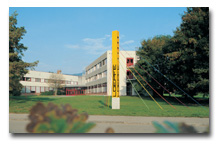 Looking
toward the future, Loepfe Brothers Ltd. has expanded its operations with the completion of a new
building. The Switzerland-based provider of electronic on-line quality control systems for spinning
and weaving reports the new facility “strengthens the entrepreneurial infrastructure and opens up
new perspectives for Loepfe.
The new building has increased the company’s office, laboratory and production space and
improved its production flows, enabling increased reaction speed and reduced throughput times,
according to Loepfe. The company anticipates the expansion will allow it to reduce costs while
continuing to grow.
March 2003
EVS Sells I-TEX® Systems To Shangdong Demian
Israel-based Elbit Vision Systems Ltd. (EVS) will supply two of its new-generation I-TEX®
inspection systems to China-based Shangdong Demian Group Stock Ltd. Co. The systems will be
integrated into Shangdong Demian’s weaving process in order to inspect the company’s greige fabrics
and upgrade their quality level.
“After evaluating options of various suppliers, we have concluded that EVS’ I-TEX technology
provides a customized solution maximizing product quality, thus increasing price performance,” said
Li Huijiang, general manager, Shangdong Demian.
April 2003
Quality Fabric Of The Month: Hard Core Textiles
incineration to produce energy without emitting toxic gases. They are inherently flame-retardant, stain-resistant, antimicrobial, strong, durable, non-absorbent, breathable and easily cleaned. Xorel fabrics also have a range of reflective qualities and can add light to a room without requiring increased electricity use.
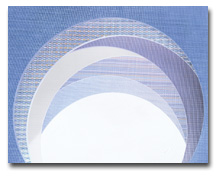
Xorel® Surfaces is available on a made-to-order basis, with choices possible from
Carnegie’s line of Xorel patterns and colorways, as well as a range of thicknesses.
New Textile Format
Carnegie now has introduced Xorel Surfaces, a hard-surface architectural product in which Xorel fabric is thermofused to Spectar®, a copolyester resin manufactured by Kingsport, Tenn.-based Eastman Chemical Co. Cliff Goldman, Carnegie’s president, said this new product uses a textile in a unique format.
“When you’re dealing with hard-surface resins, pattern and design are usually encapsulated within the resin, and the products don’t have a tactile quality,” Goldman said. “In the case of Xorel Surfaces, we have a tactile, dimensional material on the surface. In addition, the woven
product accepts light differently, especially in vertical applications. And a lot of people are interested in backlighting it because of its translucent properties.” He mentioned such vertical uses as dividers, wall accents, retail visual displays and a variety of other uses. Ceilings and table tops are other possible applications.
Carnegie produces Xorel Surfaces according to customer specifications, offering more than 40 Xorel patterns and 500 colorways, as well as six thicknesses ranging up to 0.5 inch. Dimensional embossings, textures and a variety of back finishes are available as well, and the resin can be
translucent or opaque. Xorel fabric also can be bonded to both sides of the resin.
Xorel Surfaces is flexible, yet stronger and lighter-weight than glass. The non-crystalline, shatter-resistant Spectar resin also is resistant to chemicals and does not produce toxic fumes when burned. It can be cut, drilled, tapped into, or cold-bent. Like Xorel Fabrics, the hard-surface product also can be incinerated to produce clean energy, or the fabric and resin can be separated and each recycled.
For more information about Xorel® Surfaces, contact Cliff Goldman (516) 678-6770.
April 2003
Fast Transit Automation
H
eadquartered in Henderson, N.C., Harriet & Henderson Yarns Inc. is a privately held
sales yarn company formed in 1895. Harriet & Henderson services both domestic and international
apparel and industrial markets with ring-spun (RS) and open-end (OE) yarns. Its primary end-use
markets include sports socks, knitted outerwear and underwear, as well as various woven
applications.
The company manufactures yarn using ring and OE spinning systems with slub capacities on
both.
Harriet & Henderson operates four yarn manufacturing plants, which produce roughly 150
million pounds annually. These include: the Harriet #2 Plant in Henderson, N.C.; Bladen and
Clarkton Plants in Bladen County, N.C.; and the Cedartown Plant in Georgia.
In addition, the company has distribution centers in Hickory, N.C., and Fort Payne, Ala.
Harriet & Henderson produces a wide range of spun yarn products that vary according to yarn
count (from Ne 5/1 to Ne 30/1), manufacturing process and fiber content.
The company manufactures 100-percent cotton and some 100-percent polyester yarn, as well as
various cotton/polyester and cotton/acrylic blends. These include heather blends of cotton/black
polyester and cotton/black stock-dyed cotton. The company is also developing other colored and
surface-effect yarns in an effort to bring value-added products and ideas to the market and its
customers.
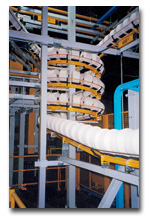
Yarn packages spiral down from overhead storage on the way to an automated packing line at
Harriet & Henderson’s Cedartown Plant. The U.T.I.T. system transports, inspects, stores and
packs the yarn.
Cedartown
The Cedartown Plant is a state-of-the-art, OE spinning facility. It began as a greenfield
plant and started continuous operation in December 1998. The plant is in an industrial park located
just outside of Cedartown, a hamlet of about 10,000 residents in northwest Georgia approximately 20
miles south of Rome.
The plant produces approximately 1 million pounds of 100-percent cotton yarn per week for
weaving, hosiery and knit outerwear applications. This means that the Cedartown Plant’s 100
associates, roughly one-sixth of Harriet & Henderson’s workforce, produce nearly one-third of
the company’s total yarn output. Yarn counts ranging from Ne 5/1 to Ne 22/1 are used domestically
and exported to the Caribbean Basin Initiative (CBI) region.
All of the production machinery from opening through spinning is Switzerland-based Rieter
Textile Systems’ equipment, including C 51 Hi•Per•Cards, RSB-D 30 drawframes and R 20 rotor
spinning machines. The plant has enjoyed a strong running schedule and has increased its production
capacity twice.
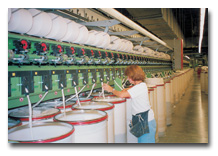
An associate at Harriet & Henderson’s Cedartown Plant tends to a Rieter R 20 open-end
spinning machine.
Expanded And Improved
“Our business has been strong,” said Gregg Webb, Cedartown plant manager. “We’ve been
fortunate in that we’ve had some kind of major addition every year.”
The plant started out with 14 spinning machines, 25 cards and 10 draw frames. In 1999, two
OE spinning machines and one draw frame were added. In 2000, the plant gained an additional five
spinning machines, nine cards and three draw frames. In 2001, an automated yarn transport,
inspection and packing system from Italy-based U.T.I.T. Wagner Automation S.p.A. was added. The
system is the first of its kind to be installed in the United States.
“We became interested in the U.T.I.T. system for labor savings, package quality improvement
and reduced ergonomic risk,” said Webb. “We had 16 people manually removing and inspecting
packages, and the potential risk of carpal tunnel syndrome was becoming a concern.
“With the addition of the U.T.I.T. system, there has been a tremendous reduction in product
handling. Now no one touches the yarn from the time it leaves the spinning machine until a forklift
places it on a truck. As a result, Cedartown has realized a decline in Occupational Health &
Safety Administration (OSHA) recordable injuries. Its most recent safety milestone is reaching the
two-year mark without a lost-time accident.
Installation of the U.T.I.T. system went relatively smoothly. There was some concern about
language difficulties between the Italian erectors and the plant’s English- and Spanish-speaking
associates. These concerns proved to be groundless. “I was amazed at how quickly our associates
picked the system up,” Webb said. “I was very pleased with the training that U.T.I.T. offered the
associates, helping them get the system up and running.”

Left to right: Giovanni Vaccari, U.T.I.T.; Mike Daniels, M&M Machinery Sales LLC; Gregg
Webb, Harriet & Henderson; and Scott Wilfong, M&M Machinery Sales. Harriet & Henderson
purchased the U.T.I.T. equipment through M&M Machinery Sales, U.T.I.T.’s US sales
representative.
The U.T.I.T. System
In the U.T.I.T. system, first, a pneumatic elevator lifts packages from each spinning
machine up to the transport system or collecting circuit.
Next, packages are loaded onto a “train” or “chain” equipped with plastic trays that hold
each package. U.T.I.T. calls the system the “Snake Cone.” It uses the same components the company
has been employing for several years on bobbin transport systems. It was shown for the first time
at the American Textile Machinery Exhibition-International (ATME-I) 2001 in Greenville.
This train-with-trays approach offers several advantages over older systems such as conveyor
belts. Packages are less likely to be damaged. The risk of mixing yarn counts also is eliminated
because all of the packages in a train come from the same spinning machine, so each chain or train
has its own identity.”
Each package rides on a single plastic tray,” said Giovanni Vaccari, sales engineer and US
sales area manager, U.T.I.T. “The system is modular and adaptable to existing buildings and
existing machinery layouts. Another advantage is speed. It is much faster than a conveyor.”
The Cedartown Plant’s spinning machines are arranged in three bays. Two have eight machines
each, and the third has five. The package transport system can handle a single doff from each of
these bays simultaneously and is guaranteed to handle a package flow of up to 1,000 packages per
hour.
Transportation, Inspection And Storage
From the spinning room, the packages are conveyed out to the warehouse. Once there, they go
through two inspection stations and are automatically checked for proper diameter, weight, conicity
and transfer tail. Any packages not within tolerance are automatically rejected.
After the packages are inspected, they are transferred to buffer trains that contain exactly
enough packages to complete a pallet or several cardboard cases. These buffer trains are stored
above the packing area. This overhead storage system can hold up to 21 different yarn counts – one
per spinning machine. While the plant can produce up to 21 different yarn counts at a time, that
can translate into as many as 50 SKUs, depending on factors such as yarn package size and the type
of packaging required by the customer.
“Domestically, more and more customers prefer the returnable tray pack and the largest
package size available,” Webb said. “Export customers prefer cardboard cases, but there too, they
are looking for larger-diameter packages.”With the exception of the packing and wrapping stations
in the warehouse, the system is installed overhead. From the overhead storage area, the trains
carry the packages to one of two automated packing stations via one of two spirals.
Packing It Out
The plant is equipped with two packing stations. One is a palletizer with a multiple head
gripper, pallet separator and cover pick-up device. It is designed to pack the yarn into tray
packs. The other unit is a boxing machine that can pack different package diameters following
different patterns into cardboard cases. These cases are automatically folded and formed by the
machine.
Both lines are capable of wrapping and strapping prior to shipping. The ability to
seamlessly switch back and forth between the two packing lines is essential at Cedartown because it
is a sales yarn plant. Here, constant product mix changes are the norm.
The automated yarn transport and inspection system has been in place for more than a year
now. Plant management is pleased with the system and reports that it has a short payback period.
Webb declined to go into specifics, other than to say there were tremendous labor savings and to
mention a 0.5-percent efficiency gain at the spinning machines due to optimization of doffing time.
Editor’s Note: Alfred Dockery is editor of The HunTex Report, a newsletter for industrial
textiles. A graduate of North Carolina State University’s College of Textiles, he has been writing
about the textile industry for 15 years. Dockery is based in Clemmons, N.C.
April 2003