Gearing Up For ITMA 2003

 
Gearing UpFor ITMA 2003
New features and formats serve all sectors of the textile industry.When an event happens
only once every four years, chances are that when it does take place, it is a rather big deal. Such
is the case with ITMA, the International Textile Machinery Show. The 2003 event, which is the 14th
edition, is slated to take place Oct. 22-29 at the National Exhibition Center (NEC) in Birmingham,
England the first time ITMA has been held in the United Kingdom. There is much anticipation among
the industry, not only because ITMA is one of the largest textile machinery shows in the world, but
also because the recent Sudden Acute Respiratory Syndrome outbreak in Asia had forced several shows
in that region to be postponed and executives to cancel their international travels.As of
Textile Worlds press time, the European Committee of Textile Machinery Manufacturers
(CEMATEX), organizer of the show, reported an ITMA 2003 attendee pre-registration increase of more
than 200 percent compared with ITMA 1999. Of those who have pre-registered, CEMATEX reports most
are from the United Kingdom, Germany, Pakistan, India and the United States; and 30 percent of
those who pre-registered are from Asia.


The venue for ITMA 2003, the National Exhibition Center, is the largest exhibition facility
in the United Kingdom.Record Number Of ExhibitorsAs of press time, there are more than 1,350
confirmed exhibitors from 44 countries a new record for ITMA, according to CEMATEX. Maria Avery,
exhibition director, said the show has attracted exhibitors from Argentina, Thailand, South Africa,
Iran and Egypt for the first time. Moreover, Avery added, Turkey has had the largest increase in
the number of exhibiting companies from 32 at ITMA 1999 to 69 as of
TWs press time, taking up more than 4,000 square meters of floor space. Italy, with 330
companies, has the largest number of exhibitors, followed by Germany, Switzerland, Spain, Belgium,
Turkey and France.Despite the growth in the number of exhibitors and pre-registered attendees, this
years ITMA is not likely to see an increase in the amount of show floor space.According to Avery,
the reasons for a lack of growth in this area include the increasing number of merged companies and
a proliferation of shows around the world, including ITMA Asia, slated to take place in Singapore
in 2005. However, Avery adds that many late applications are being processed, and a new hall for
the Dyeing and Finishing sector was added a few months ago to accommodate the unexpectedly large
number of exhibitors.Whats NewAttendees of this years ITMA can expect to see several new features
at the show. For the first time in the shows history, there will be a separate Nonwovens sector and
a new Dyestuffs and Chemicals sector.In addition, the new ITMA Forum, titled New Frontiers in
Textiles Moving MarketsandStrategic Innovations, will be held Oct. 23-25. There will be a total of
six sessions, each dedicated to a textile hot-button issue. For example, the opening discussion is
titled China: Global Domination, Strategic Alliances. Other topics include trade developments,
corporate finance, skills management, supply chain management and technical textiles.Another new
feature is an on-line interactive exhibitor directory www.itmalive.com created to help attendees
plan ahead. The searchable website includes information about exhibiting companies and their
products, as well as sales contacts.

For more information about ITMA 2003, contact the Organizing Committee 44 121 780 2003; fax
44 121 782 2003; info@itma2003.com;
www.itma.com.

August 2003

Delta Apparel To Purchase M J Soffe

Vertically integrated knit apparel manufacturer Delta Apparel Inc., Duluth, Ga., recently signed a
definitive agreement to purchase Fayetteville, N.C.-based M.J. Soffe Co., a producer of
activewear.The transaction, expected to close in September of this year, is valued at up to $72
million, including $52 million in cash that includes retirement of debt, $8 million in promissory
notes and up to $12 million in contingent payments based on performance targets.Jim Soffe will
continue to serve as CEO of M.J. Soffe.Robert W. Humphreys, president and CEO of Delta Apparel,
said, We believe the manufacturing, distribution and marketing synergies between the companies will
allow both operations to expand at a faster pace than would be possible on a stand-alone basis.

August 2003

Competition In Goods And Currency


C
ompetition is a basic principle of sound capitalism. Throughout US economic history,
every time an industry giant generates a healthy whiff of monopoly or market domination, the US
government has responded by trying to break things up. Think Ma Bell, Standard Oil, Microsoft or
the scrutiny major corporations go through when they merge.

It seems that competition is integral to the way the US economy works. So why, in a time of
mass globalization, does the US government fail to see the importance of maintaining a competitive
business environment globally?

Competitive fairness in a global economy should appeal to the most ardent free-trader. Free
trade is dependent on free markets — not markets that will be free. The law of comparative
advantage — the basis for most free-trade arguments — was cast in a competitive marketplace. The
World Trade Organization supposedly promotes this idea. However, something is lost in translation —
maybe courage?

The basic concept of market-determined value for currencies is difficult to explain.
Capitalists assume it to involve the simple process of exchange. When you think about it, currency
only exists for exchange — it is difficult to haul livestock around. But in a capitalist economy,
even the livestock’s value as currency is market-determined.

In recent months, the US dollar has lost value in most of the world. The United States has
been importing a tremendous amount of product. As the dollar has weakened, imports and the prospect
of future imports should ebb, and the atmosphere for US manufacturers of all types should improve.

But, not so fast — with European currencies consolidated into the euro, Europe will feel the
brunt of this currency slide. The sticking point is that the Chinese currency (yuan) has declined
with the US dollar. This infers that the US economic climate that caused the dollar’s slide is also
apparent in China — not so.

Since 1994, China’s currency has been artificially fixed, or “pegged,” to fluctuate with the
dollar. As the US trade balance has chased away demand for US dollars, the dollar’s value has
dropped. Demand for US exports should rise — putting US-made goods “on sale” around the world.
China’s failure to float its currency derails the process. If the dollar fell against the yuan, US
goods would be in a competitive position to export to China, while stemming imports from China.
Fair yuan valuation would reflect China’s amazing economic growth since 1994.

If China floated the yuan, its estimated adjustment of 15 to 40 percent would raise the yuan’s
value — and global competitive free trade would benefit. China also would face slower growth and
increased unemployment. Even with bipartisan efforts by Senators Schumer, Dole, Bayh and Graham in
asking the Treasury Department to take action, political will must build further to address the
issue effectively.

US manufacturing is competitive. What is needed is fairness. If the US government is willing
to sue Bill Gates, how about some action on global competitive fairness?

August 2003

Belmont Partners With Resch

Belmont Textile Machinery, Mount
Holly, N.C., has entered into a partnership with Resch Power Heat-Set GmbH, Germany. Belmont now
serves as North American sales and service representative for Resch’s Horauf/Suessen GVA (yarn
heat-setting) machines. Resch purchased the GVA program from Horauf/Suessen in September
2002.

supplier2


Resch Power Heat-Set’s Horauf/Suessen GVA machine

With the combined experience of our two companies, we can assure our customers in
North America that the team of Resch and Belmont will provide them with fresh ideas, superior
service and a renewed commitment to customer satisfaction,” said Peter Resch, president and CEO,
Resch.


July 2003


Datatex Sells CATS To Bossa, Partners With 3C Software

Milan-based Datatex S.r.l. has sold a
Computer Aided Textile Supervisor (CATS) tool to Bossa, a Turkey-based vertically integrated
textile manufacturer of cotton and blended man-made yarn and fabric. Datatex says CATS, an
automated optical fabric inspection tool, improves productivity and efficiency, reports production
faults in real time and optimizes fabric quality.

In other news, Datatex has entered into a strategic partnership with Atlanta-based 3C
Software Inc. The companies have combined Datatex’s Textile Integrated Manufacturing (TIM)
enterprise resource planning (ERP) solution and 3C Software’s Impact: ECS™ cost management system
to provide a comprehensive cost management and manufacturing solution for the textile and apparel
industries.


July 2003

Dornier AirGuide Offers Contact-Free Guidance

Dornier
AirGuide Offers Contact-Free GuidanceLindauer Dornier GmbH, Germany, has developed the AirGuide, a
contact-free solution to guide mechanical elements. The device can be retrofitted on Dorniers
P-type rigid rapier weaving machines. The AirGuide directs air to the rapier rod through a guide
plate that replaces conventional ball bearing guide rollers. A temperature monitor allows for
automatic shutdown of mechanical filling insertion systems in case of heat build-up. The air guide
cools the rod, reducing friction and increasing lubrication intervals, according to the company.
Other benefits include reduced maintenance costs, increased service life, improved efficiency, a
self-cleaning effect that enables weaving of clean fabrics and fail-safe features.Older rapier
machines also can be retrofitted with the AirGuide.
July 2003

Enzyme Could Help Break Down Hydrogen Peroxide

A catalase enzyme recently discovered by scientists at the US Department of Energys National
Engineering and Environmental Laboratory (INEEL), Idaho Falls, Idaho, could reduce the harmful
effects of industrial bleaching process wastewater on the environment. The new enzyme is able to
chemically change hydrogen peroxide often used in industrial bleaching processes into water and
oxygen.Taken from the Thermus brockianus microbe found in a hot springs pool at Yellowstone
National Park, the catalase thrives in a high-pH and high-temperature environment, and so works
well in hot, alkaline process wastewater.High-temperature stability makes this enzyme potentially
viable and economically attractive for industrial applications, said William Apel, INEEL. This new
catalase [lasts] for days, where the typical performance limit of many industrial-use enzymes is a
mere 10 hours.

July 2003

Cotton Incorporated Offers CDs Cosponsors Cotton Days

Cotton Incorporated Offers CDs, Cosponsors Cotton DaysCotton Incorporateds New York City-based
Consumer Marketing Division has launched an interactive series of educational programs covering
knitting, weaving, and dyeing and finishing processes. The five programs, available on CD-ROM, are
funded in part by the Importer Support Program of the Cotton Board.

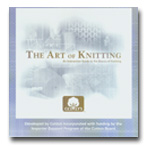
Cotton Incorporateds The Art of Knitting is part of a series of interactive educational
programs covering textile basics. Developed for sourcing professionals, the series illustrates the
transformation of raw cotton to fabric. Presentations include actual manufacturing operations, 3-D
animations, technical illustrations and a glossary of terms. The first two programs, The Art of
Knitting and The Science of Dyeing and Finishing, are now available. The Art of Weaving, Color
Science and The Art of Printing will be introduced later this year and in early 2004.In other news,
Cotton Incorporated and the Washington-based Cotton Council International (CCI) joined forces to
sponsor Cotton Days, a week of celebrations in Osaka, Japan; Seoul, South Korea; and Taipei,
Taiwan, designed to promote US cotton and Cotton USA licensee textile products in Asia.The event
first took place in 1995 in Japan with support from the Japan Spinners Association. That first
Cotton Day promoted Japanese cotton textiles and celebrated casual Fridays in the corporate
workplace. Cotton Incorporated and CCI later expanded the celebrations, bringing Cotton Day to
Taiwan in 2001 and to Seoul in 2002.
July 2003

Industry Seeks Relief From Chinese Imports

Industry Seeks Relief From Chinese ImportsThe American Manufacturing Trade Action Coalition (AMTAC)
is expected later this week to file a series of new petitions with the US Department of Commerce
seeking relief from Chinese imports by employing the “safeguard mechanism” in the US/China
bilateral textile trade agreement. The announcement will be made on Capitol Hill in order to
demonstrate support for the petitions by the industrys friends in Congress.Under the safeguard
mechanism, a provision in Chinas accession to the World Trade Organization, the US retains its
rights to impose import quotas to address surges in imports from China. The action will be taken in
view of Chinas rising imports that, during the first five months of this year, are 16.6 percent
higher than the comparable period of 2002.Several steps are involved in utilizing the safeguard
mechanism, and it can be a fairly drawn out process. First, industry petitioners must provide the
Committee for the Implementation of Textile Agreements (CITA) with specific information regarding a
claim that Chinese textiles or apparel are resulting in market disruption. Then CITA will seek
public comment on the request. CITA must determine within 60 calendar days of the close of the
comment period whether the claim is valid. If it decides it is, CITA will request “consultations”
with China. If agreement is reached during consultations, quotas may be imposed on a bilateral
basis. If there is no agreement, the US has the right to impose unilateral quotas.Last August, the
American Textile Manufacturers Institute (ATMI) filed a petition with CITA seeking reimposition of
quotas on Chinese products where triple digit growth occurred when quotas were removed, but no
action has been taken. By James A. Morrissey, Washington Correspondent
July 2003

Management Team Acquires National Textiles

Management Team Acquires National TextilesMembers of the management team of National Textiles LLC,
Winston-Salem, N.C., have acquired a majority interest in the company from its financial investors.
Jerry Rowland, president and CEO, and Keith Huskins, chief administrative officer, are leading the
new ownership group.The companys roots go back nearly 45 years to when it was part of Hanes Corp.s
manufacturing operations. In 1979, Hanes was acquired by Consolidated Foods, which was renamed Sara
Lee Corp. in 1985. National Textiles gained its independence in 1997, when Sara Lee spun off most
of its textile manufacturing operations. Rowland and Huskins have been with the company since it
was part of Sara Lee and have held their current positions at National Textiles since its creation.

Jerry Rowland (right) and Keith Huskins head National Textiles new ownership group.Employing
more than 4,000 people in Georgia, North and South Carolina, Tennessee and Virginia, the company is
one of the top US manufacturers of yarn and knit fabrics. It counts Sara Lee as its major customer,
and also sells knit fabric and cut parts to cut-and-sew suppliers and companies such as Gap and
Levi StraussandCo. According to Huskins, much of the downstream production for these companies
takes place in the Caribbean Basin.With management as owners of the company, well have a more
focused group, staying closer to our operations and our customers than have our financial investors
in the past, Huskins said. We plan to continue to grow our share of non-Sara Lee business, while
also continuing to service Sara Lee.
July 2003

Sponsors