
Russell Increases Sales, Earnings; Adds Spalding BusinessAtlanta-based Russell Corp. reported
first-quarter 2003 sales of $228 million 6 percent higher than first-quarter 2002 sales. Earnings
of 11 cents per diluted share increased 38 percent over year-earlier earnings.The strength of our
brands and the expansion of our athletic business in the retail and team sports channels certainly
contributed to our positive first-quarter results, said Jack Ward, chairman and CEO. In other
company news, Russell signed a $65 million purchase agreement to acquire the brand names,
inventory, contracts and related assets of the sporting goods business of Spalding Sports Worldwide
Inc., Chicopee, Mass.
June 2003
Russell Increases Sales Earnings Adds Spalding Business
Dan River Announces Two Plant Closings And Lowers Its Earnings Outlook
Dan River Announces Two Plant Closings And Lowers Earnings OutlookDan River Inc., Danville, Va.,
announced today it will close two manufacturing facilities in order to rationalize capacity in its
home fashions division. As a result, the company expects to record a pre-tax restructuring charge
in the second quarter of approximately $12 million, about $10 million of which is non-cash.The
company also announced that the continuing weak retail environment and excessive retail inventories
have negatively impacted sales and margins for the first two months of the second quarter. Based on
current projections and including the restructuring charge noted above, the company expects to
report a net loss of about $13 million, or $0.60 per share, for the second fiscal quarter which
ends June 28, 2003. After giving effect to the restructuring charge, the company remains in
covenant compliance under its credit facility, and it maintains ample liquidity.The company plans
to close a home fashions weaving facility located in Greenville, S.C., and a comforter sewing plant
in Fort Valley, Ga., which collectively employ about 630 people. The company expects that the
closures will be substantially completed during the third quarter. The anticipated savings from the
closings of these two facilities is expected to be about $9 million per year. As demand recovers to
more normalized levels, the company plans to transfer production capacity from the closed
facilities to other company facilities in Danville, Va., and Morven, N.C.Mr. Joseph L. Lanier Jr.,
Chairman and CEO, said, “The uncertainty we expressed in our outlook at the end of the first
quarter of 2003 was a reflection of the recent slowdown at retail. This slowdown has since
intensified. Retailers, burdened with excess inventory due to lackluster sales, continue to adjust
inventories by reducing their product intake. The current lull in our sales efforts affords us the
opportunity to make the plant consolidation moves announced today without interruption to customer
service. We will meet future increases in demand by a combination of increased internal production
and outsourcing.””We are thankful to our associates in Fort Valley and Greenville for their many
contributions,” Mr. Lanier continued. “It has been a very difficult decision to close these plants.
We are grateful for their loyal service and their contribution to the company over the years.”Mr.
Lanier closed by saying, “We expect the company’s financial results in the second half of 2003 to
be somewhat of a mirror image of the first half. As the anticipated recovery in the economy occurs,
we should experience a gradual improvement in our results over the last six months of the year.
While our financial results for the remainder of the year may be weaker than originally projected,
we continue to expect to generate free cash flow and reduce debt.”Press Release Courtesy of Dan
River Inc.
June 2003
Amazing Grace

The “DC” plays a vital role in warehousing and distributing Springs’ finished products.Enter
Springs Industries Grace Complex in Lancaster, S.C., and you enter the heart of Springs bedding
operations. Originally built in 1948 by President Colonel Elliott White Springs, Grace has
undergone several upgrades including five expansions and the addition of a screen printing plant.
Featuring 1.4 million square feet (ft2) of production space, and 590,000 ft2 of warehousing known
in Springs-speak as the DC, Grace Complex employs approximately 2,100 people on three shifts,
working a five- to six-day schedule.Grace Complex incorporates: Grace Finishing Plant including
bleaching, dyeing, printing and finishing; Grace Fabrication housing a Springs cut, sew and packing
operation; and Grace Receiving and Logistics Centers a warehousing and distribution hub for Springs
finished products.The mammoth facility also has on-site power and steam generation, water
filtration and treatment, as well as wastewater treatment.FinishingAs Springs endeavors to
strategically balance domestic manufacturing with foreign sourcing programs, Grace Finishing
receives 60 percent of its fabric from Springs internal production and 40 percent from sourced
greige goods. Processing more than 900 million yards annually, Grace Finishing is a huge consumer
of textile raw materials, going through an estimated $17 million worth of dyes and chemicals
annually to produce and finish bedding fabrics and some apparel fabrics.Automated FabricationThe
Grace Fabrication Plant produces 1.9 million sheets and pillowcases weekly. Sixty percent of
production is focused on sheet sets and bed-in-a-bag products. Receiving finished fabrics from
Grace Finishing, automated sewing systems cut, sew, attach brand and care labels, add trim, cut
corners, sew elastic in fitted sheets and even turn pillowcases inside out and fold the finished
products for packaging. These systems blaze through fabric, converting it into finished product at
the rate of 100 stitches per second. Springs associates focus on quality inspection at multiple
points in the processes, and ensure automated systems perform at peak efficiency.Receiving And
LogisticsThe Grace Receiving facility came on-line in the early 1960s, while Grace Logistics Center
is the latest addition to Grace Complex. Featuring 2.7 million cubic feet of storage capacity,
Grace Logistics shipped more than 12 million cartons in 2002 and maintains an average daily volume
of 48,000 cartons. While typical textile logistics centers handle rolls of fabric, Grace moves
boxes of finished product, ready for Wal-Mart and other customers, over two miles of conveyors,
through automated sorting from inventory to tractor trailers.Our domestic manufacturing base may
actually become more competitive due to increasing service requirements, increased differentiation
and demands on reacting faster, said Crandall Close Bowles, chairman and CEO. As Springs focuses on
the future, Bowles is confident Grace will continue to evolve and meet the companys strategic
goals.
June 2003
AMETEK Offers LG Series Gauge Revamps Batch Tester
AMETEK Test and Calibration Instruments, Largo, Fla., offers the new LG Series low-capacity
mechanical force gauges from CHATILLON® to replace the DPP range. The company claims the new gauges
are more economical, provide twice the accuracy and resolution, and are available in extended force
capacities. They can be mounted on all CHATILLON mechanical test stands.AMETEK also has upgraded
its Batch Tester software to improve efficiency, flexibility and security in automated materials
testing. Available on the latest NEXYGEN MT software CD, the program features auto log-off after
test completion and enables automatic display of graphs, batch data or SPC charts after each test.
June 2003
Machines Italia
Italian Textile Technology
TW Special Report

Textile World and a delegation from the NCSU College of Textiles team up for a look at the
latest in Italian textile technology.The Italian Trade Commission (ITC) and ICE Istituto nazionale
per il Commercio Estero have united 14 leading Italian machinery manufacturers associations in a
new initiative to showcase Italian-made machinery. These 14 associations represent more than 10,000
machinery manufacturers from industry sectors including agricultural/farming, ceramics,
earthmoving, food processing, glass, iron foundry and metallurgy, leather and tanning, marble and
stone, metalworking, packaging, plastics and rubber, printing, graphics and converting, textiles,
and wood.Representing the global textile machinery industry is the Italian Association of Textile
Machinery Producers (ACIMIT), a vital link between Italian textile machinery producers and textile
manufacturers seeking the latest in technology.Flexibility, creativity and innovation are the three
attributes most often cited by Italian equipment manufacturers as a credo for work, according to
ACIMIT.In terms of flexibility, a typical Italian manufacturing company has just 70 employees, with
company owners typically managing day-to-day operations. Quick response is common, and time and
attention are given to developing custom solutions for customers.Creativity not just in food and
fashion is part of the Italian tradition of outside-the-box thinking in design and engineering.
From Leonardo da Vinci to Ferrari, Italians have followed the guiding principle that development
can be achieved only by understanding the real needs of a situation and its intended influence. In
the manufacturing arena, this approach translates into application-specific solutions to meet
customer needs.Ingenuity and innovation thrive within todays Italian manufacturing industry, known
for leadership in machine development, integration and technological advancement.
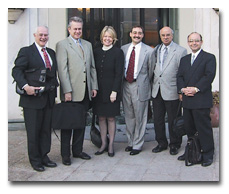
The NCSU delegation (left to right): Gary Mock, Ph.D., professor, textile engineering,
chemistry and science department; William Oxenham, Ph.D., associate dean for academic programs,
textileandapparel technologyandmanagement (TATM) department; Nancy Powell, associate professor,
TATM; Alex Mussa, assistant trade commissioner, ITC; Abdelfattah Seyam, Ph.D., professor, TATM; and
Behnam Pourdeyhimi, Ph.D., professor, TATM, and co-director, Nonwovens Cooperative Research
CenterThe US ConnectionPast successes, along with US economic growth over the past decade, have
made Italy the fourth-largest foreign supplier of industrial machinery and equipment to the United
States, with exports totaling $1.6 billion in a market worth $20.3 billion.In the textile sector,
Mauro Badanelli, an economist with ACIMIT, reports the value of Italian textile machinery produced
in 2002 amounted to 3.4 billion euros an increase of 5 percent over the previous year, 71 percent
(2.4 billion euros) of which was exported to 130 countries.Italian exports by sector illustrate the
range of equipment available:spinning machines 21 percent;weaving machines 25 percent;knitting and
hosiery machines 22 percent;finishing machines 24 percent; andlaundry, dry cleaning and other
machines 8 percent.Although Europe purchases 43 percent of this equipment, Asia is on the rise with
41 percent, followed by North America with 7 percent, South America with 5 percent and Africa with
4 percent.Technology TourITC and ACIMIT hosted
Textile World and a delegation from North Carolina State Universitys (NCSU) College of
Textiles, Raleigh, N.C., during a recent tour of machinery and manufacturing facilities in Italy,
offering a rare glimpse at the inner workings of the industry and what it has to offer. Alex Mussa,
ITCs Atlanta-based assistant trade commissioner, coordinated and facilitated the tour.In addition
to visiting manufacturers, the delegation met with ACIMIT President Alberto Sacchi; Badanelli; and
Pietro Goglia, Italian Institute for Foreign Trade. Additional presentations by Tecnotessile
S.r.l., Centro Tessile Cotoniero e Abbigliamento S.p.A. and Texilia Istituto per la Tradizione e la
Tecnologia Tessile provided a look at the regional support of technical laboratories and research
available to Italian textile manufacturers.
June 2003
The Quiet Innovator
2003 Innovation AwardBy Alfred DockeryThe Quiet
Innovator
Solid financial resources, strong brands and innovative marketing and manufacturing make
Springs a winner.Today, Springs Industries Inc., Fort Mill, S.C., stands as a home furnishings
textile company on solid financial ground and poised for growth in the decade ahead. Springs has
developed its own distinct innovative business style, and carried it across a number of disciplines
including finance, customer focus, domestic manufacturing, international sourcing and product
development.Several years ago, the company changed its focus to center its business around major
customers. This strategy has been highly successful. The companys approach to balancing domestic
manufacturing and international sourcing is another of its strategic initiatives. Finally, there is
Springs long history of product innovation most recently, its introduction in 2002 of
temperature-regulating bedding products.
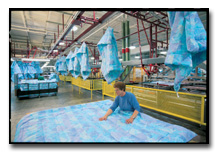
Springs’ Close Plant houses various automated systems for comforter production.Transitioning
From Public To Private OwnershipTwo years ago, looking to better implement major investments for
the long-term benefit of the company, Springs announced its intent to become a privately held
company. The transition was completed in September 2001, just days before the 9/11 terrorist
attacks and months before the Enron scandal events that later would likely have made financing the
deal impossible.It has been good not to have to deal with the constant short-term scrutiny of being
a public company, particularly in the current atmosphere, said Crandall Close Bowles, chairman and
CEO. Weve achieved a lot of our objectives and have been better off being private rather than
public in the last couple of years.Heartland Industrial Partners LP, a private equity firm based in
Bloomfield Hills, Mich., put up $225 million in the fall of 2001 to buy 45 percent of Springs
Industries. The founding Close family holds the remaining 55 percent of the company.Heartlands
stated strategy is to acquire and expand industrial companies in sectors ripe for consolidation and
growth. The company builds value by investing in well-positioned industrial companies, like
Springs, whose talent, technology, assets and market position afford them the opportunity to be a
platform for industry consolidation and value creation.Ultimately you have to grow, which means
taking market share and bringing better products to the market, Bowles said. We want to be a
viable, profitable and successful supplier of home furnishings products in the market years from
now.Springs insiders say the partnership with Heartland has been beneficial. The company has gained
much from Heartlands financial acumen and from additional infusions of capital for acquisitions.
Heartland has lent both discipline and expertise and challenged some of Springs cherished corporate
beliefs, some of which withstood objective examination from outsiders and some of which didnt.In
Acquisition ModeThe company is steadily filling in gaps in brands, products and manufacturing
capabilities. Springs recent acquisitions include:Charles D. Owen Manufacturing Co. Inc.,
Swannanoa, N.C., the worlds largest unit producer of consumer blankets;Burlington Industries window
treatments and bedding consumer products businesses, including a manufacturing facility in Mexico
and a license to use the Burlington House® and American Lifestyle® brand-names;Beaulieus rug
divisions in the United States and Canada, including manufacturing facilities that employ
approximately 650 people in Dalton, Ga., and Canada, and a license to use the Beaulieu and Peerless
brand-names on home furnishing products other than carpet;Ultima Enterprises, a Shanghai-based
sourcing business with a staff of 65; andMaybank Textiles, a yarn mill in Cartersville, Ga., with
130 employees.The first thing we look for is to add strength in our current areas, said Bowles. We
look for brands. We look for product line extensions and capabilities. If you look at the
acquisitions that we made last year, we got into the area-rug business. If you look at the pieces
of Burlington we purchased, it was more strength in top-of-bed, textured top-of-bed and soft
windows. We had a small soft windows business, and this was a significant addition to it. We got
the Burlington House brand. We acquired a small import company in the quilt product area based in
Shanghai. We always look at whats a match for our key customers.Balancing Sourcing And
ManufacturingStriking the right balance between domestic and offshore production is one of the
companys key challenges, given that almost all of its customers are actively sourcing overseas
themselves. Springs must find a way to add value doing fundamentally the same thing. Increasingly,
the company brings in commodity products from offshore in order to be competitive. At the same
time, Springs leverages its US manufacturing base to supply complex or time-critical styles and
products that dont lend themselves to sourcing because of transportation costs or other issues.Our
domestic facilities give us a big advantage in some areas, Bowles said. I dont see us ever not
having significant production here. How to best combine those is one of our strategic challenges.As
part of its sourcing strategy, Springs announced a long-term alliance with Coteminas, a Brazilian
manufacturer of bed and bath products, in 2001. Coteminas supplements Springs manufacturing
capabilities with world-class textile facilities and allows Springs to offer a broader array of
products on a competitive basis.The first thing that we consider is how to create value for the
retailer, said Tom OConnor, executive vice president and president, marketing group. We are
convinced that if we create value for the retailer, it will trickle down and create value for our
shareholders. When we look at offshore opportunities, we think about cost, supply chain and product
development. Making product in the United States is not an objective. Sourcing product offshore is
not an objective. The objective is to create value through supply chain, product development and
branding.

Dean Riggs, executive vice president, home furnishings operations

Crandall Close Bowles, chairman and CEO

Tom O’Connor, executive vice president, and president, marketing groupRetail Issues: Customer
FocusSeveral issues dominate Springs approach to retail strategy, including retailer consolidation,
SKU proliferation and ever-shorter product life cycles. The company has augmented its design and
distribution capabilities to stay ahead.Retailers have really lost the power of pricing in the
marketplace, said OConnor. They have to look to differentiation as a very important element of
their proposition. Everybody has to have his/her own thing. Then you take that one step further.
The consumer is far less patient, so product life cycles are much shorter.While no one is surprised
to learn that the companys largest customer is Wal-Mart which accounts for a huge chunk of Springs
sales and also constitutes much of the companys international business some are taken aback to
discover that Springs second-largest customer is Home Depot. This is, to a large part, due to
Springs hard windows (hardware, blinds and shades) business, and the addition of Beaulieus area rug
business last year.Springs key retail customers also include other large mass merchants and
departmental specialty stores such as Kmart, Target, Linens n Things, Federated, JCPenney, Kohls,
Sears, Lowes and Bed BathandBeyond. First and foremost, we focus on our key customers, said
OConnor. Our key customers strategy is about where consumers are shopping. To the extent that
consumers are shopping in those venues, we will be there. Brands are important resources. We want
our brands available where consumers shop. The greatest value to a brand is getting a positive
customer experience.We havent figured out how to be a scale player and a niche player
simultaneously, he continued. We just arent going to make a Mercedes in a Chevy plant. At the same
time, we will not stay away from upper-end products where they are sold in scale.Innovative
Manufacturing
Textile World editors toured several Springs plants south of Fort Mill in Lancaster, S.C.
The tour included a weaving plant where state-of-the-art, air-jet weaving machines were making
sheeting at a blistering 650 picks per minute. The plant manager has seen an increase in style
changes and expects the pace to pick up further to meet retailer demand.Also on the tour was an
automated cut, sew and assembly plant for bed-in-a-bag products. Of course, no tour of the plants
would be complete without visiting Grace Complex, which Springs executives refer to as the heart of
our bedding business
(See Amazing Grace, TW, this issue).Everywhere
TW went, plant personnel spoke about how they had shortened their production cycle time
more than they would have believed possible just a few years ago. All were actively working on
projects to narrow production times further.Springs has spent quite a bit of money over the past
five years in the bed-in-a-bag area automating production, said Dean Riggs, executive vice
president, home furnishings operations. No one else is even close to being at that level of
technology.This high level of automation cuts out labor costs in a product that would be inherently
difficult to source offshore due to its bulk and size.The company constantly looks for new
technologies to leverage, whether they are off-the-shelf solutions or emerging technologies that it
can develop working with its supplier partners.For years weve been very innovative in air-jet
spinning, said Bowles. Weve led the way with Murata to develop Murata Jet Spinning and now Murata
Vortex Spinning. Weve been partners with Murata for a long time.Riggs pointed out that Springs
leadership in vortex spinning is paying off by improving the companys ability to respond to
customer requests. He also mentioned the companys transfer of jet-sew technology, developed for
sewing washcloths, to improve bath rug production.Decision-making [for capital spending] has become
significantly more complex in the last few years, said Riggs. There are so many other alternatives
that have to be weighed out as part of the justification process. The opportunities for new
technologies or improved technologies which in the past would have been justified only against a
return in a particular plant or location now have to be looked at against whether there is an
opportunity to buy that product at a lower cost.In the past few years, more and more of Springs
capital spending has gone into areas such as distribution, information technology (IT) and design.
A good example can be found just across the street from the companys headquarters the building that
used to house a pilot plant for research and development was remodeled in 1999 to accommodate IT,
design and merchandising teams.One Springs: An ERP InitiativeDuring a tour of this building,
TW saw scores of IT associates in conference room after conference room working feverishly
to get Springs enterprise resource planning (ERP) initiative, One Springs, up and running.The
company launched this initiative less than two years ago, and it has achieved several milestones to
date, such as redesigning internal systems and processes to operate under new environments; and
going live with a new system in several areas of the business, including the first manufacturing
site earlier this year. It is scheduled to go live at two more sites in June and will continue to
roll out at other sites during the year.One Springs is broader than just IT. It is
all-encompassing, involving new software systems and a reengineering of the companys internal work
processes. The ultimate objective is to make Springs operate more efficiently with fewer resources,
deliver higher service levels to customers, run with less inventory, and thus improve the companys
competitive position.
Editor’s Note: Alfred Dockery is editor of The HunTex Report, a newsletter for industrial
textiles. A graduate of North Carolina State University’s College of Textiles, he has been writing
about the textile industry for 15 years. Dockery is based in Clemmons, N.C.
June 2003
Service Thread Wins Microsoft Pinnacle Award
Service Thread Wins Microsoft Pinnacle AwardService Thread Manufacturing Co., Charlotte, has
received the Microsoft Business Solutions Pinnacle Award for Excellence in Customer Service. The
award was presented recently in Orlando, Fla., at Convergence, Microsoft Business Solutions largest
annual customer event. Winners are chosen from more than 250,000 Microsoft Business Solutions
customers worldwide.We have significantly improved our business processes with the use of
technology and have experienced a considerable increase in sales, improved lead times for customer
ordering, improved cash flow and improved accuracy in inventory transactions. My estimate of our
return on investment is less than one year all of this in an industry that has really struggled,
said Jay Todd, CFO, Service Thread.
June 2003
Avery Dennison Opens El Salvador Facility
A ribbon-cutting ceremony marked the recent opening of Greensboro, N.C.-based Avery Dennison Retail
Information Services $3 million label-manufacturing operation in El Salvador.The new facility,
which supports Central American apparel manufacturers and their customers, produces and delivers
products such as bar-coded tags and labels, woven labels, printed fabric labels and price tickets.
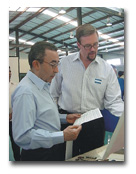
Carlos Quintanilla Schmidt, vice president of El Salvador and president of PROESA (left), and
James J. Rollo at the ribbon cutting ceremony for Avery Dennisons El Salvador facilityThe new
facility will enable us to respond more rapidly to customer needs and to reduce expenses associated
with shipping tags and labels to the United States. This in turn will allow Central American sewing
operations to more easily meet the delivery requirements of their retail and brand-owner customers
in the United States and elsewhere, said James J. Rollo, general manager, Latin America.
June 2003
Quality Fabric Of The Month: Performance Guaranteed
Interface Fabrics Group (IFG), an Atlanta-based Interface Inc. company, recently introduced its Infinity® brand 100-percent solution-dyed, high-performance contract seating fabric collection for use in such heavy-traffic arenas as stadiums; places of worship; theaters; and educational, healthcare and hospitality facilities. Initial fabrics are made from nylon or olefin, and by year’s end, Infinity will also include fabrics made from recycled polyester. IFG backs the performance of the fabrics with a 10-year warranty against wear-through and fading from light
exposure.
The excellent colorfastness of solution-dyed fibers has been proven in laboratory tests, but according to John J. Rowan Jr., vice president, sales and marketing, Performance Textiles, test results are not as relevant to consumers as real-life performance. “It shouldn’t fall on the
end-user to analyze these test data, but everybody understands a warranty. We should take responsibility for the testing data and provide assurance to the consumer of the product’s performance,” Rowan said.

Infinity® fabrics are available in nylon or olefin.
Fabrics made from recylced polyester will be
added to the line by year’s end.
The scope of IFG’s warranty, which includes material and labor replacement costs, is the strongest in the industry, he added. “The idea of having a fabric guarantee is relatively new, and we were the first to provide one. No one else offers a 10-year warranty that is as comprehensive as ours,” Rowan said. The warranty also enables seating manufacturers using Infinity fabrics to provide a complete warranty for their end-products.
As with all Interface products, Infinity fabrics are manufactured using environmentally sustainable and efficient manufacturing processes. The polyester fabrics due out later this year will be completely recyclable, and IFG is working to develop a new backing for use with the nylon
and olefin fabrics that will allow those fabrics to be recycled as well. In addition, the fabrics’ durability means replacement cycles are longer, which in turn reduces the use of raw materials, according to IFG.
The Infinity brand comprises fabrics in a range of price points and designs. Distribution channels include jobbers, furniture manufacturers and refurbishers in the contract market. The line is focused on open-line fabric designs, but Rowan said IFG is open to producing proprietary fabrics for specific customers. The fabrics are marketed through IFG’s new Performance Textiles unit, which derives its offerings from IFG’s various fabric divisions. “Once the full range of our new Infinity
products is launched later in the year, IFG will have the broadest family of performance textiles in the marketplace,” Rowan said.
June 2003
InterServices Medik Offers ProDrive For Embroidery
Austria-based InterServices Medik reports its ProDrive digital solution for embroidery machines
helps improve product quality and increases productivity. ProDrive, which also is a modular system,
can convert automat embroidery machines by replacing the automat with computer-controlled servo
motors.ProDrive is available with a four-axis control system for the main drive, two frames and the
borer. It is well-priced, easily installed and user-friendly; and simplifies repair and
maintenance, according to the company. The system operates using a PC with simple electronic and
mechanical utilities.
June 2003



