Contech Presents 24-7 In-Line Sheeter-Stacker

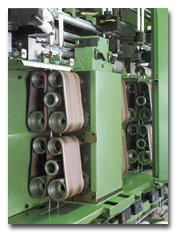
Contech, Goddard, Kan., has developed an in-line sheeter/stacker for non-stop operation. The
automation-engineered system uses a score slitter to edge-trim pressure- and light-sensitive
material, conveys the material to a visual inspection station, and then moves it to the cutter. The
material is cut using a flying knife cutter that locks on at web speed and cuts exact lengths as
the web moves along. The material is then removed to a cart using a vacuum pick-and-place system
that attaches to the sheet. The cart, which contains multiple trays to hold groups of stacks up to
2.5 inches in height, moves the stacks to a packaging operation. Contech can design, engineer and
build the system to meet customer specifications.

June 2003

Yarn Market Double-Dip

Yarn Market 

Double-DipBy James L. Lemons, Ph.D., Technical Editor The Department of Commerce (DOC)
recently reported that gross domestic product for the first quarter of 2003 increased to 1.6
percent from 1.4 percent for the last quarter of 2002. The results have some analysts predicting
the economy may not slide back into recession. This is quite a contrast from earlier predictions
that the recovery had stalled and the country was headed for a double-dip recession.With mortgage
rates at their lowest levels since the 1960s, housing sales continue to surge. According to the
DOC, consumer spending rose by 0.4 percent, as Americans streamed to the shopping malls. The
Consumer Confidence Index rose to 81.0 in April from 61.4 in March the biggest single-month
increase in more than a decade.The DOC also reported that orders to manufacturers for durable goods
rose by 2 percent in March. However, corporate earnings have been mixed for the first three months
of the year. Although sales and profits arent robust, business is much stronger than anticipated
and seems to be on a path of growth.Where Is The Marker SystemGrant Aldonas, DOC under secretary
for international trade, recently announced the current status of the textile marker system that
has been under study by Oak Ridge National Laboratory. Ultraviolet fluorescent marks, nano- or
microscopic bar codes and DNA-based markers have emerged as the top choices. These three
technologies used individually or in combination could combat attempts to gain duty-free
orquota-free status for imports. The markers would be used by yarn manufacturers to enable the
Bureau of Customs and Border Protection to readily identify the country of origin (See
Textile World News,
TW, this issue).Although quotas end in 2005, tariffs hopefully will still be in place.
Customs would use one of these technologies to specifically identify the yarn manufacturer and
point of origin, thereby collecting tariffs that might otherwise be evaded. The goal is to find the
technology that will be the least expensive for domestic manufacturers and cannot be readily
duplicated by foreign competition.One spinner said, Its great that they are still looking at this,
but when will it finally happen Another executive observed, They still dont have the funding to
complete the research. How many jobs will we lose while they get their act togetherThe 2004 federal
budget begins in October. It is estimated that it will take $1.2 million to complete this project.
If this isnt a good return on the taxpayers dollar, what is Deals Announced With VietnamThe
Bush administration recently announced a bilateral trade agreement to limit Vietnams shipments of
textiles and apparel to the United States. The accord will place quotas on 38 categories of
textile-related imports, and includes provisions that allow US Customs to inspect factories to
verify production and ensure that Vietnam is adhering to international labor standards. This
provision is especially important since accusations have arisen claiming that vast amounts of
Vietnamese-labeled goods are actually transshipments from China. In fact, the American Textile
Manufacturers Institute had pleaded to forestall the agreement until further investigations of the
transshipments could be completed. The American Yarn Spinners Association and others argued
unsuccessfully that the new quotas should be established using 2001 imports as the base, as opposed
to current levels of imports. US trade officials contend the quotas simply bring Vietnam in line
with other developing nations.Now that the deal is cut, American consumers will have access to a
flood of cheap imports. Hopefully, they will realize one thing: More than 58,000 Americans died in
Vietnam and have their names inscribed on the Vietnam War Memorial in Washington. The US Park
Service maintains a separate memorial where names are inscribed for those who did not die in
combat, but died later as a result of the conflict with Vietnam. Hopefully, The American Textile
Industry will not be added to this memorial. 

Download Current Yarn
Prices

June 2003

Key Textile Provision Dropped From Tax Bill

Key Textile Provision Dropped From Tax BillThe final version of the Bush administrations
$350-billion tax cut bill failed to include an extension of the five-year net operating loss carry
back (NOL), which has been so important to textile manufacturers during this period of economic
distress. The current NOL law, enacted last year, permits companies to “carry back” for five years
their net operating losses from 2001 and 2002. This would allow them to get refunds of taxes paid
in earlier, more profitable years. The American Textile Manufacturers Institute (AMTI) had urged
Congress to extend the NOL for another two years to cover losses in 2003 through 2005. While the
extension was included in the House version of the bill, it was not included in the Senate version,
and the provision was dropped in a House-Senate conference. Neither body approved proposals to
permit more liberal tax deductions for research and development investments.The final version of
the bill, signed by President Bush on May 28, does have some provisions that will benefit business
in general. It provides an additional first-year depreciation deduction equal to 50 percent of the
adjusted base of “qualfied property.” Qualified property was defined in the Job Creation and
Workers Assistance act of 2002. The reduced tax rates for capital gains and dividends are expected
to benefit some companies, although the major effect will be on individual taxes.By James A.
Morrissey, Washington Correspondent
June 2003

Material World SPESA Expo To Co-Locate In 2004

SPESA Expo 2004 owned and produced by Raleigh, N.C.-based Sewn Products EquipmentandSuppliers of
the Americas (SPESA) and Material World owned and produced by Atlanta-based Urban Expositions LLC
will be held together May 18-20, 2004, at the Miami Beach Convention Center in Miami Beach, Fla.
The Information Technology Exposition and Conference, owned and produced by both companies, also
will take place.The event will be hosted by SPESA and the American ApparelandFootwear Association
(AAFA), sponsor of Material World.One registration system will serve both shows, and one badge will
provide entrance to the two events.

June 2003

Machines Italia Spinning

Italian Textile Technology

By William Oxenham, Ph.D.

Machines Italia: Spinning

Marzoli S.p.A. has several US ring-spinning installations, but the company indicates it has shifted its focus to Iran, Syria, Turkey and China. Additionally, Marzoli now operates a joint venture to manufacture ring-spinning frames in China, resulting in huge reductions in manufacturing costs. Spindle prices of $230 in Italy versus $42 in China are given as broad cost comparisons for non-automated machines.

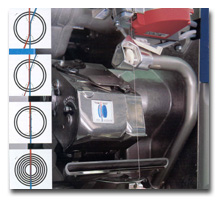
While Marzoli manufactures a full range of cotton-spinning machinery, the companys major news is its entry into the compact-spinning arena. Marzolis Olfil system can be retrofitted to its existing machines, and consists of an extra zone after the normal front rollers of the drafting system. Upon leaving the drafting system, the strand is supported on a perforated apron before passing through an extra front roller, which is belt-driven by the drafting roller. In this additional condensing zone, suction through the perforated belt creates tension in the fibers and results in a tighter yarn structure. Benefits include a 15- to 20-percent reduction in hairiness and a 10-percent increase in tenacity. Marzoli is promoting the Olfil system for processing cotton and, particularly, finer counts (24-80 Ne) for combed fibers. The company indicates there are problems with coarser yarns and short fibers, and higher trash levels have a big impact on productivity. The system, marketed as an approach to improving yarn quality rather than high productivity, is sensitive to temperature and humidity. Sticky cotton is particularly problematic.
Savio’s Twinsplicer is just one of the many splicing units that can be supplied with Savio winders.

Modern Spinning Plant

A visit to Giemme Filati S.p.A., coordinated by Savio Macchine Tessili S.p.A., offered a look at some of Savios latest developments, as well as a discussion with Giemme Filatis president, Giovanni Muratori. Giemme Filati is a modern spinning plant with 10,000 spindles for cotton yarns, plus three machines for core-spun elastomeric yarns. All machines are equipped with Savio ORION I link winding. The company also has facilities for twisting, singeing, mercerizing and dyeing (6,800 pounds per day for socks and high-quality underwear). Giemme Filati also owns a spinning mill in Paraguay. A major concern for the company is the competition from imported yarns. To offset the variations in pricing between in-house yarn and yarn imported from India, Giemme Filati not only spins 16,000 pounds per day, but also finishes 20,000 pounds of yarn sourced from India, Russia and Egypt (40s to 80s Ne).

Savio has had recent success in the United States with sales of winding machines and installations of rotor-spinning and Espero Volufil bulking units for acrylic yarns. The Italian textile industry has seen a major downturn, and 90 percent of Savio machinery is exported, with the largest market presently being China and Turkey.

Three developments were highlighted. Various types of splicing units can be incorporated into the winder. Of particular interest is the Twinsplicer, a mechanical system that can splice not only denim yarns, but also compact and core-spun elastomeric yarns. The splicing of elastomeric yarns was demonstrated in the spinning rooms at Filati.A system has been developed to identify the spindle that produces the yarn being wound on the link-winding machine. Because there is a package transfer system in the passage of the spinning tube to the winder, it is necessary to communicate the new location to the tracking system. It is believed the use of such systems should greatly improve the identification of spinning positions that are producing defective yarns and thus may need maintenance.

Savio is set to launch a rotor-spinning machine that uses a spin box from Spindelfabrik Suessen, Germany, instead of its traditional self-pumping rotor. This should enable significantly higher production speeds. Suessen has been very active in improving its components to enable the production of higher-quality yarns.

Long-Staple Processing

Sant’Andrea Novara S.p.A. is, along with Cognetex S.p.A. and Seydel, part of the Finlane Group. Sant’Andrea has been a significant player in the manufacture of machines for long-staple processing, and in particular for the processing of fine wools. Its major markets currently are China, Turkey, Italy, Mexico and Iran.

The group claims to be the largest manufacturer of long-staple processing machinery. While Sant’Andrea does not manufacture spinning frames, Cognetex offers a range of machines. Thus, the group can provide turnkey operations. The major developments presented by Sant’Andrea follow. The new P100 comb operates under a new combing law. Main features include continuous feed, simplified design and increased operating speed. The comb has been designed with minimum motion of the various components. Not only does this afford potentially higher speeds, but it also has resulted in significant improvements in setting times for the various units within the comb, coupled with easier and quicker component change.

The HC 22 ARE pin drafter (Chain Gill) twin-head drawing frame is equipped with double electronic autoleveling. As well as having the more usual open-loop system to measure and correct the feed, this machine also is equipped with the Tex-Detector closed-loop system, which measures and corrects the outgoing sliver. Additional features of note are the 30-millimeter (mm) front ratch of the drafting system and the reduced distance of 4 mm between successive rows on intersecting pins in the drafting zone. Both of these modifications should lead to improvements in sliver quality.

A second rubbing zone on Sant’Andrea Novara’s RF4 Vertical Rubbing Finisher reinforces “dead centers.”

Sant’Andrea claims 80 percent of the world market share for vertical rubbing frames. The RF4 Vertical Rubbing Finisher is its latest version. The use of a double rubbing field doubles the amount of rubbing at a particular running speed, and thus the rubbing section can potentially run at a lower oscillation rate to maintain an acceptable compaction of the roving. In addition, the second rubbing zone can reinforce the dead centers that occur at the reversal of the rubbing aprons when only one apron set is used.

Compact Spinning Centers

Cognetex currently has about 45 percent of the world market for long-staple ring frames, with Turkey accounting for about 50 percent of its sales. Its major focus recently has been the development of a compact spinning system for worsted spinning. The Com4® Wool system is the result of significant development based on Rieters Com4 system for cotton fibers. Major changes have been made to accommodate much longer fibers. This is
achieved by utilizing angled balloon rollers as the front rollers in the compacting zone. The usual benefits for compact yarn are gained with this system improved hairiness, regularity, strength, elongation and abrasion resistance. However, the claimed advantages are associated with the impact of these benefits in subsequent processing. One particular claim is that it may be possible to replace folded wrap yarns with a single Com4 Wool yarn. The system is incorporated into a machine using suppressed spinning balloons claimed to work well in conjunction with the compact drafting unit. An additional cover, termed the air conveyor, is used for certain fiber types. It is recommended for use when processing cashmere, but is said to be unnecessary for wool.

Spinning Plant Automation

U.T.I.T. Wagner Automazioni S.p.A. operates as a design and assembly company. It sources parts and components and then applies minor modifications to ensure a unified system. The company presently works either directly with the customer or through a machinery maker. The company offers many forms of material handling for different areas of the textile industry and is particularly well-known in staple spinning. Systems offered include:bale handling; transport systems for sliver cans, comber laps and rovings; complete material handling systems, from spinning/winding through palletization; filament-package handling; and textile roll handling and palletization.

U.T.I.T. has several installations operating in the United States, particularly can and roving transport, and yarn-package handling systems. The latter systems can accommodate output from up to 23 machines. The setup includes automatic package assessment for diameter, weight, conicity and yarn tail. It is possible to handle different yarns from the different spinning machines feeding the system. Research is underway to track the spinning position that is producing any defect detected by the package inspection system.

Gualchierani Textile Automation S.p.A. has two main areas of focus bale presses (including presses for making bump tops) and automation. The company proudly explains the project planning, research, construction and installation are all conducted in-house. Its major sales are to the Czech Republic, Turkey, China, India and South America.Gualchierani currently has interests in the following areas of material handling:robotic plants for partially oriented yarn, fully drawn yarn, bulk continuous filament, and other yarns from spinning through inspection to palletizing and storage, including package inspection and labeling; staple processing automation from spinning and winding through boxing and palletizing; handling of packages in the dyehouse; and warehouse automation and associated logistics.

June 2003

Synalloy Rite Cancel Deal To Combine Dye Businesses

Synalloy Corp., Spartanburg, reports the previously announced deal with Rite Industries Inc., High
Point, N.C., whereby Synalloys Blackman Uhler dye business and Rites dye business were to be
combined, is now highly unlikely. The original agreement stated the new company, Blackman Uhler
LLC, would be structured to offer a more diverse product line with stronger selling and technical
support capabilities. The two parties continue to investigate future potential transactions, but no
decisions or agreements have been reached at this time.

June 2003

Joan Velvets Adopts AF And Y39 S Marquesa Plush

Joan Velvets AdoptsAF and Y’s Marquesa PlushJoan Velvets, Hickory, N.C., has adopted Marquesa Plush
olefin yarn from Chapel Hill, N.C.-based American FibersandYarns (AF and Y) for use in a new line
of velvet fabrics for transportation and commercial furniture applications. The new fabrics were
shown on furniture manufactured by a number of Joan Velvets customers at the 2003 International
Furnishings Market in High Point, N.C.The Marquesa Plush yarn matched Joan Velvets requested
specifications for unrivaled softness, aesthetics, color and design for this new yarn made for the
residential furnishings market segment, said Michael Apperson, CEO, AF and Y. Weve always known
about the excellent performance and durability properties of olefins. Now to find it with
acrylic-like aesthetics is such an added bonus, said Robb Tomlin, vice president, merchandising,
Joan Velvets. In addition, he said, Marquesa Plush is very easy to clean and resists staining.
June 2003

Drying Technology Unveils Moisture-Sensing Method

Drying Technology Inc., Silsbee, Texas, has developed a new method of in-line moisture sensing for
products exiting industrial preheaters, ovens and dryers. The method uses two temperature sensors
and the companys patented DELTA T software. The product can be supplied as a moisture sensor or in
a control package.

June 2003

BASF Opens World39 S Largest PDH Plant

BASF Sonatrach PropanChem S.A. (BSP), a joint venture between Spain-based BASF Espa S.A. and
Algeria-based Sonatrach Petroleum Investment Corp., has begun trial operation of a propane
dehydrogenation (PDH) plant said to be the worlds largest at BASFs site in Tarragona, Spain.BSP
invested 240 million euros in the plants construction the largest single investment in the
Tarragona sites history and expects to create 70 jobs at the plant.The company chose the propane
dehydrogenation process as an economical option, because only propylene is needed at the site.This
is the first plant in Europe to operate using this innovative technology, said Jurgen Hartig,
Ph.D., chairman of the board at BSP.In the coming years, this process will become increasingly
important alongside the conventional steam cracker process for propylene.

June 2003

Close To The Customer

2003 Innovation AwardBy Janet Bealer Rodie,Assistant EditorClose To The
Customer
Springs delivers value through strong customer relationships, offering a broad range of
products and brands.
While Springs Industries Inc., Fort Mill, S.C., has a long history of
product innovation, the companys marketing and brand strategies also have helped propel it to its
current position as a leader in the soft goods home furnishings market, which comprises bedding,
bath, floor and window products. Leveraging acquisition and licensing opportunities to build up its
traditional product offerings and to bring new products into its line-up, the company has
positioned itself at the center of this important textile sector. Springs offers products in every
category of this market, as well as complementary non-textile home fashion products. No other
company in this sector offers such a broad spectrum of goods. The soft goods home furnishings
market has seen steady growth over the past several years, with anticipation of continued growth
into the future. In 2002, US consumption within this market totaled more than $15.8 billion across
all categories. The markets 3.67-percent annual growth rate from 1997 to 2002 is expected to slow
slightly over the next five years to 3.3 percent, still a respectable rate, especially considering
the roller-coaster economy and other uncertainties experienced in recent years.

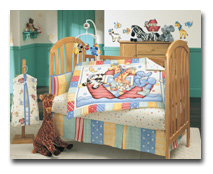
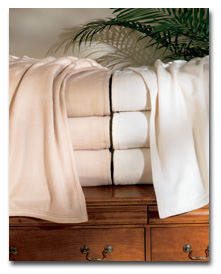
Springs offers bedding products and ensembles for all ages. Examples include Egyptian cotton
sheets (right) and the Lullaby Ark baby bedding ensemble (above).

In part, Springs success lies in building strong relationships with its retail customers to
help them compete with differentiated products.Retailers drive our business, said Crandall Close
Bowles, chairman and CEO. They get involved today in everything from yarn type to yarn count, to
construction and finishing; and in product development and product design. Color and print are just
the tip of the iceberg. In recent years, Springs customer base, which includes department,
specialty and home improvement stores, has become increasingly dominated by such mass merchandisers
as Wal-Mart, Target and Kmart. Springs develops and produces special collections for all of these
retailers.There is increased demand for product differentiation, Bowles said. Each retailer wants
to be the first and only one to have it.Product Bundling

Springs’ institutional products include Tranquility fleece blankets.Another way the company
delivers value to its customers and to the buying public is through product bundling, which
provides the consumer a convenient shopping alternative. One example of product bundling is the
bed-in-a-bag total bedding package that includes coordinated sheets and top-of-bed articles. In
addition, Springs markets collections of separate products under a single theme, such as Harry
Potter®, which includes childrens sheet sets, towel sets, shower curtains and other products.From
the markets perspective, the most important innovative steps have been in how we bundle entire
groups of products, so were no longer in the towel business, but in the bath shop business, where
were putting things together towels, rugs, shower curtains and accessories, said Tom OConnor,
executive vice president and president, marketing group. Or, with the bedding business, were not
just in sheets, but also in top-of-bed. Ten years ago, we would have been in product businesses,
but not today. To us, thats a way to solve problems for the customer, and its helped us capture
market share.BrandingThe Springs product lines include such well-known brand-names as Wamsutta® and
Springmaid® bed linens and top-of-bed ensembles, blankets, and bath towels and rugs; Regal® accent
rugs; Graber®, Bali® and Nanik® window shades, blinds and accessories; and Dundee® bed and bath
products for the hospitality and institutional markets. The company also markets its products under
licensed brands such as the previously mentioned Harry Potter; as well as Burlington House®,
Waverly, Liz/Villager, Serta, Disney, Coca-Cola, NASCAR and many others.The company recently signed
an agreement with the Egyptian Ministry of Economy and Foreign Trade and the Alexandria Cotton
Exports Association in Egypt to use the Egyptian cotton trademarked logo to promote Springs use of
100-percent Egyptian cotton in its products.

Graber wood blinds are among Springs’ window offerings.

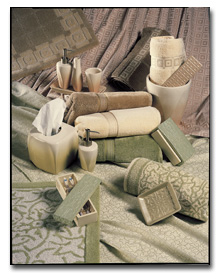
Regal bath coordinates include towels, rugs and accessories.Offering It AllWhether shopping
for bedding, bath or window textiles; accent or area rugs; kitchen and table textiles and
accessories; blankets and throws; fabric-covered lampshades; or decorative pillows, chair pads and
other home fashions made by cut-and-sew companies or offered under licensed brands from a textile
perspective, it seems todays consumer can almost completely dress the home using Springs products.
Where textiles are concerned, one need look to other manufacturers and marketers primarily for
carpet and upholstery fabric. But because Springs also offers non-textile accessories within the
home fashion categories it serves, the consumer may choose the companys wood, aluminum or vinyl
blinds; drapery hardware; shower curtains, ceramic soap dishes and other bath accessories; and
numerous other items to complete the desired looks in various rooms.The consumer also may choose
Springs baby and nursery products, including clothing, layette items, bedding and bath textiles,
blankets and more. And, the home sewer may choose from a variety of Springs fabrics and craft kits
to create unique home fashions and apparel for the family.
June 2003

Sponsors