Encouraging Signs


D
espite recent sluggishness, there’s now some hope of a modest business pickup by fall,
which sooner or later should translate into better apparel and household furnishings sales. In any
event, economists, citing new stimuli, now predict better second-half growth. One survey of 54 top
analysts sees the gross domestic product growing at a 3.5-percent annual rate over this period — a
lot faster than the 1- to 2-percent pace of the first half. And for the first six months of 2004,
these same economists look for an even bigger 3.8-percent advance.

One factor behind this new optimism: US households will have an additional $47 billion in
cash to spend over the second half, thanks to the recent tax cuts. A somewhat more buoyant stock
market and improving business profits also should help. Ditto, consumer reluctance to spend on
big-ticket items like autos, leaving more money available for purchases of less expensive items
such as apparel.
p18_Copy_5


Impact Of Textiles

What does all this mean for hard-pressed textiles? While nobody is predicting a dramatic
turnaround, the hemorrhaging of the past few years should end — certainly with no repeat of the
past 24 months, during which US textile production tumbled 10 percent. Best bet: a flattening out —
with even some fractional gains, but that should be about it. Given the current competitive climate
— exacerbated by soaring Chinese imports — it would be unrealistic to expect any really substantial
bounceback. A lot could depend on how the United States plays the Chinese import card.

The American Textile Manufacturers Institute sees three import-slowing solutions: imposition
of China textile safeguards that would restrain that nation’s shipments when all quotas are removed
in 2005; World Trade Organization action on the ministerial level to retain quota controls; and
pressure on China to abandon currency manipulation, export tax rebates and state subsidy
programs.


Pricing Problems Will Persist

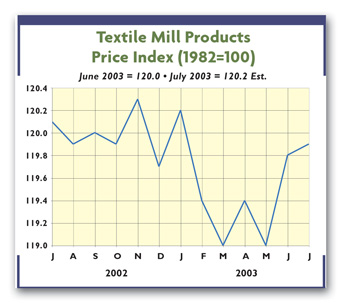
There’s no indication of any meaningful price relief anytime soon. Indeed, despite a weak
dollar, which eventually could make imports more expensive, foreign price competition remains as
strong as ever.

China again is the glaring example of this. Last year, a study of 29 Chinese apparel
categories showed tags slipping a hefty 46 percent. The trend has continued into early this year,
when these same quotes fell another 2 percent.

Today’s more-than-ample domestic supply is another price depressant. US mills are operating
at only around 70 percent capacity. That’s a rate that tends to reinforce already-strong price
competition, as mills push to keep their facilities operating at economically viable
levels. 


An Early Look At 2004 And 2005

New projections by the Global Insight economic consulting firm provide some hints about the
longer term — notably 2004 and 2005. In 2004, the firm sees industry revenues basically unchanged
from this year. But that’s still a lot better than the 9.6-percent, 3.6-percent, and estimated
6.2-percent declines for 2001, 2002 and 2003, respectively. For 2005, Global Insight analysts
anticipate some fractional gains, expecting revenues to inch up 0.6 percent. If these numbers
materialize, it would be the first meaningful gain in eight years. And with little overall change
in material and service input costs, these revenue gains are expected to drop down to the bottom
line.

Specifically, Global Insight sees gross operating profits up for both years. Ditto, the gross
profits/sales ratio, estimated at 19.4 percent and 20.1 percent for 2004 and 2005, respectively.
That’s significantly better than the 18.2-percent estimate for the current year. These profit gains
are pretty much across the board — shared by broadwoven fabrics, knitting mills, and carpets and
rugs. 


Statistical Note

As promised last month, the employment data shown in the table below have been revised and
expanded to reflect the replacement of the Standard Industrial classification system with the North
American Industry Classification System. The industry has been split into two sectors — Textile
Mills and Textile Product Mills — with the items covered by each shown in the table footnote.


August 2003
 

Air Filtration Trends

In a modern textile mill, filtration is very important, and with government regulations lowering
the dust level in the production area, it becomes even more so.In order to maintain a 133-microgram
per cubic meter (µg/m3) dust level in the production area, it is necessary to have a 20- to
50-µg/m3 dust level on the clean side of the filter. These dust levels are based on a particle size
of 15 microns 0.0006 inch or smaller. These are the particles that can get into peoples lungs and
cause the infamous brown lung disease. However, 15-micron particles are not the stuff one can see
flying around in a textile mill. The important and dangerous dust that needs to be taken out of the
air stream is four to six times smaller than a 50-micron human hair. It takes a good filter media
to accomplish this, especially considering the large amount of dust a textile mill produces every
day.

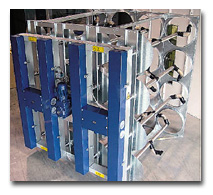
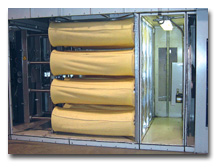
LTG Inc.’s Versadrum Filter VDF-16, shown with the filter media installed (above left) and
without the filter media installed (above right), is an example of a space-saving filtration
system.Choosing A Filter MediaWhat affects the quality of filtration The answer is: mainly, the
filter media. There are a lot of different filter media on the market these days. As a general
rule, the tighter the media, the more dust it will retain. So why isnt every textile mill using the
best filter media available The reason is a tighter media, which has smaller openings for air to go
through and has a higher pressure drop, precipitates higher operational energy costs.Reducing the
velocity through the filter media can compensate for the higher cost. In addition, a lower velocity
will help to improve filtration efficiency because fewer particles will be pulled through the
media. However, in order to lower the velocity, a larger filter is required for the same air
volume. The filter will be more expensive and will use floor space that could be used for
production.Another disadvantage of the tighter media is that it is more difficult to clean. Many
existing filters cannot be improved just by changing the media from an average media to a better,
tighter filter media. The stripper system of the filter cannot clean the new media. Therefore, it
is important to ask some key questions when buying a new filter. What will the dust level be on the
clean side of this filter Can the filter operate with any type of filter media, or does proprietary
media have to be usedA lot of mills have started using a nonwoven-type media that improves
filtration efficiency compared to the traditional media. A standard nonwoven media has an
efficiency of 99.99 percent for 6-micron particles. This efficiency can be further improved with
modifications to the standard media. But the media has a high pressure drop, and so the price to be
paid is higher energy costs. However, if the velocity through the media is kept at around 100 feet
per minute or lower, which is the velocity through most filters in opening and carding, the energy
used is not significantly higher. And compared to using two filters in series to clean, as is
customary in some textile mills, it is definitely a bargain.As already mentioned, reducing the
velocity through the media will require an increase in the filter size. A larger filter requires
more floor space, which is therefore lost for production. Most manufacturers of filter equipment
for the textile industry now offer a compact alternative to the large drum filters. These smaller
filters use half, or even less, floor space than the conventional drum filter.In production areas
that generate a lot of larger waste particles, a prefilter or preseparator is required. For a long
time, most textile mills and contractors used a condenser. Nowadays, the prefilter disc a rotary
disc with a plastic mesh and a suction nozzle has replaced most condensers, saving textile mills
valuable floor space and energy.Another trend affecting filtration is the reduction in air volume
and the increase in waste quantity. This is mainly true in opening and carding operations, and it
is a direct result of technology improvements by the machine manufacturer. In these areas, the
suction air volume per machine has increased only slightly over the years, but the machines
production capacity has increased dramatically. This means a filtration system can handle much more
material coming with the same amount of air. A textile mill in the process of buying a new
filtration system must make sure the filter can handle the increased waste.Different
RequirementsBecause different areas of a textile mill have different filtration requirements,
different types of filter media can be used in these different areas to achieve the same result. In
opening and carding, the best media usually operates with a velocity of 80 to 120 feet per minute.
In spinning and winding, the filter is usually smaller and uses less energy, because the media has
a lower pressure drop.Manufacturers of filter media for the textile industry have been, and still
are, working hard to develop new solutions to help the industry stay competitive and be ready for
tomorrows challenges as well as possible new workplace health and safety laws and regulations. The
trend is definitely towards better filtration using less floor space, while trying to make it
easier for plant personnel to maintain the equipment in the harsh plant environment in which it is
operating.Editors Note: Gerhard Seyffer is president of LTG Inc., Spartanburg. Born and educated in
Germany, Seyffer has been employed with LTG for more than 15 years in various locations and
positions.

August 2003

Dan River To Close Two Plants

Dan River ToClose Two PlantsDanville, Va.-based Dan River Inc. will close a home fashions weaving
plant in Greenville and a comforter sewing plant in Fort Valley, Ga., in an effort to rationalize
capacity in its Home Fashions Division. The closures will eliminate approximately 630 jobs and are
expected to save approximately $9 million in annual expenses. The company cited lackluster sales
and excess inventory at the retail level as contributors to its own sales declines in the first
half of 2003. As product demand recovers to more normal levels, the company said it plans to
transfer production capacity from the closed plants to Dan River facilities in Danville and Morven,
N.C., as well as outsource more product.We expect the companys financial results in the second half
of 2003 to be somewhat of a mirror image of the first half, said Joseph L. Lanier Jr., chairman and
CEO. As the anticipated recovery in the economy occurs, we should experience a gradual improvement
in our results over the last six months of the year.
August 2003

Neumag Offers CAMTRAS 3002 Winder

Neumag Offers CAMtrAS 3002 WinderGermany-based Neumag GmbHandCo. KG has launched the CAMtrAS 3002
winder as the newest edition of its RK III winder. The new winder retains the dimensions of the RK
III and can be retrofitted onto a customers existing line, reducing maintenance costs.The CAMtrAS
3002 combines the attributes of the RK III, which fits below most texturizing units, with
state-of-the-art technology. New features include: use of Siemens standard electrical components;
improved durability of yarn displacement and turntable parts; a bobbin expelling device and thread
guiding elements; simplified electronics; a 12 Mbaud Profibus without hardware contacts and a
faster software controller; and a bobbin holder that combines the Barmag bobbin holder clamping
system with Neumags yarn catching system.
August 2003

Clariant Terminates US Project

Switzerland-based Clariant International Ltd.s Functional Chemicals Division has terminated plans
for the start-up of a large-scale United States-based plant for the manufacture of detergent raw
materials because it is unable to meet certain specifications and requirements on time and within
budget.The expenditure will be entirely written off in the second quarter 2003, with a write-off
charge amounting to CHF 120 million.

August 2003

Free Trade With Chile And Singapore Approved

Free Trade With Chile and Singapore ApprovedCongress has approved free trade pacts with Chile and
Singapore that, for the first time, extend preferential trade agreements to Asia and South American
nations. The agreements, which take effect January 1, 2004, will eliminate tariff and non-tariff
barriers to trade between the US and those nations. US Trade Representative Robert B. Zoellick said
the strong congressional support for the agreements is important recognition by the Congress of the
positive role that trade plays in growing Americas economy. He said the free trade agreements are
an important part of the administrations efforts to expand trade globally, regionally and
bilaterally.While Zoellick praised the agreements and emphasized the need for additional free trade
agreements, not everyone is all that excited about them. Organized labor, including the textile
union UNITE, have attacked the agreements saying they will result in US job losses, and they fail
to protect labor rights, including freedom of association, freedom to bargain collectively, freedom
from child labor and other provisions which unions feel are important.US textile manufacturers see
some opportunities for expanded trade, as both agreements include a yarn-forward rule of origin
that requires that products receiving preferential treatment to be made of yarn and fabric produced
in the participating countries. They were disappointed, however, that the agreements contain Tariff
Preference Levels (TPLs) that extend preferential treatment to specific levels of products made of
yarn and fabric manufactures in other countries. US importers of textiles and apparel were opposed
to the yarn-forward rule of origin, since they believe it will restrict trade, but they say the
TPLs will help somewhat. Under the Singapore agreement, 25 square meters of fabric and yarn made in
other countries can receive preferential treatment, but that level of trade will be phased out over
five years. The Chilean agreement permits TPLs of 1 million square meters of fabric and 2 million
square meters of cotton and man-made fiber apparel in the first year, and those levels, likewise,
will be phased out over five years.By James A. Morrissey, Washington Correspondent
August 2003

Blue Fox Bids For Sophis

Blue Fox Enterprises N.V., Belgium, recently made a bid for the assets of Sophis Systems N.V., also
of Belgium. Sophis, which declared bankruptcy earlier this summer, produces software for woven and
printed textile design. Blue Fox plans to continue Sophis activities, in cooperation with the Blue
Fox subsidiary NedGraphics.

August 2003

Kellwood To Acquire Kasper

Kellwood Co., St. Louis, has entered into an agreement to purchase Kasper A.S.L. Ltd., New York
City, for a total of $163.6 million. The purchase price would include $111 million in cash, $40
million in Kellwood common stock, the assumption of prepaid royalties up to $12.6 million at
closing, plus the assumption of other Kasper liabilities.Kasper comprises the Albert Nipon, Anne
Klein New York, AK Anne Klein, Kasper and Le Suit namebrands.

August 2003

SONA-TROL ST-6 Offers Non-Contact Control

Waddington Electronics Inc., Cranston, R.I., says its SONA-trOL® ST-6 Ultrasonic Loop Controller
measures true diameters during unwinding and rewinding, providing non-contact tension control and
ensuring smooth converting operations.The device features a sensor head that can be mounted from 18
inches to 20 feet above a roll of material. It measures distance changes as small as 0.01 inch. Up
to 100 loop measurements per second are performed, and an alarm sounds if seven consecutive
measurements per second do not conform to present limits.The SONA-trOL ST-6 is designed to be
controlled externally using a programmable logic controller (PLC) or computer. Other features
include adjustable distance zero offset, receiver sensitivity and gain.

August 2003

Melco Launches OS Flex

Denver-based Melco Embroidery Systems has released OS FLEX software for the Amaya multi-head
embroidery system. The company says the new software makes the Amaya system unique in its ability
to offer true asynchronous multi-head operation.OS FLEX provides electronic linkage among all heads
and enables simultaneous startup using a common key combination. On-screen visualization of the
status of every head is possible by clicking once on the keypad. In addition, each head can be
started independently. Thread breaks, bobbin changes and maintenance require stoppage only of the
affected head, and individual settings can be customized or changed at any time without affecting
operation of the other heads on-line.

August 2003

Sponsors