Nonwovens Equipment Installed At Texas Tech39 S ITC

The International Textile Center (ITC) at Texas Tech University, Lubbock, Texas, has installed two
new nonwovens machines: a Fehrer H1 Technology needlepunch loom with a Tatham feeding line; and a
Phoenix thermal-bonding line.The machinery is housed at the center in cooperation with the
Institute for Environmental and Human Health, also part of Texas Tech. The US Department of Defense
is using the machines to conduct research under the guidance of Seshadri S. Ramkumar, Ph.D., a
research scientist at the university.

July 2003

V2 Introduces Non-Run Stitch Technology

V2 Composite Reinforcements Inc., Auburn, Ala., recently introduced V-Lock, a patented non-run
stitch technology that reduces runs in non-crimp multiaxial fabrics. Colin Hallam, vice president,
product management, said the V-Lock process welds the ascending stitches together on the loop side
of the fabric only. The stitch medium remains polyester and thus eliminates contamination from
off-gassing during the lamination/cross-linking process.Hallam added that the technology also makes
it possible for fabrics to be bonded using a looser stitch. The company sees V-Lock applications in
the infrastructure, construction, aerospace, automotive and marine industries, among others.

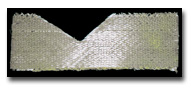
Competitors fabric without V-Lock technology

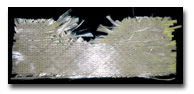
V2 fabric with V-Lock
July 2003

Level 3 Created To Serve Dyeing Finishing Industry

Keith Turner and Mel Radford recently founded Level 3 Inc., a sales, service and distribution
company in Matthews, N.C., for the North American dyeing and finishing industry.Harold Wilson and
Dave Crenshaw head Level 3s sales network, which includes agents and direct sales in strategic
areas.Galvanin S.r.l., Flainox S.r.l., EnviroSep Inc. and Gaston International LLC are current
Level 3 partners. Additional companies are expected to join Level 3 by the end of the year.

July 2003

Rep Myrick Seeks Funds For Textile Import Labeling

Rep. Myrick Seeks Funds For Textile Import Labeling In an effort to help combat illegal textile and
apparel imports, Rep. Sue Myrick (R-NC) has won tentative approval of $300,000 to develop a tagging
and identification system for imports. The funds, which would go to the Agricultural Research
Service facility in Clemson, S.C., were contained in this years Department of Agriculture
appropriations bill. The measure still has to clear the full House and the Senate before the funds
will be available.In announcing approval of the funding, Myrick said, “One of the biggest problems
facing our textile producers is the ongoing practice of illegal textile transshipments. To fight
this problem, the US Customs Service personnel who are responsible for inspecting the textiles that
enter our country need the necessary technology and capability to identify illegal textiles.. This
money will go a long way toward advancing the tagging technology to do this.”By James A. Morrissey,
Washington Correspondent
June 2003

Nano-Tex Enters Into Licensing Agreement

Nano-Tex LLC, Greensboro, N.C., has entered into a licensing agreement with Arvind Mills Ltd. and
Ashima Dyecot Pvt. Ltd. whereby the two India-based companies will manufacture knitted and woven
cotton goods enhanced with NANO-CARE® and NANO-PEL® fabric protection. We are pleased to expand our
licensed partners in India, a growing global center of apparel manufacturing, said Donn A. Tice,
CEO, Nano-Tex. The availability of NANO-TEX-enhanced fabrics in this region is critical to
supporting the global supply chain needs of Nano-Texs family of licensed apparel marketers.

July 2003

High-Tech Anti-Shox Socks Offer Comfort

Apex
Foot Health Industries, Teaneck, N.J., has introduced Anti-Shox® High Performance Socks,
constructed with high-tech acrylic fibers, and treated with an antibacterial material that helps to
eliminate odor and infection.A number of models are available, including: Outdoor Performance,
Walker/Runner and Cross Trainer Performance socks for outdoor activities; Everyday Performance
Socks for day-to-day wear; Gel Comfort Socks that protect against blisters and other skin ailments;
and Therapeutic/Comfort Socks, including Seamfree Diabetic Socks for diabetics.

July 2003

Picanol Reports Sharp Sales Increase

Picanol Reports Sharp Sales IncreaseThe Belgium-based Picanol Group reported a 35-percent increase
in first-quarter 2003 sales over year-earlier turnover. Sales totaled 167.4 million euros,
including turnover of 2 million euros by the companys recently acquired subsidiaries, The
Netherlands-based Te Strake Textile BV and Lhenry, France.The operating profit for the quarter
increased nearly 40 percent to 11.25 million euros, while consolidated net profit of 7.6 million
euros represented an 83-percent increase over the first-quarter 2002 net profit of 4.15 million
euros.The company announced a 1-to-40 stock split and the simultaneous movement of shares from the
fixed market to the continuous market, where share quotes were immediately included in the Next
Prime segment and the Next Prime index.Picanol stated it expects little impact from the Severe
Acute Respiratory Syndrome (SARS) epidemic in Asia on its global sales, but it expects the Chinese
market to make a soft landing in the second half of 2003. Recognizing the SARS impact, coupled with
the euros current strength against the dollar and the yen, the company expects 2003 will end with
sales results equal in strength to those for 2002.
July 2003

US Textile Industry Hosts Singapore Fashion And Apparel Delegation

US Textile Industry Hosts Singapore Fashion And Apparel DelegationA group of Singapore fashion and
apparel company executives and managers recently visited the United States to shop for yarn and
other textile raw materials to use in their products. The mission was the first in a series planned
following the signing earlier this year of the US-Singapore Free Trade Agreement (USSFTA).Led by
International Enterprise Singapore and the Textile and Fashion Federation of Singapore (TaFf), the
delegation visited locations in New York and the Carolinas. Stateside hosts included the American
Textile Manufacturers Institute, American Yarn Spinners Association (AYSA), Cotton Incorporated,
DuPont, Murata Machinery USA Inc., National Textile Association, South Carolina World Trade Center,
Textile Distributors Association, the US Commercial Service and US manufacturers of cotton and
man-made yarn and fabric. North Carolina Congressman Cass Ballenger also hosted the
delegation.Under USSFTA, duty-free treatment is given to textiles and apparel made with yarns or
fabrics originating in the United States and/or Singapore. The pact gives opportunities to US
producers of fiber, yarn and fabric to export their products to Singapore and use that country as a
distribution base for the Asian continent.According to Chan Heng Chee, the Republic of Singapores
ambassador to the United States, US-Singapore two-way trade in 2002 totaled $1.1 billion, and
current US textile exports to Singapore total $54 million. The upside potential [for cooperative
trade] is immense, he said. Following the mission, Mike Hubbard, executive vice president, AYSA,
Gastonia, N.C., commented, The fact that [the Singapore delegation] had the interest to come here
is very positive. There seemed to be a genuine willingness on the part of both sides to work
together.Patrick Lee, honorary president, TaFf, also was optimistic, particularly with regard to
yarn trade, although he expressed some concerns about price. Price is a challenge, he said, but
some spinners are willing to work with us.Both Hubbard and Lee acknowledged the market will be
difficult because of shipping distances. This is more true for fabrics than for yarns, Lee said.
However, he noted, Some Singapore companies have factories in the Caribbean Basin, so there are
additional opportunities in that region.It was definitely a worthwhile visit, but both sides must
work harder to overcome the challenges, Lee said.
July 2003

Chico39 S Selects Lectra39 S Design Software

Chicos FAS Inc., Fort Meyers, Fla., will automate its design process using Paris-based Lectras U4ia
design software.Automating our design process is an important initiative that will allow us to
continue to provide our customers with appealing fashion brand collections, said Steve Morales
Rodriguez, design studio manager, Chicos. This selection of Lectras U4ia design solution fits
perfectly with Chicos overall strategy and commitment to excellence.

July 2003

Textile Associations Urge Bush To Act On Trade Issues

Textile Associations Urge Bush To Act On Trade IssuesOn July 7th, a broad coalition of 14 fiber and
textile trade associations wrote President Bush urging him to reaffirm his commitment to a healthy
US textile industry by taking “strong, specific actions regarding the enormous threat from China.”
The associations urged the president to implement a “safeguard mechanism” to limit growth of
Chinese imports in 29 recently decontrolled product categories where China has taken more than 40
percent of the US market. The coalition also urged him to reject any tariff preference levels in
the Central American Free Trade Agreement, which would enable China to benefit from the agreement.
In addition, they urged the administration to reject a proposal for zero tariffs in the trade
liberalization talks underway at the World Trade Organization.In part, the letter said: “Chinas
enormous growth in 29 recently decontrolled US textile categories suggest the entire US textile and
apparel market will be the next victim. If the administration does not act, a new enormous wave of
plant closures and worker layoffs is certain to occur in the countrys major textile areas. This
will have a profound negative impact on the US struggling manufacturing sector and terminally
weaken the domestic textile industry.”Allen E. Gant Jr., CEO of Glen Raven Inc., said the letter is
part of a “full court press” the industry has underway including grassroots activities, public
education, congressional and executive lobbying activities, and efforts to line up support from
textile manufacturers in other nations that have a share of the US market.Officials of the
association said the US textile and apparel industry has lost 271,100 jobs since January 2001. And
a recent report prepared by the American Textile Manufacturers Institute predicted that an
additional 630,000 U.S. jobs will be lost, 1,300 plants closed and $42 billion in trade shifted
from other countries to China if quotas on textile and apparel products from China are allowed to
expire on December 31, 2004.Signing the letter to the president were representatives of the
American Manufacturing Trade Action Coalition, American Textile Manufacturers Institute, National
Textile Association, American Yarn Spinners Association, American Fiber Manufacturers Association,
National Cotton Council, American Textile Machinery Association, American Sheep Industry
Association, The Carpet and Rug Institute, the Association of Georgias Textile Carpet and Consumer
Product Manufacturers, USA Domestic Manufacturers Committee of the Hosiery Association, Industrial
Fabrics Association International, North Carolina Manufacturers Association and the Textile
Distributors Association.By James A. Morrissey, Washington Correspondent
June 2003

Sponsors