WestPoint Stevens Partners With Thermocable

WestPoint Stevens Inc., West Point,
Ga., has announced it will use heating technology from England-based Thermocable to power its
Vellux® Fahrenheit™ blankets and a new economical line of acrylic blankets under its Restwarmer™
brand.

“We are truly excited about the opportunity to partner with Thermocable on the new Triaxial
wiring innovation and be the first to offer this superior new product to the US marketplace,” said
Art Birkins, president of WestPoint Stevens’ Basic Bedding Division.

According to Michael Daniels, general manager, Thermocable, the Thermocable heating wire has
a soft, supple feel that complements Vellux’s softness.

Fahrenheit’s redesigned control shows 15 heat settings on a backlighted liquid crystal
display. Features include Heat Boost to provide a bed-preheating function followed by a lower heat
setting for sleeping comfort, as well as advanced diagnostics to monitor performance.


May 2004

Niceware® Teams Up With InfoGlyph™

Niceware® International LLC, a
Milwaukee-based supplier of printing software for use in automatic identification (Auto ID) and
data collection, and InfoGlyph™ USA Inc., a Scottsdale, Ariz.-based provider of software for the
development and licensing of glyph technology, have formed a strategic alliance whereby Niceware is
incorporating InfoGlyph’s glyph technology into the NiceLabel Suite of label-printing software. The
software will enable Auto ID solutions requiring security marking or lot traceability to use glyph
technology in applications that are unsuitable for bar code or radio frequency identification
technology.

newsupplier

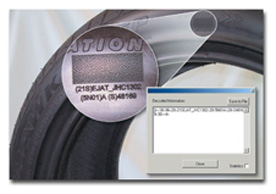
InfoGlyph™ marks contain encoded data that may be tracked by a product’s
manufacturer.


May 2004

Unimatrix™ Expands, Enters Into Alliance

Unimatrix, an international full-service, full-package supply matrix that focuses on performance
apparel, has opened new showrooms in Hong Kong, where it is headquartered. The company also has
appointed Campbell Walker managing director, Hong Kong.

Unimatrix also has entered into a strategic alliance with Unifi Inc. The alliance will
provide Unimatrix with access to Unifis knowledge of fiber design and performance, value-added yarn
portfolio, global yarn manufacturing capabilities, and relationships in the Andean and Caribbean
Basin regions.

May 2004

Koch Subsidiaries Buy Fibers Unit From DuPont

DuPont and subsidiaries of Koch Industries Inc. today finalized the sale of INVISTA, formerly
DuPont Textiles & Interiors, for $4.2 billion, including the assumption of debt and certain
joint venture and equity interests covered under a non-binding letter of intent. Ownership will
transfer at 5 p.m. EDT.

Going forward, the company will conduct business as INVISTA.  “The new INVISTA has many
capabilities, recognized brands and an innovative team, and we believe our long-term outlook is
excellent,” said Jeff Walker, INVISTA’s chief executive officer.  “Our focus for the near
future is to enhance this business’s ability to create superior value for our global customers. We
believe that this combination of INVISTA’s strengths, primarily in nylon and spandex, and KoSa’s
polyester capabilities will position us to compete successfully in the global resins and fibers
markets.”

“The fibers businesses of INVISTA have been an important part of DuPont for many
decades.  We look forward to a continuing relationship with INVISTA as a key supplier,” said
Charles O. Holliday, Jr., DuPont chairman and CEO.   “We believe these businesses can
best realize their potential as part of a company like Koch which is fully committed to INVISTA and
the markets it serves.  We highly value the contributions that INVISTA employees have made to
DuPont over the years and wish them well as part of Koch.”

Walker and the new INVISTA leadership team will concentrate on specific plans for
strengthening the various businesses within the INVISTA umbrella. The leaders are shaping their
respective organizations and making decisions to design efficient business and manufacturing asset
structures, to implement key year-one business strategies, and to offer superior customer
service.  Previously, presidents were announced for the six businesses: William Ghitis,
Apparel; David Trerotola, Performance Fibers; Alan Wolk, Interiors; Ken Wall, Intermediates; Kevin
Fogarty, Polymer and Resins; and Gerold Linzbach, Textile Fibers. Ghitis and Trerotola will locate
near Wilmington, Del.; Wolk will base near Atlanta; Linzbach will be in Charlotte, N.C.; and Wall
and Fogarty will be in Wichita.

The new INVISTA is a global integrated fiber and intermediates business with a presence in 50
countries.  It is comprised of six businesses: Apparel; Performance Fibers; Interiors;
Intermediates; Polymer and Resins; and Textile Fibers. INVISTA is committed to its customers’
growth through market insights and technology innovations combined with a powerful portfolio of the
best-known global brands and trademarks in the industry including: LYCRA®, STAINMASTER®, ANtrON®,
COOLMAX®, THERMOLITE®, CORDURA®, SUPPLEX®, TACTEL®, and in the specialty chemicals business: 
CORFREE, DYTEK, ADI-Pure and TERATHANE. Brands formerly marketed through the KoSa line include:
Polarguard®, ESP® and Avora®FR.

Koch Industries, Inc. is a privately held company that owns a diverse group of companies that
operate in more than 30 countries in core industries such as trading, petroleum, chemicals, natural
gas, gas liquids, asphalt, resins and fibers, minerals, fertilizers, chemical technology equipment,
ranching, securities and finance, as well as in other ventures and investments. 

April 2004

Veltex Acquires Garment Manufacturer

City of Industry, Calif.-based Veltex Corp. subsidiaries Veltex Apparel and Velvet Textile Mills
have purchased Bangladesh-based shirt manufacturer KCA Garment Industries. Velvet Textile Mills
will provide the cash portion of the acquisition, while KCA will receive Veltex Corp. common stock.
Velvet Textile will manufacture woven textiles for KCA, which will manufacture the textiles into
shirts, pants and other garments. Veltex Apparel will import and distribute the garments.

May 2004

Memminger-IRO, Uniwave Merge

Knitting auxiliary equipment manufacturers Memminger-IRO GmbH, Germany, and Uniwave Inc.,
Farmingdale, N.Y., have merged. As a result, each company will offer the product lines of both,
while the organizations of each company will remain unchanged. Memminger-IRO will add to its range
such Uniwave products as Quantum and Projectile lubricators, lint blowers and needle oil. Uniwave
will offer such Memminger-IRO products as the Pulsonic lubricator.

May 2004

US And Chinese Trade Officials Say No To Renewed Quotas

US and Chinese trade officials have made it clear that they are not going to negotiate a new
comprehensive bilateral quota agreement on textiles and apparel. While US textile manufacturers
have been pressing for such an agreement, Under Secretary for International Trade Grant Aldonas
says any such agreement simply is not in the cards. He said the Chinese have been categorical in
their rejection of new quotas contending that their imports are not enough of a threat to the US
market.

Last December, the US government placed quotas on three categories of textiles and apparel
under the so-called safeguard mechanism in the US/China bilateral agreement. The action limits
growth of imports of knit fabric, dressing gowns and brassieres to 7.5 percent for this year. Since
US textile manufacturers contend Chinese imports are surging in many other product categories and
the situation will only get worse when all quotas are removed by years end, they are seeking a
comprehensive quota agreement. According to the US Department of Commerce, Chinese imports of
textiles and apparel have increased last year by 67 percent over 2002, giving China about 20
percent of the US market.

Predicting that there will be continuing friction between the United States and China with
respect to rising textile imports, Aldonas said the United States will continue to address problems
using tools other than quotas or punitive tariffs.


May 2004

Investing In Stretch


W
e are fully sold out,” stated Paolo Antonietti, CEO, Radici Fibres, and a member of
Radici Group’s Board of Directors. And so began the 10th anniversary celebration of RadiciSpandex
Corp.’s Tuscaloosa, Ala., facility.

But the story runs much deeper than a simple celebration. Italy-based Radici Fibres has
developed an investment strategy that counters the rush to China by many competitors. “Our company
firmly believes in [polyamide and spandex], and we are investing in the United States and Italy
while everyone else goes to China,” Antonietti said. “We trust in the United States and Europe – in
producers as they move from commodity to differentiated products.” Radici investment has yielded a
capacity increase of 20 percent, and the fifth expansion in 10 years at the Tuscaloosa plant,
bringing plant capacity to more than 7,000 tons per year. Antonietti also spoke of branding
RadiciSpandex, following the Gore-Tex branding model, to further support manufacturers with a brand
name to aid in the transition to differentiated products.

With more than 300 guests on hand, the anniversary event emphasized the breadth and depth of
Radici Group’s manufacturing capabilities, its commitment to the marketplace and the diversity of
its product line. Radici Group’s sales across its divisions totaled approximately 1.2 billion euros
in 2003, including 0.5 billion euros generated in the fiber sector. With 29 percent of its revenues
generated outside the European Union, 36 percent in the European Union – not including Italy – and
35 percent in Italy, Radici Group’s international presence comprises production of chemicals,
plastics, fibers, textiles and other interests including utilities and real estate. This
integration allows Radici Group control and execution from raw material through finished product in
many areas of production. The company is supported by synergy and integration in polyamide 6,
polyamide 6,6, polyester, elastane, cellulose, acrylic and polypropylene products.

For the Tuscaloosa expansion, and for much of the strategy going forward, the strong
relationship – both chemically and functionally – of polyamide and spandex has a strong place in
the Radici Group family.

Bill Girrier, vice president, sales and marketing, RadiciSpandex Corp., and Gianni Norris,
sales manager, Radicifil, presented “Spandex and Polyamide: Crossed Destinies.” The presentation
illustrated the historic evolution of polymer chemistry and synergies of fiber production.

Is the stretch marketplace hot? RadiciSpandex says “Yes.” Total RadiciSpandex US
manufacturing capacity will grow to 15,000 tons per year with the Tuscaloosa plant expansion, and a
heavy-denier spandex production boost at its sister facility in Gastonia, N.C. Rumored additions
also are a possibility in the not-too-distant future.
radicientrance
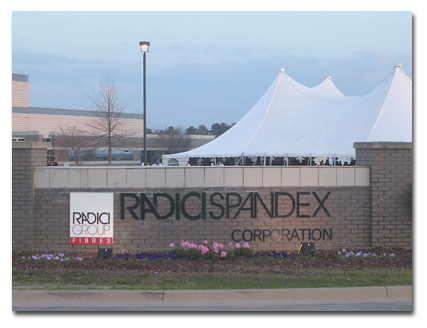
RadiciSpandex Corp.’s Tuscaloosa, Ala., facility, opened in 1994, has increased capacity by
20 percent to more than 7,000 tons per year.


Competing Globally


Robert F. Rebello, CEO, RadiciSpandex Corp., kiddingly offered to cut his speech in half
during the reception “for a quick million-pound order.” Considering the current rate of expansion,
such orders soon will be more commonplace.

“Our Tuscaloosa operation has proven that a US fiber manufacturing plant can compete in the
global market,” Rebello said.

After Radici Group’s acquisition of Globe Manufacturing Corp., Fall River, Mass., in March
2001, Rebello was named CEO in December 2002. He was key in opening the Tuscaloosa spinning
operation and leading the development and launch of several RadiciSpandex product lines.
antonietti
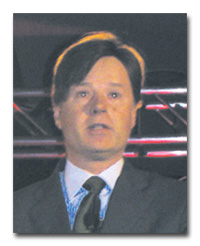
Paolo Antonietti, CEO, Radici Fibres, addressed more than 300 guests at the 10th
anniversary celebration of RadiciSpandex Corp.’s Tuscaloosa, Ala., plant.


History Of Growth


Rebello presented a concise history of RadiciSpandex in the United States, starting with its
association with Globe Manufacturing. Globe was founded in 1945 to produce extruded natural latex
rubber thread for use in textile markets, and was the first to produce round extruded rubber
thread, as opposed to the slit sheet and square cross section products that were dominant in the
industry.

In 1960, Globe diversified with the introduction of reaction-spun Type S-5 and S-7 spandex
fiber product lines for the hosiery industry in response to threats from large competitors that had
made inroads in the marketplace.

A decade later, Globe expanded to Gastonia with the introduction of a reaction-spinning
manufacturing site constructed to expand production of Type S-5 and S-7 polyester fibers in heavy
deniers for use in narrow fabrics and nonwovens.

In 1985, with the development of proprietary dry-spinning technology, Globe perfected a
fine-denier dry-spun spandex, Type S-85. The company introduced the fiber as an essential element
for fabric durability, elasticity and comfort in virtually all fabrics.

Globe completed construction of a second dry-spinning manufacturing facility in 1994. This
site – the Tuscaloosa facility – has been expanded repeatedly: first in 1995 by 33 percent; again
in 1996 by 20 percent; in 1997 by 15 percent; in 1998 by 50 percent; and now in 2004 by 20 percent.

In 1998, Globe was sold to the investment bank Code, Hennessey, Simmons. One year later,
Globe launched the S-17 chlorine-resistant product for the warp-knit industry.

Radici Group entered in 2001, buying Globe from the investment bank and investing heavily in
the Gastonia and Tuscaloosa facilities, with a focus on quality improvements and cost reductions.

radicimodel
RadiciSpandex presented its “Spandex-Polyamide — Meeting of Emotions” fashion show,
featuring spandex/polyamide designs in a range of hosiery, intimate apparel, sportswear and
eveningwear.

In 2002, RadiciSpandex launched its new S-45 fiber, followed in 2003 by S-17HP and S-72
fibers. In 2003, the company announced expansion plans as a result of the Tuscaloosa plant’s
success. Today, RadiciSpandex is positioned as the second-largest spandex producer in the Americas.

With the manufacturing capabilities of the Tuscaloosa facility and the Gastonia complex, the
company offers a broad range of traditional and innovative product lines in 10 denier to 5,040
denier:

•    S-5 – 100- to 5,040-denier spandex used in hosiery waistbands, control
tops and foundation garments, particularly garments in need of more than 150-percent stretch;

•    S-PC – 140- to 3,500 denier spandex with higher modulus than S-5 and
unique packaging and finish additives designed for primary use in personal care (PC) disposable
product applications, such as nonwovens and baby diapers;

•    S-17B – chlorine-resistant 20- to 140-denier spandex used in fashion and
competition swimwear, intimate apparel, activewear and corespun yarns for stretch wovens;

•    S-45 – high-temperature-resistant bright polyether-based 20- to
720-denier elastane developed to endure dyeing at elevated temperatures (250 to 265°F),
particularly suited for knit polyester fabrics;

•    S-52 – a brand-new high-elongation product with a flat recovery curve;

•    S-72 – polyether-based 560- to 4,300-denier elastane with high
retractive power – used in narrow fabrics; knit, woven and nonwoven tapes and bandages; disposable
nonwoven items; upholstery; and industrial products; and

•    S-85 – high-performance, low-cost 15- to 140-denier yarn solution for
sheer to mediumweight fabrics used in hosiery, corespun and covered yarns in a variety of stretch
woven, warp-knit and circular-knit applications.

The S-5, S-PC and S-72 products are produced in Gastonia using reaction-spinning technology
– a high-quality, low-cost platform for mid- to heavy deniers. In addition to the process, Gastonia
has several value-added services, such as warping (six units), knit tape and rewinding. The
reaction-spinning process, according to the company, offers prepolymer chemistry flexibility,
scalable design, product with excellent acid dye uptake characteristics and fused filament
structure of up to 1,120 denier.

The 85,000-square-foot RadiciSpandex distribution center is environmentally controlled and
features a SAP integrated enterprise resource planning system, SAP inventory management module for
pick and put-away, and electronic data interchange customer communication.

The S-85, S-17 and S-45 products are manufactured at the Tuscaloosa facility utilizing
dry-spinning technology under constant control and monitoring. This technology is very efficient
for producing high-quality, fine-denier products.

A broad product base has enabled RadiciSpandex to extend its reach into diverse product
categories without cutting production or service in core products. “Our tremendous success with our
signature S-17 chlorine-resistant fiber, our high-quality low-cost Type S-85 product line and new
exclusive products such as Type S-45 heat-resistant spandex have marked RadiciSpandex as somewhat
of a specialist in an otherwise generic market,” Girrier said.

“We’ve also made great inroads into warp knits and have established a firm position there,”
he added. “In just a few years, we have passed the test of time on quality and value. While other
spandex suppliers are shedding technical support staff and cutting back on service, we’re adding
judiciously where it counts to the market and our partners. Of course, we’re watching costs, but
our people work and try harder, and it shows. We’ve also got scale on our side. We are expanding to
accommodate real growth – not just pumping out spandex.”
radicigroup
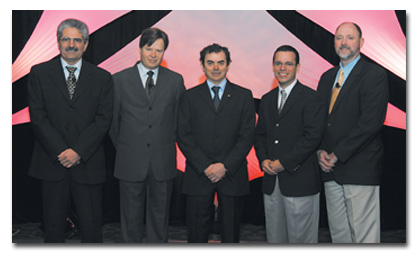
Radici executives from Italy and the United States gathered at the Tuscaloosa plant for the
first time since it was acquired in 2001. From left to right: Gianni Norris, Paolo Antonietti,
Angelo Radici, Robert F. Rebello and Bill Girrier


Celebration


The invited guests at the Tuscaloosa event were treated to a diverse mix of activities.
Beyond the speeches and presentations, there were plant tours, a fashion show of hosiery through
eveningwear, live music from opera to bluegrass, modern dance that is featured in the company’s new
advertising campaign, an art competition and a presentation of recognition awards. A special
highlight was the presentation of a new sculpture created for the occasion as a gift to the
Tuscaloosa facility from the Radici family on behalf of their Italian colleagues. This occasion
marked the first time top management from Radici Group gathered at the US facility with their
American counterparts since acquiring the spandex producer in 2001. Angelo Radici, chairman;
Maurizio Radici, vice chairman; and Paolo Radici, a member of the Board of Directors, all were on
hand to celebrate the occasion.

May 2004

Webex Offers FeatherLight™ Carbon Fiber Idlers

Webex Inc., Neenah, Wis., reports its FeatherLight carbon fiber composite idlers offer converters a
lightweight, high-strength alternative to standard aluminum idlers, enabling them to run wider,
lighter webs at higher speeds with minimum tension. The roll weight is one-third that of a
comparable aluminum roll, and load-bearing capacity is 120-percent higher. Webex says FeatherLight
also provides the lowest inertia rating of any roller on the market and responds faster to web
speed changes than other rolls.

The roll shell comprises carbon fiber composite tubing, with wall thickness optimized for the
specific application. The rolls feature lightweight aluminum headers and a special steel
stub-shaft. Standard face lengths range from 34 inches to 144 inches. Custom lengths, designs and
finishes also are available.

May 2004

US Government Rejects Petition On China Trade

The Bush administration has denied a petition by the American Federation of Labor – Congress of
Industrial Organizations (AFL-CIO) to invoke trade sanctions against China, and in the process
poured cold water on a similar petition that a number of manufacturing industries, including
textiles, were planning to file. Last month, the AFL-CIO filed a petition under Section 301 of the
Trade Act of 1974, which permits the US government to invoke trade sanctions against countries that
it believes are engaged in unfair international trade practices. The labor union charged that China
is guilty of unfair trade practices because of its labor rights abuses. A coalition of
manufacturing industries, known as the Fair Currency Alliance, was preparing a Section 301 petition
based on China’s alleged manipulation of its currency, which industry officials claim amounts to as
much as a 40 percent subsidy for Chinese exports to the United States.

Appearing at a news conference, four Bush administration cabinet officials said they cannot
support invoking punitive tariffs on Chinese imports and suggested other approaches to solving the
problems. US Trade Representative Robert B. Zoellick said accepting the petitions would take us
down the path to economic isolationism. Instead, he said the United States is engaged with China on
a number of trade reform issues and that progress in a number of areas had been made during recent
meetings between US and Chinese trade officials. Commerce Secretary Donald L. Evans said China will
be required to reform its labor standards and currency policies before it can be granted market
economy status under US trade laws.

Cass Johnson, president of the National Council of Textile Organizations, which is a member
of the Fair Currency Alliance, expressed bitter disappointment at the administrations rejection of
the petitions and the tone of the rhetoric the trade officials used in rejecting them. He said the
way the issue was handled and the comments of administration officials indicates they are committed
to doing anything about the problems manufacturing industries are having with China.


May 2004

Sponsors