ACIMIT Foundation Honors Students

The Milan-based Italian Association of Textile Machinery Manufacturers (ACIMIT) Foundation recently
honored 30 students from Italian textile technology colleges by awarding them grants for research
related to spinning, knitting and finishing machinery.

During an awards ceremony at ACIMIT Foundation headquarters, Angelo Vanali, ACIMIT past
president; and Federico Pellegata, ACIMIT director, presented nine grants worth 800 euros each for
research conducted by 24 students from five colleges located in Bergamo, Biella, Como, Prato and
Varese. The foundation also presented five special-mention half-prizes valued at 400 euros each to
six students for their research studies.

In addition to providing research grants to students, the ACIMIT Foundation supports textile
colleges and institutions by making available publications presenting Italian textile manufacturing
technology. Such publications include textbooks covering wool and cotton spinning, man-made fibers,
weaving, knitting and finishing technologies. These books have been translated into English for
distribution on CD-ROM, as well as into Chinese.

July 2004
DuPont Opens Artistri™ Technology Center In Italy

DuPont Ink Jet, Wilmington, Del., recently celebrated the grand opening of the DuPont Artistri™
Technology Center (ATC) in Milan. The facility offers demonstrations of the Artistri system, which
is comprised of the DuPont Artistri 2020 printer, DuPont Artistri ink and accompanying software.

During the open house, the company introduced new technologies including an advanced feeding
system that enables a wider variety of fabrics to be printed, a selvage protection mechanism that
provides improved printing reliability, and new aqueous-based pigment inks for digital textile
printing.

Marco Torri, DuPont regional sales manager, Europe, oversees the new center. “We are
extremely excited with the opening of the demonstration center that will serve as a showcase for
our digital printing capabilities, as well as a state-of-the-art, technical support, training and
after-sales service facility,” Torri said.

July 2004

LA Investment Firm To Acquire DyStar

Los Angeles (LA)-based global investment company Platinum Equity has agreed to acquire
Frankfurt-based textile dye manufacturer DyStar from its current owners: Germany-based BASF AG and
Bayer AG, and Hoechst AG – a Frankfurt-based subsidiary of France-based Aventis. Financial details
of the transaction, which is subject to regulatory approval, have not been disclosed.

“We are excited about the opportunity to acquire this business,” said Tom T. Gores, chairman
and CEO, Platinum Equity. “DyStar is already a leader in the textile dye industry, with a
well-deserved reputation in servicing the textile and fashion industry. We have enormous confidence
in its future potential.”

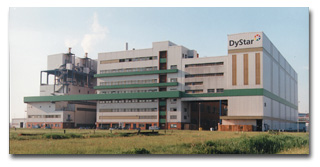
dystarplant
DyStar operates production facilities in six countries worldwide. Shown above is its plant
in Brunsbuttel, Germany.

Bayer and Hoechst established DyStar in 1995 and expanded the company with the inclusion of
BASF’s textile dye business in 2000. In 2003, DyStar a global company with a workforce totaling
approximately 3,900 employees reported sales of approximately 800 million euros.

July 2004

Lonati Group Acquires Sangiacomo

The Italy-based Lonati Group has acquired Sangiacomo S.p.A., also based in Italy. The producer of
men’s, women’s and children’s hosiery machinery, as well as seamless knitting machines, will
maintain its current business arrangement.

Under its new ownership, Sangiacomo will produce single-cylinder circular knitting machines
and new machinery for seamless garments, with emphasis on sportswear, underwear, casual apparel and
bathing suits.

July 2004

INVISTA, IFF Enter Consumer Textile Alliance

INVISTA Apparel, Wilmington, Del., recently entered into a non-equity alliance with New York
City-based International Flavors and Fragrances Inc. (IFF), a designer and producer of flavors and
fragrances. The companies plan to develop well-being and cosmetic benefits in apparel. The alliance
specifically will target Invista’s Body Care by Lycra® brand a year-old line of fibers and fabrics
that enable massaging and moisturizing benefits and freshness to be incorporated into clothing by
merging IFF’s encapsulation and delivery knowledge with Invistas fiber and fabric resources.

“By converging textile science with other technologies, we will be able to offer consumers
significant new benefits,” said Bill Ghitis, president, Invista Apparel.

July 2004

Benninger Sells Sizing, Warping Equipment In India

Benninger Co. Ltd., Switzerland, has supplied several sizing installations, as well as sectional
and direct warping machines to Welspun, India. Welspun is one of Asia’s largest manufacturers of
terry towels and bed linens.

Welspun also plans to purchase Benninger finishing equipment for all stages of fabric
finishing, according to Benninger.

July 2004

DuPont, Tate & Lyle Form PDO Joint Venture Company

Wilmington, Del.-based DuPont and London-based Tate & Lyle Plc, looking to build upon a
proprietary fermentation and purification process they developed for 1,3 propanediol (PDO), have
established a joint venture company, DuPont Tate & Lyle BioProducts LLC. The new company, to be
based in Wilmington, will begin commercial production of PDO – the key building block in DuPont
Sorona® polymer – in 2006 at a new facility in Loudon, Tenn. A pilot facility has been in operation
in Decatur, Ill., for several years. Sorona is suitable for a variety of applications including
apparel, interiors, engineering resins and packaging.

July 2004

SPI Unveils F-Nip For Nip Width Analysis

Sensor Products Inc. (SPI), East Hanover, N.J., reports its F-Nip® Flying Dynamic Electronic Nip
Analysis System is the first to allow real-time measurement of nip width while the rollers are
rotating at jog speeds. The device detects crown deficiencies, inaccurate roll alignment and roller
skewing all of which can cause defective product and other processing problems.

According to the company, F-Nip combines the advantages of Pressurex® tactile pressure
measuring film with the real-time electronic analysis capability of SPI’s E-Nip® system, enabling
nip width to be measured while the sensor chain riding on the substrate passes through the nip.

July 2004

BIFMA Completes Woven Fabric Standard

The recently completed Standard for Woven Textile Characteristics Tex4.1-2004 from The Business
& Institutional Furniture Manufacturers Association (BIFMA) International, Grand Rapids, Mich.,
now is available on the organization’s website,
www.bifma.org. The standard is the first document published by
BIFMA’s Supply Chain Management Committee. The committee’s Textile Subcommittee, working with the
Association for Contract Textiles, studied the textile supply process for standard fabrics
purchased directly from textile mills, as well as the direct or indirect supply of customers own
materials from jobbers. The standard, which applies to all sellers of woven fabrics, defines
policies for textile flaws and provides a common basis for distinguishing the face from the back of
a woven fabric.

July 2004

Sultex Debuts G6500 P7300HP At Open House

During an open house held recently, Switzerland-based Sultex Ltd. unveiled two new weaving machines
the G6500 rapier machine and its latest-generation high-performance (HP) projectile machine, the
P7300HP. The G6500 features a compact, low mass gripper head a modified version of the gripper
found on Sultex’s G6200 machine to provide smooth operation at high revolutions per minute. Using
either a raceboard or supporting teeth, the machine is capable of handling a wide range of warp
yarns. Shedding is controlled using either a dobby or a jacquard machine, and the machine is able
to insert four, eight or 12 weft colors, offering maximum patterning versatility.

Three different warp tensioning systems are available for the G6500: a negatively or
positively controlled back rest roller; tensioning with or without deflection roller; or a
positively controlled warp tensioner. According to Sultex, minimal warp loading and optimal running
parameters are created by the warp tensioning systems in conjunction with horizontal compensation
for the shedding motion to maintain rear shed geometry. Touch-screen controls with
easy-to-understand pictograms and network integration capabilities make the G6500 easy to operate.

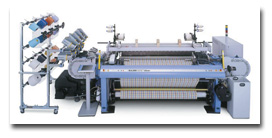
weavingnews

The new Sulzer Textil G6500 rapier weaving machine offers flexibility, maximum performance
and low production costs.

“Before the G6500 was introduced to a broader audience, we already noticed a very high level
of interest in this machine,” said Rolf Kehlhofer, CEO. “We even signed contracts with customers
who only knew the machine from photographs and drawings!”

The P7300HP projectile loom offers an increase in performance over its predecessors. Sultex
has redesigned the projectile picking unit and optimized the motion sequences of all components.
“Redesigning has enabled us to keep the shed open longer during each machine revolution,” said
Gianfranco DiNatale, product manager for the projectile machine. This allows insertion of more
picks per minute at the same weft velocity.A customized weaving technology (CWT) version also is
available for exceptionally demanding applications.

July 2004

Sponsors