ITG Nets Loan From Bank Of America

Greensboro, N.C.-based fabric manufacturer International Textile Group (ITG) has received a $150
million senior secured credit facility from Glastonbury, Conn.-based Bank of America Business
Capital, which also has agreed to provide letters of credit to the company. ITG will use the credit
facility to refinance existing debt and provide for ongoing capital requirements.

“Bank of America Business Capital structured a deal with limited financial covenants giving
us the flexibility to pursue our global business strategy,” said Joseph L. Gorga, president and
CEO, ITG. He said the loan also provides advances against certain receivables for ITG’s
international customers.

December 2004

ApparelMagic™ Software Offers Web-Based Solutions

At the recent Los Angeles International Textile Show’s Technology Showcase, Murphy &
Associates, Glendale, Calif., unveiled the latest edition of its ApparelMagic™ enterprise resource
management software.

ApparelMagic is a Web-based management solution that automates technological and business
processes including design, production, sales, distribution and accounting, among others, used by
apparel companies. The software is suitable for companies of any size; supports multiple platforms;
and is compatible with Windows®, Mac or Linux servers.

December 2004

China’s Currency Impact


T
he implications of increased economic relations between the United States and China have
been the topic of debate for some time – particularly as China acceded to the World Trade
Organization (WTO). Often, the discussion devolves into a trade theory argument. In a search for
clarity, following are direct excerpts from The US-China Economic and Security Review Commission’s
Report to Congress, published in June 2004. The 290-page report details growing concerns reached
through a broad and bipartisan consensus.

The report summary states: “Based on our analyses to date, as documented in detail in our
Report, the Commission believes that a number of the current trends in US-China relations have
negative implications for our long-term economic and national security interests, and therefore
that US policies in these areas are in need of urgent attention and course corrections.”

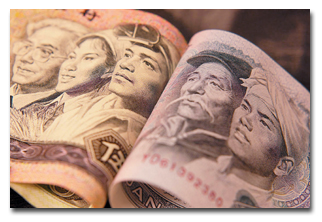
chinesemoney


Overview

The overvaluation of the dollar against the world’s currencies has been a major contributing
factor in the worsening of the US trade deficit over the last several years. Of particular concern
is the undervaluation of the yuan [currency of China] against the dollar. China pegs its currency
to the dollar, and the yuan has traded at 8.28 per dollar since 1998.

During this period, China has experienced massive export sector productivity growth driven
by FDI [Foreign Direct Investment]. This situation has enormously strengthened China’s competitive
advantage, rendering the yuan undervalued. In a free market, China’s productivity growth, trade
surplus and inflows of FDI would have caused significant exchange rate appreciation. However, China
systematically intervenes in the currency market to prevent this from happening, thereby
maintaining an important competitive advantage for Chinese exports.


Impact Of China’s

Exchange Rate Policies On US Trade

International trade is dominated by manufacturing trade, and overvaluation of the dollar has
significantly reduced the international competitiveness of US manufacturing industry. This lack of
competitiveness is reflected in the growing US trade deficit, which has negatively impacted
manufacturing output and employment. The negative effects of the overvalued dollar on manufacturing
operate through several channels.First, overvaluation makes exports relatively more expensive,
reducing foreign country demand for US manufactured goods.

Second, overvaluation makes imports cheaper, inducing a substitution in spending away from
domestically produced manufactured goods to foreign-produced goods.

Third, overvaluation reduces the profitability of US manufacturing firms by making foreign
goods cheaper, and this reduces firms’ incentive to invest in new production capacity.

Fourth, by making US-based production relatively more expensive, an overvalued dollar gives
US companies an incentive to shift production offshore and to build new production facilities
offshore.

These negative effects on the trade deficit and manufacturing in turn adversely impact
overall US economic growth. According to the Bureau of Economic Analysis, the US goods trade
deficit lowered GDP growth by 0.09 percent in 2001, 0.71 percent in 2002, and 0.42 percent in 2003.
The trade deficit therefore deepened the recession and is hampering the recovery.

The critical economic significance of exchange rates was summarized in the testimony before
the Commission by Franklin J. Vargo: ”Only 11 percent of the cost of a US manufactured good is
labor. If a product gets a 20- or 40-percent price advantage because of a currency, that is a much
more significant factor.”

The reason is that currency misalignments work on the entire cost base, so that an
overvalued currency raises the entire cost structure.


The Overvalued

Dollar And Undervalued Yuan

There is widespread agreement the dollar has been overvalued against the currencies of the
world’s major trading countries. With regard to China, the Commission heard testimony that the yuan
is undervalued by between 15 and 40 percent. Based on this testimony and other economic evidence,
the Commission believes that:

•    the yuan needs to be revalued substantially upward against the dollar;

•    as part of this revaluation, the yuan should be pegged against a
trade-weighted basket of currencies to avoid excessive fluctuation against the currency of any
single country;

•    China should refrain from adopting a floating exchange rate at this
time, as its banking system and financial markets are not yet prepared for such an arrangement; and

•    China should take active steps to reform its banking system and
financial markets to prepare them for an eventual floating exchange rate.

p37_Copy_3


Case For Revaluing The Yuan

The dollar has now entered a period of correction against the currencies of other
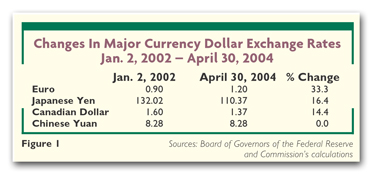
industrialized countries. As shown in [Figure 1], since January 2, 2002, it has fallen 33.3 percent
against the euro, 16.4 percent against the yen, and 14.4 percent against the Canadian dollar. In
addition, it has also fallen significantly against other currencies such as the pound sterling and
the Australian dollar. However, there has been no adjustment against the Chinese yuan, which is
fixed through official intervention. Additionally, there has been little in the way of correction
against the Taiwanese, South Korean, and Singaporean currencies, all of which countries run large
trade surpluses with the United States. This lack of adjustment has occurred despite the fact that
there is compelling evidence that the yuan is undervalued. China now constitutes the single largest
contributor to the US trade deficit, and economic fundamentals support the claim that the yuan is
undervalued.

China’s economy has been characterized by a trade surplus (external imbalance) and by rapid
economic growth with incipient inflation (internal imbalance). A currency revaluation will help
restore both trade balance and domestic economic balance by reducing exports and reducing demand
for domestically produced goods.

Conversely, the US economy has a large trade deficit (external imbalance) and excess
capacity and unemployment (domestic imbalance). Dollar devaluation will help restore both external
and internal balance by increasing exports and demand for US-produced goods.A revaluation of the
yuan is also needed for global economic equilibrium. As noted above, the United States has
significant trade deficits with other East Asian economies, including Taiwan and South Korea. These
economies are apprehensive about revaluing their currencies for fear that they will lose
competitiveness relative to China.

A revaluation of the yuan would likely free this logjam, allowing these economies to revalue
too, thereby smoothing and accelerating the process of dollar adjustment.

Additionally, failure to revalue China’s currency while currencies of other major trading
partners appreciate promises to cause economic disruption. This is because other economies – such
as Japan and the euro area – are implicitly being forced to take on a larger burden of adjustment
to correct the US trade deficit, while the country with the largest surplus (China) undertakes no
adjustment.


Arguments Against Revaluing The Yuan

Some argue the yuan does not need to be revalued. The Commission rejects this position.

One argument is that revaluing the yuan could lead to a financial crisis in the Chinese
banking system that ends up perversely generating a lower value of the yuan. The claim is that
opening China’s capital account and floating the yuan risks a massive exodus of Chinese savings
that could trigger a domestic financial crisis and yuan depreciation. Thus, paradoxically, capital
account liberalization and yuan floating could actually cause depreciation rather than
appreciation.

However, this argument confuses revaluation of China’s exchange rate with a shift to a
floating exchange rate. The Commission does not recommend floating the yuan at this time. Instead,
China should significantly revalue the yuan upward while maintaining capital controls and a fixed
exchange rate over the near term. This would address the underlying balance of payments
disequilibrium problem while avoiding financial crisis.

China has begun to recognize its problem of domestic financial fragility, but must now
accelerate the process of remedying it. The fact that capital account opening could trigger a
massive outflow of Chinese bank deposits reveals the inhospitable climate of Chinese financial
markets for domestic wealth owners. China must therefore move to make its financial assets more
attractive. The threat of domestic capital flight is not going to disappear. Indeed, it stands to
grow in magnitude as Chinese household financial wealth grows with development and households in
turn seek to diversify their portfolios internationally.

The bottom line is that China’s domestic financial fragility does not justify an undervalued
exchange rate that exports deflationary pressures and destroys US manufacturing jobs.

A second argument is there is no need to revalue, since market forces will force a
revaluation despite the Chinese government’s exchange rate intervention.

This argument is based on the discredited economic doctrine of monetarism. The claim is that
China’s persistent trade surplus forces its central bank to sell yuan and buy dollars to prevent
appreciation and that this expands the money supply, which will in turn cause inflation that drives
up Chinese prices. As a result, China will gradually become less competitive, while US
manufacturing companies will become more competitive.

The above monetarist argument is flawed. First, even if the mechanism worked, there are long
and unpredictable lags between expansion of the money supply and higher prices. In the meantime,
American manufacturing firms may be compelled to close down, with consequent loss of jobs.

Second, Chinese monetary authorities can take measures to mitigate the effect of a rising
money supply on prices. These include raising reserve requirements in the banking system and
sterilizing the monetary expansion by selling bonds and thereby withdrawing money from circulation.

A third argument is that the China trade deficit is unrelated to the exchange rate and is
the result of a shortage of US saving – principally the result of the large US government budget
deficit.

The argument is the US economy is consuming in excess of what it can produce and has to
import the balance. The Commission believes the United States must address its chronic budget
deficits, but it rejects the notion that this obviates the need for China to address its currency
undervaluation.

Contrary to the claims of the saving shortage hypothesis, the US economy currently has
severe excess manufacturing capacity and is capable of producing significantly increased
manufacturing output. A shortage of national savings is not the problem. The real problem is that
the misaligned exchange rate results in US goods being too expensive relative to foreign goods.
This drives down demand for US-produced output, and, over a more extended time period, contributes
to the elimination of US manufacturing capacity and the creation of a structural trade deficit.
Plant closures and the loss of well-paying jobs in turn undermine the tax base and contribute to
state and local fiscal problems.

A fourth argument is that though the United States has a large trade deficit with China,
China’s overall trade surplus with the rest of the world has been much smaller, and in the first
quarter of 2004 it registered a small deficit. Consequently, China’s currency may not be
undervalued.

Again, the Commission rejects this argument. [Figure 2] shows the United States has a trade
deficit with every region of the world, and the deficit with China is especially large. This
pattern points to a need for a generalized realignment of the dollar, and China should revalue its
currency as part of that realignment.

Second, for the last several years, China has run a global trade surplus. Moreover, the fact
that China has run a surplus even as it grew at 9 percent per annum is compelling evidence of
undervaluation. Any other country that grew at that rate would have quickly run up a huge trade
deficit. The small move into deficit in the first quarter of 2004 reflects continuing breakneck
growth and rising commodity prices, particularly in oil. That China still essentially has balanced
trade under these conditions is testimony to how undervalued the yuan is.

Finally, China is also running a capital account surplus generated by the flood of FDI into
China. This means China has an enormous basic balance surplus, defined as the combined surplus on
current and capital accounts. Thus, in 2003, China had a current account surplus of $45.9 billion
and a capital account surplus of $52.7 billion, making for a basic balance of $98.6 billion. This
put significant upward pressure on the exchange rate, but purchases of $116.8 billion of foreign
exchange by China’s central bank prevented the exchange rate from appreciating.


Editor’s Note: The US-China Economic and Security Review Commission’s Report to Congress is
available in full at
www.uscc.gov.
Textile World wishes to thank Associate Director Kathleen J. Michels for
permission to excerpt.


December 2004

Cooley COOLPRO® Protects Big Canyon Reservoir


The 200 million-gallon Big Canyon Reservoir in Corona del Mar, Calif.

The Big Canyon Reservoir rehabilitation project has selected Cooley COOLPRO® for use in
a new floating cover. COOLPRO is a high-quality, National Science Foundation-approved, reinforced
polypropylene geomembrane manufactured by Cooley Engineered Membranes, a division of Pawtucket,
R.I.-based Cooley Group.

The 200 million-gallon Big Canyon Reservoir in Corona del Mar, Calif., supplies water to the
Newport Beach area. Built in the 1960s, the structure is undergoing a $5 million rehabilitation
because it has been plagued by turbidity, and taste and odor problems associated with algae growth,
which can occur in an uncovered reservoir.

The COOLPRO floating cover is fabricated from a 60-mil poly-propylene composite membrane,
with a 40/60 distribution ratio coating for improved abrasion resistance. The thicker side of the
membrane is used for the underside of the cover. In addition, a 45-mil polypropylene chaffer strip
is fitted around the reservoirs sides and anchored to the concrete floor. The chaffer strip
protects the cover from excessive wear resulting from movement of the cover caused by fluctuating
water levels. In total, the project uses 1.5 million square feet of COOLPRO.

December 2004

SDL Atlas Unveils Fiber Imaging Analysis System, PillGrade Fabric-Scanning System

SDL Atlas, England, has introduced a Windows®-based Fiber Imaging Analysis (FIA) system for
microscopic measurement of longitudinal and cross-sectional aspects of natural and man-made fibers.
The company says the system offers a time- and cost-saving alternative to using chemicals to assess
the quality and composition of blended fibers.

The FIA system includes image-processing software that offers contrast-stretching,
background-leveling, Fast Fourier Transform filtering, and watershed and skeleton-based
segmentation functions. Extraction software measures cotton fiber convolution; and wall thickness,
maturity and medullation for cotton and particular animal fibers. The system also measures the
cross sections of elliptical, triangular and trilobal-shaped man-made fibers.

In other company news, SDL Atlas now offers the PillGrade automated 3-D fabric-scanning
system that analyzes and grades fabrics for pilling, fuzziness, snags and other surface properties.
The system was developed by LineTech Industries Inc., Brooklyn, N.Y., which worked in conjunction
with SDL Atlas.

PillGrade, which is ASTM- and ISO-compliant, tests textile fabric samples in any weight,
color and pattern and delivers results in five seconds. Functions include measurement of pills per
square inch and average pill size, and plotting of pilling distribution. Computer-generated test
results can be viewed on a screen or printed out.

December 2004

November 2004

colorsbbThe Trend Curve, Eden Prairie, Minn., a color and trend forecaster for the home

furnishings industry, has introduced ‘Tis The Season Colors 2005-2006, featuring 27 colors and
three metallics. The color kit includes a How To Guide and a portable mini-deck on a ring.

Burlington, N.C.-based
Kudzu Enterprise LLC, a specialty warp-knit products manufacturer, has achieved
ISO 9001:2000 certification.

Effective October 25,
DAK Fibers LLC, Charlotte, has increased by 3 cents per pound the price of its
staple fiber products sold to apparel, home furnishings, industrial and fiberfill markets.

Performance and Practices of Georgia’s Manufacturing Firms, a recent manufacturing survey
conducted by
Habif, Arogeti & Wynne;
Georgia State University;
The McCart Group; and the
Georgia Industry Association — all based in Atlanta — is now available free of
charge at www.hawcpa.com.

With the addition of Trade Direct AirSM to its Trade Direct Services, Atlanta-based
UPS has added air capability to its available options for moving goods imported
into the United States.

The Wayne, Pa.-based
Cordage Institute has made available International Guideline CI 2001. The 60+ page
guide provides information needed to inspect, evaluate and determine retirement criteria for used
fiber ropes.

Cuyahoga Falls, Ohio-based
Americhem Inc. has changed the name of its Dalton, Ga.-based Extruded Colors Inc.
subsidiary to Americhem Dalton Subsidiary Inc. The subsidiary recently achieved ISO 9001:2000
certification.

Spintex Yarns Ltd. and
Lanatex Yarns Ltd. have relocated to: 120 Tiffield Road, Scarborough, Ontario,
Canada M1V 5N2. The companies’ phone and fax numbers remain the same.

The
American Casual Furniture Fabric Association, a special interest group of the
Roseville, Minn.-based
Industrial Fabrics Association International (IFAI), has changed its name to The
Casual Furniture Fabric Association. Also, IFAI’s Market Research Services has released a 12-page
Data Textile Snapshot for the body armor market.

The
American Filtration & Separation Society has relocated to: 7608 Emerson Ave.
S, Richfield, Minn. 55423; (612) 861-1277; fax (612) 861-7959.

Carolina Finishing of NC LLC has relocated to: 220 Elmira St., Burlington, N.C.
27217; (336) 227-2770; fax (336) 227-2720; carolinafinishing@bellsouth.net.

Pearl River, New York City, has made available at www.pearlriver.com more than 75
satin brocade and cotton Chinese-style fabrics in a variety of colors.

pacbbNewark, Del.-based
Precision AirConvey Corp.’s (PAC’s) new website,
www.precisionairconvey.com, features full-color
cutaway illustrations; product descriptions, photos and literature; and details of PAC’s auxiliary
equipment line.

Effective October 15,
Rohm and Haas Co., Philadelphia, has increased the price of acrylic emulsions,
vinyl acrylic emulsions, solution polymers, solid grade resins and additives sold to the textile
and nonwovens industries in North America.

Effective October 4,
Polymer Group Inc., North Charleston, S.C., raised prices on its products.

Concept III International has relocated to: 130 Maple Ave., Suite 7B, Red Bank,
N.J. 07701; (732) 530-1976; fax (732) 530-4969.

TKF Inc., Cincinnati, has made available a four-color brochure detailing the
features and advantages of its PosiGrip Accumulation Conveyor.

ADM Tronics Unlimited Inc., Northvale, N.J., has released Product Bulletin
ADM-103, which describes its Santel, Aqualene and Unex lines of water-based resins, coatings and
adhesive products.

Effective October 1, Midland, Mich.-based
Dow Chemical Co. raised the list and off-list prices of certain products in its
oxygenated solvents portfolio.


November 2004

Central And South America Want You!


R
egardless of your opinion of the Central American Free Trade Agreement (CAFTA) as
currently proposed, the linchpin issues focus on trade preference levels and cumulation that
threaten US manufacturers’ claim on supply to the region. Many North Americans want
tariff-incentivized imports from the region to start with their products. But, a question kept
surfacing at the recent American Apparel Producers’ Network (AAPN) meeting in Cancun, Mexico —
Where are the North American fiber producers, spinners, weavers, dyers and finishers?

The meeting — which brought together Western Hemisphere sourcing managers, apparel
manufacturers and others — went well but suffered from a lack of participation from the back-end of
the supply chain — North American manufacturers. Members from the region reported the problem runs
deeper than meeting attendance, which did include some dedicated North American suppliers. The
situation needs to improve quickly if effective supply chains are to be established to compete with
the China threat.

So, is this lack of interest in Central and South America real? And if North American
producers are not serving the region properly, isn’t recent investment in the region from European,
South American and Asian producers a signal that something is wrong?

The North American industry often is criticized as a lazy industry that has benefited from
protectionist policies that have created a less-than-world-class business culture — maybe not in
investment in manufacturing processes, but certainly in developing and servicing new businesses. In
the good old days, you may remember turning down business that didn’t fit the mill, or was lower
than your run size or put-up. In many cases, that is yesterday’s news, as many companies now step
up to the plate to serve the customer with the flexibility demanded by today’s market.

So then, what is the problem?


Textile World
editors often hear, “I know all of my customers,” a phrase that speaks of both arrogance and
stagnant selling. If you think you know all of your customers, and the industry continues to
contract, it is just a matter of time until you will be out of business. New business is hard to
come by and expensive to generate. New customers bring risks, financial and otherwise. But, if the
Central and South Americans are right, one must ask if North American mill culture has failed to
change. What does it take for the industry to participate and become partners in product
development?


TW
was contacted and asked, “Can you help? These guys are your readers. Where are they?” Why
aren’t opportunities like the AAPN meeting embraced? What opportunities do North American mills
need to get them to participate? Certainly price differentials are significant on products imported
to the region, but if the region starts to compete as a supply chain, isn’t there a benefit to
trying? If all is lost, why fight CAFTA?


November 2004

Countries Seek WTO Assistance


G
overnments from 30 countries have appealed to the World Trade Organization (WTO) to
undertake “an urgent review” of the impact of the quota phase-out on less-developed countries and
to seek solutions to what they see as a major crisis resulting from China’s dominance of world
trade. They have asked the WTO’s Council of Trade in Goods to place the textile trade issue on its
permanent agenda, so it would be required to address the problem at all of its meetings.

They would like the WTO to conduct a study and establish a permanent work program to deal
with problems identified in such a study. Peter Mandelson, the incoming European Union trade
commissioner, added his support, saying China is on target to take over 50 percent of the world’s
textile trade market. Admitting it is too late to reverse the decision to remove quotas, Mandelson
said steps must be taken to help less-developed countries adjust to the quota removal. He added
that China, however, is likely to resist any new quotas and said, instead, that the best way to
address the problems of less-developed countries is to enhance the assistance programs of the World
Bank and International Monetary Fund, and remove what China sees as impediments to trade found in
preferential trade agreements such as the North American Free Trade Agreement, the Caribbean Basin
Initiative and the African Growth and Opportunity Act. US manufacturers and others in the Western
Hemisphere, on the other hand, see the preferential pacts as the key to their future growth and
prosperity.


Administration Cites China Trade Progress

Although a growing number of manufacturing industries are expressing concern over the dominance
of China in international trade, the Bush administration has stoutly defended its policies, which
it says are producing “real results” and increasing opportunities for US workers, farmers and
companies. US Trade Representative Robert B. Zoellick has issued a fact sheet that highlights five
areas, including textile trade, where the administration is getting positive results. He said that
in the past 12 months, US exports to China grew to $33 billion, and that since President Bush took
office, the United States has exported nearly $90 billion in goods and services to China. This, he
said, has made China one of the fastest-growing export markets in US history.

Zoellick said the United States has successfully resolved numerous potential cases with China
in the WTO, opening markets for high-technology and other manufactured products, and agricultural
commodities including cotton. Zoellick added that in four years, the administration has imposed
nearly as many antidumping orders against unfair imports from China as the Clinton administration
imposed in eight years.

With respect to textile trade, Zoellick said the administration exercised its right to impose
safeguards against Chinese imports on robes, undergarments and knitted fabrics. In addition, it has
negotiated free trade pacts with 12 countries, and in most cases, they call for a yarn-forward rule
of origin — supported by US textile manufacturers — and tariff preference levels that extend the
tariff concessions in the agreements to a limited amount of products originating in
non-participating countries. That pleases US importers of textiles and apparel.

The fact sheet does not address the burgeoning imports from China and the resulting trade
deficit. In the case of textiles and apparel alone, in 2003, the United States had a $13 billion
trade deficit with China; and in the first seven months of 2004, the deficit increased by 28
percent.

aldonas_Copy

Under Secretary Of Trade Grant Aldonas


Battle Looms Over Quota Extension

Look for a real donnybrook as US textile manufacturers and others in less-developed countries
seek to have restrictions placed on Chinese imports of textiles and apparel after all import quotas
are removed Jan. 1, 2005. The debate grew increasingly intense after a top US Department of
Commerce official opened the door for textile manufacturers to propose making wider use of the
so-called safeguard mechanism in China’s WTO accession agreement. US textile manufacturers want the
government to use the safeguard mechanism and impose import quotas in the face of a threat of
market disruption rather than waiting for actual market disruption to be proven, as has been the
case in the past. Without indicating what the outcome of such an approach would be in specific
cases, Under Secretary of Commerce Grant Aldonas said the industry has the right to seek relief on
the basis of a threat of market disruption.

That immediately set off a firestorm in the importing community and in China. A Chinese
Commerce Ministry official said such an approach would “brazenly breach” WTO rules and “seriously
hurt the confidence of Chinese firms and public in the global trade environment.” He said China’s
textile and apparel exports to the United States would grow “to a certain extent,” but claimed that
would be “normal” in global trade.

US textile importers, who objected earlier to quotas imposed on the basis of actual market
disruption, reacted even more sharply to the threat proposal and accused the Bush administration of
bowing to political pressure by changing the rules. They said that in the past, the interagency
Committee for the Implementation of Textile Agreements (CITA) has repeatedly said safeguard cases
could be brought only in situations where disruption of the US market already has occurred and not
on the basis of future anticipated disruption. Tracy Mullen, president, National Retail Federation,
said it is “simply unacceptable” for a government agency to change rules and policies governing
administrative procedures according to the direction of the political wind.

The question of imposing unilateral quotas or reaching a negotiated agreement faces a long,
contentious and sometimes bitter route, and it is unlikely that anything will be settled for
several months.

Under safeguard procedures, CITA determines whether there is market disruption or a threat of
market disruption. If such a determination is found, it would offer to have consultations with
China on a bilateral agreement to impose quotas. If agreement is not reached, the United States can
impose unilateral quotas for one year with a 7.5-percent growth and has the right to continue
quotas if the problem persists.


Plans For New Flammability Standard Moving Forward

Home furnishings manufacturers are concerned about and attempting to shape federal and state
regulations that for the first time would create flammability standards for top-of-bed home
furnishings. After several years of looking into the issue, California now appears to be close to
announcing a standard, and the federal Consumer Products Safety Commission (CPSC) is likely to
follow suit.

The proposed standard would affect sheets, comforters, pillows, mattress pads and other
filled bedding products.

The National Textile Association is spearheading an effort to make the standards something
the industry can live with. The industry and the California Bureau of Home Furnishings and Thermal
Insulation appear to be close to developing a standard that will provide consumer safety and not be
too much of a burden on the industry. The standard would use a weight loss test method whereby a
mock-up of a product would be subjected to an open flame and the amount of weight loss could then
be used to measure its flame resistance. In the meantime, CPSC soon is expected to issue an advance
notice of proposed rule-making, which would start the ball rolling on a federal standard.

The textile industry would like to see the federal government adopt the California standard
as a federal standard to ensure that interstate commerce is not complicated or disrupted.

It also would like to make certain the regulations would apply to imported goods as well as
those made in this country.


November 2004


Quality Fabric Of The Month: Family Affair

At this year’s Outdoor Retailer Summer Market in Salt Lake City, Quebec-based Huntingdon Mills (Canada) Ltd. unveiled PurEffort moisture-management/odor-control activewear fabrics, offered under its SkinTech™ moisture-management brand. The fabrics are made with Charlotte-based DAK Americas LLC’s Delcron® HydroPur fiber, which combines the hydrophilic properties of Delcron Hydrotec™ fiber with the antimicrobial properties of Delcron SteriPur®AM fiber — made with AlphaSan®, Spartanburg-based Milliken Chemical’s zirconium phosphate-based ceramic ion-exchange resin containing silver.

Ricky Lane, corporate communications manager, DAK Americas, said Delcron HydroPur is the first fiber to offer the dual functions of moisture management and antimicrobial protection. “Through molecular engineering, both properties are built into the fiber,” he said. “Because they are inherent rather than applied topically, they don’t inhibit downstream processing and don’t require special manufacturing processes. Molecular engineering also provides consistency across the
fiber, yarn and fabric, whereas topical treatments could be inconsistently applied.”

qfom_Copy_16

Ultra-light-weight PurEffort Interlock is suitable

for T-shirts and other next-to-body apparel.

Regarding the company’s branding strategy, Lane said, “DAK Americas offers its fibers in a trade-branding platform that allows the downstream manufacturer to sell and develop its own unique brand and create its own identity.” Hence, Huntingdon Mills developed its PurEffort branded fabrics on the platform of DAK’s HydroPur fibers, which provide the back-up story of how the fabric works.

Huntingdon Mills is among the first fabric makers to use HydroPur. “There are other companies that have fabrics in development, but Huntingdon Mills is the first to take it all the way,” Lane said.

Huntingdon Mills’ SkinTech brand comprises a number of fabrics that offer varying degrees of moisture management at different price points to satisfy customer requirements. David Waters, the company’s vice president, sales and marketing, said the PurEffort fabrics take the brand to a new level of performance.

PurEffort Interlock is an ultra-lightweight, next-to-body fabric suitable for T-shirts and inner garments or as a liner for heavier-weight garments. PurEffort Fleece has a jersey outer face and is lightly napped on the inside face. In apparel, it can be worn next to the body or as an
outer layer, in which case it continues to wick moisture from the next-to-body garment through to its outer surface, Waters said. He added that the wickability of the HydroPur fiber used in the fabrics has been shown to be greater than that of any other fiber on the market.

Waters said the initial response to PurEffort has been very positive. “We expect PurEffort to become a whole family of fabrics,” he said, noting the company already has additional fabrics in development, including a lightweight stretch fabric that offers wicking and four-way stretch for ease of movement and high mobility. “Active people want a fabric to be an extension of the body, so that it allows them to move easily and enhances their own performance,” he added.


For more information about PurEffort fabrics, contact David Waters (973) 360-0764, or
customer@huntingdonmills.com.


November 2004


Demand For Ring-Spun Yarns


A
fter running strong for most of the year, ring spinning (RS) appears to be slowing.
Open-end (OE) spinners are holding their own. Air-jet and vortex continue to suffer because they
are coupled with the sheeting and home furnishings businesses, which remain flat on their backs.

“Our business has slowed down recently,” said a ring spinner. “There has been a slowdown in
the denim market, which has affected all yarn. Our outlook is not as bullish as it was six months
ago — that’s for sure.”

He noted his plant is still running seven days a week and is beginning to build inventory. He
expects a normal Christmas shutdown and says circular knitting and hosiery haven’t softened as much
as denim.

A multisystem spinner sees a business slowdown in the fourth quarter.

“Going into next year, it’s a mixed bag,” he said. “The RS business is going to slow down. OE
won’t have the same structural problems as ring and air-jet. Air-jet is oversupplied and tied too
much to the furnishings sector.”

For once, an OE spinner is the ray of sunlight for the yarn market. He reports a definite
pickup in business across all segments.

“We’ve seen good improvement in the past few weeks,” he said. “We’ve had a good response from
our customers in Central America. Retail is obviously starting to lay down some orders there.”


Man-Made Fiber Getting Extensive

Cotton prices have stabilized and
found a temporary bottom. Man-made fibers continue to rise, and at least one spinner reported some
success in passing those increases along.

“Yarn prices are going down,” said a ring spinner. “People are wanting us to pass along the
cheaper raw material costs.”

He noted he is not yet processing the cheaper cotton, but the decrease in demand has given
buyers some additional pull on yarn prices.

“When cotton goes up, it is difficult at best to pass along the price increase, but
everybody calls when it goes down wanting to know when you are going to lower their price. It is a
classic one-way street,” he said.

Another spinner declared man-made fiber prices are getting up to a dangerous level. “It’s
going to start affecting consumption,” he said. “You’re at a level now where a spinner that’s been
polyester-rich starts converting back to cotton-rich in blends just because of the leverage. It’s a
bad thing for this market.”


No Tsunami Of Imports?

Spinners surveyed felt the 2005 textile quota phase-out will probably have a slow but sure
effect on business and will not turn into the tidal wave some fear.

“It is still unclear, but I don’t think you can come up with any scenario that would be
positive,” said a ring spinner. “I don’t think you will see a tremendous negative impact all at
once. It will be a gradual effect. I’m afraid it will further deteriorate prices at retail,
therefore creating a backward demand on the whole supply chain for lower prices.”

One industry observer warned that spinners who don’t feel their main markets aren’t directly
threatened by increased imports should realize that other domestic spinners with idled spindles or
positions in other segments will be shifting production wherever they can.


Billboard Campaign Strikes A Chord

Spinners were solidly behind the recent grassroots campaign kicked off in Greensboro, N.C., by
the American Manufacturing Trade Action Coalition, the National Council of Textile Organizations,
and the National Textile Association. The groups have rented 48 billboards in 32 communities. They
read: “Stop Sending Jobs Overseas. Fix Trade Policy Now! Register … VOTE!”

“They’re putting some pressure on Washington and are probably part of the reason the
government has done an about-face on safeguards,” said one spinner.

Another spinner liked the billboards, but was less upbeat about the likelihood of 11th-hour
political solutions.

“It’s a great idea, but it has to have some success,” he said. “Nobody can hold anybody
accountable for anything anymore. Look at the presidential race; both guys are saying the same
thing. We’ve got a system that is broken.”


November 2004


Sponsors