PicoJet Demonstrates New Ink-Jet Printhead

After five months in development, PicoJet Inc., Hillsboro, Ore., successfully demonstrated its new
PJ-N256 drop-on-demand ink-jet printhead. Using patented, ultrasonic bonding technology, the
stainless steel printhead was shown to be able to simultaneously fire its 256 jets at 10,000 drops
per second, creating a high-resolution, 300 dots-per-inch image.

The PJ-N256 also features a metal ink channel that enables the printhead to jet a wide
variety of aggressive ink chemistries; and the elimination of the use of epoxy and piezo ceramic in
the ink channel, allowing the printhead to jet fluids reliably without nozzle clogging.

June 2005

European Union And China Agree To Limit Textile Imports

In order to short circuit what could have been a contentious, ongoing controversy over textile and
apparel imports, the European Union (EU) and China have reached an agreement that will limit
imports through 2008. The action came after the EU was threatening to follow the US governments
actions and impose unilateral quotas on textiles and apparel using the safeguard mechanism
contained in China’s World Trade Organization accession agreement. The new agreement covers 10
product categories and will limit annual growth to between 8 and 12.5 percent between now and the
end of 2007. The final year will be subject to a somewhat vague phase-out plan. Products covered by
the agreement are pullovers, mens trousers, blouses, T-shirts, dresses, brassieres, flax yarn,
cotton fabrics, bed linen and table/kitchen linen.

In announcing the agreement, the EU Commission said the removal of textile quotas last
January was an important prize for progressive trade liberalization, adding that free trade in
textiles will provide global competitive disciplines that will improve productivity and lower
consumer prices. It said the competitive prices are being driven by China, whose formidable
production and export capacity will quickly reinforce its status as one of the worlds largest
producers and exporters of textile and clothing products.

Managing this transition presents a challenge both for China and its trading partners, many
of whom have textile industries of their own, the Commission reported. European textile producers
face tough competition from China. European industry has a huge capacity for innovation and
adjustment, but a sudden, steep and sustained surge in Chinese textile exports could be highly
damaging.The Commission said the agreement allows importers and retailers to plan and purchase in
China under conditions of maximum predictability and minimum market disruption, factors that appeal
to US importers of textiles and clothing who have strongly opposed to this country’s use of the
safeguard mechanism to impose new quotas on Chinese imports. The commission also said the agreement
provides a window for adaptation for producers in developing countries whose textile exports to the
EU were being displaced by a surge in imports.

Shortly after the announcement was made, Chinese Vice-Premier Wu Ti praised the EU for
reaching the agreement and criticized the US government for placing unilateral quotas on imports
before a voluntary agreement could be reached.Cass Johnson, president of the National Council of
Textile Organizations, said the EU-China agreement could pave the way for a comprehensive agreement
with the US government along similar lines.

June 2005

NSC, Orlandi Form Alliance

France-based NSC Group and Italy-based Orlandi S.p.A. are exploring a possible merger between NSC
subsidiary N. Schlumberger S.A. and Orlandi subsidiary Finlane S.p.A., which includes Italy-based
SantAndrea Novara S.p.A. and Cognetex, and Germany-based Seydel Maschinenfabrik GmbH into a 50/50
joint venture. The two companies would continue to maintain their distinctive identities as
producers of machinery for the long-staple market, as well as their own values and brands, while
sharing support services to improve customer service.

June 2005

Q1 Results


I
ndustry activity, despite the huge jump in Chinese imports, managed to hold its own
during the first quarter of 2005. Thus, the dollar volume of fabrics and other basic textile
shipments over this period remained pretty much unchanged from year-earlier levels. Sales of more
highly fabricated textile products like carpets and home furnishings were even able to eke out a
small dollar gain.

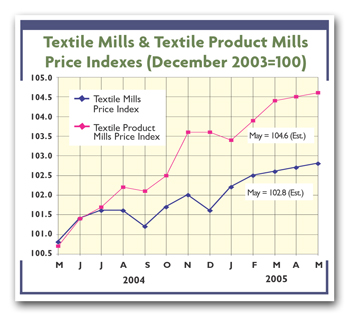
Another reassuring sign: Prices have continued to creep up, helping to offset continuing
man-made and cotton fiber cost increases. Basic mill and mill product quotes at last report were
running close to 2 percent and 4 percent, respectively, above year-earlier levels. Preliminary
first quarter profits, due out shortly, should still be in the black.

p14_Copy_11


Inevitable Declines

It would be unrealistic to expect a continuation of this not-too-bad performance. Overall
textile activity should head down from here on in as soaring imports finally begin to have a
significant impact on domestic activity.

Compared to February levels, dollar shipments started edging down in March. Preliminary April
figures from the Institute of Supply Management (a grass-roots purchasing group) indicate this
slippage is continuing into spring. Second-quarter textile performance is likely to be
disappointing, and certainly substantially under first-quarter levels.


Drop Off

The big question is, just how disappointing? The answer depends on how much of an optimist you
are. A few still feel the wave of Chinese imports should begin to subside. These people blame the
huge import surge on one-shot pent-up demand following the recent ending of global quotas — adding
that gains soon will begin to taper off.

Not surprisingly, Beijing concurs — and now says April already shows some signs of slowdown,
with even more deceleration anticipated in coming months. But plenty of analysts disagree. They
point to both burgeoning Chinese capacity and that country’s recent negative responses to US and
European criticisms.

Time will tell who’s correct. For now,

Textile World
tends to agree with recent predictions made by Global Insight. A few months ago, this
economic forecasting firm began calling for a sizable decline — with 2005 basic mill and mill
product shipments falling 6 percent and 5 percent, respectively.


Beijing Moves

Just how accurate these estimates are will depend on what eventual compromises will be made by
the contesting parties. On the Beijing front, China is making changes in its tariff system, wherein
the government has raised duties on fast-growing export items like shirts and cotton pants. The
system would set different tariff ratios for different textile categories.

Another option: Chinese moves to reduce or eliminate its implicit and explicit export
subsidies. Then, there’s growing belief China eventually will allow its currency to move up
vis-à-vis the dollar — something that would tend to raise the price of its textile and apparel
exports. But the question is, how much upward revaluation? Probably nothing earthshaking — with
little chance of the 25-percent or higher revaluation most economists say is needed to really have
a meaningful impact. 


US Reaction

US moves to counter the Chinese threat also are hard to pinpoint. There could be more moves like
Washington’s recent imposition of new quotas on seven categories of textile and apparel imports for
China
(See “
Textile World News,”
TW, this issue)
. Such safeguard moves could last only until the beginning of
2008 — and during this period, China still would be able to boost its textile exports by 7.5
percent a year.

Then there’s the new congressional bill that would impose a 27.5-percent tariff on all
Chinese products entering the United States if China fails to raise the value of the yuan.

Going out longer-term, the pending Dominican Republic-Central American Free Trade Agreement
(DR-CAFTA) bill presumably would guarantee US mills a market for their goods by allowing apparel
produced in that region to enter the United States duty-free as long as products include a
substantial amount of US-made fabric and yarn.

June


 2005


New Carpet Design Features Now Available On Alpha 360

The Alpha 360 double carpet weaving machine from Germany-based Schonherr Textilmaschinenbau GmbH, a
member of the Stli Group, now is capable of producing high-pile carpets of wool, acrylic,
polypropylene or blended yarns in up to eight pile colors and with a pile height of up to 30
millimeters per carpet.

Suggested application areas include bedroom, bathroom and area rugs; long-pile shaggy rugs;
and imitation animal fur rugs; among others.The carpets are reversible; and can be produced with
2×4 pile, and with different designs on top and bottom.

June 2005

NYC Art Project Uses Fabric Woven On Dornier Machines

The Gates, a temporary art installation by renowned artists Christo and Jean-Claude, was set up in
New York City’s Central Park earlier this year. The piece consisted of 7,503 rectangular
saffron-colored recyclable nylon fabric panel-covered arches installed in long rows over walkways
and footpaths.

The panels were woven on a 360-centimeter-wide PTV-type weaving machine from Germany-based
Lindauer Dornier GmbH. The PTV model was the only machine capable of producing the panels because
it features rigid rapiers and positively controlled center transfer, which reliably produces such
high-strength fabrics, according to Dornier.

J. Schilgen GmbH and Co. KG, a Germany-based developer and producer of technical fabrics, and
processor of natural and man-made yarns, delivered the panels.

The project remained in the park for 16 days. After its removal, the materials, including
116,389 miles of nylon thread woven into 1,067,330 square feet of fabric, were recycled.

June 2005

Fibreguide Offers FG5 Jet For Draw Texturing Air Covering

Fibreguide, an England-based manufacturer of jets used in a range of fiber production
processes, has introduced the FG5 jet for draw-texturing and air-covering applications. According
to the company, the FG5 available in tungsten carbide or high-quality ceramic models features
improved durability and jet cores that are easily removed for cleaning or changing.


fg5


Fibreguide’s FG5 jet for draw-texturing and air-covering applications


June 2005

Linz Textil Uses Rieter R40 To Develop Viscoblend Yarn

YarnLinz Textil GmbH, an Austria-based manufacturer of cellulosic yarn, has introduced Viscoblend®
viscose yarn an open-end rotor-spun yarn produced using Switzerland-based Rieter Textile Systems
R40 spinning machine and made with viscose fiber from Austria-based Lenzing AG. Linz Textil reports
technical parameters for the new yarn also required further development of spinning components.

According to the company, Viscoblend features improved strength and elongation, increased
evenness, and reduced imperfections. It is available in soft, medio and special qualities. Spinning
capabilities up to a yarn count of Nm 80/1 (Ne 47/1) present other possibilities for an expanded
range of offerings.

June 2005

BYK-Chemie Extends Line With New Products

BYK-Chemie GmbH, Germany, has added 12 new products to its line of additives used in the inks,
coatings and plastics industries.The new offerings include: DISPERBYK®-145 wetting and dispersing
additive; BYK®-425 rheological additive with improved properties; new products in the companys
NANOBYK nanotechnology-based series; and additives for aqueous systems such as DISPERBYK-194
wetting and dispersing additive for aqueous 2K-PU and epoxy systems.

June 2005

The Many Shades Of Sunbrella


W
ith its launch in 1960, Sunbrella® branded fabrics established a presence few fabric
products have ever achieved. “It is a branded approach that is unique for the textile industry – as
people think of textiles,” said Steve Ellington, president, Glen Raven Custom Fabrics LLC.

In an industry with many fiber brands that pull through to consumer and home furnishings
brands largely fashion-branded through design houses, few performance fabric brands continue to
garner recognition such as that established and supported by Glen Raven Custom Fabrics, one of two
subsidiaries within Glen Raven Inc. Whether in awning, marine, automotive convertible top,
residential or casual furniture markets, Sunbrella continues to meet the challenge of a demanding
marketplace by blending performance, style and value while escaping commoditization.

sunbrellaopen
Although Sunbrella® fabric was launched 45 years ago, the product maintains exceptional
brand awareness, and continues to attract new customers and find new markets and
applications.


Custom Fabrics


“I came through the sales and marketing side of the business,”  Ellington said. “I think
you learn very quickly that, to the consumer, it is not about having the nicest, most
technologically advanced manufacturing facility. That can be one part of it, but if you don’t have
a product that the consumer wants, one that is providing value, one that in some way enhances their
life, what benefit is there to what you are doing?”

Glen Raven spends a great deal of time and applies many resources to understand consumer
value.

“For the person who owns a boat,” Ellington continued, “the fabric that is on the interior or
exterior cushions – that’s fashion, that’s the product that enhances his or her enjoyment. To see a
BMW convertible ride by on the road – that top is something we manufacture –  to have your
product as part of that package is value provided to the consumer.”

Fashion is just part of the story. The Custom Fabrics subsidiary is responsible for the
Sunbrella brand. Glen Raven’s France-based Dickson S.A. subsidiary is a dominant international
supplier. Dickson is known worldwide in the awning and marine markets. The business has established
brands such as Banguard, a durable outdoor banner fabric; and Nitelite, a fabric specifically
designed for back-lit awning and sign applications.

Custom Fabrics continues to innovate with Glen Raven Media Fabric, a unit that serves
specialized graphics printing businesses by providing fabrics that enhance printed graphics.
Sunbrella Graphics Systems, another Custom Fabrics unit, offers Sunbrella fabrics and a system
partnered with 3M Corp., St. Paul, Minn., to create the industry’s first warranty-backed graphics
system. The system allows contractors to create consistent, repeatable multicolor graphics that fix
3M graphic film and Sunbrella fabrics through a durable bonding system.
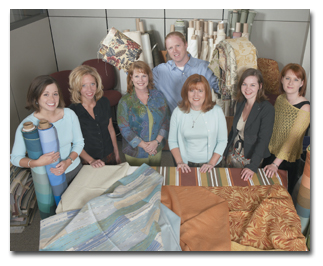
sunbrellateam
Custom Fabrics design team members (left to right): Anderson Hicks; Claire Madera; Sara
Hall; Greg Voorhis; Gina Wicker; Amy Rochester; and Nicole Ziecik. Not pictured:  Jenifer
Borg


The Customer’s Customer


In many of the industries served by Sunbrella branded products, the  Custom Fabrics
subsidiary’s marketing and merchandisers’ efforts create value for contractors, architects and
specifiers.

In a recent drive into high-end casual home applications, the company has had the benefit of
easy care, durability and sophisticated style and design demanded by the jobber market.

“It really creates a lifestyle,” Ellington said. “There is value in being associated with
Sunbrella.” Recent Calico Corners catalogues illustrate the breadth of branding Sunbrella has
achieved, sharing pages with well-known lifestyle brands such as Ralph Lauren Polo home interior
fabrics.

“The consumer is very sophisticated,” Ellington continued. “They are plugged into fabrics now
in terms of what performance or benefit the product provides, whether it is in sports apparel or
for boating, awnings or interiors.”

And more performance is on the horizon. “Ultraviolet protection enhancement is an area you
will see us push more in terms of value to the consumer,” he said.

June 2005

Sponsors