Lees Carpets Facility Earns ISO 14001 Certification

Kennesaw, Ga.-based Lees Carpets, a subsidiary of Calhoun, Ga.-based Mohawk Industries Inc., has
announced that its Glasgow, Va., manufacturing facility has earned ISO 14001:2004 certification for
its environmental management system. The facility previously earned ISO 9001:2000 certification
related to the quality of its products. “It is one of only a few carpet manufacturers that have met
the requirements of both certifications,” according to Diann Barbacci, vice president of
sustainable design. “This will expand new business opportunities from companies that insist on
partnering with manufacturers committed to environmentally sound practices,” Barbacci said.

May 2005

NCTO Celebrates First Anniversary

The National Council of Textile Organizations (NCTO), Washington, marked its first year of
operation in April. Assembled from the remnants of the American Textile Manufacturers Institute and
threading in the purposes formerly espoused by the American Yarn Spinners Association, NCTO has
established itself as a unified voice representing a comprehensive range of sectors within the US
textile industry, and now counts nearly 100 active members. Its activities have included national
and international initiatives, as well as industry outreach, grass-roots campaigns and
communication via the various media.

NCTO has conducted lobbying campaigns targeting Congress, the US Trade Representative and senior
White House officials, as well as Washington’s largest lobbying day in more than 15 years. Allen E.
Gant Jr., NCTO chairman, became the first textile industry representative in more than 10 years to
be named to the Advisory Committee for Trade Policy and Negotiations.

NCTO’s efforts led to the reimposition of quotas in four categories for textiles and apparel
imported from China following quota removal in 2002, and to government acceptance of industry
safeguards based on threat of market disruption. It also lobbied successfully for the defeat of a
Haiti bill deemed harmful to industry interests and for increased funding for textile enforcement
by the US Customs Service.

NCTO is a founding member of the Global Alliance for Fair Textile Trade, which includes 96 trade
groups from 52 countries opposed to unbridled Chinese textile and apparel trade. The council has
joined with the American Manufacturing Trade Action Coalition, Washington, and the National Cotton
Council, Memphis, Tenn., to develop joint positions on trade and other issues. “The road ahead is
not an easy one, but not an insurmountable one either,” Gant said, looking ahead. “The key to the
textile industry’s continued success is unity in purpose and vision. It is the goal of NCTO’s
leadership and staff to ensure this unity is maintained and utilized to the best interest of our
companies and the workers we employ.

May 2005

A Fiber Trilogy


O
ne of the joys of writing regularly for

Textile World
is the opportunity to keep abreast of happenings in an industry that has had many happy
years. One of the frustrations is the limited availability of time and space, thereby causing many
smaller stories interesting in themselves but not sufficiently large enough to command an entire
three- or four-page allotment to be relegated to the trash bin. And so, this month

TW
has developed and delivered three smaller stories. They are not directly connected, but are
related tangentially as they refer to the surprisingly similar reactions to imports and exports by
three different segments of the textile market.


Cotton

According to Fiber Organon – the Arlington, Va.-based Fiber Economics Bureau’s (FEB’s) monthly
statistical journal that summarizes confidential producer information on the US manufactured fiber
market – 2004 world cotton fiber consumption amounted to 102,612 thousand bales – up 2.6
percent from 2003 levels; above the 1-plus-percent rate of the past 15 years but consistent with
the 2-plus-percent rate achieved since cotton resumed its surging growth late in the last century.
There really is nothing unusual about the change in rate, except this one is accompanied by a
substantive change in the relative positions of supply and demand participants
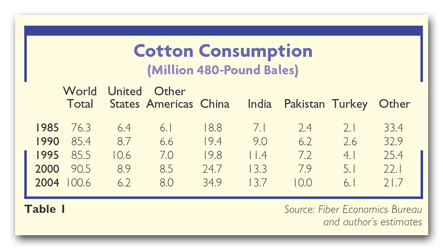
(See Table 1). After acknowledging that cotton is consumed everywhere, it is obvious the
number of active participants has narrowed severely. China increased its share in the period from
1985 to 2004 from 25 percent to 35 percent. The Americas dropped from 16 percent to 14 percent.
India grew from 9 percent to 14 percent; Pakistan, 3 percent to 10 percent; and Turkey, 2 percent
to 6 percent. While the market grew at a 1-plus-percent compounded rate, other consumers dropped
share from 44 percent to 28 percent. This concentration of power bodes ill for equal treatment, at
least in cotton goods. Recent announcements about the quantities of Asian merchandise arriving on
US shores since the advent of a full World Trade Organization (WTO) attest to this fact.
Counterintuitively, traditional man-made fiber-producing countries such as Korea, Taiwan and Japan,
whom one would expect to share in cotton’s growth, also dropped cotton market share in the period.
The availability of land, vis-á-vis foodstuffs, leads the number of reasons. India, Pakistan and
China picked up the slack.

An additional calculation by the FEB points out another change. In 1985, the United States
consumed 6.4 million bales of domestically produced cotton and exported a historically low 2
million bales, resulting in an excessively large carryover. (Authors note: Exports in the United
States in the 80s averaged more than 6 million bales annually. There is no purported reason for the
1985 anomaly.) By 2004, the United States was consuming the same 6-plus million bales, but by now
was exporting more than 11 million bales. The concept of export is laudable; the concept of
exporting raw materials ignores the reasons – primarily value-added for engaging in trade. In the
interests of effective use of capital, is growing and exporting 11 million bales of cotton the best
use for the required resources, including acreage

Solutia Redux


TW
has commented on St. Louis-based Solutia Inc.’s exit from the acrylic business
(See Oh Mexico, Where Art Thou?,
www.TextileWorld.com, March 2005)
.
Sadly, the restructuring surrounding the company’s Chapter 11 bankruptcy filing continues, this
time with recent news the company intends to shutter part of its Pensacola, Fla., nylon facility,
lay off a number of employees and exit some portions of the industrial nylon fiber business. True,
some activities are being transferred to the Greenwood, S.C., nylon operation, which, being some
years newer than the Pensacola facility, contains sufficiently modern equipment that will enable
the company to remain competitive in portions of the industrial yarn industry.

It’s probably fair to say this exit is not unexpected. Several times in the past,

TW
has commented on the surge by domestic polyester producers into industrial market uses. The
last five years have seen polyester increase its share in the 300 million pounds of domestic
shipments to original equipment and replacement tire manufacturers from a majority 55-percent share
to a dominant 72-percent share of 2004’s smaller 235 million-pound market.

Polyester has maintained its shipment level in the 165 million- to 170 million-pound range;
nylon has borne all the losses. Unfortunately, it appears the industry’s assumptions of a safe
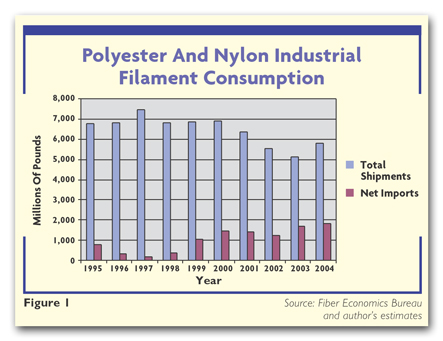
harbor for nylon and polyester in industrial end-uses are fallacious. Figure 1 highlights the
evolving import position.

As domestic polyester squeezed nylon out of many industrial end-products such as tires, hoses,
seat belts and airbags, offshore polyester producers – in particular the leading five of which are
Canada, Mexico, Korea, Japan and Taiwan – spotted opportunities in the United States and
increasingly poured high technology fibers into the market at a rate increasing by a compounded
14-plus percent every year, driving down the US presence in world markets. The quality of imported
yarn, made using the latest equipment, gradually improved, and imports rapidly siphoned off 30
percent of nylon usage and 36 percent of polyester usage. To emphasize the importance of the
industrial business, one week after announcing the Pensacola decision, Solutia announced a
10-percent price increase on industrial filament yarns. No wonder it had to throw in the towel.


Apparel Versus Non-Apparel Imports

The FEB recently introduced a new data series measuring the imports of textiles and apparel in
millions of square meter equivalents (smes). This in itself is not new, but the presentation
includes separating the imports into apparel and non-apparel categories. The originating data
source is the Office of Textiles and Apparel (OTEXA) within the Department of Commerce, which
reports that in 2004, the United States imported 46 billion smes of textiles of all fibers in the
form of apparel and non-apparel items – a 21-percent increase over 2002 totals. More interesting
than the totals is the split – almost 20 billion smes entered as apparel, but 26 billion smes came
in as non-apparel. In square meter terms, non-apparel exceeded apparel by 36 percent.

But, consider which category makes the news. The answer appears analogous to complaining about
paying $2.25 per gallon – 1-3/4 cents per ounce for automobile fuel while you sip your 10-ounce
Starbucks latte for which you paid $4.00 – 40 cents per ounce. This article is, in a sense, an
obituary for apparel. In early 2005, China, under the auspices of WTO membership, has increased
apparel-dominated shipments to the United States, maybe in sufficient quantity to energize a
political response. Meanwhile, remaining textile industry assets such as industrial and home
fashions items, presumably locked safely in the barn, are being deluged by imports in quantities
never before imagined by mills and manufacturers. Many of the non-apparel items are home fashions
like linens, but increasingly napery, upholstery fabrics and upholstered furniture are being
imported. The barbarians are at the gate; markets the US industry had falsely assumed would resist
imports are under siege; and the focus continues to be on a fait accompli – the export of the
apparel industry.

A Common Thread

While these three reports appear dissimilar, they are joined by the common thread of vision. US
cotton production remains high despite the dramatic slowing of cotton demand by US manufacturers.
Solutia’s Pensacola plant, hobbled by bankruptcy court proceedings, lags in investment with a
less-desired product that will not allow it to effectively compete in an increasingly technological
world. Worldwide manufacturers of non-apparel items appear poised to repeat the market penetration
strategies that have been so successful in the past several decades. Industry responses generally
have been reactive and, frankly, less than successful – US companies shut down facilities and lay
off dedicated workers and divert investment to exporting excess raw materials when it is arguable
that a better investment return combined with new, higher-technology jobs would be a more desirable
result. Isn’t it time for this industry to be more realistic about the future of textiles after
almost 50 years of increasing penetration and disruption by a never-ending parade of
developing-nation candidates?

 
May 2005

C And A Achieves Green Awards, Extends Product Warranties

Dalton-based C and A Floorcoverings’ ethos high-recycled-content cushion backing made from
polyvinyl butyral film recovered from post-consumer laminated safety glass recently was named a Top
10 Green Building Product of 2004 by Architectural Record and Building Green Inc. – publisher of
Environmental Building News and GreenSpec Directory.

In other company news, C and A now offers a 25-year non-prorated warranty for its 6-foot floor
coverings that feature closed-cell vinyl cushion backings including ethos Cushion 100, Powerbond
Cushion, Powerbond Condensed Cushion and ER3 Cushion. The products also carry the company’s
Sustainable Warranty for 100-percent recyclability.

May 2005

China Blocks Discussion Of Import Impact

In an escalating trade war, the Chinese government has blocked an attempt by textile-importing
nations to have a World Trade Organization (WTO) World committee discuss the impact of the removal
of textile and apparel import quotas. The issue was on the agenda for the May meeting of the WTO
Council on Trade and Goods (CTG), but when China objected to considering an appeal from Tunisia,
the meeting was cancelled.

Trade associations from the United States and 54 other countries had succeeded in getting the
textile issue on the CTG’s agenda, hoping that a discussion of problems resulting from the quota
removal would eventually result in some actions to alleviate problems being experienced in the
United States and other importing countries. When the issue was raised, Tunisia, Jordan and Turkey
insisted that it should not be removed from the agenda, and when China persisted, the meeting was
cancelled.

Speaking on behalf of the 96 trade groups that comprise the Global Alliance for Fair Textile
Trade, Cass Johnson, president of the National Council of Textile Organizations, commended Tunisia,
Turkey and Jordan for resisting the effort by China and a few other countries, saying that the US
textile and apparel market is in a critical crisis, adding that without a timely and comprehensive
WTO resolution to the crisis associated with the removal of textile quotas, millions of textile and
apparel jobs will be lost to the predatory practices of a handful of countries.

Auggie Tantillo, executive director the American Manufacturing Trade Action Coalition, said US
imports of textiles and apparel from China are up by 63.7 percent for the first four months of
2005, and if that trend continues, Chinese imports could increase from 25 to 40 percent of the US
market. European Union textile association officials also said Chinese imports are at record
levels. The next meeting of the CTG is not scheduled until at least July.


May 2005

GrayWolf DirectSense TVOC Measures IAQ Parameters

GrayWolf Sensing Solutions, Trumbull, Conn., has introduced the DirectSense TVOC monitoring kit
to measure total volatile organic compounds (TVOCs) and other indoor air quality (IAQ)
parameters.

The kit includes sensors to measure TVOC concentrations in parts per billion or parts per
million, relative humidity and temperature. Up to three electrochemical gas sensors may be mixed or
matched to measure a choice of gases such as ozone, ammonia, chlorine, carbon monoxide, hydrogen
sulfide and oxygen, among others. Other probes may be added to monitor carbon dioxide, particle
counts, differential pressure and other parameters. On-board sensor tips, government and industry
guidelines, and a report template also are included, as well as desktop PC software.

May 2005

Cotton Incorporated Lends Support To HueMetrix

Cotton Incorporated, Cary, N.C., will assist HueMetrix Inc., Raleigh, N.C., in the commercial
development of its Right First Time dyeing systems by making available its laboratory and pilot
plant facilities and equipment. Right First Time systems are designed to optimize the dyeing
process through dye exhaustion monitoring and shade control
(See
Dyeing,
Printing and Finishing News
, February 2005)
.

According to Cotton Incorporated, the systems increase shade consistency in cotton-based goods
and lower the operational costs of dyeing them.

“We are impressed by HueMetrix’s technology, and believe it will help the cotton industry by
enabling dyers to better control their exhaustion processes to more effectively and efficiently dye
cotton products,” said Don Bailey, vice president, Textile Research and Implementation, Cotton
Incorporated.

May 2005

Ciba, Reggiani Establish Digital Technological Center

Switzerland-based Ciba Specialty Chemicals and Italy-based Reggiani Macchine S.p.A. have teamed
up to establish the Digital Technological Center (DTC) in Italy.

The center will focus on developing digital inks and pre- and post-treatment systems; supporting
Reggiani in software and hardware development, color calibration, computer-aided design driver
releases, upgrades and work flow research; coordinating and hosting events and conferences;
validating clients industrial printing trials; and supporting textile universities in the promotion
of industrial digital printing.

The DTC also will offer clients live monitoring between the center and their machinery, and
on-site and remote support and service.

May 2005

Shaw To Expand Thomson Nylon Extrusion Facility

Shaw Industries Inc., Dalton, Ga., is to invest $27 million in its Thomson, Ga., facility in
order to expand its nylon extrusion capacity for carpet manufacturing. The expansion is a response
to increased demand for the companys products and will add 70 jobs to the local economy.

Richard Stuckey, director of extrusion for Shaws Thomson and Aiken, S.C., plants, said the
expansion will increase capacity at the Thomson plant by 65 to 70 percent.

“We are also refurbishing our Superba heat-set units and replacing twisters with new models, and
will upgrade the entire manufacturing process,” he said.

Shaw expects to complete the expansion in early 2006.

May 2005

Teijin To Increase Twaron Capacity In The Netherlands

Teijin Ltd., Japan, and its Netherlands-based Teijin Twaron BV subsidiary will invest 140
million euros to expand production capacity by 20 percent for Twaron® para-aramid pulp and yarn at
two plants in The Netherlands. The expansion, expected to be completed in the second half of 2006,
will include monomer and polymer capacity in the Delfzijl plant, and spinning capacity in the Emmen
plant.

It will increase annual capacity to approximately 23,000 tons.

Teijin Twaron’s plant in Emmen, The Netherlands

May 2005

Sponsors