
Zimmer Interquisa Partner To Further PTA Technology

Frankfurt-based Zimmer AG and Spain-based Interquisa have entered into a technology cooperation
agreement for the licensing of Interquisa technology for the production of purified terephthalic
acid (PTA). The partnership will combine Zimmer’s engineering and design expertise with
Interquisa’s operating and market know-how. The companies also will work together to improve
Interquisa PTA technology.

May 2005

Guilford To Trim Yarn Operations

Guilford Mills Inc., Greensboro, N.C., will close its Greensboro warping plant and reduce
operations at its spinning and warping plant in Fuquay-Varina, N.C., eliminating 230 jobs. The
plants supply polyester yarn for Guilford’s automotive interiors, performance apparel and technical
textile operations; and also for external customers. Guilford CFO David Taylor said waning external
sales due to lower-cost imports have led to underutilization at the two facilities. Yarn operations
will be consolidated at Fuquay-Varina, which will continue to employ 175 associates.

In other news, Guilford announced CEO John A. Emrich has resigned.

May 2005

Performance Fibers To Expand Production In China

Colonial Heights, Va.-based Performance Fibers, formerly part of Honeywell International, has
announced plans to build a second polyester fiber and fabric plant at its facility in China. The
expansion will double production capacity for dimensionally stable polyester (DSP®) at that
facility, which had doubled its original capacity with the addition of new lines earlier this
year.

The new plant will produce and convert the newest generations of DSP fibers for use in
automotive, tire reinforcement and other industrial and consumer applications.

“Construction is expected to be complete by the first quarter of 2006,” said Greg Rogowski,
president and CEO. “Additional expansions are planned, which will again double our DSP fiber and
fabric capacity in China by 2008.”

May 2005

Spotlight On Stretch

Hyosung Corp. is targeting its Creora® spandex yarn to athleticwear markets.


S
ince its introduction about 50 years ago, spandex has gone from replacing rubber in
narrow elastics to being the most popular fiber on the fashion block. Today, there is not much that
has not been impacted by stretch fiber. From swimwear to men’s suits, from shoes to bed linens,
stretch fibers are in demand. They offer greater comfort and fit, and fewer wrinkles or bagging
than their stretchless counterparts. The stretch phenomenon has expanded dramatically – spandex use
is growing at an annual rate of 6 to 8 percent. After elastic waistbands for hosiery were
introduced, lighter and finer fibers were developed for the legs of hosiery. Then came swimwear.
With each new end-use came newer fibers and variants developed for specific end-use applications.
Today’s consumers are more sophisticated, educated, active and affluent than those of past decades.
They are into a variety of physical fitness activities in a big way. They want their clothing to
look good, feel good and perform with minimal upkeep. Fabrics that are knitted or woven with a
stretch yarn are fulfilling this demand.


Dow Fiber Solutions

Midland, Mich.-based Dow Fiber Solutions is a relative newcomer to the stretch market, with its
DOW XLA fiber. Launched in 2002, XLA is the first elastic olefin-based fiber to be introduced into
the global textile marketplace. Giving a move-with-you soft stretch, it has received the generic
designation lastol. The fiber is resistant to extreme chemicals and heat, even temperatures of up
to 220°C. It can withstand severe dyeing, bleaching, mercerizing and garment-washing conditions. In
processing, it behaves like the base rigid fiber. It is compatible with natural fibers including
cotton and wool, and man-mades including polyester. In 2004, Dow opened a manufacturing site in
Tarragona, Spain. “Our new, dedicated production site in Spain allows Dow Fiber Solutions to serve
our customers globally with premium-quality product and the flexibility to produce new fibers based
on market demand,” said Juan-Carlos Cuadrado, global business director.

Reaching out to markets where stretch had not been a factor, Dow went to leading European
shirting fabric producers to introduce XLA. Albini, Italy, and Emanuel Lang, France, were the among
the first companies to try it. It was an immediate success. “Dow XLA elastic fibers’ exceptional
performance is convincing more and more brands that it can provide their customers with
unprecedented comfort, style and performance,” Cuadrado said. Dow recently introduced no-iron
stretch women’s blouses from New York City-based Brooks Brothers. The fabric from Luthai Textile
Co. Ltd., China, is a blend of 94-percent cotton and 6-percent XLA woven with yarns from Fujian
Kartex Textile Co. Ltd., also based in China. After shirts, XLA targeted sportswear. Some of the
first firms to work with XLA were Dan River Mills Inc., Danville, Va., which produced chambray
fabrics woven with core-spun yarns from R.L. Stowe Mills Inc., Belmont, N.C.; and Tejidos Royo,
Spain, which produced indigo-dyed denim.

Wool blends and swimwear soon followed. Italy-based wool weaver Luigi Botto S.p.A. reported the
addition of XLA enhances the drape and hand of wool fabrics. It provides modest stretch without
altering the base fiber. The touch is pure wool. According to Abigail Job, sales promotion manager,
Dow Fiber Solutions, the next apparel step will be no-iron stretch trousers. The next XLA
development will be colored fibers. “We’re looking at colored fibers that don’t bleed or fade,” Job
said. “Right now, we’re asking the market for feedback. We expect to see where we will go with this
within six months.”
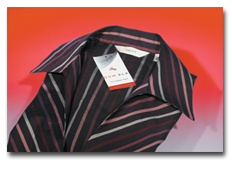
Dow Fiber Solutions is marketing its Dow XLA fiber to European shirting fabric
producers.


Hyosung

Creora®, Korea-based Hyosung Corp.’s spandex fiber, is ranked second worldwide in spandex yarn
production, according to the company, which has a reported annual growth rate of 50 percent.
Hyosung maintains 26 offices around the world, with facilities in China, North America and Europe.
Specialty products are finer-denier, antibacterial and thermo-sensitive spandex fibers. Creora
C-100B antibacterial spandex was developed in October 2002. In fine deniers, it has been used
widely in hosiery and intimate apparel. In addition to bacteria, it completely eliminates
unpleasant odors. Athleticwear, casual sportswear, knitwear and outerwear are other current target
markets.

Creora C-400 is Hyosung’s newest spandex. It can be dyed at low temperatures and was developed
to blend with heat-sensitive fibers. At high temperatures, it prevents discoloring from mold and
mildew.


INVISTA

New variants of Lycra®, the brand that began the spandex trend, continue to be developed for
specific end-uses. Lycra hangtags are seen on hosiery, sportswear, swimwear, knitwear, intimate
apparel, casualwear and formalwear. Woven or knitted, Lycra has a dominant position in stretch.
Last fall, INVISTA Apparel, Wilmington, Del., introduced Black Lycra
(See Finding Design Inspiration In Paris,
www.TextileWorld.com,
February 2005).
This fiber variant reduces elastane grin-through in dark fabrics and can be
used to create marl and pattern effects. Currently, fabrics containing Black Lycra are available at
Brugnoli and Jersey Lomellina, both based in Italy; Fieratex, Greece; and Spain-based Dogi
International Fabrics. In February, Invista announced the development of Xtra Life Lycra, a stretch
fiber developed for swimwear. It was introduced on the NBC Sports Illustrated Swimsuit Model Search
reality show broadcast earlier this year. Invista and Roudi/Chargeurs Mens Fabrics, France,
recently launched Elixir, a range of high-performance stretch fabrics. The principle of Elixir
fabrics is based on a high density of ultra-fine yarns to create a lightweight feel for comfort and
bidirectional stretch. Fabrics are woven of 50-percent wool, 47-percent polyester and 3-percent
Lycra (22 decitex). They are crease- and stain-resistant. Air France announced garments made of
these fabrics will replace uniforms worn by all of its staff 36,000 people worldwide. Invista
recently presented a collection of ultra-fine circular knitted fabrics and denims shown in garments
by the emerging young designer Silvio Betterelli. Low-denier Lycra yarns are used in fine knits
that are warm, thin and light, offering comfort and freedom of movement. Denim fabrics in the
collection were woven by Legler and Italdenim – both based in Italy – using T-400 and Lycra blended
with cotton. T-400, Invista’s multicomponent comfort stretch fiber, has received the US Federal
Trade Commissions new fiber generic designation, elasterell-p. This fiber is chlorine-resistant.
When it is used in denim, fabrics can withstand bleaching and washing treatments not typically used
on stretch denim. Fabrics knitted or woven with T-400 fiber provide enhanced performance, lasting
fit and ease of movement. Low shrinkage, improved wrinkle resistance, stability, a smooth
appearance, soft hand and crease retention are some of its attributes. In addition to denim, target
markets are knitwear, shirts, sweaters and trousers.


RadiciSpandex

With 30,000 tons of spandex fiber from China and Korea coming into Europe, there is a price war
going on, according to Guido Morelli, marketing and communication manager, fashion and interiors,
RadiciFibers. Innovation is one way to combat mass-market imports from Asia. Radici recently showed
a new taslanized yarn in a nylon and spandex mix for the fancy yarns sector. It imparts a natural
look and soft hand; and provides performance, comfort and easy care. It is quick-drying and has an
absorption capacity similar to that of cotton. “Now we, the fiber manufacturers, are challenged to
provide add-ons to stretch,” said Bill Girrier, vice president of sales and marketing at Gastonia,
N.C.-based RadiciSpandex Corp. Again, these add-ons come in the form of functionality enhancers.
Case in point: a chlorine-resistant spandex that also offers protection from degradation due to
[ultraviolet] rays, suntan and body oils.

“A new product like RadiciSpandex Type S-45 [heat resistant spandex] provides both the designer
and the mills with answers, while allowing mills to incorporate better-[disperse]-dyeing polyester
fibers and raise dye temperatures for improved dye take-up and superior washfastness, sometimes
even saving in finishing costs,” he added. Also, designers can now opt for new polyester/spandex
fabrics that offer better and richer color selections. In broadwoven fabrics, S-45 heat-resistant
spandex fiber opens up whole new markets. Girrier said RadiciSpandex is well into the development
of Type S-AM, a spandex fiber with antimicrobial capability. The company also is promoting its Type
S-TS low-heat-settable spandex fiber.

“There is no doubt,” Girrier added, “that global competitiveness has put a squeeze on the whole
supply chain … and innovative stretch is part of the solution. Western Hemisphere designers
and mills are all endeavoring to create apparel that is unique, functional and stylish … and
at the same time … [to] move quickly to ensure that the value they create is not readily
converted into mass-market imports from Asia,” Girrier said.


Design Students Stretch To The Future

Stretch to the Future, the annual design scholarship competition sponsored by RadiciSpandex
Corp., is now in its seventh year. It was developed to foster the creative development of
design students while educating them about the technical aspects of garment construction using
fashion fabrics containing a highly technical fiber such as elastane. This year, for the first
time, Stretch to the Future awards will go to undergraduates at the Pratt Institute College of Art
and Design in New York City. Stan Herman, three-time Coty Award-winning designer and president
of the Council of Fashion Designers of America, will serve as the designer judge and
honoree. Three scholarship prizes will be awarded to the winning students at Pratt’s year-end
fashion show this month. Students will be allowed to combine stretch fabrics containing
RadiciSpandex fiber with one non-stretch fabric. Stretch fabrics have been donated by Coville,
Winston-Salem, N.C.; Cyberknit, a division of Paul Gottlieb & Co. Inc., New York City;
Darlington Fabrics, a part of the Moore Co., Westerly, R.I.; Fab Industries Inc., New York City;
McMurray Fabrics Inc., Aberdeen, N.C.; Native Textiles Inc., Glen Falls, N.Y.; Sextet Fabrics Inc.,
New York City; Symphony Fabrics, New York City; and Vanity Fair Intimates, a part of Greensboro,
N.C.-based VF Corp.
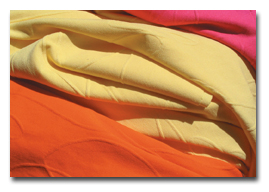
Sextet Fabrics donated fabrics to the Stretch to the Future competition sponsored by
RadiciSpandex Corp.

 
May 2005

Kaeser Filter Elements Replace Any OEM Element

Fredericksburg, Va.-based Kaeser Compressors reports its new line of replacement filter elements
fits virtually any original equipment manufacturers (OEMs) filter housing without the need for an
adapter kit or other modification. The elements are available in a range of sizes and types, are
made using high-strength fibers in a random-orientation mesh design, and meet or exceed OEM
performance specifications for contaminant removal, according to Kaeser.

May 2005

Pima Cotton Supplies Tight


D
espite a record crop of 736,000 bales, Pima cotton has become a scarce commodity. As one
spinner put it: “Pima is in very short supply right now. So if you don’t have Pima, you’re not
getting it, not good-quality Pima.”

“US Pima is basically sold out as of [the] first of April,” said Rodger Glaspey, president of
Fresno, Calif.-based Dunavant of California.

This year’s crop was a record in terms of yield, due in part to good weather throughout the
growing season. However, late-season rains in California’s San Joaquin Valley resulted in a higher
than normal percentage of lower grades.

Over the last five years, Pima cotton exports have ranged from 400,000 bales to this year’s
projected 800,000 bales. Between 1999 and 2003, US Pima exports have averaged 492,000 running
bales; domestic use, 106,000.


Supply And Demand

Glaspey credits the demand to a combination of growing consumer preference for higher-end,
fine-count yarns and very competitively priced Pima due to the export subsidy.

“Domestically, US spinners will use between 50,000 and 60,000 bales, and exports will be
close to 750,000,” said Jarral Neeper, vice president of marketing for Bakersfield, Calif.-based
Calcot Ltd. “Total off-take of Pima should exceed 800,000 bales. Ending US stocks will be less than
30,000 bales. This is one of the tightest situations ever.”

The worldwide supply/ demand situation of extra-long staple (ELS) cottons also is extremely
tight. The total world carryout of all ELS varieties is estimated to be about 900,000 bales, one of
the smallest on record. This compares to total world consumption of roughly 4 million bales.

Pima and ELS cotton is grown in Arizona, New Mexico and Texas, but the lion’s share comes
from the San Joaquin Valley. Another major source for ELS cotton is Egypt.

Glaspey expects a 10- to 15-percent increase in planted US Pima acreage this year, weather
permitting. Pima requires a significantly longer growing period than conventional upland cottons.
If producers can’t get it in the ground by late April, they will switch to planting upland
cottons.


Shifting Exports

This year, Pakistan leads the top five leading Pima importers with purchases of 182,200 bales.
China, India, Japan and Taiwan follow with purchases of 116,000 bales, 76,200 bales, 72,300 bales
and 59,800 bales, respectively. These nations account for 67.3 percent of export-based purchases of
US Pima made to date this year, according to Phoenix, Ariz.-based Supima, the promotional group for
US Pima growers. In 2004, the largest buyer was Pakistan, followed by China, Japan and Peru.

“A shift is taking place,” Glaspey said. “We see some of our traditional customers — Japan,
Italy and Switzerland, as well as the United States — [have shrunk] in the last three to four
seasons. The markets that have really been on the rise, as far as spinning fine counts, have been
Pakistan in particular, [and] China, Indonesia and India.” 


Marketing Pima

Pima products have traditionally included fine shirting, sheeting and high-end knit apparel.
Recently, the fiber has moved into other product categories including towels and even denim.

“The Supima organization has done a tremendous job of promoting and leveraging the product
lines,” Neeper said. “They have done a great job inculcating the consumer with the message that
Supima cotton represents luxury and quality.”

The name Supima®, an abbreviation for superior Pima, is a licensed trademark owned by Supima.
The brand is used to promote textile and apparel products made of 100-percent US Pima cotton.

“With today’s trend toward luxury goods, the consumer is looking for high quality and is
willing to pay for it,” said Buxton Midyette, marketing director, Supima. “Consumers are really
beginning to pay attention to the fiber content of what they buy — what fiber is used and the
quality of that fiber.”

Another recent trend for Pima is a move into coarser-count yarns.

“A lot of Pima is going into the lower counts that have traditionally been the playground of
upland cotton,” Glaspey said. “We’ve heard of Pima being spun all the way down to the Ne 20s to Ne
40s. Pima is traditionally used to [spin] Ne 50s to Ne 100s yarns.”


May 2005


Administration Delays Action On Safeguards

In a setback for US textile manufacturers, the Committee for the Implementation of Textile
Agreements (CITA) has announced it will extend the deadline for acting on threat-based market
disruption petitions seeking relief for Chinese imports. The original period for comments on the
threat-based petitions closed December 3, 2004, but further action was blocked by an injunction
issued to a federal court. The injunction was removed April 27 of this year, and CITA announced a
series of extensions for various products ranging from eight to 30 days. That would mean the
committee could delay until as late as July a final decision on some products. If a decision is
reached that products are disrupting the market, CITA can impose import quotas, but they would run
only until the end of this year, and the industry then would have to present new petitions for
another one-year extension.

Products involved in the threat-based petitions are cotton trousers, cotton knit shirts and
blouses, mens and boys cotton and man-made fiber shirts, (non- knit), man-made fiber knit shirts
and blouses, man-made fiber trousers, cotton and man-made-fiber underwear, combed cotton yarn, some
synthetic filament fabric, men’s and boy’s wool trousers, knit fabric, dressing gowns and robes,
and brassieres.

AMTAC issued a statement saying: “There is absolutely no reason for the US government to stall
the decision-making process any longer on cases where the public comment period has already closed.
To do so would exhibit callous disregard by the US government to the plight of a beleaguered US
textile industry.”


May 2005

RadiciGroup To Form Alliance With Rhodia, Snia

Italy-based RadiciGroup has signed a letter of intent with France-based Rhodia and Milan-based
Snia S.p.A. to form an alliance between RadiciGroup’s RadiciFibres man-made fibers division and
nylon textile yarn manufacturer Nylstar, a joint venture between Rhodia and Snia.

RadiciGroup will be the majority owner of the new joint venture, which will employ more than
4,000 people worldwide and is expected to generate more than 800 million euros in annual sales. The
alliance is expected to give RadiciFibres and Nylstar greater leverage in the face of growing
imports from Asia.

May 2005

Kanebo To Spin Off Textile Business

Kanebo Ltd., Japan – a manufacturer of consumer products and textiles – plans to spin off its
textile business into a joint venture with Japan-based dyeing and finishing firm Seiren Co. Ltd.
The new company will comprise Kanebo Spinning Corp.’s cotton business and Kanebo Gohsen Ltd.’s
man-made fibers and resin business. It will produce high-value-added fabrics using Kanebo’s
advanced dyeing and finishing; high-quality polymer modification; and compound and bicomponent
fiber and fine-denier spinning technologies. Seiren will contribute its macromolecule, and dyeing
and finishing technologies. The transfer is expected to be completed by July 1, 2005. Majority
owner Seiren will have an option to purchase Kanebo’s 49-percent interest and make the company its
wholly owned subsidiary.

May 2005

US Government Approves Threat-Based Petitions

The US government’s Committee for the Implementation of Textile Agreements (CITA) has approved
three threat-based safeguard petitions providing relief form import competition from China in the
most heavily import-impacted textile product categories. Products involved are cotton knit shirts
and blouses, cotton trousers, and cotton and man-made fiber underwear. CITA determined that the US
market is being disrupted and that there is a threat of further disruption. While CITA has approved
petitions based on actual market disruption in the past, this is the firs time it has acted on the
basis of a threat of market disruption, reporting that the situation with these three products
threatens to impede the orderly development of trade.

In announcing the decision, Commerce Secretary Carlos Gutierrez said: “Today’s action by CITA
demonstrates this administrations commitment to leveling the playing field for US industry by
enforcing our trade agreements. We will consult with the Chinese to find a solution that will
permit the orderly development of trade in a quota-free environment.” CITA will now request
consultations with China by the end of May with a view toward easing or avoiding market disruption.
Consultations must be held with 30 days of receipt of the request by the Chinese government.

A bi-lateral negotiation will take place, and if agreement cannot be reached within 90 days, a
quota with a 7.5-percent annual growth rate will remain in place for the remainder of 2005. New,
one-year petitions could be filed in January and again until 2008, when the safeguard provisions
expire.

The US Association of Importers of Textiles and Apparel (USA-ITA) immediately blasted the
decision, reporting all pretense of legitimate deliberations was clearly dropped since the decision
was made just four days after the close of the public comment period. Laura E. Jones, executive
director of USA-ITA, said: “After a 30-day comment period in which a large number of companies
invested a great deal of time and effort to explain why safeguards would be wrong, why they won’t
help the US industry and why products made in China are in many cases items that are not made here,
the government takes all of four days to say that our views don’t matter.”

Predictably, textile lobbying organizations were pleased with the action, because it will likely
save thousands of textile jobs. Cass Johnson, president of the National Council of Textile
Organizations, said the government has acted faster than ever before to address these and other
textile import issues. He said a surge of imports from China more than 1,500 percent in cotton
trousers would have caused enormous job losses if the government had not made a quick decision.
Mark Lange, president of the National Cotton Council, said “this is a case of appropriate use of
the safeguard mechanism.”

Pointing out that the textile industry has additional safeguard cases pending in what the
industry considers critical categories, Auggie Tantillo, executive director of the American
Manufacturing Trade Action Coalition, urged the government to approve them as quickly as possible.

May 2005

Sponsors



