Coalition Attacks China-EU Textile Deal

The 97-member Global Alliance for Fair Textile Trade (GAFTT) which represents 97 trade groups from
55 countries in Europe, Asia, Central America, Mexico and the United States has blasted a European
Union-China plan to release some 83 million in textile imports that had been embargoed when China
exceeded it quotas. The EU/China agreement is expected to allow immediate entry of all of the
textiles and clothing that had been embargoed. Under the new arrangement, 50 percent of the goods
will be permitted to exceed the quota agreement and the remaining 50 percent will be charged
against 2006 quotas.

Charging that the importers caught in the embargo took a calculated business risk and got
burned, Cass Johnson, president of the National Council of Textile Organizations, a GAFTT member,
said: “The EU-China textile deal unfairly penalizes textile and clothing producers from the rest of
the world who play by the rules.”

Auggie Tantillo, executive director of the American Manufacturing Trade Action Coalition,
another GAFTT member, said China contributed to the EU embargo problem by eliminating its export
licensing requirements early this year. He said granting China additional access to the EU market
simply rewards China for its own irresponsibility.

Last June, China and the European Union agreed to place import quotas with annual growths
ranging from to 8 to 15 percent on 10 product categories. The action was taken in response to an
increase in imports from China that EU officials called an unprecedented surge of imports in
several product categories.

GAFTT used the EU action to reiterate its efforts to persuade the World Trade Organization to
take actions that would prevent China, India and a handful nations from monopolizing the world
textile markets. GAFTT wants to see a permanent safeguard mechanism to protect domestic
manufacturers in countries where it can be demonstrated that imports are disrupting their markets.

September 2005

Brückner Consolidates Production At Two Sites

Brückner Trockentechnik GmbH and Co. KG recently announced it has consolidated production and
company operations at two of its sites in Germany. Production is now concentrated at Brückner
Stahlbau GmbH at the company’s Tittmoning site in Bavaria. As a result, Brückner Stahlbau has
established a new, more efficient production structure.

Administrative operations such as development and design, purchasing, sales and marketing,
and after-sales service remain at company headquarters in Leonberg.

September 2005

Cotton Incorporated, Gymboree Launch Fabric

Cotton Incorporated, Cary, N.C., has teamed up with children’s apparel retailer Gymboree
Corp., San Francisco, to offer SuperSoft 100-percent cotton fabric for newborns’, toddlers’ and
children’s apparel. The fabric is double brushed and washed to provide exceptional softness,
according to the companies. A line of SuperSoft garments is now available at Gymboree stores in the
United States and Canada.

 
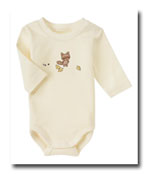
onesie

“For newborn babies, you want the softest and highest quality fabrics against their tender
skin,” said Lisa Bayne, senior vice president, marketing, Gymboree. “That is why Gymboree developed
SuperSoft. This joint marketing campaign with Cotton Incorporated reinforces Gymboree’s expertise
in bringing the best possible products to its customers.

September 2005

Quality Fabric Of The Month: Less Is More

ARC Outdoors, Broken Arrow, Okla., and NanoHorizons Inc., State College, Pa., have formed a partnership to promote and license nanotechnology to textile manufacturers and brands.

ARC Outdoors sells body heat-reflective cold weather apparel and manufactures outdoor
activewear with scent-elimination properties. NanoHorizons was established by Stephen Fonash,
Ph.D., founder and director of the Penn State Center for Nanotechnology Education and Utilization,
to develop solutions based on nanotechnology licensed from Pennsylvania State University.

“We had problems we wanted to resolve with existing products when we met NanoHorizons and began investigating what nanotechnology could do to improve our products,” said Rus Huffstutler, executive vice president, ARC Outdoors. The company has introduced a line of E47™ Nano Technology branded fabrics and yarns, and through the ARC Materials Licensing Program will offer the technology to other manufacturers. Huffstutler noted E47 application areas will include more than just performance apparel, mentioning carpet, baby clothes and footwear, among other areas.

qfom_Copy_22

E47™ cotton fiber magnified 2,650 times looks unaltered. Inset: Magnification of 40,000
times shows embedded E47 nanoparticles.

The first E47 products offer anti odor properties through an additive that the companies claim provides truly permanent, safe and effective protection without compromising a garment’s other performance properties or comfort level; and offers an inexpensive solution that allows the use of conventional manufacturing
machinery in downstream processing.

The antiodor technology embeds silver particles measuring less than 15 nanometers (nm) in diameter throughout the fiber. Dennis Schneider, director, sales and marketing, NanoHorizons, explained that, volume for volume, particles of this size offer far more surface area to produce microbe-fighting silver ions than larger nanoparticles. Therefore, less silver is needed to accomplish the same end.

E47 additives have been developed for cotton and polyester, and versions for nylon and polypropylene are planned. Schneider said the cotton additive bonds permanently to the cotton fiber and is applied using a process similar to dyeing. “We believe we have created the first antimicrobial additive that creates permanently antimicrobial cotton — and the only one that allows the end product to still be ‘just like cotton,’” he said.

The polyester additive is pelletized for use in a hot-melt extrusion process. “Our Master Compound is blended with standard polyester pellets in a very specific recipe in the fiber extruder, creating a polyester fiber that has an even distribution of our custom nanoparticles bonded directly and permanently into the polyester itself,” Schneider said.

He also noted the E47 additives will not clog extruders or affect fiber quality, as other particle additives are prone to do.

Huffstutler said E47 technology can be customized. “The effectiveness of a property can be increased or decreased according to the end-use,” he explained. “The technology will allow brand manufacturers to innovate their own products.”


For more information about E47™, contact Bob Parker or Bill Douglas, ARC Outdoors (918)
258-8788;
 www.e47nano.com.


September 2005

Küsters Donates FlexNip To Pakistani University, Commissions Range In Turkey

Germany-based Eduard Küsters Maschinenfabrik GmbH & Co. KG recently donated a laboratory
version of its FlexNip chemicals applicator to the National Textile University of Faisalabad,
located in Pakistan. Students will be able to use the new applicator to conduct practice-oriented
laboratory tests.

kusters_Copy_4
Küsters’ laboratory version FlexNip chemical applicator

Küsters presented the machine to the university earlier this year during Igatex 2005 – an
international conference and trade fair held in Pakistan for the textile, apparel and leather
machinery industry.

In other news, the company successfully commissioned a complete system at Zorlu Linen Dokuma
Emprime, Turkey, a manufacturer of bed linens. The system consists of a continuous bleaching range
with FlexNip applicator, a pad-batch dye range with Contidos SF dosing station and a HyCon-L
textile calender.

September 2005

EU Commissioner Announces Agreement On Chinese Textiles

“We have found a satisfactory and equitable solution” says EU Commissioner Peter Mandelson in a
press conference on the Chinese textile issue. In a press conference held in Beijing after the
signature of an agreement between the EU and China to unblock the current textile imports blocked
in the EU borders, the EU Trade Commissioner reminded that the agreement still has to be discussed
among the EU member states and referred to the difficulties risen on implementing the agreement
signed in Shanghai in June: “when member states were pressing me to negotiate I said that there
were difficulties to operate an agreement like this. We have to make sure that the agreement is
managed smoothly and that we listen to all, importers, suppliers, retailers and textile producers.”
The agreement concluded today could mark the end of goods blocked in EU ports. “I hope it will be
possibly quickly to unblock the goods currently at the EU border,” Mandelson said, referring to the
urgency to solve the current situation. On questions about trade war, Mandelson answered that
“textile issues have been out of proportion this summer but it has increased the importance of free
trade, and China and Europe have not, are not and will not be at war. We have common interests and
we want this relationship in the long term” and reminded those asking for protectionist measures
that “the laws of comparative advantage persist even if China is a major economic power”. Mandelson
finally explained that “this is not about the return to quotas of the past, the textile quotas of
the old agreement are not coming back, we are moving to an era were there will be no quotas at all,
but Europe needs two to two and a half years to manage the transition”. The Commission spokesperson
Franse Le Bail earlier announced today that a special meeting of the trade committee (the 133 committee) in the Council would discuss the agreement reached.

Press Release Courtesy of the European Union

September 2005

AATCC Acquires CITDA Assets

The American Association of Textile Chemists and Colorists (AATCC), Research Triangle Park, N.C.,
has acquired selected assets of the Charlotte-based Computer-Integrated Textile Design Association
(CItdA). The assets include the CItdA name, logos, members list, website and CItdA Student
Scholarship Competition.

According to AATCC, the CItdA assets will enhance its ability to offer new programs and
activities through its Concept 2 Consumer interest group, which offers publications and events, and
conducts specific projects of importance to textile designers and manufacturers.

September 2005

US-China Textile Trade Talks Bogged Down

As a second round of negotiations failed to reach a US/China comprehensive agreement on textile and
apparel imports, the US government is continuing to consider and approve petitions to limit imports
using the safeguard mechanism China agreed to as a condition or its admission to the World Trade
Organization. On August 31, the Committee for the Implementation of Textile Agreements (CITA) added
two more product categories brassieres and man-made filament fabric to the list of some 30 product
categories where the safeguard mechanism is being used. Decisions on four other cases covering
sweaters, dressing gowns, wool trousers and knit fabric were delayed until October 31.

The US government in July imposed quotas on cotton trousers, cotton knit shirts and
underwear, and an embargo already has been placed on those products for the remainder of this year
as the quotas were quickly filled. If additional quotas are approved, they would extend only to the
end of this year, and the textile industry would have to submit new applications demonstrating
market disruption. In the case of petitions decided upon after October 31, the quotas would be in
effect for a full calendar year if the petitions are approved.

While the safeguard mechanism has restrained some imports and likely will do it for more, US
textile manufactures would like to have a comprehensive import limitation agreement through 2008.
Importers of textiles and apparel, while opposed in general to import quotas, would if necessary
like to see an agreement that would result in some certainty in the marketplace.

The US and Chinese governments continue to be interested in reaching agreement on a
comprehensive bilateral agreement. Following the second round of unsuccessful negotiations, Special
Textile Negotiator David Spooner said he is consulting with the Chinese on a date and place to
resume the talks and he remains optimistic that progress can be made toward resolving remaining
issues.

After the talks broke down, textile importers called for renewal of the negotiations while
cautioning that the United States should proceed cautiously and not agree to quotas that would not
necessarily bring production back to the United States. In a statement following the collapse of
the talks, Laura E. Jones, executive director of the US Association of Importers of Textiles and
Apparel, said: “We are extremely concerned by reports that the United States presented a proposal
in Beijing that was even more restrictive than what the US side presented during negotiations in
San Francisco earlier this month. If the United States really wants an agreement, it should be
moving toward a compromise, not in the opposite direction.” She said any agreement should reflect
the interests of the United States and whole including importers, retailers and consumers, as well
as textile manufacturers.

When the talks were broken off, the major textile and apparel manufacturers trade
associations praised the US negotiators for taking a strong stance on behalf of the domestic
industry. Karl Spilhaus, president of the National Textile Association, said the industry is united
in its belief that no agreement is better than a bad agreement. Cass Johnson, president of the
National Council of Textile Organizations, said that in view of the failure to reach a
comprehensive agreement, the US industry will continue to be aggressive and shortly will be filing
additional safeguard petitions.

September 2005

TEXbase Online Offers Web-Based Suite Of Solutions

TEXbase, Bozeman, Mont., has introduced its TEXbase Online suite of subscription-based software
solutions to facilitate development of textile raw materials and shorten time-to-market for new
products.

According to the company, the Web-based solution is affordable and easy to use, and enables
textile professionals to save up to 50 percent of the time required for development. Customers may
subscribe only to the software applicable to their particular needs. Included in the suite are
Textile Marketing Manager to speed up bui
lding of market share; Lab Data Manager for automated storage and analysis of a high
volume of performance data; and Sourcing Manager to facilitate sourcing, research and development
of new fibers, yarns and fabrics.


September 2005

Industry Pursues New Trade Agenda


F
ollowing ratification of the Dominican Republic- Central American Free Trade Agreement
(DR-CAFTA), US textile and apparel manufacturers and importers are looking ahead for what they can
see with respect to trade with China and a worldwide round of trade liberalization negotiations
known as the Doha Round.

From the standpoint of US textile manufacturers and importers, the highly controversial
DR-CAFTA, which barely squeaked by Congress, holds out the promise of new market opportunities and
more long-range stability for those companies willing to make the necessary commitments to do more
business in this hemisphere.

No one expects DR-CAFTA to result in a new surge of trade opportunities, but rather an
evolution that will result in less dominance of international trade in textiles and apparel by
China and other Asian low-wage country suppliers. The DR-CAFTA countries have combined economies of
less than 2 percent of that of the United States and a standard of living well below the US poverty
level. As a result, they don’t present much of a market for US clothing, home furnishings or other
textile products. Where the market opportunities lie is in the US-made inputs in apparel that will
be made in the Central American countries and exported duty-free to the US market.

DR-CAFTA provides duty-free access to the US market for apparel made of US or regional yarn
and fabric. Pocketing and linings also must be of US origin.

Apparel with Mexican and Canadian inputs will be duty-free eventually under cumulation
provisions of the agreement. Before that can happen, Canada must pass legislation modifying its
participation in the North American Free Trade Agreement (NAFTA), and Mexico must enter into new
customs agreements with the United States to prevent illegal transshipments.

There is a special tariff preference level (TPL) with Nicaragua that initially will allow 100
million square meters of fabric or yarn from foreign sources in its cotton trousers, and that
eventually will be scaled down over a five-year term, after which Nicaragua must match its use of
foreign inputs with an equal amount of fabric and yarn made in the United States. Costa Rica has a
small TPL that permits use of 500,000 square meters of foreign wool inputs. The agreement also will
require participating countries to demonstrate they are enforcing their own labor laws and working
to improve them. Up to this point only three countries — El Salvador, Guatemala and Honduras — have
ratified the agreement. Until the other three ratify it, they cannot benefit from the special
duty-free treatment for their exports.

Since the Central American countries for the most part already had duty-free access to the
United States under the Caribbean Basin Trade Partnership Act (CBTPA), the new pact has two
important features: DR-CAFTA is permanent, while the previous CBTPA legislation was subject to
renewal and perhaps modification; and DR-CAFTA should result in more two-way trade. Members of the
National Retail Federation, Washington, and other importers say DR-CAFTA will give them more
choices for sourcing clothing, and Central American countries will have a definite time-to-market
advantage.

chesnutt_Copy_2James W. Chesnutt, CEO, National Spinning Co., New York City, and
chairman, National Council of Textile Organizations (NCTO), Washington — a strong supporter of
DR-CAFTA as it worked its way through Congress — sees many opportunities for US textile
manufacturers in Central America. He believes there is a good amount of unused capacity in Central
America that can be put to work using US-made fabric and yarn. In order to benefit from the pact,
he believes, textile manufacturers should encourage their customers to look toward Central America
to produce their finished products, they should use whatever influence they have with retailers to
do the same, and they need to work with partners to develop full packages.

“We need to find out what they need and then provide the products, quality and service they
want in order to take advantage of the opportunities proximity to market presents,” he said.


Trade With China

Ever since Chinese apparel imports surged as much as 1,500 percent after quotas were removed
last January, the US government, at the behest of domestic textile manufacturers, has been using
the safeguard mechanism in China’s WTO accession agreement to impose new quotas. Some 20 safeguard
petitions covering a wide range of products have been approved or are pending. China is not very
happy about that, and neither are US importers of textiles and apparel, but domestic manufacturers
see safeguards as a way to stem the flood of imports. The trouble with safeguards — which if
approved will apply a 7.5-percent annual growth factor on imports for one year — is they will
expire at the end of this calendar year, and an attempt will have to be made to roll them over. In
addition, the safeguard opportunity expires in 2008.

As a result, US textile manufacturers have been pressing for a comprehensive quota agreement
to replace the piecemeal safeguards approach. US and Chinese trade officials held negotiations on a
comprehensive agreement, but differences remain. A spokesman for the US Trade Representative said, “
Both China and the United States are working towards a broad solution that provides greater
certainty for the textiles market.” That certainty is something US importers of textiles and
apparel would like to have, and textile manufacturers would like to have a cap on import growth.

Above and beyond any consideration of quotas, China’s manipulation of its currency remains a
major problem. China announced it would revalue its currency by 2 percent, but no one in the United
States feels it would make much of a difference with a currency that textile industry leaders say
amounts to a 40-percent subsidy for imports. A broad-based coalition of manufacturing, labor and
farm organizations has dubbed China’s action “woefully inadequate.” Members of Congress are holding
a club over China’s head with legislation that would impose a 27.5-percent duty on Chinese goods if
it does not revalue its exchange rate. The legislation’s chance of passage is slim, and President
Bush likely would veto it.

Other legislation of interest is a measure that would permit the United States to levy
countervailing duties on goods from non-market economies such as China. A goal of US textile
manufacturers, it could become a reality as Congress becomes more concerned about what it says is
illegally subsidized China trade.


What’s In The Doha Round For Textiles?

The Doha Round of trade liberalization negotiations is not too far over the horizon. World Trade
Organization (WTO) member nations have set the end of 2006 as the deadline to conclude an overhaul
of international trade by reducing tariffs and non-tariff barriers, cutting agriculture subsidies
and generally promoting free and fair trade. US Trade Representative Rob Portman met recently with
WTO officials in Geneva and following the sessions said: “The United States will continue to lead
in the Doha Round. … [W]e believe in it, we believe as prime advocates of reform across the board
that a successful Doha Round is extremely important not just for the United States but to the
global economy and particularly to the developing world. We continue to be very ambitious in what
we’d like to see Doha achieve in market access.”

The next important step is a ministerial meeting scheduled for next December in Hong Kong, at
which time it is hoped a formula for the formal discussions will emerge.

In connection with that formula, US textile manufacturers want “sectoral negotiations” where
textile trade will be considered separately from other manufacturing industries. They do not want
textiles to become a bargaining chit in deals with other commodities. The US government is
supporting that position.

In the formal negotiations, US manufacturers will be opposed to any tariff cuts until textile
and apparel tariffs in other countries are brought down to US levels. In addition, they will seek a
comprehensive, long-term safeguard mechanism that could remain in effect beyond the 2008 expiration
date of the Chinese safeguard agreement.

The very shape and future of the US textile industry will be at stake as these issues unfold
over the next few months.


September 2005

 

Sponsors