
Optimizing Apparel Manufacturing

datatexopen


O
limpias

S.p.A., the Italy-based manufacturing
organization of the Benetton Group, has completed the consolidation of 10 servers to optimize its
information technology (IT) structure by leveraging existing skills and resources, and
standardizing applications and data.

Today, the Italy-based Benetton Group S.p.A. is present in more than 120 countries around
the world. With apparel production at its core, it is a group with a strong Italian character and
its style, design expertise and passion are clearly seen in its brands – the casual United Colors
of Benetton, the more fashion-oriented Sisley, Playlife leisurewear and Killer Loop streetwear. The
group produces around 110 million garments every year.

Olimpias operates 12 plants in Italy, with 2,000 employees and a turnover of more than 300
million. Its most important customer is Benetton; however, 30 percent of its output is sold to
companies outside of the group – proof of Olimpias’ production quality and level of customer care.

Its organizational structure to reach these targets is complete – product design, product
engineering, and marketing and sales. The production can be marketed at any level of the bill of
material and of the production cycle – yarn, gray fabric or finished fabric.

Olimpias handles all production steps from yarn to finished fabric – yarns, weaved and
knitted fabrics, printed fabrics, and dyeing and washing operations.

The company recently enlisted Switzerland-based Datatex AG, a leader in enterprise resource
planning for the apparel and textile industry, to upgrade its IT infrastructure. Mario Pillon,
chief information officer, Olimpias, recently gave his view of the consolidation project.

mario
Mario Pillon, chief information officer, Olimpias


Datatex: What’s the primary goal of your project with Datatex?

Pillon: The deployment of the Datatex solution in 12 Olimpias plants drove
significant benefit to our company – enhanced efficiency, measured by the inventory levels, and
reduced time to market. Moreover, the Datatex solution was the tool to align to a single
organization model. The 12 plants previously worked with different structures.

However, our group was not satisfied with the reached level of standardization and
information sharing. Therefore, we launched this project to gather together all resources and to
integrate the data. The project was feasible because every plant was using the same information
system functions, in spite of different manufacturing activity.

Datatex: What are the main phases of your project?

Pillon: The project goal is to concentrate physically and logistically all the
production supporting applications. The target is a unique information system providing services to
all the plants, fully fitting the specific requirements of every manufacturing unit and
guaranteeing a correct interface with the departmental applications.

The first phase was the migration of every plant information system to the iSeries installed
in Ponzano Veneto. Of course it was not a simple removal. We took advantage of this activity to
enhance the level of use of the Datatex solution in all those plants that had implemented a subset
of the available functions.

The second phase is focused on the “logical” consolidation of the information system. For
example, we will have a single bill of material, used by the Olimpias’ plants producing yarns and
by those manufacturing fabric. Therefore, the article code of the yarn has no need to be changed
when it is delivered to the plant using it.

Datatex: Can Olimpias be viewed as a single, integrated plant?

Pillon: Yes, but in order to understand the project size and complexity, it is
useful to remember that the project concerns companies acquired through the years, located in 10
different places, each of them with a significant use of third-party manufacturing operations. The
starting point was 10 Datatex solutions installed in 10 different locations to support a total of
330 workstations.

Datatex: Usually, for a complex project, the hottest item is the respect of the
time budget. What about you?

Pillon: Olimpias management was strongly committed to the project and gave it the
highest priority. Therefore, the plant managers forgot the fear of “losing” their own information
system and were involved by the top management to evaluate and reach the big benefits for the whole
group.

From the operational point of view, we created a team with Olimpias system engineers and
Datatex project leaders. The pace was the consolidation of a plant information system every three
months.

Datatex: Any main direction or idea to make the project feasible?

Pillon: First of all, we worked to fit the specific requirements of each plant. We
are becoming a “virtual” single vertical plant without imposing changes to the structure and
guaranteeing the application functions already implemented by each plant. Moreover, the project
preliminary phase was the creation of analysis standard and of implementation and development
standards. These tools shortened the implementation time and made uniform and consistent the work
of the whole group.

November 2005
Hong Kong Mill Licenses Cotton Incorporated’s EFS® System

Central Textiles (Hong Kong) Ltd. has
become the first textile mill in Hong Kong and China to license and implement the Engineered Fiber
Selection® (EFS®) Cotton Fiber Management System, a suite of software developed by Cotton
Incorporated, Cary, N.C., to facilitate production of high-quality cotton yarn.

Central Textiles operates one 57,000-square-meter spinning mill in Guangdong province and is
set to open a second mill. The family-owned company currently purchases 250,000 bales of US cotton
annually and employs 1,500 people.

EFS software enables users to access and use High Volume Instrument (HVI) data provided by
the US Department of Agriculture (USDA) for each bale of US-produced cotton, which is the only
cotton that is evaluated for its key properties and labeled with USDA HVI data.


October 2005

Textile Innovators Offers WFK Test Fabrics In US, Canada


Windsor, N.C.-based Textile
Innovators has been named exclusive US and Canadian distributor for Germany-based WFK consumables,
such as soiled samples and other test materials. The samples are used in testing the efficacy of a
wide range of detergent products, as well as washing machines.

WFK, a spin-off company from WFK Research Institute, supplies cotton, cotton/polyester,
wool, silk, acrylic and nylon testing samples stained or soiled with natural and man-made
substances such as foodstuffs, lipstick, motor oil, shoe polish, clay, vacuum cleaner dust, and a
peat moss/soot/ cement mixture. The samples are available in standard widths of 80 centimeters and
lengths of up to 36 inches, with other sizes available on request.

Through a reciprocal arrangement, WFK sells Textile Innovators’ consumables in
Europe.


October 2005

Filtration Group Consolidates HVAC Filter Manufacturing

Filtration Group, Joliet, Ill., has
combined its three East Coast heating, ventilation and air conditioning (HVAC) filter manufacturing
operations at one location in a new 235,000-square-foot production facility in York, S.C. The
company previously operated facilities in Delaware, North Carolina and York.

“Having our entire East Coast operations in York is going to improve the speed of delivery,”
said Dave Flynn, director of manufacturing. “Orders can be shipped directly to the customer,
without passing through another distribution point, saving Filtration Group and our customers not
only time, but money.”

The company has added 35 new employees in York and plans eventually to hire 75 to 100
additional people, according to Larry Ost, CEO.


October 2005

Optiant, GlobalReact Team Up To Provide SCM Solutions

Optiant Inc. — Boston-based developer
of the PowerChain® software solution for supply chain management (SCM) — and GlobalReact — a
Charlotte-based software provider and technology consulting firm — have formed a partnership
whereby GlobalReact will supply PowerChain to manufacturers of textiles and apparel, among other
products. The software suite facilitates the design and optimization of supply chains; and includes
tools for management of inventory placements, and integration of sourcing and distribution
strategies.


October 2005

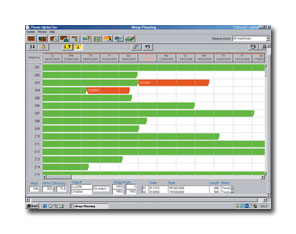
TC Nicolon Selects Porini’s AlphaTex CIM System

Ten Cate Nicolon USA (TC Nicolon),
Pendergrass, Ga., has selected Italy-based Porini S.r.l.’s AlphaTex computer integrated
manufacturing (CIM) system to enable it to implement a lean manufacturing approach in its
operations.


supplier_Copy_14


Warp-planning screen from Porini’s AlphaTex CIM system


Porini reports AlphaTex combines industry-specific capabilities and consulting expertise in
a user-friendly system that can be integrated with existing business systems and dynamic report
generation tools.

“We believe that the AlphaTex CIM system will improve our manufacturing execution and provide us
with a state-of-the-art platform for monitoring the shop floor,” said Kevin Cook, engineering
director, TC Nicolon.

October 2005

Jacob Holm Opens US Subsidiary

Jacob Holm Industries GmbH, a
Switzerland-based manufacturer of hydroentangled and composite nonwovens, has opened a production
line in Candler, N.C., to serve industrial, hygiene and wipes markets in the Americas. Jacob Holm
Industries (America) Inc. boasts a 4.5-meter-wide line and an annual production capacity of 15,000
metric tons. The plant will process a variety of raw materials including cotton, and also will
offer a variety of off-line after-treatment options.

According to the company, the new facility will offer its North American customers shortened
delivery lead times for innovative and cost-effective products, and will improve access to its
research and development, technical, quality and sales resources.

October 2005

Dracup Presents Selvedge Jacquard Sample Machines

England-based Dracup (UK) Ltd. recently unveiled its new-generation
HS2000 Selvedge Jacquard machine and its upgraded Sample Master Weaving Machine.

The HS2000, used to produce names and other design elements, is horizontally end-mounted on
the weaving machine and offers high-speed operation, according to the company. Features include
electronic selection, and a standard lift range from 60 millimeters (mm) to 90 mm, or an optional
range from 120 mm to 180 mm using a double lift unit. The machine may be driven via mechanical
linkage from the host weaving machine or via an independent drive system using an electronic
resolver to control its own servo motor. The Dracup Loom Controller automatically monitors and
synchronizes the jacquard and the host machine. The Sample Master enables speedy sample weaving and
style changes, and uses the jacquard harness to weave both complex and dobby designs. The upgraded
version produces striped fabric samples more quickly than the previous one, the company reports.
The Dracup CAD (computer-aided design) system used to develop and modify patterns allows them to be
rotated.

October 2005

Herff Jones Implements Third Eton UPS System

Indianapolis-based graduation cap and
gown producer Herff Jones Co. of Indiana Inc. recently implemented its third unit production system
(UPS) from Sweden-based Eton Systems AB, a leading provider of such systems for the sewn products
industries. The system is designed to automate throughput of material during production and
minimize material handling at each step of the manufacturing process.

Graduation cap and gown producer Herff Jones Co. of Indiana Inc. has impelemented its third
Eton unit production system.

Herff Jones installed the UPS at its
Arcola, Ill., plant, which manufactures more than 1.5 million graduation gowns each year. With this
addition, the company has completely converted from a progressive bundle system to unit production
for almost all of its ClassKeeper™ retainable cap and gown production.

October 2005

ATMI Presidents 1910-1920

ATMI Presidents D.Y. Cooper, 1910-1911, was president of Henderson Cotton Mills and Harriett Cotton
Mills, Henderson, N.C. He was born in Granville County, N.C., April 21, 1847 and died in Henderson
on December 20, 1920. As ACMA president, he stressed development of a sounder foreign trade.Captain
Ellison A. Smyth, 1911-1912, was associated with Francis J. Pelzer in establishing Pelzer
Manufacturing Company at Pelzer, S.C. and was a founder, officer or director of a number of other
mills in South and North Carolina. He is credited with installing the first incandescent lighting
system in an American cotton mill in f1882: the first electric drives used in cotton mill in 1895;
and the purchase of the first Draper automatic looms. He also was involved in banking, in the
newspaper business, and in the electric power industry. As president of the South Carolina Cotton
Manufacturers Association, he was the first to sponsor a state child labor law. Captain Smyth was
born in Charleston on October 25, 1847 and died August 3, 1942 at the age of 94.W. A. Erwin,
1912-1913, began his textile career in 1882 and for some 11 years served as general manager and
treasurer of E. M. Holt Plaid Mills in Alamance County, N.C. He established Erwin Cotton Mills Co.
a West Durham, N.C., and, at the time of his death, also controlled the Durham Cotton Manufacturing
Company, the Pearl Cotton Mills, Oxford Cotton Milles, Locke Cotton Mills Co. and Erwin Yarn Co. He
was born July 15, 1856 and died February 28, 1932.Scott Maxwell, 1915-1916, began his career at
Androscoggin Bag Mill, Lewiston, Me., and worked in mills in New England, South Carolina and
Alabama before becoming mill agent at Indian Head Mills, Cordova, Ala. in 1903, a post he held
until his death in 1916. He was born at Webster, Me., July 8, 1855, and died November 4, 1916 at
Dover, N.H.John A. Law, 1916-1917, worked actively for a closer relationshop between Southern and
New England manufacturers. He was a member of the committee that organized the Cotton-Textile
Institute, and was an original member of the National Industrial Conference Board. He served for
many years as president of Saxon Mills, Spartanburg, S.C.Fuller E. Callaway, 1917-1918, organized
and directed anumber of cotton mills in Georgia, the best known being Callaway Mills at LaGrange.
He served as ACMA president during the difficult first year of World War I, then became chairman of
the Commission on European Representation at the World Cotton Conference, which he served as vice
president. He was born at LaGrange, Ga., on lJuly 15, 1870 and died February 12, 1928. A son, Cason
J. Callaway, served as Association president 1931-1932, and another son, Fuller E. Callaway, Jr.,
was first vice president.Arthur J. Draper, 1918-1919, president of Chadwick-Hoskins Co., Charlotte,
also served as president of the North Carolina Cotton Manufacturers Association. He was born on
April 28, 1875 and died April 26, 1932.James D. Hammett, 1919-1920, was born March 16, 1868 at
Greenville, son of Colonel Henry Pinckney Hammett, one of the South’s pioneer cotton manufacturers.
He began work at the bottom of the mill in 1890, because assistant treasurer of Orr Cotton Mills,
Anderson, S.C. in 1900 and went on to organize Chiquola Manufacturing Co., Honea Path, S.C. and to
serve as president of Chiquola, Anderson Cotton Mills, Brogan Mills and Orr Cotton Mills, all at
Anderson and Watts Mills, Laurens, S.C. He was a director of Piedmoont and Northern Railway and
active in banking. A son, L.O. Hammett, became president of the South Carolina Cotton Manufacturers
Association.Stuart W. Cramer, 1913-1914, is credited with having planned or equipped one-third of
the cotton mills operating in the South at the time of World War I. An inventor of note, he was
granted more than 60 patents. He was president of the National Council of American Cotton
Manufacturers in 1917-1918 and again from 1920 to 1927. He was a vice president of the
Cotton-Textile Institure, and a director and treasurer of the Textile Foundation. The National
Association of Cotton Manufacturers awarded him a medal in 1913 for his work on the protective
tariff.T. I. Hickman, 1914-1915, was second president of The Graniteville Co., 1889-1915. As
Association president, he campaigned energetically for more extesive use of cotton goods, even
attempting to get railroads to replace the traditional blue serge of conductors with cotton khaki.
He was born April 14, 1866 an died in Augusta, Ga., on March 21, 1941.

Sponsors