Devanlay Establishes Subsidiary In El Salvador

France-based Devanlay — global
licensee and part owner of the Lacoste apparel brand — recently set up manufacturing operations in
El Salvador. The company attributed the country’s excellent business environment, easy access to
the United States, support provided by the government and productivity of its workers as
contributing factors to the decision.

Devanlay, which also has operations in China and Peru, will establish Trans America Textil
El Salvador S.A. de C.V. in the Miramar Free Zone, and will work with local subcontractors. The
Argus Group will provide cut-and-sew processing, while Industrias Duraflex will manufacture and dye
cotton fabrics.

kanews_Copy_13
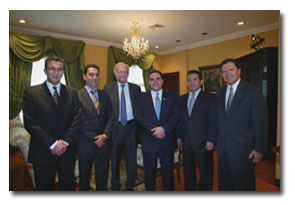
El Salvador and Devanlay representatives celebrate Devanlays decision to establish a
subsidiary in El Salvador. From left to right: Badis Kouidrat, managing director, Devanlay Peru;
Bruno Luppens, board member, Devanlay; Guy Latourrette, president of the Board of Directors,
Devanlay; Elias Antonio Saca, president, El Salvador; Roberto Bonila, president, Miramar Free Zone;
and Ricardo Avila, vice president and managing director, Miramar Free Zone.

Trans America first will produce men’s
polo shirts and expects to export nearly 200,000 units to the United States in 2005. The company
hopes to expand with the production of striped polo shirts for men, ladies’ polo shirts and
dresses, and children’s sportswear, among other items.

November/December 2005

Johns Manville To Boost Richmond Plant Capacity

Johns Manville (JM), Denver, will
increase its Formaldehyde-free™ fiberglass insulation capacity by almost 20 percent when it
constructs a new loose-fill line at its Richmond, Ind.-based manufacturing plant. The company
expects to complete the new line by mid-2006.

The expansion is the next phase of JM’s capacity-increase efforts, which will add up to 200
million pounds of insulation and will be complete by the end of 2006. Loose-fill production will be
boosted by almost 50 percent.

November/December 2005

Reinventing Advanced Cerametrics


agassi
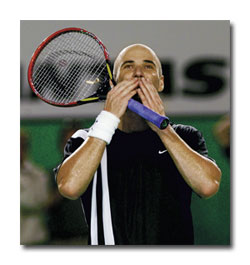
Andre Agassi uses a Head Intelligence series tennis racket powered by Advanced Cerametric
Inc.’s self-powered piezoelectric ceramic fiber composites.


A
dvanced
Cerametrics Inc. (ACI), Lambertville,
N.J., has developed a technology to produce ceramic fiber from nearly any ceramic material. These
fibers possess the desirable properties of ceramics — such as thermal, chemical, electrical and
mechanical properties — but mitigate the detrimental characteristics —such as brittleness and
weight. ACI’s ceramic fiber technology has many novel applications including the ability to
scavenge functional amounts of electric power directly from wasted mechanical energy, eliminating
the need for batteries or power cabling in many systems.


Corporate Overview

ACI has supplied ceramic and metal thread guides to the domestic and
international textile industry for more than 58 years. ACI’s origins trace back to 1947 when Dick
Cass founded Lambertville Ceramic and Manufacturing Co. (LCMC). LCMC grew steadily through the
early 1970s as Cass’ son, Richard “Bud” Cass, joined his father in the business. The crash of the
US textile industry began in earnest in the late 1970s, and many of LCMC’s customers closed their
doors. Those textile businesses that remained open began purchasing foreign textile machines,
forcing LCMC to suffer a double blow to its customer base. As a result, the company searched for
new ways to use resident core technologies to find a way to survive.


The company adopted the name Advanced Cerametrics in 1991 to reflect its plan to enter into
high-tech markets. ACI capitalized on its technical strengths and developed a range of new products
starting with Conduxite, its patented, highly electrically conductive ceramic for use in
electrochemistry. This led to the formation of HiTc Superconco, a wholly owned subsidiary, whose
business model used ACI’s ceramic expertise to manufacture new ceramic high-temperature
superconductor materials. The superconductor venture led ACI into the realm of high-tech research,
and the company became an expert at winning Small Business Innovation Research grants and others
from the US departments of Defense and Energy and the National Aeronautics and Space
Administration. These grants permitted the company to develop a Viscous Suspension Spinning Process
(VSSP) to form fibers from nearly any ceramic material. This patented process is the basis for many
innovative fiber products, ranging from energy harvesting in sporting goods to reinforcement of
bone scaffolds to solid oxide fuel cell separators.


VSSP

This process loads a rayon precursor viscose with a high-volume percentage of
ceramic powder. This mix is spun through platinum spinnerets into mild sulfuric acid with a high
percentage of an added salt. The resulting acid/base reaction coagulates the cellulose with the
ceramic in it, and the salt pulls the water out, dehydrating the fiber and reducing its diameter
without stretching, which normally would pull the ceramic particles apart. This cellulose/ceramic
fiber then is washed and handled like a textile. Once formed into desired shapes, it is placed in
the furnace and processed as if it were ceramic.

Ceramic materials that have successfully been made into fiber form using ACI’s process
include: lead zirconate titanate for PZT-piezoelectric; titanium dioxide for batteries and water
purification; yttrium-stabilized zirconium oxide for biomedical uses, fuel cells and ceramic and
metal matrix composites; aluminum oxide for ceramic matrix composites; iron silicide for stealth
applications; and calcium carbonate for paper applications; among many others.


History Of the Process

In the late 1980s, LCMC’s management recognized that developing new technologies
was critical to saving the business. Building on core competencies, the company expanded its
superconductor and conductive ceramic businesses to conceive an entirely new technology. LCMC’s new
president, Bud Cass, was looking for ways to make superconducting fiber. Media reports had
speculated that 90 percent of all high-temperature superconductors would be in the form of wire.
Knowing ceramic wire was not a realistic possibility, Cass sought a way to make superconductors
from ceramic fiber.


Ceramic superconductors require extremely pure processing conditions. The first thought was
to coat an organic fiber with a superconductor and then burn the organic fiber away. Carbon fiber
was selected because it burns away as carbon dioxide and water, leaving no residuals in the crystal
grain boundaries.

Superconducting tubes were produced, thus proving the concept. However, the tubes were too
weak to be practical. Cass looked farther back into the fiber process to see how carbon fiber was
made, with the idea of loading the carbon fiber precursor with the superconductor powder and then
burning the precursor away.

Through pure serendipity, LCMC’s largest customer was Avtex Fibers Inc., Front Royal, Va. —
the largest manufacturer at the time of carbon fiber precursor rayon fiber. LCMC convinced Avtex to
load viscose with LCMC’s superconductor powder using LCMC’s new methods, and spin it as if it were
rayon.

The concept worked. Once Avtex recognized the value of its rayon as a fugitive carrier for
LCMC’s product, the idea of using the same machines and people to make $300-per-pound ceramic fiber
versus 50 cents-per-pound rayon made sense.

After Avtex shut its doors in the late ‘80s, LCMC — soon to become ACI — worked with
Germany-based BASF AG and then with Elizabethton, Tenn.-based North American Rayon Corp. as its
viscose supplier.

ACI acquired Avtex’s pilot spinning line, made significant modifications to the rayon
process and began spinning fiber in Lambertville. Using its modified process, ACI has been able to
make ceramic fiber from rayon viscose, cellophane viscose, sausage casing viscose and sponge
viscose.

ceramicfibers
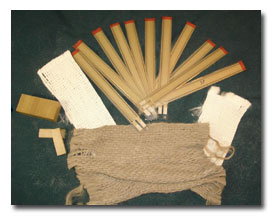
ACI manufactures ceramic fibers of various compositions in the form of sensors, actuators
and woven mats for composite reinforcement and fuel cell separators.


Applications And Products

The first commercial products
emerging from this process are high-performance ultrasound transducers that can signal over
multiple frequencies and solve the lateral wave interference of dice and fill solutions, providing
a significantly cleaner image trace than current state-of-the-art transducers. The most successful
products have been Amsterdam-based Head NV’s family of Intelligence™ “smart” tennis rackets and
skis. JossWest, Ruidoso Downs, N.M., sells smart pool cues that use ACI’s ceramic fiber composites
to dampen up to 50 percent of the vibration of a break or shot, providing more comfortable playing
and straighter shots.

ACI currently is investing significant monies to develop energy-harvesting technologies that
will eliminate batteries in applications ranging from heart pacemakers that use pulse as the source
of power to wireless sensor networks that use the activity being sensed as the source of power.

The company’s fibers are able to generate and store enough power to run small electronic
systems from a few seconds of moderate-type vibrations. One example is the ability to power a
soldier’s global positioning system from the vibrations of his steps while walking.

ACI also has developed a new generation of products that can produce light from mechanical
energy directly without using any intervening electronics. An example is self-powered lights on
navigation buoys that use rocking as the source of power, eliminating the use of batteries.

Self-diagnostic systems also are being realized. One example is a self-diagnostic bearing
that uses ambient vibration to charge a radio frequency transmitter that relays information to a
central data collection site, informing maintenance of the bearing’s health.

ACI’s Variable Diameter Fiber (VDF) technology has been shown to increase the absolute
strength of reconstructive bone cement by a few percentage points. This is a good thing because one
wouldn’t want new bone area to be significantly stronger than surrounding bone.


The Future Of ACI

ACI has taken its core technology and
combined it with the oldest synthetic fiber technology to become a textile company, resulting in
many new uses and textile processes that were unheard of just five years ago.

The company currently is focusing on producing piezoelectric fiber composites for energy
harvesting, where it can harness ambient mechanical energy such as vibration to power electronic
systems without the need for external power systems such as batteries. Self-powered sports
computers using ACI’s piezo fiber composite power sources will be in stores in the summer of
2006.


Editors Note: Richard Cass is president; Farhad Mohammadi, Ph.D., is director, research; and
Stephen Leschin is manager, business development, at Advanced Cerametrics Inc.

November/December 2005

Fordham Changes Name To United Apparel

Fairfield, N.J.-based apparel company
Fordham Inc. has rebranded itself as United Sport Apparel.

“This change builds upon our acquisitions this year of Hewitt Manufacturing and Gorga
Athletic Wear, bringing 65-plus years of handcrafted, quality apparel to this new name,” said James
Lombard, president, Fordham. “Rebranding as United Sport Apparel recognizes the scope of our
product offerings, as well as our united approach to servicing our customers’ needs as we move
forward.”

In other company news, United Sport Apparel’s customers now may order products on-line at
www.unitedsportapparel.com.


November/December 2005

Polymer Group Inc. Announces New $455 Million Senior Secured Bank Facility

Polymer Group, Inc. announced it has
successfully closed and received proceeds from its new $455 million syndicated credit facility
arranged by Citigroup Global Markets, Inc.

“This refinancing is expected to have a positive impact on our cash flow due to the
significantly lower interest rate. Additionally, we view this as an affirmation from the financial
markets of the improvements we have made in our business and confirmation of our sound strategies
for future growth,” said Polymer Group’s chief executive officer, James L. Schaeffer.

The new senior bank facility consists of a $45 million revolving credit facility maturing in
2010 and a $410 million senior secured term loan that matures in 2012. The proceeds were used to
fully repay indebtedness outstanding under the company’s previous senior credit facility. The
interest rate on the new facility is based on a spread over the London Interbank Offered Rate
(LIBOR) of 2.25% – or 1.25% over a defined Alternate Base Rate (ABR) – for both the revolving
credit facility and the term loan. The company’s previous senior facility included a $280 million
Term Loan B with an interest rate of LIBOR plus 3.25% (or ABR plus 2.25%), a $125 million Term Loan
C with an interest rate of LIBOR plus 6.25% (or ABR plus 5.25%) and a $50 million revolving credit
facility with an interest rate of LIBOR plus 2.50% (or ABR plus 1.50%). The credit facility is
secured by certain assets of the company.

Press Release Courtesy of PR Newswire

November 2005

DuPont™ Artistri™ Partners With Xorella

The Wilmington, Del.-based DuPont™
Artistri™ marketing program has teamed with Switzerland-based Xorella AG to offer complementary
equipment and software.

“Xorella has a long history of developing and manufacturing equipment specifically for the
textile industry,” said David Belfiore, commercial product manager, DuPont Ink Jet. “Xorella’s
expertise in pressure steaming and fabric conditioning technology resulted in the rapid development
of the Minicontexxor® DPX, which offers customers a high-quality, pressure-steaming solution with
the capacity to support multiple Artistri 2020 printers at a reasonable price.”

November/December 2005

Milliken’s 180 Walls™ Receives Greenguard Certification

The Atlanta-based Greenguard
Environmental Institute — a nonprofit organization that oversees the Greenguard Certification
Program for low-emitting products and establishes acceptable standards for interior products and
testing protocols — recently awarded Spartanburg-based Milliken & Company’s 180 Walls™
adhesive-backed textile wall covering with Greenguard Indoor Air Quality Certification. The product
was tested for emission performance and proven to meet Greenguard’s standards for low-emitting
products.

“The Greenguard Certification of 180 Walls demonstrates Milliken’s commitment to our
customers and improving the indoor environment,” said Mark Will, director, marketing, Milliken. “In
addition to being low-emitting, 180 Walls is a high-performance product, combining antimicrobial
and stain-resistant technologies, adhering to walls for seven years and more, making this
innovative self-adhesive textile wall covering ideal for any interior.”

November 2005

Springs, Coteminas To Merge

Springs Industries Inc., Fort Mill,
S.C., and Brazil-based Coteminas — a key Springs supplier since 2001 — will combine their home
textile businesses in a joint venture to be called Springs Global, which will have its headquarters
in Brazil.

“Springs Global will be the largest vertically integrated textile home furnishings company
in the world, uniquely positioned to lead the rapid transition of our industry to global operations
and global competition,” said Crandall Close Bowles, chairman and CEO, Springs; and Josué
Christiano Gomes da Silva, chairman and CEO, Coteminas.

Gomes da Silva is the son of José Alencar Gomes da Silva, founder of Coteminas and vice
president of Brazil.

In a recent video message, Bowles assured Springs employees that, despite Springs Global
having Brazilian headquarters, the company’s US operations “will continue to be based in Fort Mill
just as they have been, in the same offices my grandfather built in 1952.

“Now, does this mean we will close more plants and move production to Brazil? The answer is,
maybe, but no more and no more quickly than we would have without this merger. As you know, we have
already moved a lot of towel and bedding production to Coteminas,” Bowles added.

Bowles and Gomes da Silva will be co-CEOs of the joint venture. Each company will hold 50
percent of Springs Global’s voting and total capital under the deal, which is expected to close by
year-end. Certain segments of each company’s businesses will remain in place and not join in the
venture.

November/December 2005

Advancing Needlepunched Nonwovens


T
he

technology for processing fibrous
batts on a needleloom to produce a fabric was invented by William Bywater of Leeds, England, more
than 100 years ago. A number of terms are used to describe fabrics the technology produces, and
these terms often are used interchangeably. They include “needlefelts,” “needled nonwovens,” “
needlepunch” or “needlepunched nonwovens.” “Needlefelts” and “needlepunched nonwovens” are used
interchangeably throughout

the industry.

Needlepunched nonwovens are produced by mechanically interlocking the fibers of a carded,
airlaid or spunbonded web using a needle-loom. Early needlelooms operated at relatively low speeds
of up to 100 strokes per minute. Jute, sisal and animal hair were the major fiber materials used in
the early needlefelts for carpet underlay and spring insulators for furniture and mattresses.
Needling requirements for making papermaker felts for the papermaking industry drove the need for
higher speeds and greater precision in needlelooms.

John Foster, vice president, Foster Needle Co. Inc., Manitowoc, Wis., has provided the
following description of the basic types of needlelooms:

The most commonly built needleloom in the world is the singledown punch machine. This basically
consists of one single needle board going across the entire length of the machine. The single board
machine does a good job needlepunching those products that do not require a high degree of
integrity of strength — such as paddings and waddings, carpet pads, etc. For more intense
needlepunching, the needleloom producers will add needle boards to their machines. This machine is
a double board up and down punch. In other words, the needleloom has four boards, two of the boards
needle from the top and two needle from the bottom. So for lower intensity needle-punching, single
board needle-looms are commonly used, and by adding more needle boards to the needlelooms, they are
better suited to produce products that require higher needle penetration levels. The degree of
needle penetrations is measured as needle penetrations per square inch (ppsi). Since ppsi is
related to throughput speeds, this variable is important.

PPSI plays an important role with such product characteristics as tensile strength, surface
characteristics, porosity and much more. Up to a certain point, [the higher the fabric’s ppsi, the
higher its strength]. Beyond this point, higher ppsi will lower fabric strength because of fiber
breakage.

Listed below is the general range of ppsi needed to produce various types of needlepunched
products:

• man-made leather substrates: 5,000 ppsi;

• geotextile — 4 ounces per square yard (oz/yd2): 1,500 ppsi;

• filter media — 12 oz/yd2: 1,200 ppsi;

• blankets — 10 oz/yd2: 800 ppsi; and

• carpet cushion — 30 oz/yd2: 200 ppsi.

diloom


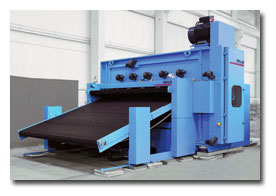
The elliptical needling process of the Dilo DI-LOOM HSC Hyperpunch provides increased
productivity and improved surface appearance, according to Dilo Systems Group.


Broadening Markets

The continuing growth of
needle-punched nonwovens has resulted from close cooperation of fabric producers with needleloom
and needle manufacturers and fiber producers. The three major producers of needlelooms — Dilo
Systems Group, Germany; Dr. Ernst Fehrer AG, Austria; and NSC Group, France — are all strong
competitors, and their competitive efforts have enabled needlepunch fabric producers to increase
productivity and boost quality levels. The needleloom producers have formed strong alliances not
only with their suppliers, but also with the suppliers of auxiliary equipment such as cards,
crosslappers and control systems.

In addition to the formation of alliances, there have been acquisitions such as the
Switzerland-based Saurer Group’s acquisition of Fehrer via its Neumag nonwovens machinery
subsidiary
(See “
Nonwovens/Technical Textiles News,”
TW, July/August 2005)
, which previously had acquired North Adams, Mass.-based
needleloom producer Morrison Berkshire’s intellectual property rights for the design and
manufacture of paper machine clothing web-forming, needling and finishing machinery; and
Switzerland-based Rieter Textile System’s recent cooperation agreement with NSC.


Recent developments for needleloom technology include refinements in structured needlelooms that
have enabled production of a wider range of rib and velour patterns including large repeat patterns
and borders at higher speeds. An example of this type of machine is Fehrer’s NL 11/Twin-SE
Carpet-Star.


The elliptical needling process of the Dilo DI-LOOM HSC Hyperpunch provides
higher productivity and improved surface appearance. This unit reduces drafting during the needling
process.


NSC’s development of the A.50-SDB
needleloom is designed to rib a heavy carpet product at speeds of up to 16 meters per minute, which
corresponds to 1,250 kilograms per hour.

Major suppliers of needles for needlelooms, such as Foster Needle and Groz-Beckert USA Inc.,
Fort Mill, S.C., are keeping pace with machinery developments. They are supplying needles that are
more resistant to breakage and have a longer wear life, as well as finer needles.

These developments enable structured needlepunch fabrics to be used in interior trim and
floor coverings for automotive, recreational and boating products. Needlefelts’ market share in
filtration is increasing. Improvements in control systems for needlepunching lines simplify product
changeovers and improve quality control.

The increase in productivity is resulting in overcapacity in larger commodity-type fabrics
for geotextiles, hospital/medical, furniture and apparel applications. Product development efforts
have accelerated to find more profitable niche specialty markets for needlepunch fabrics.
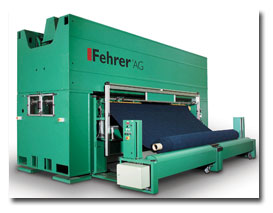
carpetstar_Copy_1
Dr. Ernst Fehrer AG’s NL 11/Twin-SE Carpet-Star is one example of structured needlelooms
that enable production of an increased range of rib and velour patterns.


Tex-Tech Industries

Portland, Maine-based Tex-Tech
Industries, a producer of a broad range of industrial woven and nonwoven fabrics, sells products
for the aircraft industry that include duct insulation, over-frame aircraft blankets,
flame-resistant sound insulation and thermal barriers.

“Needlefelts provide a simple process for controlled fiber orientation. [T]he felting
process mechanically moves fibers into the Z direction to ensure strength,” the company reports.

Needlefelt properties include:

• controlled fiber orientation in the machine or cross-machine direction, or at an
intermediate angle;

• Z-directional strength, which improves shear strength and reduces the potential for ply
delamination;

• high void volumes for easy absorption of resins;

• cost-effective thickness of composite structures by reducing the number of plies, weight,
lay-up times and overall costs;

• ease of blending diverse fibers and fiber structures such as high-strength and
thermoplastic fibers during the needlepunching process;

• distinct batt layering of two or more layers of distinct fiber types in one needlefelt,
and the ability to incorporate lightweight woven fabrics, films and other fabric forms into the
needlefelt structure; and

• compressibility for easy molding or shaping, which allows for intricate design.

Tex-Tech has used its experience in products for the commercial aviation industry to develop
fire-blocking products for school bus, railroad and racing car seating. Its patented fire-blocking
fabric is a nonwoven needlepunched fabric layer preferably saturated with a treatment as a means
for imparting water and stain repellency to the fabric. The surface treatment consists of a
fluoropolymer, such as Wilmington, Del.-based DuPont’s Zonyl™ or St. Paul, Minn.-based 3M’s
Scotchgard™. This treatment is applied using a conventional textile padding process, and is
subsequently dried and cured.


Precision Custom Coatings LLC

Totowa, N.J.-based Precision Custom
Coatings LLC (PCC) is unique in its backward integration into the needlepunched nonwovens business
from its base coating and lamination skills. PCC currently supplies a polyester-blend fabric used
as a sheath for the hoodliner of Cadillac cars. The fabric is embossed with the Cadillac emblem.
The company uses its coating skills to apply materials to the needlepunched fabric to provide the
necessary embossing and molding properties, as well as fire-retardant protection.

PCC also produces a hot-melt coated needlepunched fabric laminated to a spunlaced nonwoven
used in Princeton, N.J.-based Church & Dwight Co. Inc.’s Brillo Scrub ‘n’ Toss® scrubbing pads.
The scrubbing action of the pad results from the proper selection of a lower-melt fiber blend
component and the hot-melt coating.


Goodrich Corp.

After exiting the tire and chemical
businesses, Goodrich Corp., Charlotte, restructured. Its prime business became the fabrication of
components and the provision of services for the aviation industry including wheels, landing gears
and brakes.

The company’s patented process is used to form fibrous preform structures such as carbon or
graphite products suitable for subsequent processing into high-temperature-resistant composite
structures such as aircraft brake discs.

The process compensates for fiber pullback induced by fiber resilience, and for compaction
in previously needled layers induced during subsequent needle passes. The displaced fibers
generated by the needling process are referred to as Z-fibers because they are generally
perpendicular to the layers comprising a fibrous preform structure. Z-fiber distribution throughout
the thickness of the fibrous preform structure may be manipulated as necessary to achieve a desired
distribution. Z-fiber distribution throughout a brake disc can have a profound effect on disc wear
life and on performance of the brake disc in slowing or stopping an aircraft.


Bridgeman, Ritter And Montgomery

William A. Bridgeman, Eric D. Ritter
and Eliza L. Montgomery have developed a nonwoven, carbon-based weld blanket that protects
automobile exteriors and interiors and industrial equipment from weld spatter.

The blanket is made of a needlepunched webbing of pre-oxidized polyacrylonitrile fibers. The
fabric then is assembled using carbon precursor fibers that have been interlocked using a
needlepunch process to produce a nonwoven and non-plush fabric. The resulting weld blanket is
light-weight and effective at a cost-effective thickness and density.

In use, the weld blanket can be taped to automobile components or industrial equipment to
ensure the security and protection of equipment from molten spatter near welding locations.

November/December 2005

AATCC Colocates Conference With Megatex 2006

The American Association of Textile
Chemists and Colorists (AATCC), Research Triangle Park, N.C., will colocate its annual
International Conference & Exhibition with the Megatex 2006 exhibition that will take place
Oct. 31 through Nov. 3, 2006, at the Georgia World Congress Center in Atlanta.

Megatex will include the American Textile Machinery Exhibition-International® (ATME-I®),
owned by the Falls Church, Va.-based American Textile Machinery Association. Formerly held in
Greenville in two parts, ATME-I will run as a single event at Megatex.

Additionally, the Industrial Fabrics Association International (IFAI) Expo, sponsored by
Roseville, Minn.-based IFAI, will be a part of Megatex.

November/December 2005

Sponsors