United States And South Korea Studying Trade Pact

The United States and South Korea
appear to be close to starting negotiations on a free trade agreement (FTA) that could be one of
the largest with a single country — second only to the three-nations in the North American Free
Trade Agreement. Two-way trade between the United States and South Korea amounts to more than $70
billion, making South Korea the United States’ seventh largest trading partner. The United States
currently imports $1.7 billion in textiles and apparel and exports $1.5 billion worth fo goods.

While the Bush administration has negotiated 13 free trade agreements and has at least
another half a dozen in various stages of negotiation, most of them involve small countries. An FTA
with South Korea would be a major development for US international trade.

In a recent meeting with reporters, US Trade Representative Rob Portman cited South Korea as
an example of how trade can be a significant factor in helping a country become a booming economy.
Portman said: “After the Korean War, the North Korean economy was stronger than South Korea. In the
interim, North Korea has closed down to trade, taken a self-sufficiency point of view as South
Korea has done just the opposite, They’ve opened up to trade. The beneficiaries have been the
citizens of the Republic of Korea. It’s an amazing story to go from a truly poor developing country
to a country which is now one of the stronger economies in the world.”

A South Korean FTA could be in for some rough sledding. South Korean farmers do not like the
idea, and the latest US FTA — the Central American Free Trade Agreement —barely squeaked through
Congress.

January 31, 2006


Anver Vacuum Lifters Handle Tall Boxes, Curved Goods

Anver Corp., Hudson, Mass., has
introduced two new attachments as part of its VT-Series vacuum tube lifting systems.

The company reports its stainless steel curved pad attachment can lift rolls measuring up to
5 feet long and weighing up to 200 pounds, and features a manual tilt mechanism that enables
vertical stacking of rolls and loading of mandrels.

Another new attachment allows one person to load and unload pallets of tall, narrow boxes
weighing up to 200 pounds without bending or stretching, the company claims. Features include a
guide handle, two pivoting vacuum suction pads and quick-connect coupling.

VT attachments are custom-designed and interchangeable. The systems also feature a conical
flow valve to allow smooth vacuum operation and unlimited starts/stops per minute with instant
attach/release mechanism, and an extended ergonomically designed handlebar.


January 31, 2006

Peru Free Trade Agreement Before Congress

A US/Peru free trade agreement (FTA)
is now before Congress, and it has the strong support of textile manufacturers. Cass Johnson,
president of the Washington-based National Council of Textile Organizations, said its members like
the agreement and hope it will serve as a “template” for agreements with the other Andean nations —
Colombia, Bolivia and Ecuador. The agreement has a yarn-forward rule of origin; no tariff
preference levels allowing use of inputs from nonparticipating countries and calls for strong US
Customs enforcement — all provisions the US textile industry has sought in other free trade
agreements. Calling the Peruvian FTA a “very good agreement,” US Trade Representative Rob Portman
said “it is a very important part of our Andean Pact free trade strategy.”

January 26, 2006


Somelos Expands With Benninger Machinery

In an effort to increase capacity at its Portugal plant, Somelos Group, Portugal, has ordered a
Bensizetec sizing system and four Ergotec sectional warpers from Switzerland-based Benninger Co.
Ltd.

The international textile group expects the Ben-sizetec system will provide a controlled and
reproducible sizing process, leading to improved quality and efficiency in weaving. The Ergotec
installations are expected to improve warp quality and increase productivity. Somelos already owns
several Benninger warpers, sectional warpers and sizing ranges.

January/February 2006

Avery Dennison RIS Obtains Heat-Transfer Technology

Philadelphia-based Avery Dennison Retail Information Services (RIS) and Subli Impresos, Murr
S.A. de C.V. (SIMSA), Mexico, have signed an agreement that provides Avery Dennison RIS with SIMSA’s
advanced heat-transfer technology for tag-free labeling of apparel and footwear. The technology
may be used to create text, security characters, images and bar codes.

Custom heat-transfer producer SIMSA was looking for — and found in Avery Dennison RIS — an
international company capable of distributing the technology and providing customers with service
and support, according to Rodolpho Murra, president, SIMSA.

“Our agreement with SIMSA will benefit quality-conscious apparel and footwear manufacturers
worldwide,” added Kevin Young, vice president and general manager, Avery Dennison RIS.

January/February 2006

Covercraft Upgrades Eton 4000 System At Texas Plant

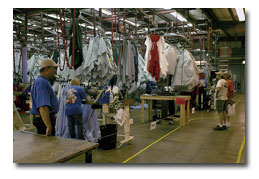
Covercraft Industries Inc., Pauls Valley, Okla., is adding to its computerized, ceiling-mounted
Eton 4000 conveyor system from Eton Systems Inc., Alpharetta, Ga. — a subsidiary of Eton Systems
AB, Sweden — at its manufacturing facility in Wichita Falls, Texas.

supplier
The Eton 4000 conveyor in use at Covercraft Industries

The Eton upgrade will enable the custom vehicle cover manufacturer to add more loading,
sewing and packing stations to its existing system. Additionally, Covercraft is automating its
silk-screen printing process by installing a new sorting and handling system as part of the Eton
4000.

“With Eton, we have been able to double our operators’ productive needle time,” said Marty
Lichtmann, president, Covercraft. “This translates into an average increase in overall productivity
of 50 percent to 60 percent.”

January/February 2006

DSM Adds Dyneema® Production Capacity

DSM, The Netherlands, has begun
construction on a new Dyneema® high-performance polyethylene fiber production line at its
Greenville, N.C., plant. The new line, which will cost tens of millions of dollars, is expected to
be fully functional by mid-2007.


dyneema


DSM is adding another production line at its Greenville, N.C., plant for Dyneema® fiber,
which may be used in mooring ropes for large vessels.


The plant’s expansion to four lines is the third such recent increase, bringing DSM’s total
fiber lines to nine. Strong demand coupled with a focus on supplying the US Army and law
enforcement agencies led to the decision, according to DSM.


“This additional investment fully
supports our growth and innovation strategy while contributing to improving the balance between our
sales by origin and by destination,” said Jan Zuidam, deputy chairman, DSM Managing
Board.


January/February 2006

Defense Bill Bolsters Textile And Apparel Sourcing Rules

The 2006 Department of Defense (DOD)
Authorization bill, passed by Congress at the end of 2005, includes a provision introduced by Rep.
Robin Hayes (R-N.C.) that strengthens domestic sourcing requirements for DOD procurement of
textiles and apparel.

A “Buy American” provision for textiles included in the 1941 Berry Amendment allows waivers
to be issued when certain products are not available from domestic makers. Under the new rule, the
DOD must notify Congress and the US textile and apparel industry within seven days of plans to
purchase textile and apparel items from foreign sources, and all components of textiles and apparel
for DOD use must be sourced domestically.


January/February 2006

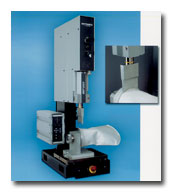
Sonobond Launches Filter Collar Bonder®

Sonobond Ultrasonics, West Chester,
Pa., has designed its new Filter Collar Bonder™ — a single-module version of the company’s
three-module RingMaster™ unit — to ultrasonically attach rigid plastic collars to nonwoven filter
bags. Suitable for assembling bag filters for chemical and industrial liquid applications at the
rate of 50 to 80 bags per hour, the machine uses SureWeld 20™ technology and special tooling to
attach the collars, and requires minimal training to operate.


sonobond

“Ultrasonic bonding eliminates the
need for adhesives,” said Janet Devine, president. “It speeds production because no time is needed
for drying glues or other solvents [and] also eliminates the problems inherent with stitching. For
example, there are no perforations to adversely affect the durability of the product.”

January/February 2006

NCTO Presents 2005 Year-End Economic And Trade Review

In its year-end textile trade and
economic review, the National Council of Textile Organizations (NCTO) cited the removal of quotas
on January 1st and the conclusion of a China textile bilateral agreement on November 8th as two of
the most important events affecting the United States textile industry in 2005. Other important
factors were the sharp rise in oil prices and passage of the DR-CAFTA agreement.

NCTO Chairman Jim Chesnutt commented, “In NCTO’s 2004 report, we noted that 2005 presented
enormous risks for the industry because of the quota-phase-out and the danger of an enormous flood
of subsidized imports from China.

“I am pleased to report that while the flood from China did indeed materialize – with
imports up some 1,500 percent in sensitive categories – quick action by the U.S. government, in
terms of safeguards, moderated the damage and even led to small production increases in the latter
half of the year.

2005 was significant for the industry in many ways, including some important political ones.
For instance, by supporting the CAFTA agreement, the industry was able to work with the
Administration and members of Congress to secure several changes to the agreement that are
beneficial to U.S. textile producers. This improved cooperation further resulted in a tough
three-year bilateral agreement with China that imposed comprehensive restrictions on imports in the
industry’s most sensitive categories.

In addition, we are pleased that the Administration was able to beat back a concerted
attempt in Hong Kong during Doha Round talks to give Bangladesh and other competitive textile
players duty-free status in the U.S. market.

These successes would not have been possible without the strong, steady and often
impassioned support of key members of Congress. The members of the Textile Caucus fought hard for
the industry in 2005, sometimes making politically difficult votes in order to defend the jobs of
textile workers in their districts. We thank them once again for coming through for us.

Our industry also deserves congratulations. According to WTO figures, the US textile
industry is now the 3rd largest textile exporter in the world, overtaking Korea and Japan. We now
ship product to more than 50 countries. And we continue to modernize and innovate. Figures show
that annual industry investment in new plants and equipment totaled nearly $1.5 billion, an
increase of six percent. ”


2006 – A Look Ahead


As we noted, the threat from China to textile and apparel sectors around the world became
terribly apparent in 2005. Chinese exports to the United States and the EU increased by $9 billion
last year, while exports from other developed countries fell by $5 billion. Chinese import market
share in U.S. apparel categories not covered by quotas in the US-China bilateral rose from 12.5% to
41% in just nine months and is projected to hit 75% by January 1, 2007.

As we look to 2006, enormous challenges lie before us. The China safeguard expires at the
end of 2008 and NCTO’s number one effort in 2006 will be to work with our many partner trade groups
around the world to make sure the Doha Round produces a more permanent solution to the China
threat, while also allowing trade preference programs currently in place to grow and prosper. This
means that we must have a textile sectoral in the Doha Round.

Regarding the US-China bilateral, NCTO will also be working closely with the Customs Service
to ensure strict enforcement of the China bilateral as well as enforcement of the trade preference
programs, which have often been exploited by China to transship textile and apparel products. And
NCTO will continue to urge Congress to pass legislation that forces China to revalue the yuan and
end its 40 percent export subsidy that has been so damaging to millions of U.S. manufacturing jobs.

NCTO will continue working with the U.S. government to finalize changes to the CAFTA
agreement regarding pocketings and linings and Nicaraguan TPLs. Furthermore, NCTO will be working
to help complete the Andean Round of trade talks and to make sure that the industry’s priorities
are included in ongoing negotiations with the Andean countries, Thailand, South Africa Customs
Union, Panama and United Arab Emirates.

In addition, as Vietnam moves closer to WTO admission, NCTO will be advising the government
to ensure appropriate measures are put into place to prevent Vietnam, and its state-owned and
subsidized textile sector, from becoming a new “China.” NCTO will also be on guard against damaging
legislation, like TPLs for Haiti and duty-free/quota-free access for all LDCs.

With respect to the Berry Amendment, special thanks go to the successful efforts of Rep.
Robin Hayes to have the waiver process for Berry strengthened and more accountability inserted into
the system. NCTO will begin working with Rep. Hayes and other members of Congress to expand Berry
to other departments, like the Transportation Security Administration, with a national security
focus.


Review of 2005 Textile Industry Economic and Trade Statistics


NCTO noted that following numerous plant closings and sharp job losses early in the year, US
textile production and employment began to stabilize shortly after safeguards were imposed on China
in May 2005. Five of the last six months have shown small production gains in the textile sector
with total textile shipments in the United States at $75.1 billion, only two percent off of 2004
figures. Moreover, textile profits rebounded, reaching $1.3 billion during the first three quarters
of 2005, an increase of 78% over similar 2004 figures. Final year end textile job losses slowed,
declining by 11,300 in 2005, compared to a loss of 25,000 jobs in 2004.

Textile and apparel exports increased for the second year in a row, up 2.7% to $16.5
billion. According to the WTO’s 2005 Statistical Report, the U.S. textile industry is now the 3rd
largest exporter of textile products in the world, overtaking Taiwan and Korea. The industry today
ships to more than 50 countries. And despite Chinese currency manipulation and other subsidies, US
textile exports to China (including Hong Kong) increased by 10 percent in 2005, totaling $634
million.

However, domestic shipments from textile yarn and fabric mills, which produce mostly for the
apparel trade, were off 6 percent for the year while textile plant closings increased to 31,
compared to 24 in 2004. This reflected production lost to China early in the year and the intensely
competitive global trade system since quotas were removed.


Press Release Courtesy of NCTO

Sponsors