Creating A Total Floor Covering Resource


T
hroughout its history, Mohawk has routinely reinvented itself to adapt to changing
business conditions and challenges. In the 1970s and ’80s, carpet was the floor covering of choice
for style and luxury. In the ’90s, this began changing, with hard-surface products like tile,
hardwood and, later, laminate gaining more and more market share. Because of changing consumer
tastes, Mohawk made the decision to become more than just a carpet resource and began actively
developing other product lines. These included two major acquisitions: Dal-Tile for ceramic and
Unilin for laminate. In addition, Mohawk developed partnerships with a number of hardwood suppliers
to expand its wood line, and became a national distributor for Congoleum® resilient. As a result,
Mohawk’s overall product mix changed dramatically. In 2001, 5 percent of company sales were
hard-surface products; in 2005, 35 percent of sales were hard surface.
mohawk3mroom

Mohawk has established strong partnerships with other suppliers including St. Paul,
Minn.-based 3M, which provides Scotchgard™ finishes for Mohawk hardwood flooring products.


Mohawk Carpet: Commercial And Home

Carpet is still the core of Mohawk’s business, and the company has a strong presence in
residential carpet, commercial carpet, and rugs and accessories. Mohawk’s residential brands
include Aladdin®, Horizon®, Wunda Weve®, Custom Weave® and Karastan®, which provide consumers with
a vast selection of products at virtually any price and quality level. Mohawk has created three
aligned dealer networks —Mohawk Floorscapes®, Mohawk ColorCenter® and Mohawk Floorz® — that provide
cobranding opportunities between Mohawk and key independent retailers nationwide. This has not only
strengthened Mohawk’s relationships with many of the nation’s best flooring dealers, but also has
produced better retail selling systems that have improved store profitability and the consumer
buying experience
(See “A Step Forward For Retailing,”

www.TextileWorld.com
, July/August 2006)
.

On the commercial side of the business, Mohawk’s brands include Bigelow Commercial®, Durkan
Commercial®, Karastan Contract®, Mohawk Commercial® and Lees®. These businesses provide Mohawk with
the capability to service the overall commercial market and also allow the company to target brands
to specific industry subsets, such as hospitality, medical and modular flooring.

Mohawk Home, the company’s multifaceted rug and textile business based in Sugar Valley, Ga.,
provides rugs, throws and other home décor merchandise including bath rugs, matelassé bedspreads
and throw pillows to mass merchants and specialty retailers across the nation. Mohawk products are
marketed under Mohawk Home®, Mohawk Select®, Goodwin Weavers®, Karastan and numerous private
brands. Designers and artists who have contributed to Mohawk’s line include Raymond Waites, Thomas
Kinkade and Susan Sargent.

For a number of years, Mohawk has been producing its own carpet fiber — establishing
facilities and brands for nylon, polyester and olefin products; and currently supplying a
significant percentage of its fiber needs internally. In addition, Mohawk has maintained strong
partnerships with other fiber and fiber treatment suppliers such as Invista (Stainmaster®), Solutia
(Wear-Dated®) and 3M (Scotchgard™). In 2005, Mohawk announced it had teamed with DuPont to become
the exclusive supplier to the carpet industry of SmartStrand™ fiber made with DuPont™ Sorona®
polymer. Considered according to industry consensus to be the biggest innovation in fiber in 20
years, as reported by industry publications, SmartStrand fiber offers exceptional stain resistance
and cleanability, durability, and styling options. Mohawk reports the SmartStrand launch has been
the biggest new product introduction in its history.

“The SmartStrand launch was significant in that it was the first really new fiber for carpet
in more than two decades,” said Ed Williams, senior vice president of marketing. “It has the
resilience of nylon coupled with remarkable stain resistance and a very soft hand. Stain resistance
is engineered into the fiber, so it will never wear off. It has Mohawk’s first-ever Limited
Lifetime Warranty for stain resistance. It also allowed Mohawk to partner with DuPont for the power
of two key brands that consumers strongly associate with floor covering innovation.”

Williams noted the SmartStrand launch to customers across North America included
demonstration kits, displays and video presentations that could be incorporated into store
displays. Some retailers were so enthusiastic about the product that they went so far as to remodel
their stores so the SmartStrand display was the first thing consumers saw as they entered the
store.

Beginning in 2007, SmartStrand will have a unique sustainability story, as DuPont begins
making Sorona polymer, in part, from sugar-based crops such as corn
(See “Sustainability Yields Quality,”
www.TextileWorld.com, July/August 2006)
.


Dal-Tile: Ceramic & Stone

In 2002, Mohawk became the leading provider of ceramic tile in the United States with its
acquisition of Dallas-based Dal-Tile Corp. Dal-Tile has annual sales of $1.7 billion and is the
largest resource in the United States by a significant margin for ceramic tile. The Daltile® and
American Olean™ brands are well-recognized among dealers, builders and consumers; and Dal-Tile
offers the most comprehensive product line in the industry.

Dal-Tile added to the largest ceramic tile production capacity in North America recently
with the opening of new facilities in Oklahoma and Mexico, increasing its production volume by 14
percent. Market share is increasing in the residential market, and profitability is benefiting from
an emphasis on higher-margin products.

More than half of Dal-Tile’s sales service centers have been remodeled, and the number of
sales personnel has been increased. In six major US markets, Dal-Tile has established gallery
selection centers that showcase its entire product portfolio. This gives the division the
opportunity to show just how many design options are available with its product line. And like
Mohawk, Dal-Tile has grown through carefully planned acquisitions that increased its presence in
stone surfaces.

Mohawk also markets a separate line of ceramic products under its Mohawk Ceramic brand,
which has allowed more penetration into floor covering retail markets.
mohawktile

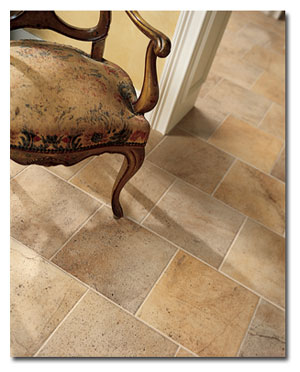
Mohawk’s acquisition of Dal-Tile Corp. in 2002 added ceramic tile to its portfolio of
products.


Unilin: Laminate Flooring

In 2005, Mohawk completed an acquisition that gave it a major presence in the fast-growing
laminate market. Patterned after the Dal-Tile acquisition, the purchase of Unilin NV, a
Belgium-based company, was designed to fast-forward Mohawk’s development of a key product category.

“As we did through the acquisition of Dal-Tile in early 2002, we have further diversified
our product base, distribution strategy and geographical footprint through the acquisition of
Unilin,” said Jeff Lorberbaum, chairman and CEO, Mohawk. “We were impressed by Unilin’s operating
team and the strength of the Quick-Step® brand strategy, as well as the company’s attractive growth
prospects going forward.”

Unilin is the only vertically integrated laminate manufacturer in North America, and has
just opened a new plant in Thomasville, N.C., with the capacity to produce 100 million square feet
per year. In addition, Unilin and its brand, Quick-Step, are recognized as major innovators in the
laminate market, creating dramatic new flooring styles that mimic natural stone and wood, complete
with texture, grain, beveled edges, random patterns and even hand-scraped looks. Unilin’s glueless
plank locking system, Uniclic®, allows easy angled assembly of the floor or — in tight spaces such
as under counters — a sliding method of securely bonding the boards by tapping them together with a
mallet.

The US market for laminate flooring is expected to grow at 15 percent annually, and
Unilin/Quick-Step is positioned to take a significant part of that share. In addition, Mohawk
markets a separate line of laminate products under its Mohawk Laminate brand, providing the
opportunity for even more market penetration.


Creating The

Optimum Distribution Resource


As North America’s largest flooring company, Mohawk requires an efficient and comprehensive
distribution infrastructure.

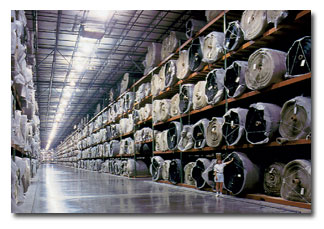
Mohawk’s national distribution network is comparable to a small national freight company.
Mohawk operates 21 factory warehouses, 19 regional warehouses and 43 satellite warehouses across
the nation. A fleet of 1,000 trucks and 2,000 trailers services more than 30,000 customers across
the continent.
carpetplant


More Than Half Next Day

This highly flexible operation is capable of delivering carpet, tile, hardwood,
laminate, vinyl, rugs and other products anywhere in the nation. More than half of Mohawk’s
expansive product inventory is available to customers typically within a day’s time.

“Fast availability of our products is essential, not only to compete in our industry, but to
be competitive with other categories of consumer goods,” said Ed Williams, senior vice president of
marketing. “Consumers have a myriad of choices for using their income, and they’re used to rapid
response and fulfillment. Our dealers need the ability to get the merchandise promptly and schedule
installation. The customer isn’t used to waiting.”


Inventory Control

Mohawk’s inventory is tracked at every step of production and delivery using the company’s
exclusive Real Time Visibility software.

With Real Time Visibility, dealers can get up-to-the-moment reports on orders throughout the
system, which uses satellite signals, transmission towers and wireless mobile computers to
continuously monitor deliveries from Mohawk. The system lets Mohawk and its customers know when
orders load onto the truck, where the truck is located, when each order delivers, what was
delivered and who signed for it. Dealers can pinpoint within a matter of minutes when their orders
will be arriving at the loading dock.

Mohawk also is a strong believer in backwards integration and has executed a number of
acquisitions to help manage manufacturing for carpet, ceramic tile, laminate and other products.
This helps improve efficiency even further and manage costs.


Hardwood, Vinyl And Other Lines

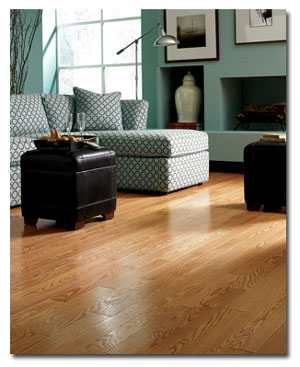
Mohawk also distributes a full range of hardwood flooring products in a wide variety of
specifications and finishes. Mohawk’s hardwood flooring line has been singled out by key industry
publications for its quality, styling and value. Dealers themselves have voted Mohawk hardwood
products as being their choice of all new offerings for the year.

Mohawk also is a distributor of Congoleum vinyl products, which offer versatility,
durability, and an exceptionally wide selection of colors and styles.

Other Mohawk product lines, like Mohawk Home rugs and throws, are marketed through mass
merchants, discounters and department stores, adding an entirely new level of distribution
activity. Because of the size of these customers, Mohawk distribution also utilizes new
technologies such as radio frequency identification to manage inventory and shipments.


July/August 2006

Sustainability Yields Quality


I
n Mohawk Industries’ corporate environmental policy statement, CEO Jeff Lorberbaum states
that sustainability is an essential business practice in today’s global economy. The policy
outlines the company’s commitment to support and comply with programs that foster environmental
stewardship and safety in line with its common goals.

Affirming the environmental movement’s mantra, reduce, reuse and recycle, Mohawk has developed
numerous programs to reduce waste and consumption, and to recycle used products into new carpet and
other floor covering products. Its recycling efforts began in the 1990s as technologies became
available to convert used materials into new products. They are consistent with overall US carpet
industry initiatives through the Carpet America Recovery Effort, of which it is a corporate
sponsor, to divert 40 percent of used carpet from landfills by 2012, and eventually to recover all
carpet for recycling or reuse. The company continually reevaluates its operations, design processes
and the raw materials used in its products looking for alternatives to current practices, materials
and natural resource use that will help it reduce its environmental footprint. Last year, its Lees
Carpets plant in Glasgow, Va., received ISO 14001 certification for its environmental management
system and became one of only a handful of carpet manufacturers to have earned both ISO 14001 and
ISO 9001:2000 certification related to product quality
(See ”
Floor
Covering News
,”
TW, May 2005
). Mohawk’s Landrum, S.C., woven carpet plant, which has had ISO
9001 certification for more than 10 years, is currently working toward ISO 14001 certification; and
several other carpet-manufacturing plants are working toward earning both ISO 9001 and ISO 14001
certification within the next 24 to 36 months.

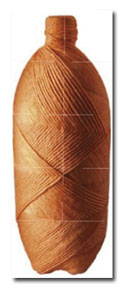
plant


Recycling Program

Mohawk converts approximately 25 percent of all the plastic bottles used in North
America into 160 million pounds per year of high-quality polyester carpet fiber that generally
matches or exceeds the quality of fiber made from virgin resin. Since 1999, when it acquired a
bottle recycler, it has recycled more than 17 billion polyethylene terephthalate beverage bottles,
and claims to be the largest recycler of plastic bottles in the world, estimating its recycling
system accounts for more than 70 percent of all post-consumer recycled carpet fiber produced.

Mohawk Home uses 10 million pounds of used tires per year to make designer
doormats. The number of tires recycled in this way is 28 times the number used by the entire
Chicago taxicab fleet. In a recycling/waste reduction initiative, the company converts waste
including carpet edge trim, soft drink bottle caps and film used to wrap pallet loads into man-made
fiber carpet cushion and plastic carpet roll cores. The cores, themselves recyclable into new
cores, replace cardboard rolls, lasting three times longer and providing better support for the
rolled carpet. Mohawk reports this initiative saves 68,000 trees each year.

Mohawk counts among its commercial product offerings more than 200 that contain
recycled materials from both post-consumer and post-industrial sources. These include nearly 100
broadloom products offered under three commercial brands and containing an average of 15 percent
post-consumer content based on weight. The company says the recycled content in these products
represents more than 9 million pounds of discarded product diverted from landfills annually, and
projects this figure will grow as it converts other carpet products to similar systems.

One of the most recent developments is a proprietary carpet tile made of
materials that include recycled carpet and carpet-related components. Through a closed-loop system,
the carpet is eternally recyclable into new carpet. In addition, certain components contain
materials mined from the nearby Dalton/Whitfield County, Ga., landfill.

Mohawk also has implemented a National Carpet Recovery initiative whereby the
company utilizes its distribution systems logistics and infrastructure as well as external
resources nationwide to recover and recycle its carpet products at the end of their useful life.
Mohawk anticipates its ReCover system will reclaim millions of pounds of used carpet
annually.


Reductions

In terms of reductions, Mohawk cut its water usage in half from 1995 to 2003 through
conservation initiatives and development of new processes. Its Dublin and Sugar Valley, Ga.,
facilities include water treatment plants that restore the effluent to a quality much higher than
is required by the Environmental Protection Agency, the company reports.

Mohawk has reduced the phosphorus content in its wastewater by 70 percent as a result of a
processing change. Today, hazardous waste streams from most company facilities fall below base
levels that require reporting under federal regulations. Over the last decade, Mohawk also has made
substantial reductions in energy consumption through the implementation of energy conservation
programs and manufacturing equipment upgrades. Although no renewable energy is available locally,
the company has committed to purchase renewable energy tags from totally renewable energy sources
as offsets. It also has initiated proprietary research into developing renewable energy for one of
its major manufacturing plants.

Beyond reductions in water, energy and chemical waste streams, Mohawk has reduced the amount of
fiber needed to manufacture some carpet and rug products through production of woven carpet which
uses 30-percent less fiber and lasts more than twice as long as tufted carpet.


Carpet From Corn

sodayarnWithin another year, Mohawk expects to be making carpet from bio-based man-made

fibers. The company has partnered with Wilmington, Del.-based DuPont to bring to market a new line
of residential carpet offered under the SmartStrand with DuPont Sorona® polymer brand. Sorona, a
family of polymers made from 1,3-propanediol, originally was developed as a petroleum-based
polymer, but DuPont has developed a bio-based variety made partly from corn sugar. The bio-based
polymer will be in commercial production later this year, and Mohawk will begin producing the new
tufted residential carpet line in 2007.


The Right Thing To Do

Commenting on Mohawk’s commitment to environmental stewardship, Monte Thornton, president,
Mohawk Flooring, stated: First and foremost, it is the right thing to do. Next, there is a
financial reward associated with good environmental stewardship. It costs more on the front end to
implement these programs, but these commitments yield great returns, from reduced depletion of
natural resources, and reduced water and energy usage, to improved employee morale and being good
corporate and community citizens. The informed consumer now expects to purchase products from
environmentally responsible companies.

July/August 2006

Groz Beckert Offers New Needles, Holder

Groz-Beckert KG, Germany, has
introduced three new sewing machine needles to address problems seen in several different sewing
applications, as well as a new needle holder.

The GB 134 ZZ needle system, designed for zigzag applications, is the result of an
examination of the most popular zigzag sewing needle systems as they relate to today’s sewing
development and production. The new needle system offers reliable stitching and allows a high
needle throw using all popular machine concepts, the company reports.

Groz Beckert also has re-engineered its GB SAN® 10 needle to allow it to process finer
materials including fine knits and microfiber fabrics than previously, and also to process
new-style yarns. According to the company, the needle sews more uniform seams, treats the processed
fabric more gently and offers higher productivity than the previous version.

The GB SAN® 12 is a special application needle for two-needle machines used to process
leather for upholstery, seat production and automotive interiors. The company reports the left- and
right-hand needles work in tandem to make optically identical stitch lines.

The company has developed the Gebeswitch needle holder to quickly and reliably change
needles from one size to another on medium- and heavy-duty step stitching machines with vertical
loopers. Such machines are used to produce high-quality automotive interior fittings and seats. The
new holder maintains a constant scarf position regardless of needle size; and requires no machine
adjustments other than changing the needle, setting the size at the Gebeswitch and
rethreading.


July/August 2006

Building The Power Of A 100-Plus-Year-Old Brand


A
t nearly 130 years old, the Mohawk brand is older than household names such as Hershey,
Coca-Cola or Disney. For the last decade, branding has been a major area of investment for Mohawk
Industries. After its major acquisitions in the early 1990s, Mohawk set about consolidating many of
the floor covering brands it had purchased and bringing them under the Mohawk flagship. While many
of these brands still have some presence among dealers, the emphasis with consumers has been to
take advantage of the power of the Mohawk name.

cinderella

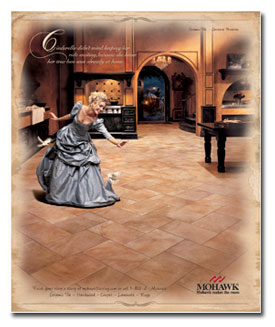
Mohawk’s 2006 consumer advertising campaign, named “What If?,” features fairy-tale
characters.


Consumer Advertising

For the last several years, Mohawk has conducted strong consumer advertising programs, using key
consumer shelter publications and national television. In the last four years, the consumer ad
campaign has also been tied to national sales events to give Mohawk’s aligned dealers — Mohawk
Floorscapes, Mohawk ColorCenter, Mohawk Floorz — extra selling opportunities. Studies show that
Mohawk is one of the most-recognized brands in the floor covering business, and the company
continues to reinforce this through a very active consumer advertising and public relations
program.

Mohawk’s 2006 consumer advertising campaign is using print and television to make more than
1.2 billion impressions targeted to floor covering shoppers across the nation. The campaign
includes ads in more than 30 magazines and on 11 national television channels. 


goldilocks


The television campaign continues the use of Mohawk’s “Shall We Dance?” commercial, which
features a dancing vacuum cleaner, while the print campaign entitled “What If?” features all-new
creative based on classic fairy-tale characters, including Cinderella, Goldilocks and the Evil
Queen. Ads feature different types of floor covering — carpet, hardwood and ceramic — and ask: What
if the ending of a classic fairy tale or fable is changed by the beauty of a Mohawk floor?

The “Cinderella” ad features the would-be princess in her kitchen, while her pumpkin carriage
awaits, visible in the background. But she’s not in a hurry to get to the ball — the copy explains,
as she gazes at the floor, Mohawk Ceramic’s new Sardara. She’s already found her “true love.”

A second ad, “Goldilocks,” showcases the beauty and comfort of Mohawk Carpet. Cottage
Hideway, featuring Wear-Dated® fiber and Scotchgard™ Protector Advanced Repel Technology, is the
product highlighted in the ad. It shows Goldilocks asleep in the three bears’ bedroom, but not on
any of the beds. She’s dozing on the floor, which is the place that’s really “just right.”&
#160;


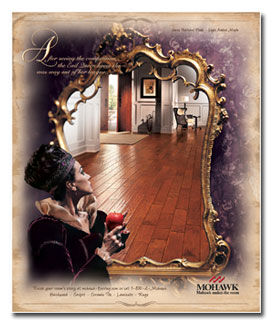
wickedwitch


A third ad takes a slightly different approach for Mohawk Hardwood. The Evil Queen of
fairy-tale fame is looking in a mirror at Mohawk Hardwood’s Santa Barbara Plank. Her countenance is
more grim than usual as she realizes she has unbeatable competition for the “fairest of all.”

“The humorous approach we’ve used in previous campaigns is still a strong way to build
recognition of the Mohawk brand and our products,” said Ed Williams, senior vice president of
marketing for Mohawk. “This year’s campaign uses the humor of universally known stories to call
attention to the beauty and comfort of Mohawk floors. We were particularly pleased with how
strongly this campaign scored in consumer testing, especially with women. It really strikes a chord
with the people who are most likely to be floor covering shoppers.”

The print campaign started in April and will continue through November in magazines including
Better Homes and Gardens; Good Housekeeping; Architectural Digest; House & Garden; House
Beautiful; Country Living; O, The Oprah Magazine; Martha Stewart Living; Real Simple; Food and
Wine; Parents; Sunset; and Southern Living. Among the channels included in the television campaign
are HGTV; DIY Network; Discovery Home; The Learning Channel; We, Women’s Entertainment; and the
Travel Channel.

The fairy-tale graphics are an integral part of the Mohawk consumer website,
www.mohawk-flooring.com, which was updated recently to
make it easier for consumers to get information and find local dealers. Information is now
categorized into three stages: “Decorating and Planning”; “Shopping and Buying”; and “Caring and
Maintaining.”

“By organizing information in this manner, consumers can have easy access to the details they
need at every step of floor covering selection and ownership,” Williams said. “This means they come
into dealerships better informed and better prepared to buy.”

An easy-to-use and informative website is critical as shoppers do more research online before
going out to visit actual stores.


July/August 2006

Logistics Center Stage


A
t a time when shipping and logistics present an ever more critical opportunity in
leveraging supply chains, the city of Charleston, S.C., recently hosted the 33rd annual South
Carolina International Trade Conference (SCITC). The conference, which offered educational business
sessions and tabletop displays by companies active in the industry, began with a welcome speech to
the more than 500 attendees by 2006 Conference General Chairman Elizabeth Colbert-Busch, director
of sales and marketing, South Atlantic region, Orient Overseas Container Line (OOCL) (USA) Inc.,
San Ramon, Calif.

Bernard S. Grosclose Jr., chairman of the American Association of Port Authorities, and
president and CEO of the South Carolina State Ports Authority, presented the keynote speech.
Grosclose spoke of the challenges encountered as well as the successes achieved by the South
Carolina ports. He spoke of the cooperation necessary between the community and the port, the
growth and success achieved through an active and responsive diologue, and the resulting measurable
performance gains in movement of cargo through the port.

bernard
Bernard S. Grosclose Jr., chairman of the American Association of Port Authorities, and
president and CEO of the South Carolina State Ports Authority

Education took the form of panel
discussions focused on bringing together the many aspects of shipping and logistics. Subjects
ranged from “International Logistics From the Shippers Perspective” — which paired two retailers, a
domestic manufacturer and a cotton logistics manager — to “India — Trading Partner, Employer, New
World Power” — in which professionals experienced in trade with India spoke of the opportunities in
developing improved trade flows.

Textile World
moderated the panel titled “Transportation Challenges in the Decade Ahead,” which paired
Robin Lanier, executive director of the Waterfront Coalition, with Kenny Riley, president of the
International Longshoremen’s Association Local 1422. It was apparent that with logistics
complexity, volume and security demands increasing in the face of challenges such as shortages in
trucking and fuel price increases, moving product in and out of the port will need increased
cooperation and collaboration among the port, security, shippers, truckers, labor and the
community. Such activity demands investment and cooperation to maximize the performance and
productivity of the port while meeting the growing demands of all links in the supply chain.


busch


SCITC General Chairman Elizabeth Colbert-Busch, director of sales and marketing, South
Atlantic region, OOCL (USA) Inc.


In addition, as part of its educational outreach, the board presented eight scholarships to
an impressive group of college students.

On a lighter note, Comedy Central’s Stephen Colbert, a James Island, S.C., native, used his
local knowledge and sharply skewed analysis to delight conference attendees. On the topic of
globalization, Colbert observed the Chinese economy is booming. “We need to learn something about
capitalism from the communists,” he quipped.

With Charleston in a tight race with the Port of Savannah, Ga., to be the fourth-most-active
container port in the United States, it is apparent the demands on international shipping and
logistics are a double-edged sword for the domestic textile industry. Those adversely impacted by
imports see the challenges faced by the port and its resources as a barrier to import growth at a
time when speed to market is increasingly important. At the same time, in an era of globalization
when members of the US industry attempt to grow in international exposure, those same challenges
present obstacles to global growth. The conference left little doubt that the future of the Port of
Charleston is focused squarely on performance quality, security and growth.

July/August 2006

July/August 2006


Karin Malmstrom
has joined
Cotton Council International, Washington, as its China and Hong Kong director.

Midland, Mich.-based
The Dow Chemical Co. has appointed President and CEO

Andrew N. Liveris
chairman of the board, and

William H. Weideman
vice president and controller.

Greenville-based
Batson Group Inc. has named

Charles Little
group manager with responsibility for capital equipment sales and marketing; and has
hired

Bruce Kalley
as service and spare parts manager, with responsibility for service and spare parts sales
for original equipment manufacturers.

Performance Fibers Inc., Richmond, Va., has named

James A. Johnson II
vice president, chief information officer, with responsibility for the company’s global
Information Technology group.

Precision Custom Coatings LLC, Totowa, N.J., has hired

Moe Kovangji
as general manager.

Paris-based
Lectra has appointed

David Rode
president of Lectra USA Inc., where he will be responsible for all company business in
Canada, Mexico, the United States and the Caribbean. The company also named

Guido Turco
product lifecycle management business development manager for Italy.

Tolland, Conn.-based
Gerber Technology has presented the Gerber WebPDM® Achievement Award to

Christina Wong
, a recent graduate of the Fashion Institute of Design and Merchandising’s International
Manufacturing & Product Development program. The company also has welcomed

Linna Lin
, a customer solutions center coordinator, as its 200th full-time employee in greater
China.

Dalton, Ga.-based
Thomas Industries LLC CEO

Jerry L. Thomas
has assumed the role of board co-chairman and will head a special committee tasked with
identifying strategic business opportunities. Also,

Dick Bierie
now is president, Marketing & Sales.

WestPoint Home Inc., West Point, Ga., has named

Chris N. Baker
COO.

Kellwood Co., St. Louis, has appointed

Jeffery Streader
president, Operating Services Division;

Gail Cook
, president, David Meister brand; and

James Weinberg
CEO, Halmode suit and dress division.

Blue Bell, Pa.-based
Acme-Hardesty Co. has named

Cynthia A. Cox
president and promoted

Wulan Gerile
to global sourcing manager.

Emeryville, Calif.-based
Nano-Tex Inc. has promoted

James P. Curley
to president and CEO, and named him to the company’s Board of Directors.


Mark Welles
has joined
TradeCard Inc., New York City, as vice president of sales in Asia Pacific.

Consoltex Inc., Quebec, has named

Sirio De Luca
president, Commercial Operations.


Jessica Franken
, associate director of government affairs for the
Association of the Nonwovens Fabrics Industry, received the Alexis de Tocqueville
Award upon her recent graduation from Fairfax, Va.-based
George Mason University’s School of Public Policy.

Omnova Solutions Inc., Fairlawn, Ohio, has elected

Robert A. Stefanko
to its Board of Directors.

The
American Association of Textile Chemists and Colorists (AATCC), Research Triangle
Park, N.C., has named the following Concept 2 Consumer/Computer Integrated Textile Design
Association design competition winners: Print Design, Interior Design —

Andrea Singer
, Philadelphia University, first place, and

Elizabeth Newcomb
, North Carolina State University (NCSU), second place; Print Design, Apparel Design —

Carla Rickenbacher
, Drexel University, first place, and

Christine Schmitt
, Savannah College of Art and Design, second place; Product Design, Interior Design —

Jessica Roush
, NCSU, first place, and

Elizabeth Newcomb
, second place; and Product Design, Apparel Design —

Colleen Keller
, Cornell University, first place, and

Cora D. Smith
, NCSU, second place. AATCC also presented awards in its inaugural Engineering Design
Competition, Medical/Biomedical Fibrous Structures Area to

Harold D. Dillow
,

David J. Janowiecki
,

Chloe Zhuang Wan
and

Marc R. Williams
, University of Kentucky, first place; and

Hang Liu
and

Hong Yu
, University of Georgia, second place.

Precision Roll Grinders Inc., Allentown, Pa., has named

William “Bill” Cargile
general manager of its Texarkana facility.


William E. Giblin
, president and CEO, Tweave Inc., Norton, Mass.; and former chairman, National Textile
Association, Boston, recently received an honorary Doctor of Business Administration degree from
the
University of Massachusetts Dartmouth.

American Fibers & Yarns Co. (AF&Y), Chapel Hill, N.C., has hired

Roger Morelock
as vice president of operations for its Bainbridge, Ga., facility.

The Board of Directors of Dalton, Ga.-based
Shaw Industries Inc. has elected

Vance Bell
to succeed Robert E. Shaw as CEO effective Sept. 1, 2006. Shaw, a co-founder of the
company, will remain on the board. The board also has elected

Randy Merritt
president of the company. Merritt succeeds Julian Saul, who recently retired.


July/August 2006

Fostering Cotton Quality


C
ary, N.C.-based Cotton Incorporated unveiled its MILLNet software for Windows® at its
recent Engineered Fiber Selection® (EFS®) System Conference, which also included presentations on
cottons sustainability, global cotton yield and consumption, and the home and apparel textile
markets. The eight panel presentations at the 19th edition of the conference, which was held over
two days in Greenville, emphasized technology’s role in the sustainability and worldwide
competitiveness of cotton fiber.

Cotton Incorporated Board Chairman S.
Louie Perry explained in his opening remarks that technology is key in “giving us a leg up in the
field and the factory,” adding that “[k]eeping up with technology advances keeps your business on
the cutting edge.”


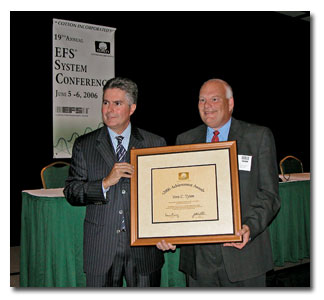
cottonaward


Cotton Incorporated President and CEO J. Berrye Worsham (left) presents the 2006 Cotton
Achievement Award to Sara Lee Branded Apparel’s Vern C. Tyson at the recent EFS® System
Conference.


The latest addition to the company’s EFS System, a suite of cotton management software
programs, is MILLNet software for Windows, which tracks the purchase, receipt and use of cotton
using high-volume instruments (HVI) classification data. Features of the new program include
enhanced graphics and customization of reports, graphs, and other data. Users also may export data
to Microsoft® Office applications such as Word or Excel.

The EFS System, which includes other programs such as EFS-USCROP™, QRNet32, MILLNet and
MILLNet32™, allows for the evaluation, inventory and handling of different types of cotton fiber
for the production of high-quality yarn. According to the company, program users apply each cotton
fiber’s unique properties to their growing, ginning, spinning and processing methods, allowing them
to produce statistically uniform cotton mixes for specific end-uses.

“Over the past 20 years, the increased use of the EFS System software and the feedback from
users at these conferences have helped us keep the software in step with our clients needs,” said
Charles Chewning Jr., vice president, Fiber Management Research Group, Cotton Incorporated.

Another conference feature was a special presentation on cottons sustainability and how it
compares to that of man-made fibers. Because of certain agricultural advancements such as
genetically modified seeds and integrated pest management, cotton growers have reduced the amount
of land, water and pesticides needed, according to research presented at the conference. Conference
attendees also reviewed an attitudinal survey that showed consumers perceive cotton to be
environmentally friendly.

Additionally, Cotton Incorporated honored Vern C. Tyson, vice president of cotton purchasing
for Winston-Salem, N.C.-based Sara Lee Branded Apparel, as the 2006 Cotton Achievement Award
recipient. Tyson manages the purchasing, warehousing and distribution of cotton for Sara Lees seven
manufacturing operations, which account for approximately 13 percent of the total US cotton
consumption, said J. Berrye Worsham, president and CEO, Cotton Incorporated, during his
presentation of the award.

Since 1991, Cotton Incorporated has given the award to individuals who have increased cottons
profitability by advancing the marketing of the EFS System and US Department of Agriculture HVI
testing.


July/August 2006

Mohawk Industries – Growth & Innovation


I
magine in the textile industry building a business that is growing — growing in revenue,
growing in product offerings, and growing ownership and support of its supply chains. After
spending time with the 2006

Textile World
Innovation Award honoree, Mohawk Industries, it becomes apparent many of the traditional
barriers to growth have been removed and the company succeeds through innovation.

As evidenced by Mohawk’s expansion from a $300 million company when it went public in 1992 to
one with projected sales of $7 billion in 2006, growth is central to the Mohawk success story.

But, where is the innovation? The simple fact is innovation plays a major role in almost
every facet of the company — in product, process, business strategy, marketing, brand management
and serving the customer. Mohawk’s track record speaks for itself. The company has a culture that
forces solving problems and developing opportunities without being bogged down by traditional
solutions. An example would be adapting to changing consumer tastes in floor covering.

Instead of seeing this as a crisis, Mohawk saw an opportunity, entered the hard-surface arena
and redefined floor covering. In doing so, it created opportunities for retailers and consumers.
Its product range broadened, and it developed sales and marketing solutions to support the
redefinition. The potential crisis was really an opportunity that strengthened all facets of the
company and positioned it as a total floor covering solutions provider.

The following pages attempt to illustrate just how much is going on inside Mohawk and how
willing the company is to invest in its future. With a history that stretches back to 1878, when
four brothers bought 14 secondhand weaving machines and entered the carpet business, this is a
company that knows its business. It is also a company that is keenly aware of new opportunities.

Issues like sustainability are ever present. Mohawk recycles 25 percent of all the plastic
bottles used in North America each year into 160 million pounds

of carpet fiber. In 2007, the company expects to offer carpet under the SmartStrand™ made
with DuPont™ Sorona® polymer brand — carpet containing innovative biobased man-made fiber.

Mohawk’s associates are key to the company’s success. As Jeff Lorberbaum, Mohawk president
and CEO, said in his interview with

TW
, “There is no alternative to bright, motivated people who like to succeed focused on a
common vision.” That vision has been sustained under conditions of tremendous growth. When asked
the key to Mohawk’s success, Lorberbaum said, “Continuously reinventing everything we do and
executing it with a vengeance.”

Congratulations to Mohawk Industries and all of its associates company-wide. Thank you for a
great story of growth and innovation.


July/August 2006

Textiles Have Stake In Legislation


A
s the 109th Congress winds down between now and November, the US textile industry and
importers have a vital stake in some of the issues that may or may not be dealt with in an
atmosphere charged with politics as the congressional election campaign unfolds. For the most part,
textile issues are in the area of international trade, where decisions made now will have a major
impact on the future shape of the industry. In some cases, congressional action is expected this
year, while others likely will have to wait for the new Congress in 2007.

Berry Amendment — The Berry Amendment, which directs the Department of Defense
(DoD) to buy its textiles and apparel from domestic courses whenever possible, will be acted upon,
but there is an effort by Rep. Robin Hayes, R- N.C., to expand the requirement to the Department of
Homeland Security. Past efforts by DoD procurement officials to weaken the Berry Amendment have for
the most part failed, but those officials are likely to try again. Extension of Buy American to
homeland security remains doubtful at best.

Chinese Currency — US textile industry officials and others contend currency
manipulation by the Chinese government amounts to as much as a 40-percent subsidy for its exports
to the US market. A number of bills have been introduced in Congress to address the issue. One
sponsored by Sens. Charles Schumer, D-N.Y., and Lindsey Graham, R-S.C., would impose a 27.5-percent
tariff on Chinese goods imported to the United States unless the president certifies China no
longer is manipulating its currency in order to gain an unfair international trade advantage. A
companion measure in the House of Representatives is sponsored by Reps. Sue Myrick, R-N.C., and
John Spratt, D-S.C. Those bills are not likely to become law in view of President George W. Bush’s
opposition, but they have been useful as a club to force voluntary action by the Chinese
government. A second approach to the problem, sponsored by Reps. Tim Ryan, D-Ohio, and Duncan
Hunter, R-Calif., would declare exchange rate manipulation by China actionable under US
countervailing duty and product safeguard statutes. That bill has the backing of a broadly based
farm, industry and labor currency manipulation coalition including textiles; and has a better
chance of enactment than the Schumer-Graham bill.


Trade Preference For Least-Developed Countries
— The Tariff Relief Assistance for
Developing Economies (TRADE) Act would permit 15 least-developed countries to ship their textile
apparel products to the United States duty-free regardless of the country of origin of yarn, fabric
or other components. US textile manufacturers are opposed to this legislation, contending it would
undercut the benefits of the North America Free Trade Agreement and the Central America-Dominican
Republic Free Trade Agreement. This legislation enjoys considerable support and could be enacted,
but not without a fight from the textile industry’s supporters in Congress.

Countervailing Duties For State Economies — A major problem for US textile
manufacturers is a ruling by the government that countervailing duties cannot be imposed on
state-run economies such as China and Vietnam. The House in July 2005 passed legislation designed
to reverse that ruling. In addition, it would establish a monitoring and reporting system to
measure China’s compliance with its trade obligations under the World Trade Organization (WTO).
Senate action is pending.


Free Trade Agreements
— Congressional action is pending on free trade agreements
(FTAs) that the US textile industry opposes. The Haiti Economic Recovery Opportunity (HERO) Act
would grant duty-free entry into the United States for apparel assembled in Haiti regardless of the
fabric’s country of origin. The HERO bill caps the amount of duty-free articles that can enter the
United States, and while the numbers appear small, they would amount to $2 billion in apparel
exports taken from other Caribbean and Central American countries. The Bush administration also has
entered into FTA negotiations with South Korea. While that pact has not been finalized and sent to
Congress, the US textile industry is strongly opposed to it, and it hopes to get congressional
input that will modify it before it is submitted for ratification.

Vietnam Agreement — Legislation that would grant permanent normal trade relations
to Vietnam has been introduced in Congress. The legislation is a necessary step toward Vietnam’s
accession to the WTO. It is strongly opposed by US textile manufacturers, but importers are
supporting it.


Textile And Apparel Research Funding
— Legislation pending in Congress would
continue the federal government’s long-standing support for textile and apparel research at the
Spring House, Pa.-based National Textile Center (NTC) and the Cary, N.C.-based Textile Clothing
Technology Corp. [(TC)2] at the current levels of $13 million for NTC and $2.5 million for (TC)2.
The federal government’s support for these two organizations is intended to improve the industry’s
competitiveness. With Congress tightening its purse strings in some areas, the outlook is uncertain
at this time.


Textile Trade Future Cloudy In View Of WTO Problems


The uncertain future of the WTO’s Doha Round of trade liberalization negotiations raises more
questions than answers with respect to the future of international trade in textiles and apparel.
While trade officials in the United States and abroad hope the round can be revived, there is a
chance it will die a slow death over the next few months.

The demise of the negotiations would be one of those good news/bad news situations for
textile manufacturers and importers. If the talks collapse, the US industry would not have to worry
about reductions or elimination of US textile and apparel tariffs. On the other hand, they feel the
round can be a vehicle to get a permanent safeguard mechanism that would prevent China, and perhaps
one or two more nations, from completely dominating the US apparel import market. Importers, on the
other hand, who do not like the idea of a safeguard mechanism, would lose the tariff reductions
they believe are so important in their future overseas sourcing.

As the talks reached a critical juncture in early July, the House weighed in on behalf of the
US textile industry when it passed legislation stating the US negotiators must adhere to the
objectives of the Trade Act of 2002. That act states: “The principal negotiating objectives of the
United States with respect to trade in textile and apparel articles are to obtain competitive
opportunities for the [US] exports of textiles and apparel in foreign markets substantially
equivalent to the competitive opportunities afforded [to] foreign exports in the [US] markets and
to achieve fairer and more open conditions of trade in textiles and apparel.”

While that language is somewhat vague and can be read in different ways by different people,
it does underscore the congressional interest in promoting fair trade in textiles.


Military Procurement Of Textiles, Apparel Faces Crisis


While the US textile and apparel industries have a long history of successfully meeting the
peacetime and wartime needs of the armed forces, demands of the war on terrorism and military
procurement practices are resulting in what many industry officials believe is a crisis. They
contend the defense industrial base is eroding to the point where it is increasingly difficult for
them to meet the needs of the armed forces.

The problem has resulted from inconsistent buying patterns. New orders are few and far
between, incoming orders under existing contracts are sporadic and unpredictable, and frequent
start/stop orders are being issued. In past wartime buildups, the military relied on more of a
centralized procurement system, but today procurement is spread across several agencies with
differing requirements and procedures. Industry officials say the Iraq War and lack of
communication and organization have caused “tremendous confusion in the industry, stretched limited
resources to the breaking point and have made fact-based production planning nearly impossible.”

The National Textile Association, Boston; the American Apparel and Footwear Association,
Fairfax, Va.; and the Parachute Industry Association, Skokie, Ill. — which represent most of the
500 companies of the defense industrial base — have launched a series of meetings with defense
officials in an effort to fix the problem.

Members of the defense industrial base provide the armed forces with their most basic needs:
socks, undergarments, combat and other uniforms, hats, gloves, boots, wet-weather gear,
cold-weather gear, chemical-protective gear, body armor, utility bags, sleeping systems, parachutes
and tents.

July/August 2006

TenCate Selects Benninger Bleaching Machine

The Netherlands-based TenCate
Advanced Textiles has brought online an automated process-controlled, continuous open-width
bleaching machine with a fully integrated operating system. The company worked with
Switzerland-based Benninger Textile Systems Co. Ltd. to design the machine according to TenCate’s
specifications.

The new pretreatment line performs separate singeing, scouring and bleaching operations in
one process sequence. Features include microprocessors for automated measurement and adjustment of
variables including water, chemicals, speed and pressure; and 25 automatic dosing positions for
chemicals.

The line represents a 6 million-euro investment including building alterations, and
foundation and platform construction.


July/August 2006

Sponsors