WL Ross, ITG Team With Phong Phu To Explore Opportunities In Vietnam

 
New York City-based investment firm
WL Ross & Co. LLC and its majority-owned unit International Textile Group Inc. (ITG),
Greensboro, N.C., have signed memoranda of understanding with Phong Phu Corp., a state-owned
Vietnam-based cotton textile and apparel manufacturer, to explore opportunities to expand their
joint-venture operations and strategic investments in Vietnam.

WL Ross and Phong Phu will team to explore real-estate-related joint ventures, and a
possible investment and privatization assistance by WL Ross in Phong Phu “as the latter privatizes
through an initial public offering.”

“Vietnam is among the most rapidly growing countries in the world, and we are delighted to
have the opportunity to commit additional capital to support that growth,” said Wilbur L. Ross Jr.,
chairman, WL Ross. “We are especially eager to broaden and deepen our relationship with Phong Phu
and are committed to help that management to change from being a State Owned Enterprise to becoming
a privatized business. “The Memoranda of Understanding that we have just signed with President
Nguyen Minh Triet provide for the basis for expanding our mutual relationship.”

ITG — whose Burlington WorldWide division has partnered with Phong Phu to build an $80
million cotton fabric and apparel manufacturing complex in Da Nang, Vietnam — and Phong Phu will
consider an additional investment of $100 million for operating support, possible expansion of the
Da Nang complex and other textile and/or apparel manufacturing joint ventures.


June 26, 2007

Doha Round Of Negotiations Suspended Once Again

 
The latest breakdown of talks related
to the Doha Round of trade liberalization negotiations was not all that disappointing to US textile
representatives in Washington who have felt all along they had more to lose than to gain from the
round. They were afraid their tariffs could be cut without getting any significant overseas market
access in return. Top trade officials of several leading players in the international trade picture
had scheduled four days of negotiations in Potsdam, Germany, but the talks were broken off
prematurely when it became clear they were getting nowhere.

US Trade Representative Susan C. Schwab expressed her “deep disappointment” but said the
United States remains committed to a successful round and the support of the World Trade
Organization. She said the United States has been looking for an “ambitious and balanced” outcome,
but that apparently was not developing. The major stumbling blocks were Brazil’s stance on
agriculture, India’s position on services, and differences on manufacturing issues. “The United
States has shown and will continue to show our willingness to be constructive, a constructive
negotiating partner to anyone who wants to negotiate in good faith, but we cannot negotiate with
ourselves or with those who draw such red lines as to make it impossible to proceed,” Schwab said.
She added that the rigidity of the positions taken by Brazil and India seem quite distant from the
interests of the developing countries.

Expressing his “great disappointment” with the collapse of the talks, the American Apparel
and Footwear Association’s President Kevin M. Burke said, “The citizens of the United States,
India, Brazil, the European Union and the world are the true losers in the most recent collapse of
the Doha process.”


June 26, 2007

PGI Increases Global Prices

 
Polymer Group Inc. (PGI), Charlotte,
has announced international price increases of between 3 and 12 percent for most of its converted
and roll goods products.

“Prices for our raw materials eased in late 2006, but have since increased steadily as the
capacity of our suppliers remains tight,” said Veronica M. “Ronee” Hagen, CEO, PGI. “We have been
managing some of the cost increases throughout the year. However, as certain raw materials have
seen dramatic increases in recent months, we are compelled to make necessary adjustments.”

The price of pulp-based materials such as viscose and petroleum-based materials such as
polyester, polypropylene and polyethylene have increased as much as 30 percent over the last six
months, according to the company.


June 19, 2007

Dow Announces Price Increases

The Dow Chemical Co., Midland, Mich.,
has announced price increases effective July 1, 2007, for several products.

The company and its affiliates will raise the prices of butyl acrylate and 2-ethylhexyl
acrylate by 5 cents per pound in North America; US$120.00 per metric ton in Asia Pacific, Middle
East/Africa and Latin America; and 90 euros per metric ton in Europe. Prices of ethyl acrylate,
methyl acrylate and glacial acrylic acid will increase by 3 cents per pound in North America;
US$70.00 per metric ton in Asia Pacific, Middle East/Africa and Latin America; and 50 euros per
metric ton in Europe.

Dow will raise off-list prices in North America of Carbowax™ and Carbowax Sentry™
polyethylene glycols by 2 cents per pound; Tergitol™ nonylphenol ethoxylate surfactants by 2 cents
per pound; and Triton™ octylphenol ethoxylate surfactants by 5 cents per pound.

Also effective July 1, 2007, or as contracts allow, Dow will increase the list and off-list
prices of its oxygenated solvents products in North America from between 3 to 5 cents per pound.
According to the company, the increase is due to a tight supply of butanol, butanol derivatives and
chemical feed stocks combined with an increase in raw material costs.


June 19, 2007

BASF Ups Prices Of Carboxylic Acids And Mixtures And Mixtures

 
Effective immediately or as contracts
allow, Germany-based BASF AG has raised the prices per metric ton in Europe of 2-ethylhexanoic acid
and 85-percent formic acid by 40 euros; 99-percent formic acid by 60 euros; Lupro-Cid®
formic/propionic acid mixture by 50 euros; and Lupro-Mix® formic/propionic acid mixture by 30
euros.


June 19, 2007

Indonesian Company Selects Sultex Weaving Machines

PT Unggulrejo Wasono, Indonesia, recently purchased 30 Sulzer Textil G6500 rapier weaving machines
from Switzerland-based Sultex Ltd. Established in 1979, PT Unggulrejo weaves fabrics in a 2-hectare
facility and exports 40 percent of the fabric produced.

“We opted for the G6500 because of its high performance, its versatility, its reliability and
the excellent fabric quality,” said Martin Lukas, director, PT Unggulrejo. “In addition, with
Sultex we have a superb partner with outstanding local technical support. With this machine, we
will enhance our exports of high-value-added dobby fabrics for the apparel segment.”


June 19, 2007

Starensier/Cosmo Expands Agion Technology Use

Newburyport, Mass.-based Starensier Inc. and its Cosmo Hong Kong Ltd. subsidiary have expanded
their use of Wakefield, Mass.-based Agion Technologies Inc.’s natural antimicrobial, odor-reducing
technology to include the use of Agion® in such brands as Columbia Sportswear, Crocs and Under
Armour. Agion technology may already be found in Starensier/Cosmo fabrics, finishes and composites
used in a wide range of footwear and apparel products from certain name brands.

“Increasing numbers of consumers are looking for antimicrobial protection in their footwear
and recognize the benefit of reduced odor in products that have antimicrobial protection,” said
Josh Van Dernoot, president, Starensier/Cosmo. “Through our exclusive partnership with Agion, we
can provide these solutions to consumers just by telling them to look for the trusted Agion name
for safe, natural protection in their footwear and apparel products.”


June 19, 2007

Techtextil, Avantex Announce Innovation Prize Winners

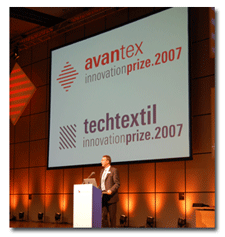
A total of nine Innovation Prizes were awarded at last week’s Techtextil and Avantex symposia,
which accompanied the corresponding Techtextil, the International Trade Fair For Technical Textiles
and Nonwovens, and Avantex, the International Forum for Innovative Apparel Textiles — events held
in Frankfurt, Germany. The goal of the competitions is to promote new ideas and innovations in the
high-tech textiles field, as well as to promote the transfer of ideas among research, industry and
end-user.

janecke
Michael Jänecke, brand manager, Techtextil Avantex, Messe Frankfurt Exhibition GmbH,
presents the innovation honorees during the recent Techtextil held in Frankfurt, Germany.

The following Techtextil Innovation Prizes were awarded:

New Material Developments

Technical blade of grass: Dr. Markus Milwich, Prof. Heinrich Planck, and Dr. Thomas
Stegmaier, Institute for Textile Technology and Process Engineering, Germany; and Dr. Prof. Thomas
Speck and Dr. Olga Speck of the Plant Biomechanics Group at the University of Freiburg, Germany,
developed this bionically optimized composite fiber material whose potential application areas
include such fields as aerospace, automotive, construction and apparatus engineering, where there
is a demand for tube-shaped structures, as well as medical purposes such as prosthetics.

New Areas of Application

Intelligent Impact Protection: Dr. Liz Mallen, Dr. Steve Robson, Graham Budden, Ph.D., and
Dr. Rich Sibbick, Dow Corning Corp., Midland Mich., developed a textile that serves as an
alternative to hard armoring, becoming solid upon impact but otherwise remaining flexible for
freedom of movement.

Auxetic Fabric: Dr. Patrick Hook, Auxetix Ltd., England; John Stimpson, Heathcoat & Co.
Ltd., England; and Prof. Ken Evans, Exeter University, England, developed a fabric that reduces
pressure created by explosions, offering new application possibilities in the security and
protection sectors.

Self-Cleaning Textile Surfaces with a Nano Finish: Dr. Ralf Nörenberg, Wolfram Badura and
Sylvia von Krog, BASF AG, Germany, developed a finish that repels oil, water and particles, and
whose potential application areas include tents, parasols and awnings.

Functional Translucent Concrete: Dr. Gerd Frankze, Helge Hausding, Dr. Evelin Hufnagl, and
Dr. Chokri Cherif from the Institute for Textile and Apparel Technology at the Technical University
of Dresden, Germany, developed a process based on the automatic fixation of rod-shaped elements
made of solid or tubular fibers in matrix or mat form. The process allows the integration of
additional features to provide for the transmission of signals or modification of room climate,
among other functions.

New Products

Water-Saving Irrigation Mat: Dr. Holger Erth, Rolf Arnold and Reinhard Helbig of the Saxon
Textile Research Institute at the Technical University of Chemnitz, Germany; Thomas Roess,
Internationale Geotextil GmbH, Germany; and Dietmar Haub, Eco Rain GmbH, Germany, developed a mat
made of two nonwoven layers of fabric with perforated tubes that enable water savings of up to 70
percent, according to the developers. Application areas may include agriculture, landscaping and
horticulture, especially in hot and dry climates.

innovationhonorees
Honorees were recognized for their innovative developments in technical textiles.


The following Avantex Innovation Prizes were awarded:


Innovative Apparel


Photo-luminescent textiles with long-term effect: Jean-Marc Viénot, Imasol Sprl, Belgium;
Christian Fombert, Setila S.A., France; and Michel Sarazain, Idem Conseil, France, developed a
textile that emits light for more than 12 hours, and with apparel applications such as rain,
motorcycle, work and sports.

Bionic climate membrane: The development team at Switzerland-based Schoeller Textil AG
developed the c_change™ wind- and waterproof membrane technology capable of controlling water-vapor
permeability, whose application area may include apparel.

Anatomic motorcycle suit: Designer Jasmin Julin-Aro with the research and design team from
Rukka/L Fashion Group Oy, Finland, developed a breathable, windproof, climate-controlled motorcycle
suit that incorporates an intelligent impact-protection textile that becomes a solid shield upon
impact. The suit uses Outlast climate-control technology and the Dow Corning® Active Protection
System.


June 19, 2007

DHL Opens New Hub In Mexico

San Francisco-based DHL has opened an international gateway in Hermosillo, Mexico, that offers
next-day delivery for all shipments up to 150 pounds from Hermosillo to anywhere in DHL’s US
network, and second-day delivery to and from Guaymas, Ciudad Obregón, Navojoa, Empalme and
surrounding communities in northwestern Mexico. The new hub operates daily flights between
Hermosillo and Phoenix; northbound shipments are routed through Phoenix to the company’s
Wilmington, Ohio, ground and air hub.

The Hermosillo facility offers a streamlined customs facility for cross-border shipments. DHL
customers may also contract with a Customs agent of their choice.


June 19, 2007

Congress Attacking China Currency Problem

The US Treasury Department’s decision not to label China a currency manipulator has triggered a
sharp and quick response from the leadership of the trade committees in Congress. In its
semi-annual congressionally mandated International Economic and Exchange Rate Policies report, the
Treasury said that even though China’s currency, the yuan, is undervalued, it does not meet the
technical requirement that the policy is being carried out for the purpose of preventing effective
balance of payments adjustment or gaining unfair competition advantage in international trade.

The report said, “Even though the Treasury has not designated China according to the criteria
of the law, the Treasury forcefully raises the Chinese exchange rate regime with Chinese
authorities at every available opportunity and will continue to do so.” It went on to say China
should not hesitate any longer to take “far more vigorous action” to rebalance its economy and to
tackle the currency’s undervaluation. Shortly after the report was issued, the China central bank
allowed the yuan to break through what had been a symbolically important level of 8 to the dollar.
The move was seen as an effort by the Chinese to cool down the debate in the United States over its
currency policies.

That did not satisfy members of Congress who serve on committees with jurisdiction over trade
matters. Sens. Max Baucus, D-Mont., chairman of the Finance Committee, and Charles E. Grassley,
R-Iowa, the ranking committee member, introduced legislation that would require the Treasury
Department to develop a new report that identifies “fundamentally misaligned currency” as something
requiring US action and eliminating the “intent” criteria. The bill would mandate the Treasury to
consult with key trading partners and the International Monetary Fund to address currency problems.
In addition, the Department of Commerce would be required to consider currency manipulation in
evaluating anti-dumping cases.

On the House side, Democrats on the Ways and Means Committee said they plan to address
currency manipulation problems in a number of ways with legislation that would put pressure on
China and the administration to act. One such measure is the Ryan-Hunter bill, which is pending in
the House and now has 105 cosponsors. It would define exchange-rate manipulation as a prohibited
export subsidy and clarify that the US countervailing duty law applies to both market and nonmarket
economies, such as China.


June 19, 2007

Sponsors