FKI Logistex Opens New TEC Facility

St. Louis-based FKI Logistex North America — a supplier of automated material-handling solutions
for manufacturing operations; and warehouse, distribution and other facilities — has opened the FKI
Logistex Technology & Education Center (TEC) next to its manufacturing facility in Cincinnati.

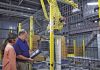
The center enables visitors to test their own products on FKI Logistex sorting, conveying,
automated storage/retrieval and order fulfillment systems; preview new material-handling solutions;
and receive operator training.

“The TEC provides FKI Logistex customers with a state-of-the-art, technology-rich, material
handling environment to see the industry’s latest solutions in action,” said Stephen Legg,
director, product and technology development, FKI Logistex.


September/October 2007

Executive Forum: Made In Germany


diloG

erman textile machinery manufacturers have been at the top of the worldwide producer list
for decades.

Textile World
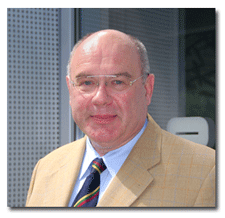
asked Johann Philipp Dilo, chairman of the German Engineering Federation (VDMA) Textile
Machinery Association’s Executive Board, how he masters his work as chairman in addition to the
daily routine as CEO of the Dilo Group. A prominent personality in the German textile machinery
industry, Dilo has successfully led the Dilo Group for many years. He also has been a member of the
VDMA Textile Machinery Association’s Executive Board for many years, and for the last two years has
served as its chairman.

TW: What were the reasons to accept the VDMA position?

Johann Philipp Dilo (JPD): At first, one must notice that these honorary jobs are
also suitable to look beyond one’s own nose, to work and to take on responsibility not least for
the members and the entire Executive Board. This has primarily arisen from the sense of duty.
Everybody knows that it’s not always easy to find people in politics or trade associations to
accept an honorary post. However, it is also an asset with an information platform, as well as the
exchange of thoughts and strategies.

TW: What are your personal challenges with this chairmanship?

JPD: Everyone suffers from a shortage of time in a position of corporate
management, isn’t it so? Providing time for this activity is the greatest challenge. However, it is
also so that the stress is even bigger during the time as a CEMATEX delegate. [The European
Committee of Textile Machinery Manufacturers (CEMATEX) designated VDMA to organize ITMA 2007.]

TW: Does this extra work also bring some advantages?

JPD: It brings the advantage that I also deal with and have a good look at the
strategy of the German textile machinery manufacturers. In terms of exhibitions, many things are
moving. In this respect, it brought me firsthand information as a member of the Executive Board for
many years. And as chairman, I am in very direct contact with the office of Thomas Waldmann
[managing director, VDMA Textile Machinery Association] and his staff. And there, too, there is
firsthand information to be processed.

TW: The VDMA Textile Machinery Association is one of the largest textile machinery
associations in the world and has been for many years. Why do you think this is still the case?

JPD: I think that has primarily to do with the manifold structure of the German
textile machinery market. The situation is characterized by large companies with group structure on
one side. On the other hand, there are a large number of medium-sized, family-run enterprises with
long traditions and strong reputations that are handed down from generation to generation. And
then, I have to mention again the continuity. Today, one can hardly achieve ad hoc successes in the
textile machinery industry. All new developments are processes prepared in the long run. If all
this occurs in the family-owned enterprise, one has continuity in the development work. And this is
the prerequisite for success.

TW: So a company can’t buy a history?

JPD: Exactly, and it’s hard to accelerate it. Of course, one can delay history,
but it is very difficult to suddenly make a great leap in research and development. One always
wants this as a machinery builder, and searches for revolutionary solutions.

At the end of the day, one notices, however, that these were mostly modest jumps making the
next step forward. However, the number of smaller jumps is decisive.

TW: And how do you reconcile all this?

JPD: The profession of an independent entrepreneur presupposes that one does not
have too many interests alongside his job. I even think that one should be a little more reserved
with his hobbies. Today’s challenges are so manifold that one must concentrate all personal
strengths to be successful. The person who is willing to have success must remember his own
strengths, have a concept, and — to be more precise — a long-term, lasting concept. At all joyful
development work, one must set on continuity and be confident himself.


VDMA


There are some 130 enterprises in the
German textile machinery industry, and they achieve a turnover of approximately 3.5 billion euros
(US$4.78 billion) per year. Ninety percent of this turnover is generated by VMDA members.

TW: What are the advantages of VDMA membership?

JPD: The VDMA makes a big effort to promote the German textile machinery industry
worldwide. It is in this respect that it watches also very strongly our markets and provides the
members with information about market trends, business cycle data and statistics. However, it also
watches and documents the industry-specific results in the textile machinery industry with export
data. Statistics play a very important role.

The second point is the show information policy. One watches numerous fairs worldwide, and
is also present. Regarding advertising, purchase guides are distributed to present the German
textile machinery industry itself. The exhibitions, design, participation and the support in the
organization play an important role. Of course, the VDMA is represented prominently in the CEMATEX
committees and contributes its ideas.

TW: What does the VDMA think about education?

JPD: This is a great topic. The VDMA, of course, also cares about the young blood,
for example, with grants for engineering training. In connection with this, the VDMA is also
organizing global-scale symposia, in markets where it makes sense. In this respect, it is also
helpful for the members to find programs. Furthermore, one has to deal with technical questions,
contract forms, standards, safety techniques and so on, as well as have contact with the leading
textile institutes.

TW: You mentioned the keyword “exhibitions.” This is the hot topic, because there
are apparently too many fairs. Do you agree?

JPD: I don’t belong to the group of people who say there are too many fairs. One
simply must choose the right ones, and everybody has the freedom to do so. But the choice of too
many fairs is not that bad at all. And it is not only about machinery shows, but also about
smaller, local fairs or events without machinery — like Techtextil, where there are many customers
with whom one can talk about new products. The already mentioned symposia give even more events to
choose from, again where one meets the customers. And all this choice of where one can meet his
customers in one place is a very efficient opportunity to do marketing and saves various journeys.
In this respect, I suggest to everybody not to complain but to select the appropriate exhibitions
for their business.

Approximately 35 VDMA textile member enterprises are working in the area of nonwovens. Many
of them are also machinery manufacturers for spinning equipment. This sector is very progressive
and shows stable growth of 10 percent per year, sometimes even more. The classic textile machinery
industry can only dream of this growth rate. However, this applies not only to nonwovens, but also
to technical textiles, which have just as big a future potential. This development also will find
its expression at ITMA if one sees what kinds of products are shown for these areas.


Market Situation


Dilo considers the current market
situation quite positive. “The figures speak a considerable language,” he said. “The German textile
machinery industry expects an increase in sales of about 13 percent this year. This applies to the
entire textile machinery industry including accessories. The incoming orders still are developing
positively. It looks like a successful ITMA 2007 and a promising year for European textile
machinery manufacturers. As is well-known, the textile machinery industry is always the subject of
strong fluctuations. In 2005 and at the beginning of 2006, we all had below-average capacity rates.
This has improved so that we have arrived in the top midfield now.”

TW: How do you see the short- and medium-term future for the European textile
machinery industry? Will it be able to withstand the global competition, or will this industry
slowly migrate to Asia?

JPD: With all cautiousness, I am very positive for the reasons that I have already
mentioned. When one can contribute as a member of the Executive Board of the VDMA and also in his
peer group, one also needs to have a certain stability in his point of view. One also needs
self-motivation and self-conviction. One also must have faith — without faith nobody can be
successful. People who only live with fear can’t survive as businessmen. Having our own company
success in mind, I am very confident about the future.


September/October 2007

Diolen Introduces Diofort® Multifilament Yarn

The Netherlands-based Diolen Industrial Fibers has introduced Diofort®, the first high-tenacity
multifilament yarn made with Wilmington, N.C.-based Fortron Industries LLC’s Fortron® polyphenylene
sulfide (PPS) for use in fabrics, nonwovens or textiles, or as reinforcement. The yarn — which can
be combined with carbon, glass and other polymer fibers to produce blended fabrics — features
chemical resistance, flame retardancy, high durability, low water absorption, toughness and the
ability to withstand extremely high temperatures, according to Diolen.

Diofort’s production process comprises plasticizing and extruding Fortron PPS in a
multifilament extruder at the desired diameter, then stretching individual filaments in a defined
temperature range.

Diofort can be used to reinforce hydraulic oil hoses in power steering systems, reducing
vibration and noise; and composites for use in aerospace systems.


September/October 2007

Balta Unveils Softline® Yarn, Carpet Collections

Belgium-based Balta Group’s Balta Rug division has developed Softline® polypropylene yarn to impart
softness to rugs. The new yarn incorporates a high volume of ultrafine fiber strands that are
softened via a chemical process during production. Softline yarns are not made with traditional
softeners such as oil, making it environmentally friendly.

Balta has introduced two rug collections featuring the new yarn. Softline View rugs are
suitable for contemporary interiors, while Softline Style rugs are targeted to more traditional
settings.


September/October 2007

Wellman Sells WIL To Aurelius AG Affiliate

Wellman Inc., Fort Mill, S.C., has sold Ireland-based Wellman International Ltd. (WIL), the
company’s European recycled-based fibers business, to an affiliate of Germany-based investment firm
Aurelius AG for approximately $38 million. The sale is in line with Wellman’s strategy to focus on
its US chemical-based business.

“We are pleased with the result of Wellman’s investigation of strategic alternatives for our
business,” said Dick Budden, managing director, WIL. “With the support of Aurelius, we shall
continue providing first-class products and service to all our customers, and have the resources to
expand our business, both in fibers and in recycled materials for other applications.”

WIL has an annual production capacity of approximately 185 million pounds of primarily
post-consumer-recycled-content polyester fiber. Applications for the fiber include car interior
trim, industrial, loose-filled bed products, personal hygiene and upholstered furniture uses.


September/October 2007

Faytex, NanoHorizons Partner To Offer Footwear Benefits

Faytex Corp. — a Weymouth, Mass.-based developer of moisture-management fabrics — has partnered
with NanoHorizons™ Inc. — a State College, Pa.-based developer of nanoscale materials for a range
of industries including apparel — to offer its Dri-Lex® shoe lining material with NanoHorizons’
SmartSilver™ anti-odor/antimicrobial technology.

“Faytex is the industry’s recognized leader in high-performance footwear fabrics,” said
Dennis Schneider, director, sales and marketing, NanoHorizons. “Faytex and its Dri-Lex show lining
material present a perfect opportunity for NanoHorizons to showcase SmartSilver’s unmatched
anti-odor performance in a challenging odor-generating environment. SmartSilver’s nanoscale
technology enables Faytex to maintain all of Dri-Lex’s leadership comfort and moisture-movement
capabilities and add lab-proven antimicrobial performance — delivering the perfect solution.”

Faytex is currently working with Vista, Calif.-based Zoot Sports to incorporate the new
material into Zoot’s new line of footwear.


August 28, 2007

County Draperies, Vinyl Technology To Install Eton Systems

County Draperies Inc., a family-run manufacturer of draperies, bedspreads and accessories for
commercial industries, will install an Eton 4000 materials-handling and factory-floor
data-collection system at its facility in Middletown, N.Y. The Eton 4000, the first of three Eton
lines the company plans to install, will consist of 38 workstations that will be used to produce
draperies. The line will include a specially designed six-rail sorting buffer that will sort order
components back together before packing and shipment to customers.

Monrovia, Calif.-based Vinyl Technology Inc., a family-owned contract manufacturer of
industrial fabrics for commercial and military applications, plans to install an Eton 2002 system.
The system, consisting of three lines and 54 workstations, will operate at its Monrovia facility
and be used to manufacture carrying cases for the US Army.

“Eton is a key component of our aggressive modernization initiative,” said Dan Mollura,
president, Vinyl Technology. “We see it as a good fit for our operation because of the wide variety
of products that we produce. Eliminating material handling time and costs will make bulky items
easier to handle and drive greater efficiency across our entire sewing operation.”

Installation is expected to be complete in the fourth quarter of this year.


August 28, 2007

US DOC Awards Export Achievement Certificate To Knit-Rite

The US Department of Commerce (DOC) recently awarded Knit-Rite Inc. — a Kansas City, Kan.-based
producer of medical and consumer textiles — its Export Achievement Certificate in recognition of
Knit-Rite’s first sales to businesses in Greece, Lebanon and Turkey.

Knit-Rite exports products such as prosthetic socks, diabetic socks, compression hosiery and
orthotic textiles, among other products, to more than 40 countries including Mexico, Chile and
Australia.

The certificate program recognizes businesses that have successfully made their first export
sale and/or entered new foreign markets with assistance from the US Commercial Service, a DOC
agency that aids small to mid-sized US companies sell products worldwide. Knit-Rite achieved the
sales in Greece, Lebanon and Turkey with the assistance of services provided by the Kansas City US
Export Assistance Center.

“The Commercial Service has saved our company valuable time and resources, enabling us to
boost our exports and achieve a higher level of sales in the face of international competition,”
said Chris Vering, executive vice president, CFO and COO, Knit-Rite. “Our export sales continue to
make a vital contribution to our company’s growth here at home, enabling us to both maintain and
add local jobs.”


August 28, 2007

VDMA To Offer Guided Tours At ITMA 2007

The German Engineering Federation (VDMA) Textile Machinery Association will offer trade visitors
guided tours of textile machinery and technologies at ITMA 2007. Three tours, all offered in
English, will be held Thursday, September 13 from 9:30 to 11:30 a.m. Each tour will commence at the
VDMA information booth, located at Booth 11 at the Association Center East Entrance.

Tour 1 will cover man-made fiber plants, spinning preparation and machinery, and nonwovens
machinery. Tour 2 will feature weaving, knitting and braiding machinery; and Tour 3 will include
washing, bleaching, dyeing, drying and finishing machinery.

More information may be found at the English version of the VDMA website,
www.vdma.org/textile. Each tour is limited to 20 participants. The registration deadline is
September 6.


August 28, 2007

Dienes, Mainsite Team To Provide Complete Spinning Solutions

Germany-based Dienes Apparatebau GmbH — a spinning plant and man-made-fiber treatment solutions
provider — and Mainsite Services GmbH & Co. KG — operator of the Obernburg Industrial Center
(ICO), also based in Germany — have joined forces to provide complete, customized upgrade or
conversion solutions, from extrusion to winding, for spinning plants that process bulk continuous
filaments, polyethylene terephthalate, polyamide, elastane and assorted high-performance fibers.
The two companies together employ 30 engineers and technicians who work closely with customers to
develop concepts, special components, and automation and process control techniques; and oversee
their technical implementation.

Recently, Dienes and Mainsite completed a project to design a single-step manufacturing
process for Diolen Industrial Fibers GmbH — a manufacturer of high-quality technical polyester
yarns — at Diolen’s facility in the ICO. According to the two companies, the project, which was
completed in record time over a period of a few months without interfering with ongoing operations
at the plant, quickly achieved the goal of improving production efficiencies and optimizing costs
while maintaining product quality.


August 28, 2007

Sponsors