Success In Munich


T
he globalization of the textile industry was reflected at ITMA 2007 in Munich, Germany. A
total of 1,451 companies from 38 countries presented their latest developments and technical
innovations for the entire textile chain to visitors and competitors, in a display area covering
102,000 square meters.

The 15th International Exhibition of Textile Machinery attracted approximately
118,000 trade visitors from 149 countries. Never before had ITMA had attendees from so many
different countries. After Germany, the other top 10 countries with regard to visitor numbers were
Italy, India, Turkey, Brazil, France, Switzerland, Spain, Iran and Belgium. Interest from Central
and South America was particularly strong. More than 4,500 trade visitors came from Brazil, more
than 2,000 from Argentina and more than 1,500 from Mexico. In total, ITMA 2007 attracted
approximately 12,000 visitors from Central and South America.
itmahall

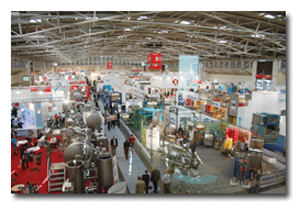
ITMA 2007 filled 16 halls at the New Munich Trade Fair Centre with technology for the
textile industry.


Small Progress


According to statements from everyone interviewed by

Textile World
at the show, there actually was no revolution at ITMA. However, there were many further
developments of existing technologies and processes. The trend is clear: All producers are trying
to increase output with lower and lower amounts of energy, water and dyestuffs, while the quality
of the end products must improve. This squaring of the circle is not easy to accomplish.

Andrew Fernandes, head of marketing communications, Huntsman Textile Effects,
Switzerland, thinks a dyeing machine still looks the same, but the results get better and better.
Hans Rosemann, advertising manager, Germany-based Trützschler GmbH & Co. KG, explained that the
actual machine improvements are considerable overall; however, improvements are still possible in
the details. Klaus A. Heinrichs, vice president, marketing, at Germany-based A. Monforts
Textilmaschinen GmbH & Co. KG, also thought there was no real sensation to see. The
contributions vis-à-vis environmental sustainability are becoming more and more important, and many
improvements to the machines are aimed exclusively in this direction.

There were some novelties to see, like Trützschler’s magnetic sets for cards, or the
new weft insertion system from Switzerland-based Sultex Ltd. for different yarns, which was shown
for the first time on an air-jet weaving machine. Edda Walraf, marketing head, Textile Division,
Rieter Management AG, Switzerland, thought it was an ITMA of world records for Rieter. The company
reported it exhibited four of its highest-performing machines ever.

All interviewed companies had 50 to 80 representatives in their booths, with the
exception of the Oerlikon Textile group, which had 180 employees at different booths throughout the
show.


Machinery Presentations Still Necessary


Presenting machines, preferably working, is one of the large cost factors affecting
show exhibitors. Everyone agrees nevertheless to showcase machines because ITMA is the only place
where visitors can compare so many machines in the same place at the same time. Johann Philipp
Dilo, general manager, Dilo Maschinensystem GmbH, Germany, said his enterprise installed 300 tons
of machines at ITMA within 24 days. Dilo had the biggest stand by far at the show. But, as Dilo
stated, one cannot put forth such an effort at every fair, unless it is practically in front of
your door.


Positive Feedback


Munich was confirmed as a virtually ideal fair location. Many exhibitors, including
non-Germans, declared the organization, easy hall access and the open layout of the New Munich
Trade Fair Centre as ideal for an ITMA. It was heard through the grapevine that the ideal fair
places are Munich for Europe and Singapore for Asia.

The response to new products exhibited was very good. Bill Fong, executive director,
European Operations, Fong’s Industries Co. Ltd., Hong Kong, thinks textile companies are full of
confidence again after the turbulence with the World Trade Organization. After many slow years, it
is now time to invest again, and not only in Europe.

Every one of the enterprises questioned was very satisfied with the visitors. The
expectations of ITMA were mostly exceeded. It was particularly striking that the visitor quality
continues to increase. Business owners often came together with their engineers to discuss and
complete projects on the spot.

André Wissenberg, vice president of corporate communications, Oerlikon Textile GmbH
& Co. KG, Germany, said the company had 4,000 high-quality conversations with visitors over the
course of the show; this is 400 contacts per day.

Several companies confided to

TW
they had concluded sales during the show. Up to now, fairs like ITMA have been known more
for the presentation of machinery rather than for big sales.

Dilo looks back at a good ITMA. He thought his company would never have had so many
positive responses to its booth as at this ITMA.

Edi Strebel, manager of marketing services at Switzerland-based Jakob Müller AG,
Frick, mentioned that more and more end products are being shown at the booths, and not just
machines, so visitors can get a better idea of what kind of products the machines are capable of
producing. The trend goes generally in this direction. One saw samples of semi-finished products at
many exhibitor booths.

Everybody interviewed declared the current market situation to be very good to
excellent. This opinion applies especially to the suppliers of machines for nonwovens and technical
textiles, which still show constant growth rates of 10 to 15 percent. As important markets, China,
India and Pakistan were mentioned, but also Turkey and Brazil. This gives great hope for the near
future.

Daniele Pellissetti, administration and advertising manager of Italy-based Savio
Macchine Tessili S.p.A., said today, one simply must follow the market and must produce what the
markets need. He is also convinced that 2008 can be just as positive as 2007.


Too Many Fairs?


At a press conference hosted by the European Committee of Textile Machinery
Manufacturers (CEMATEX), it was announced that ITMA Europe shall continue on a four-year rotation,
and ITMA Asia will be held every two years. This will lead to some overlaps. No one who was asked
about these plans wanted to comment positively. The question whether it is really necessary to
carry out an ITMA for all industry segments every two years bothered Oerlikon’s Wissenberg. How
shall one offer real novelties for the Asian market every two years? And one should show more
innovations and less steel at ITMA, said Flurin Valentin, vice president, director of sales and
marketing, ITEMA Weaving and Sultex. It gets particularly difficult for the exhibitors such as
Dilo, Fleissner, Rieter Perfojet and Trützschler, who are also working in the nonwovens industry.
Here the situation is amplified because the nonwovens industry carries out an exhibition on a
three-year cycle in Europe, the United States and Asia.


Barcelona? Barcelona!


Of course, the venue of the next ITMA in 2011 created high waves in Europe.
According to CEMATEX, eight venues were in the running to host the next ITMA, and ultimately,
Barcelona was chosen. This provoked initial protests by some exhibitors, but during later
conversations with these exhibitors, it appeared Barcelona was no longer an issue. It was mentioned
that the next ITMA may have fewer Italian exhibitors because the Italian textile machinery industry
consists for the most part of small and medium-sized enterprises that financially and logistically
cannot afford to travel far to attend a trade show. It is hoped that certain sectors of the
industry will not split off, as was the case with the knitters at ITMA 2003 in
Birmingham.


Everyone wants to have a strong ITMA in Europe, and this can only happen if there
are many exhibitors. ITMA simply should not degenerate into a tourist fair. There must be a balance
between working time and leisure time. And one thing ITMA should never be is a money-making machine
for the organizers. The original aim of ITMA Asia was to drastically reduce the number of
exhibitions, and what has been decided is heading in a completely different direction.

November/December 2007

DuPont Develops New Kevlar® Variant

Wilmington, Del.-based DuPont has developed a 300-denier Kevlar® fiber variant for
use in vests worn by corrections officers. Kevlar Correctional™ fiber technology provides excellent
puncture resistance, according to the company, and prevents sharp instruments from passing through
the body armor by dissipating energy and restricting the instrument from pulling the Kevlar
Correctional fibers apart.

When blended with other Kevlar ballistic materials, the new fiber, which helps vests
meet National Institute of Justice standard 0115.00, can also provide threat protection from
bullets and handmade weapons.


November/December 2007

Mount Vernon Mills Expands Chemicals Business

Mauldin, S.C.-based textile manufacturer Mount Vernon Mills Inc. has expanded its
chemicals business during 2007 through the acquisition of several chemicals companies. The company
will offer the products of that business domestically and internationally in both textile and
non-textile industry markets.

Companies acquired in 2007 include Apollo Chemicals; Sage Technology; FCI
Technologies; American Manufacturing International; and Chemical Technologies, which includes
Callaway Chemicals, Crompton & Knowles and Yorkshire Pat-Chem. New plant locations include
Graham, N.C., Opelika, Ala., and San Pedro Sula, Honduras — all of which are ISO 9002-certified.
The acquisitions have added 75 employees to the chemical group’s employee base of 50.

“These performance and specialty products are extensions and complements to the
products currently produced at our Phil Chem plants in Greer and Ware Shoals, S.C.,” said William
E. “Bill” Duncan, vice president, Mount Vernon Mills. He added that certain recently acquired
products will be manufactured in Ware Shoals.

According to Mount Vernon, its chemicals business has increased twelve-fold since it
acquired Phil Chem in 2003, and it now sells its products in 20 countries, with a significant
proportion going to Central America.


November/December 2007

3M Launches Scotchgard™ Protector Repellent Finish

The new Scotchgard™ Protector Repellent Finish is the latest in St. Paul,
Minn.-based 3M Corp.’s line

of Scotchgard fabric treatments that protect fabrics from stains and exposure while
maintaining their hand and breathability.

The finish, designed for man-made fabrics used in active and casual outerwear,
provides lasting water-repellent characteristics through the use of a next-generation formula that
3M claims is a more sustainable, environmentally friendly alternative to competitive protective
treatments.

The formula’s chemistry uses
short-chain carbon (C) lengths of C4
and below, rather than longer chain chemistries used in the chemical makeup of
competitive products. These shorter carbon chain lengths have low toxicity and low environmental
impact, according to 3M.


November/December 2007

Chemical Industry Ready For The Future


T
he chemical industry has been an integral part of ITMA exhibitions since the 2003 show in
Birmingham, England. This branch of the textile industry is a primary factor in finishing, if not
the decisive factor. Many textile products become the requested high-tech product after the right
finishes are applied according to specifications.

The environment was a hot topic at ITMA 2007 in Munich, Germany. Never before was a
trend toward greater ecology and energy savings more obvious. For example, machines feature reduced
water and dyestuff consumption, and environmentally friendly processes. These features go
hand-in-hand with increased and reproducible quality.

Machinery suppliers know today’s customers want more than just machines — they want
methods and solutions. Therefore, suppliers cooperate very closely with the chemical industry. The
future lies in developments that are a cooperation between the machinery producer and the chemical
manufacturer. Many suppliers showed such partnerships at ITMA 2007.

dowdenim

Dow Corning Corp. has introduced a new silicone softener for denim that can be combined
with previously incompatible processing steps, thus reducing the amount of water used during
processing.


Global Presence


The trend toward increased environmental consciousness is favorable for European
producers, which are constantly developing environmentally friendly processes and chemicals. Today,
the big manufacturers of finishing machinery and chemicals are not only suppliers of machines and
dyestuffs, but more often providers of total solutions.

This is today especially the case in all countries with a high level of
environmental consciousness. However — and this is the overall opinion of the industry — in a short
amount of time, all markets are being required to move in the same direction for ecological and
economic reasons. The increasing price of oil is accelerating the problem even more.

The strengths of the European chemical industry are its proximity to and presence in
all important textile regions, and its global network based on local expertise. All products
fulfill international standards regarding quality and ecology, regardless of origin, and are
tailor-made to meet specific regional customer requirements.

Chemical companies are present in all major global textile markets. Production sites
and technical service centers are located in the most important textile markets, including growing
markets such as China, India and other Asian countries. This ensures efficient delivery of service
and high-quality products. BASF AG, Germany, has moved the global headquarters of its textile
chemicals business to Singapore to strengthen its focus on the aforementioned growth markets in
Asia.


New Products


To produce a higher-quality end product, high-quality dyestuffs are required, for
the continuous dyeing process in particular. Reactive dyes  — less delicate than other
dyestuffs — are commonly used.

According to Switzerland-based Huntsman Textile Effects, chromium-free dyestuffs
were of interest at ITMA. Huntsman’s latest development is a chromium-free black dye called Lanasol
Deep Black CE-R.

BASF has developed a new crosslinker, Helizarin Fixing Agent TX 4737, with reactive
centers that are free of formaldehyde. In addition, a formaldehyde-free binder, Helizarin Binder TX
4738, has been developed that is ideally suited to the new crosslinker. Together with BASF’s
existing formaldehyde-free thickeners, the new products form the formaldehyde-free Helizarin
pigment-printing system
(See “BASF Develops Formaldehyde-Free Pigment-Printing System,” www.
TextileWorld.com, Sept. 11, 2007).
According to BASF, the advantages of the
new products are considerable:

•       All the components of the printing system
(binder, crosslinker, thickeners and other auxiliaries) are formaldehyde-free.

•       Formaldehyde levels on the textile 
before and after the printing process remain unchanged.


•       High-quality printing is guaranteed, meeting
the requirements of the industry with regard to processing properties on the printing machine and
fastness standards.

•       Textile producers can now meet all regulatory
standards as well as the leading retailers’ and brands’ requirements related to formaldehyde
without any additional measures, even in dark shades.


Market Situation


Another important topic at ITMA was raw material savings — with lighter weights at
the same quality level as heavier weights. If the raw material costs make up 60 percent of the
finished product cost, this issue will become more prominent in the future. Flexibility and quality
monitoring for even better products were mentioned, as well as an increasing regularity and
reproducibility of the products.

There is a trend in the finishing industry — until now, only countries that were
forced by law were interested in heat recovery. However, with increasing energy costs, Asian
countries also are now interested in this technology.

Effects and functions are still a hot topic. Today, most consumers expect a garment
to offer some functional features. As a result, the demand for functional textiles, especially, as
BASF mentioned, for wrinkle-free, antimicrobial, and anti-stain and -soil finishes, is increasing.
There is great interest in and a demand for sustainable textile solutions. At the moment, BASF sees
this especially in the following areas:

•       safer production at textile mills, as well as
consumer safety — for example, the new formaldehyde-free Helizarin pigment printing system;
and

•       resource-saving solutions and technologies —
for example, the Cyclanon XC-W after-soaping agent for reactive-dyed cellulosic fibers, which has
both economical and ecological advantages in time, energy and water savings, according to
BASF.

In the marketplace, there is a constant shift of textile production towards Asia
from North America Free Trade Agreement (NAFTA) countries and Europe. Therefore, there has been a
lot of consolidation in the textile chemicals business in the last few years. BASF has followed
this shift of textile production in the past, and has improved its competitiveness significantly in
the global market.

NAFTA countries and Europe continue their trendsetting roles with regard to
technical and fashion-driven innovations in textiles. In Europe, there is a still-growing interest
for technical textiles.


Sustainable Solutions


There is an increasing demand for sustainable textile solutions. Regulatory
standards as well as requirements by retailers and brands are becoming increasingly strict. Also,
public awareness is increasing, and consumers are becoming more ecologically conscious.
Manufacturers hold certain obligations to protect consumers, and the industry expects the
significance of this responsibility will become more evident in the future.

Leveraging the global network and proximity to customers, chemical companies can
provide tailor-made solutions for their customers. In addition, customers can rely on extensive
know-how and expertise based on the global network of most of the suppliers from Europe, especially
when it comes to fulfilling international standards in terms of quality and ecological
aspects.


Dow Corning Launches Silicone Softener For Denim

With the introduction of a new silicone softener, Midland, Mich.-based Dow Corning
Corp. hopes to reduce the amount of water it takes to process denim fabrics. Dow Corning®

GP 8000 Eco Softener is a water-dilutable, nonionic treatment that is stable over a
range of pHs and temperatures, and is compatible with other enzymes and washing stones typically
used to process denim, allowing the softener to be applied in previously incompatible processing
steps. The softener produces a rugged, natural hand on processed fabrics.

GP 8000 Eco Softener can be applied in a wide variety of denim processing baths
including enzyme baths for fading, desizing baths, post-bleach neutralizing baths, stone-washing
baths and rinsing baths; or in an enzyme wash bath for biopolishing twill garments.

According to Dow, the ability to combine the softener with other denim-processing
steps could potentially reduce the water-processing requirement by 30 to 50 percent — equivalent to
as much as 15 liters per pair of jeans.

“With GP 8000 Eco Softener, processors can reduce their utility bills and improve
productivity,” said Anthony Feng, global industry director for Dow Corning’s textile business. “And
brand owners can improve their image by offering the market more sustainably produced garments.”&
amp; amp; amp; amp; amp; amp; amp; amp; amp; amp; amp; amp; amp; amp; amp; amp; amp; amp; amp; amp;
amp; amp; amp; amp; amp; amp; amp; amp; amp; amp; amp; amp; lt; /font>

The product was developed
for use in denim fabric and garment wet processing, but Dow states it also can be
used in exhaust or padding applications and may have potential in other garment, fabric and knits
processing.


Textile World Special Report


Transfertex Opens New Office

Germany-based transfer paper printing supplier Transfertex GmbH & Co.
Thermodruck KG has opened a new office in Lille, France. Transfertex France will serve as sales
headquarters for France and Belgium, offering one of the largest openline design collections in the
world at its showroom. Transfertex has appointed Daniel Mazurkiewicz sales representative for
Transfertex France.

In addition, Transfertex France will serve as the home office for Transfertex’s new
Fashion Creative Team including Justine Cox, Irina Velkova and Ines Travers. The team will
collaborate with the office in Germany on the creation of fashion collections, development of
customer engravings and recoloration of designs.

“We are very confident that the result will be even better service for our customers
and the highest quality fashion collection that Transfertex has ever offered,” said Daniel Page,
director, sales and marketing, Transfertex.


November/December 2007

EVS Receives Upgrade Orders

Israel-based Elbit Vision Systems Ltd. (EVS) has received $1.5 million worth of
orders from textile manufacturers in North America for upgrades to more than 10 of its inspection
systems.

“These orders show the enormous benefit our newest generation of automatic
inspection systems offer to our current customer base,” said Sam Cohen, president, EVS US Inc. “
Although these customers currently receive great benefits from the older systems, the newest
generation upgrades have proven success in bringing a significant return on investment, which
justifies their purchase.”


November/December 2007

Benninger Unveils Versomat Warping Machine


Benninger AG, Switzerland, has launched the Versomat sectional warping machine with
the flexibility to produce short warps and samples as well as normal production warp lengths, using
yarns ranging from staple fiber and silk to multi- and monofilament.

Available in a working width of 3.6 meters for furniture coverings and decorative
fabrics, and 2.2 meters for apparel, the Versomat features a reed headstock integrated into its
superstructure; and laser-aided feed determination and section tension control, which ensure
correct package build-up over the width of the warp and constant thread tension over the warp
length. A new leasing device also located in the superstructure, rather than fixed to the floor,
enables efficient operation when changing lots.


November/December 2007

November/December 2007


EDANA, the Brussels-based International Association Serving the Nonwovens and
Related Industries, has issued a

call for papers for its Nonwovens Research Academy, to be held Oct. 9-10, 2008, in
Germany. Short abstracts are due

Jan. 3, 2008. In addition, EDANA has made available grants for students who wish to
attend the academy. Grant applications are due June 1, 2008. For more information, contact
Catherine Lennon 32 2 734 93 10; fax 32 2 733 35 18;
catherine.lennon@edana.org; www.edana.org. EDANA
also offers online a summary of its “2006 European Nonwovens Production and Deliveries”
report.

edana.org


The Fiber Society, Raleigh, N.C., has issued

a call for papers for presentation at its Spring 2008 conference, to be held May
14-16, 2008, in France. Submissions are due Jan. 15, 2008. For more information, contact Pam
Gabriel (919) 513-0143;

fax (919) 515-3057;
pam_gabriel@ncsu.edu.


Research Inc. has relocated to 7041 Boone Ave., Brooklyn Park, Minn. 55428; (763)
398-1739.


Ahlstrom Corp. will relocate its headquarters to Salmisaari, Finland, in December
2007. The company’s post office box address, phone and fax numbers will remain the same.


Phifer Inc., Tuscaloosa, Ala., has added 10 new colors to its line of vinyl-coated
polyester SheerWeave® 4800 fabrics.

phiferfabrics

Phifer Inc.’s SheerWeave® 4800 fabrics


Glen Raven Logistics, Altamahaw, N.C., now offers an online quoting service at the
Logistics

section of its website,
www.glenraven.com.


The Association of the Nonwoven Fabrics Industry (INDA), Cary, N.C., has created
an online government affairs forum at
http://imisw.inda.org/.

iMISCM/AM


Bluestar Silicones, France, has launched www.advantex-textiles.com to support its
advantex™ fabric coating technology.

November/December 2007

Browzwear Unveils Fabric Testing Kit

Israel-based Browzwear International Ltd. — a developer and producer of 3-D fashion design and
communication software solutions for the apparel and textile industries — has developed a Fabric
Testing Kit to enable fashion designers and pattern makers to easily measure fabric properties
required for true-to-life 3-D apparel. The kit — the first offered for 3-D visualization — measures
a fabric’s stretch, bend and shear properties, and verifies the test results.

When used with Browzwear’s V-Stitcher™ fashion design and communication software, the Fabric
Testing Kit is capable of shortening production time, reducing costs and enhancing the realism and
accuracy of fabric simulation, according to the company.

October 30, 2007

Sponsors