US Army Selects Milliken’s Abrams™ FR Fabric For ICVC

Spartanburg-based textile and chemical manufacturer Milliken & Company’s Abrams™
flame-resistant (FR) fabric has been selected as the only approved fabric for the US Army’s
improved Combat Vehicle Coverall (iCVC), which replaces the current one-piece FR CVC uniform.

Abrams contains a combination of proprietary-blended fiber technologies, including DuPont™
Nomex®, to provide FR and other heat-related protection, as well as abrasion and tear resistance
and moisture-wicking capabilities. According to Milliken, the new uniform’s design offers improved
fit, function, and comfort.

The fabric also is approved for use in other combat uniforms. Milliken is a materials
subcontractor for all US military branches as well as the US Coast Guard, US Post Office and the
Department of Homeland Security.


November/December 2008

Trützschler: Serving The Nonwovens Industry


F
or decades, Germany-based Trützschler GmbH & Co. KG has been known as a premium
supplier of spinning preparation machinery. In 2006, the company acquired Germany-based nonwovens
machinery manufacturer Fleissner GmbH. Since that time, the group of companies, which also includes
Germany-based Erko Trützschler GmbH, has become a serious supplier of complete nonwovens lines.

In September 2008 during an open-house event, Fleissner presented new machinery at its
technology center in Egelsbach. For nonwovens manufacturing, the following new products were the
focus of attention:

New cards: Three machines will support the existing Fleissner AquaJet Spunlace
lines. The previous card has been replaced by the newly developed EWK-413 card from sister company
Erko Trützschler. It is designed to process up to 400 kilograms per hour (kg/h) and is said to
deliver carded polyester/viscose as well as cotton products. This means that all main components of
the high-speed spunlace process for carded products can be supplied from companies in the
Trützschler organization: fiber opening and blending, and carding machines from Erko Trützschler;
and spunlace and drying from Fleissner.

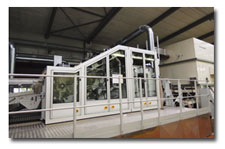
trutz1
The new EWK-413 card from Erko Trützschler is designed to deliver carded polyester/viscose
as well as cotton products.

Small spunlace machine: The second new machine installed in the technology center
with the AquaJet line is the Trützschler TC 07-H card, which is said to have an improved machine
direction/cross direction ratio and together with the new Fleissner MiniJet spunlace machine offers
an economical solution. The machine is a tool to enter the spunlace nonwovens market, thanks to its
small size and production throughput. It mainly serves the needs not only of institutes and
companies conducting research and development, but also of producers in niche markets. The main
features of the quasi-plug-and-play machine are a working width of 50 or 100 centimeters (cm),
pressures of up to 400 bar and the possible integration of its specially designed foam padder into
the spunlace line. Fleissner decided to push the chemical bonding process, traditionally limited to
speeds of not more than 70 to 100 meters per minute (m/min), to line speeds of up to 200 m/min.

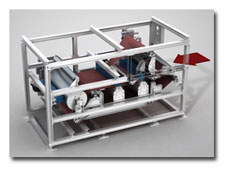
trutz2
The new “MiniJet” spunlace machine is said to be an economical solution, thanks to its
small size and production throughput.

Belt oven technology: Also shown at the open house was Fleissner’s belt oven
technology for thermobonding of high-loft products. Webs from 200-cm up to 720-cm working width can
be processed. During the design phase, Fleissner paid special attention to providing highest energy
efficiency, lowest energy losses and easy access for maintenance. Working height and working width
adjustments are accomplished in a user-friendly way.

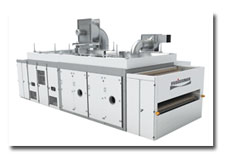
trutz3
Fleissner’s belt oven technology is suitable for thermobonding high-loft nonwovens.

During the event at Fleissner,

Textile World
had the opportunity to interview Dr. Michael Schürenkrämer, Trützschler Group board member.
Schürenkrämer discussed Trützschler’s strategy and expectations with regard to its expansion into
the nonwovens market.

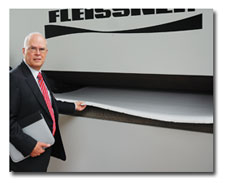
trutz4
Fleissner Senior Sales Manager Peter Ziehl shows the high-loft product cured in the new
belt oven.


Independent Supplier


TW:
For decades, Trützschler has been one of the market leaders in spinning preparation. Now,
with the acquisition of Fleissner, the group is very active in nonwovens manufacturing. What were
the main reasons to expand the activities into this area?

Schürenkrämer: Trützschler already had delivered similar machinery for fiber
preparation in the nonwoven industry since the end of the 1960s. With the chute feeder for cards,
known by the name of Scanfeed, we even had solutions for special applications, which were not found
elsewhere on the market.

However, our product portfolio did not cover all requirements, even for fiber preparation,
and at the end of the day, we were merely subcontractors without any direct contact with the end
consumer in many cases. Furthermore, there was an ongoing consolidation process by our competitors.
For years, we were questioning ourselves whether to become totally independent or to abandon the
products. We preferred to do the first.


TW
: Do you have an official group name for the nonwovens activities?

Schürenkrämer: No, not yet, but we think that with Trützschler Nonwoven, our
activities might be clear enough for everybody involved in this industry.


TW

: Fleissner was sold by its founder to the Zimmer Group. Now, you have acquired Fleissner.
How did this happen?

Schürenkrämer: Well, we had heard that Zimmer wanted to sell Fleissner, and we
showed our interest. This was in 2006.


TW
: Why just Fleissner?

Schürenkrämer: Fleissner, coming from the dryer area, developed over decades a
very broad product program holding different bonding technologies, particularly spunlace. In a link
with our machinery and that of Erko Trützschler, we now can offer complete lines. Our interest in
Fleissner was obvious, and the chance came to us.


TW
: Are you satisfied with the business development since you have taken over Fleissner?

Schürenkrämer: To some extent, yes. For the nonwovens business, it represents our
cautious expectations, although we would have wanted it to be better. The man-made fiber area had
been very strong over the last years, and then it dropped. However, we already knew this situation
before the takeover.


TW

: Were your expectations fulfilled?

Schürenkrämer: Yes, with regard to the common further development of the product
program. The fine-tuning in the group gets gradually better, and we have already concluded the
first project with all three companies. We are quite happy with the result, taking into
consideration the short period of time.

trutz5
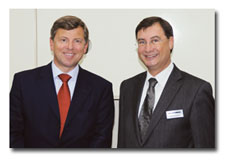
Dr. Michael Schürenkrämer (left), a Trützschler Group board member, with Hans-Georg Buckel,
CEO, Fleissner GmbH


The Right Timing


TW
: You can now offer complete lines for nonwovens made of staple fibers from one source only.
Why did you wait with the presentation until this Fleissner event?

Schürenkrämer: An open house event offers different possibilities of presenting
the available know-how and products as well as demonstrating all kinds of solutions.


TW
: Why didn’t you do it at ITMA Asia?

Schürenkrämer: Now, we are able to present novelties that were not yet ready for
ITMA Asia.


TW
: What is the ratio in your group of traditional applications to nonwovens?

Schürenkrämer: The ratio is about 2.5 to 1.


TW
: How do you see Trützschler’s strengths in the nonwovens sector as a group and within the
individual companies?

Schürenkrämer: Total solutions are more attractive for many customers because of
the simplification of the project negotiations and implementations as well as warranty matters. For
this, however, it requires a wide supply range to be able to play an important role. We can claim
our role for many applications today. It’s nevertheless a usual practice for us to combine complete
lines on request of the customer and in cooperation with our competitors.

Furthermore, one of our strengths is our worldwide presence, which is already visible mostly
in the USA, because of the importance of the nonwovens business, followed by Brazil, but also India
and China, where we have our own production centers. In medium terms, all this will certainly bring
added value for our customers.

Erko Trützschler and Fleissner have their strengths in their products, the flexibility but
also in the respective services – each company in its own way, but this is certainly natural
because they have developed individually. The future lies in an even more intensive cooperation for
all involved companies.


TW
: What is the organization regarding service, representations and such? Are these the same
people who are also responsible in the area of the classic textile industry?

Schürenkrämer: Some representations were merged with the spinning, and some not.
We did what is best for the individual markets.


TW

: Is the turnover for your nonwovens activities increasing?

Schürenkrämer: Basically, yes, but the period of time for our extended activities
in this field is still too short to give a firm answer.


TW
: Were your turnover expectations fulfilled regarding nonwovens?

Schürenkrämer: Yes, with the exception of the mentioned situation of the man-made
fiber area. In my opinion, the combined activities of Trützschler and Erko, the extended product
line with the first needling machine from Erko, and the expectations of the customers that
Trützschler stands behind the two companies led to this pleasant situation.


TW:
Is Trützschler’s nonwovens group complete, or are you considering further acquisitions?

Schürenkrämer: The product program is already rather homogeneous; however, it
takes time for everything to accrete – grow organically – together. We are already on the right
track, but there is still some homework to be done.

trutz6
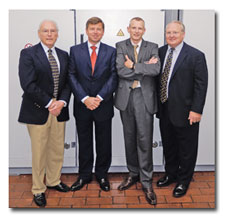
The United States is the center of the Trützschler Group’s nonwovens activities. This was
underlined by the presence of staff from American Truetzschler, Inc. at Fleissner’s open house at
its technology center in Egelsbach, Germany. Pictured are CEO Kurt Scholler (far left) and Jim
Greene (far right), American Truetzschler; with Schürenkrämer; and Dr. Dieter Zenker, technical
director, Fleissner.


Market Situation


TW
: How do you see the current market for nonwovens?

Schürenkrämer: I see it with mixed emotions. In spinning, we have had a dramatic
drop since the last few months of 2007. This situation was primarily characterized by
overcapacities built up in the Far East. The situation for nonwovens is different because of the
more differentiated product spectrum. Applications in the automotive area are also showing a
decrease, but other areas are growing. At present, we have a lot of projects, which gives us an
affirmative thinking. However, the realization is still a long time coming.


TW
: How do you see the medium-term future for nonwovens?

Schürenkrämer: For years, the nonwovens business has shown growth rates above
average. There are great opportunities in this industry by using innovative approaches for new
applications and further growth. Creativity is needed to deal with the different applications and
to generate new products. As manufacturers of this machinery, we want to further support these
efforts.

Moreover, there are markets, like India, in which the nonwovens industry has not gained a
foothold at all yet. Much is said about nonwovens also from the spinning industry, but the
breakthrough hasn’t come yet. The search for the right products in an unknown territory is full of
risks, so one is understandably careful. On the other hand, there are already a number of
installations. All in all, we are convinced that we will have a further upswing if the general
conditions are positive.


November/December 2008

NAT Conducting Trials To Commercialize Crailar®

Canada-based Naturally Advanced Technologies Inc. (NAT) — a developer of technology to process bast
fibers including industrial hemp for use in a range of applications — is conducting bulk
commercialization trials with a leading US apparel maker and a North American pulp and paper
producer. Trial results will help NAT plan its next course of action to bring Crailar® Organic
Fiber and Advanced Materials technology developed by its susidiary, Crailar Fiber Technologies
Inc., to market.

“These trials are a significant milestone in our long-term strategy to commercialize the
patented Crailar Technology Platform, which we developed in partnership with the National Research
Council of Canada and the Alberta Research Council,” said Ken Barker, CEO, NAT. “We are very
excited to reach the final stages of the trials and look forward to discussing the results and our
preliminary plans to apply this technology on a large commercial scale.”

Crailar technology makes use of industrial hemp’s natural properties, including tensile
strength, themoregulation, and antimicrobial and abrasion resistance. Industrial hemp cultivation
does not require the use of pesticides or herbicides; and it flourishes in cool climates, is
drought-tolerant, benefits the soil and supports elimination of greenhouse gases.


November/December 2008

DSM Dyneema To Expand Dyneema Purity® Capacity

DSM Dyneema, the Netherlands, is increasing manufacturing capacity and capabilities for Dyneema
Purity® medical-grade ultra-high-molecular-weight polyethylene fibers. Dyneema will set up the
first production line for the fibers at its Greenville, N.C., plant, where it will produce Dyneema
Purity TG dtex 25 TS180, a smaller-diameter grade, and Dyneema Purity UG, used to develop
orthopedic implants.

The proposed line will enable manufacturers to develop customized grades for specialized
requirements with reduced time to market. The line is scheduled to come online in mid-2010, and
will operate under the ISO 13485 standard for medical device manufacturing.

November/December 2008

Zoltek De Mexico Starts Up

St. Louis-based carbon fiber manufacturer Zoltek Cos. Inc. has begun manufacturing operations at
its Zoltek de Mexico facility in Guadalajara. Zoltek acquired the textile acrylic plant in October
2007, modified it to produce acrylic precursor for use in carbon fiber production and installed
four continuous carbonization lines.

“The Mexico plant now enables us to meet anticipated major increases in demand in the wind
energy and other large emerging commercial applications,” said Zsolt Rumy, chairman and CEO,
Zoltek. “We have substantially increased our capacity to produce low-cost carbon fibers on a timely
and extremely cost-effective basis, and further extended our leadership in the growing commercial
advanced composite market.”

According to company estimates, the Guadalajara facility eventually could produce 60,000
metric tons of precursor material annually, supporting the production of more than 27,000 metric
tons of carbon fibers.

As part of its strategy to commercialize carbon fibers as a widely used building material,
Zoltek has expanded its management team, recentered its research and development programs, and
heightened its efforts to improve operations.

November/December 2008

Man-Made Fibers: New Attitude


M
an-made fibers are becoming more important than ever. Their share of world fiber
consumption today is more than 60 percent. The challenge and the opportunity for the man-made fiber
industry will be in the area of environmentally friendly products. This development is a matter
more of a new attitude than of technology. And the fiber industry is on the right track, especially
the European man-made fiber industry.

Every year, the man-made fiber industry summit, the Dornbirn Man-Made Fibers Congress, takes
place in Austria. The 47th congress, held in September 2008, closed with a record attendance of
more than 720 visitors from 40 countries. Main topics included new fiber developments, sportswear,
safety, technical textiles and nonwovens. However, the overarching subject was sustainability, with
the focus on cradle-to-grave products.

Not only is the global climate changing, but also the attitude of the man-made fiber
industry. It was remarkable to see that the industry worries about climate change, too, as was
reflected in many papers presented at the congress. However, the whole situation has become very
emotional, because climate change directly and personally affects each and every one of us.
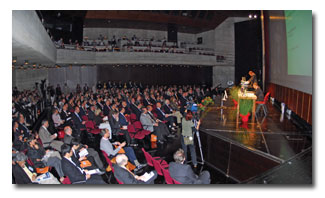
dornbirn
The 47th Dornbirn Man-Made Fibers Congress offered lectures covering a range of topics
including fiber developments and sustainability, among other topics, to more than 720 congress
attendees from 40 countries.


Rising Raw

Material Costs And Energy Prices

It’s obvious that raw material and energy prices and the consciousness related to climate
change are linked with one another. In a world of finite resources, an increasing number of people,
mainly in Asian countries, are striving to attain the same consumption level of the West, and the
gap between production and demand is increasing.

Over the last few years, the man-made fiber industry has enjoyed considerable global growth.
Today, the production ratio of natural to man-made fibers is about 35 percent to 65 percent, with
the share of man-made fibers growing.

The current need for raw materials on the part of the high-growth economies of China and
India is in contrast to a raw material supply industry that has been stagnating for decades. In the
past few months, just like in almost every other industry sector, problems have occurred
dramatically as energy prices and raw material costs have exploded. According to experts, the era
of relatively inexpensive natural resources is over. This situation will remain for many years, due
to the fact that the production of raw materials is a very capital-intensive and time-consuming
process. For example, the expansion in capacity of petroleum-based raw materials is nothing that
can be solved in a short time. For sure, speculative trading in raw materials has intensified this
effect. However, without this firm trend toward increasing demand, there would not be any
speculators.

The price of energy has become more volatile than ever in the last 12 months. In spite of
day-to-day fluctuations between $100 and $140 per barrel and back down to below $60, it is more
important to know that oil prices rose to these levels from the customary $10 to $20 a barrel.


The Carbon Footprint

Everybody is aware that energy costs have become a major item on the balance sheets of
companies, whatever sector of activity they may be involved in. This awareness has in recent months
become part and parcel of a new form of consumer awareness with respect to greenhouse gas
emissions, global warming, and the so-called carbon footprint. A number of retailers have now begun
to be more transparent as a result of consumer pressure, and are indicating, for example, whether
or not a food product offered for sale has been air-freighted into the country of consumption.

This transparency offers the consumer a choice. Other retailers are prepared to quote the
number of air miles flown per kilogram of product, in a kind of inside-out loyalty scheme. There
will inevitably come a time when this approach will also apply to apparel and other lighter-weight
products – which, as distance and weight are linked to increased air-freight costs, will begin to
shift back part of the production advantage toward the Western industrialized countries and their
peripheries. The same thing, too, will apply, mutatis mutandis, to maritime transport. In Europe,
for example, there is a growing opportunity for more efficient and just-in-time man-made-fiber
apparel and technical textiles production in and around the Mediterranean region as compared to the
Far East, with the added advantage that European yarns and fabrics are used as raw materials for
the final making-up processes. This opportunity also exists in the Western Hemisphere.

The unforeseen rise of the euro and the decline of the US dollar, which could not have been
predicted to the extent that they have occurred, cannot be laid at the door of European companies.
Soaring energy costs, the introduction of REACH – the Registration, Evaluation, Authorization and
Restriction of Chemical substances – and other burdens have been imposed upon European producers
and have not made their lives easier. Sustainability is one of the key issues in the production of
fibers and fabrics. The most important parameters for the future are:

•    fiber production;

•    yarn and fabric production;

•    dyeing, printing and finishing;

•    conversion to end product;

•    transportation

•    product use and maintenance; and

•    recycling, incineration or disposal.

Today, economic success, social acceptance and political stability are intimately linked to
the sustainable economic management of a company. However, governments also have a high level of
responsibility to create an overall framework enabling companies to pursue this approach. The
debate about climate change has led all big companies to reconsider their policies. Some years ago,
nobody could explain the term “carbon footprint.” Now, this expression has almost become
mainstream. Companies that refuse to deal with the issue of sustainable development are clearly at
a competitive disadvantage.

Europe cannot pass responsibility for sustainable economic development to others, experts
said in Dornbirn. Whoever violates the rules that the international community has imposed as a
basis for ensuring the preservation of a world worth living in should potentially be subject to
sanctions. For this reason, the Western industrialized countries should deal with the issue of
import duties on products that are not optimally produced when it comes to their carbon footprint.

This issue especially affects the fiber industry, which is particularly vulnerable. Europe
faces massive expenditures for environmental protection. But for companies outside of Europe, these
costs comprise a fraction of what is spent in Europe. This is a perverse distortion of the
situation: Factories that produce fibers but fail to sustainably and efficiently use natural
resources are rewarded with high margins, whereas plants that act in a more responsible manner are
being punished.

Page34


Trends

On the one hand, fiber producers are in the midst of a long-term, substantial growth in
demand for their products. On the other hand, everybody is forced to prudently and sustainably use
natural resources.

If one is to produce more but use fewer natural resources, one should make use of more
renewable raw materials. One example is cellulosic fibers. Wood from trees is the basic raw
material required for 90 percent of regenerated cellulosic production, and trees have a very low
impact on the environment and the fertility of the soil. Moreover, one is far from tapping the full
global potential for wood production. According to Austria-based Lenzing AG, the leading producer
of viscose fibers, only about 10 percent of the annual worldwide wood harvest, currently totaling
about 1.7 billion metric tons, is processed into pulp. Of this amount, only about 3 percent is
chemical pulp, which is used in the fiber industry and for other applications. In addition, 90
percent of the renewable land biomass is lignocellulose, which underlines the growth potential.


Product Life Cycle

Product life cycle is becoming more important than ever, and the understanding of the life
cycle of products with respect to greenhouse gas emissions has significantly improved. Assessing
the carbon footprint will become standard practice for all products in the same way that tenacity
is used to describe fiber strength. The fundamental understanding of the climatic impact of the
products is the prerequisite for optimizing production. Those companies that implement innovative
measures at an early stage will logically have a competitive edge.

In the upcoming decades, there will continue to be sufficient raw materials for the
polyester industry, but at higher prices. Polyester is the most important polymer for fiber and
will remain so in the future, especially if the recycling rate for polyester increases. It will
also be necessary to discover completely new raw materials for the man-made fiber industry.

However, these raw materials will only be able to gain a significant market share on a
long-term basis because they are hard to process in technological terms, or they compete with other
applications. Think of casein. Its use as a raw material for fiber production is considered to be
technically feasible, but it will involve fiber producers in a competition with the food industry.
The fact is that cellulose is one of the most widely used natural polymers, which are the easiest
to process, particularly in an ecologically sensible manner, based on the technologies available
today. Perhaps, some years from now, the cellulose required for the fiber industry will not only be
derived from wood, but also from quickly growing plants – such as sugar cane, grass and straw –
thus opening up new perspectives.

The market share of fibers produced by using renewable raw materials with a correspondingly
attractive energy/greenhouse-gas balance will certainly increase in the years to come, and those
fibers that are manufactured in line with sustainability criteria will be more enthusiastically
welcomed by consumers. In this regard, new fiber qualities and increasingly specific applications
will be developed by mixing different raw materials.

Page36


Don’t Waste Your Waste

The industry must significantly increase the share of recycled raw materials, particularly
petroleum-based polymers, in the manufacturing process. Because of increasing raw material prices,
recycling has become quite attractive to the fiber industry. For economic reasons based on the rise
in energy costs, many industries have been driven to achieve impressive recycling quotas.

Europe is at the cutting edge of this development. The recycling rates in Europe are: for
paper, 55 percent; nonferrous metal, 50 to 70 percent;  and glass, 62 percent, with
Switzerland recycling 99 percent.

In contrast, the recycling rates for US companies are considerably below the levels in
Europe. For example, the US glass industry recycles about half the quantities recycled in Europe.
However, some companies are already using polymers recycled from post-consumer waste, such as
polyethylene terephthalate bottles.


The European Challenge

Productivity is growing rapidly – close to 7 percent in 2007 as compared to an average of 3
percent in the final years of the 20th century. This bodes well for the future. In addition, there
is ever-growing recognition of the need for continuous innovation across the whole spectrum of
textile and apparel activity. There are technical textiles, but also apparel and interior textiles.
It is therefore no surprise that the European Technology Platform for the future of the textile and
apparel industry, established at the end of 2004, sees the following three main cornerstones:

•    a move from commodities to specialties;

•    new textile applications; and

•    mass-customization.

These bases provide opportunities to get away from those areas in which, because of higher
costs, the Europeans are more vulnerable to outside competition. It will, for example, be
self-evident that as mass-customization grows, so will the consumer’s desire to have the product
delivered to him or to her as soon as possible. This will mean demand for fabrics made within
Europe and then made into final apparel articles there, too.


Consumer Awareness

Ultimately, consumer awareness will play a decisive role. An increasing number of companies
are already reacting to growing demand for eco-labels that provide information on how many grams of
carbon dioxide or equivalent greenhouse gas emissions arose in production, transport and storage of
a given product. An increasingly large group of consumers is prepared to pay more money to acquire
sustainably produced products.

In terms of the quantities used, the most important raw material in the man-made fiber
industry is and will naturally continue to be petroleum, which is a finite resource, as is
well-known. “Easy oil” is a relic of the past, and the gap between oil reserves and
demand/consumption continues to grow.


Consolidation

It is clear the textile industry is   again going through a period of
consolidation. There are jobs to lose, but the European industry still employs 2.5 million people.
The automation of apparel manufacturing will stimulate a return of this activity to the European
Union (EU) and the countries in close proximity to it, and create sustainable demand for the yarns
and fabrics which that industry needs, and this demand in turn will be fueled by the growth of
mass-customization.

More generally, transport costs and environmental and ethical concerns – which until now
have tended to be costly handicaps – will foster a greater consumer awareness of the values of EU
production. Tomorrow, they will translate much more easily into consumer drivers.


Dynamic Growth Branch

From today’s perspective, one thing is clear: the man-made fiber industry will remain a
dynamic growth branch, with the exception of short-term cyclical fluctuations in demand. On the one
hand are the increasing demands for technical textiles and nonwovens. On the other hand is
population growth. Even if mankind more effectively manages to control population growth, there is
a consensus that the global population will continue to increase from the current level of 7
billion people to about 9 billion in the year 2050.


November/December 2008

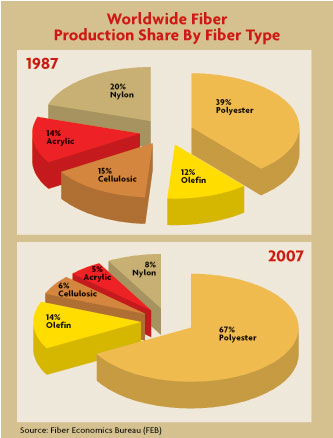
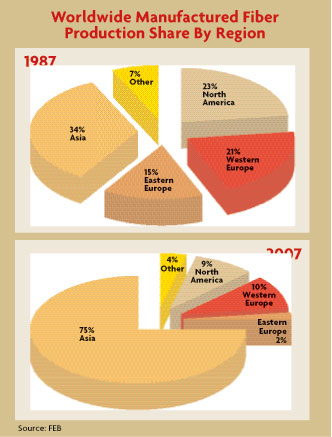
FEB Releases 2009 Guide To Fibers

The Arlington, Va.-based Fiber Economics Bureau (FEB) has released the 2009 edition of the World
Directory of Manufactured Fiber Producers.

The directory includes an up-to-date listing of fiber trademarks; contact information for
more than 1,300 companies in 66 countries; the Fiber Cross Index; and an updated introduction
summarizing long-term production trends by fiber type and region, and global manufactured fiber
plant distribution. It is available in both print and CD-ROM formats and can be ordered online at
www.fibersource.com.

November/December 2008

RadiciSpandex Rebrands Fibers As RadElast®

Gastonia, N.C.-based spandex fiber manufacturer RadiciSpandex Corp., the North American business of
Italy-based RadiciGroup, has launched the RadElast® brand to identify its group of performance
stretch fibers.

The new brand — which combines the Radici name with elastane — is part of RadiciGroup’s
comprehensive corporate initiative for its fiber and textile divisions throughout the world, and is
expected to help end-users boost their sales. The branding program will be available free of charge
to fabric mills, manufacturers, designers and retailers in all end-use markets. The company will
provide hangtags featuring the RadElast logo, and will incorporate the new name into all
communications tools.

Effective November 2008, all RadiciSpandex stretch fibers will be identified by their
established code names in combination with new RadElast brand. End-uses include swimwear, lingerie,
activewear, hosiery, denim, sportswear, nonwovens, narrow fabrics, personal care, medical and
industrial applications. 

The RadElast fiber range includes S17B chlorine- and ultraviolet-resistant spandex; S17PC,
used in baby diapers and adult incontinence products; SRB premium black spandex; S45
polyether-based spandex with high-temperature resistance; and S85 clear spandex.

November/December 2008

AWI Introduces MerinoCool™, MerinoFresh™

Australian Wool Innovation (AWI) — the research, development and marketing organization of
Australia’s wool industry — has launched MerinoCool™ lightweight, woven year-round apparel fabric
weighing less than 165 grams per square meter. According to AWI, the fabric, made with yarns spun
using a new generation of fine Australian Merino wool, also offers a soft hand as well as good
drape properties. The company is targeting MerinoCool to the smart casual market in Italy, France,
Japan, Korea, India and China.

AWI also has introduced MerinoFresh™, a technology that permits woven apparel made from
Merino wool to be refreshed or cleaned by rinsing for three to four minutes in a domestic shower.
The process removes smog, dirt, common water-based stains, smoke and odors. Water-based stains that
are more infixed can generally be removed with a mild detergent solution.

Following rinsing, garments can be drip-dried at room temperature. Usually, the garments
need no ironing following cleaning.

The MerinoFresh manufacturing process involves the following: first, the base fabric is
stabilized to eliminate shrinkage; then the garment is sewn and made up using special techniques;
and lastly, the garment seams, creases, trims and accessories are permanently set.

November/December 2008

Miroglio Partners With NatureWorks

Italy-based textile manufacturer Miroglio Group has signed an Ingeo™ Master License Agreement (MLA)
with Minnetonka, Minn.-based biopolymer producer NatureWorks LLC to offer Ingeo fiber as a raw
material and manufacture its own range of Ingeo yarns. Miroglio will develop and use the yarns
internally for a variety of textile applications, and will market and sell them globally to textile
suppliers. 

Ingeo biopolymer is made entirely from renewable plant resources. Its production uses 65- to
77-percent fewer fossil fuel resources than traditional polymers and reduces greenhouse gas
emissions by 91 to 97 percent, according to NatureWorks.

“Signing our MLA with NatureWorks demonstrates our belief in Ingeo as a new material with a
bright future for us all,” said Stefano Cochis, commercial director, Miroglio. “It’s the essential
product of real difference that we can add to the wide range we offer customers today, and we know
we can leverage its unique message into the market and match the growing demand for better, more
responsible, low carbon footprint products that offer that point of difference today.”


November/December 2008

Sponsors