
The 2009 Holiday Season


N
ear-term textile and apparel trends could well depend on how the upcoming Christmas
season fares. Most of the predictions making the rounds these days suggest a basically flat pattern
over the next month or two – though a few, like the one from the National Retail Foundation, expect
some fractional declines.

Textile World
, however, is somewhat more positive — anticipating a small gain over last year’s numbers.
If

TW
is correct, it would be a considerable improvement over 2008, when November/December retail
sales dropped 3.4 percent. Part of

TW
‘s optimism is based on the fact that consumer confidence is now significantly higher than it
was just a few months ago. Adding to this confidence is the fact that pay from wages and salaries
has turned upward for the first time in nearly a year. Still another reason to expect a buying
pickup: Households have managed to recover more than $4 trillion in recession-lost net worth over
the past two quarters — thus recouping a modest percentage of the $14 trillion lost during the
previous year or so. Last, but not least, clothing is expected to do a bit better than other goods
during the 2009 gift season — primarily because consumers are still wary about making purchases of
more expensive items. Throw all of the above into the computer hopper, and there would seem to be
little reason to anticipate further textile/apparel declines. Indeed,

TW
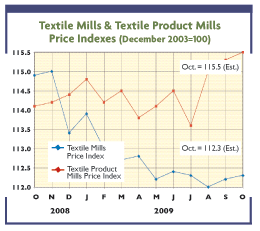
‘s equations suggest the bottoming out in both mill production and shipments noted over the
past six months will continue, hopefully setting the scene for an improved 2010.
Page14


Employment

A less rosy picture is seen when it comes to industry jobs, which should continue to shrink.
Much of the worker decline over the past few years can be traced to the big slide in mill activity.
But another part simply reflects increasing productivity. As such, even with the expected leveling
off in mill activity projected over the next few years, the number of industry employees is
expected to continue shrinking. One recent long look ahead by the Bureau of Labor Statistics
projects a 2.75-percent annual rate of employment decline in the basic textile mill sector over the
10-year period ending in 2016. The rate of decline in the more highly fabricated textile product
sector over the same period of time — though at a lower 1.25-percent annual rate — can also be
considered significant. It means the overall US industry workforce, which has been more than halved
since 2000, will continue to contract. But, as pointed out previously, there is a brighter side to
all this. Specifically, the increasing productivity factor noted above, along with only minimal pay
increases – expected to average in the low 2- to 3-percent range over the next few years — will
continue to reduce unit labor costs, and in the process help keep the US industry competitive in
today’s one-world textile/apparel market.


Cotton Prices

Calling the turn on cotton quotes may be a bit easier now. That’s because the US Department
of Agriculture (USDA) has removed its long-term ban on forecasting prices of this key natural
fiber. In fact, the agency’s economists have developed a new mathematical model that predicts
prices on the basis of changes such as variables in US and global supply/demand factors,
macroeconomic developments and global policy shifts. Some of the model’s findings: A 1-percent
increase in US supply from the previous year will cause US cotton tags to drop about 0.9 percent in
real terms; changes in foreign supply affect US prices on a nearly one-to-one basis, with quotes
falling as supply rises; a 1-percent increase in end-of-season stocks covered by the government’s
loan program, with stocks measured as a proportion of US cotton use, raises tags by 0.4 percent;
and a 1 million-bale increase in China’s net imports raises prices by 3.1 percent. More detailed
information on the model is available at
www.ers.usda. gov/publications/err80.
While the USDA has not as yet published any overall price forecast, an already-existing model
developed by the International Cotton Advisory Committee (ICAC) suggests a slight price rise may be
in the making for the 2009-2010 marketing year. Specifically, the ICAC model, noting a 1-percent
expected decline in global supplies, suggests a current year’s price advance of about 5 percent.
But that would still leave tags well under recent peaks.

November/December 2009

Karl Mayer Malimo Launches Malitronic® Multiaxial

Karl Mayer Malimo Textilmaschinenfabrik GmbH, Germany, has launched the Malitronic® Multiaxial
machine for production of reinforcing textiles, which can be used for prepreg applications for wind
turbines, aircraft, boats and building repairs.

One unit is available for customer trials and training at the company’s technical center. A
second machine already is in place performing trials for a multiaxial textile producer.

Mayer reports the machine, which features a modular design for optimal flexibility and can be
configured to meet customer specifications, offers 20- to 25-percent increased productivity
compared with the previous-generation model.

Other features include: a full-width, continuous conveyor belt to feed materials such as
chopped glass mats or pretensioned weft layers to the bonding section of the machine; an optional
wide cutting unit for producing chopped glass mat feedstock from glass rovings; a compensating yarn
tensioner to provide constant yarn take-off from the package and even out differences in yarn
tension as the yarns are laid on the conveyor belt; an optimized drive system for the weft laying
system; and simplified and optimized filler thread delivery, offering constant thread tension;
among other features.

November/December 2009

Dystar Resumes Deliveries, Restarts Investor Search

After filing for bankruptcy in September 2009, Germany-based DyStar Textilfarben GmbH, DyStar
Textilfarben GmbH & Co. Deutschland KG and DyStar Holdings GmbH — providers of dyes,
auxiliaries and services for the textile and leather processing industries — report talks with
banks and secured creditors are moving forward and the companies have been granted permission to
continue supplying their customers. DyStar Textilfarben GmbH & Co. Deutschland KG also has
restarted production at its manufacturing facility in Geretsried.

Prefinancing of insolvency payments owed to DyStar Textilfarben GmbH’s 73 employees as well
as staff at DyStar Textilfarben GmbH & Co. Deutschland KG has been negotiated.  “We are
setting up a control point with the agency for labor to look for a good solution for
extraordinarily affected employees,” said Dr. Stephan Lauabereau, preliminary insolvency
administrator of DyStar Textilfarben GmbH & Co. Deutschland KG.

DyStar also has resumed a search for investors. “We have already conducted initial talks with
potential investors,” said Miguel Grosser, preliminary insolvency administrator of DyStar
Textilfarben GmbH. “It is still too early, though, to assess the situation.”

November/December 2009

Brückner Celebrates 60 Years

Germany-based Brückner Trockentechnik GmbH & Co. KG, a manufacturer of textile finishing and
dyeing machinery, is celebrating its 60th year in business. Brückner was founded in 1949 by Kurt
Brückner as an air conditioning unit manufacturer. Soon after it opened, the company changed
direction and began to focus on drying machines, which still comprise Brückner’s core business
today. The company reports it has supplied more than 5,000 lines to its customers over the past 60
years.

dpf
Brückner’s latest-generation Power Frame tenter

Currently, the company is run by Regina Brückner, the founder’s daughter, and her husband,
Axel Pieper.

November/December 2009

Velcro USA Unveils Evaptex™ High-performance Fabric

Velcro USA Inc., Manchester, N.H., a global conglomerate offering a range of products including
Velcro® hook and loop fasteners, now offers Velcro Evaptex™ woven fabric that combines
breathability and moisture-wicking properties, allowing air circulation through the fabric while
maintaining a neutral temperature for the wearer.

The machine-washable, laminated two-layered fabric features a patent-pending evaporation
technology and silver ion-based antimicrobial properties. The next-to-skin surface has a very soft,
comfortable hand, and the outer loop surface is compatible with Velcro hook materials to facilitate
fastener placement and adjustment. Targeted applications include orthopedic braces, sleep apnea
headgear, tracheotomy straps and other medical devices; as well as turnout gear and fire protection
suits and other emergency responder applications.

November/December 2009

Schoeller Offers Coldblack® Finish For Wool

Schoeller Technologies AG, Switzerland, reports its coldblack® textile finish is now available for
wool products. Coldblack technology enables black fabrics to reflect rather than absorb the sun’s
rays, offering both ultraviolet and solar heat protection
(See ”
Cool
Rider,
” Quality Fabric Of The Month, Oct. 9, 2007)
. Schoeller reports temperature changes
are less noticeable when wearing dark wool clothing finished with coldblack technology.

November/December 2009

Denimatrix, ACTEX Team Up

Denimatrix LP, Guatemala — a fully-integrated denim apparel producer, and part of Lubbock,
Texas-based Plains Cotton Cooperative Association’s Textile and Apparel Division — has formed a
partnership with Guatemala-based label producer Accesorios Textiles (ACTEX) under which ACTEX will
establish a state-of-the-art label-production facility to manufacture woven labels, hangtags, heat
transfers, price tickets, size strips and jocker tags at Denimatrix’s plant. Denimatrix will apply
the labels to denim jeans it manufactures for customers including Gap, Banana Republic, Abercrombie
& Fitch and others.

“Our design and development capabilities, combined with our manufacturing flexibility in
high-end products and this new venture with ACTEX, will boost our speed to market by eliminating
the lead time of sourcing outside the region,” said Carlos Arias, president, Denimatrix.

November/December 2009

Wacker Polymers Establishes New US Headquarters

Germany-based Wacker Chemie AG — a manufacturer of binders and polymer additives used in coatings,
printing inks, construction chemicals and other applications — has opened a new US headquarters in
Allentown, Pa., for its Wacker Polymers division. The 6,200-square-meter site features a technical
center with research and applications labs, customer service, sales and marketing, and
administrative functions. Wacker also plans to establish a training center at the facility.

November/December 2009

Navis Global Ships 200th Machine To Honduras

Navis Global, formerly known as Tube-Tex — a Lexington, N.C.-based designer and producer of
textile finishing equipment — reports that Honduras-based apparel manufacturer Bay Island
Sportswear Inc. and its knitting and dyeing facility Simtex International recently purchased a Pak
Nit II SP Compactor. The purchase marks the 200th Navis Global machine shipped to Honduras; and the
first compactor and fifth TubeTex machine installed by Bay Island.

In making the decision to buy the machine from Navis Global/TubeTex, Bay Island cited its
good experience with prior TubeTex equipment and the availability of a local service center and
parts warehouse in San Pedro Sula, Honduras. Navis Global has installed tubular pads, relax dryers,
nappers, open-width compactors, pin tenters and more than 130 compactors at various companies
throughout Honduras.


November/December 2009

Murata Celebrates Mach Splicer’s 30th Anniversary

It has been 30 years since Japan-based Murata Machinery Ltd. invented the Mach Splicer. The company
originally introduced the splicer at the International Exhibition of Textile Machinery (ITMA) in
1979.

Using compressed air, the splicer joins two ends of yarn without the need for a knot, a
process that improves the quality of a spun yarn. The original Mach Splicer was suitable for
splicing cotton yarns, but Murata also currently offers splicers for wool, linen and core spun
yarns. Murata says its research and development efforts in splicing technology are ongoing, with
the aim of advancing the technology.

November/December 2009

Sponsors



