Denimatrix, ACTEX Team Up

Denimatrix LP, Guatemala — a fully-integrated denim apparel producer, and part of Lubbock,
Texas-based Plains Cotton Cooperative Association’s Textile and Apparel Division — has formed a
partnership with Guatemala-based label producer Accesorios Textiles (ACTEX) under which ACTEX will
establish a state-of-the-art label-production facility to manufacture woven labels, hangtags, heat
transfers, price tickets, size strips and jocker tags at Denimatrix’s plant. Denimatrix will apply
the labels to denim jeans it manufactures for customers including Gap, Banana Republic, Abercrombie
& Fitch and others.

“Our design and development capabilities, combined with our manufacturing flexibility in
high-end products and this new venture with ACTEX, will boost our speed to market by eliminating
the lead time of sourcing outside the region,” said Carlos Arias, president, Denimatrix.

November/December 2009

Wacker Polymers Establishes New US Headquarters

Germany-based Wacker Chemie AG — a manufacturer of binders and polymer additives used in coatings,
printing inks, construction chemicals and other applications — has opened a new US headquarters in
Allentown, Pa., for its Wacker Polymers division. The 6,200-square-meter site features a technical
center with research and applications labs, customer service, sales and marketing, and
administrative functions. Wacker also plans to establish a training center at the facility.

November/December 2009

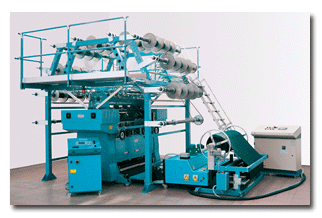
Comez Introduces DNB/EL-1270 Warp Knitting Machine

Comez S.p.A., Italy — a producer of crochet knitting, warp knitting and narrow weaving machinery
— now offers the DNB/EL-1270 double-needle-bed warp knitting machine for making a wide range of
fabric styles including technical, medical and apparel.

comez

Features include: 1,270-millimeter working width; individual latch needles; five to 18
needles-per-inch gauges; 12 electronically controlled pattern guide bars, allowing creation of
different structures without stopping the machine; electronically controlled thread feeders,
allowing varying stitch density, as well as differing weft and warp feeding; and Comez’s new Data
Control Controller. The machine is compatible with any yarn, and knockover sinker groups are
available if specified.

The DNB/EL-1270 can be fed by creels or beams, or both. Floor-standing external electronic
yarn feeders can be used, or it can be equipped with electronic yarn feeders. Finished product
collection systems can be tailored to specific requirements.

Using two needle beds and the pattern guide bars, the machine can produce double-faced
fabrics. Spacer fabrics also can be produced. Rigid and elastic products can be created in flat or
tubular configurations to form netting-type products that range from simple, open structures to
more complex structures.


November/December 2009

Navis Global Ships 200th Machine To Honduras

Navis Global, formerly known as Tube-Tex — a Lexington, N.C.-based designer and producer of
textile finishing equipment — reports that Honduras-based apparel manufacturer Bay Island
Sportswear Inc. and its knitting and dyeing facility Simtex International recently purchased a Pak
Nit II SP Compactor. The purchase marks the 200th Navis Global machine shipped to Honduras; and the
first compactor and fifth TubeTex machine installed by Bay Island.

In making the decision to buy the machine from Navis Global/TubeTex, Bay Island cited its
good experience with prior TubeTex equipment and the availability of a local service center and
parts warehouse in San Pedro Sula, Honduras. Navis Global has installed tubular pads, relax dryers,
nappers, open-width compactors, pin tenters and more than 130 compactors at various companies
throughout Honduras.


November/December 2009

Murata Celebrates Mach Splicer’s 30th Anniversary

It has been 30 years since Japan-based Murata Machinery Ltd. invented the Mach Splicer. The company
originally introduced the splicer at the International Exhibition of Textile Machinery (ITMA) in
1979.

Using compressed air, the splicer joins two ends of yarn without the need for a knot, a
process that improves the quality of a spun yarn. The original Mach Splicer was suitable for
splicing cotton yarns, but Murata also currently offers splicers for wool, linen and core spun
yarns. Murata says its research and development efforts in splicing technology are ongoing, with
the aim of advancing the technology.

November/December 2009

Sellers Unveils Pile Removal System

England-based carpet-finishing machinery manufacturer Sellers Engineers Ltd. and its US subsidiary,
Sellers of America, Dalton, Ga., have introduced the Fibrebak pile removal system for the recycling
industry. Sellers reports the system can separate pile and backing on both carpet and tile
products, enabling carpet manufacturers and waste recyclers to reduce product waste and minimize
landfill costs. Features include an adjustable head for maximum fiber removal; operator panels that
house the machine controls; and a conveyor to accommodate the manual feed.

November/December 2009

The Rupp Report: Ecology Pays Off

Among its ever-growing readership, the Rupp Report enjoys a lively e-mail exchange with dedicated
readers, which is always more than welcome. In the past weeks, I’ve had a vivid communication with
some readers who have asked: “Are you on the green trip now?” because

Textile World
has published some reports with green or environmental content. No, I’m not, I replied. There
are hundreds of reasons today to be conscious of the environment, and it pays off.

Ecology is not a simple marketing phrase or a public relations tool. Austria-based Lenzing
AG, a leader in global viscose production, is heavily committed to an environmentally friendly
production and attitude in its business. In 2008, the group recorded sales of 1.33 billion euros,
with an export share of 88 percent. The annual fiber production was 540,300 metric tons with a
staff of 5,945 people.

Global Collapse Of The Fiber Market …

The global collapse of the fiber market at the end of 2008 was followed by a second-quarter
2009 minor recovery, which continued into the third quarter. The cotton price of 60 cents per pound
at the end of the third quarter was still far below the 2008 peak price of more than 80 cents. The
situation for polyester prices was similar; they increased slightly due to rising crude oil prices.
In July 2009, the Lenzing Group acquired 40 percent of Indonesia-based fiber trading company PGL,
which has been in cooperation with Lenzing’s Indonesian subsidiary PT. South Pacific Viscose (SPV)
for many years. As PGL itself holds a 12-percent share in SPV, Lenzing thereby raised its share in
SPV from 86 percent to about 91 percent.

… Followed By Rising Demand For Cellulose Fibers

According to recent information, Lenzing is enjoying a rising demand for cellulose fibers.
Positive second-quarter developments continued into the third quarter, due to this rising demand,
the company said. However, the global economic crisis had a considerable impact on the company’s
first-quarter results and affected sales and figures. Consolidated sales in the first nine months
of 2009 fell to 912.3 million euros, compared with 1,012.1 million euros in the same period in
2008. On the other hand, the nine-month financial result improved by 44 percent to -10.4 million
euros, compared with -8.4 million euros in the first nine months of 2009, owing to a positive
foreign currency result.

Textile And Nonwoven Fibers

By the end of second-quarter 2009, Lenzing’s fiber production approached full capacity at all
locations. At the same time, inventories were significantly reduced due to rising demand, and the
market accepted the first price increases. Pulp prices recovered, making it necessary to further
adjust prices. Viscose fiber prices are still considerably lower than last year’s price levels.
Beginning with the second quarter, the Textile Fibers business unit again realized very good sales
results for both standard fibers and special fibers, including Lenzing Modal®, Lenzing FR® and
Tencel®. Lenzing also noted very strong regional demand in Asia and Brazil.

The Nonwoven Fibers business unit recorded significantly increased demand for cellulose
nonwovens products and a slight increase in fiber prices. New situations, such as the fear of a new
influenza epidemic, caused demand to rise for hygienic wipes and medical face masks. Disposable
products, such as baby wipes, were very successful in the United States “due to the natural origin
of the fibers”, the producer claims.

A Look Into The Crystal Ball

Lenzing is “cautiously positive” about its business development for the rest of 2009, noting
“better than expected” development of the fiber market over the past year. The company anticipates
trends in Asia, Turkey and South America may remain positive, but it is still possible inventories
may build up in the textile supply chain, and forecasts beyond the end of 2009 are tentative. In
addition, Lenzing expects anti-dumping procedures in Brazil and India will significantly slow sales
of products that contain its fibers.

Imitators Welcome

A few weeks ago, the Rupp Report informed its readers with the latest news from the fiber
front, quoting that Lenzing is heavily dedicated to environmentally friendly production
(See
The
Rupp Report: The U-Turn Of The Man-Made Fiber Industry
, Sept. 22, 2009)
. Lenzing board
member Friedrich Weninger mentioned that any fiber production should be environmentally friendly
and that “responsibility has to become the key issue of economic, social and environmental
activities.” This seems to pay off, at least for the Austrians. Here, imitators following an
ecological and economical way are more than welcome.


November 10, 2009

PCMC To Unveil Marlin Technology

Green Bay, Wis.-based Paper Converting Machine Co. (PCMC) — a global supplier of high-performance
nonwovens converting machinery, and part of St. Louis-based Barry-Wehmiller Companies Inc. — is
introducing Marlin cross-folded wet wipes converting technology at its upcoming technical
conference, to be held November 18-19 in Somerset, N.J.

The company will offer technical and commercial presentations along with a continuous
demonstration of the PCMC Marlin cross folder in combination with a Rose Forgrove Integra wrapper
and Veltron II floating nose feeder — both manufactured by PCMC’s Greenville-based sister
division, HayssenSandiacre. PCMC also will unveil its Mako cutting technology for the high-speed
cutting of flat folded wet wipes.


November 10, 2009

Highland Industries To Expand Chesterfield County Plant

Greensboro, N.C.-based Highland Industries Inc. — a manufacturer of man-made industrial textiles,
with specialization in fabric forming and finishing technologies — will expand its weft-insertion
manufacturing operations at its Cheraw, S.C., facility.

“We are extremely satisfied with the continued growth and the expansion of our operations,”
said Nick Irwin, director of manufacturing, Highland Industries. “We are proud of the job creation
opportunities for Cheraw. The strength of our operations is the diversification of our business and
the adaptability of our associates to participate in the growth.”

“Highland Industries’ expansion in Chesterfield County is a great reminder that our state’s
business-friendly environment is working to attract new investment and jobs throughout South
Carolina,” said S.C. Secretary of Commerce Joe Taylor. “Highland Industries has reaffirmed its
commitment to the area and this is a wonderful compliment to the workforce and local leadership in
Chesterfield County. The County has laid the groundwork to make itself an attractive place to do
business and we believe today’s news will be the start of more good things to come. We thank
Highland for their new investment in South Carolina and look forward to growing our relationship
with them in the years ahead.”

November 10, 2009

Sandler To Build New Plant In Schwarzenbach, Germany

Germany-based nonwovens manufacturer Sandler AG has announced it will build a new plant in 2010 at
its headquarters in Schwarzenbach. The company plans to begin construction this year, which will
include a new parking area, access road and bridge. Sandler will tear down its existing central
warehouse for voluminous nonwovens to build the new two-story facility, which will cover 10,500
square meters per floor.

Sandler reports the million-euro investment will not only enable the company to continue
supplying existing and new markets with nonwovens products and provide additional workplaces, but
also will make Schwarzenbach one of the largest nonwovens production sites globally. 

November 10, 2009

Sponsors