In Memoriam: James A. Morrissey Sr.

James A. Morrissey Sr., 81, died peacefully in his sleep Saturday, Sept. 4, 2010, at his home in
Potomac Falls, Va. He is survived by his wife of 51 years, Constance M. Morrissey; four children,
James A. Morrissey Jr., Erin M. Ingrisano, Patrick E. Morrissey and Michael C. Morrissey; 10
grandchildren; and sister, Marilyn Roberts.

Morrissey was a long-time contributor to

Textile World
, holding the position of Washington correspondent following a 28-year career as director of
communications for the American Textile Manufacturers Institute. His service to the textile
industry was much appreciated by all who had the privilege of working with him, and he is greatly
missed by

TW
staff and readers of his bimonthly Washington Outlook column and weekly online reports from
Washington.

November/December 2010

Creativity Through The Supply Chain


A
t SpinExpo, organized by Hong Kong-based Well Link Consultants Ltd., visitors were
encouraged to photograph displays. As Karine Van Tassel, SpinExpo director, said: “Creativity can
exist in any economy. We are here to serve the industry. With smaller staffs, companies are careful
on how they spend time. At this show, we are bringing major global fiber, yarn and machinery
suppliers to buyers and presenting wonderful, fresh ideas that show ways to use them.”

Direction and Printsource focused on new prints and surface designs for Fall/Winter 2011.

SpinExpo Creative Director Sophie Steller said fabrics are having a greater impact on
fashion than silhouettes. Texture, novelty and yarn mixes are in demand. Chunkier yarns are
selling, and the newest patterns are subtle. She mentioned sheen, diffused effects and hairy
surfaces. Colors are rich, warm and saturated; tonality continues, and there is iridescence through
the use of metallic yarns.
KA#1

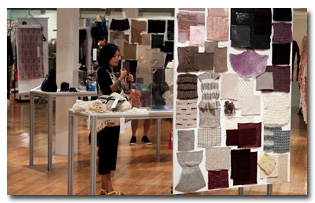
SpinExpo’s trend forum displayed a wide range of fabric concepts that showed off its
exhibitors’ yarns.


Fibers And Machinery


Angelina® metallic fibers producer Meadowbrook Inventions, Bernardsville, N.J., showed its
soft-hand, brilliant and iridescent fibers made from recycled polyester and post-industrial waste.
Aluminum Angelina fibers comprising plain or pigmented recycled aluminum are dyeable, protect
against ultraviolet rays and electromagnetic waves, and have antistatic properties. Copper fibers
and copper-coated polyester fibers are said to have therapeutic, anti-inflammatory properties;
regulate temperature and static; and be antimicrobial. Another new product is security fibers to
guarantee a product’s authenticity.

Australian Wool Innovation (AWI) showed fabrics and garments divided into two collections to
demonstrate the versatility of Australian merino wool. For the U.S. market, knits comprised the
largest portion of what was shown. Fabrics in the Touch group have a silky-soft feel. Some are
knitted of 100-percent mercerized merino; others, in blends with silk. Most fabrics are
machine-washable, ultralight and soft.

Garments in AWI’s Casual collection have a vintage look and a lot of texture. There are
garment-dyed sweaters and felted fabrics that look as if they are knitted using crimped yarns. AWI
has developed a new process of treating yarns to give a variety of surface and color effects. There
are rustic looks, muted heathers, denim types and boiled wool touches in this collection. A lot of
fabrics have natural stretch and are easy-care.

Two textile machinery companies, Santoni S.p.A., Italy, and H. Stoll GmbH & Co. KG,
Germany, showed the versatility of their equipment. New Santoni machines include a compact seamless
warp-knitting machine. This whole-garment technology does it all on one machine, from patterned
fabrics to all of the sewing. A new single-jersey machine produces seamless garments knitted with
mesh, eyelet and lace patterns and combining yarns and fiber blends. Another machine moves from rib
to single jersey and can produce a garment in three minutes.

Stoll highlighted the capabilities of its machinery and support center. New electronic flat
multi-gauge machines offer improved efficiency and speed. A collection of knitted garments
illustrated how Stoll’s new technology can knit different gauges, patterns and textures using
different yarns, and integrate collars and buttonholes. Stoll’s trend collection and pattern
library give ideas to designers and teach them how to put it all together. Along with apparel,
there are fabrics for the home and industrial products.

KA#2

Direction by Indigo displays illustrated concepts for surface design and prints.


Yarns


Yarn Mavens Inc., New York City, now in its fourth generation, represents a variety of
top-quality global spinners. The company showed super-fine baby alpaca/silk blends at one-third the
price of cashmere; novelty yarns with a touch of sparkle spun in natural/man-made blends, and
textured, fluffy and chunky yarns; all from Lanficio Dell’Olivo, Italy. From FiliVivi S.r.l.,
Italy, there are soft lambswool/merino blends. Merino/silk tweed yarns, chenille, cashmere and
torqueing yarns from a Chinese mill were of interest.

Himesa Hilos y Mechas S.A. de C.V., Spain, showed high-bulk Amicor acrylic antibacterial and
antifungal yarns. Blankets are a major end-use. At Filatures du Parc, France, classic and fancy
heather and chine yarns from recycled garments were available. Extra-long-staple cotton alone or in
blends with other natural fibers at Filartex S.p.A., Italy, was selling for weaving and circular
knits. Indigo-dyed cotton was of interest.  At Miroglio Textile, Italy, a tweed yarn with wool
neps, fluffy yarns and high-performance yarns in wool and blends were pointed out.

Non-shedding longhair angora, cashmere, lambswool and blends are a specialty at British
spinner Z. Hinchliffe & Sons Ltd., where there are 120 colors in stock. At Huntington Yarn Mill
Inc., Philadelphia, which has its own skein dyehouse, soft metallic, space-dyed and novelty twisted
yarns were of interest.

Superfine merino and blends with silk, cotton or cashmere are a specialty at worsted
spinning mill Biella Yarn by Südwolle, Germany. Best sellers were coarse or ultrafine.

It was innovation plus tradition at Sato Seni Co. Ltd., Japan. Now in its fourth generation,
this company is noted for high-twist, high-performance, organic ultralight yarns of kid mohair,
washable wool, silk and blends. There are plied, dyed, printed, looped and wrapped yarns. One new
yarn features wool wrapped around paper. It has the lightness of paper and the softness of wool.
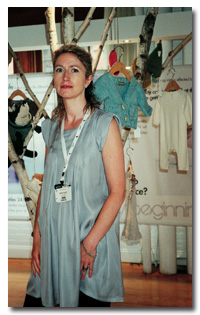
KA#3

Sophie Steller, creative director, SpinExpo, said fabrics are having a greater impact on
fashion than silhouettes.


Surface Design


Soft blurred designs, dissolving edges, splatters, blotches, abstract swirls, fragmented
scenics, mixed-media geometrics and tonal shadings are some of the new ways with prints. Reinvented
black-and-white combos, flowers, paisleys and skins all turned up at Direction by Indigo and
Printource. 

At Direction, the Stoll Fashion & Technology Center, New York City, and Pointcarré,
France, were exhibitors. The focus at Stoll was on prototype knitwear samples, and services
provided for designers and manufacturers at its showroom.  Pointcarré demonstrated its
computer-aided design/computer-aided manufacturing software and included woven and knitted fabric
designs for apparel and the home.

At Tom Cody Design, New York City and London, vintage paisley borders, washy and brushstroke
florals, textured foliage and vines on ombré grounds, linear and graphic monotones, and angular
geometrics were popular print motifs, along with burn-outs. Burn-outs were sellouts at Baxter
Fawcett, London. Textural grounds, ’70s florals, blurred tonals, Bohemian arty florals, and dots
and animal skins were shown on ultra-sheer fabrics.

Dimensional patterns at Whiston & Wright, U.K., were blurred. Furnishings-inspired
paisleys, lacy looks and black-and-whites were popular. Circleline, U.K., showed splatters and
sprays that looked as if they were moving, scratchy surfaces, bold tonals, photorealistic images
and large-scale patterns with almost no repeat. 

Abstract landscapes with leafless trees, splattered galaxies, blurred giant tartans and
skins, tonal designs, and black-and-whites turned up at Quinnconfrey, Ireland. Longina Phillips
Design Ltd., Australia, showed faded and blurred architectural designs and hand-drawn shaded and
tonal florals.

At Printsource, a lot of studios focused on the home. Atelier Mineeda Co., Japan, showed
big, blurred, watery florals; tonal flowers on embossed grounds; and giant, tonal paisleys. At
Ejame Studio, New  York City, there are sketchy black and white circles, tie-dyes and tonal
patterns. Bernini Studio Designs, Italy, has patchwork skins, misted checks and irregular
dimensional zigzags. 

Childrenswear was another strong area at Printsource. Noelle Palm, New York City, showed
coordinated collections of hand-painted flowers and birds. Some have an abstract look, and others
suggest Matisse. There are cute animals, conversationals and coordinating plaids, stripes and
flowers at Elka Studio, France.

November/December 2010

Unifi Returns To Profitability


U
nifi Inc. opened for business as a manufacturer of textured polyester yarn in 1971,
setting up headquarters in Greensboro, N.C., and a manufacturing plant in Yadkinville, N.C. Over
time, the company became one of the world’s largest textured yarn makers as it expanded its
operations and fiber offerings; established new markets and subsidiaries abroad; and developed a
portfolio of branded, premium value-added (PVA) products that offer a range of performance and
other benefits.

The turn of the millennium brought challenges, including the ever more globalized market and
competition from textile makers in low-cost countries. Such challenges caused U.S. textile
manufacturers to shed hundreds of thousands of jobs, shutter domestic operations and look abroad
for less costly manufacturing or sourcing opportunities. Unifi suffered along with most other U.S.
textile manufacturers, and saw its profits disappear despite all efforts to stay competitive. In
2007, its Board of Directors put in place a new management team, headed by current President and
CEO William L. Jasper, to bring a fresh perspective to meeting the challenges; and Unifi’s fortunes
began to improve. For the fiscal year end June 27, 2010, the company recorded its first annual
profit in 10 years, and now appears to be set on a path to continuing profitability.

ExecJasper

William L. Jasper


Textile World

recently talked with Jasper about Unifi’s history, turnaround and future plans, and
presents his comments below:


TW
:
What was Unifi’s initial focus, and how did it change over the years?

Jasper: Unifi was started by Allen Mebane, and it grew very quickly, primarily as
a manufacturer of polyester textured yarns. Allen’s philosophy was that if you make the best
quality of yarn at the lowest cost, you’ll always have a market, and this approach proved to be
very successful for Unifi. Unifi continued this philosophy from the early ’70s through the late
’90s. During the first 25 years, capital was invested to continuously modernize the equipment and
grow capacity and capabilities, including the purchase of a nylon texturing and covering business,
but the philosophy always was to have the most efficient equipment and make the best-quality
product.

In the late ’90s, Asia began to grow as a manufacturing venue for polyester yarns as well as
fabrics and finished products. The U.S. textile market — most notably, apparel — eroded
significantly between 1998 and 2008. 


Reversing The Downward Spiral


TW
:
Coming into 2007, Unifi had been losing money year after year since 2000. What measures were
taken to turn the company around?


Jasper: In September 2007, the Board put in place a new executive management team,
and we refocused on being a successful U.S. manufacturing company. In some ways, the company was
heading away from U.S. manufacturing and more towards manufacturing in China through a joint
venture we had established in the region.

To turn the company around, we consolidated and refocused the company on our manufacturing
capabilities. We now have three plants — Yadkinville, Madison and Reidsville — and about 1,950
employees in the United States. At each of those plants, we’ve made tremendous improvements in
efficiency and flexibility, realizing several million dollars in savings. Certainly, our operations
over the last three years have become much more efficient and flexible. To help us in that effort,
we are using [Knoxville, Tenn.-based] Qualpro’s multivariable testing (MVT) process to implement
statistical process control in all areas; and we are using lean manufacturing principles focused on
the supply chain and streamlining operations.


TW
:
How has the MVT process helped Unifi improve its operation?

Jasper: With MVT, you take every project you initiate through a step-by-step
process and very aggressively and efficiently complete them. Using statistically sound principles
and process control to measure improvement, you continue to measure whatever you are improving
using a control chart. We’ve completed more than 50 projects and have probably 50 going on now.
Unifi has made great progress in the last two years from the projects we’ve completed, and we
expect further progress as we conclude additional projects. It’s a very disciplined, rigorous
process that makes you focus on and complete the most important projects before moving on to the
next ones.


TW
:
Unifi’s line employees have played a role in implementing improvements. What has been the value
of this involvement?


Jasper: Once you complete a project and you’re monitoring improvement it’s the men
and women on the floor who make sure we continue to do things right, and they’re very involved in
both the MVT and the lean manufacturing programs. They know a lot more about what’s going on than
anyone else, and if you involve them, you will find things you wouldn’t have otherwise. Also, if
they’re part of developing the solution, it’s a lot more likely to be successful because they’ve
got a stake in it, and they’ll make it succeed. For instance, breaks at our polyester texturing
facility have been reduced substantially. We’ve been in tough times, and they recognize that the
more we improve our processes, the more likely it is we’ll stay in business. Our people on the line
have been absolutely fabulous — very bright, very aggressive — and they’ve helped us get a lot of
these things done.


TW
:
What other measures have you taken to improve the business?

Jasper: We’ve focused on and put resources toward growing our branded PVA
products. Even through the recession, we increased our R&D and marketing expenditures because
we truly believe the PVA products will continue to grow and provide revenue, especially Repreve®
[Unifi’s 100-percent polyester and nylon recycled-content product line], and we’ve been very
aggressive in maintaining our market share.

With the investment in the Repreve Recycling Center, we’re backward integrating the Repreve
production chain
(see ”
From
Waste To Worth
,” www.TextileWorld.com)
, which will help us better control the quality and
secure a cost-competitive source of raw materials. We’re buying the latest technology, and it will
be very, very efficient.


Unifi’s Global Markets


TW
:
Have the North America and Central America-Dominican Republic Free Trade Agreements (NAFTA and
CAFTA-DR) had much effect on your business?


Jasper: NAFTA and CAFTA-DR are very important to our business. Actually, over the
last year, we’ve seen growth in that region. That’s really helped stabilize our business.

The region is primarily fed from our U.S. operations, but we’re also putting a texturing and
twisting operation in El Salvador that we expect will be fully operational by December 2010. That
operation will employ about 175 workers and supply sewing thread, which is a big market in Central
America. The operation will increase our regional polyester texturing capacity by about 15 percent.
We’re putting in eight texturing machines that will process some 200,000 to 400,000 pounds per
week, depending on denier; and we’re installing about 26 twisting machines, adding another 200,000
pounds per week of twisting capacity.


TW
:
Unifi has a subsidiary in Brazil. What markets does that operation serve?

Jasper: Unifi do Brasil was formed in the late 1990s, and it now employs about 500
workers and in fiscal 2010 provided around 20 percent of Unifi’s consolidated net sales. It
produces primarily polyester textured yarn almost exclusively for the Brazilian market. It has been
quite a good business, especially over the last few years as the Brazilian economy has continued to
grow. There was a little downturn during the recession, but we’ve been very pleased with that
business, and also its prospects for growth in the future.


TW
:
Unifi also put a subsidiary in China to replace its earlier joint venture.

Jasper: We decided it would be better for us to exit the joint venture and create
a wholly owned sales and marketing company there. We now have 11 sales and marketing
representatives there and work with local manufacturers who commission manufacture to our
specifications, and that is working well. We sell primarily our branded PVA products in China, made
to the same specifications as those made in the United States, allowing us to supply the same
product locally produced here and in China. That’s a big selling point with brands and retailers
that they can buy the same products in both places, especially if they have a dual sourcing
strategy.

execCottoncones

Spools of Unifi’s PVA yarns are color-coded to indicate specific products


The Sustainability Factor


TW
:
How does your sustainability platform play into your strategy?

Jasper: Unifi has a long history of sustainability. For many years, we have
focused on reducing our packaging and have used returnable packaging to ship our products. We
continue to donate biosolids generated from our dye houses to local area farmers to use as
fertilizer. We have done quite a lot to reduce the amount of waste generated in our manufacturing
processes, including recycling our own waste to help make Repreve, which is a big step in what we
have been doing. Recently, we announced a 40-percent ownership of a biomass feedstock company
called Repreve Renewables LLC. We believe the crop is the best biomass in the Southeast. This
biomass stock is called FREEDOM™ Giant Miscanthus [a hybrid grass that converts sunlight to biomass
energy], which is trademarked by Mississippi State University and used under license by Repreve
Renewables
(See ”
Unifi Invests In
Repreve® Backward Integration, Establishes JV
,” www.
TextileWorld.com)
. The plant consumes carbon dioxide (CO2), and when it dies,
the CO2 is sequestered back into the ground before the plant is harvested.


TW
:
Will you be using the biomass in your own operations?

Jasper: Indirectly — It will be used for power generation, which we may use.
Ultimately, it may be turned into ethanol and diesel. We’re in the embryonic stage of this venture
and are excited about its potential over the next several years.


Future Expectations


TW
:
What do you foresee in the future for the U.S. textile industry and for Unifi?

Jasper: The U.S. textile industry is going to be flat at best, and maybe continue
to erode a bit, but we think that erosion will be offset by growth in Central America. The Central
American supply chain really is competitive with the Chinese supply chain, at least for certain
types of garments — such as performancewear, T-shirts and men’s pants. There was tremendous erosion
from 2000 to 2007, but we think that’s moderated somewhat, and we’re not looking for any great
erosion in this region in the next few years. While there are always risks, our planning models
work off the assumption that the combined regional market will be generally flat going forward.

We are optimistic about Unifi’s future, assuming slow growth in the U.S. economy. Our target
is to double sales of our branded PVA products over the next three years. We’ll continue to improve
efficiencies in our operations — we believe that there’s still savings we can get there, and we’re
optimistic that we’ll continue to improve our results. We did $55 million EBITDA in fiscal 2010 and
expect to do $65 million this fiscal year. We’re spending more capital this year than we have in
the last several years on projects that have a fairly quick payback, so we anticipate our results
will continue to improve over the next two years.


TW
:
What sorts of investments are you making?

Jasper: We typically spend $8 million to $10 million a year to maintain our
plants. We expect to spend around $20 million in fiscal 2011. The Repreve Recycling Center will
cost roughly $8 million in total, and we have several other capital projects slated that we believe
will increase our asset flexibility and product capabilities.

November/December 2010

From The Editor: Looking Forward: Textiles 2011

By Jim Borneman, Editor In Chief

As 2010 comes to a close and eyes focus on 2011, one questions whether business can shrug off the uncertainty of the recent past and build some confidence in the forecast for 2011. There are real challenges in discerning opportunities from threats to business in 2011. The soft dollar? Crazy cotton prices? The ups and downs of consumer confidence? Tax policy with full asset depreciation? Increased thriftiness of U.S. consumers?

On the bright side, the U.S. Department of Commerce Bureau of Economic Analysis continues to report good news regarding private direct investment in plant and equipment. Innovation abounds, whether it be advances in nanofiber technology, surface modification of textiles or enhanced moisture management in fabrics. Ever-strengthening sustainability initiatives are changing the way textiles are made. And there is a sense among many that with the carnage of 2008 and 2009 behind them, 2010 was a better year, and 2011 could be the beginning of a new cycle.

What do Textile World readers think? In response to the 2010 TW Digital Focus Group, 77.9 percent of respondents see business improving at their facilities, while 16.2 percent see no noticeable change and 5.9 percent see business slowing. In
addition, 39.5 percent are considering new equipment purchases in the upcoming year, a 9.1-percent increase compared to last year.

Weighing in on his company’s plans for 2011, Unifi Inc. President and CEO William L. Jasper comments in this issue’s Executive Forum: “We typically spend $8 million to $10 million a year to maintain our plants. We expect to spend around $20 million in fiscal 2011.”

As Yarn Market Editor Jim Phillips reports in his column, business has been strong. As one of Phillips’ contacts states,  “I think I would have to go back to the mid-1990s, maybe even
further, to find a time when business conditions were this good.” – a strong statement of the current upswing experienced by U.S. spinners – one that has expanded from ring-spun to include open-end yarns.

It is not fair, however, to ignore the challenges the industry continues to face: coping with Chinese currency and import challenges, the scarcity and rising price of cotton – which is squeezing margins – and sluggishness of new orders based on fear of building inventory.

Even with these challenges, however, there are many positives for U.S. textiles and global growth. Well-known German industrialist Johann-Philipp Dilo, owner and chairman of the DiloGroup, faces a global market for his company’s nonwoven technology. In this issue, he comments, “For DiloGroup, for some six months, a quick increase of incoming orders has been recorded, with the consequence that the turnover will increase considerably this year.” He goes on to comment on the origins of investment, saying:  “By all means, Asia, with strong emphasis on China. Nevertheless, the recovery is taking place worldwide.

This also applies to nonwovens in the United States. The main market in South America – Brazil – was less influenced by the financial crisis.”

Things just might be looking up!

November/December 2010

SYFA Presents G3 Fall Conference


T
he Clover, S.C.-based Synthetic Yarn and Fiber Association (SYFA), whose role “is to
promote the production, improvement, and use of synthetic yarns and fibers and to facilitate
various end-uses,” recently held its 2010 Fall Conference, titled “G3 — Global, Green and Growing —
New Domestic Textile Market.” More than 100 members and guests attended the two-day conference
featuring 11 presentations.

After opening remarks and a welcome by SYFA President John Edwards of Nan Ya Plastics
America, Mary O’Rourke, O’Rourke Group Partners LLC, presented a market outlook and reported on
sourcing trends from sportswear to uniforms. In considering global trends, O’Rourke spoke of
changes in attractiveness in the U.S. market that are associated with low-margin products, while
China’s supply to Europe is led by higher-margin products, and Asian and Chinese domestic markets
provide strong margins and a less demanding market. She commented that U.S. and European markets
will take until 2011 to recover to 2007 volumes and are characterized currently as “skittish,
cautious and thrifty.” She also said that stockout metrics, trade preference levels, improved
sampling and true value costings are attractive trends for a move to regional sourcing in the
Americas.

SYFAroom

More than 100 SYFA members and guests gathered in Charlotte for SYFA’s two-day 2010 Fall
Conference, “G3 — Global, Green and Growing,” which featured 11 presentations on a broad range of
synthetic fiber and business topics.


SYFA’s next speaker, Eraina Duffy, a veteran with more than 27 years at Nike Inc., brought
years of experience focused on corporate sustainability programs. Having led Nike’s sustainability
materials initiatives since 2001, Duffy outlined Nike’s various programs, which include recycling
shoes, use of organic cotton and non-polyvinyl chloride alternatives.

Jo Douglas provided an overview of developments at the South Carolina State Ports Authority.
Douglas is the agency’s regional sales manager and tariff administrator.

National Council of Textile Organizations (NCTO) Vice President  Michael Hubbard gave
an update on lobbying efforts on behalf of U.S. textiles. China currency, the U.S.-Korea Free Trade
Agreement, the Trans-Pacific Partnership agreement and customs enforcement were hot topics.

SYFAEdwards

SYFA President John Edwards welcomed attendees to the association’s fall
conference.


James Calder, manager of the regulatory group of Intertek Health and Environment, discussed
chemical and environmental compliance and regulation issues facing the global supply chain. He
brought to bear the complexity and need for understanding of the changing world of regulation.

PCI Fibres’ Alasdair Carmichael presented a comprehensive overview of the global synthetic
marketplace. Comprising a review by fiber, market and trends, Carmichael’s data-dense presentation
was a conference highlight.

Additional presentations were made by Rick Todd of the South Carolina Trucking Association,
Frank Hurd of The Carpet and Rug Institute, Sarah Faye Pierce of NCTO and Joseph Langley of IHS
Inc. Langley provided an analysis of the North American light vehicle market.


For more information about SYFA, visit
www.thesyfa.org or contact Kim Pettit +704-589-5895;
kpettit@thesyfa.org.


November/December 2010

Nonwovens Industry: Promising Future


D
iloGroup, Germany, is a global leader in the manufacture of complete nonwovens production
lines. In an exclusive interview with

Textile World
, Owner and Chairman Johann-Philipp Dilo explains the company’s situation after the
industry’s slump in 2008 and 2009. He also reflects on some trends in nonwovens products for the
near future and offers his thoughts on ITMA 2011 in Barcelona, Spain.

As the former chairman of The German Engineering Federation (VDMA) Textile Machinery
Association, which hosted ITMA 2007 in Munich, Germany, Dilo is the right person to talk about
ITMA’s future in Europe or in Asia. As a European textile machinery manufacturer, and a true
entrepreneur with his own company, he is a man with a clear view. He is also the right person to
talk to about the future of nonwovens.


TW
:
How do you judge the general economic situation compared to 2009?

Dilo: At least since the second quarter of 2010, the general economic development
at DiloGroup has been positive, with a steep rise in incoming orders and turnovers.


TW
:
How do you see the current economic situation for nonwovens?

Dilo: The positive development is also valid for the nonwovens sector. However, in
any case, it makes sense to consider the different sectors one by one.

nwttJDilo

Johann-Philipp Dilo, owner and chairman, DiloGroup, notes there has been a steep increase in
incoming orders and turnovers since the second quarter of 2010, both in the general economy and in
the nonwovens sector.


Increased Incoming Orders


TW
:
Has the economic situation for DiloGroup changed compared to 2009?

Dilo: For DiloGroup, for some six months, a quick increase of incoming orders has
been recorded, with the consequence that the turnover will increase considerably this year.


TW
:
Which world regions are in the forefront in terms of Dilo’s turnover?

Dilo: By all means, Asia, with strong emphasis on China. Nevertheless, the
recovery is taking place worldwide. This also applies to nonwovens in the United States. The main
market in South America — Brazil — was less influenced by the financial crisis.


TW
:
Are there regions that have not recovered yet?

Dilo: Yes, in Western Europe, the investment situation is still held up by the
financial crisis, which is not yet over completely. Fortunately, Germany is showing very strong
recovery.


TW
:
Which of Dilo’s machinery products are in greatest demand today?

Dilo: In a nutshell, one can notice high demand for staple-fiber web formation by
needlepunching and hydroentanglement. As one knows, there was an annual growth of some 6 to 7
percent for needlepunched products before the crisis started in the fourth quarter of 2008. This
positive trend is now seen again, particularly for technical products in the automotive,
geotextiles and filtration areas.

For hydroentanglement, there are cards with a wide working width of more than 5 meters and
high-speed throughput of more than 300 meters per minute. For this sector, DiloGroup is enjoying a
particularly high number of incoming orders -which are not just concentrated in Asia — including
systems starting at fiber preparation with opening and blending, high-value card-feeding and
carding systems for maximum throughput and fabric evenness.


TW
:
What are the main reasons for this positive trend?

Dilo: At present, there are state programs for infrastructure provision in many
countries, so the geotextiles sector also profits from these programs. And in China, the importance
of sufficient environmental protection is recognized favorably, so the filtration sector has become
very important. A strong upswing also has occurred in the automotive sector.

In numerous fast-developing nations, economic development is indicated by the increasing
spending power of the so-called middle class. This strongly influences the hygiene, cosmetics and
medicine sectors, where bonding by hydroentanglement has its domain and where we think DiloGroup is
technically and technologically in a leading position with its preparation and web-formation
processes.


Service Above All


TW
:
DiloGroup maintains a large and well-equipped application technology facility. How important is
this for your customer relations?


Dilo: This is very important. Any textile enterprise that is faced with a decision
to make a large production plant investment tries to minimize its investment risk. Our technology
center can help to define the throughput performance, nonwovens quality and machine efficiency. So
in this respect, our application trials are the foundation for the quality of customer relations;
and, therefore, they are continuously being conducted as we are mainly working in the investment
business.

nwttDilo

Dilo’s large and well-equipped application technology facility underlies the quality of its
customer relations.


Dynamic Chinese Market


TW
:
How satisfied were you with the outcome of ITMA Asia 2010?

Dilo: ITMA Asia in Shanghai is very well-established and appreciated as an
important event for Asia. Dilo can also support very well its project-related work by participation
in this exhibition. In this respect, we are very satisfied with the results of the ITMA Asia 2010.


TW
:
Can you protect your products in Asia?

Dilo: There is a main emphasis within DiloGroup in the field of research and
development works, which frequently lead in inventions and are accompanied by patent applications
in all important markets. We have therefore shifted to holding Chinese patent applications too,
because we think that by now, a well-operating patent culture is established that is working
according to the European system.


TW
:
How do you judge the fact that in two years, another ITMA Asia will take place?

Dilo: The Chinese market is characterized by high dynamics. Therefore, it can make
sense to arrange an exhibition of this kind in a shorter rotation — at least in the near future. In
this context, it must be recognized that ITMA Asia at present is still holding to a different
direction compared to ITMA in Europe. ITMA Asia is seen by many — and also by DiloGroup — to
support sales efforts directly and concretely as a so-called operational fair. In this respect,
there is hardly any significant representation of some of the latest developments of Western
manufacturers in the area of nonwovens machinery. Exceptions may confirm the rule. On the other
hand, the European ITMA, if one takes a look at its main targets, wants to offer exactly this
platform for innovations. Of course, there are overlaps.


TW
:
Do you find it acceptable that with the current rhythm since 2010 and ITMA Europe in 2011, an
ITMA will take place three years in a row?


Dilo: Well, one has to take into consideration that because of the geographical
distance, up to now, not many Chinese visitors but also relatively few Chinese exhibitors are
taking part in the European ITMA. Therefore — at least at present — one can imagine that it makes
sense to maintain the current frequency of both events. However, for the future, the target should
be that there will be an ITMA either in Asia or Europe every two years.


The Future


TW
:
What do you expect for the year 2011?

Dilo: Currently, the high amount of incoming orders continues for the first six
months of 2011. However, the good order backlogs will partly be completed only next year, so there
are good reasons for continued optimism for the year 2011.

As already mentioned, needlepunch bonding has a bright future thanks to our mature
technology in the areas of fiber preparation, web formation and bonding, because virtually every
fiber type — natural, man-made, mineral and even metal fibers — are processable. This gives the
positive result that most different products and applications already exist for nonwovens; and it
is fueled by a continuous development for future products. This trend continues and is supported by
the numerous new developments in the fiber industry. This includes, for example, high-temperature
fibers for filtration and high-tenacity fibers for structured parts such as moldings.

The application of natural fibers for car manufacturing still has a promising future, too.

In general, machinery and production lines have to be constantly improved with the aim that
the higher production goes along with quality improvements in the final textile product and a rise
of the availability. These are the classics for research and development. It must be highlighted
that a particular focus has to be on the easy maintenance or, in particular, the cleaning of the
machines, to minimize downtime.

The major cost factor in the textile business is fiber consumption. DiloGroup undertakes
great efforts to achieve further evenness of the fiber mass flow and a reduction of variability in
the end-product to achieve and allow further fiber savings. Alongside, there are also strong
development efforts to better fulfill ecological criteria in general, to further reduce energy
consumption, and to either reduce or reprocess waste. In certain markets, reduced water consumption
and wastewater treatment are also important objectives.


Important ITMA 2011


TW
:
What do you expect from ITMA 2011 in Barcelona?

Dilo: Well, ITMA 2011 will be an indicator in a certain way of how the European
ITMA can further be developed and optimized in the future. By all means, the consequences of the
economic weakness of 2009 will still be apparent. One nevertheless expects that a strong
participation by visitors, particularly from the Mediterranean region as well as from South and
Central America, will be a strong signal for the location of textile production sites in the West.
This production may relate to some special applications and niche markets — among others, in the
sector of technical applications. The advantages of manufacturing close to the consumer markets
have a special impact on short-dated fashion trends and can therefore serve as one of the more
important reasons for a revitalization and increased flexibility in the Western textile economy.

For nonwovens, there is no such strong trend toward a shift to Asian production sites.
Therefore, ITMA in Europe remains attractive certainly for new machinery developments for the
production of technical textiles and nonwovens in Europe.

November/December 2010

ATMC, NSSC Sign Textile Manufacturing Agreement

The University of Massachusetts — Dartmouth (UMass Dartmouth) and the U.S. Army Natick Soldier
Systems Center (NSSC), Natick, Mass., have finalized a research and development agreement to create
specialized camouflage material for U.S. soldiers.

Scientists from NSSC and UMass Dartmouth’s Advanced Technology and Manufacturing Center
(ATMC) will collaborate to develop digital high-speed textile printing processes and technology
that will allow companies to create customized textiles on demand for military clients requiring
specialized camouflage clothing and equipment that minimizes heat transfer and is invisible to
infrared sensors.

The agreement was announced following a roundtable discussion on Massachusetts’
competitiveness in the global textile industry hosted by Secretary of Housing and Economic
Development Greg Bialecki, who stated, “This partnership is designed to support innovation and
collaboration in the textile manufacturing industry here in Massachusetts as the Commonwealth
continues to lead the nation out of the recession.” Approximately eight textile printing companies
are currently operating in the state.

“We have many opportunities to collaborate to enhance the competitiveness of the
Massachusetts textile and advanced materials industry,” said Louis Petrovic, director, ATMC. “From
opening some of the earliest mills in the nation to developing some of today’s most advanced
capabilities, Massachusetts has been a historic leader in materials engineering, and it will be
partnerships like this that keep our industries well-positioned in the rapidly evolving global
economy.”

“We believe there is a real opportunity to grow a 21st century technology textile industry
in Massachusetts through digital technology,” said Richard Himmelwright, CEO of Three Rivers,
Mass.-based Cold Spring Technology, which is working with the university, state, and Natick on the
project. “Digital technology has revolutionized music, photography, publishing and many other
sectors of our economy. Now, we have an opportunity to revolutionize textiles in Massachusetts and
the United States. This partnership is a great start.”

November 16, 2010

The Rupp Report: Cotton Is Still The Focus

The Rupp Report is the outcome of all kinds of information, trends, gossip and even the Bush
Telegraph. Every time, dear reader, when you have the latest Rupp Report on your screen, the next
one is already in the pipeline, at least in the writer’s head. But sometimes the news is even
outrun by events. This is happening at the moment with cotton, the premium natural fiber of the
world.

After being on the road for the last two weeks in Western Europe, the intention was to inform
you in this week’s report about the upswing of the textile industry in general and textile
machinery in particular. All companies visited report only one “problem,” if any: supply. Owing to
the well-known problems in the last 18 to 24 months, most manufacturers reduced their output and so
did their suppliers. However, as mentioned before, cotton is still the talk of the town, and there
is a lot of new information almost every day. Therefore, the Rupp Report will report the good
company news from next week on.

Unstoppable Prices

Among others, an ever-important source of cotton information is the Bremen Cotton Exchange,
which reports that the “upsurge of the price indices has appeared to be unstoppable for months.”
One has to know that the Bremen CIF Index, which was about 80 cents per pound at the beginning of
2010, was fixed at 168.50 cents per pound on Nov. 5, 2010. Those “limit ups” — having been
registered regularly at the New York Futures Market for quite some time — as well as the movements
of the two price indices — Cotlook A and Bremen CIF — cannot be justified by fundamental data
anymore. During the first week of November, the Cotlook A Index increased between 150 and 540
points; the price formation was shaped by a “dramatic upswing.” Looking back, it becomes obvious
that for several decades, cotton prices have tended to remain on a very low level or to drop.
However, it took 30 years — until June 2010 — for them to catch up with the price level of 1980.

Many Reasons

The fundamental data that caused prices to increase continually for several months have been
dominated by the lack of available raw material, as the Rupp Report has reported over several
months. Causes include the flood catastrophe in Pakistan, which ranks fourth among the global
cotton producers; crop expectations of the cotton giant China revised downwards; as well as export
restrictions in India. Furthermore, global stocks were reduced by 25 percent to 8.9 million metric
tons during the 2009-10 season. Such a low level has not prevailed during the last seven seasons.
On the other hand, the demand for cotton has grown by 5 percent.

According to the Bremen Cotton Exchange, there are three major leading indices for cotton
prices:

  1. The Cotlook A Index Far East, published daily by Cotlook Ltd. This index is a price average of
    varieties traded in the Far East.
  2. The Bremen Cotton Exchange’s Bremen CIF Index, also published daily, and the only index based
    on European offers.
  3. The quotes of the IntercontinentalExchange (ICE) of New York. These quotes do not reflect the
    physical cotton business, but, rather, futures trading, and they can lead possibly to quite
    significant volatility.

ITMF Letter

On November 10, the International Textile Manufacturers Federation (ITMF) wrote a letter to
India’s Minister of Textiles Thiru D. Maran, to express the concern of the global textile industry
about soaring cotton prices and its negative impact on the international cotton textile industry.
New ITMF President Bashir H. Ali Mohammad explained in this letter the reasons and the outcome of
soaring cotton prices.

However, the problem is not only market demand, but also governmental actions. ITMF writes:
“Government interventions that are undermining the sanctity of contract are distorting the
international cotton and textile markets and are therefore affecting negatively large parts of the
global cotton and textile industry.” ITMF therefore “urges the Indian government to honor the
sanctity of contract and to refrain from unpredictable and unlawful interventions in the
international cotton markets by restricting cotton exports from India that have already been
contracted.”

Volatility

Many professionals at ITMF’s recent conference in São Paulo, Brazil, mentioned the fact that
it’s not the price as such, but the volatility of the markets that makes the markets unpredictable
and shaky. The extreme upward price trend that has not been compatible with the fundamental data is
the dominating factor. Many cotton traders mentioned in São Paulo that the fulfillment of contracts
might be a risk and could end up in big losses. On the other side, there is fear of contract
infringements.

However, experts at the Bremen Cotton Exchange say product perspectives for the upcoming
season are positive: a significant rise is expected as cotton production has become more attractive
for numerous countries thanks to the price situation. Yet, the current supply situation is
extremely tight. Again, time will tell, and the Rupp Report will keep you informed about the latest
trends.

November 16, 2010

American Truetzschler’s Scholler To Retire After 21 Years As CEO

Kurt Scholler, CEO of Charlotte-based American Truetzschler Inc., will retire at the end of this
year after 21 years of service to the U.S. subsidiary of Germany-based spinning and nonwovens
machinery manufacturer Trützschler GmbH & Co. KG.

Scholler, who earned a masters degree in business administration from the University of
Cologne, Germany, had been associated first with the Germany-based Bayer Group, which sent him to
the United States in 1970 to work for one of its subsidiaries in the areas of finance, accounting
and administration. Around 1981, he left Bayer to join Villeroy & Boch, where he had sales and
marketing responsibilities.

Scholler joined American Truetzschler in 1989, replacing Otto Beck, who had led the company
since it was founded in 1969. The two men worked together at the company for several years prior to
Beck’s retirement in 1994.

“Originally, American Truetzschler was a three-man outfit that sold spinning preparation
equipment from bale opening through carding. Then we widened our product palette, adding draw
frames and getting into the nonwovens area,” Scholler said, referring to Trützschler GmbH’s
acqusition of nonwoven machinery manufacturers Erko and Fleissner in the mid-2000s. “We have been
trying to get quite a bit involved in the nonwovens industry because it’s one industry that hasn’t
been moved totally to China,” he added. The company’s focus today is not only on the manufacture of
machinery and equipment, but also on services it can provide to the industries it serves.

Despite the difficulties the U.S. textile industry has faced in recent years, American
Truetzschler has remained successful and now has 141 associates in two locations. “We’ve had some
difficult times to overcome. The last 10 years were not really a cakewalk, but it looks like
there’s some light at the end of the tunnel,” Scholler said.

Earlier this year, Trützschler acquired the U.S. business of Greer, S.C.-based textile
equipment supplier John D. Hollingsworth on Wheels Inc.. The company has expanded that operation,
which makes wire products, as well as its Charlotte operation, where it is expanding a production
building to provide additional card wire manufacturing capacity.

In addition to his responsibilities at American Truetzschler, Scholler has served in various
capacities with industry trade associations, including as chairman of the American Textile
Machinery Association from 2001 to 2003. Upon his retirement, he will continue his involvement with
American Truetzschler as a member of the Board of Directors and also will continue to be involved
with various industry associations.

Scholler will be succeeded in his leadership role at the company by Stefan Engel, vice
president finance and administration; and Detlef Jaekel, vice president sales, production and
service.

Schoeller

Left to right: Detlef Jaekel, Kurt Scholler and Stefan Engel


November 16, 2010

Invista Announces Energy Efficiency And Emissions Improvements, Debuts LCI Calculator

Wichita, Kan.-based integrated fibers and polymers manufacturer Invista’s Performance Surfaces
& Materials (PS&M) business reports it has significantly improved its energy efficiency and
emissions reductions at its North American plants over the past three years.

Since 2007, Invista has achieved a 13-percent reduction in total fuel energy intensity by
focusing on waste elimination in site-generated utilities such as steam, and upgrading utility
systems to eliminate heat losses; a 21-percent reduction in total fuel carbon dioxide (CO
2) intensity by replacing outdated coal boilers with state-of-the-art natural gas
boilers, and improving operation strategies for boilers a certain locations; and a 6-percent
reduction in total CO
2 emissions intensity by redirecting bulk continuous filament production to more
energy-efficient locations.

“We have dedicated resources at all of our North American plant sites to achieve energy
improvements, and we’re proud of the progress that they and their teams have been making,” said
Derek Young, global sustainability director, Invista PS&M. “Collectively, we are committed to
producing products responsibly and efficiently, conserving resources, eliminating waste, and
designing long-lasting products that give consideration to sustainable attributes such as recycled
content, recyclability and renewable content.”

Invista also has launched a new operations goal of achieving a 20-percent reduction in energy
intensity by 2020. The program will begin in 2011.

In other company news, Invista has debuted the Life Cycle Impact (LCI) Calculator, an online
tool that shows the potential energy and greenhouse gas emissions savings that can be achieved by
choosing carpet made with Invista’s Antron® fiber. To obtain calculations, the user plugs in the
square yards of carpet installed, and selects either the energy savings or emissions savings
button. The tool then calculates total potential savings, based on the projected first life of the
carpet, and equates it to real-world examples of energy consumption.

“Architects, designers and end-users have been impressed with our performance data that shows
that carpets made with Antron fiber can last up to 75 percent longer than the majority of
competitive carpets, which can result in up to 38 percent lower energy consumption and 42 percent
lower greenhouse gas emissions,” said Diane O’Sullivan, global marketing director, commercial
interiors, Invista. “We created the Life Cycle Impact Calculator so they could easily translate the
potential energy and greenhouse gas savings into tangible examples that helps them, as well as
other decision makers in the process, to understand how carpet specification and purchase can
affect the environment.”


November 16, 2010

Sponsors