Outlast Debuts Polyester Heat-Management Fiber

Outlast Technologies Inc., Boulder, Colo., developer of Outlast® temperature-regulating technology
and phase-change materials (PCMs) and applications, has developed the first heat-management
polyester fiber — a bicomponent fiber featuring a PCM core and polyester sheath to combine climate
regulation with conventional polyester fiber characteristics, such as low moisture absorption; the
ability to transport moisture; improved wrinkle, water and wind resistance; and high tearing and
abrasion resistance. Targeted applications include T-shirts, socks, baselayers, athletic wear and
underwear.

January/February 2011

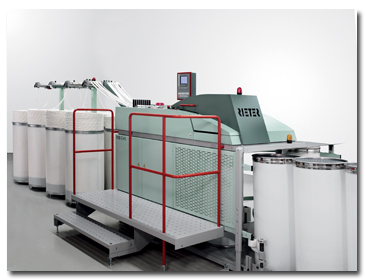
Rieter Adds Features To RSB-D 45 And SB-D 45 Draw Frames

Rieter Machine Works Ltd., Switzerland, reports new features on its RSB-D 45 and SB-D 45 draw
frames improve both machine flexibility and sliver quality. The draw frames offer a maximum
delivery speed of 1,100 meters per minute.

According to the company, delivery speed on a model without autoleveling can be changed by
pushing a button using the machine’s touch-screen interface. No drive disc change is necessary,
allowing the delivery speed change to take place at short notice. The change gear now is placed
ergonomically near the rotational plate drive, making alterations to can rotation and sliver
distance to the can quick and easy. The machines’ new gear layout now features a reduced number of
belts.

Rieter

Rieter RSB-D 45 draw frame

Upgrades also include the addition of Cleantube, a rotational plate control device that
reduces buildup of cotton trash particles and short fibers in the sliver channel. According to
Rieter, Cleantube saves up to 300 man-hours per year by reducing the need to clean trash from the
sliver channel, and also reduces the amount of sliver waste generated by up to 0.6 percent. Fewer
trash particles also result in improved sliver quality by eliminating up to 200,000 faulty places
per year per draw frame, leading to easier downstream processing.

January/February 2011

Teijin Announces Fiber, Fabric Developments

Teijin Fibers Ltd., Tokyo, plans to produce and market ECO CIRCLE® PlantFiber, a plant-based
polyethylene terephthalate (PET), beginning in April 2012. The new fiber contains approximately
30-percent content from sugar cane-derived biofuels. The bio-derived content will comprise the
ethylene glycol (EG) component of PET, and will replace oil-derived EG used to make conventional
PET. End-uses will include apparel, automotive seats and interiors, and personal hygiene products.
At the end of their useful life, those products will be recyclable, along with conventional PET
fiber products, through Teijin’s Eco Circle closed-loop recycling system.

FWpic

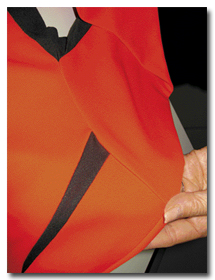
Teijin Ecopure pH-stable polyester fabric

Teijin also has debuted a polyester fabric featuring an inherent, slightly acidic pH level
similar to that of healthy skin. The fabric, tentatively called ECOPURE, is targeted to
high-performance sportswear, general apparel and other applications. The technology involves
permanently modifying polyester polymer by creating localized hydrophilic properties and mild
acidity on the surface of the inherently hydrophobic fiber, without affecting other inherent
properties of the polymer. Teijin reports the mild acidity can selectively control growth of
unhealthful bacteria while promoting beneficial bacterial growth, thereby maintaining healthy skin
and providing ultraviolet protection. The hydrophilic properties enable absorption of perspiration
as well as removal of sebum-based stains by washing, and the mild acidity neutralizes its alkaline
components.

January/February 2011

Acme-McCrary Dyeing Operation Supported By New Solar Energy System

Acme-McCrary Corp., Asheboro, N.C., has installed a solar thermal energy system at its Pritchard
St. hosiery plant in Asheboro to heat water for its hosiery and seamless apparel dyeing operation.
According to the company, the system — which comprises 200 solar panels manufactured by
Jacksonville, Fla.-based Alternate Energy Technologies (AET) and installed by FLS Energy,
Asheville, N.C. — will generate 10,000 gallons of hot water a day at temperatures up to 180°F, and
will reduce Acme-McCrary’s carbon emissions by 249,000 pounds annually. The system also includes
two 10,000-gallon tanks to store hot water for use when the sun is not shining. The company reports
the system is believed to be the largest such installation in the United States for industrial and
manufacturing applications.

FLS Energy designed and installed the system at no cost to Acme-McCrary and is selling the
energy generated to the company at a price lower than the cost of fossil fuel, reducing
Acme-McCrary’s energy costs by more than $20,000 per year.

The North Carolina State Energy Office’s ARRA Renewable Energy Grant program provided partial
funding for the project.

Acme-McCrary, a supplier of product to Walmart and a member of Walmart’s Sustainability
Council, initiated the project in response to sustainability requirements that Walmart has
instituted for its vendors.

January/February 2011

Clariant To Build Innovation Center

Specialty chemicals manufacturer Clariant International Ltd., Switzerland, is investing 50 million
euros to build a 23,000-square-meter innovation center in Frankfurt to expand its global research
and development activities. The Clariant Innovation Center will house 500 employees and will work
closely with company facilities in Gendorf, Germany, Lamotte, France, and Suzano, Brazil, along
with 40 application centers globally.

The center is scheduled to be completed by the end of 2012. The center’s open architectural
office and laboratory concept will bring together chemical research and development activities
under Clariant’s Group Technology Services structure and application-oriented laboratories and the
technical marketing functions of several business units. Clariant’s Chemical Analysis and New
Business Development and Intellectual Property Management units as well as the Patent department
will be located in the building. 

“Our product innovations will also address current megatrends such as renewable energies,
energy efficiency and renewable resources with a view to opening up new business opportunities
beyond current markets,” said Christian Kohlpaintner, Executive Committee member and head of
research and development, Clariant. “A market- and customer-focus will remain at the center of our
activities.”

January/February 2011

PermaShrink To Open Plant In Clover, S.C.

The PermaShrink Co. Inc., Charlotte — a provider of products and services to customers involved in
textile fabric preshrinking, or sanforizing — will invest $3.3 million to establish a plant in
Clover, S.C., to produce SanforSet® rubber shrinking belts, with the expectation of creating 16
jobs. The company will sell the belts to some 2,000 customers in 82 countries worldwide, with 95
percent of its production slated for export.

The new plant will be located in a building provided by the York County Natural Gas
Authority and located in Clover’s Westgate Industrial Park. According to Christopher D. Clickner,
vice president, PermaShrink, it will be the most technologically advanced plant of its type
worldwide.

“PermaShrink will be a tremendous asset to the Clover area. The partnership this company
formed with the York County Natural Gas Authority is a model for corporate cooperation,” said Buddy
Motz, chairman, York County Council. “The fact that this company exports most of their products to
emerging markets will add further value to the local and U.S. economy. We welcome the company and
new jobs they bring to western York County.”

January/February 2011

Owens Corning Expands Aiken, S.C., Facility

Owens Corning, Toledo, Ohio, has announced it will invest $36 million to add a nonwoven glass fiber
mat production line at its Aiken, S.C., facility, with the expectation of adding 24 jobs. The line
will manufacture materials for use in industrial and construction applications, and is scheduled to
be operational in mid-2012.

January/February 2011

Sattler Acquires Outdura From Shuford Mills

Sattler AG, Austria, has acquired the Outdura® brand of solution-dyed acrylic canvas fabrics for
outdoor furniture, marine and awning applications from Shuford Mills LLC, Hickory, N.C., for an
undisclosed price. The deal includes Shuford Mills’ manufacturing operation and distribution center
in Hudson, N.C. Outdura is Shuford Mills’ sole product line. Sattler plans to invest $4.56 million
in the operation, now known as Outdura Corp., and will retain Shuford Mills’ current 60 employees
while expanding the operation’s facility and manufacturing systems, and adding 12 or more positions
over the next three years.

Prior to the Outdura acquisition, Sattler employed approximately 540 people globally and
annually produced more than 20 million square meters of fabric including membrane solutions for
architectural and industrial applications; sun-protective fabrics for tents and awnings, boat
covers, and other applications; and technical textiles for truck tarpaulins, advertising, hall and
booth, and other applications. The company’s headquarters and two other manufacturing operations
are located in Austria; and its Ceno Tec textile architecture subsidiary is located in Germany.

January/February 2011

Hohenstein Develops EM/IR Treatment, New Upholstery

The Hohenstein Institute and ITCF Denkendorf, the Institute for Textile Chemistry and Chemical
Fibers, both based in Germany, have developed a textile treatment that effectively screens out both
electromagnetic (EM) and infrared (IR) radiation. The treatment uses indium tin oxide (ITO), which
is integrated into or coated onto man-made fibers to provide the screening effect. Tests conducted
by researchers have shown the treatment is not biologically harmful, and that the treated textiles
are comfortable as well as wash-, abrasion- and weathering-resistant.

“These novel materials are not only extremely effective at screening radiation but they also
conduct electricity so they are anti-static,” said Dr. Edith Classen, project leader. “This makes
them ideal for use in Personal Protection Equipment for firemen, workers in foundries and welding
workshops, in the semiconductor industry or for maintenance staff working on telecommunications
systems.”

Classen also anticipates potential domestic and technical textile applications. “For example,
you could imagine making roller blinds which not only screen out solar radiation in summer to keep
the room cool, but at the same time also offer protection from the electromagnetic radiation from
mobile phone masts in the vicinity,” she said. ITO-treated textiles in military uniforms could make
the wearer invisible to IR cameras as well as provide protection from EM radiation.

In other news, Hohenstein Institute researchers have teamed with the Germany-based Institute
for Wood Technology and Research Institute of Leather and Plastic Sheeting to develop new types of
upholstery for use on public transport, car seats, easy chairs and mattresses that would offer
improved hygiene. The groups are studying the link between moisture accumulation and the
colonization of bacteria or fungi, and plan to create guidelines for material selection and
structural designs that would help transport moisture out of the upholstery.

January/February 2011

Tuscarora To Expand Clover, S.C., Plant

Tuscarora Yarns Inc., Mount Pleasant, N.C., will expand its Clover, S.C., plant, with the
expectation of creating 40 jobs. The $3.5 million expansion will add 6,000 square feet of
manufacturing space to the 190,000-square foot facility as well as new machinery and equipment, and
will increase production capacity by 20 percent.

The plant began operating in 1998 under the company Four Leaf Textiles LLC, which later
became CloverTex LLC. In May 2009, CloverTex and Tuscarora Yarns merged, forming the largest
specialty yarn company in the Americas.

“The Town of Clover, York County and the state of South Carolina have been very supportive of
textile manufacturing at this location for the past 12 years and Tuscarora Yarns is proud to
increase its investment and its workforce at this site,” said David Roberts, COO, Tuscarora Yarns.

January/February 2011

Sponsors