
TenCate Geosynthetics, AGT International Team For Dike Monitoring Project In China

The Netherlands-based TenCate Geosynthetics — a developer of solutions and systems for
transportation infrastructure, water management and cleaning, and environmental applications — and
Switzerland-based AGT International — a developer of solutions for infrastructure and border
protection, urban management, cyber security, transportation, law enforcement, and natural disaster
preparedness applications — have agreed to partner to install a TenCate GeoDetect® monitoring
system in a dike body at the Yellow River in China’s Henan province.

The system, which comprises a geotextile with interwoven fiber optics that record changes in
a dike or embankment, will be used in the AGT Flood Early Warning System (FEWS), which will collect
and evaluate data related to dike stability, dike deformations and flooding risk. Using those
analyses, operators will be able to take steps as quickly as possible to prevent dike failure or
sagging. In addition, FEWS can conduct a flood prognosis and thus enable timely evacuation if
required, and can monitor and report on the dike’s condition and stability.”

Our solution collects real-time information from new and existing systems to generate a
real-time assessment of the river conditions,” said Pieter-Christiaan van Oranje-Nassau, head of
AGT International in the Netherlands. “Our advanced prediction and simulation software will
generate alerts and recommendations to affected areas. Another key element for the full realization
and success of the project is our commitment to turning key project findings into shared learning
opportunities.”

For the Yellow River project, AGT International is collaborating with the Netherlands-based
R&D organization TNO Operations, which develops knowledge for practical applications for a
variety of industrial and government entities. The project was commissioned by the Yellow River
Conservancy Commission, which handles water issues for the entire 5,000-kilometer-long river.


March 20, 2012
Timzo Tufting Selects NedGraphics’ ITex Application

NedSense NedGraphics BV — a developer of software solutions for the fashion and textile industry,
and a subsidiary of the Netherlands-based NedSense enterprises NV — reports it has supplied its
iTex virtual sampling application to the Netherlands-based Timzo Tufting Industry BV, a
manufacturer of loop pile tufted wall-to-wall carpet.

NedGraphics’ iTex application employs unique virtual sampling technology that replaces real
fabric samples with virtual samples in a comprehensive database. The company reports the tool is
especially useful for salespersons in the carpet and weaving industries, as it enables them to
present to their clients an instant virtual sample of a product and/or collection on an iPad and
offers a low-cost, lightweight method of carrying a full up-to-date portfolio.

iTex technology allows on-site colorway adjustments for any type of design or fabric
including prints, knits, wovens, and wall and floor coverings. Salespersons can categorize virtual
samples and create concise reports comprising pictures and product information to help their
clients make decisions. iTex also enables creation of custom samples, and NedGraphics offers a
guarantee that the product will correspond exactly to the virtual sample.

“With iTex we can offer our clients an experience which is instant, to their choice and real
to the eye,” said Jan Bakker, head of product development, Timzo Tufting. “Moreover this solution
increases our internal efficiency by saving us costs and time as this simulation element speeds up
our sales process in true dialogue with our customers.”

March 20, 2012

Teijin Aramid Pioneers In Protection Technology For Optical Fiber Cables

ARNHEM, The Netherlands — March 19, 2012 — Teijin Aramid announces a new and improved way of
protecting optical fiber cables: Twaron Tape. Optical fiber cables play an increasing essential
role in today’s telecommunications, and their fragile cores need protection from various hazards
and strains.

Optical fiber cables are getting smaller and smaller — and at the same time it becomes more
difficult to protect the optical fiber core. Twaron Tape is an aramid fiber matrix construction
that enables the production of optical fiber cables with a diameter as small as 1.2mm.
Simultaneously, it provides three to five times better crush resistance compared to currently used
aramid fiber protection.

The production of thinner cables using Twaron Tape results into several more advantages
compared to current solutions. For example, the production of 1.2mm cables translates into an
increased capacity for optical distribution frames of 30-50% (compared with 1.6mm cable).
Furthermore, the thinner cables demand less cooling power, thereby cutting costs — and emissions —
at distribution centers.

Twaron Tape D2800 is a robust and flexible patented solution that contributes to increased
cable production speed, saving valuable time. Twaron’s flexibility enables quicker and more
convenient installation and handling, with easier stripping and connectorization of optical fiber
cables. The Tape consists of a single, spread Twaron yarn which is impregnated and fixed with a
matrix material. This results in significant saving in space and enables optical fiber cables to be
this thin. In order to provide complete coverage and optimal force and crush resistance, it is
evenly wrapped around the core of the optical fiber cable.

Christoph Hahn, Commercial Director at Teijin Aramid: “We are one of the early pioneers of
reinforcement technology for fiber-optic cables, and as this market has developed, we have gained
an in-depth understanding of the market requirements. We are proud to contribute to this industry
by offering our knowledge in high performance aramid fibers to our worldwide partners.”

Teijin Aramid experts will be present at Wire Düsseldorf 2012, booth 9C37, to show Twaron
Tape and discuss with visitors how they could benefit from the added value of this new product.

Posted on March 20, 2012

Source: Teijin Aramid

DyStar And RedElec Start Sustainable Indigo Dyeing

Singapore — March 19, 2012 — DyStar and RedElec are pleased to announce a significant development
collaboration which focuses on sustainable Indigo dyeing for the denim industry.

Increasing global awareness of environmental issues created by the textile supply chain is
propelling Brands, Retailers and their Industry partners to look for sustainable solutions for
their businesses.

To help address those pressing needs, the DyStar Denim team in Germany and RedElec
Technologie in Switzerland have decided to join forces to develop electrochemical dyeing of Indigo,
a sustainable solution that will eliminate harmful substances in dyeing and waste water. The team
will use its patented products, DyStar Indigo® Vat 40% Solution and RedElec’s electrochemical
technologies, throughout the development process.

“As a leader in ecology & environment in the textile industry and technology leader for
Indigo, our customers expect us to develop new products and processes that help reduces their
environmental impact,” said Thorsten Hüls, Marketing Manager Denim in Ludwigshafen. “The
cooperation with RedElec is a big step forward to help improve the environmental profile of Indigo
dyeing,” added Günther Widler, Technology Manager Denim.

With the collaboration, RedElec is given opportunities to explore and further develop its new
and promising electrochemical technologies for clean processes. “In the near future,
electrochemical processing will become the new and essential technology to limit the negative
impacts of industrial activities”, said Dr. Crettenand, Director of RedElec. 

The initiative further affirms DyStar’s sustainability and econfidence® commitments to the
textile industry — to offer sustainable solutions through environmentally & ecologically
friendly products, process and services — a “sure-to-win” strategy which will also help its
customers stay ahead of  competitors.

Posted on March 20, 2012

Source: DyStar

Teijin Introduces Twaron® 550f1000

Teijin Aramid BV, the Netherlands, reports its Twaron 550f1000 aramid yarn offers improved
ballistic protection in body armor for police, military and law enforcement officers.

According to the company, the new yarn, which comprises 1,000 filaments and is the
finest-filament aramid-based yarn available, has the highest tenacity combined with breaking
strength of all the yarns in its porfolio — offering improved resistance to the blast effects of
roadside bombs, good fragment resistance, and enhanced bullet protection. The yarn will be used
primarily in soft antiballistic products for the police, military and law enforcement markets; but
may also be used in a woven fabric for antiballistic and anti-stab products.

“This new yarn is our response to the demand for lightweight ballistic protection, which
itself is the result of the increasing threat of violence in society,” said Karl Henke, business
manager, Ballistic, Teijin Aramid. “Police officers, soldiers and even private citizens who require
protection will start wearing a bulletproof vest earlier when the weight and comfort is even better
than nowadays.”

March/April 2012

Södra Begins Textile Pulp Production

Södra — an economic association comprising more than 51,000 forest owners in Sweden and having
production activities in the areas of wood products for construction and interiors, wood pulp, and
energy — is now producing hardwood-based textile pulp at one of its pulp mills, and expects to
produce 170,000 metric tons of textile pulp annually once that operation reaches full capacity.

Södra has been producing wood pulp for reinforcement and paper applications since the late
1950s. In December 2010, it decided to invest in textile pulp production, and has been implementing
the investment and developing a marketing organization to serve the textile segment. The textile
pulp, derived from hardwoods such as birch and aspen, will be supplied to viscose fiber
manufacturers.

“We are focusing on textile pulp as this is a growing market to which we can supply a
certified, renewable forest raw material,” said Gunilla Saltin, president, Södra Cell.

The company also plans to expand textile pulp production to an additional pulp line that is
producing paper pulp at one of its other mills.

March/April 2012

UMC Utrecht Selects Dyneema Purity® For Heart Valve Development

Biomedical materials science company Royal DSM NV and the University Medical Center of Utrecht (UMC
Utrecht), both based in the Netherlands, have signed a collaborative agreement under which DSM will
provide its Dyneema Purity® fiber technology to UMC Utrecht for the development and evaluation of a
prototype of a non-biological support scaffold for use in minimally invasive treatment of valvular
and vascular disease.

UMC Utrecht selected Dyneema Purity to use in this development based on the fiber’s high
strength and flex fatigue resistance, tear resistance, low elongation, and minimal profile.

“We believe that heart valves with scaffolding made from Dyneema Purity® fibers have the
potential to lead to a revolutionary new solution, giving those dealing with heart disease the
benefit of a less invasive transcatheter heart valve replacement,” said Paul Gründeman, M.D.,
Ph.D., principal investigator, Heart and Lungs Division, UMC Utrecht. “Although we are in a very
early feasibility stage and prototyping only, we believe Dyneema Purity fiber is a very interesting
material to use as basis for this feasibility study.”

March/April 2012

Spinrite To Establish Facility In Washington, N.C.

Canada-based craft yarns manufacturer Spinrite LP has announced it will invest $9.1 million to
establish a manufacturing facility in Washington, N.C., and add 90 jobs.

Last year, Spinrite acquired certain assets of handknitting and crocheting yarn and
equipment supplier Caron International, including a facility in Washington, from National Spinning
Co. Inc. (See ”
National
Spinning Sells Caron International To Spinrite
,” TextileWorld.com, Dec. 6, 2011). Employees who
lost their jobs following that acquisition will be able to apply for new positions with Spinrite.

“We are very excited about our new opportunity in North Carolina,” said Ryan Newell,
president, Spinrite LP. “The talented workforce in Beaufort County will provide an excellent
foundation for further expansion and growth of our business.”

The project was facilitated in part by a $180,000 grant from the One North Carolina Fund.


March/April 2012

[TC]2 Introduces KX-16 Body Scanner

[TC]2, Cary, N.C., has unveiled the KX-16 next-generation 3-D body scanner offering expanded
functionality. KX-16 is targeted to the apparel, health and fitness, and medical markets.

Measuring 20 square feet and featuring 16 low-cost 3-D scanning sensors, KX-16 is the same
size as [TC]2’s current leading body-scanner, NX-16, but, at $10,000, is one-third the price.

NewProducts

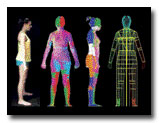
[TC]2’s KX-16 3-D body scanner scans subject using 3-D scanning sensors.

KX-16 utilizes the same technology used by NX-16, with sensors placed around the body at four
specific heights and four specific angles to give complete and accurate body scans. The scanner
features an attached changing room and includes the full suite of [TC]2 Body Scanning software
functionality including automatic body measurements at more than 400 points; manual measurement
capabilities; embedded size selection for stock size apparel; embedded Made-to-Measure features for
custom apparel; automatic 3-D digital avatar creation including face texturing from a photo;
Virtual Fashion feature enabling quick virtual try-on of each apparel item; body shape and body fat
analysis tools; and a private self-scanning mode.

KX-16 also offers color scan data acquisition; low sensitivity to room light or sharp color
contrasts on the scan subjects; and generation of more than two million data points at full-body
resolution.

March/April 2012

Burlington Technologies To Add Cut/Sew Operation

Burlington Technologies Inc., Burlington, N.C., plans to expand its manufacturing operation in
Burlington, investing $725,000 to add cut-and-sew capabilities and creating 110 jobs. The company
has received a $120,000 grant from the One North Carolina Fund along with other incentives from
state and local entities to support the project.

Burlington Technologies operates two core businesses: Burlington Manufacturing Services
(BMS) — a package-yarn dyeing operation serving the home furnishings, apparel and industrial
textile markets — and Se7en LLC — a producer of woven decorative fabrics for home furnishings,
hospitality and contract markets. It also has two business affiliates: VitaFlex LLC — a
manufacturer of elastic nonwoven products for various markets; and Diagnostic Chips LLC — a
developer of diagnostic testing technologies for medical applications. The plans for the
cut-and-sew operation are contingent upon the company receiving a contract from the U.S. military
to produce military dress pants using wool-based fabrics already supplied to the military by
Greensboro, N.C.-based International Textile Group.

“This would be a new capability for our company,” said Mike Durham, president and CEO,
Burlington Technologies. “The system would be very automated, very process-oriented and efficient,
and ideally suited to a contract with the military. Once we get this up and running, it appears we
could have a niche that would serve other customers and markets as well.”

March/April 2012

Sponsors



