VDS Denim Plant Certified To LEED® Platinum Level

New York City- and Bangladesh-based apparel maker VDS Group’s new Vintage Denim Studio
manufacturing facility in Bangladesh has earned the U.S. Green Building Council’s Leadership in
Energy and Environmental Design (LEED®) Platinum certification. It is the first factory in
Bangladesh to earn LEED certification, and the first worldwide to achieve LEED-NC v3 status.

The 300,000-square-foot facility treats and reuses 100 percent of its wastewater, and has
installed a stormwater management system and water-efficient landscaping and fixtures, with
expectations of achieving water savings of 46 percent. A 100-kilowatt photovoltaic panel provides
13 percent of its total energy, and energy-efficient fixtures and other design features are
expected to cut energy usage by 45 percent. The facility also sends no waste to landfills. Other
green initiatives include site design geared to controlling erosion and sedimentation, heat-island
reduction, use of non-fossil-fuel vehicles, and monitors and controls to regulate water and energy
consumption as well as carbon dioxide emissions and other chemicals and pollutants.

July/August 2012

Quality Fabric Of The Month: Infection Reduction

PurThread Technologies Inc., Durham, N.C. — developer of an antimicrobial technology based on silver, copper and other elements that it integrates into nylon and polyester polymers during fiber
formation to provide permanent efficacy — now is developing textile products such as privacy curtains, linens, scrubs and doctors’ coats that contain its proprietary Complex Element Compound, with the intention of reducing the bioburden of such soft surfaces and, hopefully, the incidence of healthcare-associated infections (HAIs) in the clinical environment. HAIs impact some 5 percent of patients admitted to hospitals, according to the Centers for Disease Control and Prevention, accounting for 1.7 million infections at a cost of up to $45 billion per year. Between 20 and 40 percent of these infections reportedly are transmitted to patients via hand contact from healthcare workers despite frequent hand-washing, because pathogens can linger on hard and soft surfaces they may touch in the environment.

QFOM


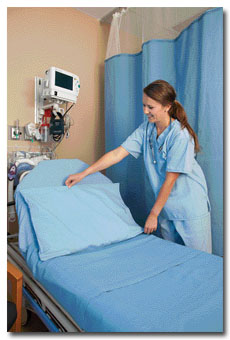
PurThread Technologies has developed hospital privacy curtains, surgical scrubs, linens and
other textiles containing its continuously active Complex Element Compound.

Soft textile surfaces may be harder to keep clean than hard surfaces because pathogens can nestle into the fabric. A recent study of contamination on traditional hospital privacy curtains revealed that 92 percent of the curtains became contaminated with methicillin-resistant
Staphylococcus, vancomycin-resistant Enterococcus and/or other bacteria within one week after laundering. Intervals between launderings may span months, and such curtains are touched frequently
by hospital workers while they are working with patients, so unless those workers wash their hands immediately after touching the curtains, they risk passing infections to the patients.

“We are trying to break the chains of pathogen transmission from surfaces to vulnerable patients, and improve patient outcomes through the reduction of incidence of HAIs,” said Bill O’Neill, vice president of infection control applications, PurThread Technologies, adding,
“Infections are very expensive to treat. If we reduce them, we will also reduce the overall financial burden for the healthcare system.”

O’Neill said a follow-up study has been conducted in a hospital setting to test the efficacy of PurThread’s technology on privacy curtains, and the conclusions have been quite promising. The peer-reviewed study has been accepted for publication in a major infection control journal. “The study showed a meaningful bioburden reduction on PurThread curtains,” he said.

PurThread has submitted its technology to the Environmental Protection Agency for registration as an antimicrobial technology, and expects to offer products on the market later this year. The company is working with U.S. fiber, yarn and fabric producers to make the fabrics. Beal
Manufacturing Inc., Gastonia, N.C., is spinning the yarn. End products will be cut and sewn in Mexico. Because the compound is permanently integrated into the fiber, the textiles need no special handling and can be laundered and otherwise treated using traditional healthcare laundry protocols.


For more information about PurThread’s Complex Element Compound, contact Bill O’Neill or Jenifer Smyth +800-673-5939; info@purthread.com; purthread.com.


July/August 2012

An Introduction To 3-D Weaving

So, what is 3-D weaving? The term “three-dimensional weaving,” or “3-D weaving,” has been bantered
about correctly, incorrectly and rather loosely over the years for one textile structure variation
or another — just about everything from woven baskets to highly complex near net-shape preforms.
Manufacturers from diverse textile industry segments use the term to describe their respective
products such as spacer fabrics, geotextiles, surgical implants, webbings, conveyor belts and more.
Of course, if you happen to know a physicist or a fussy materials engineer, (s)he will kindly
inform you that every textile fabric, or pretty much any structure, for that matter, must have
three dimensions. And, as everyone has learned along the way, those three dimensions are most
commonly referred to as length, width and height — or depth.

In today’s technical textiles marketplace, when people mention 3-D weaving or 3-D fabrics,
they usually are referring to a growing category of products used primarily in highly
performance-driven composite applications. Such applications range from jet engine components and
engineered shapes to composite billets for bulkheads and ballistic armor panels. The attraction and
interest in 3-D woven products specifically for composite applications stems from the following
attributes:

  • design flexibility and versatility;
  • inherent resistance to delamination;
  • improved damage tolerance;
  • ability to tailor composite properties to the application;
  • near net-shape preform capabilities; and
  • reduced lay-up complexity and handling time.
3Dweaving

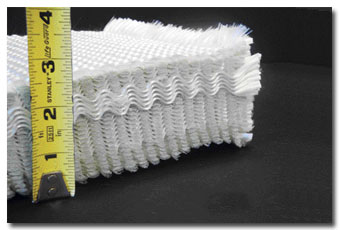
This close-up cross section of a thick 3-D woven glass billet shows the layer-to-layer weave
configuration.


Reviewing The Basics


Though composite applications are currently the primary use for 3-D woven products, there is
vast potential for future applications, both within the composites marketplace and in non-composite
applications as well. In an attempt to clarify and hopefully define what constitutes 3-D weaving or
a 3-D woven fabric, a brief review of traditional weaving might be helpful.

According to Wikipedia.com, “weaving is a method of textile production in which two distinct
sets of yarns or threads are interlaced at right angles to form a fabric or cloth.” And, as many
may recall from some weaving instructor in the past, the weaving process historically is defined by
repeating a basic four-step cycle:

  • Shed formation: An opening is created in the warp, or machine-direction, yarns for the weft, or
    filling, yarn to pass through. The subsequent shed changes create the weave’s pattern.
  • Weft, or filling, insertion: The weft yarn is inserted in the shed.
  • Beat-up: The weft yarn is beaten into the fell of the cloth.
  • Take-up and let-off: The resultant fabric is taken-up from the fell, and a corresponding amount
    of warp yarn is let-off to fill the void.

Successful repeats of this cycle result in the production of a woven fabric. Most people
tend to think of and recognize conventional woven fabrics as roll goods having a clearly defined
length and width, but very little discernable depth or thickness. In the composites marketplace,
primarily because of their lack of discernable depth, these traditional woven fabrics, while
possibly made from carbon, fiberglass, aramid, or any variety of combinations, are generally
understood to be two-dimensional, or 2-D, fabrics. 3-D fabrics are the same in principle as 2-D
fabrics, but possess a noticeable third dimension of significant depth or thickness created during
the 3-D weaving process.

3Dweaving2

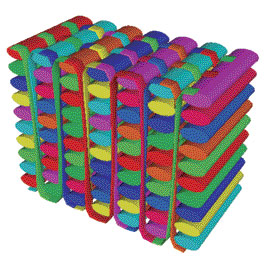
In an orthogonal, or through-thickness, weave, the weaving and connecting of lengthwise warp
and crosswise fill layers generate inherent through-thickness physical properties in the
fabric.


Adding A Third Dimension


The same basic four-step weave cycle applies to both 2-D weaving and 3-D weaving, but to
create the third dimension, additional warp yarns are manipulated into multiple layers. This
manipulation of the warp, with multiple layers woven in sync using extra filling insertions,
creates the fabric’s depth by weaving through the thickness — commonly referred to as
through-thickness. The through-thickness weaving and connecting of warp and fill layers generates
the 3-D woven fabric’s highly desirable and inherent through-thickness physical properties.

Generally, 3-D fabrics are produced on customized or purpose-built weaving machines, which
most likely incorporate a Jacquard unit to control the action of each warp yarn independently via
computer. The Jacquards used are heavy-duty, but similar to those found weaving carpets and
intricate home-furnishing fabrics. For most 3-D woven fabrics, the warp yarns are commonly woven
from a creel setup instead of from traditional loom beams. This setup affords the freedom for each
warp yarn to be tensioned individually throughout the weaving process. Individual tension of the
warp yarn is necessary, given that many are likely to travel different lengths while weaving
distinctive paths through the fabric’s thickness, compared with those of their respective warp
neighbors that may be weaving entirely different paths.


Combining recent improvements in weave design tools with individual tensioning and Jacquard
head control of each warp yarn not only creates numerous possibilities for the design engineer, but
also provides the freedom to incorporate a number of different yarns and yarn systems into the 3-D
woven structure. Theoretically, it is possible, though probably not practical, to use a different
yarn type for each of the warp ends in a 3-D woven fabric. It should be noted that in part because
of the extensive setup and yarn-handling requirements, 3-D weaving does result in relatively higher
weaving costs than traditional 2-D weaving. In many applications, however, the higher incurred 3-D
weaving costs can be offset by reduced lay-up complexity and material handling time, and improved
product performance.


Growing Range Of Possibilities


Given the fact that a design engineer now has access to vastly improved design technology
and the added depth component of a 3-D woven structure, a wide variety of simple to rather complex
shapes can be created. The growing array of 3-D woven fabric possibilities tends to fall into one
of two categories: billets and fabric panels; or complex near net-shape preforms.

Billets or flat panels of consistent thickness can be as thin as 0.125 inch (3 millimeters
[mm]) or as thick as 5 inches (125 mm) or more. When molded and shaped, these are used in various
applications in which delamination is a concern, as structural components and possibly as
replacements for heavier metallic versions. 3-D woven billets also are being evaluated in advanced
ballistic armor applications, in which their inherent resistance to delamination, improved damage
tolerance relative to 2-D laminated structures and significant weight savings show great promise.

Near net-shape preforms can have rather complex geometries tailored to specific applications
including airfoils, fan blades, radomes, tubes, bifurcated shapes, contours and structural cross
sections such as T’s, Pi’s and X’s. Many are made from ultra-high-performance fibers and used in
extreme high-temperature applications in which traditional metals are not able to withstand the
operating environment. Other applications include unique cross-section components that help to
improve joint strength for composite assemblies. For these applications, the flexibility of 3-D
weaving allows for the orientation and positioning of fiber paths that are more in line with
physical stresses, resulting in improved product design and efficiency.

It should also be noted that in many 3-D woven preforms, when compared to 2-D laminates,
there is generally a trade-off of in-plane strength for through-thickness strength. As a result,
each potential 3-D woven application should be evaluated specifically for that application’s
performance requirements. 3-D woven composite applications and their performance attributes will be
discussed in more detail in part two of this series, which will be published in the next issue of
Textile World.

Manufacturers of 3-D woven fabrics stand at the ready to assist engineers and developers
with new applications for 3-D weaving technology.


Editor’s note: Jim Kaufmann is a senior engineer at TEAM Inc., Woonsocket, R.I., specialists in
textile engineering and weaving fabrics and preforms from high-performance, difficult-to-handle
fibers including carbon, glass, aramids and ceramic fibers.


July/August 2012

Fibers Focus At Fabric Shows

In January and July, New York City fabric shows are offering new items for apparel. Fiber companies
are among the exhibitors showing innovations — and where to find them. At Texworld USA, held July
24-26 at the Javits Convention Center, Lenzing will focus on MicroModal®, with increased production
in the United States and Asia; and on MicroModal Edelweiss
(See ”
Edelweiss:
Eco Improvement For Modal® Fiber
,”
Textile World

, March/April 2012). Invista and FiberMax® cotton are two sponsors of the Kingpins Show
and its satellite show, The Continuum, held July 24-25 at Center 548; and Cotton Incorporated is a
Kingpins exhibitor.


Lenzing Fibers At Texworld USA


Lenzing AG, Austria, has expanded its reach. At Texworld USA, the company will have 41
exhibitors, including 10 from the United States. “We see an increased demand for Made in America,”
said Tricia Carey, merchandising manager, Lenzing. “Time, smaller orders and quality are some of
the contributing factors. And, we are working through the supply chain, from yarns to knitted
fabrics and finally to garments.”

Buhler Quality Yarns Corp., Jefferson, Ga., spinners of high-quality yarns, will feature
extra-long-staple cotton, MicroModal Edelweiss, and MicroTencel®. Rainbow technology will be on
display, with fabrics from Tricots Liesse, Montreal, showing different color depths that can be
achieved using this yarn. MicroModal and MicroModal/Supima® cotton slub yarns also will be
featured.

At Tuscarora Yarns Inc., Mount Pleasant, N.C., there will be both ring-spun and vortex yarns
of Modal/polyester. Vintage Modal triblends; and Modal/cotton heathers, mock twists and nubs are
among the choices.

Texollini Inc., Long Beach, Calif., has a wide range of fabrics knitted with Modal,
MicroModal, ProModal®, Tencel® and MicroTencel. The range goes from sheer tissue weights and
textures knitted on Texollini’s Superfino® equipment to heavy fabrics for activewear. And look for
new phase-change technology and Fire Stomp® featuring Lenzing FR®.
KA3

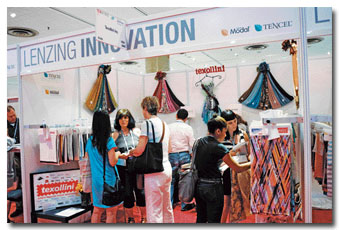
Texollini Inc. is one of 41 companies, including 10 from the United States, that will be
exhibiting as part of Lenzing Innovation at Texworld USA.


Design Knit Inc., Los Angeles, knits to order, from sheer to heavyweight fabrics. The company
can do lightweight sweater knits, novelty and basic fabrics made with cashmere, silk, wool, rayon,
cotton, linen, MicroModal, ProModal, Tencel or any other fiber. New fabrics are offered every
season.

At Mansfield Textiles Inc., Vernon, Calif., 60 new knitting machines are helping the company
renew its dedication to developing new textiles. Laguna Fabrics, Los Angeles, uses blends with
MicroTencel to create crepes, nep jerseys, streaky slubs and jacquards. At Los Angeles-based
Ecotex, it is about color and print.

FesslerUSA, Orwigsburg, Pa., produces knitted fabrics and garments. One new fabric is a
flame-resistant interlock containing Lenzing FR that is soft next to the skin and weighs in at 6.4
ounces
(See ”
Quality
Fabric Of The Month: Comfortable FR Underneath It All
,”
TW, May/June 2012)
. Others are jerseys, interlocks and stripes in blends of
MicroModal with Supima cotton and polyester. A 3.6-ounce cotton/MicroModal jersey has a very heavy
slub. A 3.1-ounce jersey slub with a bold stripe is knitted using a blend of Supima cotton,
MicroModal and polyester; and a 4.3-ounce heathered stripe also contains Supima cotton, MicroModal
and polyester.


Denim Trends At Kingpins


At Kingpins, Cotton Incorporated, Cary, N.C., will show results of its recent trend analysis
with Spain-based dyeing and finishing machinery manufacturer Jeanologia. Here, new methods have
been developed that are environmentally and cost friendly. Some involve laser-cut edging, ozone
washing to eliminate harsh bleaching, digitally printed denim to get the indigo hue without
stonewashing, and printing with realistic prints. Some of the prints include animals, dandelions,
exaggerated pinstripes and marbleized effects.

Cotton Incorporated also will show TransDRY® denim from Levi’s®, produced in Asia and sold
locally. The TransDry treatment pulls moisture through the fabric to help keep the body cool and
dry. And, there will be denim developments from Cotton Incorporated’s extensive fabric library
along with very explicit directions on how to weave or knit each fabric.
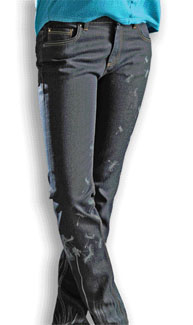
KA1


Photoscan is one of 10 directional denim inspirations combining fashion and sustainable
innovation developed by Cotton Incorporated and Jeanologia.

Bayer CropScience Inc.’s FiberMax brand, one of the sponsors of Kingpins, will show
customers fabrics and garments that have been made with its fibers. FiberMax is extra-long-staple
cotton grown in Texas.

Sustainability will be a topic at one of The Continuum seminars. “We will try to explain the
word ‘Sustainability,'” said Robert Antoshak, managing director of Kingpins organizer, Olah Inc. J.
Berrye Worsham, president, Cotton Incorporated, will be a seminar participant.

Wichita, Kan.-based Invista, also a Kingpins sponsor, has developed three themes around
denim. The first, Ecology, was developed in cooperation with Jeanologia. Here, innovative laser
printing and waterless washes are used to finish fabrics. Each is rated on a score from one to 100.
“One is the best score,” said Jean Hegedus, global marketing director — Bottoms. “Most of ours came
to about 16.

“We launched this project at Première Vision Denim,” Hegedus continued. “A fabric from
[China-based] Seazon Denim that was printed with a cable stitch pattern was well-received, along
with fabrics from Prosperity Textiles and Central Textiles [both based in Hong Kong].

“Our second theme is called Ethnic,” Hegedus said. “It includes a lot of bright colors and
prints.”

She pointed out jeans made in a fabric from C.D.I. (Color Denim International Ltd.), Hong
Kong, using yarn-dyed yarns rather than being garment dyed, ”so you see a lot of white,” she said.

Another fabric, from Tavex, Spain, contains LYCRA® dualFX®, which, Hegedus explained,
comprises two stretch fibers, Lycra for stretch and Lycra T400® for recovery.

Emerging is the third theme Invista will present. “Here, we did a lot of research in the
menswear market,” Hegedes explained. “We discovered that there is a lot of crossover between
sportswear and rugged activewear. Men want fabrics that are strong and abrasion-resistant,” she
said. TOUGH MAX™ Lycra provided the answer: It has toughness, resists abrasion and doesn’t add
weight. It contains Lycra T400. Some of the fabrics she pointed out are from Kaltex®, Mexico;
A.D.M. Denim, Pakistan; and India-based Bhaskar Industries Ltd. and Arvind Ltd.

July/August 2012

Kimbrell Receives BSA’s Distinguished Eagle Scout Award

W. Duke Kimbrell, Chairman of the Board, Parkdale Mills Inc., Gastonia, N.C., has received the Boy
Scouts of America’s (BSA’s) Distinguished Eagle Scout Award. The award acknowledges Eagle Scouts
who have achieved national-level eminence within their field and have maintained a strong record of
voluntary community service for at least 25 years.

BSA President and Exxon Mobil CEO Rex Tillerson, a past recipient of the award, presented
Kimbrell with a medal and plaque at an awards ceremony held at the Gaston Country Club in Gastonia.

Kimbrell began his career at Parkdale at the age of 14, when he was hired to do odd jobs for
company owner Bill Robinson. Following high school graduation and service in the Air Force during
WWII, he attended North Carolina State University’s School of Textiles and earned a textile
manufacturing degree. He then returned to Parkdale and was named CEO in 1961, and chairman in 1967.

The Piedmont Council Boy Scouts has established the Scout Camp Expansion Fund in honor of
Kimbrell. Parkdale Mills will match funds to help the Council reach its goal of raising $300,000.

July/August 2012

Canton Fair Organizers Report Results From 111th Event

Organizers of the 111th China Import and Export Fair (Canton Fair) — held last spring at the China
Import and Export Fair Complex in Guangzhou, China, and comprising three phases offering a wide
range of commercial products — report that trade at the fair was affected by European and U.S.
economic conditions, but not as much as had been widely expected.

The Canton Fair is organized by the China Foreign Trade Centre. It is hosted by the Ministry
of Commerce, People’s Republic of China; and the People’s Government of Guangdong Province. The
venue offers an exhibition area of 1.16 million square meters and 58,700 booths.

A record-breaking 210,000 buyers from 213 countries and regions attended the fair,
0.23-percent and 1.23-percent increases, respectively, over the 110th and 109th editions held in
2011. However, export values, at US$36.03 billion, were 2.3-percent and 4.8-percent lower,
respectively, than spring 2011 and fall 2011 values; and trade volumes were 8.1-percent and
5.6-percent lower than respective year-earlier volumes.

Emerging markets including India, Brazil and Russia averaged a 4.1-percent increase in trade
volumes; and African markets registered a 13.5-percent increase in these volumes.

The Canton Fair International Pavilion presented the products and services of more than 520
companies from 44 countries and regions. Organizers hope to attract more foreign companies in the
future, particularly from industries targeting environmental markets, and report that most of the
International Pavilion booths have already been booked for the 112th Canton Fair scheduled for fall
2012.

Buyers were quite positive in their assessment of the fair. Kristrian Holmqvist, a first-time
attendee from Finland, stated: “It saved me a lot of time from going to many places to search for
new suppliers. Here is a great platform for us to find business opportunities.”

The 112th Canton Fair will be held Oct. 15-Nov. 4, 2012, at the same venue. Phase 1,
scheduled October 15-19, will offer electronics and household electrical appliances, lighting
equipment, vehicles and spare parts, machinery, hardware and tools, building materials, and
chemical products. Phase 2, October 23-27, will include consumer goods, gifts and home decorations.
Categories offered during Phase 3, October 31-November 4, include textiles and garments, shoes,
office supplies, cases and bags, recreation products, medicines, medical devices and health
products, and food.

July/August 2012

Starlinger Opens Office In Uzbekistan

Austria-based woven plastic packaging production and plastic recycling machinery manufacturer
Starlinger & Co. GmbH has opened a Central Asia representative office in Tashkent, Uzbekistan,
to offer sales and after-sales service in Uzbekistan, Kazakhstan, Kyrgyzstan, Tajikistan and
Turkmenistan.

Yuldosh Kazakov, Starlinger’s chief representative for the region since 2009, heads the
office, and a local technician is on hand to offer immediate customer service and troubleshooting
for any machine malfunctions.

Starlinger anticipates strong growth potential for its business in the Central Asian region,
which has experienced strong economic growth over the past several years. The company already has
sold machinery to companies in Uzbekistan and Turkmenistan for production of AD*STAR sacks, and in
Uzbekistan for bottle-to-bottle polyethylene terephthalate recycling.

July 17, 2012

Dornbirn-MFC Organizers Anticipate “Vivid Participation”

The Austrian Man-made Fibers Institute (MFI) — organizer of the 51st Dornbirn Man-made Fibers
Congress (Dornbirn-MFC), to be held Sept. 19-21, 2012, in Dornbirn, Austria — reports that, based
on the number of early-bird registrations for this year’s congress in comparison to last year, it
is anticipating “vivid participation” in September. In all, more than 700 attendees from more than
30 countries, including a significant delegation from Japan, are expected to attend this year’s
event.

Austrian MFI has announced that this year’s congress will focus on “future viability based
on Sustainability, innovation and communication with the upcoming generations.” More than 100
lectures have been scheduled and will cover topics such as: “Fibers and Textiles in Automobiles”;
“Unconventional Fiber Applications;” “Fiber Innovations”; “Man-made Fibers for Environmental
Protection”; ” Medical Applications”; “Technical Nonwovens”; and “EU-Projects”; among other topics.

Organizers note that they are continuing to pursue a goal to make Dornbirn-MFC a central
communication platform in Europe, where participants are able to network and share ideas and
expertise. Participants include professionals involved in academics, research and industry; as well
as others from throughout the processing chain.

This year’s event will include an opportunity for six university students to present their
research to the plenary and afterwards through poster sessions to congress visitors.

As the result of cooperation between Dornbirn-MFC organizers and the German Association of
the Automotive Industry (VDA), the Textiles in Automotive working group will hold a meeting in
Dornbirn on September 18. Congress organizers are planning a similar so-called “clustering” of
roofing organizations at a future congress.

July 17, 2012

Radici Group: R-Radyarn For Sport; Raditeck® High-Tenacity Yarn

Italy — July 2, 2012 — RadiciGroup r-Radyarn® is a low environmental impact product made from 100%
post-consumer recycled PET bottles. It is an eco-sustainable yarn ideal for applications in the
technical sportswear and medical sectors. What is more, r-Radyarn® is a safe product, the result of
a multi-stage process — from post-consumer bottle collection to reprocessing and yarn production —
all taking place in Europe and monitored at every step.

“There is so much talk about the green revolution and it affects us directly,” said Roberto
Parenzan, RadiciGroup Polyester Area R&D manager. “Sustainability concerns so many of our
target sectors, from technical sportswear to intimatewear and automotive, to mention just a few.
Now the players involved must set forth goals that are clearer, more concrete and more tangible.”

“The r-Radyarn® range,” Mr. Parenzan continued, “represents a concrete example of our
commitment to increasing the lifecycle of raw materials, reducing energy consumption and lowering
CO2 emissions, as well as safeguarding the health and safety of people. The latter issue has
recently been the centre of attention of the world of sport, football, in particular. Indeed,
during the last few weeks, the European Consumers’ Organization (BEUC), after an investigation,
warned against the presence of toxic substances, dangerous to the health, in the shirts of some
teams participating in the 2012 European Football Championship. The results of the investigation,
once again in the strongest terms, stressed the need for sportswear producers to have reliable
suppliers. Our Group has developed the r-Radyarn® range so it can offer its customers
sustainability, high performance and safety. In creating Radyarn® we have turned plastic waste into
a resource and a new raw material that finds its application in sportswear with a smaller
measurable environmental footprint, maximum comfort, freshness, breathability, colour solidity and
thermoregulation. Sustainable, high-performance garments that are, above all, safe. Our Oeko-Tex
certified yarns are free of heavy metals and other toxic substances and can be confidently used to
manufacture garments with guaranteed safety.”

The r-Radyarn® range is available in a variety of counts, colours and lustres, and in three
different versions: textured, interlaced and taslan (POY and drawn versions of this eco-compatible
yarn are sold under the r-Starlight® brand name).

r-Radyarn® comes in several cross-sections: standard (round and trilobal) and special
(multi-lobal, channel and hollow trilobal). For higher environmental sustainability, these yarns
are also available in solution-dyed versions. Besides utilizing recycled raw materials,
solution-dyed r-Radyarn® ensures a considerable savings in both water and energy consumption, in
addition to lower waste treatment costs.

In other RadiciGroup news, the company reports its Raditeck® high-tenacity PA66 yarn can be
used for resistant, safe, reliable fabrics; and it has added new fine and medium counts to its
product portfolio of high-tenacity PA66 yarns

Developed for applications in the technical textiles sector, Raditeck® Fine and Raditeck®
Dyna polyamide 66 yarns ensure excellent fabric performance — improved tear and abrasion resistance
with superior light stability — even in critical applications. These products are ideal for the
manufacture of sails, parachutes, hot-air balloons, as well as sportswear, workwear, footwear,
backpacks and suitcases.

RadiciGroup has added new fine and medium counts to its product portfolio of high-tenacity
PA66 yarns, which already includes traditional counts: 33/10 dtex, 55/13 dtex and 78/34 dtex FLAT
yarn and 580/140 dtex and 1100/280 dtex TASLAN yarn. “The market response to these new products has
been really positive,” said Filippo Bona of Radici Yarn R&D. “The development and marketing of
the Raditeck® Fine versions began about two years ago. We started off by proposing a range of fine
counts, such as 33/10 dtex, for applications in the sportswear segment and then, quite recently
actually, introduced new high-tenacity 180/68 dtex and 360/136 dtex TASLAN yarn for applications in
the technical, sportswear and workwear sectors. These yarns were designed to guarantee resistance,
total reliability, safety and quality — to meet market demand for materials providing better
performance.”

“RadiciGroup’s competence and experience, as well as the vertical integration of its nylon
production chain, has played a fundamental role in the development of these products,” Mr. Bona
continued. “Inside our Group, we have the needed raw material, polyamide 66, which comes from out
chemical production plant in Novara, Italy, and the necessary yarn processing technology. Also of
central importance has been our close collaboration with customers. In effect, our customers are
the starting point of every innovation at RadiciGroup.”

Posted on July 17, 2012

Source: RadiciGroup


Teijin To Expand DMT Supply Capability

TOKYO, Japan — July 17, 2012 — Teijin Ltd. announced today that it will expand its supply
capability for dimethyl terephthalate (DMT), a petrochemical used as a raw material in producing
polyethylene terephthalate (PET) and for other specialty chemical applications. The company’s
existing DMT production facility at the Matsuyama Factory in Ehime Prefecture, Japan, will add a
new line that processes DMT into high-purity briquettes, the form suited for external sales.
Capital expenditure for the expansion will be approximately one billion yen. Construction will
begin in October, with operations scheduled to begin in April 2013.


The expansion will enable Teijin to double its annual supply capability for DMT from the
current 50,000 tons to 100,000 tons, making the company one of the largest DMT suppliers in the
world. By 2016, the company plans to roughly triple its current revenue of approximately 5 billion
yen from DMT sales.


DMT is a petrochemical produced from mixed xylene. When polymerized with ethylene glycol,
DMT can be used as a raw material for PET. In the past, DMT was widely used for this application,
but now purified terephthalic acid (PTA), which can be mass-produced at larger facilities, has
become the raw material of choice for general purpose PET production. As a result, the number of
global DMT manufacturers has been declining, and only a few retain systems for processing DMT for
external supply.


However, due to the fact that functional particles can be added to DMT at low temperatures,
that DMT dissolves easily in a solvent and can easily be made to react, and that DMT is neutral,
offering little interference with the function of additives-all characteristics PTA lacks-there is
increasing global demand for DMT as a raw material for specialty chemical applications. Examples
include specialty polyesters, elastomers, adhesives, and other alternatives to glass with superior
chemical resistance.

Teijin has been producing DMT as a raw material for in-house production of polyester fibers,
films, and other materials since 1964. In the 1980s, with the establishment of technologies to
process DMT into flakes, enabling long-term storage, Teijin began external sales and has been
expanding that business while establishing other advanced processing technologies. The company’s
total production capacity for DMT is 230,000 tons per annum, of which the company will have the
capability to process 100,000 tons for external sales upon completion of the expansion, doubling
the current external supply capability of 50,000 tons.

July 17, 2012

Source: Teijin Ltd.

Sponsors