Jeanologia Introduces EIM Software, Eco-Clock

Jeanologia, Spain — a developer of technologies for washing, dyeing and finishing jeans and other
textiles — offers two new tools to encourage sustainability in the textile industry.

Environmental Impact Measuring (EIM) software analyzes the environmental impact of a garment
finishing process in the individual categories of water consumption, chemical product use, energy
consumption and worker health, as well as the impact of the total process. The tool also enables
users to compare the environmental impacts of various finishing processes.

The Eco-Clock gives real-time information on water, energy and chemical usage in the denim
finishing process. It compares results from conventional processes with those from Jeanologia’s
processes and calculates the total savings that can be realized by using Jeanologia’s processes.

July/August 2012

Milliken Launches Carpet Landfill Diversion Program

Spartanburg-based performance materials, chemicals and floor covering manufacturer Milliken &
Company has launched its Carpet Landfill Diversion Program to help its customers reduce the amount
of used carpet sent to landfills.

The program involves determining the optimal method of recovery, offering alternatives
including recycling old carpet into new carpet, downcycling it into other products and donating it
to charity. Customers should contact Milliken to receive a quote for landfill diversion based on
evaluation of an 8-inch-by-8-inch carpet sample to determine the best method of recovery. Milliken
will provide a quote 72 hours after receipt of samples and online quote requests.

The program follows all guidelines of the Carpet America Recovery Effort (C.A.R.E.), of which
Milliken is a founding member and board member.

July 24, 2012

Me-Ality™ Expands To Match Shoppers For Upper Body

NEW YORK CITY — July 24, 2012 — Me-Ality™, a revolutionary body scanning machine that enables
customers to find their best fitting jeans and pants through a 10-second body scan, announced today
an expansion of their technology to match shoppers for the upper body. Consumers can now visit any
Me-Ality™ size matching station, get scanned and find out what stores offer their perfect fit for
both tops and pants. Consumers who have already been scanned are automatically matched to best
fitting tops using the measurements generated from their original scan, so shoppers are encouraged
to visit their online profile to see what brands’ sizes and styles fit them best.

“After the incredible success Me-Ality™ has seen in the preview stage of matching customers
for jeans and pants, I am thrilled to announce that our matching service now includes the upper
body,” says Tanya Shaw, CEO of Me-Ality™. “Me-Ality™ is committed to transforming the shopping
industry for both retailers and consumers and this new rollout to tops represents a tremendous step
forward in this process.”

Me-Ality™ will continue to expand its matching technology, with size matching for dresses and
intimates to be added in fall 2012.

For additional information about the Me-Ality™ size matching station – locations, brands, new
styles or shopping guide – please contact Me-Ality™ at 1-888-510-0780, or use the e-mail form at
http://me-ality.com/contact.


Posted on July 24, 2012

Source: Me-Ality/PRNewswire

Cotton Outlook Figures Continue To Indicate Global Oversupply

BIRKENHEAD, United Kingdom — July 19, 2012 — Cotton Outlook’s supply and demand estimates for this
season and next have been subject to only modest change during the past month or so. Production
during the 2011/12 season is forecast at 26,660,000 tonnes, down 67,000, but still a record world
crop. The figure for next season is reduced by 52,000 tonnes,to 24,878,000 tonnes.

Consumption forecasts for both seasons are unchanged on the month, at 21,639,000 and
22,915,000 tonnes, respectively.

As a result, the apparent addition to world supply during 2011/12 remains in excess of five
million tonnes, while the further increase forecast for next season dips just below two million
tonnes.

Full details of Cotlook’s figures for this season and next are published in this week’s
edition of the weekly Cotton Outlook magazine. For details of how to subscribe please visit
www.cotlook.com, or email subscriptions@cotlook.com


Posted on July 24, 2012

Source: Cotlook Ltd.

Techtextil North America Symposium 2013 Call For Papers

ATLANTA — July 18, 2012 — The 2013 edition of Techtextil North America is now accepting papers for
the highly acclaimed Techtextil North America Symposium being held March 19 – 21, 2013 at the
Hilton Anaheim in Anaheim, California.

Papers are especially solicited in the following areas:

1) Extreme fibers and fabrics for special applications

2) Composites – involving high performance fibers/fabrics

3) New innovation/developments in protective textiles

4) Technical textiles in sports and outdoor

5) Automotive and aerospace applications

6) Smart/intelligent nonwovens and other materials

7) Nanotechnology in technical textiles – potential and real world applications

8) Future materials – what, when, and how technical textiles will impact industry

9) Medical – special applications

10) Agricultural applications

Selection of papers to be presented will be based on abstracts of 300-500 words. Authors
should emphasize new and significant findings/developments.

Deadline for submission is August 15, 2012 through electronic submission (email) to the
following:

Claudia Maurer

Marketing Manager

Techtextil North America

1600 Parkwood Circle

Suite 615

Atlanta, Georgia 30339

Phone:   678-732-2433

Fax:        770-984-8023

Email:    claudia.maurer@usa.messefrankfurt.com 

URL:      www.techtextilNA.com

The abstract must include the name, company or other affiliation, telephone number, fax
number, e-mail address and mailing address of the speaker and/or the person to whom correspondence
about the abstract should be directed. Only one speaker per presentation will be allowed, though
co-authors may be listed. The speaker for the paper should be underlined and (the speaker only)
will receive a complimentary symposium registration.

Authors will be notified of acceptance of their abstracts by September 5, 2012. Authors of
accepted papers will be required to provide a full paper and/or presentation by March 1, 2013. The
papers/presentations will be published in the Conference Proceedings on a USB Stick provided to all
registrants, in pdf format only. While full papers are preferred, extensive outlines and PowerPoint
presentations will be considered for inclusion on the USB Stick (in pdf only). Authors are
responsible for securing any necessary copyright or other clearance for all abstracts, papers and
other materials submitted.

All presentations should be planned to run approximately 20 minutes plus 10 minutes for
questions. For questions, please contact Claudia Maurer at 678-732-2433 or
claudia.maurer@usa.messefrankfurt.com.

Posted on July 24, 2012

Source: Messe Frankfurt Inc.

EDANA 2011 Nonwoven Production Statistics: Continued Strengthening Of Nonwovens Production

BRUSSELS — July 12, 2012 — Today EDANA, the International Association Serving the Nonwovens and
Related Industries, released a public summary of its annual statistics on Nonwovens Production and
Deliveries for 2011. This shows a growth in production volume for 2011 of 5.7%, with several market
segments recording their best output ever in both tonnage and square metres, including baby
diapers, medical, personal care wipes, civil engineering, automotive and agriculture.

The total deliveries reached the level of 1,897,748 tonnes and 55,740 million square metres
in 2011. In global terms, the production of Greater Europe represented approximately 25%. The 2011
expansion, albeit at a slower pace than the increase of 10.9% observed in 2010, has continued the
positive growth of the industry after the hiccup of the recovery year of the economic crisis.

Additional positive signs were also recorded. Jacques Prigneaux, EDANA’s Market Analysis and
Economic Affairs Director, stated that “Each production process obviously has its own specific
trends depending on the evolution of the market segments. Spunmelt production recorded two
successive growths of more than 9% in 2010 and 2011. Within the fibre-based products, while
thermo-bonded nonwoven production has been quite flat over the last two years, spunlace production
recovered the most, and was by far the most important drylaid output”.

Even if trade flows in and out of the European Union are still limited compared to local
production, the exports of nonwovens to the rest of the world have never been as high as the
current period for both volume and value. Last year, import into the region from China increased by
24% and China became the EU’s most important supplier, but, for each sub-category of Nonwovens the
EU-27 remained a net exporter of products.

The EDANA nonwovens database and statistical methodology, which is over 30 years-old (and has
obviously been refined using latest IT features), is unique and the largest of its kind in the
world, based on an exhaustive annual survey with direct input from nonwoven producers.

With all significant players from Greater Europe and a large number of companies
participating already from the Middle East and Africa in a parallel system (with data presented in
February 2012 at the 3rd EDANA MENA Nonwovens Symposium), around 100 major nonwoven producers are
directly involved, representing over 85% of the production in both regions. The remainder of the
market is covered by qualified estimates for an equivalent number of generally much smaller
players.

EDANA’s leadership in this area is based on a multi-dimensional expert system with internal
consistency checks, based on verified reports of the consumption of raw materials, production of
roll goods by process, and deliveries both by process and end-uses.

Other systems, relying on less frequent direct input, on nominal – published or estimated –
capacities of installed nonwoven production lines and/or random telephone interviews, often result
in much less accurate data.

“Our leadership in nonwoven market surveys, with a scope representing well over 30% of the
world’s nonwoven production, gives EDANA both an advantage and responsibility for the future
provision of global nonwovens statistics”, said Pierre Wiertz, General Manager. “We are pleased to
cooperate with INDA on a Global Nonwovens Outlook 2012-2017, to be published by the 3rd quarter of
2012, and during ANEX 12, we have offered our colleagues from ANFA (representing companies from
China, Japan, India, Korea, Taiwan and Vietnam) to explore a similar collaboration for the future.”

The full report and detailed data for the “2011 European Nonwovens Production and
Deliveries”, an exclusive EDANA membership benefit, has been made available since mid-June.


Posted on July 24, 2012

Source: EDANA

Quality Fabric Of The Month: Infection Reduction

PurThread Technologies Inc., Durham, N.C. — developer of an antimicrobial technology based on silver, copper and other elements that it integrates into nylon and polyester polymers during fiber
formation to provide permanent efficacy — now is developing textile products such as privacy curtains, linens, scrubs and doctors’ coats that contain its proprietary Complex Element Compound, with the intention of reducing the bioburden of such soft surfaces and, hopefully, the incidence of healthcare-associated infections (HAIs) in the clinical environment. HAIs impact some 5 percent of patients admitted to hospitals, according to the Centers for Disease Control and Prevention, accounting for 1.7 million infections at a cost of up to $45 billion per year. Between 20 and 40 percent of these infections reportedly are transmitted to patients via hand contact from healthcare workers despite frequent hand-washing, because pathogens can linger on hard and soft surfaces they may touch in the environment.

QFOM


PurThread Technologies has developed hospital privacy curtains, surgical scrubs, linens and
other textiles containing its continuously active Complex Element Compound.

Soft textile surfaces may be harder to keep clean than hard surfaces because pathogens can nestle into the fabric. A recent study of contamination on traditional hospital privacy curtains revealed that 92 percent of the curtains became contaminated with methicillin-resistant
Staphylococcus, vancomycin-resistant Enterococcus and/or other bacteria within one week after laundering. Intervals between launderings may span months, and such curtains are touched frequently
by hospital workers while they are working with patients, so unless those workers wash their hands immediately after touching the curtains, they risk passing infections to the patients.

“We are trying to break the chains of pathogen transmission from surfaces to vulnerable patients, and improve patient outcomes through the reduction of incidence of HAIs,” said Bill O’Neill, vice president of infection control applications, PurThread Technologies, adding,
“Infections are very expensive to treat. If we reduce them, we will also reduce the overall financial burden for the healthcare system.”

O’Neill said a follow-up study has been conducted in a hospital setting to test the efficacy of PurThread’s technology on privacy curtains, and the conclusions have been quite promising. The peer-reviewed study has been accepted for publication in a major infection control journal. “The study showed a meaningful bioburden reduction on PurThread curtains,” he said.

PurThread has submitted its technology to the Environmental Protection Agency for registration as an antimicrobial technology, and expects to offer products on the market later this year. The company is working with U.S. fiber, yarn and fabric producers to make the fabrics. Beal
Manufacturing Inc., Gastonia, N.C., is spinning the yarn. End products will be cut and sewn in Mexico. Because the compound is permanently integrated into the fiber, the textiles need no special handling and can be laundered and otherwise treated using traditional healthcare laundry protocols.


For more information about PurThread’s Complex Element Compound, contact Bill O’Neill or Jenifer Smyth +800-673-5939; info@purthread.com; purthread.com.


July/August 2012

An Introduction To 3-D Weaving

So, what is 3-D weaving? The term “three-dimensional weaving,” or “3-D weaving,” has been bantered
about correctly, incorrectly and rather loosely over the years for one textile structure variation
or another — just about everything from woven baskets to highly complex near net-shape preforms.
Manufacturers from diverse textile industry segments use the term to describe their respective
products such as spacer fabrics, geotextiles, surgical implants, webbings, conveyor belts and more.
Of course, if you happen to know a physicist or a fussy materials engineer, (s)he will kindly
inform you that every textile fabric, or pretty much any structure, for that matter, must have
three dimensions. And, as everyone has learned along the way, those three dimensions are most
commonly referred to as length, width and height — or depth.

In today’s technical textiles marketplace, when people mention 3-D weaving or 3-D fabrics,
they usually are referring to a growing category of products used primarily in highly
performance-driven composite applications. Such applications range from jet engine components and
engineered shapes to composite billets for bulkheads and ballistic armor panels. The attraction and
interest in 3-D woven products specifically for composite applications stems from the following
attributes:

  • design flexibility and versatility;
  • inherent resistance to delamination;
  • improved damage tolerance;
  • ability to tailor composite properties to the application;
  • near net-shape preform capabilities; and
  • reduced lay-up complexity and handling time.
3Dweaving

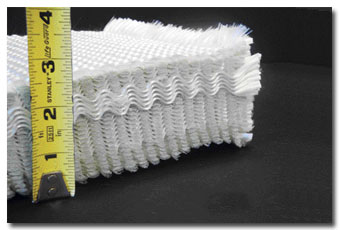
This close-up cross section of a thick 3-D woven glass billet shows the layer-to-layer weave
configuration.


Reviewing The Basics


Though composite applications are currently the primary use for 3-D woven products, there is
vast potential for future applications, both within the composites marketplace and in non-composite
applications as well. In an attempt to clarify and hopefully define what constitutes 3-D weaving or
a 3-D woven fabric, a brief review of traditional weaving might be helpful.

According to Wikipedia.com, “weaving is a method of textile production in which two distinct
sets of yarns or threads are interlaced at right angles to form a fabric or cloth.” And, as many
may recall from some weaving instructor in the past, the weaving process historically is defined by
repeating a basic four-step cycle:

  • Shed formation: An opening is created in the warp, or machine-direction, yarns for the weft, or
    filling, yarn to pass through. The subsequent shed changes create the weave’s pattern.
  • Weft, or filling, insertion: The weft yarn is inserted in the shed.
  • Beat-up: The weft yarn is beaten into the fell of the cloth.
  • Take-up and let-off: The resultant fabric is taken-up from the fell, and a corresponding amount
    of warp yarn is let-off to fill the void.

Successful repeats of this cycle result in the production of a woven fabric. Most people
tend to think of and recognize conventional woven fabrics as roll goods having a clearly defined
length and width, but very little discernable depth or thickness. In the composites marketplace,
primarily because of their lack of discernable depth, these traditional woven fabrics, while
possibly made from carbon, fiberglass, aramid, or any variety of combinations, are generally
understood to be two-dimensional, or 2-D, fabrics. 3-D fabrics are the same in principle as 2-D
fabrics, but possess a noticeable third dimension of significant depth or thickness created during
the 3-D weaving process.

3Dweaving2

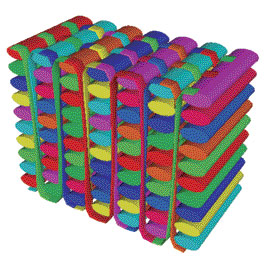
In an orthogonal, or through-thickness, weave, the weaving and connecting of lengthwise warp
and crosswise fill layers generate inherent through-thickness physical properties in the
fabric.


Adding A Third Dimension


The same basic four-step weave cycle applies to both 2-D weaving and 3-D weaving, but to
create the third dimension, additional warp yarns are manipulated into multiple layers. This
manipulation of the warp, with multiple layers woven in sync using extra filling insertions,
creates the fabric’s depth by weaving through the thickness — commonly referred to as
through-thickness. The through-thickness weaving and connecting of warp and fill layers generates
the 3-D woven fabric’s highly desirable and inherent through-thickness physical properties.

Generally, 3-D fabrics are produced on customized or purpose-built weaving machines, which
most likely incorporate a Jacquard unit to control the action of each warp yarn independently via
computer. The Jacquards used are heavy-duty, but similar to those found weaving carpets and
intricate home-furnishing fabrics. For most 3-D woven fabrics, the warp yarns are commonly woven
from a creel setup instead of from traditional loom beams. This setup affords the freedom for each
warp yarn to be tensioned individually throughout the weaving process. Individual tension of the
warp yarn is necessary, given that many are likely to travel different lengths while weaving
distinctive paths through the fabric’s thickness, compared with those of their respective warp
neighbors that may be weaving entirely different paths.


Combining recent improvements in weave design tools with individual tensioning and Jacquard
head control of each warp yarn not only creates numerous possibilities for the design engineer, but
also provides the freedom to incorporate a number of different yarns and yarn systems into the 3-D
woven structure. Theoretically, it is possible, though probably not practical, to use a different
yarn type for each of the warp ends in a 3-D woven fabric. It should be noted that in part because
of the extensive setup and yarn-handling requirements, 3-D weaving does result in relatively higher
weaving costs than traditional 2-D weaving. In many applications, however, the higher incurred 3-D
weaving costs can be offset by reduced lay-up complexity and material handling time, and improved
product performance.


Growing Range Of Possibilities


Given the fact that a design engineer now has access to vastly improved design technology
and the added depth component of a 3-D woven structure, a wide variety of simple to rather complex
shapes can be created. The growing array of 3-D woven fabric possibilities tends to fall into one
of two categories: billets and fabric panels; or complex near net-shape preforms.

Billets or flat panels of consistent thickness can be as thin as 0.125 inch (3 millimeters
[mm]) or as thick as 5 inches (125 mm) or more. When molded and shaped, these are used in various
applications in which delamination is a concern, as structural components and possibly as
replacements for heavier metallic versions. 3-D woven billets also are being evaluated in advanced
ballistic armor applications, in which their inherent resistance to delamination, improved damage
tolerance relative to 2-D laminated structures and significant weight savings show great promise.

Near net-shape preforms can have rather complex geometries tailored to specific applications
including airfoils, fan blades, radomes, tubes, bifurcated shapes, contours and structural cross
sections such as T’s, Pi’s and X’s. Many are made from ultra-high-performance fibers and used in
extreme high-temperature applications in which traditional metals are not able to withstand the
operating environment. Other applications include unique cross-section components that help to
improve joint strength for composite assemblies. For these applications, the flexibility of 3-D
weaving allows for the orientation and positioning of fiber paths that are more in line with
physical stresses, resulting in improved product design and efficiency.

It should also be noted that in many 3-D woven preforms, when compared to 2-D laminates,
there is generally a trade-off of in-plane strength for through-thickness strength. As a result,
each potential 3-D woven application should be evaluated specifically for that application’s
performance requirements. 3-D woven composite applications and their performance attributes will be
discussed in more detail in part two of this series, which will be published in the next issue of
Textile World.

Manufacturers of 3-D woven fabrics stand at the ready to assist engineers and developers
with new applications for 3-D weaving technology.


Editor’s note: Jim Kaufmann is a senior engineer at TEAM Inc., Woonsocket, R.I., specialists in
textile engineering and weaving fabrics and preforms from high-performance, difficult-to-handle
fibers including carbon, glass, aramids and ceramic fibers.


July/August 2012

Fibers Focus At Fabric Shows

In January and July, New York City fabric shows are offering new items for apparel. Fiber companies
are among the exhibitors showing innovations — and where to find them. At Texworld USA, held July
24-26 at the Javits Convention Center, Lenzing will focus on MicroModal®, with increased production
in the United States and Asia; and on MicroModal Edelweiss
(See ”
Edelweiss:
Eco Improvement For Modal® Fiber
,”
Textile World

, March/April 2012). Invista and FiberMax® cotton are two sponsors of the Kingpins Show
and its satellite show, The Continuum, held July 24-25 at Center 548; and Cotton Incorporated is a
Kingpins exhibitor.


Lenzing Fibers At Texworld USA


Lenzing AG, Austria, has expanded its reach. At Texworld USA, the company will have 41
exhibitors, including 10 from the United States. “We see an increased demand for Made in America,”
said Tricia Carey, merchandising manager, Lenzing. “Time, smaller orders and quality are some of
the contributing factors. And, we are working through the supply chain, from yarns to knitted
fabrics and finally to garments.”

Buhler Quality Yarns Corp., Jefferson, Ga., spinners of high-quality yarns, will feature
extra-long-staple cotton, MicroModal Edelweiss, and MicroTencel®. Rainbow technology will be on
display, with fabrics from Tricots Liesse, Montreal, showing different color depths that can be
achieved using this yarn. MicroModal and MicroModal/Supima® cotton slub yarns also will be
featured.

At Tuscarora Yarns Inc., Mount Pleasant, N.C., there will be both ring-spun and vortex yarns
of Modal/polyester. Vintage Modal triblends; and Modal/cotton heathers, mock twists and nubs are
among the choices.

Texollini Inc., Long Beach, Calif., has a wide range of fabrics knitted with Modal,
MicroModal, ProModal®, Tencel® and MicroTencel. The range goes from sheer tissue weights and
textures knitted on Texollini’s Superfino® equipment to heavy fabrics for activewear. And look for
new phase-change technology and Fire Stomp® featuring Lenzing FR®.
KA3

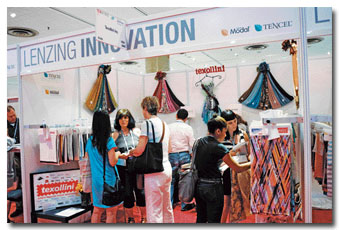
Texollini Inc. is one of 41 companies, including 10 from the United States, that will be
exhibiting as part of Lenzing Innovation at Texworld USA.


Design Knit Inc., Los Angeles, knits to order, from sheer to heavyweight fabrics. The company
can do lightweight sweater knits, novelty and basic fabrics made with cashmere, silk, wool, rayon,
cotton, linen, MicroModal, ProModal, Tencel or any other fiber. New fabrics are offered every
season.

At Mansfield Textiles Inc., Vernon, Calif., 60 new knitting machines are helping the company
renew its dedication to developing new textiles. Laguna Fabrics, Los Angeles, uses blends with
MicroTencel to create crepes, nep jerseys, streaky slubs and jacquards. At Los Angeles-based
Ecotex, it is about color and print.

FesslerUSA, Orwigsburg, Pa., produces knitted fabrics and garments. One new fabric is a
flame-resistant interlock containing Lenzing FR that is soft next to the skin and weighs in at 6.4
ounces
(See ”
Quality
Fabric Of The Month: Comfortable FR Underneath It All
,”
TW, May/June 2012)
. Others are jerseys, interlocks and stripes in blends of
MicroModal with Supima cotton and polyester. A 3.6-ounce cotton/MicroModal jersey has a very heavy
slub. A 3.1-ounce jersey slub with a bold stripe is knitted using a blend of Supima cotton,
MicroModal and polyester; and a 4.3-ounce heathered stripe also contains Supima cotton, MicroModal
and polyester.


Denim Trends At Kingpins


At Kingpins, Cotton Incorporated, Cary, N.C., will show results of its recent trend analysis
with Spain-based dyeing and finishing machinery manufacturer Jeanologia. Here, new methods have
been developed that are environmentally and cost friendly. Some involve laser-cut edging, ozone
washing to eliminate harsh bleaching, digitally printed denim to get the indigo hue without
stonewashing, and printing with realistic prints. Some of the prints include animals, dandelions,
exaggerated pinstripes and marbleized effects.

Cotton Incorporated also will show TransDRY® denim from Levi’s®, produced in Asia and sold
locally. The TransDry treatment pulls moisture through the fabric to help keep the body cool and
dry. And, there will be denim developments from Cotton Incorporated’s extensive fabric library
along with very explicit directions on how to weave or knit each fabric.
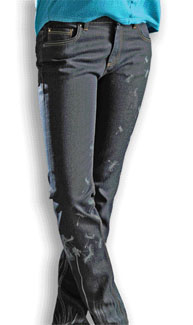
KA1


Photoscan is one of 10 directional denim inspirations combining fashion and sustainable
innovation developed by Cotton Incorporated and Jeanologia.

Bayer CropScience Inc.’s FiberMax brand, one of the sponsors of Kingpins, will show
customers fabrics and garments that have been made with its fibers. FiberMax is extra-long-staple
cotton grown in Texas.

Sustainability will be a topic at one of The Continuum seminars. “We will try to explain the
word ‘Sustainability,'” said Robert Antoshak, managing director of Kingpins organizer, Olah Inc. J.
Berrye Worsham, president, Cotton Incorporated, will be a seminar participant.

Wichita, Kan.-based Invista, also a Kingpins sponsor, has developed three themes around
denim. The first, Ecology, was developed in cooperation with Jeanologia. Here, innovative laser
printing and waterless washes are used to finish fabrics. Each is rated on a score from one to 100.
“One is the best score,” said Jean Hegedus, global marketing director — Bottoms. “Most of ours came
to about 16.

“We launched this project at Première Vision Denim,” Hegedus continued. “A fabric from
[China-based] Seazon Denim that was printed with a cable stitch pattern was well-received, along
with fabrics from Prosperity Textiles and Central Textiles [both based in Hong Kong].

“Our second theme is called Ethnic,” Hegedus said. “It includes a lot of bright colors and
prints.”

She pointed out jeans made in a fabric from C.D.I. (Color Denim International Ltd.), Hong
Kong, using yarn-dyed yarns rather than being garment dyed, ”so you see a lot of white,” she said.

Another fabric, from Tavex, Spain, contains LYCRA® dualFX®, which, Hegedus explained,
comprises two stretch fibers, Lycra for stretch and Lycra T400® for recovery.

Emerging is the third theme Invista will present. “Here, we did a lot of research in the
menswear market,” Hegedes explained. “We discovered that there is a lot of crossover between
sportswear and rugged activewear. Men want fabrics that are strong and abrasion-resistant,” she
said. TOUGH MAX™ Lycra provided the answer: It has toughness, resists abrasion and doesn’t add
weight. It contains Lycra T400. Some of the fabrics she pointed out are from Kaltex®, Mexico;
A.D.M. Denim, Pakistan; and India-based Bhaskar Industries Ltd. and Arvind Ltd.

July/August 2012

Kimbrell Receives BSA’s Distinguished Eagle Scout Award

W. Duke Kimbrell, Chairman of the Board, Parkdale Mills Inc., Gastonia, N.C., has received the Boy
Scouts of America’s (BSA’s) Distinguished Eagle Scout Award. The award acknowledges Eagle Scouts
who have achieved national-level eminence within their field and have maintained a strong record of
voluntary community service for at least 25 years.

BSA President and Exxon Mobil CEO Rex Tillerson, a past recipient of the award, presented
Kimbrell with a medal and plaque at an awards ceremony held at the Gaston Country Club in Gastonia.

Kimbrell began his career at Parkdale at the age of 14, when he was hired to do odd jobs for
company owner Bill Robinson. Following high school graduation and service in the Air Force during
WWII, he attended North Carolina State University’s School of Textiles and earned a textile
manufacturing degree. He then returned to Parkdale and was named CEO in 1961, and chairman in 1967.

The Piedmont Council Boy Scouts has established the Scout Camp Expansion Fund in honor of
Kimbrell. Parkdale Mills will match funds to help the Council reach its goal of raising $300,000.

July/August 2012

Sponsors