RHL Reports U.S. Investments In Its Calendering And Squeezing Equipment

United Kingdom-based calender roll manufacturer Richard Hough Ltd. (RHL) reports several U.S.
technical nonwovens producers have invested in its calendering and squeezing equipment this year.

Two companies — one in Georgia and one in South Carolina — each have installed two of RHL’s
Syncast™ polyamide-covered calendar rolls on their 230-inch-wide nonwoven geotextile lines. Syncast
rolls and sleeves are made using a highly elastic thermoplastic polymer developed specifically for
textile calender rolls, and are produced on a state-of-the-art centrifugal casting machine. Their
high degree of elasticity ensures minimal surface marking and shape distortion, good runability and
maximum service life, according to RHL. RHL supplies the roll covers in diameters of up to 1.25
meters and in face lengths of up to 7 meters.

RHL also reports a North Carolina-based producer of nonwoven surgical fabrics recently
purchased a second Roberto™ squeezing roll to provide the final squeeze on a 140-inch-wide
hydroentanglement line. Roberto rolls squeeze out liquids from woven, knitted and nonwoven fabrics;
and can provide improved performance compared with conventional rubber or polyurethane rolls,
according to the company. The rolls use a special microporous covering to remove the maximum amount
of liquid from a fabric, and reduce residual moisture by 30 percent compared with conventional
rubber rolls, resulting in substantial cost savings, RHL reports.

RHL’s U.S. representative, Burnsville, N.C.-based Ford Trimble & Associates Inc.,
assisted the company in procuring the contracts.

August 21, 2012
Uniquelami Installs Web Processing PUR Laminating Machine

Web Processing M/C Ltd. — a United Kingdom-based manufacturer of coating, laminating, flocking and
prepregging machinery for the technical textiles, composites, paper and plastics industries, and a
Cygnet Group company — reports that South Korea-based automotive interior textiles manufacturer
Uniquelami has installed a PUR reactive polyurethane laminating machine to manufacture performance
textiles for use in automotive seats and headliners. Uniquelami replaced its existing solvent-based
laminating system with Web Processing’s three-roll hot-melt lamination machine, which it is using
to laminate textiles to nonwovens.

The PUR machine utilizes a discontinuous application technique to apply the adhesive in a
series of fine lines, resulting in a strongly bonded, soft and flexible finished material that is
suitable for molded parts. The PUR adhesive reacts with moisture in the air to become crosslinked,
converting the material from a thermoplastic to a thermoset and giving it permanent strength
without requiring high temperatures or drying time.

According to Web Processing, the PUR lamination machine not only provides a stronger bond
than that created by conventional solvent-based laminating systems, but also is lighter-weight,
weighing 8 to 10 grams per square meter, and has a smaller footprint, featuring a compact
construction and 5-meter production line. In addition, the machine uses significantly less energy,
produces virtually no emissions, and can run with short changeover times from roll to roll.

“Web Processing’s machine allows us to produce high performance textiles that are not only
heat-resistant by easy to mould and permanently set, and increase production speed and volume by up
to 23 percent,” said Mr. Kim, managing director, Uniquelami. “The machine is enabling us to break
new ground in the car interiors sector with a product that surpasses anything else in the market in
terms of performance, resilience and value.”


August 21, 2012

Fiber Costs Drop

What a difference a year or so makes. Cotton quotes, which had skyrocketed in early 2011 to well
over $2 per pound, are now hovering in the low, well-under-$1-per-pound range. The latest U.S.
Department of Agriculture supply/demand estimates provide the details behind the huge decline.
Global production over the new 2012-13 marketing year beginning this month, for example, is put at
more than 115 million bales. That’s well above expected usage, which is targeted to reach only 109
million bales. Compare the two numbers, and it’s easy to see why stocks at the end of the marketing
year look to jump by nearly 9 percent — to more than 72 million bales. Equally important, this
means that the widely watched stock/usage ratio — a bellwether indicator of market trends -will
soar to near 66 percent at that time. That’s far above the low 40-percent reading recorded as
recently as 2009-10. Zero in on comparable U.S. numbers, and the picture is pretty much the same —
with the projected 2012-13 stock/usage ratio coming to 31 percent — more than double that reported
only two years earlier. Given all the above, it’s hard to justify any appreciable cotton price
recovery. To be sure, there could be a few rallies, but they’re likely to be modest and temporary.
Nor are any problems anticipated in the other major fiber area — man-mades. True, the government
price index here shows tags running some 4-percent ahead of a year earlier, but that’s hardly
earthshaking. Moreover, there are even a few areas of weakness. The polyester fiber reading, for
example, has slipped more than 3.5 percent vis-à-vis a year ago — with spun synthetic yarns off by
an even larger 6.5 percent. Finally, even wool quotes have tended to ease a bit compared to 12
months ago. In short, mill material costs are now pretty much under control.

BFgraph


The Bottom Line Impact


This changing material cost picture is also having a strong positive effect on the U.S.
industries’ financial health — primarily by lowering the proportion of the revenue dollars
earmarked for this key production input. Thus,

Textile World
figures show that during last year’s cotton price run-up, material outlays for companies
making basic products like fabric accounted for a hefty 74 percent of each revenue dollar. This
year, however, the figure is expected to slip to near 72 percent. And it’s pretty much the same
story for both more highly fabricated mill products like home furnishings and carpets, and apparel
-with last year’s 67-percent and 61-percent ratios each falling about four or five percentage
points. More importantly, these cost trends are expected to continue into next year.

TW
editors, for example, see material cost/revenue ratios declining even further in 2013 — to 62
percent for basic mill products, 44 percent for more highly fabricated mill items, and 45 percent
when it comes to apparel. These are clearly not insignificant declines. Indeed, they pretty much
support

TW
‘s feeling that industry profits and margins will improve not only in 2012, but in 2013
as well.


Some Thoughts On Prices


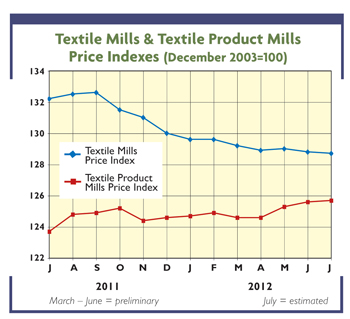
Prices, too, are contributing to overall industry optimism. One might think that recent
declines in production costs would lead to some pressure on buyers to lower tags. But so far,
there’s been precious little evidence of this happening. Indeed, quotes on some key sectors like
finished fabrics and apparel have actually continued to inch up. And again, all indications suggest
this pattern will persist through the foreseeable future. One key reason: Fairly solid domestic
demand is helping reduce the need for discounts and other price concessions. Note, for example,
that over the past year, purchases of home furnishings, carpets, and apparel have all outpaced
year-ago levels. Moreover, the positive demand impact on pricing is being reinforced by recent
small declines in domestic excess capacity — as production potential continues to shrink. Still
another price-bolstering factor: The gradual narrowing of the U.S.-overseas price gap. Other things
being equal, this is calculated to strengthen domestic producer pricing clout. Strong confirmation
of this shrinking gap comes from recent textile and apparel import price hikes — increases that
have tended to outpace any relatively fractional ones posted by domestic firms. Throw all of the
above into the computer hopper, and it suggests some modest upward revisions in

TW
‘s earlier 2012 price forecasts — with the following increases now projected: 3 percent or so
for basic mill products; 1 percent for more highly fabricated ones; and 1 to 2 percent for apparel.
And for 2013, odds still favor firmness, with, again, a chance of some modest advances.

August 21, 2012

People

Atlanta-based
Messe Frankfurt USA has named Kristy Meade group show director, Textile Events.

Brussels-based
EDANA, the International Association Serving the Nonwovens and Related Industries,
has elected the following officers of its 2012-2013 Board of Governors:
Patricia Featherstone, RKW, chair;
Gerd Ries, Johnson & Johnson, and
Jean-Marie Becker, Suominen Nonwovens, vice co-chairpersons; and
Paul Eevers, Unilever, treasurer.

Salem, Va.-based
Integrated Textile Solutions Inc. has named
Dan Swift to head business development; and has named
Raymond Wallen to its business development team to handle the company’s
military/government business.


PeopleSwift

Swift

The Hohenstein Institute, Germany, has named
Alexandra Hlawatsch manager, Down and Feather Test Centre.

Wakefield, Mass.-based
Sciessent LLC has named
Yanira Bugarin and
Meg McComb directors of business development, textiles.


The Woolmark Company
, Australia, has presented the International Woolmark Prize USA
Award to
Sophie Theallet.

The Dixie Group Inc., Chattanooga, Tenn., has appointed
Vinson Lee Martin president, Masland Contract; and
David Hobbs manager, Modular business.

Gainesville, Fla.-based
Quick Med Technologies Inc. has named
Bernd Liesenfeld, Ph.D., president and a member of the Board of Directors; and has
promoted
Roy Carr to vice president, business development; and
William Toreki to vice president, research and development.

The
Carpet America Recovery Effort (CARE), Dalton, Ga., has named
Robert Peoples, Ph.D., executive director.

France-based
Techtera has elected
Louis Vovelle, Bluestar Silicones, chairman of the Board of Directors.

San Francisco-based
Banana Republic has named
Narciso Rodriguez advisor.

Katy Jessee, Missouri State University, has won the ninth Project OR competition,
held at the
Outdoor Retailer (OR) Summer Market earlier this month in Salt Lake City.

Jennifer Mendez, vice president for government relations, The Carpet and Rug
Institute (CRI), Dalton, Ga., was awarded the
State Government Affairs Certificate, at the State Government Affairs Council
(SGAC) meeting held recently in Chicago.

Summerville, S.C.-based
Thrace-LINQ Inc. has promoted
Deatrick Doctor to process engineer and
George Lockwood Tupper IV to technical fabric sales support.

White Plans, N.Y.-based
GLM has named
John Erich sales manager, SURTEX®.

Carmel, Ind.-based
Top Value Fabrics has appointed
Kevin Kesselring to its print media sales consultant team.

PeopleKesselring

Kesselring

Hickory, N.C.-based
Balega International has appointed
Kay Martin president, Balega Outdoor.

August 2012

In Memoriam: William H. “Bill” Hills Sr.

William H. “Bill” Hills Sr., one of the great pioneers in the synthetic fibers extrusion industry,
passed away on August 10, 2012, following a brief illness. Hills was a chemical engineering
graduate of Worcester Polytechnic Institute. He started his professional career in 1955 with the
Chemstrand Corp. — which later became the Fibers Division of Monsanto Co. — where he served in
technical and management capacities involving areas such as nylon fibers, spunbond technology and
metal spinning. Hills left Monsanto in 1971 to become a founder of Hills R&D — which later
became Hills Inc. — in West Melbourne, Fla. Hills led the company in the development and supply of
advanced fiber extrusion systems until he retired in 1988, and until recently remained interested
in contributing to various technical projects at the company. Hills was the inventor in numerous
patents that significantly contributed to the advancement of technology and to the fibers
industry. 

Arnold Wilkie, president and owner of Hills Inc., said: “We are all grateful for having had
the opportunity to know and work with Bill over the years. He was a great leader and friend. His
personal contributions to our company, industry and world will live forever.”  

Posted on August 21, 2012

Source: Hills Inc.


Elbit Vision Systems Ltd. Received 600 Thousand Dollar Orders For Its New Inspection System Designed For Thin Glass Fabrics Used In Smartphones And Tablets

CAESAREA, Israel — August 20, 2012 — Elbit Vision Systems Ltd. (OTCBB:EVSNF), a leading global
supplier of vision inspection and process monitoring systems, unveiled its innovative, new solution
for thin, lightweight glass fabric inspection.

The glass fabric industry, which supplies the key component for printed circuit boards (PCB)
used in virtually all electronics, has recently experienced a product shift towards lighter weight
materials. This move was essential for the industry to better adapt itself to the new products in
the market, such as thinner and more advanced smart phones, tablets, and televisions. Over the last
few months, EVS has developed a unique solution for inspecting this new type of glass fabric during
the production process.

This innovative, new EVS product provides a defect map of the glass fabric, with images, and
creates a detailed report which includes instructions for precise, efficient cutting, maximizing
the yield of the material. EVS, which has already received a number of orders for this product,
expects a substantial increase of business from this market over the next few months, given the
industry wide switch to the new, thin glass fabric.

Sam Cohen, CEO of EVS, commented, “This new solution has given us a significant technical
advantage over our competitors, and positioned EVS as the industry leader in this new, lightweight
glass fabric inspection. The new cameras, which we first presented in September 2011, have allowed
us to fit our product to growing market demands. In this regard, market potential amounts to a few
million USD, and since our solution is quite unique, I believe it will be widely adopted.”


Posted on August 21, 2012

Source: Elbit Vision Systems Ltd.

X-STATIC Silver Antimicrobial Technology Provides Infection Prevention For Healthcare

SCRANTON, Pa. — August 16, 2012 — X-STATIC®, the silver-based fiber technology used widely by US
Military Forces, Olympic Athletes, NASA astronauts and hundreds of well-known consumer brands, is
now available to the healthcare textile industry.  Soft surfaces constitute 90 percent of the
patient healthcare environment and include privacy curtains, lab coats, scrubs, bed linens and
cubicle curtains. Clinical studies have proven these surfaces are highly contaminated by pathogenic
organisms, which have the potential to transmit to patients and cause healthcare associated
infections (HAIs). 

Healthcare associated infections take the lives of nearly 100,000 people annually and cost
billions of dollars in additional medical treatments. Although hospitals continue efforts to
improve infection control, standardized practices for soft surface bacterial management are
inadequate compared with those for hand and environmental hygiene. Further, laundering practices
are inconsistent and simply ineffective, as re-contamination occurs after laundered items are put
into use.

Textiles made with X-STATIC® silver antimicrobial technology have been clinically-proven to
inhibit the growth of bacteria directly on the surface of the fabric. X-STATIC delivers quick,
comprehensive and permanent protection with a continuous release of silver ions that lasts for the
life of the product.

“Soft surfaces represent a clear gap in everyday infection prevention practice,” said Peg
Luebbert, Infection Control Expert and Founder of Healthcare Interventions, Inc. “Hand
washing/sanitization is only effective until a healthcare worker touches a contaminated soft
surface through regular behaviors like opening a privacy curtain or retrieving a pen from a pocket.
For example, if a healthcare worker washes his/her hands and then puts those hands in a
contaminated uniform pocket before touching a patient, the risk of cross contamination still
exists.” 

Products made with X-STATIC antimicrobial technology also mitigate compliance challenges
because the healthcare staff is not required to change behavior or protocols. Luebbert adds,
“Antimicrobial textiles are “engineering controls” in OSHA terms. They minimize the risk of
contamination and exposure without depending upon safe work practices by the healthcare
staff.” 


Posted on August 21, 2012

Source: Noble Fiber Technologies LLC

Culp To Expand Mattress Fabric Business, Add 129 Jobs

High Point, N.C.-based Culp Inc. plans to expand its mattress fabrics business in Stokesdale, N.C.,
investing at least $450,000 to add cut-and-sew operations and adding 129 jobs. The company has
begun preparing a manufacturing facility across the street from its existing weaving facility in
Stokesdale and anticipates starting up the new operation this fall. The ultimate total investment
could exceed $900,000.

Culp comprises two divisions: Culp Home Fashions including knitted and woven mattress
fabrics, with manufacturing facilities located in High Point and Stokesdale as well as in Canada;
and Culp Upholstery Fabrics, with manufacturing located in High Point, China and Poland. The
company’s current workforce at its North Carolina facilities numbers more than 410 people.

The mattress fabrics business has grown over the last several years, from representing a
20-percent share of the company’s total business in 2000 to 57 percent in 2011. The company claims
to have the leading U.S. market share in both businesses and realized net sales of $254.4 million
in fiscal year 2012 — up 17.4 percent from 2011 and including $145.5 million in mattress fabric
sales, an 18.9-percent increase for the year in that business.

The new facility will produce mattress covers that will be marketed to Culp’s customers under
a joint marketing agreement with Chicago-based mattress cover supplier A. Lava & Son Co. The
facility will be wholly owned by Culp.

“This new venture, known as Culp-Lava Applied Sewn Solutions, represents a natural
progression of Culp’s mattress fabrics business as we continue to capitalize on growth
opportunities in more innovative product offerings,” said Iv Culp, president, Culp Home Fashions.
“We believe this new venture highlights our commitment to enhance Culp’s leadership position in the
bedding industry with an expanded and flexible manufacturing platform, supported by exceptional
design, superior customer service, reliable delivery performance and consistent quality and value.”

“We are very excited about this expansion and vertical integration for that area of our
business because it will allow us to be more responsive to customers and have a broader product
offering,” said Teresa Huffman, vice president, human resources, with responsibility for corporate
communications, Culp Inc. “We are looking forward to starting up the new operation this fall.”

The company has received a $82,560 grant from the One North Carolina Fund to assist in the
expansion.

August 14, 2012

Quick-Med Receives Expanded EPA Approval For Stay Fresh® Antimicrobial

Gainesville, Fla.-based Quick-Med Technologies Inc. has received an amended U.S. Environmental
Protection Agency (EPA) registration for its hydrogen peroxide (H2O2)-based Stay Fresh®
Antimicrobial — a nontoxic, cost-effective, durable technology that retains its efficacy on
textiles and other materials when subjected to a range of laundering conditions, according to the
company.

The amendment expands approval for use of the technology to 30 new sites, enabling its use
in products such as adhesives, aprons, backpacks, incontinence pads, lumber, luggage, shoe liners
and inserts, shower curtains, superabsorbent polymers, and wound dressings. It also addresses
treatment application levels based on an article’s intended use and provides for “ultimate”
durability, “standard” application and warehouse “inventory protection” rates.

In addition to textile applications including military uniforms, apparel and other consumer
textiles, Stay Fresh has potential applications for products such as medical devices. Quick-Med has
filed a 510(k) Premarket Notification with the U.S. Food and Drug Administration (FDA) for its Stay
Fresh Skin Fold Management Textile, a Stay Fresh-treated medical absorbent textile product designed
to provide moisture management as well as antimicrobial protection in order to prevent damage to
skin from abrasion within skin folds.

August 14, 2012

NSA Introduces FR Classic Cotton™ Knit Shirt Line

National Safety Apparel (NSA) — a Cleveland-based manufacturer of protective apparel for industrial
safety applications — has introduced a line of flame-retardant (FR) 100-percent cotton knit shirts
that offer a single-layer FR solution, eliminating the need to layer garments to combat arc
flash-related injuries.

FR Classic Cotton™ Knit shirts are soft, supple and breathable while also featuring an
increased arc flash protection of 12 small calories of heat energy per square centimeter — a
benchmark that comparable garments previously have been unable to reach, NSA reports.

The shirts are suitable for both indoor and outdoor wear, and are available in a range of
colors and styles.

August 14, 2012

Sponsors