
Textiles 2013: The Turnaround Continues

It’s been another tolerably good year for U.S. mills and apparel manufacturers. And barring the
unforeseen, there’s little to suggest otherwise, not only for the new year but also well into the
second half of the decade.

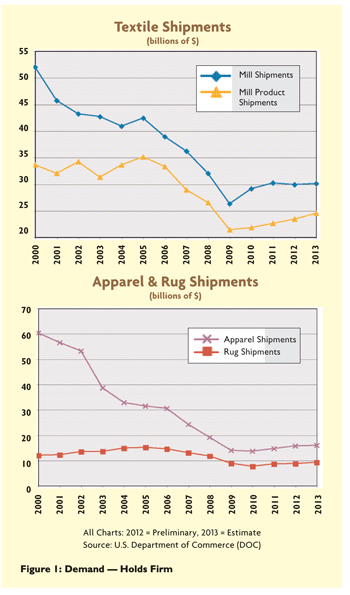
Domestic mill shipments, for example, should approach $54 billion to $55 billion in 2013 —
the fourth consecutive year that totals have held steady or inched ahead. And the same is likely
for apparel, for which the new year’s shipment total will approach $16 billion — more than a
double-digit percentage gain over 2010, when the industry hit its recession low.

Econfeature

Do the math, and all this adds up to a $70 billion to $71 billion textile and apparel
industry — not bad for a sector that many analysts were writing off as a lost cause as recently as
four to five years ago.

And the picture is even brighter when it comes to industry profits. Indeed, anticipated
after-tax earnings gains for 2013 are quite impressive — nearly double last year’s for textile
mills.

Nor are these projections based on just a lot of wishful thinking. Quite the contrary —

Textile World
‘s new numbers are solidly buttressed by an imposing list of positive signs, including:

  • An improving macroeconomic outlook: For one,

    TW
    feels that by avoiding a fall off the fiscal cliff, gross domestic product (GDP) — the
    economy’s all-inclusive measure of health — will advance another 2 to 2.5 percent, and probably
    approach the 3-percent rate by the following year. Moreover, once the 3-percent level is reached,
    there could be some meaningful progress in bringing down the still-uncomfortably-high domestic
    jobless rate.
  • Stronger consumer financing positions: Household debt payments as a share of after-tax income
    are at their lowest point in 20 years. Access to credit is also improving, and home refinancings
    have freed up a lot of additional cash for apparel and other consumer goods.
  • Substantial housing recovery: The huge construction decline stemming from the 2008-09 mortgage
    collapse is beginning to reverse itself — with new starts up significantly over the past few
    months. This is not an unimportant shift, as construction accounts for a sizable portion of textile
    sales as well as U.S. employment and GDP.
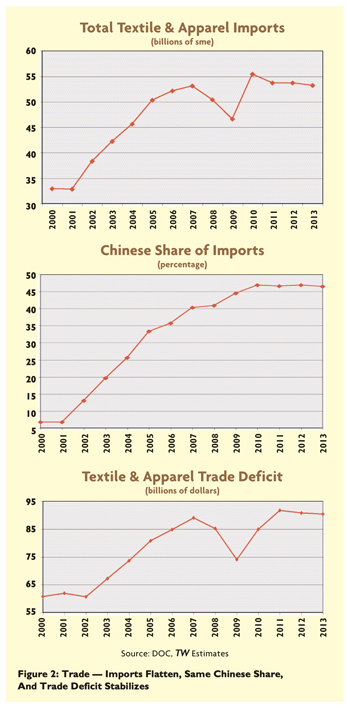
  • Leveling imports: This past year’s flat pattern of incoming textile and apparel shipments,
    following the previous year’s small decline, would seem to confirm that earlier big U.S.-foreign
    price differentials may be starting to narrow a bit.
  • Improved industry strategies and planning: These would have to include increased management
    emphasis in such areas as sourcing, inventory control, use of more flexible and efficient machinery
    and equipment, new and upgraded consumer products, more ecologically friendly offerings, and more
    Made-in-USA labels. More on all these production and marketing strategies below.

To be sure, there’s always a chance that an unexpected factor — a war, a euro crisis or
continuing Washington political squabbles — could dim the above scenario. On the latter score,
however,

TW
feels that chances of any major economic shock are relatively small. Nevertheless, these
uncertainties should serve as a reminder that close monitoring and periodic reviews should continue
to be the order of the day.

With all the above in mind, here’s a more detailed look at what

TW
sees ahead, both for the new year and beyond:


Demand Holds Firm


As noted above, dollar shipments of textiles and apparel will on the whole match or even
inch a bit above last year’s levels. But there could be some differences among the industries’
various subsectors. Mills making basic products like fibers and fabrics, for example, aren’t
expected to do much more than match their 2012 performances.

On the other hand, mills specializing in more highly fabricated products like rugs, home
furnishings and industrial products should rack up some modest gains. This is most likely in the
carpet area, as an improving construction market beefs up demand. Given this prod, rug and carpet
shipments could rise about 5 percent or so in 2013 — reaching their highest level since 2008.

And there are indications this recovery could continue for at least another few years. Based
on one research firm’s projection, floor coverings can expect close to an 8-percent annual rate of
growth in square-foot terms over the 2010-15 period, with tufted carpet and rug products —
especially broadlooms — sparking the advance.

Meantime, another solid year of auto sales will help mills making automotive interior
fabrics. This is an important market, too. According to one recent estimate, well over 20,000 tons
of textiles are needed for upholstery, headliners and door panels. Moreover, this doesn’t include
significant amounts going into such areas as carpets, floor mats, tire cord, molded parts, seat
belts and even airbags.
Econshipments

Add in other industry usages, and overall U.S. shipments of fabricated mill products could
rise by upwards of 4 percent — making for a second straight year of solid growth.

The outlook for apparel also doesn’t seem to be all that bad. The fact that recent holiday
sales managed to post a small gain in the face of today’s uncertainties suggests consumers are
becoming more willing to spend on new clothing after several years of what can only be described as
penny-pinching on wardrobes.

Another positive factor here: Men are becoming more clothes-conscious, with 2012 sales of
those items up by 2 to 3 percent. And, in the case of men’s outerwear, the increase has been near 6
percent. This is a lot more substantial than the only fractional gains reported in womenswear —
and, if nothing else, suggests an added plus for overall U.S. apparel purchases.

Still another upbeat sign for clothing manufacturers is the fact that imports of those
products have been leveling off. Indeed, incoming shipments of clothing actually fell some 2
percent over this past year. Couple this with the just-discussed better consumer buying outlook,
and there’s a better-than-even chance that 2013 shipments of domestic apparel could again show a
small gain.


Import Penetration Slows


Several factors could be contributing to the above-noted apparel import slowdown — which is
also having a braking effect on incoming shipments of textiles. Probably one of the most important
is the fact that foreign producers have already picked most of the low-hanging fruit. Or put
another way, there are now few vulnerable markets left to capture.

But rising overseas costs could also be playing a major role — especially when it comes to
China, which at last report was supplying a hefty 46- to 47-percent of all U.S. textile and apparel
imports.
Econimports

More important, Chinese production costs are likely to continue rising over the next few
years. A recent survey by the Boston Consulting Group (BCG) involving more than 100 large U.S.
manufacturers — including some textile and apparel firms — pretty much tells the story. One key
projection: more sharp price increases — enough to erode Beijing’s position as the world’s low-cost
provider.

The research outfit, in detailing the changing Chinese competitive position, also notes the
following:

  • More than one-third of surveyed companies now are either planning or actively considering the
    reshoring of some of their China production back to the United States.
  •  Beijing sourcing is a lot more costly than simple per-hour labor cost comparisons would
    seem to indicate — primarily because of much higher U.S. productivity.
  • There are other intangible advantages for reshoring — including product quality, proximity of
    customers and ease of conducting business.

Still another key BCG prediction is that by the current decade’s end, the narrowing
U.S.-Chinese price gap should both create two million to three million new American jobs and reduce
the U.S. jobless rate by some one to two percentage points.

Research by The Hackett Group, another consulting firm, pretty much backs up BCG’s
conclusions. As The Hackett Group puts it, “the tide has begun to turn on the flow of manufacturing
jobs from the U.S. to China and other low-cost countries.

“Some companies are already reshoring a portion of their manufacturing capacity and this
trend is expected to reach a crucial tipping point over the next 2-3 years as the total landed cost
gap between the two nations continues to shrink, driven in part by rising wage inflation in China
and continued productivity improvements in the U.S.”

In any case, reshoring is expected to become more viable with each passing year as the total
landed cost gap for imports shrinks. The Hackett Group finds that the cost gap between the United
States and China has shrunk by nearly 50 percent over the past eight years. It’s expected to stand
at just 16 percent this year — with the trend driven by rising labor costs in China as well as
rising fuel and shipping costs.

But despite all this, it would be unrealistic to expect any big return to domestic textile
and apparel sourcing. For one, even if there is some decline in sourcing from China, it would
probably be replaced by a substantial shifting over to other low-cost foreign suppliers. Indeed, a
fair amount of this switching is already occurring.

Secondly, China is now taking some corrective steps to counter any wholesale loss of its
U.S. customer base. In many instances, for example, the Chinese are stepping up their purchases of
more automated, labor-saving equipment. Equally important, the rise in the value of Beijing’s
currency, the yuan — something which tends to boost the price of Chinese products — has stalled,
with little indication of any change over the next few years.

Bottom line:

TW
‘s import projections for 2013 point to a basically flat pattern — with only an outside
chance of some fractional decline. On a brighter note, however, that should be enough to leave the
incoming total some 4 percent under the 2010 all-time high.

There’s also a modicum of good news on the export side of the trade equation — with outgoing
textile and apparel shipments moving up in 2012 for the third consecutive year — enough to bring
totals some 36 percent above the 2009 low point. And another modest increase seems likely for 2013.
Couple this with the basically flat import level anticipated for the new year, and it should make
for the second straight year of small declines in the U.S. textile/apparel trade deficit.


Changing Production Potential


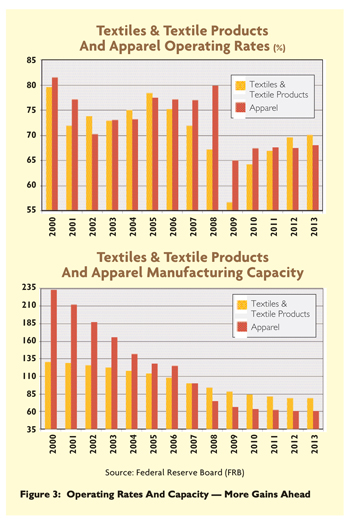
Meantime, the relatively improved demand outlook referred to above is helping to slow down
the past few years’ slide in textile and apparel production capacity. Indeed, domestic mill
production potential at last report was slipping at only a 2-percent annual rate. That’s well under
the near-5-percent pace of the recent 2003-10 period.

Changes are even more dramatic in the clothing sector, where the capacity decline has slowed
down to only about 1 percent a year. That’s far under the near-6-percent annual tumble noted in the
early 2000s.

Credit two factors for this flattening out in domestic production capacity. One, as just
noted, is the encouragement to invest, fostered by a somewhat brighter demand outlook. But an
equally important contributor has been growing competitive pressures — pressures necessitating more
investment in new, more efficient capacity or the facing of additional losses to foreign suppliers.

How much, then, are U.S. domestic firms spending? Preliminary evidence suggests a pretty
impressive sum — probably upwards of $1 billion a year. That’s pretty much what they were shelling
out a decade ago, when the market potential was much larger.

Nevertheless, despite the magnitude of these outlays, there’s still no surefire guarantee
that this strategy can recapture any sizable part of domestic firms’ lost markets. That’s primarily
because foreign suppliers, facing their own cost and competitive pressures, are also stepping up
their capital spending.
EconOperatingRates

A recent study by research outfit Global Industry Analysts Inc. would seem to confirm this
worldwide investment uptick. That company sees the global market for textile machinery growing to a
hefty $23 billion by 2017. It attributes all this spending to a shift from conventional machinery
requiring the availability of cheap labor to more sophisticated equipment that can produce better
and cheaper products. In short, producers around the world are increasingly seeking automation
solutions in their efforts to hold onto or even expand their markets.

One thing for sure, textile and apparel operations are going to look a lot different in just
a matter of a few years — with production and distribution not only becoming more efficient, but
also a lot more flexible, allowing for both smaller and faster deliveries.

This latter development, in turn, could further facilitate the ongoing trend toward
inventory retrenchment. That’s something that would also bolster bottom-line performance inasmuch
as industry stocks in factories and warehouses constitute one of the industry’s major cost drains.

Still another point to make on the changing face of capacity: This ongoing capital
investment should also provide the industry with a better green footprint. Clearly, all the current
new equipment and that expected to come onstream in the near future will reduce air and water
pollution. And, as an added ecological plus, this modernization drive includes the opening of a
spate of new recycling facilities to convert textile waste into new textile uses and resins.

Finally, before leaving the subject of investment, it’s important to keep in mind that all
the new spending will keep factory utilization rates low — as the opening of new, modern plants
offsets the retirement of older ones. This, in turn, means that operating rates for both textiles
and apparel should remain stuck in the low 70-percent range.

Unfortunately, those rates are well under preferred rates. In fact, they’re so much under
that they would seem to guarantee a continuation of the sharp price competition that has
characterized all segments of the U.S. industry for more than a decade now.


Labor Costs And Productivity


It’s also worth noting that anticipated increases in industry efficiency, when combined with
only minor hourly pay boosts, should help keep unit labor costs under control. In fact, that’s been
the case for several years now, and there’s little to indicate any near-term change.

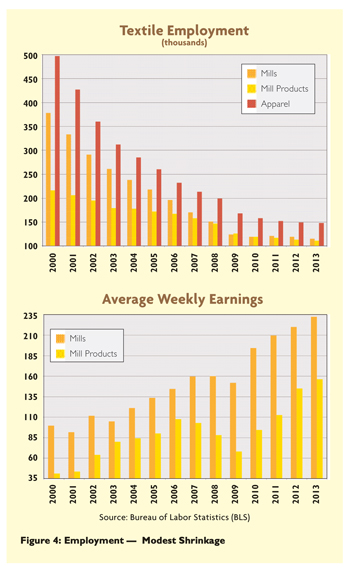
A few key industry statistics tell the story here. This past year, textile mill pay hikes
averaged out at only 2 to 3 percent. But productivity — measured by comparing the number of workers
to the amount of product turned out — has been rising by a slightly higher 3-percent-plus rate. The
implication is clear: Mill labor costs to produce one unit of output have actually been edging a
bit lower.
Econemployment

Moreover, as far as productivity is concerned, the 3-percent-plus annual rate of increases
in efficiency seems all but certain to continue. And, make no mistake about it, that’s a pretty
impressive number. Indeed, it’s a full percentage point above the productivity gains that
government forecasters see for all U.S. manufacturing over the same time span. In short, domestic
mills could well be outperforming the overall economy as far as efficiency gains are concerned.

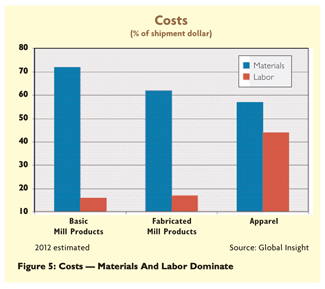
This is especially important for U.S. mills, where labor accounts for a significant share of
the typical textile sales dollar. Based on figures supplied to

TW
by economic consulting firm Global Insight, for example, labor’s share of the mill sales
dollar comes close to 16 to 17 percent.

The same pattern is apparent for apparel. Indeed, labor is an even more important factor
here, draining upwards of 40 percent of the typical apparel manufacturer’s sales dollar.

But holding these costs down through efficiency gains can also have a negative impact —
namely, a smaller industry workforce. In the textile sector, for instance, squeezed by productivity
gains, overall employment should drop from 232,000 in 2012 to near 209,000 by 2015. The only
consolation is that the annual decline comes to only about 3 percent — far lower than the tumbles
of earlier years.

The picture is much the same for apparel, where similar job declines are expected — bringing
that workforce down by another 11,000 over the three-year period ending 2015.

All told, this means the United States’ total textile and apparel job number will drop to
near 350,000 by 2015. Go out another five years to 2020, and the overall number drops further, to
285,000 workers.

But that’s still a relatively significant number. According to the National Council of
Textile Organizations, for example, each single textile job supports as many as three other U.S.
workers.


Other Costs


As important as labor costs are to maintaining mill health, they pale when compared to the
other big cost drain: fibers and other material purchases. Thus, last year — when material costs
skyrocketed — some 72 percent of the sales dollar for companies making basic mill products was
needed to cover these expenses. And the material cost bite for outfits making more highly
fabricated mill products like carpets and home furnishings was an almost-as-large 62 percent.

What happens here can make a tremendous difference as far as bottom-line performance is
concerned. And

TW
‘s projections here are basically upbeat. Looking first at cotton, which has been backing and
filling around the 70-cents-per-pound level for more than six months now, there’s little sign of
any real firming. Indeed, tags could well inch lower in face of current glutted market conditions.
Econcosts

A recent U.S. Department of Agriculture outlook study makes this oversupply crystal clear.
Put simply, it points out that with global production continuing to outpace global consumption,
world ending stocks of the fiber should rise substantially.

As for the specifics, global cotton use during the current crop year is put at 106.3 million
bales. That lags global production estimates, which are put at 116.8 million bales.

Result: Global stock levels by the end of the marketing year should jump to 80.3 million
bales. Zero in on the stocks-to-use ratio — a key cotton price barometer — and this year’s jump is
even more impressive — from 67.5 percent in 2012 to 75.5 percent for the current marketing year.

The other natural fiber, wool, also doesn’t seem to present any problems. Weak demand and a
lack of orders have pushed quotes down significantly since last spring.

More importantly, chances of any appreciable wool price run-up are practically nil — at
least not before late 2013 at the earliest. For one, a far-from-robust economy will limit any
demand gains. Then, too, wool growers have had to contend with the historical volatility of prices,
something that continues to convince some users — especially carpet makers — to switch over to
man-mades like polyester.

As for man-mades, prices here also have been a bit soft of late, largely reflecting recent
declines in petrochemical feedstock costs. As a result, man-made averages have slipped and are now
actually fractionally below where they were a year ago.

To be sure, there are also other costs to consider like transportation. True, they have been
rising, as have administrative expenses. But when all production and distribution costs are added
up, overall cost increases have been and should remain modest.


No Big Price Boosts


These relatively benign cost pressures should, in turn, help keep a lid on prices. Indeed,
there’s precious little to indicate anything more than a continuation of the extremely low textile
and apparel inflation rates of the past few decades.

Actually, the United States’ two industries have shown smaller increases than those recorded
in most other domestic manufacturing sectors for a long time. Overall, the long-term textile and
apparel average advance comes to less than 2 percent a year.

That’s pretty much an across-the-board pattern, too — with fibers, greige goods, finished
fabrics, industrial fabrics, home furnishings, and carpets all sharing in this slow creep-up. And
the same holds for apparel. In fact, the typical long-term annual advance in clothing tags has been
an exceptionally low 1 percent. Nor is all this likely to change any time soon. All signs point to
more of the same for this year, with the boosts likely to be even less than those posted in 2012.

One exception here could be for rugs and carpets. Here,

TW
doesn’t rule out somewhat larger price hikes — primarily because housing should be a lot more
robust than it has been. But even here, no really big increases are anticipated.

Costs, of course, aren’t the only reason for all this price restraint. There’s also excess
capacity — abroad as well as in the United States — an excess that’s likely to foster strong price
competition for what is essentially limited demand.

If there’s any doubt of the glut here in the United States, look back to the previously
noted low 70-percent operating rates that now seem almost sure to continue into the future.

The fact that the glut is across the board also suggests strong inter-subsector pressures.
What happens in one area, for example, can have an impact on another. Clearly, the harder it is for
clothing manufacturers to post hikes, the more likely they are to resist price boosting attempts on
the part of their mill suppliers.


Profit Gains Ahead


But despite the lack of any meaningful price hikes, earnings and profit margins should
continue to post solid advances. Credit the gains to a combination of factors — the better cost
picture alluded to above, some modest uptick in demand, and stepped-up industry efforts both to
hold onto existing markets and to develop new ones.

In any event, this stronger profit picture is already becoming evident. Thus, Uncle Sam’s
latest — third-quarter 2012 — estimates show overall textile mill earnings for that three-month
period rising to $521 million, some 35 percent above the year-earlier numbers.

Apparel manufacturers also fared well. Here, the third-quarter 2012 after-tax take came to
$2.3 billion — a fair-sized 9-percent jump over the comparable year-earlier level.
Econprofits

A similar picture seems to be shaping up when it comes to both textile and apparel margins.
Specifically, third-quarter 2012 after-tax earnings per dollar of sales also have increased
vis-à-vis a year earlier — from 3.9 percent to 5.4 percent for mills; and from 8.8 percent to 9.8
percent in the apparel sector.

Look at another margin yardstick — after-tax earnings per dollar of shareholder equity — and
the numbers are even more impressive. For mills, the comparable year-to-year advance is from 9.8
percent to 12.8 percent. For apparel, it’s from 12.4 percent to 23.4 percent.

Unfortunately, government forecasts for the next few years are not available. But

TW
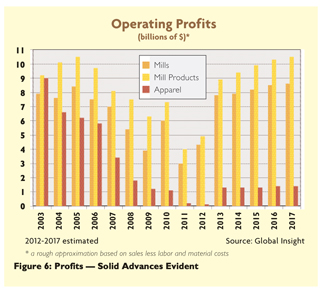
does have some estimates, courtesy of Global Insight, whose analysts, using their rough and
dirty estimate of profits — shipments less labor and material costs — see the 2012 earnings uptrend
continuing for years.

Dividing the mill sector into its two major subgroups, Global Insight projects a sold
earnings rise for both areas. For basic mill products, the earnings jump is from $4.3 billion last
year to more than $8 billion by 2015. As for the other subgroup — more highly fabricated products —
totals are expected to rise from $4.9 billion last year to just over $10 billion by 2015.

The most impressive gain, however, should be in apparel — primarily because recent earnings
have been depressed, as manufacturers were forced to work off all the expensive cotton they had
rushed to purchase during the fiber’s 2010 run-up. But that’s now about to change, with last year’s
near break-even level jumping to well above $1 billion profit levels over each of the next few
years.

Finally, a few words on all these rising dollar profit estimates. While clearly moving in
the right direction, there’s absolutely no way earnings will ever again approach the much larger
numbers of the past decades. The industry has shrunk much too much to permit any such bounceback.
As such, margins — relative rather than absolute earnings measures — should provide a much better
idea of the U.S. textile and apparel industries’ overall financial health.


More And Better Products


Meantime, U.S. companies have been increasingly active in their efforts to innovate and
improve. It’s a big part of a strategy to keep their firms not only viable but also profitable in
today’s hotly competitive global marketplace.

It’s an approach that potentially can pay handsome dividends. For one, there’s probably no
better way to whet consumer appetites.

Secondly, new, upgraded offerings generally command higher markups as well as increased
sales volume. A spokesman from market research company NPD Group, emphasizing the markup factor,
notes that much of the strength in dollar sales these days can be traced to consumers who, after
years of penny-pinching, are willing to splurge for something a little different or a little
better.

Not surprising, then, each year, the number of such premium products hitting the market
grows larger and larger. They cover virtually every segment of the market — including fibers, woven
and nonwoven fabrics, clothing, carpets, new industrial applications, and even garments embedded
with electronic components.

Putting the spotlight on fibers first, the innovations more often than not are being sparked
by new chemical breakthroughs, like recently developed new additives that help both degrade stains
and kill bacteria on cotton and other fibers when exposed to light. It could well point the way to
a market for self-cleaning clothes.

New antimicrobial technologies, meantime, can now also easily be integrated into nylon and
polyester polymers. The big selling point: lowering infection rates in such hospital items as
privacy curtains, linens, scrubs, and doctor coats.

And the list goes on and on, with still another chemical innovation aimed at blocking
ultraviolet light. The technique is already being applied to clothing and accessories like shoes
and umbrellas — with offerings available from such big outfits as Gap, Izod and Lands’ End.

Move over to apparel, and the picture is equally impressive. Washable and wrinkle-free
products are now more the rule than the exception. And the touting of these and other attributes is
no longer limited to one particular fiber or fabric. Makers of cotton, wool, man-mades and blends
now emphasize their products’ pluses in such areas as thermal regulation, moisture-wicking,
antimicrobial control, insulation, durability, water repellency, breathability, comfort and
biodegradability.

A few words are also in order on the increasing development and availability of so-called
advanced textiles. There’s now increasing potential for their use in aviation, automobiles,
military equipment and law enforcement.

Consumer goods aren’t being forgotten here either. One example is new apparel that
incorporates such extra features as conductive threads, sensors, batteries, and even small
microprocessors. Also coming are T-shirts that can shoot full-light videos or use GPS to point a
traveler to his/her destination.


Other Strategic Moves


While all of the above innovations have clearly played a major role in keeping U.S. textile
and apparel companies healthy, they are not the only factors behind recent successes. Given today’s
rapidly changing world and business climate, there’s a lot more that can be done — especially in
areas like sourcing, supply chain management, ecology, government help, development of niche
products, and improved quality.

Some of these subjects have already been touched upon. But some additional comments are
needed on a few of them. As for supply management, there’s the increasing need to keep inventories
and, hence, inventory carrying costs as low as possible.

The basic message from virtually every company’s CEO is the same: Keep stock levels low.
Worry less about long-term order problems and more about being lean, flexible, and in tune with
ever-shifting consumer wants and needs. In short, put more emphasis on stronger supply chain
networks — those that allow for low inventories and quicker reaction times to ever-changing market
demands.

A lot more attention is also being given to ecological demands. And with good reason: A
recent Cotton Incorporated survey finds more than two-thirds of U.S. consumers are now bothered if
they find that an item has not been produced in an environmentally friendly way. Most of these same
people also tend to blame the company making the product.

Not surprising, water conservation often gets the most attention, as a growing number of
technologies emerge that reduce both the amount of water needed and the discharge of wastewater
into the environment.

Also worth noting is industry group the Sustainable Apparel Coalition’s Higg Index, which
allows brands, factories and chemical manufacturers to score the relative sustainability of their
products. Eventually, the index aims to provide the data to consumers, perhaps on clothing hangtags
or websites.

An impressive number of large companies are already starting to use the index to measure the
effects of their fabric choices, pattern-making and waste products. Brands can get points for
asking consumers to wash items in cold rather than hot water — as Levi Strauss & Co. does — or
using recycled components like polyester made from used plastic bottles.

In another area, domestic firms are being helped by having Uncle Sam be more proactive in
protecting against unfair foreign competition. More steps are needed like the recent Washington
decision to participate in Chinese-Mexican talks on unfair Beijing subsidies.

Other moves involve the protection of intellectual property. This is something that can
likely help the U.S. industry, as 5 percent of all complaints here have been in the clothing field.

Free trade pacts can also contribute to industry well-being. At the moment, there are
negotiations to establish a Trans-Pacific Partnership involving Pacific Rim countries. This is in
addition to the 46 already existing free trade agreements.

Still more trade help could be coming from the U.S. National Export Initiative program
started a few years back. It could be one reason why U.S. outgoing shipments of textiles and
apparel have sported double-digit gains over pre-initiative levels.

Another approach that’s paying off is the development of more niche products. Big domestic
outfits like Milliken & Company, for example, have gradually been diversifying out of
traditional textiles and into specialized markets. Result: These companies’ revenues and profits
have been climbing.

In another marketing tactic, there’s the stepped-up emphasis on quality. It’s clearly
something that consumers want, if a recent Cotton Incorporated survey is any indication. Note that
respondents rated “higher quality” twice as important as “more fashionable” when choosing a new
garment.

Domestic producers are also bolstering demand by stressing that their products are made here
in the United States. Again, a relatively recent survey, one indicating that nearly 90 percent of
buyers prefer to support the U.S. economy, would certainly seem to justify this approach.

To sum up: If there’s anything that best characterizes all the above strategies, they’re the
words “flexibility” and “change.” The good old days of just maintaining the status quo are gone.
The big winners from here on will be those companies willing to move quickly and decisively when
new or innovative opportunities present themselves.

And indeed, judging from all the evidence, that’s becoming more and more the mind-set of the
U.S. industry.  In fact, that’s one of the key reasons why

TW
is so confident that the firming demand and rising profit trends of the past few years will
continue through the foreseeable future.

January/February 2013

United States Trade Representative Ron Kirk Announces Plans To Depart In Late February

WASHINGTON — January 22, 2013 — Ambassador Ron Kirk today announced that after nearly four years of
service as United States Trade Representative, he intends to depart the position in late
February. 

“It has been no less than my greatest professional privilege to serve President Barack Obama
alongside the dedicated professionals of USTR,” said Ambassador Kirk.  “Together, we have made
great strides to bring about the President’s vision of a more robust, responsible, and responsive
trade policy that opens markets to products stamped ‘Made-in-America’ and enforces Americans’ trade
rights around the world – and does so in a way that is more consistent with America’s core values
on issues like the rights of workers and the environment. 

“In President Obama’s first term, trade has been a major part of this Administration’s
efforts to support American jobs right here at home.   I am proud of USTR’s contribution
to America’s ongoing economic recovery.”

A full biography of Ambassador Kirk can be found here
<http://www.ustr.gov/about-us/biographies-key-officials/united-states-trade-representative-ron-kirk>.

Among the hallmarks of the last four years at USTR have been the completion, passage through
Congress, and implementation of long-pending trade agreements with Korea, Colombia, and Panama; the
launching and significant advancement of the Trans-Pacific Partnership trade negotiations; the
revitalization of American trade enforcement and the standing up of the Interagency Trade
Enforcement Center (ITEC); the U.S.-led “turning of the page” at the World Trade Organization to
revitalize Members’ work in Geneva, including the exploration of a new International Services
Agreement and negotiations toward expansion of the Information Technology Agreement and an
agreement on trade facilitation; the renewal and strengthening of Trade Adjustment Assistance; the
termination of the Jackson-Vanik amendment’s application to Russia and the full application of the
WTO agreement between Russia and the United States; and the renewal of the Generalized System of
Preferences and the Andean Trade Preferences Act.   

A broader review of USTR’s latest activities across the spectrum of U.S. global trade can be
found by clicking here
<http://www.ustr.gov/about-us/press-office/blog/2012/december/weekly-trade-spotlight-ustr’s-2012-year-review>. 


Posted on January 28, 2013

Source: USTR

Ten New Laureates For The JEC Europe Innovation Awards Program In 2013!

PARIS — January 28, 2013 — This year, 10 companies and their partners will receive an awards at JEC
Europe – Composites Show and Conferences (March 12-14, 2013) for their composites innovations. The
jury has selected the best composite breakthroughs, based on their technical interest, market
potential, partnerships, financial & environmental impact and originality. The decision to give
prominence to these projects was based on their atypical nature and various noteworthy aspects.

In 2013, the winners were selected from the following categories: Raw materials,
Thermoplastics, Multifunctional materials, Machining & Tool, Building & Construction,
Aeronautics, Automotive, Wind Energy, Sports & Leisure and a Special prize.

The JEC Innovation Awards ceremony will take place on Tuesday March 12 at 5:00 pm on the JEC
Show (at the Agora) and will be open to all exhibitors and visitors.The ceremony is sponsored by
CYTEC, JEC Composites Magazine, Aviation Week and Innovation & Industrie.

Category: Raw materials

Winner: BAC2 Limited (UK)

Name of Product or Process: A new family of latent acid catalysts to make
pre-polymeric mixes easier to store, transport, handle and process.

Description:The development of the CSR family of latent acid catalysts was driven
by the desire to make pre-polymeric mixes easier to store, transport, handle and process during
product manufacturing. Without a latent catalyst to control polymerization, the storage life of
pre-polymeric mixes may be anything from a few seconds to a few minutes. Other catalysts that
extend storage life are available. However, they typically require temperatures above 200°C for
activation, something that is both energy-hungry and impractical with many of the materials
involved in manufacturing processes that utilise resins. Bac2 developed the CSR family of latent
acid catalysts to address the above issues. The key innovation was to develop a family of products
that activate between 50°C and 120°C, depending on the application and the speed of cure required,
enabling them to be used with many materials and processes. Critically, the catalysts do not have a
detrimental effect on the mould flow or other characteristics of the resins with which they are
used. Originally developed for use with Bac2’s electrically conductive ElectroPhen polymer resin,
the CSR family of catalysts has since been expanded to include formulations that retard and control
the curing of phenol-formaldehyde resoles, furan resins, urea and melamine formaldehyde resins.

Using CSR catalysts, the storage life of pre-polymeric mixes has been extended to over 3
months, simplifying storage, transportation and materials handling. Process efficiency improvements
of 130% have been demonstrated in pultrusion. In SMC and BMC processes, room-temperature storage
life is extended to several months. CSR catalysts also enable the manufacture of inherently
flame-retardant mouldings by facilitating the production of stable phenolic and furan-based
pre-polymeric mixes.

Bac2 estimates the potential global market for its latent acid catalysts to be at least £100
million. The company has identified 3 primary sectors where the innovation offers the greatest
benefits:

1. During the manufacture of wood products such as MDF, particle board and plywood, high
temperatures are used to cure the resin used for bonding the materials and to drive out moisture.
Using CSR reduces the cure time, reducing the time during which the high temperatures need to be
maintained. This in turn reduces the energy consumption and cost.

2. In abrasives manufacture, the overall temperature of the manufacturing process is reduced,
saving energy and cost.

3. In the manufacture of sheet or bulk moulded composites, for which there are applications
in everything from interior fittings in transportation to seating for stadiums, CSR can be used to
produce inherently flame-retardant products at lower temperatures than previously possible.

Category: Thermoplastics

Winners: MVC (Brazil) & Arkema (France)

Partners: PPE (France), Chomarat (France), 3B-the fibreglass company (Belgium)

Name of Product or Process: An innovative transportation concept using a
revolutionary thermoplastic composite resin solution.

Description: Altuglas® composite resin solutions are innovative (meth) acrylic
formulations developed within a research and development partnership between Arkema and PPE. These
formulations can be used to produce (meth)acrylic thermoplastic composites reinforced with
continuous glass, carbon or flax fibres with the same low-pressure processes and equipment as those
currently used to produce thermoset composite parts. The resulting (meth) acrylic thermoplastic
composite parts show mechanical properties similar to those of parts made of thermoset materials
while presenting the major advantages of being post-thermoformable and recyclable and offering new
possibilities for composite/composite or composite/metal assemblies.

“Sofia Project – An innovative transportation concept”: The project consists in developing a
new technology for the construction of bus, train wagon, van and car bodies in an innovative and
sustainable way. The final product will be an “assembly kit” that can be assembled in a few hours
and without major tooling investments. Different kinds of technologies will be used, but the new
RTM-T process will be the main technology used for the structural body components. This composite
manufacturing process is based on traditional LRTM, but using a brand new PMMA-based thermoplastic
resin formulation developed by Arkema. This is the reason for the name RTM-T (T from
thermoplastic). The thermoplastic composite produced with this new resin will make it possible to
produce a “recyclable” main body, with lower weight (PMMA has a lower density than the thermoset
resins normally used for RTM), better mechanical properties, and at the end better surface quality
(very important for this market segment). All the main body parts will be made of a sandwich
structure with a low-density PU core, bonded together with structural adhesives. The “joint design”
has also been extensively studied to improve the adhesion power of structural adhesives, making the
assembly process as simple, quick, and intuitive as possible.

Category: Multifunctional Materials

Winner: Institut für Textiltechnik (ITA) of RWTH Aachen University (Germany)

Name of Product or Process: A thermally conductive fibre-reinforced composite
material.

Description:The innovation combines pitch-based carbon fibres and a thermoset
resin to increase the thermal conductivity of fibre-reinforced plastics from 0.4 W/mK to 26 W/mK,
especially in the out-of-plane direction. The pitch-based carbon fibres are combined, protected
against bending and integrated into a honeycomb structure. The innovation can be integrated in
selected areas of the honeycomb, and not necessarily in all cells. Thus, money can be saved and
local properties can be modified. The fibres in the cells can also be connected to the skins of the
honeycomb sandwich to help avoid delamination. Moreover, the heat flow is guided from the in-plane
direction through the honeycomb to the other face sheet where heat is dissipated.

Composites are used more and more in applications that generate heat. Both electronic
components and the composite structure itself have to be protected and kept at lower temperatures.
The innovation can conduct heat away from heat sources or components in the desired directions. So,
metal components can be replaced by lighter fibre-reinforced plastics components. The service
temperature of the matrix system can be increased because the continuous fibres guide the heat away
from the heat source and avoid overheating.

A prototype has been built and the innovation was submitted to the German Patent Agency in
Munich.There is a need for a thermally conductive fibre-reinforced composite in the out-of-plane
direction in the air and space industry, as well as in automotive and industrial applications. The
invention can be helpful everywhere heat dissipation is needed.

Category: Machining and Tools

Winner: Cruing Italy Srl (Italy)

Name of Product or Process: A tooling solution to evacuate hot dust particles
produced during cutting operations.

Description:The Aerotech® System is a tooling solution that thoroughly evacuates
hot dust particles produced during cutting operations. By effectively air cooling the material and
cutter, it significantly reduces machining temperatures. This allows manufacturers of composite
parts to consider dry cutting their components, providing a practical alternative to machining with
coolants.

Heat produced while routing creates problems for the cutter and material. Coolants or ‘wet
cutting’ methods help resolve this problem, but these fluids can have an impact on human health and
water resources. Cruing identified the need for an air-cooled dry cutting solution as an
alternative to wet cutting, and thus began developing the Aerotech System.

Anyone who wants to dry cut CFRP at high feed speed, without delamination and with a quality
edge finish, can benefit from the Aerotech System.

Many chemicals used in the composition of cutting fluids, such as biocides, anticorrosive,
antifoam and others substances, can have a negative effect on the environment. Moreover, cutting
fluids and coolants have been associated with health problems such as skin rashes, dermatitis,
esophagitis, lung disease and cancer that result from either toxicity or bacterial or fungal
contamination.

The heat produced during cutting operations contributes to deteriorate tool life, with
negative effects on the quality of the finished components. Some of the materials used in today’s
industries are particularly sensitive to heat and can delaminate due to overheating. If heat is
allowed to persist, its conduction up through the CNC machine’s electrospindle can alter the
characteristics of the grease used to lubricate the electrospindle bearings. This can begin to
occur at temperatures of ~73°C, and is detrimental to bearing efficiency. It can also damage the
electrospindle. The Aerotech System air-cools the cutter and material effectively by removing dust
particles that become super-heated while cutting. This ensures that the electrospindle does not
overheat.

Category: Automotive

Winner: ECM (France)

Partners: Peugeot Citroën Automobile (France), PPE (France), Cedrem (France)

Name of Product or Process: Self-supporting composite structure for a light urban
electric vehicle.

Description:The innovation is a complete, self-supporting composite structure for
a light urban electric vehicle designed and manufactured using thermoset resin and glass fibre
reinforcement. This structure replaces a “traditional” steel body-in-white, offering equivalent
mechanical behaviour and significant weight savings.The prototype meets industrial feasibility
criteria. At this stage, the use of glass fibre reinforcement results in 30 to 40% weight savings
compared to an equivalent steel structure. According to calculations, further development using
carbon fibre could bring additional weight savings.

Following a first “traditional” step using steel as the main material for the body-in-white,
the goals of the second step of the development process were:

– to design and manufacture a self-supporting composite structure using glass fibre and the
RTM process;

– to achieve a manufacturing process at the industrial stage that allows a daily production
of 50 to 100 vehicles;

– to minimize investment, production and assembly costs by limiting the number of parts to be
produced and integrating functional aspects in developed parts;

– to save weight while meeting the required static and dynamic performance level.

The key benefits of the innovation are: weight reduction at acceptable cost for the
automotive industry, reduced vehicle emissions due to reduced car weight, design of vehicle parts
with integrated functional aspects, significantly reduced number of parts to build a car, and
savings on investment and assembly costs.

Category: Wind Energy

Winner: SchäferRolls Gmbh & Co KG (Germany)

Partners: Institut für Verbundwerkstoffe Gmbh (IVW), MWN Niefern Maschinenfabrik
Gmbh (Germany)

Name of Product or Process: A thick-walled filament-wound carbon fibre composite
shaft more than 8.5 metres long and nearly 1 metre in diameter.

Description:The thick-walled (about 80 mm) filament-wound carbon fibre composite
shaft is designed to carry extreme torque loads in a wind turbine drive train. It is manufactured
in about 40 hours using a customized epoxy system with a long work life.

The shaft is flexible in bending to minimize the loads arising from manufacturing tolerances
and designed to carry a very high torque load, hence its name “FlexShaft”. This was made possible
by an innovative design with a clever use of the composite material’s anisotropy. The innovative
lightweight FlexShaft torque shaft can transfer a torque load of several thousand kNm within a
restricted geometrical design space. Handling the exothermic reaction of several hundred kilograms
of epoxy resin, lasting several hours, during the manufacturing process is a task that few
specialized companies can manage. A new method was developed to allow in-situ placement of the
necessary connecting elements between the CFRP shaft and steel flanges during the manufacturing
process, allowing fabrication without additional rework and improving the overall fabrication
quality and load transfer.

After a 2-year development phase, a first full-scale prototype has been operating since
September 2012 in Envision’s new 3.6 MW two-bladed direct drive offshore wind turbine in Denmark.

The market potential is about 100 million euros.

Category: Sports and Leisure

Winner: Zodiac Recreational (France)

Partners: Dehondt – Flax Technic (France), Fimalin (France)

Name of Product or Process: New generations of ecodesigned semi-rigid boats.

Description:These new semi-rigid boats consist of an assembly between a rigid
composite hull and an inflatable float. The two boats presented were designed along the same
ecodesign guidelines.

The project’s main objective was to reduce the environmental impact of the Bombard AirEthic
semi-rigid boat and the Zodiac Z-Concept dinghy. The AirEthic is a series-produced boat, and the
Z-Concept is a concept boat that incorporates all aspects of eco-impact reduction, including
recyclable thermoplastic materials, bio-sourced materials, clean processes and electric motor.

To reduce the composite hull’s environmental footprint, the project managers chose to produce
it using the RTM process with flax-fibre reinforcement. The AirEthic’s underwater hull and deck are
both RTM moulded with flax-fibre reinforcement. The Z-Concept’s entire hull is one-step moulded,
with the flax reinforcement on the deck side.

Zodiac has been using composite materials for this type of boat for a long time. Composites
give these boats the desired strength and low weight, along with the possibility to create complex
shapes at moderate investment and production costs. Because flax is a bio-sourced plant fibre,
using it lowers the composite’s environmental impact. It is possible to replace part of the glass
fibre reinforcement with flax.

These boats are Zodiac’s first ecodesigned models. The AirEthic project was launched in April
2012, and the boat was presented at the December 2012 International Boat Show in Paris. The
Z-Concept project got off to a start in July 2012, and the boat concept was also presented at the
Paris Boat Show.

Over the long term, consumers’ growing concerns about environmental impacts when they choose
a product and the gradual toughening of regulations on production conditions will make traditional
polyester materials and techniques obsolete, relegating them to bottom-of-the-line product
offers.The new process and these materials could eventually be applied to all Zodiac boats, since
the experience with both models shows that this is feasible for this type of boat. The principle
could also apply to most composite parts.

Category: Special Prize

Winner: BMW Group (Germany)

Name of Product or Process: LifeDrive concept: the world’s first body architecture
that is purpose designed and built for the series production of electric vehicles.

Description:Though carmakers all over the world are rushing out electric models,
BMW i’s LifeDrive architecture is the first to be custom-built for electric vehicles. In the early
1930s, progress in metal cutting and a desire for lighter, more powerful automobiles gave birth to
an innovation that would dominate motor vehicle manufacturing for many decades: the integral
monocoque body. Three quarters of a century later, at the dawn of the electric vehicle era, the BMW
i team was again facing the challenge of how to reduce a vehicle’s weight – this time to
accommodate the battery for an electric motor. The result of their deliberations was the world’s
first body architecture specifically designed and purpose-built for the series production of
electric vehicles: the LifeDrive concept. In contrast to vehicles with a monocoque body, the
LifeDrive architecture is made up of two separate functional units. The upper Life module consists
mainly of a high-strength and extremely lightweight passenger cell made of Carbon Fibre Reinforced
Plastic (CFRP). This innovative concept not only compensates for the extra weight of the battery
unit, but it also lowers the vehicle’s centre of gravity to make it a more dynamic vehicle to
drive. A lightweight design is not the only benefit LifeDrive brings. The carbon-fibre passenger
cell is exceptionally rigid and strong. Moreover, in the case of the BMW i3 there is no
space-consuming tunnel running through the middle of the vehicle, since all the power components
are housed in the drive module. As a result, passengers can enjoy streamlined seating and a
lounge-like sense of space.

Up to 2020, BMW anticipates a worldwide market share of 4 to 8% for electric vehicles (BEV
and plug-in hybrid). Furthermore, together with the German Government, BMW adheres to the target of
one million electric vehicles on German roads by 2020. Although the LifeDrive concept with its CFRP
passenger cell is a stand-alone vehicle architecture that is purpose-built for the BMW i3 and BMW
i8, other model series may also stand to benefit in the long term from the CFRP expertise that BMW
has developed.

Posted on January 28, 2013

Source: JEC Group

The Rupp Report: Crisis – What Crisis?

Often things change in an editorial calendar … or something happens. That’s why journalists are
virtually always in a hurry to get answers immediately and to be on time for publication.

Currently,

Textile World
and

Textiles Panamericanos
are working on a country survey among the most important companies belonging to CEMATEX (the
European Committee of Textile Machinery Manufacturers) member associations. Companies in
Switzerland, Italy, Germany and France will be the first countries to have a look at it. The
results will be published in

TPA
and also will be published online at

TextileWorld
.com and

TextilesPanamericanos
.com.

Missed Opportunity

As usual, for this kind of work, the questionnaire was sent out with the request to mail back
the answers as soon as possible – which means three to four days. Some did send back the answers;
some didn’t.

Mostly, the explanation for not being able to participate is the following sentence: “Sorry,
our CEO is not available at the moment. As soon as he’s back in the office, we will let you know
the answer — in about one week’s time.” Fair enough. Hopefully these companies will not complain
when they are not mentioned in the survey. Deadlines are deadlines. But a missed opportunity is
just one side of the coin. The other side is quite tricky.

Starting A — Negative — Avalanche

Picture this, dear reader: In your production, one of your workers had an accident. Or, as
another example: In most countries, a strike in a mill can occur for whatever reason. A walkout of
the workers will provoke immediate questions, which lead to public information. Or, as an even more
dramatic situation: Something happened with a garment made of your yarns or fabrics. The lady who
wore the garment attended a party, and it caught on fire from a cigarette or lighter. She was
severely hurt, and the public impact will be huge and loud. The list of situations that may require
a clear statement from the management can be extended endlessly. All of you, dear readers, know at
least one or two examples. This is the first act of the – now public – drama.

After you have solved the immediate problem, the public is always knocking at your door — and
“public” here means, first of all, the daily newspapers and the TV stations. They want to talk to
you, but “Sorry, our CEO or responsible person is not available at the moment. As soon as they are
back in the office we will let you know” — and so on. And this is the next act of the drama and the
trigger to your real big problems.

Why? Because today, we are an interlinked society and live in a world of social media, and
social media never sleeps. The Internet and its different platforms such as Facebook or Twitter are
so powerful that your inability to give an answer right away will immediately kick off a negative
avalanche
(See ”
The
Rupp Report: Beware of Communication
,”
TextileWorld.com, October 23, 2012)
. Then, you will truly be in deep trouble.

Be Prepared

Every company must be prepared for every problem that can occur, no matter whether it’s on a
local, national or global scale. The understanding and the perception of the public today is that
you and your enterprise have a solution prepared for every situation. How is your company
organized? Does a crisis management plan exist? A company strategy cannot be executed without even
a simple but efficient crisis management. The solution for that is not so difficult. Just follow
your common sense and picture yourself in a similar situation. What do you want to know? In this
context, the following questions are important:

  • Who is the overall responsible person for the whole case?
  • Who can help?
  • Where is help?
  • Who is involved in this plan?
  • Is everybody aware of this plan?
  • Does everybody have a written crisis management manual and know his/her responsibilities?

And, more importantly, who is talking to the public? There must be a Mr. Speaker, not only in
a parliament. And probably not just one person — a deputy must be designated, just in case —
remember the missing CEO. And there are some traps into which you can fall.

Traps

Journalists, even if you don’t like them at all, are just doing their jobs like all of us.
And their job is to get an answer to their questions. A number of journalists from daily newspapers
or TV stations have an attitude of behaving sometimes like a prosecutor. Their reaction and
behavior depends very much on your own ability to calm down these people and talk to them
explaining the situation carefully but truthfully.

There is not enough room in the Rupp Report to write down a full crisis management plan.
However, crisis management with a maximum grasp is essential for your company’s image. If you want
to share with the global readers of the Rupp Report some situations that happened in your own
company, please share your thoughts by writing to
jrupp@textilworld.com. If requested, the Rupp Report
will not disclose your name or your company’s name. This exchange of information could probably
deliver some answers to your questions … just like the missing survey about your company. And the
question remains: Is a CEO always needed to answer questions — at least from the trade press?

January 22, 2013

98 Denimatrix Employees Earn High School Diplomas

LUBBOCK, Texas and GUATEMALA CITY, Guatemala — January 2, 2013 — The dream of a high school diploma
became reality recently for 98 employees of Denimatrix in Guatemala City, Guatemala. Denimatrix is
part of the Textile and Apparel Division of Lubbock, Texas-based Plains Cotton Cooperative
Association (PCCA). More than 500 family members, friends and guests attended the graduation
ceremony.

The Rotterdam School in Guatemala oversees the fully accredited program and provides teachers
and the curriculum. Denimatrix provides a Continuing Education Center at its facility where classes
are held after business hours and on weekends. More than 370 Denimatrix employees were enrolled in
the program in 2012, and after graduating, they are eligible to apply for admission to a
university. Since 2009, 301 employees have earned their diplomas.

“We believe the best way to improve society and provide better opportunities for our
employees is through education,” said PCCA President and CEO Wally Darneille. “It is remarkable how
many of our employees are involved in continuing their education,” he added, “and making this
opportunity available is another example of our commitment to social responsibility.” Denimatrix
makes it possible for the employees to pay for their tuition through payroll deductions.

“This accomplishment takes great dedication and motivation, and it is nothing short of
remarkable,” said PCCA Vice President of Administration and Human Resources Jim Taylor. “These
employees attend the school voluntarily, on their own time, at their own expense, and often travel
long distances to be in class. Meanwhile, they work at Denimatrix, have families to care for, and
must study to prepare for their lessons.”

Teachers address all educational levels from elementary through high school while offering
higher-level courses in subjects including computer science, management, accounting, secretarial
skills, and English as a second language.

Denimatrix was one of three recipients of the 2010 Award for Corporate Excellence presented
by the U.S. State Department for its environmental stewardship and corporate social responsibility
(CSR). Earlier this year, the company was named Exporter of the Year in the Textiles and Apparel
category by the Guatemalan Association of Exporters (AGEXPORT) for its 25 percent growth in the
value of jeans exports with quality, creativity and innovation and for its unique CSR program.

Denimatrix was formed in 2009 by PCCA to produce high-fashion denim jeans. PCCA is a
farmer-owned cotton marketing cooperative with 10,000 active members in Texas, Oklahoma, Kansas,
and New Mexico. Its Textile and Apparel Division, comprised of Denimatrix and American Cotton
Growers (ACG) Denim Mill in Littlefield, Texas, is the only fully vertically integrated supply
chain for denim fabric and jeans in the Western Hemisphere.


Posted January 22, 2013

Source: Denimatrix

Huntsman Textile Effects And DyTech Taiwan Partner To Deliver Environmentally Sustainable Solutions For Taiwan’s Textile Industry

SINGAPORE — January 16, 2013 — Huntsman Textile Effects and DyTech Taiwan announced today a
collaboration that is set to drive sustainable excellence and world-class standards of high quality
dyes and specialty chemicals for the Taiwan textile industry.

Huntsman Textile Effects will work closely with DyTech Taiwan, as its agent in Taiwan, to
deliver sustainable, high performing processing and effects chemicals that have low environmental
impact, with significant reductions in energy consumption and production time.

Commenting on this partnership signed in Taipei, Mr Kent Kvaal, Vice President of Global
Sales and Technical Services at Huntsman Textile Effects said, “The Taiwanese textile industry is a
strategic and promising market for Huntsman Textile Effects. We believe our partnership with the
experienced DyeTech Taiwan team will help to bring world-class, environment friendly technical
service solutions to our Taiwanese customers and we look forward to a successful collaboration with
them, both within and beyond Taiwan.”

Added Mr. Andrew Chen, Director of DyTech Taiwan, “We are very excited about this partnership
with Huntsman Textile Effects and believe this collaboration will create a new benchmark for the
Taiwan textile industry in the areas of sustainability and differentiation, which are key
ingredients to becoming a preferred supplier to key customers.”

The Taiwan textile industry has long been a strategic sourcing destination for leading
sportswear brands. An important component in the global textile market’s supply chain, the industry
has been seeking for ways to reposition itself in the face of increasing global competition.
Capitalizing on the nation’s culture of innovation and creativity, the industry has targeted
different segments to enhance its branding and to invest in energy-saving facilities and processes.
Taiwan was the 26th biggest textile importing country in the world in 2010 with imports amounting
to US$1.3 billion.

Huntsman Textile Effects is the global leader in developing total textile solutions across
all aspects of the textile chain and is committed as the global leader in developing sustainable,
high performing processing and effects chemicals that have low environmental impact with
significant reductions in energy and time.

Posted January 22, 2013

Source: Huntsman Textile Effects

Massif In Partnership With Gore® Military Fabrics Introduces New Massif® Battleshield™ And Battleshield X™ Flame Resistant Fabrics

ELKTON, Md. — January 15, 2013 — Massif, in partnership with the Military Fabrics Division of W. L.
Gore & Associates, announces the commercial introduction of Massif® Battleshield™ and Massif
Battleshield X™ fabrics, two revolutionary new nylon-faced, flame resistant, water resistant
laminates for the military and tactical markets. Nylon garments have a long history of field-proven
outdoor performance, yet have never before provided adequate flame resistance. Massif Battleshield
and Battleshield X fabrics offer a shift in FR protection by combining filament nylon-faced
laminates with exceptional FR protection.

Massif Battleshield and Battleshield X fabrics provide excellent durability, water
resistance, breathability, flame protection, stretch, and warmth-to-weight ratio. There is simply
nothing like the Battleshield fabrics on the market; they perform as well as other non-FR outdoor
fabric in the industry and provide exceptional flame protection.

Massif Battleshield and Battleshield X feature GORE® FR stretch technology, which
dramatically increases breathability while simultaneously improving water repellency and water
entry pressure. The result is an extremely durable, highly breathable fabric with a superior
warmth-to-weight ratio that is very water resistant and fully flame resistant.

“Gore has played a pivotal role in providing best in class durable, breathable and
environmentally protective products to the U.S. military,” says Mark Miller, Product Specialist at
Gore. “We are excited to be working with Massif and bringing this product line to the warfighting
community. Unlike any other flame-resistant, water resistant softshell fabrics, Massif Battleshield
and Battleshield X fabrics featuring GORE® FR stretch technology compete with the very best
technical performance softshell fabrics on the market today.”

Over the past year, every branch of the United States military has been evaluating either
Massif Battleshield or Battleshield X fabrics. “We’re getting some very exciting feedback from our
military partners,” said Dave Bywater, Vice President of Government Sales at Massif. “It’s
gratifying to be able to provide garments and fabrics that increase comfort and durability, improve
life cycle costs, and provide the best flash-fire protection possible for our soldiers.”

Some of the key benefits of Massif Battleshield and Massif Battleshield X fabrics are:

  • Breathability/Comfort — With unsurpassed breathability, Massif Battleshield and Massif
    Battleshield X fabrics can dramatically increase the warfighter’s overall comfort. In high-activity
    situations Massif’s unique fabrics, in combination with Gore’s breathable, stretch membrane, reduce
    overheating and chilling from moisture retention and reduces user fatigue, ultimately keeping
    soldiers dryer, safer, and more effective in a wider range of situations and temperatures.
  • Durability -—The nylon face fabric of Massif Battleshield and Massif Battleshield X fabrics
    provide superior durability when compared to traditional FR fabrics on the market today. In fact,
    for its weight, Battleshield is likely the most durable FR fabric on the market today. This extreme
    durability can significantly reduce life cycle costs as compared to other FR materials.
  • Weather Protection/Water Resistance — Massif Battleshield and Massif Battleshield X fabrics
    provide exceptional water resistance by combining Gore’s breathable, stretch membrane with a
    technically superior face fabric that will not absorb or retain water as with conventional
    cellulosic-based fabrics.
  • Stretch/Functionality — With multidirectional stretch, a key feature of any high- quality
    outdoor garment, Massif Battleshield and Massif Battleshield X fabrics offer excellent mobility and
    comfort.
  • Flame Resistance/Burn Protection — These truly revolutionary synthetic fabrics have all of the
    benefits of high-quality outdoor softshell fabrics while meeting the stringent requirements of ASTM
    F2302/ASTM D6413 and showing extremely low Burn Injury Prediction when tested on a manikin per ASTM
    F1930.

Massif will begin using Massif Battleshield and Massif Battleshield X fabrics in its Massif®
Elements™ Tactical Jacket. Plans for using these fabrics in US military and tactical garments are
underway.

Posted January 22, 2013

Source: Gore & Associates

Manufacturers Chemical Introduces Levechrome

DALTON, Ga. — December 2012 — Manufacturers Chemicals LLC has introduced the “Levechrome” system
for dyeing polyester. The system builds color beginning at low temperature gradually developing
full shade and then at boil will transfer completely on tone. These properties yield unparalleled
uniformity and reproducibility. The system is ideal for carpets, apparel, yarn dyeing, space
dyeing, and printing. It is suitable for atmospheric or pressure dyeing.

In initial production trials it was observed that dye carrier could be reduced 45%, leveling
agent eliminated, and other process auxiliaries drastically reduced, and the cycle time was
shortened.

Mike Junkins of Manufacturers commented; “We were astonished with the potential savings in
energy, chemicals, and cycle time. It is possible to save more that the dye cost so it is like
getting your colors free. Even with the overall savings, perhaps the larger impact is
environmental. The Levechrome process can slash chemical usage, reduce reworks and save energy.”

Posted January 22, 2013

Source: Manufacturers Chemicals

New Italian Textile Machinery Technology Training Center At DKTE’s Textile & Engineering Institute (DKTE), Ichalkaranji, M.S. (India)

MILAN — December 2012 — By the signing of the agreement between the Association of Italian Textile
Machinery Manufacturers (ACIMIT) and the DKTE’S Textile & Engineering Institute, Ichalkaranji
Dist. Kolhapaur, Maharashtra State, both the parties have agreed to implement the establishment of
Italian Technology Centre for the benefit of Textile Sector in India.

The project includes providing on free using basis of textile machinery by interested
manufacturers for a maximum period of 3 years, training activities provided by the same Italian
Textile machinery companies adhering to the initiative, the distribution of ACIMIT’s digital
technology manual containing Italian state-of-the-art technology, and the awarding of scholarships
to three students selected by a committee of DKTE’S faculty in order to help them to pursue their
professional training. 

The project will be coordinated by a working group representing ACIMIT, which agrees to
participate in all engagements held both in Italy and India, and an Indian counterpart, Raretech,
which will be responsible for coordinating all onsite activities.

The technology training center is a part of a larger initiative called Machines Italia,
financed by the Ministry for Economic Development (MiSE), which has entrusted its organization to
Federmacchine (the Federation of Italian Manufacturers of Capital Equipment). Machines Italia in
India aims to lend its support to the internationalization efforts of companies in the sector, in
one of the world’s most intensely developed industrial areas.

“Through this technology training centre, ACIMIT’s President Mr. Sandro Salmoiraghi
summarized, ACIMIT intends to strengthen the profitable relationship which already exists with
India’s textile industry.” The market in India is currently the third most important destination
for our exports (over the first half of 2012, we exported 58 million euros worth of machinery).
“This initiative aims to increase everyone’s awareness, continues Salmoiraghi, of the important
synergy with the territory’s textile manufacturers, represented by the world of academia. The
benefits in terms of image will be felt not just by individual participating Italian businesses
supplying machinery, but for the whole of Italy’s textile sector.”

The Director General for Internationalization Policies and Promotion of Exchanges of MiSE,
Pietro Celi, expressed his satisfaction for the realization of the Technology Center, “an
expression of the desire and capabilities of the private and public sectors to interact and
operate, in complementary way, to support Italian businesses and strengthen our competitiveness in
global markets.” 

The Member of Governing Council of DKTE’S Textile and Engineering Institute and Former
Minister of Textiles, M.S., Mr. Prakash Awade has promised all the help and support for the
successful implementation of the project and expressed hope that this training centre equipped with
state of the art Italian textile machinery will go a long way in catering to the needs of the
textile industry in India and strengthening the ties between the two Countries, Italy and
India. 


Posted on January 22, 2013

Source: ACIMIT

SML Group Ltd. Expands Into Inlay Design And Production With The Launch Of Three New UHF RFID Inlays, Aimed At The Global Retail Apparel & Textile Markets

NEW YORK CITY — January 16, 2013 — SML Group Ltd., a global brand identification solutions provider
that supplies Tags, Swing Tickets and Labels to the retail apparel industry, today announced the
opening of a new inlay Production Center at its CGP facility in Clayton, Nr. Raleigh, North
Carolina, USA. The new high tech facility will produce inlays that are designed and developed at
the SML China and USA technical labs.

On the back of this announcement the company is pleased to launch 3 new inlays which are
specifically designed for the fast growing retail apparel markets. All three inlays are available
for global markets.

GB1 50 X 30mm (1.97 X 1.18 ins)

GB2 40 X 15mm (1.57 X 0.59ins)

Maze 68 X 14mm (2.75 X 0.05ins)

The new UHF EPC Gen 2 inlays are a perfectly fit for the requirements of most label sizes
that are found in applications where individual items are tracked from ‘Source to Store’. The Maze
inlay comes with the NXP G2iL chip while GB1 and GB2 use the Impinj M5 chip. All three inlays
operate under ISO1800-6C EPCglobal Class 1 Gen 2 standard at 860 – 960 MHz and contain 128 bits of
EPC memory. Superior read range, orientation and sensitivity will enable new applications across
the supply chain in such areas as retail Loss Prevention and Pick/Pack audit.

The Maze and GB1 inlays come fully approved by the University of Arkansas. There is no such
testing approval for the GB2 size of inlay at the University but SMlL states that performance of
this inlay is equal to or better than any other inlay of its type.

“The opening of these new Inlay production and design centers marks our continued expansion
of technology based labels and tickets that are aimed to enhance our RFID ViziT program and produce
additional benefits for both the retailer and brand owner supplier,” says Henry Lau; SML Global
RFID Product Manager. “This represents the first step in our continued drive to push the limits of
technical innovation which will soon enable products such as metal Bakewear items or small
Cosmetics containers to be tracked with an SML ViziT label. In addition, we are planning further
expansion of our RFID technology operations for the EMEA region which is to be based in the UK,”
says Mr. Lau.

Posted on January 22, 2013

Source: SML Group Ltd.

Sponsors


