A First Look At 2013


Textile World
‘s annual trek to the crystal ball seems to be getting increasingly difficult. This time
around, there have been more than the usual number of iffy factors to deal with — questions that
not only impact overall economic growth, but also the fortunes of the United States’ domestic
textile and apparel industries. These include the almost certain continuation of Washington
political infighting, even after the modest year-end compromise. The trouble is that the new pact
that prevented the U.S. economy from falling off the fiscal cliff does little more than push the
really tough decision further on down the road. Then, there are two other disturbing uncertainties
— namely, the still-simmering euro crisis and a possible slowdown in the Chinese economy, which
could hurt both global and U.S. growth.

TW
editors, however, are basically optimistic as far as all these questions are concerned —
feeling that, while uncertainties will persist, nothing catastrophic will happen. And the many
economists

TW
has talked to are pretty much of the same mind — with their 2013 average gross domestic
product gain remaining in the 2- to 2.5-percent range. That should be enough to allow for modest
textile and apparel growth as well as some significant improvement in bottom-line performance.
Moreover, if its recent track record is any indication,

TW
‘s projections won’t be all that much off their mark. For example, 2012 numbers presented
last January in most cases came within 0.5 to 1 percent of actual results.
BFgraph


More Thoughts


Meantime, a few more words on how

TW
sees things shaping up: First, there has been a very real trend shift away from the steady
tattoo of sharp textile and apparel declines that marked the last few decades and toward the
flat-to-slightly higher levels noted since 2010. These recent U.S. gains have been marginal, but
the fact that they’ve persisted for three years suggests that this is not a temporary blip, but
rather the beginning of a new, more positive future. That’s not to say there will be any
significant recouping of past huge losses, primarily because business recovery will be slow and
import competition isn’t about to disappear. True, the U.S.-overseas cost gap has been narrowing a
bit, but not nearly enough to bring back any really substantial portion of the markets U.S. textile
and apparel producers lost. Moreover, as costs in countries like China — by far the United States’
biggest foreign supplier — rise significantly, there will be plenty of other countries willing and
able to pick up Beijing’s losses. However, there should still be plenty of opportunities for
sizable gains by domestic firms that come up with more innovative products — especially ones aimed
at niche markets. A similar rosy outlook beckons for companies willing to invest in flexible,
labor-saving equipment — the kind that can both lower costs and better satisfy customer needs.


Bottom Line Impact


All the above would also seem to bode well for domestic industry profitability. Indeed, the
outlook — both for the new year and the long pull — is actually quite bullish. This is clearly
the case for 2013, for which some really impressive increases loom ahead for all the
textile/apparel subsectors — basic mill products, fabricated mill products, and clothing. While
somewhat better volume is one reason, a good part also reflects the sharp decline in material costs
following the 2010-11 cotton price slump. As for the specific gains, new predictions by Global
Insight provide the details. Analysts at this firm are calling for an almost doubling in 2013
after-tax earnings for both the basic and fabricated mill areas. And the improvement is even more
dramatic in the apparel sector, for which a big jump is projected — erasing the dismal performance
of 2012, when clothing manufacturers as a whole barely managed to avoid dropping into the red. Nor
should this gain prove to be a one-year aberration. Global Insight anticipates continuing, albeit
small, advances for the following few years, with domestic textile and apparel profit levels in the
3- to 5-percent range over the 2014-16 period. Moreover, go even further out to the year 2020, and
the United States’ domestic firms should continue to more than hold their own. In short, U.S.
companies are alive and well — and likely to end up even stronger as the end of the decade
approaches.

January/February 2013
Brother International Upgrades Firmware For GraffiTee™ Printers

Brother International Corp. — a Bridgewater, N.J.-based provider of industrial and home appliances
and business products — now offers two firmware upgrades for its Brother™ GraffiTee™ GT-341, GT-361
and GT-381 digital garment printers.

The first upgrade increases the maximum print area to up to 16 inches by 18 inches, or 16
inches by 17 inches for CMYK with white ink. The upgrade requires the purchase of a Brother large
platen for operation.

The second upgrade provides LAN/Ethernet connectivity, which can help accelerate the transfer
of design data to the printer by up to 50 percent and therefore reduce production times, Brother
reports.

The GraffiTee series of digital garment printers includes a CMYK-only printer, a CMYK with
two white print heads, and a CMYK with four white print heads and single pass printing for
increased speed and performance.


January 29, 2013

Gildan Completes CanAm Acquisition

Gildan Activewear Inc., Montreal, has finalized the acquisition of CanAm Yarns LLC — its
50-percent-owned yarn-spinning joint venture with Frontier Spinning Mills Inc., Sanford, N.C. — and
is investing approximately $85 million to expand CanAm’s yarn-spinning operations.

CanAm was established in 2003 to supply yarn to Gildan for use in knitted apparel. Gildan
plans to expand and modernize CanAm’s existing open-end yarn-spinning facilities, which are located
in Clarkton, N.C., and Cedartown, Ga., and employ approximately 230 people.

Through CanAm, Gildan also will open a ring-spinning plant in Salisbury, N.C., and will hire
approximately 170 employees, with production expected to begin in 2014. That project is funded in
part by a North Carolina Job Development Investment Grant.

In addition to its U.S. yarn-spinning facilities, Gildan operates 15 sewing, textile
manufacturing and sock manufacturing facilities in Honduras, Nicaragua, and the Dominican Republic.
The Salisbury plant will allow Gildan to take advantage of the Central America-Dominican Republic
Free Trade Agreement (CAFTA-DR).

According to a statement from Gildan, “the strategic rationale for the company’s investment
in vertically-integrated yarn-spinning is to support its projected sales growth and to continue to
pursue its business model of investing in global low-cost manufacturing technology and in product
technology which will provide consistent superior product quality. The company is investing in
ring-spun yarn technology which will provide enhanced quality features as well as qualify for
duty-free access to U.S. markets under CAFTA-DR, which requires the use of U.S. yarn or yarn spun
in other CAFTA-DR member countries. Ring-spun products will be utilized as part of the company’s
branded product offering in Branded Apparel.”

Gildan has secured new branded programs for fiscal 2013 and has launched the first national
marketing campaign to support its retail brand.

“Quality products plus smart, targeted marketing are helping to define this brand as we
greatly expand our presence at retail,” said Rob Packard, vice president of marketing and
merchandising, Gildan’s retail unit.

January/February 2013

Agru America Expands Operations, Adds 126 Jobs

Geosynthetics producer Agru America Inc., Georgetown, S.C., is investing $39.1 million to expand
its operations in Georgetown, S.C., and Andrews, S.C., and add 126 jobs.

The company will expand its Georgetown plant by 40,000 square feet (ft2) to accommodate at
least three new machines and will add a 130,000-ft2 asphalt storage yard. That site will add 49
employees.

It will also upgrade and expand its Andrews plant to accommodate additional production
equipment, and will add 77 new jobs. The company acquired that facility in January 2012 and added
production of needlepunched nonwoven textiles for environmental, industrial, automotive, bedding
and furniture products.

“We are pleased with the opportunity to move forward with these expansions,” said Robert
Johnson, president, Agru America. “We have seen demand for our products increase and adding
capacity at both facilities will help us meet our manufacturing goals.”

Agru America claims to be the only U.S. manufacturer to use the flat die extrusion
calendering process to produce structured geo-membranes for the global civil/environmental market.
The company reports the process enables production of a textured liner that offers a consistent
core thickness and high puncture, tear and elongation values.

January/February 2013

Americhem Introduces NDuramax™ Combinations

Americhem Inc., Cuyahoga Falls, Ohio, now offers combinations of its nDuramax™ family of
ultraviolet (UV)-stabilizing masterbatches designed for outdoor man-made-fiber applications
including geotextiles and other geosynthetics, outdoor carpeting, synthetic turf, awning fabric,
and marine covers, among other applications.

The combinations blend UV stabilizers that are good for both short- and long-term exposure.
Americhem reports use of the combinations results in better tensile strength retention and longer
product life compared to using individual stabilizers.

January/February 2013

Karl Mayer Reissues HKS 4-M EL Tricot Machine

Germany-based Karl Mayer Textilmaschinenfabrik has reissued its HKS 4-M EL tricot machine at a
reduced price point. The machine now features the EL drive system as well as an improved motor and
changes to the Pattern Control function management. According to the company, these changes make
the HKS 4-M EL machine efficient and flexible, and an attractive investment.

January/February 2013

ColdPruf Selects Repreve® For Base Layers

Yadkinville, N.C.-based base layer manufacturer ColdPruf Base Layer, a division of Indera Mills
Co., has selected Repreve® recycled polyester fiber for use in its Eco-Terra and Pro-Tek base
layers for men and women. Manufactured by Greensboro, N.C.-based Unifi Inc., Repreve is made from a
blend of post-consumer and post-industrial recycled polyester content including polyethylene
terephthalate (PET) bottles.

January/February 2013

Cone Denim Launches Tencel® Denim Fabrics

Austria-based cellulosic fiber manufacturer Lenzing AG, manufacturer of Tencel® lyocell fiber,
reports that Cone Denim, Greensboro, N.C., has added Tencel® Denim fabrics to its Sustainblue™
collection of eco-friendly denim fabrics made using recycled cotton, polyester and sustainable
yarns. The new fabrics offer Tencel’s soft hand, gentle drape and a unique sheen; and include,
among other styles, S Gene Indigo Stretch fabric, featuring Cone Denim’s S Gene corespun stretch
technology incorporating more than one core. The stretch fabric is used in jeans and jeggings.

KAnews

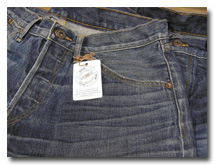
A pair of jeans made using Cone Denim’s Sustainblue™ denim fabrics with Tencel®
fiber.

January/February 2013

Kornit Introduces Kornit Paradigm Add-on Solution

Kornit Digital Ltd. — an Israel-based developer, manufacturer and marketer of digital printing
solutions for the textile and apparel industries — has introduced a digital add-on solution for
screen-printing carousels that enables unlimited color possibilities and photorealistic images.

The Kornit Paradigm, an industrial direct-to-garment printer, carries a digital station that
when fastened to an operational carousel enables screen printers to combine printing techniques to
create multiple printing applications. The printer employs screen techniques such as glitter,
cracking, foil, flock and burn-out; and is able to produce dark garment prints with screen
discharge or white ink under-base, complex four-color processes, spot and metallic combinations,
and pure digital applications for short runs.

The solution is compatible with both manual and automatic screen-printing carousels using
Spectra Polaris print heads that are available with CMYK inks. Kornit Digital reports that use of
the digital add-on station can shorten setup time and screen preparation costs.

“The Kornit Paradigm solution is the outcome of a paradigm shift in the direct-to-garment
printing industry,” said Yuval Neria, corporate marketing director, Kornit Digital. “Printers can
now combine the best of two worlds: analog and digital printing, and it’s the best solution for
garment decorators and screen printers that are looking to adapt to the growing needs of the
fashion industry.”

January/February 2013

Sunbrella® Renaissance Unity Features Recycled Content

Glen Raven Custom Fabrics LLC, Glen Raven, N.C., recently launched Sunbrella® Renaissance Unity
awning and shade fabrics made using 50-percent post-industrial recycled Sunbrella solution-dyed
acrylic fiber. The Unity fabrics, which feature the same fade resistance and solar protective
properties as all other Sunbrella fabrics, comprise the third collection in the Sunbrella
Renaissance product line, which also includes braided rugs and upholstery fabrics. The fabrics are
Greenguard Children and SchoolsSM certified for their contribution to indoor air quality.

The Renaissance program engages certain trade partners that are reclaiming and reprocessing
fiber and fabric both internally and from outside sources – including materials collected through
the company’s Recycle My Sunbrella service, under which it accepts post-industrial and
post-consumer Sunbrella fabric waste shipped to its recycling center in South Carolina.

FWGlenRaven

A selection of Glen Raven’s Sunbrella® Renaissance Unity awning and shade fabrics

January/February 2013

Sponsors