The Rupp Report: And The Femmy Goes To …

No, the title is not a mistake; it is about fibers and fabrics — delicate fabrics. The Rupp Report
can imagine, dear reader, that you are making an association with another award ceremony, hearing:
“and the Oscar goes to … .” Yes, but there is also an award called the Femmy.

Lenzing The Winner

Cellulosic fiber manufacturer Lenzing AG, Austria, was honored with the Femmy 2013 award by
the Underfashion Club Inc., New York City, in the category of Supplier. Earlier this month, Global
Marketing Director for Textile Fibers Andreas Dorner accepted the award on behalf of Lenzing at the
2013Femmy Gala in New York City.

The Underfashion Club

What is the Underfashion Club? Founded in 1958 as the Corset and Brassiere Women’s Club Inc.,
it was renamed the Underfashion Club in 1963 and reorganized as a nonprofit, intimate apparel
industry organization dedicated to education. The club provides scholarships and internships to
up-and-coming talent and organizes activities such as seminars, panel discussions and networking
opportunities for industry professionals.

According to the club’s mission statement, “It is the intention of certain members of the
Intimate Apparel Industry to raise funds and expend energy to safeguard the present and future
health of said industry by:

  • Supporting education of new talent
  • Attracting this talent to careers in Intimate Apparel
  • To act as a good citizen in the local community within the industry
  • To accomplish these goals these members have formed the Underfashion Club, Inc”

Acting Underfashion Club President Walter A. Costello, Macra Lace Co., stated: “For 55 years,
the Underfashion Club has been a bastion of dedicated volunteers who are passionately working to
make a difference in our industry. We strive each year to offer our members benefits that will
enhance their knowledge of the industry, and their opportunity for advancement.”

Underfashion Club members are involved in all aspects of the intimate apparel industry; in
areas including retailers, manufacturers, textile mills, fiber producers and trim suppliers; and in
functions including management, marketing, merchandising, sales, design, education and human
resources.

Prominent Award-winning Group

Once a year, the club presents the Femmy award to recognize the accomplishments of leading
industry companies and personalities in five categories. The 2013 winners in the various categories
are a kind of “who’s who” in intimate apparel:

Supplier: Lenzing Textile Fibers

Retailer: Bloomingdale’s

Manufacturer: Cosabella

Innovation: Haute Look

Lifetime Achievement: Josie Natori.

Femmy selection committee member Mark Sandler, president of Komar Layering said: “Lenzing
brings many elements of excellence to our industry. Lenzing’s innovative fibers help our industry
create the luxurious, fashionable, comfortable and sustainable intimate apparel our consumers
demand. Lenzing is a dedicated and attentive supplier who attains very high standards in our very
demanding industry. We are pleased to recognize their years of years of outstanding service.”

It Feels Good

The Rupp Report interviewed Dorner after the reception.

RR
: How does it feel to be the winner of such a prestigious award?

Dorner: It feels good, and I am extremely proud that Lenzing is the 2013 Femmy
award winner. On behalf of our staff in the USA, but also worldwide, I gladly accept this prize.


RR: How do you get involved? We suppose that a company cannot just “participate”
in this contest?

Dorner: Of course not. Nobody can just participate in this contest. A jury will
decide on the nominations. Leading retailers and brands from the U.S. are recommending the
nominees, and a jury will decide the finalists. We were informed about the nomination in November
2012, and in December we were informed that we are the winner.


RR: What is the justification for awarding the prize to Lenzing?

Dorner: The justification of the jury was quite complex: Over the years, Lenzing
has provided the intimate apparel industry in the U.S. with fiber and application innovations.
Lenzing has created platforms in the role of a leader at the Texworld show. At that event, we
organize twice a year seminars and discussions for the industry. Lenzing supported famous U.S.
brands and retailers in sourcing in Asia by inviting the Asian companies to attend the show in New
York City. On top of that, the Lenzing certifications and certificates provide security and
confidence to the involved companies.

Comprehensive Service


RR: Are there any other Lenzing activities going on in North America?

Dorner: Yes, innovative samples and fabric references made of MicroModal® and
Lenzing Modal® are seasonally presented to the U.S. companies. No other fiber company today offers
this full service package for the intimate apparel sector in the USA.


RR: Was there any particular fiber mentioned at the award ceremony?

Dorner: MicroModal was the hot topic thanks to its softness and the new Edelweiss
technology, which offers additional arguments about sustainability for the industry.


RR: This prize is quite an achievement and it certainly means a lot for Lenzing.
Are you allowed to exploit your position as a Femmy award winner?

Dorner: Fortunately, yes. We are allowed to take advantage of the prize and to use
it for our own purposes for one year.


RR: Do you know any previous winners of the award?

Dorner: The list is very long. Just to name a few, there are Victoria’s Secret;
Sears, Roebuck & Co.; Sara Lee; Cotton Incorporated; Saks Fifth Avenue; Fruit of the Loom;
Donna Karan; and many more.


Femmy

The Underfashion Club’s Femmy Award


February 26, 2013

Oerlikon Textile Offers New Solutions For Carbon, Glass Fiber Production

Germany-based Oerlikon Textile GmbH & Co. KG business units Oerlikon Barmag, Oerlikon Saurer
and Oerlikon Textile Components have developed new equipment targeted to processing of high-tech
fibers such as carbon and glass. The new solutions will be presented to the composites industry
next month at JEC Europe Composites Show & Conferences, which will take place March 12-14 in
Paris.

For carbon fiber processing, Oerlikon Barmag reports its WinTrax two-yarn winding head
enables cost-effective production of high-quality carbon fibers along with perfect package-building
and equal running lengths. Packages up to 310 millimeters in diameter can be produced using the
WinTrax-A 2cop model, thereby reducing tooling times and composite production costs.

Oerlikon Barmag also has developed a plug-and-play GM Control independent metering unit that
can be controlled directly or retrofitted to an existing process control system. The GM pump is
available for a variety of conveying capacities.

Oerlikon Saurer’s Volkmann GT glass twister is an ergonomically designed modular ring twister
that includes creel baskets and ring twisting spindles equipped with single motor drives, pneumatic
brakes and supplementary central ring rail drive with servo motor. The twister can twist three-ply,
hybrid and other plied yarn structures when a package creel and godet supply units are substituted
for the creel baskets. Application areas include polyamide, polyester, aramid, Dyneema® and
polyethylene/polypropylene, among other areas.

Oerlikon Textile Components will show its Accotex® aprons including the 964 FG3 glass fiber
apron, developed for processing super-fine BC, C and D filaments, which measure 4, 4.5 and 5
micrometers, respectively.

February 26, 2013

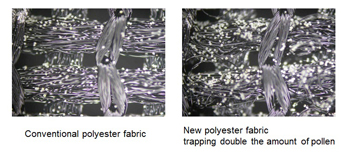
Teijin Frontier Co. Introduces Pollen-Trapping Polyester Curtain Fabric

Tokyo-based Teijin Group’s fiber-product converting company, Teijin Frontier Co. Ltd., has
developed a polyester curtain fabric that reportedly can trap twice the amount of pollen as
conventional polyester curtain fabric. The fabric will be available to manufacturers of lace
curtains beginning in March. Teijin Frontier is aiming to realize annual sales of 50 metric tons of
fabric in the fiscal year beginning April 2013 and 100 metric tons the following fiscal year.

To achieve the pollen-trapping function, Teijin Frontier has altered the polyester fiber
structure to have crimps as opposed to conventional adhering agents, resulting in a fabric that
retains its functionality as well as typical polyester fiber properties after repeated washing. The
fabric’s cotton-like texture coordinates with a variety of interiors, according to Teijin.

In addition, the company offers a pollen-shedding polyester fabric for sports outerwear
applications. That fabric features static-electricity-resistant durable polyester thread that keeps
pollen from adhering to the garment.

Teijinnews


Left to right: These electronmicroscopic images show a typical polyester fabric and Teijin
Frontier’s new polyester fabric trapping twice the amount of pollen.

February 26, 2013

ExpoProducción Has Successful Debut

The inaugural ExpoProducción — an annual trade show focused on serving the complete apparel, home
textiles and technical textiles production supply chain in Mexico and Central America — was held
Feb. 6-8, 2013, at the World Trade Center in Mexico City. ExpoProducción producer and organizer
Clarion Events North America Inc., Atlanta, reports the event saw more than 129 exhibitors from
Mexico, Italy, Sweden, China, India, Singapore and the United States showing their products and
services to more than 2,900 attendees from 11 countries including Mexico, Colombia, Costa Rica, El
Salvador, Guatemala, Panama, Puerto Rico, Venezuela, Spain, Canada and the United States.

“We are extremely pleased with the participation and attendance at this first edition of
ExpoProducción,” said David Audrain, president and CEO, Clarion Events North America. “The
escalating interest from the industry ensures that next year’s event will be significantly larger
with attendance growth from all of Mexico and Central America.”

Products and services exhibited at the show, which took up more than 5,500 square meters of
floor space, included fibers and yarns; fabrics; nonwovens; findings/trims; cutting and sewing
equipment/supplies; textile machinery; computer software/information technology; contract
manufacturing; logistics services; research and development products; associations/academia; and
publications.

ExpoProducción also offered a concurrent three-day, comprehensive educational program that
included more than 14 sessions — many of which had standing-room only attendance, according to
organizers — covering topics such as the latest research and development in cutting and sewing;
international trade updates; advancements in military, protective and safety apparel production; an
apparel industry market update; and the creation of design and trademarks.

The show was supported by the Cámara Nacional de la Industria del Vestido (CANAINVE); Clover,
S.C.-based Synthetic Yarn and Fiber Association; Washington-based National Council of Textile
Organizations; Textile World and its sister publication Textiles Panamericanos; and MexCostura, a
magazine covering apparel, textiles and fashion in Mexico and Central America.

The next edition of ExpoProducción will take place Feb. 5-7, 2014, at the World Trade Center
in Mexico City.

February 26, 2013

SGS Opens Consumer Testing Lab In Bangladesh

Switzerland-based SGS Consumer Testing Services has opened a consumer testing laboratory in
Chittagong, Bangladesh. The lab provides inspection and audit services, training and consulting,
and physical and chemical quality testing services using state-of-the-art equipment to the area’s
many apparel manufacturers so they may comply with international standards and regulations such as
Registration, Evaluation, Authorisation and Restriction of Chemical Substances (REACH), the
Consumer Product Safety Improvement Act (CPSIA) and other regulations required for doing business
in Europe and the United States.

“Both physical and chemical tests will be performed in the lab and SGS has plans to make
more strategic expansion to include testing and processing for the leather and footwear industry,”
said Pradit Young Pan Chai, Asia Pacific regional manager, SGS.

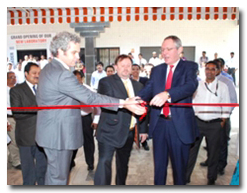
The company officially celebrated the opening with a ribbon-cutting ceremony and guided
laboratory tour. More than 150 guests attended the event including representatives from the SGS
Group, Bangladesh Garment Manufacturers and Exporters Association (BGMEA), Chittagong Port
Authority, Custom House, Bangladesh Standards and Testing Institution, Bangladesh Export Processing
Zones Authority, and the Bangladesh Environmental Authority.

Nasir Uddin Chowdhury, first vice president, BGMEA, said the lab will help ensure
sustainable growth, playing a vital role in developing business both in Chittagong and the entire
country. New Export Processing Zones will be created by the Bangladeshi government to further
encourage business.

“I am very pleased with this new laboratory,” said Ariel Miranda, managing director, SGS
Bangladesh Ltd. “It is in line with our Consumer Testing Service strategy to increase SGS’
geographical footprint in Bangladesh. We will leverage our Chittagong laboratory within our
Bangladesh and global network, and then further expand our service offerings in Chittagong.”

February 26, 2013

Eleven New Laureates For The JEC Europe Innovation Awards Program In 2013

PARIS — February 13, 2013 — This year, 11 companies and their partners will receive an awards at
JEC Europe – Composites Show and Conferences (March 12-14, 2013) for their composites innovations.
The jury has selected the best composite breakthroughs, based on their technical interest, market
potential, partnerships, financial & environmental impact and originality. The decision to give
prominence to these projects was based on their atypical nature and various noteworthy aspects.

In 2013, the winners were selected from the following categories: Raw materials,
Thermoplastics, Multifunctional materials, Machining & Tool, Building & Construction,
Aeronautics, Automotive, Wind Energy, Sports & Leisure and a Special prize.

The JEC Innovation Awards ceremony will take place on Tuesday March 12 at 5:00 pm on the JEC
Show (at the Agora) and will be open to all exhibitors and visitors.The ceremony is sponsored by
CYTEC, JEC Composites Magazine, Aviation Week and Innovation & Industrie.

Category: Raw materials

Winner: BAC2 Limited (UK)

Name of Product or Process: A new family of latent acid catalysts to make
pre-polymeric mixes easier to store, transport, handle and process.

Description:The development of the CSR family of latent acid catalysts was driven
by the desire to make pre-polymeric mixes easier to store, transport, handle and process during
product manufacturing. Without a latent catalyst to control polymerization, the storage life of
pre-polymeric mixes may be anything from a few seconds to a few minutes. Other catalysts that
extend storage life are available. However, they typically require temperatures above 200°C for
activation, something that is both energy-hungry and impractical with many of the materials
involved in manufacturing processes that utilise resins. Bac2 developed the CSR family of latent
acid catalysts to address the above issues. The key innovation was to develop a family of products
that activate between 50°C and 120°C, depending on the application and the speed of cure required,
enabling them to be used with many materials and processes. Critically, the catalysts do not have a
detrimental effect on the mould flow or other characteristics of the resins with which they are
used. Originally developed for use with Bac2’s electrically conductive ElectroPhen polymer resin,
the CSR family of catalysts has since been expanded to include formulations that retard and control
the curing of phenol-formaldehyde resoles, furan resins, urea and melamine formaldehyde resins.

Using CSR catalysts, the storage life of pre-polymeric mixes has been extended to over 3
months, simplifying storage, transportation and materials handling. Process efficiency improvements
of 130% have been demonstrated in pultrusion. In SMC and BMC processes, room-temperature storage
life is extended to several months. CSR catalysts also enable the manufacture of inherently
flame-retardant mouldings by facilitating the production of stable phenolic and furan-based
pre-polymeric mixes.

Bac2 estimates the potential global market for its latent acid catalysts to be at least £100
million. The company has identified 3 primary sectors where the innovation offers the greatest
benefits:

1. During the manufacture of wood products such as MDF, particle board and plywood, high
temperatures are used to cure the resin used for bonding the materials and to drive out moisture.
Using CSR reduces the cure time, reducing the time during which the high temperatures need to be
maintained. This in turn reduces the energy consumption and cost.

2. In abrasives manufacture, the overall temperature of the manufacturing process is reduced,
saving energy and cost.

3. In the manufacture of sheet or bulk moulded composites, for which there are applications
in everything from interior fittings in transportation to seating for stadiums, CSR can be used to
produce inherently flame-retardant products at lower temperatures than previously possible.

Category: Thermoplastics

Winners: MVC Soluções em Plásticos (Brazil)

Partners: PPE (France), Arkema (France)

Name of Product or Process: The new technology for the construction of busses,
trains wagons, vans, and automobiles bodies

Description: “Sofia Project – An innovative transportation concept”: The project
consists in developing a new technology for the construction of bus, train wagon, van and car
bodies in an innovative and sustainable way. The final product will be an “assembly kit” that can
be assembled in a few hours and without major tooling investments. Different kinds of technologies
will be used, but the new RTM-T process will be the main technology used for the structural body
components. This composite manufacturing process is based on traditional LRTM, but using a brand
new PMMA-based thermoplastic resin formulation developed by Arkema. This is the reason for the name
RTM-T (T from thermoplastic). The thermoplastic composite produced with this new resin will make it
possible to produce a “recyclable” main body, with lower weight (PMMA has a lower density than the
thermoset resins normally used for RTM), better mechanical properties, and at the end better
surface quality (very important for this market segment). All the main body parts will be made of a
sandwich structure with a low-density PU core, bonded together with structural adhesives. The
“joint design” has also been extensively studied to improve the adhesion power of structural
adhesives, making the assembly process as simple, quick, and intuitive as possible.

Category: Thermoplastics

Winners: Arkema (France)

Partners: Chomarat (France), PPE (France), 3B-the fiberglass company (Belgium)

Name of Product or Process: New (Meth)acrylic based chemical formulations for the
production of thermoplastic composite parts

Description: Altuglas® composite resin solutions are innovative (meth) acrylic
formulations developed within a research and development partnership between Arkema and PPE. These
formulations can be used to produce (meth)acrylic thermoplastic composites reinforced with
continuous glass, carbon or flax fibres with the same low-pressure processes and equipment as those
currently used to produce thermoset composite parts. The resulting (meth) acrylic thermoplastic
composite parts show mechanical properties similar to those of parts made of thermoset materials
while presenting the major advantages of being post-thermoformable and recyclable and offering new
possibilities for composite/composite or composite/metal assemblies.

Category: Multifunctional Materials

Winner: Institut für Textiltechnik (ITA) of RWTH Aachen University (Germany)

Name of Product or Process: A thermally conductive fibre-reinforced composite
material.

Description:The innovation combines pitch-based carbon fibres and a thermoset
resin to increase the thermal conductivity of fibre-reinforced plastics from 0.4 W/mK to 26 W/mK,
especially in the out-of-plane direction. The pitch-based carbon fibres are combined, protected
against bending and integrated into a honeycomb structure. The innovation can be integrated in
selected areas of the honeycomb, and not necessarily in all cells. Thus, money can be saved and
local properties can be modified. The fibres in the cells can also be connected to the skins of the
honeycomb sandwich to help avoid delamination. Moreover, the heat flow is guided from the in-plane
direction through the honeycomb to the other face sheet where heat is dissipated.

Composites are used more and more in applications that generate heat. Both electronic
components and the composite structure itself have to be protected and kept at lower temperatures.
The innovation can conduct heat away from heat sources or components in the desired directions. So,
metal components can be replaced by lighter fibre-reinforced plastics components. The service
temperature of the matrix system can be increased because the continuous fibres guide the heat away
from the heat source and avoid overheating.

A prototype has been built and the innovation was submitted to the German Patent Agency in
Munich.There is a need for a thermally conductive fibre-reinforced composite in the out-of-plane
direction in the air and space industry, as well as in automotive and industrial applications. The
invention can be helpful everywhere heat dissipation is needed.

Category: Machining and Tools

Winner: Cruing Srl (Italy)

Name of Product or Process: A tooling solution to evacuate hot dust particles
produced during cutting operations.


Description:
The Aerotech® System is a tooling solution that thoroughly evacuates hot
dust particles produced during cutting operations. By effectively air cooling the material and
cutter, it significantly reduces machining temperatures. This allows manufacturers of composite
parts to consider dry cutting their components, providing a practical alternative to machining with
coolants.

Heat produced while routing creates problems for the cutter and material. Coolants or ‘wet
cutting’ methods help resolve this problem, but these fluids can have an impact on human health and
water resources. Cruing identified the need for an air-cooled dry cutting solution as an
alternative to wet cutting, and thus began developing the Aerotech System.

Anyone who wants to dry cut CFRP at high feed speed, without delamination and with a quality
edge finish, can benefit from the Aerotech System.

Many chemicals used in the composition of cutting fluids, such as biocides, anticorrosive,
antifoam and others substances, can have a negative effect on the environment. Moreover, cutting
fluids and coolants have been associated with health problems such as skin rashes, dermatitis,
esophagitis, lung disease and cancer that result from either toxicity or bacterial or fungal
contamination.

The heat produced during cutting operations contributes to deteriorate tool life, with
negative effects on the quality of the finished components. Some of the materials used in today’s
industries are particularly sensitive to heat and can delaminate due to overheating. If heat is
allowed to persist, its conduction up through the CNC machine’s electrospindle can alter the
characteristics of the grease used to lubricate the electrospindle bearings. This can begin to
occur at temperatures of ~73°C, and is detrimental to bearing efficiency. It can also damage the
electrospindle. The Aerotech System air-cools the cutter and material effectively by removing dust
particles that become super-heated while cutting. This ensures that the electrospindle does not
overheat.

Category: Building and Construction

Winner: Owens Corning (France)

Partners: Ademe (France), Exel Composites (Belgium), CSTB (France), Goyer
(France), Compositec (France), ENPC (France)

Name of Product or Process: High-energy-efficiency façade panels based on
composite profiles.

Description: As new European thermal insulation regulations for building envelopes
become increasingly stricter (RT 2005 – 2012), the best way to lower the energy needs of buildings
is through thermal insulation of façade components. Current façade panels made of aluminium
profiles with embedded polyamide thermal breaks will only meet the lowest limits of these
regulations. Moreover, the use of conventional materials would result in thicker and thicker wall
constructions. This has driven Owens Corning and its partners to study, design and plan the
industrialization of an incremental solution targeting new and old buildings (fewer than ten floor
levels) that could meet new thermal regulations.

The global panel solution, named COFAHE, is the result of a strong partnership among key
industrial players and is composed of different parts and materials. The profile component uses
composites to replace the PA thermal breaks and part of the aluminium.

The main advantages of this composite component are:

– an almost “ready-to-use” (panel) incremental solution with minimum changes in existing
technology and machinery, and no change in the aesthetic aspect of the façade;

– lower thermal conductivity and better insulation while keeping good mechanical properties,
thanks to the composite/aluminium combination;

– a solution that can evolve in the future to meet the expected tightening of thermal
regulations, as opposed to current solutions, which have reached their limits. Together with Goyer,
OC assessed the value that will be created by replacing all their PA thermal breaks with pultruded
reinforced vinylester (reinforced with Xstrand® H glass in this case). The change is motivated by
the improved mechanical properties and thermal insulation.

Moreover, building contractors will be able to sell larger living surfaces inside the
buildings using composite profiles combined with extremely thin vacuum-insulated panels instead of
traditional mineral wool. Europe-wide, the potential market for the COFAHE façade panel solution is
4-5 million square metres, consisting of new-build and renovation projects for buildings below 28
metres in height.

Category: Aeronautics

Winner: Fokker Aerostructures B.V. (The Netherlands)

Partners: AgustaWestland (Italy), TenCate Advanced Composites (The Netherlands),
Ticona GmbH (Germany)

Name of Product or Process: The first thermoplastic composite tailplane developed
and put into production for a helicopter.

Description:The innovation is a full thermoplastic horizontal tailplane with a
co-consolidated, single-piece multi-spar torsion box for the AgustaWestland AW169 helicopter. This
main load-carrying member is 3 metres long and spans tip-to-tip. It consists of four preforms that
are melted together under pressure. Replaceable thermoplastic leading and trailing edges are
attached to the torsion box. The leading edges are made of consolidated thermoplastic laminates,
supported by a number of thin press-formed ribs. Thermoplastics were used for the leading edges
because of their good impact properties. The trailing edges are made of thin thermofolded
thermoplastic laminates supported by press-formed ribs. All the components are made of TenCate
Cetex® carbon/PPS fabric-based materials. The strongly curved winglets are conventional laminated
carbon/epoxy prepreg parts. The new design results in a 15% weight reduction for AgustaWestland
vis-à-vis previous composite tailplane designs.

The value of the innovation lies primarily in weight and cost savings. The weight saving
results in lower fuel consumption and NOx/CO2 emissions. The low-weight solution is made possible
by the toughness of the thermoplastic material and by the strong, stiff multi-spar torsion box
design. The design is made affordable by applying co-consolidation of simple preforms to create the
main structural element of the single-piece torsion box.

AgustaWestland expects the new AW169 to be highly successful in the civil market, and that
the company will easily exceed sales of 500 aircraft. The new concept could also be applied to more
tailplanes. The co-consolidated multi-spar concept is also suitable for other products such as
aircraft floor panels.

Category: Automotive

Winner: ECM (France)

Partners: Peugeot Citroën Automobiles (France), PPE (France), Cedrem (France)

Name of Product or Process: Self-supporting composite structure for a light urban
electric vehicle.


Description:
The innovation is a complete, self-supporting composite structure for a
light urban electric vehicle designed and manufactured using thermoset resin and glass fibre
reinforcement. This structure replaces a “traditional” steel body-in-white, offering equivalent
mechanical behaviour and significant weight savings.The prototype meets industrial feasibility
criteria. At this stage, the use of glass fibre reinforcement results in 30 to 40% weight savings
compared to an equivalent steel structure. According to calculations, further development using
carbon fibre could bring additional weight savings.

Following a first “traditional” step using steel as the main material for the body-in-white,
the goals of the second step of the development process were:

– to design and manufacture a self-supporting composite structure using glass fibre and the
RTM process;

– to achieve a manufacturing process at the industrial stage that allows a daily production
of 50 to 100 vehicles;

– to minimize investment, production and assembly costs by limiting the number of parts to be
produced and integrating functional aspects in developed parts;

– to save weight while meeting the required static and dynamic performance level.

The key benefits of the innovation are: weight reduction at acceptable cost for the
automotive industry, reduced vehicle emissions due to reduced car weight, design of vehicle parts
with integrated functional aspects, significantly reduced number of parts to build a car, and
savings on investment and assembly costs.

Category: Wind Energy

Winner: SchäferRolls GmbHH & Co. KG (Germany)

Partners: Institut für Verbundwerkstoffe GmbH (IVW), MWN Niefern Maschinenfabrik
GmbH (Germany)

Name of Product or Process: A thick-walled filament-wound carbon fibre composite
shaft more than 8.5 metres long and nearly 1 metre in diameter.

Description:The thick-walled (about 80 mm) filament-wound carbon fibre composite
shaft is designed to carry extreme torque loads in a wind turbine drive train. It is manufactured
in about 40 hours using a customized epoxy system with a long work life.

The shaft is flexible in bending to minimize the loads arising from manufacturing tolerances
and designed to carry a very high torque load, hence its name “FlexShaft”. This was made possible
by an innovative design with a clever use of the composite material’s anisotropy. The innovative
lightweight FlexShaft torque shaft can transfer a torque load of several thousand kNm within a
restricted geometrical design space. Handling the exothermic reaction of several hundred kilograms
of epoxy resin, lasting several hours, during the manufacturing process is a task that few
specialized companies can manage. A new method was developed to allow in-situ placement of the
necessary connecting elements between the CFRP shaft and steel flanges during the manufacturing
process, allowing fabrication without additional rework and improving the overall fabrication
quality and load transfer.

After a 2-year development phase, a first full-scale prototype has been operating since
September 2012 in Envision’s new 3.6 MW two-bladed direct drive offshore wind turbine in Denmark.

The market potential is about 100 million euros.

Category: Sports and Leisure

Winner: Zodiac Recreational (France)

Partners: Dehondt – Flax Technic (France), FiMaLin (France)

Name of Product or Process: New generations of ecodesigned semi-rigid boats.

Description:These new semi-rigid boats consist of an assembly between a rigid
composite hull and an inflatable float. The two boats presented were designed along the same
ecodesign guidelines.

The project’s main objective was to reduce the environmental impact of the Bombard AirEthic
semi-rigid boat and the Zodiac Z-Concept dinghy. The AirEthic is a series-produced boat, and the
Z-Concept is a concept boat that incorporates all aspects of eco-impact reduction, including
recyclable thermoplastic materials, bio-sourced materials, clean processes and electric motor.

To reduce the composite hull’s environmental footprint, the project managers chose to produce
it using the RTM process with flax-fibre reinforcement. The AirEthic’s underwater hull and deck are
both RTM moulded with flax-fibre reinforcement. The Z-Concept’s entire hull is one-step moulded,
with the flax reinforcement on the deck side.

Zodiac has been using composite materials for this type of boat for a long time. Composites
give these boats the desired strength and low weight, along with the possibility to create complex
shapes at moderate investment and production costs. Because flax is a bio-sourced plant fibre,
using it lowers the composite’s environmental impact. It is possible to replace part of the glass
fibre reinforcement with flax.

These boats are Zodiac’s first ecodesigned models. The AirEthic project was launched in April
2012, and the boat was presented at the December 2012 International Boat Show in Paris. The
Z-Concept project got off to a start in July 2012, and the boat concept was also presented at the
Paris Boat Show.

Over the long term, consumers’ growing concerns about environmental impacts when they choose
a product and the gradual toughening of regulations on production conditions will make traditional
polyester materials and techniques obsolete, relegating them to bottom-of-the-line product
offers.The new process and these materials could eventually be applied to all Zodiac boats, since
the experience with both models shows that this is feasible for this type of boat. The principle
could also apply to most composite parts.

Category: Special Prize

Winner: BMW Group (Germany)

Name of Product or Process: LifeDrive concept: the world’s first body architecture
that is purpose designed and built for the series production of electric vehicles.


Description:
Though carmakers all over the world are rushing out electric models, BMW
i’s LifeDrive architecture is the first to be custom-built for electric vehicles. In the early
1930s, progress in metal cutting and a desire for lighter, more powerful automobiles gave birth to
an innovation that would dominate motor vehicle manufacturing for many decades: the integral
monocoque body. Three quarters of a century later, at the dawn of the electric vehicle era, the BMW
i team was again facing the challenge of how to reduce a vehicle’s weight – this time to
accommodate the battery for an electric motor. The result of their deliberations was the world’s
first body architecture specifically designed and purpose-built for the series production of
electric vehicles: the LifeDrive concept. In contrast to vehicles with a monocoque body, the
LifeDrive architecture is made up of two separate functional units. The upper Life module consists
mainly of a high-strength and extremely lightweight passenger cell made of Carbon Fibre Reinforced
Plastic (CFRP). This innovative concept not only compensates for the extra weight of the battery
unit, but it also lowers the vehicle’s centre of gravity to make it a more dynamic vehicle to
drive. A lightweight design is not the only benefit LifeDrive brings. The carbon-fibre passenger
cell is exceptionally rigid and strong. Moreover, in the case of the BMW i3 there is no
space-consuming tunnel running through the middle of the vehicle, since all the power components
are housed in the drive module. As a result, passengers can enjoy streamlined seating and a
lounge-like sense of space.

Up to 2020, BMW anticipates a worldwide market share of 4 to 8% for electric vehicles (BEV
and plug-in hybrid). Furthermore, together with the German Government, BMW adheres to the target of
one million electric vehicles on German roads by 2020. Although the LifeDrive concept with its CFRP
passenger cell is a stand-alone vehicle architecture that is purpose-built for the BMW i3 and BMW
i8, other model series may also stand to benefit in the long term from the CFRP expertise that BMW
has developed.

Posted on February 26, 2013

Source: JEC Group

SGS Opens State-of-the-Art Laboratory In Chennai, India

GENEVA — February 25, 2013 — SGS India is pleased to announce that its largest laboratory and
facility has been officially opened by Chris Kirk, Chief Executive Officer, SGS Ltd. in December
2012 in Chennai, India. Located at Ambattur, Chennai, the facility houses multiple state-of-the-art
laboratories along with inspection and audit services.

The new state-of-the-art facility in Chennai has been designed to offer testing, inspection
and certification services for textile, footwear, PPE, food, environmental, agricultural, minerals
and industrial products. The laboratory and facility adheres to the best quality standards set by
the industry and regulatory bodies alike.

In addition to being SGS’ largest laboratory in India, the facility is also the most
efficient one,with special emphasis being placed on work flow movement. The facility is also a
benchmark in meeting SGS’ commitments to corporate sustainability, with solar powered external
lighting, rainwater harvesting, a building management system and dedicated Zero Discharge Effluent
Treatment Plant (ETP) enabling considerable water saving every day.

SGS

Officials cut the ribbon to inaugurate the new SGS laboratory in Chennai, India


The facility comprises of the following key laboratories among others:

– Personal Protective Equipments (PPE) Testing Laboratory

– Restricted Substance and Product Testing Laboratory

– Footwear Testing Laboratory

– Microbiology Laboratory

– Pesticide Testing Laboratory

– Environmental Laboratory

– Mineral Laboratory

– Food and Agriculture Laboratory

Speaking on the occasion, Chris Kirk, Chief Executive Officer, SGS Ltd. said: “Our new
laboratory and facility in Ambattur, Chennai will help us to offer world class services to our
clients and set a new benchmark in the Testing, Inspection, Verification and Certification space,
helping us further to achieve our goal of being the best service organization in the world.”

The addition of this new laboratory and facility in the SGS network will add new capabilities
and capacities to the ever expanding SGS India network.

Posted on February 26, 2013

Source: SGS Consumer Testing Services

FibeRio® Technology Corporation Announces Strategic Investment Financing Led By SABIC And Aster Capital

MCALLEN, Texas — February 25, 2013 — FibeRio, the developer and manufacturer of ground breaking
Forcespinning® nanofiber production systems today announced it has completed a $13M capital raise
led by two global strategic investors – SABIC Ventures B.V., Saudi Basic Industries Corporation’s
corporate venture capital arm, and Aster Capital Partners, sponsored by Solvay, Schneider Electric,
Alstom and the European investment fund. The funding will be used to accelerate the company’s
commercial growth, introduce larger scale production systems to the market and execute on a growing
pipeline of orders and global opportunities with industry leading customers.

“The support of two of the leading, knowledgeable strategic investors in this space, SABIC
and Aster Capital, is a strong validation of the uniqueness of our Forcespinning technology and
will help the company accelerate our growth, open new markets and enable new applications for all
of our customers” commented Ellery Buchanan, CEO of FibeRio. “This collaboration will greatly
accelerate our vision of the Forcespinning process becoming the world’s leading, cost effective
process to produce nanofibers at scale never before achieved.”

Forcespinning is a disruptive, platform technology which enables leading manufacturers to
produce nanofibers on a truly commercial scale in a cost effective way using a wide range of
polymers and an environmentally sensitive process.  Forcespinning is the only fine fiber
production system capable of both melt and solution spinning from lab scale to full industrial
scale production.  Unlike electrospinning, Forcespinning does not require materials to contain
certain dielectric properties for processing which limits the materials that can be produced into
fiber.  Nanofiber applications are used in a variety of markets including filtration,
nonwovens, battery separators, textiles, biomedical and conductive applications.

Hans Kolnaar of SABIC Ventures commented “FibeRio’s unique processing technology not only
increases our market reach, but offers SABIC an opportunity to move further down the value chain
with innovative fibers for our customers.”

“We view the cost effective production of nanofibers at scale as a key technological focus
for the nonwovens marketplace for a wide variety of applications in the filtration, energy,
medical, hygiene and textiles markets. Thanks to our sponsor, Solvay, we were able to validate that
FibeRio has a unique breakthrough technology to accelerate nanofiber growth for all levels of
production. We are excited to partner with a company that will be driving the deployment of
nanofibers for the foreseeable future” commented Pascal Siegwart and Todd Dauphinais, partners at
Aster Capital in a joint statement.

The combined breadth of resins represented by SABIC and Aster cover everything from commodity
polymers such as polypropylene and nylon to high performance materials including fluoropolymers,
polysulfones, polyethyleneimines, and liquid crystal polymers among others. A number of these
materials have never been made into nanofibers before and can offer materials performance
advantages to FibeRio Forcespinning equipment customers. FibeRio, SABIC and Solvay will all benefit
through the integration of a wide range of resins with Forcespinning technology.

FibeRio’s existing shareholders also participated in this financing round,including the
University of Texas System – UT Horizon Fund, the University of Texas – Pan American, the State of
Texas, Silverton Partners and Cottonwood Technology Fund I. As part of this financing, James
Wilson, of SABIC’s Innovative Plastics Strategic Business Unit, and Todd Dauphinais of Aster
Capital will join the FibeRio board of directors.


Posted on February 26, 2013

Source: FibeRio Corp.

The Rupp Report: They Never Give Up

Recently, the annual figures of the national gross domestic products (GDPs) of various countries of
the European Union (EU) were published. Most of them are not very favorable compared to those for
Asian countries. Most of them show a negative growth. Many Western industrialized countries not
only are dealing with the aftermath of the financial crisis, but also with the long-term flattening
growth of their economies.

Group Of 30

Now, some financial newspapers have published the message that the Group of Thirty (G30), an
association of leading representatives of the global financial industry, warns urgently of the risk
that insufficient long-term investment will occur worldwide in the coming years. They claim that
this could weaken the growth sensitively. The G30 is a secretive panel of private bankers. Mario
Draghi, president of the European Central Bank (ECB), and Bank of England Governor Mervyn King are
among its members — but why is that so? The EU now wants some clarification: What is this group,
and what do they want?

From 2006 to 2011, Draghi, an Italian bank manager and economist, was governor of the Bank
of Italy, and since Nov. 1, 2011, has served as president of the ECB. He was also former vice
chairman of Goldman Sachs International, and is currently also a board member of the Bank for
International Settlements in Basel, Switzerland.

Who’s Who Of Global Finance

In 1978, Geoffrey Bell, an American banker and economist, founded the G30 on the initiative
of the Rockefeller Foundation. Bell is an extremely important and powerful advisor to private and
central banks. Johan Witteveen, former managing director of the International Monetary Fund, served
as the group’s first chairman. According to its website, the G30 currently has 32 active members,
which reflects a real Who’s Who in the banking sector: In addition to Draghi and King, other
members include JPMorgan Chase International Chairman Jacob A. Frenkel, chairman of the G30’s Board
of Trustees; and U.S. economist and Nobel Laureate Paul Krugman. Former ECB President Jean Claude
Trichet is the group’s chairman.

Conflicts Of Interest

Now, the Corporate Europe Observatory, an organization that fights against corruption, is
blaming Draghi for a conflict of interest: The organization raises questions about Draghi’s
independence as a member of the G30, which is mostly entangled with large bankers. The cornerstones
of the EU should be “impartiality, independence and objectivity” — factors that are obviously in
strong conflict with practices at the G30.

Lobbying

In a self-declaration, the Group of Thirty states that “it is dedicated to the study of
economic and financial phenomena.” For this, the members meet twice a year to gain “a deeper
understanding of international business and finance” and to understand “the impact of decisions in
the public and private sectors.” In it unclear to what extent the G30 is influencing the world
economy. Having these confidential gatherings and the composition of the group — that is, its
exclusive members — in mind, critics suspect unwritten and clandestine agreements.

According to a G30-commissioned study titled “Manufacturing the future: The next era of
global growth and innovation,” prepared by the consulting firm McKinsey Global Institute, the group
claims that the investment needs of the nine largest countries — which together are responsible for
60 percent of the GDP — will grow from 30 percent of the GDP in 2010 to 34 percent in 2020. This
would represent a real investment needs growth of US$7.1 trillion to US$18.8 trillion.

The authors believe that the global financial system will struggle to provide the necessary
capital to provide for the expected surge in investment. The main sources of investment, subject to
national differences, include self-financing by households and companies, which represents
approximately one-third; governments, which represent 25 to 30 percent; and bank loans and
mortgages, representing approximately one-third. The study claims that banks and governments, as a
result of the financial crisis, are not able to do their job. That’s why the “non-banking sector
and the capital market should step much more into the breach,” they state.

New Regulations (?)

Now, the G30 proposes to remedy “an array of especially regulatory measures to strengthen
the capacity and willingness to long-term investments.” That is strange.

On the other side, 11 EU countries — out of 27 member states — decided that from 2014, a
uniform minimum tax would apply to bank and stock market transactions. The fact that not all EU
member states want to participate should leave one wondering. The EU Taxation Commissioner in
Brussels has presented parts of a proposal to introduce a financial transaction tax. The tax is
expected to provide the Commission with annual revenues of 30 billion to 35 billion euros from the
11 countries. Financial experts say that this seems to be a fair and technically sound control,
which would strengthen the internal market and bridle irresponsible trade.

With this tax, banks and other institutions should contribute to the costs of the financial
crisis, which have been paid mostly by taxpayers. Liability for taxation should be placed only on
financial institutions. Ordinary banking activities, credit and savings services, and insurance are
not included.

The G30 says that portfolio managers of pensions and sovereign wealth funds should be more
powerful, and, for example, might receive bonus incentives (!). But also, the group supports
implementing accounting rules that “give the short-term market volatility of long-term investments
less weight.” And there is no limit -the “cooperation between the public and private investors
could be developed.”

The Purpose Of The Group Of Thirty

What is this Group of Thirty really doing, and what do they want? Board Chairman Frenkel
said in January 2012 that “the effectiveness of the G30 is directly related to the quality and the
status of its group members.” What is the effectiveness of a private lobbying organization
dedicated to directly influencing the world economy?

Many personalities from politics and business complain that bodies such as the G30 can
hardly distinguish between public duties and private interests; and also that all that relates to
politically relevant content and discussions and decisions can hardly be private. What do these
people really discuss and negotiate? No one knows. Social networks are already on call to stop the
G30. Now the European Ombudsman is trying to resolve the Draghi case and the question of whether
the G30 will have some influence on the fortunes of Europe. One thing is clear: The top leaders of
the financial world do not give up so quickly.

February 19, 2013

Textile Manufacturing: Global Cost Trends From A U.S. Perspective: Trends In Fiber And Yarn Prices

Introduction

There recently has been a noticeable increase in the U.S. public’s interest in domestic
manufacturing. This was a much-discussed topic in recent political elections for a variety of
reasons, including patriotism and concern for the U.S. economy. Co-author B.J. Hamilton sought to
examine trends in production costs to determine whether conditions are becoming more favorable for
textile manufacturing in the United States. This is the first installment of a four-part series of
papers created from part of that research.

The main source of secondary data utilized in this paper was the monthly “Yarn Market”
department of

Textile World
magazine from 1980 to 2012.

Fiber And Yarn Price Data

In subsequent parts of this series, it will be shown that due to the cost structure of yarn
manufacturing, the United States would benefit from an increase in fiber prices, such as the steep
increase in cotton prices in 2010-11. In order to show the overall influence of fiber prices on
yarn prices, which obviously impact the total costs of subsequent textile processes and products,
it was believed worthwhile to review historical trends. Figures 1-3 show the historical prices of
fibers and the yarns made from those fibers.

Figure 1 shows the prices of raw cotton fiber, 10/1 ring-spun yarn and 10/1 rotor-spun yarn
from 1990 to 2012. Figure 2 shows the prices of 1.5-denier polyester fiber and 8/1 ring-spun
polyester yarn from 1984 to 2012. Figure 3 shows the prices of 3-denier acrylic fiber and 12/1
rotor-spun acrylic yarn from 1984 to 2012. In each instance, any increase in fiber price is
reflected by a similar increase in yarn prices and these cost increases and decreases are quickly
passed down the textile supply chain. It is clear also that, particularly for cotton, there is the
expected slight lag between changes in fiber prices and changes in yarn prices.

Figure 4 compares the prices of the fibers found in the past three figures from 1990 to
2012. A relationship can be seen among the three fibers. The market dictates that if the price for
one goes up, the demand for others will increase, leading to the prices of the other fibers also
increasing. It is seen that in 2010-11, the sudden price increase in raw cotton was soon followed
by price increases for polyester and acrylic fibers.

Conclusions

This paper shows the close relationship between the price of raw fibers and the yarns made
from those fibers. It also shows the correlation between various fiber prices. This means that an
increase in any one fiber price should affect the costs for both spinners of other fibers and for
fabric makers.

References

Hamilton, B.J. (2012). “Short- and Long-Term Opportunities for US Textile Manufacturing.”
PhD Dissertation, North Carolina State University.

Textile World “Yarn Market” (1984-2012).


Editor’s note: Brian John Hamilton, Ph.D., is product developer – Domestic Lifestyle at New
Balance Athletic Shoe Inc., Boston. William Oxenham, Ph.D., is Associate Dean, and Kristin Thoney,
Ph.D., is Associate Professor at North Carolina State University’s College of Textiles, Raleigh,
N.C.


February 19, 2013

Sponsors