Salvadoran Synthetic Textile And Apparel Cluster Will Participate In AAPN Annual Meeting

SAN SALVADOR — April 12, 2013 — Members of the Salvadoran synthetic textile and apparel cluster are
preparing to participate in the annual American Apparel Producers’ Network (AAPN) forum in which
the theme will be “Apparel Made in the Americas”. This forum seeks to educate and facilitate the
exchange of experiences and information on America’s shorter cycle times, new capabilities, speed
to market, flexibility, among other important criterion taken into consideration by apparel
sourcing executives to select vendors since there seems to be mixed perceptions on the Western
Hemisphere’s performance versus the East. Sourcing shifted from the Western Hemisphere due to cost
reasons but in the process the region has managed to attract new investments in yarn and fabric
production, trims, apparel and related product and services that have strengthen and reinforced the
region’s capabilities and have positioned the region as an alternative now that energy and
transportation costs in Asia are rising and apparel labor availability in China shrinks.

“As textile mills we have definitely perceived a renewed interest in the DR-CAFTA region on
behalf of U.S. and Global apparel sourcing executives in the past three years. We have been
constantly receiving sourcing executives in our manufacturing facilities that are exploring and
evaluating coming back to the region. They are interested in learning about our capabilities as
narrow and wide fabric manufacturers in El Salvador and rediscovering the apparel value chain in
the region.” said Dana Barlow, CEO of The Moore Company.

The DR-CAFTA Exports to the U.S. in 2012 reached $7.8 billion and El Salvador (positioned as
the 9th apparel supplier) contributed with $1.8 billion in exports and was the only DR-CAFTA
country that actually experienced a growth in apparel exports to the U.S.

A robust and vertically integrated synthetic textile manufacturing cluster has developed
over the past several years in El Salvador. The eight companies joining forces to promote the
cluster include: George C. Moore Company, Darlington Fabrics, Apparel Production Services (APS), CS
Central America, Pettenati, TexOps, ProDept and Unifi. For example, George C. Moore and Darlington
Fabrics have combined their efforts to expand the region’s capability by locally producing and
supplying apparel manufacturers with woven and knit narrow fabric, as well as warp knit stretch
fabric for the underwear, intimate apparel, athletic compression, performance apparel, swimwear,
orthopedic & medical, industrial and military markets. “George C. Moore has almost seven years
of successfully operating in El Salvador where we have received several recognitions from our
customers. We have recently been selected for the 2012 Supplier Innovation of the Year Award
granted by Fruit of the Loom, Inc. This innovation award is very important for us since it came as
a result of our team’s capacity to develop a new style of elastic and to lead the transition
without any lost production and on-time delivery. I am very proud of our workforce in El Salvador
since they constantly maintain the highest levels of quality and service and the company supports
innovation executed by our employees by making the necessary investments in equipment to satisfy
the specific needs of our customers” said Andrew Dreher, Senior Vice President of George C. Moore.

The AAPN carried out a research to understand the perceptions of 13 senior sourcing
executives about sourcing in Asia versus sourcing in the Americas. This research provided feedback
on the performance of the Western Hemisphere in areas such as apparel suppliers’ knowledge and
experience with US markets, vertical integration of the value chain, speed, costs, ease of doing
business, product development capabilities, social compliance and risk assessment. One of the
biggest advantages of the East is the greater number and selection of textile inputs, although they
do acknowledge West is definitely expanding in performance fabrics.

“On this survey it was mentioned that the West needs more synthetics, for which as members
of the synthetic textile and apparel cluster in El Salvador we definitely know we are on the right
path but we are also well aware of the fact that sourcing in the region will not increase only for
one country or one company, we need to grow and work as a region” said Steve Perry, Senior Vice
President of Darlington Fabrics. “Despite the challenges of the West versus the East in terms of
costs, flexibility, verticality, among others, the gap between the two regions is not as pronounced
as we would have expected (3.1 vs. 3.5) so this is definitely an opportunity to take this feedback
and work as a region to address and overcome our weaknesses” S. Perry added.

Posted April 16, 2013

Source: George C. Moore
Techtextil North America Symposium 2014 – Call For Papers

ATLANTA, GA — April 11, 2013 — The 2014 edition of Techtextil North America is now accepting papers
for the highly acclaimed Techtextil North America Symposium being held May 13 -15, 2014, Georgia
World Congress Center Atlanta, Georgia USA.

Papers are especially solicited in the following areas:

  1. Extreme fibers and fabrics for special applications
  2. Composites — involving high performance fibers/fabrics
  3. New innovation/developments in protective textiles
  4. Technical textiles in sports and outdoor
  5. Automotive and aerospace applications
  6. Smart/intelligent nonwovens and other materials
  7. Nanotechnology in technical textiles — potential and real world applications
  8. Future materials — what, when, and how technical textiles will impact industry
  9. Medical — special applications
  10. Agricultural applications

Selection of papers to be presented will be based on abstracts of 300-500 words. Authors
should emphasize new and significant findings/developments.

Deadline for submission is July 1, 2013 through electronic submission (email) to the
following:

Kristy Meade

Group Show Director

Techtextil North America Symposium

1600 Parkwood Circle

Suite 615

Atlanta, Georgia 30339

Phone:   678-732-2424

Fax:        770-984-8023

Email:    Kristy.Meade@usa.messefrankfurt.com

Website: www.techtextilNA.com

All abstract must include: the name, company or other affiliation, telephone number, fax
number, e-mail address and mailing address of the speaker and/or the person to whom correspondence
about the abstract should be directed. Only one speaker per presentation will be allowed, though
co-authors may be listed. The speaker for the paper should be underlined and (the speaker only)
will receive a complimentary conference/event registration. Authors will only be notified if their
papers are accepted by September 15, 2013.

Authors of accepted papers will be required to provide a full paper and/or presentation by
April 1, 2014. Authors are responsible for securing any necessary copyright or other clearance for
all abstracts, papers and other materials submitted.

All presentations should be planned to run approximately 20 minutes plus 10 minutes for
questions.

Posted on April 16, 2013

Source: Messe Frankfurt USA

Industrial Fabrics Association International (IFAI) And Clarion Events North America Sign Collaboration Agreement

ATLANTA, Georgia —April 15, 2013 — Clarion Events North America, Inc. announced today that a
collaboration agreement has been signed with the Industrial Fabrics Association International
(IFAI) regarding Clarion’s annual ExpoProducción event in Mexico City.

The collaboration will include an IFAI Pavilion and Conference to be held within the annual
ExpoProducción trade show in Mexico City beginning with the February 2014 edition. This new
collaboration will also allow the two organizations to explore further cooperation in the
development of other textile events in the Americas and Globally.

David Audrain, President & CEO of Clarion Events North America stated, “IFAI is a
world-renowned organization with a long history of producing successful events. We are extremely
pleased to have them partner with us in the expansion of our ExpoProducción show in Mexico City.
There is a great deal of interest in Mexico and Central America for the types of specialty fabrics
and related products provided through the IFAI members. The addition of the IFAI Specialty Fabrics
Pavilion and Conference as part of ExpoProducción will bring a new market and group of decision
makers to the event thereby enhancing the scope and appeal of the trade show.”

Todd Lindemann, Vice President, IFAI added “IFAI is very excited to announce this
collaboration with Clarion in Mexico, and for the potential opportunities that lie ahead. David
Audrain and his team at Clarion are experienced and well respected, and we look forward to great
things ahead!”

The second edition of ExpoProducción will held February 5 -7, 2014 at the World Trade Center
in Mexico City, Mexico.

For additional information please visit www.ExpoProduccion.com

Posted on April 16, 2013

Source: Clarion Events North America Inc.

Textile Manufacturing: Global Cost Trends From A U.S. Perspective: Staple Spinning

The renewed interest in the potential of increasing domestic manufacturing has been spurred by
studies that indicate that such an increase may not be simply a political dream, but could offer
economic advantages. In 2012, co-author B.J. Hamilton conducted a substantial research project that
sought to examine trends in production costs, to determine if conditions are becoming more
favorable for textile manufacturing in the United States. This is the second installment of a
four-part series of papers created from that research.

The main sources of secondary data utilized in this paper are surveys conducted by the
International Textile Manufacturers Federation (ITMF), Switzerland,. The survey reports include the
ITMF International Production Cost Comparison reports (1991-2010) and the ITMF International
Textile Machinery Shipment Statistics reports (1990-2010).


Yarn Spinning Capacity Data


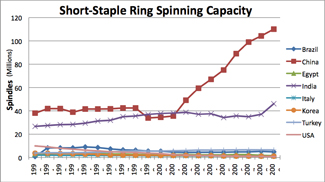
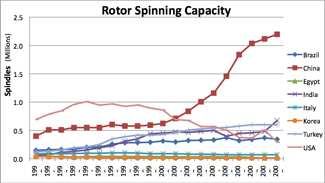
The yearly capacities, in number of spindles, for both ring spinning and rotor spinning are
displayed in Figures 1 and 2. Figure 1 shows that, among the included countries, the United States
had the highest capacity for rotor spinning from 1990 to 2001. After that year, China became the
leader in rotor spinning capacity and continued to increase capacity every year. Meanwhile, US
capacity continued to decline, and in the most recent survey, had less capacity than countries such
as India and Turkey. Figure 2 shows the yearly short-staple ring spinning capacity for each
country. This graph shows a similar trend of Chinese capacity increasing every year beginning in
2001, and having by far the highest capacity in the most recent survey. These patterns reflect the
phasing out of the World Trade Organization (WTO) safeguards that were in place for China during
this time period.


Figure1
Figure 1: Country Rotor Spinning Capacities By Year

Data Source: ITMF International Textile Machinery Shipment Statistics (1991-2010)


Click here to view Figure 1 in a new window


Figure2
Figure 2: Country Short-Staple Ring Spinning Capacity By Year

Data Source: ITMF International Textile Machinery Shipment Statistics (1991-2010)


Click here to view Figure 2 in a new window

Spinning Cost Trends


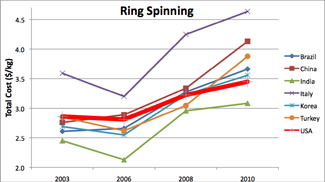
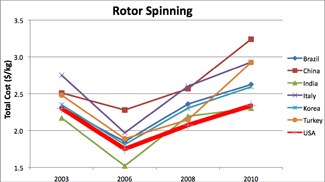
Figures 3 and 4 exhibit the time trends of total spinning costs, including the cost of fiber,
for each participating country in the surveys. In both figures, the United States is highlighted
using a bold red line to show its place among the other countries over this time period. Figure 3
shows that for ring spinning, Italy had the highest cost for the entire time period. The United
States began with the second-highest cost, but over the years was surpassed by four other countries
and ended up having the second-lowest cost per kilogram of yarn. Meanwhile, the cost of ring
spinning in China rose to become the clear second-highest behind only Italy. Figure 4 also shows
the rising cost of making yarn in China, this time for rotor spinning. The United States was
already one of the less expensive countries in 2003, but the gap between it and China widened over
the years. This trend is extremely important to the future of the U.S. textile industry. American
companies already have certain location advantages, and any cost advantage gives U.S. customers
even less reason to import textile products. Opportunity is coming to the United States because
worldwide costs are rising at a faster rate.


Figure3
Figure 3: Country Ring Spinning Costs By Year

Data Source: ITMF International Production Cost Comparison (2003-2010)

Click here to view Figure 3 in a new window

Figure4

Figure 4: Country Rotor Spinning Costs By Year

Data Source: ITMF International Production Cost Comparison (2003-2010)

Click here to view Figure 4 in a new window


Components Of Spinning Cost


The cost of spinning in each country was further broken down in the surveys into the cost
components of raw material, interest, depreciation, auxiliary material, power, labor and waste.
This breakdown was useful because it allowed for the impact of an increase in a particular cost
driver to be analyzed. For the sake of brevity in this paper, only the results for ring spinning
are shown below, but rotor spinning costs followed similar trends. In fact, according to Hamilton,
the labor component is even less of an issue with rotor spinning compared to ring spinning because
there is a higher degree of automation in rotor spinning.

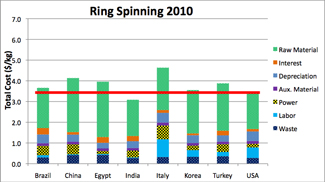
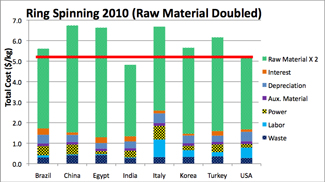
Figure 5 shows the total cost of ring spinning for each country in 2010, broken into cost
components. A bold red line is placed on the top of the U.S. bar in order to gauge its cost
relative to the other countries. This figure shows that the United States has the second-lowest
total cost and that raw material is the largest cost driver for each country. Figure 6 shows what
the total cost for each country would become if the raw material cost were doubled, a situation
that has precedence in the 2010-11 elevation of cotton prices. The United States remains the
second-least expensive; however, the gap between it and some of the more expensive countries — such
as China, Egypt, and Italy — has widened, with several of the countries now being a full dollar per
kilogram higher. India has gained a similar advantage and remains less costly than the United
States. Power is another cost component for which a uniform increase might be advantageous to the
United States, This, of course, assumes a uniform global increase in costs; naturally, regional
variations would give slightly different results.


Figure5
Figure 5: Cost Components Of Ring Spinning

Data Source: ITMF International Production Cost Comparison (2010)

Click here to view Figure 5 in a new window


Figure6
Figure 6: Cost Components Of Ring Spinning (Raw Material Doubled)


Data Source: ITMF International Production Cost Comparison (2010)

Click here to view Figure 6 in a new window


Conclusions


This paper shows that the United States, while losing worldwide share in yarn production, has
been slowly gaining in global cost competitiveness in both ring and rotor spinning. Additionally,
the cost structure of U.S. yarn spinning provides the opportunity for the United States to benefit
from global increases in fiber prices. This would seem to open up the opportunity for the United
States to reclaim some of its lost manufacturing capacity in the spinning area because the cost of
producing yarns in the United States is lower than for most competitors.This advantage would also
carry with it the benefits of higher quality, shorter time to market and potential for
collaborative arrangements with fabric producers. Recent announcements, such as international
textile company Gildan Activewear Inc.’s plans to build a large new ring-spinning facility in the
United States, seem clearly to support these conclusions.

References


Bethea, A. (2012). “Yarn-spinning facility,170 jobs, headed to Rowan.” The Charlotte
Observer. Dec. 19, 2012. Retrieved from:
http://www.charlotteobserver.com/2012/12/19/3736225/yarn-spinning-facility-170-jobs.html

Hamilton, B.J. (2012). “Short- and Long-Term Opportunities for US Textile Manufacturing.”
PhD Dissertation, North Carolina State University.

ITMF. (1990-2010). International textile machinery shipment statistics.

ITMF. (1991, 1995, 1997, 1999, 2001, 2003, 2006, 2008, 2010). International production cost
comparison: Spinning, texturing, weaving, knitting.


Editor’s note: Brian John Hamilton, Ph.D., is product developer – Domestic Lifestyle at New
Balance Athletic Shoe Inc., Boston. William Oxenham, Ph.D., is Associate Dean, and Kristin Thoney,
Ph.D., is Associate Professor at North Carolina State University’s College of Textiles, Raleigh,
N.C.


April 16, 2013

People

Switzerland-based
Rieter Group has nominated
Norbert Klapper, Ph.D., CEO, effective by Jan. 1, 2014. Erwin Stoller will
continue to serve as chairman of the Board.

 
PeopleKlapper

Klapper

The
U.S. Department of Commerce has appointed
David Hastings, National Council of Textile Organizations and Mount Vernon Mills,
to the 2013 Manufacturing Council.

Lawrence, Mass.-based
Polartec LLC has named
Colin True account manager, Southwestern United States.

Germany-based
Spindelfabrik Suessen GmbH has appointed
Roland Eberhardt joint managing director.

 
PeopleEberhardt

Eberhardt

The
Association of the Nonwoven Fabrics Industry (INDA), Cary, N.C., has elected the
following to its Board of Directors for three-year terms:
Thomas Marth, Nonwoven Solutions LLC;
Renita Anderson, IMERYS Performance Minerals;
Don Brown, Bonar Inc.;
Christophe Guillaumot, Glatfelter Gatineau Ltd.;
Jenny Dobmeier, Johns Manville Corp.;
John Rank, Spuntech Industries Inc.; and
Chris Peart, HDK Industries Inc. INDA also has appointed
Brad Kalil director, market research & statistics.

Paris-based
Lectra has appointed
Myriam Akoun-Brunet communications director.

PeopleAkounBrunet

Akoun-Brunet

The
American Apparel & Footwear Association (AAFA), Arlington, Va., has named the
following officers of its Board of Directors:
Philip C. Williamson, Williamson-Dickie Manufacturing Co., chairman;
Rick Helfenbein, TellaS Ltd., vice chairman;
Rob DeMartini, New Balance Athletic Shoe Inc., treasurer; and
Paula Zusi, Ann Inc., secretary. AAFA also has named
Al Gervais, Marc Fisher Footwear;
Edward Gribbin, Alvanon Inc.; and
Tim Mantel, Target Sourcing Services, members of the Board of Directors.

Cuyahoga Falls, Ohio-based
Americhem Inc. has named
Robert Baldy market manager, North American nonwovens market.

Denmark-based
Novozymes A/S has named
Peder Holk Nielsen president and CEO.

Red Bank, N.J.-based
Brand & Oppenheimer Co. Inc. has named
Peter Raneri vice president, sales and business development.

The
American Association of Textile Chemists and Colorists (AATCC), Research Triangle
Park, N.C., has presented the 2012 Henry E. Millson Award for Invention to the following U.S.
Marine Corps. (USMC) Systems Command and scientists at the U.S. Army Natick Soldier Research,
Development and Engineering (RD&E) Center, Natick, Mass.:
Gabriel R. Patricio, Lt. Col., USMC, Retired, Program Manager, Infantry-Combat
Equipment, USMC Systems Command;
John Heisterman, Gunnery Sgt., USMC, Retired, Chief Instructor, Scout Sniper
School, USMC Training and Education Command;
Luisa C. DeMorais, textile chemist, U.S. Army Natick Solder RD&E Center;
Deirdre Townes, textile technologies, U.S. Army Natick Soldier RD&E Center;
and
Anabela Dugas, textile technologist, U.S. Army Natick Soldier RD&E Center.
AATCC also has presented the J. William Weaver Paper of the Year Award to
Keith R. Beck,
David Hinks,
Nathan H. Weisner and
Anne Crawford for the paper titled “Liquid Chromatographic and Mass Spectrometric
Analysis of Dyes for Forensic Purposes”; and the 2013 AATCC Technical Committee on Research Service
Award to
Gregory Walter Haggquist, Cocona Inc.

Sweden-based
Telenor Group has promoted Telenor Connexion CEO
Per Simonsen to lead the group’s Machine-to-Machine division, Telenor Digital
Services.

Rutherford College, N.C.-based
O’Mara Inc. has appointed
Gary Bradley president;
Joseph X. Leirer Jr. vice president, finance; and
Gary Hicks vice president, operations.

Portland, Ore.-based
Skins Compression Clothing has appointed
Danielle Said senior marketing manager, digital, communications and e-commerce,
North America.

Newton, Kan.-based
Bunting Magnetics Co. has promoted
Simon Ayling to managing director, Bunting Magnetics Europe; and has named
Clive Wright general sales manager and
Robert Webb finance director, Bunting Magnetics Europe.

April 2013

The Rupp Report: Quality Or Label?

One of the favorite sayings of the author of the Rupp Report is “There is no coincidence — it has
to happen.” And — as a confirmation of that — a coincidence happened with regard to some
discussions during the yarn exhibition FILO in Milan, which took place March 20-21, 2013, and an
article in the latest issue of

Textile World
.

Managing Editor Janet Bealer Rodie wrote for the last issue of

TW
an article with the question, “What’s In A Brand?” And the Rupp Report had a very lively
discussion at FILO with Roberto Belloli, managing director of Antonio Aspesi S.r.l., Busto Arsizio,
Italy. Aspesi produces mainly customized warps for its clientele. “Our customers are weaving
special products, so they need special warps, customized to their needs,” Belloli said, “And that
is what we are doing.” (See ”
The Rupp
Report: FILO: The European Art Of Surviving In Spinning
,”

TextileWorld
.com, March 26, 2013.)

Description Of Definition Problems?

But what is the definition of customers’ needs? Is it quality? Or are all requirements from
the customers incorporated in a label or a brand? Or are the characteristics of the product even
hidden behind the label? If a fiber or a fabric has inherent technical characteristics that can be
measured, there is no problem. Rodie wrote in her report about various man-made fibers and their
properties. However, she also wrote that “numerous branded fibers are emphasizing their low carbon
footprints, citing reduced energy and resource consumption, and reduced greenhouse gas emissions.”
Well, true or not? That is the question.

It’s The Image That Counts

Now, what’s the basic aim of every business? Of course, it’s selling. And successful selling
includes all well-known aspects of the whole marketing activity. Over the last decades, some
companies built up a certain reputation with a consequent and — on top of it all — consistent
labeling or brand policy. And this is a big money affair: Especially, some big retail chains and
brands in the sportswear industry are spending millions and millions of dollars to be recognized in
the market as top brands. Even big sports heroes are on the payroll to support the defined
characteristics and, above all, the image of the brand or label.

Up to now, some big labels have been having tremendous success: For example, U.S. producer
Nike can show impressive figures: In 1972, when Nike started selling athletic shoes under its
label, revenues were less than $2 million. In 1977 the company had revenues of $28.7 million. In
1981, they were already more than $457.7 million. In 2008, they totaled $18.6 billion; and in 2012,
$24.13 billion was recorded. These are very impressive results and are based virtually on two
pillars: effective and low-cost production; and brand marketing. Experts say that Nike is spending
10 percent of its turnover in communications activities — which means events, advertising and top
athletes as product endorsers — showing again that external communications are very important for
the success of a company. That is also the case for business-to-business (b2b) relations.

But Not Only

However, big retail companies and sports brands also are having some trouble caused by the
perception of modern young people vis-à-vis ecologically and socially questionable production
facilities and methods. And, even more, small companies never have the cash to spend so much money
on external communication. They make their success through quality and service: “Yes,” Belloli
said, “all that might be very important for the retail side. But for our b2b customers, quality is
the top priority. We don’t have the money to push our name through all the stages of production, so
we have to convince our customers with top quality, top service and outstanding products. To be
successful, we need a package of performances that are not comparable with those of other
suppliers.”

Of course, one has to define its target customers. All the exhibitors of FILO are playing in
the top league of yarn producers. And they do it successfully. As Nicole Camenzind, director of
Switzerland-based silk yarn producer Camenzind said: “We can’t compete on price if we are in the
segment in which most of the global players try to find their success. There is always one who is
cheaper than you are. For a European manufacturer, and even more for a Swiss company, you have to
offer the market products and services that are second to none. We do not sell on price — we sell
top quality with our label Swiss Mountain Silk. And, as you can see, we are still alive,” she added
with a smile.

Find The Right Way

For obvious reasons, many traditional textile companies are trying to find new key markets,
but having too many competitors: Their products are replaceable. Some are challenging the
industrial fabrics sector, while others are trying to find a niche. These strategies can work if
you have the right ideas, skilled people with the necessary experience and a lot of courage. Also,
in the b2b sector, branding can play an important role. Here are a few names that Rodie mentioned
in her report: ComFortrel®; EcoSure®; Repreve®; LYCRA®; and Sorona®. In the case of DuPont’s Lycra,
it worked — that brand became virtually a generic name for elastic yarns in the mad-made fiber
industry.

However, it takes time and a lot of money. And, as DuPont demonstrated over the decades,
don’t forget to communicate, whether you are selling an image or top quality. And, at the end of
the day, it’s always human relations that dictate success!

April 9, 2013

Polytex USA Introduces Star Artificial Turf Yarn

Polytex USA — a Calhoun, Ga.-based manufacturer of monofilaments, texturized yarn and fibrillated
products for the artificial turf industry — has introduced Star, a star-shaped artificial turf
monofilament yarn.

The 1,800-denier, 315-micron-thick yarn features an extra-wide blade design measuring 1.35
millimeters that offers a more natural look and better infill coverage than are achieved using
traditional turf yarns. It has been optimized for abrasion resistance and durability, and testing
using the Lisport® wear tester has shown the yarn can endure 55,000 cycles without fiber splicing,
Polytex USA reports. Star yarn may be manufactured in either a single or dual tone.

“The new Star shaped yarn combines aesthetics with performance to enhance the overall look
of the turf,” said Axel Hinrichs, CEO, Polytex USA. “[It] offers a nice alternative to the ever
increasing yarn choices out of the Far East. Turf produced using our yarn is truly made in the
USA.”

April 9, 2013


JEC Group Extends Application Deadline For I.C.S. Speakers, JEC Innovation Awards

JEC Group — a France-based association that provides networking and information services for the
composites industry — has extended the deadline to April 15, 2013, for submitting applications to
speak at the Innovative Composites Summit (I.C.S.) and to enter the JEC Innovation Awards
competition, both of which will take place as part of the JEC Asia Composites Show &
Conferences to be held June 25-27, 2013, at the Suntec International Convention & Exhibition
Center in Singapore.

I.C.S. gathers experts from companies in the composites community to offer insights on new
advances in composites materials. The JEC Innovation Awards recognize composites innovations in
various categories. Applications for both may be submitted at jeccomposites.com.

April 9, 2013

Trützschler Nonwovens, Voith Paper Collaborate On Nonwovens Lines

Germany-based nonwovens machinery supplier Trützschler Nonwovens, part of Trützschler Nonwovens
& Man-Made Fibers GmbH, has entered into an agreement with paper machine manufacturer Voith
Paper — a division of Germany-based Voith GmbH — to jointly develop and market complete production
lines for wetlaid and hydroentangled nonwovens.

Voith’s main contribution is its HydroFormer™, which has been optimized for wetlaid nonwovens
production. The company also will offer technical support for stock and water systems, press
concepts, fabrics, and calenders.

Trützschler’s hydroentangling AquaJet will be used to bond the web, and the company also will
contribute drying and winding machinery to the production line.

“We are certain that this partnership will enable us to offer convincing machine concepts,”
said Marc Wolpers, sales director, Trützschler Nonwovens & Man-Made Fibers. “By providing
common solutions we can meet the market requirements in a much better and faster way than we ever
could by acting independently.”

“This cooperation allows us to offer our customers a complete line ranging from wet laying,
bonding, to drying and winding,” said Klaus Afflerbach, Ph.D., responsible for special machines,
Voith Paper. “The combination of two wet processes in form of HydroFormer and AquaJet results in a
high-quality web that is of interest to manufacturers of cleaning cloths throughout the world.”

VoithHydroFormer

Voith’s HydroFormer

TrutzschlerAquaJet

Trützschler Nonwovens’ AquaJet

April 9, 2013

Trützschler Switzerland To Handle Texturis’ Spare Parts Activities

Effective immediately, Trützschler Switzerland AG will take over spare parts activities previously
managed by Texturis AG, also based in Switzerland, because Texturis shareholders have decided to
cease business operations. Texturis was formed in April 2012 by a group of SwissTex employees to
ensure continued market availability of spare parts for SwissTex bulk continuous filament systems.
Switzerland-based Gebr. Bräm AG was in charge of founding Texturis.

Current orders will be processed by Texturis, but moving forward, all activities will be
handled by Trützschler Switzerland in partnership with Gebr. Bräm.

Martin Kümin, formerly employed by SwissTex and later Texturis, will manage the spare parts
division for Trützschler Switzerland effective April 15.

April 9, 2013

Sponsors