Santoni Upgrades SM8-TOP1V Knitting Machine

Italy-based Santoni S.p.A. reports it has improved its SM8-TOP1V knitting machine increasing its
speed factor by 40 percent compared to that of other Santoni knitting machines. The speed increase
along with a gauge change to 40 gauge result in a knitting time of four minutes for basic garments,
Santoni reports. Even at the higher output, seamless comfort and quality is maintained according to
the company, and different designs and knitting structures still may be used on the machine.

The company displayed the improved machine at the recent Expotextil-Perú in Lima.

October 29, 2013

Monterey Mills Acquires Glenoit Fabrics

Janesville, Wis.-based sliver knitter Monterey Mills has acquired sliver knitter Glenoit Fabrics
(TT) Corp. Inc., Tarboro, N.C., from the management group that has owned the company since 2009.
Monterey plans to invest in Glenoit’s infrastructure, add employees and expand market share in the
sliver-knitting segment.

“The acquisition of Glenoit gives Monterey an important presence in the heart of America’s
textile industry,” said Dan Sinykin, president, Monterey Mills. “Although Glenoit is a mere shell
of its past going from 1,100 people in 1997 to less than 50 in the factory today, my vision is to
turn that trend around, add jobs in Tarboro and leverage the Made in America brand.”

Glenoit Fabrics was founded in Beloit, Wis., in the 1950s and as late as 1997 employed 1,100
workers in Tarboro. China-based Haixin Group Co. Ltd. acquired Glenoit following bankruptcy
reorganization in 2002 and operated the Tarboro facility until late 2005, when it closed the plant
with the intention of moving production to China and Canada. At that time, former Glenoit Fabrics
Plant Manager Jerry Howard and his staff, doing business as Tarboro Textiles LLC, resumed
production at the plant under contract to Glenoit. In 2009, Tarboro Textiles acquired the business.
Glenoit manufactures sliver knit pile fabrics including faux fur, fleece and a range of other pile
fabrics. Plant equipment includes computerized jacquard knitting machines that enable a wide
variety of patterned fabrics.

Monterey Mills was established in 1965 as a knitter of faux fur for women’s apparel and for
toys, and knit pile for home furnishing products. In 2005, the company was acquired by Roller
Fabrics, which took the name as its own. Today, Monterey manufactures paint roller fabric as well
as pile fabrics for buffing pads, washing mitts, apparel, toys, home furnishings and industrial
applications. The company claims to have an estimated 60-percent share of the market it serves and
ships its fabrics around the world.

October 29, 2013

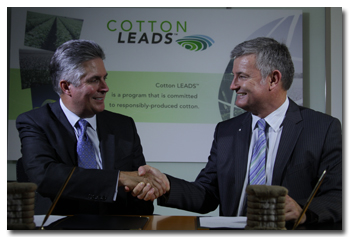
Cotton LEADS™ Raises Awareness Of Responsible U.S., Australian Growing Practices

Cary, N.C.-based Cotton Incorporated; the Memphis, Tenn.-based National Cotton Council of America
and its export promotion program Cotton Council International; and Cotton Australia have come
together to establish Cotton LEADS™ — a program focused on raising awareness of the responsible
cotton production practices among growers in the United States and Australia, which produce some 17
percent of the world’s cotton supply. Targeted to brands, retailers and manufacturers that want to
use responsibly and transparently produced cotton, the program touts the advancements made in the
U.S. and Australia vis-à-vis water and soil conservation, pest management, land use and
biodiversity practices, reduced carbon footprint, and traceability.

“Cotton producers in Australia and the U.S. pioneered practices that have resulted in
impressive country-wide environmental gains,” said Adam Kay, CEO, Cotton Australia. “Both countries
approach improvement on a national level. This includes national reporting and regulatory
enforcement, but also facilitates the national implementation of best practices and the ability to
collect data on a national level.”

“Apparel brands, retailers, and manufacturers require large volumes and a reliable supply of
responsibly produced fiber, as well as proof of responsible production,” said Berrye Worsham,
president and CEO, Cotton Incorporated. “Through Cotton LEADS we demonstrate how cotton grown in
the United States and Australia can help meet these requirements.”

The program is based on five core principles: commitment to social, environmental, economic
and regulatory considerations related to world-class cotton production; recognition of the need for
ongoing improvement, investment, research and sharing of best practices information among growers
and industry; understanding of the importance of collaboration with farm, regional, national and
international programs to bring about more responsible, sustainable cotton practices; belief in the
benefits of cooperation with other similar programs for ensuring cotton’s competitiveness in global
fiber markets; and confidence in a cotton identification system that ensures traceability
throughout the supply chain.


CottonLEADS

Left to right: Cotton Incorporated President and CEO Berrye Worsham and Cotton Australia CEO
Adam Kay celebrate the establishment of the Cotton LEADS™ program to promote the use of responsibly
grown U.S. and Australian cotton by textile brands, retailers and manufacturers.


October 29, 2013

NCTO Applauds The Announcement Of The Textile Enforcement And Security Act

WASHINGTON — October 25, 2013 — The National Council of Textile Organizations (NCTO) applauded the
announcement of the reintroduction of the Textile Enforcement and Security Act (TESA). On October
24th, U.S. Senator Kay Hagan toured the Nonwovens Institute at North Carolina State University and
announced the reintroduction of the bill which seeks to increase U.S. Customs and Border Protection
enforcement activities as well as trade facilitation through improved targeting, increased
resources, and enhanced authority. 

“We applaud Senators Kay Hagan (D-NC) and Lindsey Graham (R-SC) for taking the lead on this
crucial issue.  Strong enforcement of our trade laws is imperative to the preservation of the
over 500,000 U.S. jobs which rely on the domestic textile and apparel industry.  Proper
enforcement of our agreements and trade obligations is a basic necessity, not a luxury in regard to
U.S trade policy.  Legislation such as TESA will help ensure that U.S. workers and
manufacturers have an opportunity to fairly compete in markets both at home and abroad,” said NCTO
President Auggie Tantillo. 

Joining Sen. Hagan at the announcement, NCTO Board Member Jim Chesnutt, Chairman, President,
and CEO of National Spinning in Washington, NC, endorsed the bill by stating “This important
legislation gives U.S. Customs and Border Protection the resources it needs to better enforce the
rules that govern textiles in our free trade agreements.Not only would this bill ensure that we
have more and better trained import specialists at our ports of entry, but it would also create
important programs for tracking textile inputs and the potential bad actors who would skirt our
laws and hurt American workers.” 

The TESA legislation addresses many of the industry’s key concerns by providing U.S. Customs
with expanded authority to better target fraudulent textile and apparel goods coming into the U.S.,
while also giving them additional tools and resources to increase their commercial enforcement
efforts and reduce the prevalence of fraud that creates an uneven playing field for the U.S.
textile industry.

Posted October 29, 2013

Source: NCTO

Radiant Energy Systems Opens Pilot Coating Line

HAWTHORNE, N.J. — October 29 , 2013 — Radiant Energy Systems, Inc. has recently added a second
pilot line to its research and development laboratory. This new pilot coating line is designed for
laminating webs such as nonwovens using powder or web adhesives. Webs run on this line include
films, nonwovens and fabrics.

The line consists of an unwind roll for the primary substrate, a powder adhesive spreader, a
belt to carry the product through an infrared heater to melt the powder, an unwind for the second
web, a laminating nip and a rewind. Webs up to 30″ wide can be run. The line can be rented for any
period of time and customers are encouraged to participate in testing.

Posted October 29, 2013

Source: Radiant Energy Systems Inc.

DuPont Industrial Biosciences, Huntsman Partner In Groundbreaking Cotton Processing Study

Singapore — October 23, 2013 — DuPont Industrial Biosciences, in collaboration with Huntsman
Corporation, announced today the results of a case study that demonstrates the superior performance
of Gentle Power Bleach™, powered by DuPont’s first-to-market enzymatic bleaching technology,
DuPont™ PrimaGreen® EcoWhite. The study, conducted between 2006 and 2012, measured significant
reductions in water use, energy consumption and chemical use coupled with notable increases in
product quality and yield.

Portugal’s Acabamentos Têxteis de Barcelos (ATB), the nation’s leading knitwear dyeing and
finishing specialist and one of the largest textile mills in Europe, introduced this technology to
their facility with the goal of increasing performance while using fewer resources.  According
to a new case study, it worked; between 2006 and 2012, the case study:

  • Measured an increase in production of 3,380 tons in 2006 to 4,409 tons in 2012.
  • Measured a reduction in water usage of 55 cubic meters of water per ton of fabric
    produced.
  • Measured a reduction in use of chemicals per ton of fabric produced: 0.55 in 2012 as opposed to
    0.74 in 2006.
  • A significant reduction in energy consumption (measured since 2009).

“This case study is proof positive that through technology innovation and collaboration,
significant sustainability improvements can be made in textile processing in high-volume production
environments,” said Wayne Ashton, global business leader Home & Personal Care for DuPont
Industrial Biosciences.  “Global competition is stronger than ever and with Portugal facing
seasonal water scarcity and the need to curtail energy consumption, DuPont and Huntsman delivered
maximized productivity while achieving considerable environmental savings.”

Conventional cotton bleaching techniques require a high temperature and large amounts of
caustic chemical additives to modify and neutralize the pH range.  To increase sales and
profitability and reduce environmental impacts, ATB could not simply expand operations using
traditional methods, and the company turned to DuPont and Huntsman’s unique enzyme-based bleaching
system.  This groundbreaking technology allows for low-temperature bleaching of textiles at
65°C in a neutral pH range with less water and energy consumed.”

The textile industry is undergoing a major push toward greater accountability and
sustainability.  At Huntsman, we believe that any product we develop needs to be both
economically and environmentally sustainable,” said Steve Gray, vice president of Marketing and
Strategic Planning.  “The combination of Gentle Power Bleach™ and AVITERA® – our flagship and
environmental award winning tri-active dye, not only helped ATB reduce utility and water
consumption, it has a lower environmental impact and is a clear demonstration of how collaboration
across the textile supply chain can make a positive difference.”

“In order to satisfy our environmental and economic needs, we need to respond to change by
looking at our processes holistically.  Sometimes, this requires us to have a mindset change
and think out of the box to look for a total solution, rather than just changing part of the
process,” said José Carlos, ATB Technical Manager.  “Huntsman Textile Effects is helping us
stay at the cutting edge of innovation, which allows us to differentiate ourselves while being cost
effective.”

Cotton pre-treated with Gentle Power Bleach™ demonstrates a softer, bulkier, more natural
handle with less fabric weight loss. The system also delivers brighter color shades with a higher
color yield and bleaches regenerated cellulosic fibers to full-white levels.

The textile industry is a mainstay of Portugal’s economy, providing employment and export
earnings.  Competition from low-cost overseas manufacturers and weak global demand has pushed
other firms offshore or out of business.  ATB, which processes 35,000 kilograms of fabric
every day, has remained strong with new, innovative technologies.

“Since our foundation, ATB has made the conscious decision to invest in products and
technologies that will help us reduce water consumption while also increasing our capacity through
right-first-time processing,” said Ricardo Mano, ATB administrator.  “To ensure we can
continue to expand in an environmentally responsible way, we needed a partner capable of delivering
high-performance products to address the challenges of processing cotton in modern Portugal.”

Huntsman Textile Effects is the leading global provider of high-quality dyes and chemicals to
the textile and related industries. Sustainability, innovation and collaboration are at the heart
of what we do.  We use cutting-edge technology to develop solutions and create innovative
products with intelligent effects such as built-in freshness, sun protection or state-of-the-art
dyes which reduce water and energy consumption.  All these go toward meeting the needs of our
customers in supporting a more sustainable environment.

With presence in more than 90 countries including eight primary manufacturing facilities in
seven countries (China, Germany, India, Indonesia, Mexico, Thailand, Switzerland) and 14
Formulation Distribution Centers spread across 12 countries, Huntsman Textile Effects is uniquely
positioned to provide fast and expert technical service wherever our customers are based.

DuPont (NYSE: DD) has been bringing world-class science and engineering to the global
marketplace in the form of innovative products, materials, and services since 1802.  The
company believes that by collaborating with customers, governments, NGOs, and thought leaders we
can help find solutions to such global challenges as providing enough healthy food for people
everywhere, decreasing dependence on fossil fuels, and protecting life and the environment. 
For additional information about DuPont and its commitment to inclusive innovation, please visit
www.dupont.com.

Posted October 29, 2013

Source: DuPont Industrial Biosciences and Huntsman Corp.

NatureWorks Introduces Its Next Generation Polymer Grade Lactide

MINNETONKA, Minn. — October 24, 2013 — NatureWorks, the largest producer of biobased lactides,
announced today world scale availability of its new Ingeo™ M700, a high-purity, polymer-grade
lactide rich in meso-lactide. Ingeo M700 has been designed to package and deliver performance and
functionality all in one unique molecule. This is different than previous industry approaches,
which have attempted to deliver the functionality requested by the market with mixtures of two
different materials, L-lactide and D-lactide.

“A few producers have offered what is described chemically as racemic or ‘DL’ lactide,” said
Dr. Manuel Natal, global segment leader for lactide derivatives at NatureWorks. “Compared to those
lactides, Ingeo M700 is a next generation solution in terms of processing efficiency, cost
effectiveness and, in a number of applications, higher end-product performance.” 

Ingeo M700 lactide can be used as an intermediate for copolymers, amorphous resins, grafted
substrates, resin additives and modifiers, adhesives, coatings, elastomers, printing toners,
surfactants, thermosets and solvents. Ingeo M700’s melting point is below 60°C, compared to racemic
lactide’s melting point of nearly 130°C, and L- and D-lactide’s around 97°C. Providing a product
with a lower melting point allows NatureWorks to supply processors with a more effective chemical
intermediate on a number of different levels. For example, because of its lower processing
temperatures, Ingeo M700 offers more energy efficient and generally easier manufacturing processes
to deliver ester functionality and, because it is effectively an anhydrous form of lactic acid,
processors will not have to deal with water when using Ingeo M700.

Ingeo M700 is up to two times more susceptible to ring-opening reactions than L-, D- or
racemic lactides, which can mean less catalyst usage, lower reaction temperatures, faster reaction
time and improved throughput. It can be processed below 80°C, which under most circumstances
eliminates the need to handle expensive solid particles and allows easier processing.

For samples and additional information about Ingeo M700 meso-lactide, contact Dr. Manuel
Natal at (952) 562-3315, or manuel_natal@natureworksllc.com. Follow NatureWorks on Twitter
(@natureworks) for the latest updates. The international Ingeo users’ forum Innovation Takes Root
will be held February 17-19, 2014, in Orlando, Fla.


Posted October 29, 2013

Source: Natureworks LLC

United States Continues To Press Guatemala On Enforcement Of Worker Rights

WASHINGTON, D.C. — October 25, 2013 — United States Trade Representative Michael Froman today
expressed serious concerns about the enforcement of Guatemala’s laws protecting worker rights,
saying that significant work remains to ensure that an Enforcement Plan signed by the Guatemalan
government earlier this year is effectively implemented.  Ambassador Froman recognized
important steps taken by Guatemala under the plan, but communicated to Guatemalan officials today
that the United States expects solid progress in fully implementing the commitments over the next
six months.  If Guatemala fails to comply with the provisions of the Enforcement  Plan,
the U.S. Government retains the right to reactivate an arbitration panel established in the 2011
labor enforcement case brought under the Dominican Republic-Central America-United States Free
Trade Agreement (CAFTA-DR). 


On April 26, 2013, the United States and Guatemala signed the 18-point Enforcement Plan
outlining concrete actions to strengthen labor law enforcement in Guatemala, which Guatemala
committed to implement within six months.  Guatemala has adopted a number of reforms,
consistent with applicable deadlines, but implementation of those reforms is key to improving
worker rights in Guatemala.  While the arbitration panel will not be reconvened at this time,
Ambassador Froman stressed that much work remains to be done to ensure effective
implementation.   

“Guatemala has taken steps to improve enforcement of worker rights, but there is
substantially more progress to be made,” said Ambassador Froman.  “We will continue to work
with the Guatemalan Government and with our partners in the labor movement to ensure the
implementation of Guatemala’s commitments to strengthen labor law compliance.”


The following are among the actions Guatemala has taken to date pursuant to the Enforcement
Plan: 


To enhance its ability to enforce labor laws, the Government of Guatemala:

  • Issued a Ministerial Accord,  concluded an interagency agreement between the Ministry of
    Labor and the Ministry of Interior and issued a directive to the national police to ensure police
    assistance to facilitate labor inspector access to worksites;
  • Hired 100 new inspectors;
  • Submitted draft legislation to Congress for Ministry of Labor authority to issue fine
    recommendations and establish an expedited process for judiciary to adopt Ministry of Labor fine
    recommendations.

To strengthen export companies’ compliance with labor laws, the Government of
Guatemala:

  • Published a Ministerial Accord requiring the Ministry of Labor to conduct annual inspections of
    all enterprises receiving tax benefits under special provisions of Guatemalan law;
  • Published a Ministerial Accord to establish a public comment process as part of its application
    review and to reject new applications for benefits received from companies that are found to have
    violated labor laws;
  • Published a Ministerial Accord to provide for a streamlined process to revoke tax benefits for
    existing beneficiaries that violate labor laws, which requires publication of the enterprises whose
    benefits are withdrawn.

To strengthen the enforcement of court orders:

  • Guatemala’s newly created Verification Unit within the Judiciary established standardized
    procedures and criteria for verifying employer compliance with labor court orders and is verifying
    such compliance;
  • The Judiciary has initiated a systematic review of all labor courts to hold accountable 
    judges who fail to take measures required by law to enforce court orders.

To address payments to workers when enterprises suddenly close, the Government of
Guatemala:

  • Issued a Ministerial Accord requiring the Labor Ministry to intervene upon receiving
    information  of a potential enterprise closure and to take the necessary steps to obtain
    payment to workers if the enterprise closes, including by petitioning relevant labor courts to
    embargo or seize assets;
  • Issued a Ministerial Accord to establish an Inter-Institutional Rapid Response Team to attempt
    to prevent closures of export enterprises receiving tax benefits and to ensure payments owed to
    workers if the closure cannot be prevented.

To increase stakeholder input, the Government of Guatemala:

  • Implemented a tripartite sub-committee with both worker and employer representatives to provide
    input on instruments and procedures issued under the Enforcement Plan.

In announcing that the United States will support continued suspension of the arbitration
panel at this time, Ambassador Froman noted particular areas that require additional and prompt
action from the Guatemalan Government. These areas include making every effort possible to swiftly
pass legislation providing for an expedited process to sanction employers that violate labor laws
and to implement a contingency mechanism to address payment to workers in cases where export
enterprises have closed. Serious efforts are also needed to ensure that the instruments and
procedures issued under the Plan are effectively implemented and enforced. If at any time, during
the next six months, the U.S. government determines that Guatemala is not effectively implementing
the Enforcement Plan, it can request that the panel resume its work.

Posted October 28, 2013

Source: USTR

ICIS Innovation Award Honors Archroma’s Breakthrough Sustainability Service

REINACH, The Netherlands — October 24, 2013 — Archroma, a global leader in color and specialty
chemicals, and the former textile, paper and emulsions businesses of Clariant, today announced that
its ONE WAY sustainability service has been honored with the prestigious ICIS Innovation Award for
Best Business Innovation. The company’s ONE WAY sustainability service is being recognized for its
game-changing approach to textile manufacturing based on the strong conviction that both ecological
and economic benefits are reachable.

Archroma’s ONE WAY was launched in October 2012 to help customers meet their sustainability
targets in a fast and reliable manner. It is a 3-step systematic approach to the selection of
chemicals and production processes that once completed, gives customers calculation results that
assess the cost, performance and environmental profile of the evaluated products and processes.

“We developed this approach with customers, for customers,” says Emrah Esder, Archroma’s Head
of Marketing Chemicals, Textile Specialties Business. “Their input was critical in making ONE WAY a
sustainability service that customers could count on to make their business more successful.”

ONE WAY systematic approach

The first step is: Product Selection, the selection of products based on data on over 200 ONE
WAY products collected and integrated in the “ONE WAY Selector”. All dyes and chemicals included
have been screened by Archroma’s product stewardship specialists against more than 15 eco-standards
and critiera1, which provides instant information access on how each ONE WAY product scores in
terms of toxicological and ecological profile and standards.

The second step is: Process Short Listing, during which textile manufacturers can narrow down
their selection of products to one of four process groups, based on their environmental focus and
how it affects climate, resources, waste water content and volumes.

The third step is: Solution Selection, based on sophisticated software Archroma calls the ONE
WAY Calculator. It assesses the cost, performance and environmental profile of products almost
instantly. Possible measurements with the ONE WAY Calculator include:

  • The cost and performance of a given product process based on relevant parameters such as dyes
    and chemicals, water, energy or time;
  • Their environmental profile based on actual measurements of chemical oxygen demand (COD),
    biological oxygen demand (BOD), CO2 emissions, energy consumption and water usage.

Recognized commitment to sustainability – again

Archroma’s Textile Specialties Business has been recognized for the second time by ICIS.

In 2012, then a Clariant business, Archroma’s Textile Specialties Business was honored with
two ICIS Innovation Awards for its ADVANCED DENIM breakthrough eco-advanced dyeing technology. It
received the ICIS Innovation with Best Environmental Benefit Award and the overall ICIS Innovation
Award.

Posted October 28, 2013

Source: Archroma

ShriVallabh Pittie To Build Spinning Plant In Georgia, Create 250 Jobs

ShriVallabh Pittie Group — an India-based industrial group with textile, finance, real estate,
retail and jewelry businesses — is investing $70 million to build a yarn manufacturing plant near
Sylvania, Ga., and hire 250 employees.

The facility, located at the Screven County Industrial Park, will employ state-of-the-art
machinery to manufacture carded cotton yarn in a variety of counts. The company reports that
production will be flexible to meet market demand.

“We are very excited about this project, which is the biggest single investment in the U.S.
cotton yarn sector in decades,” said Vinod Pittie, chairman, ShriVallabh Pittie Group. “We believe
there is a significant market opportunity for yarn manufacturing in Georgia due to a skilled local
workforce, proximity to high-quality cotton fiber, the economical supply and reliability of power
and world-class infrastructure to international markets. We are proud to generate 250 new U.S. jobs
and to bring a positive economic effect on the local area and its rich cotton textile heritage.”

ShriVallabh Pittie Group was established in 1898, and started its textile business, which
operates under the name Platinum Textiles Ltd., in 2003. Platinum Textiles mainly manufactures
cotton, polyester and blended yarn, and has a considerable presence in India’s textile sector, with
13 manufacturing facilities and 140,000 spindles in operation. The company also recently announced
plans to expand capacity with the addition of 60,000 spindles at its facility in Ramnad, India.

October 22, 2013

Sponsors