Delta Apparel Moves Some N.C. Production To Honduras

Delta Apparel Inc. , Greenville, plans to transfer some of its fabric production for basic T-shirts from its Maiden, N.C., plant to its Ceiba Textiles facility in Honduras, in an effort to lower costs for those products.

The consolidation will reduce fabric production in Maiden by 35 percent and increase it at Ceiba by 8 percent to some 900,000 pounds of fabric weekly. It also is expected to shorten production cycle time and reduce costs by some $1.1 million annually.

The move will result in the loss of 70 jobs at the Maiden plant, which will retain 190 employees to produce fabric for its U.S.-made marketed goods and private-label products along with its Mexico sewing operations.

July/August 2014

Freudenberg Marks 40 Years Of Medical Innovations

Freudenberg Nonwovens, Germany, is celebrating 40 years of medical textile innovations. The company began producing activated carbon filters in the 1970s. These filters are still used in stoma pouches. In the 1980s, it introduced nonwoven pads to adhesive bandages, replacing the knitted pads previously used in such products. During the 1990s, it added antimicrobial finishes to the nonwovens used in adhesive bandages.

Freudenberg has focused recent efforts on advanced wound care — particularly moist wound care, which encourages new tissue to grow while preventing scab formation, and can halve healing time compared to dry healing treatments. The company has engineered nonwovens using chitosan fibers for the moist treatment of chronic wounds. Chitosan, a biopolymer derived from the shells of sea crustaceans, has been shown to stop bleeding and heal wounds faster than other wound-care products.

“One goal for us is to stimulate the human body’s capacity to heal itself following an acute injury,” said Oliver Heneric, Ph.D., head of Freudenberg Nonwovens’ Medical Segment. “And another is to help make life easier for people with chronic wounds, like diabetics.”

Freudenberg credits close, long-standing relationships with its customers for many of its developments.

“We have a close and trusting collaboration with Europe’s leading medical device manufacturers and can offer customers individual product solutions based on our long-standing experience worldwide,” said Bernd Schlesselmann, Ph.D., head of medical nonwovens research and development, Freudenberg Nonwovens.

July/August 2014

PerformanceScrubs.com Moves Cullman Operations To Florence, Ala.

PerformanceScrubs.com — a Nashville, Tenn.-based Performance HealthCare Products Inc. company — has invested $4 million to move its Cullman, Ala., manufacturing operations to a 50,000-square-foot, high-tech manufacturing facility in Florence, Ala., approximately one hour from Cullman. The company is offering all of its Cullman employees jobs at the new facility, and hopes to have at least 50 to 60 positions filled by the end of the year, with plans ultimately to employ three shifts comprising 65 workers each.

The new facility features PerformanceScrubs.com’s high-tech, on-demand manufacturing system that automates and integrates almost every component of the manufacturing process and allows for on-demand customization. The company reports its proprietary workflows and complex software will enable it to manufacture millions of garments in any quantity on-demand while reducing inventory costs and streamlining the supply chain. While the facility initially will focus on manufacturing scrubs and sleepwear, PerformanceScrubs.com says the factory model can produce any type of garment.  

“We’ve spent years planning and designing our comprehensive system that has the potential to revolutionize how clothing is made,” said J. Kirby Best, CEO, PerformanceScrubs.com. “The rich history of garment manufacturing in Florence/Muscle Shoals makes this the ideal location to launch a state-of-the-art facility.”

The company’s medical scrubs and sleepwear are made using moisture-wicking; antimicrobial; wrinkle-, stain- and fade-resistant fabrics manufactured by Spartanburg-based Milliken & Company.

All garments, including components, are 100-percent Made in the USA.


Conveyor lines at PerformanceScrub.com’s Florence, Ala., manufacturing facility are part of the company’s on-demand manufacturing process and systems.

July/August 2014

Surya To Open Facility In Cartersville, Ga., Add 200 Jobs

Surya Inc., India — a manufacturer of machine- and hand-knotted area rugs and soft goods for the home furnishings market — is investing $30 million to open a U.S. corporate office and distribution facility in Cartersville, Ga., and add 200 employees to its U.S. workforce.  

Surya manufactures its products abroad and ships them to the U.S. for sales and distribution. It has showrooms in major U.S. markets as well as in Toronto and India.

The state-of-the-art, 1,000,000-square-foot facility in Cartersville will handle Surya’s supply chain management, sales, and web creative development services. The company currently has a corporate facility in Calhoun, Ga., and reports that 250 jobs will be retained with the opening of the new facility.

 “Our new facility will enable us to consolidate our product offerings under one roof, providing a highly efficient logistics base and the operational flexibility needed to optimally serve our designer and retailer customers,” said Satya Tiwari, president, Surya, noting that the company has grown significantly over the past several years.” The addition of 53,000 square feet of inviting office space, designed with Surya’s energetic and collaborative culture in mind, will provide a great working environment for both existing employees and new talent as we continue to execute on our strategy to become a $1 billion company.”

July/August 2014

Jacob Holm Acquires DuPont™ Sontara® Business

Jacob Holm & Sønner Holding A/S, Switzerland, has agreed to acquire the DuPont™ Sontara® business of DuPont Protection Technologies, Wilmington, Del. The sale, expected to be completed in the third quarter of this year, includes Sontara assets at DuPont sites in Old Hickory, Tenn., and Asturias, Spain; as well as some 240 employees, mostly in the United States and Spain.

Jacob Holm currently has production facilities in Candler, N.C., and France; and employs some 230 workers in the production of spunlaced nonwovens for home care, hygiene and industrial applications. Sontara produces spunlaced nonwovens for medical and wipes applications.

July/August 2014

Quality Fabric Of The Month: Comfort & Safety In The Extreme

By Janet Bealer Rodie, Contributing Editor

Workers involved in hazardous activities such as oil and gas exploration and drilling and utility work in extreme weather environments like those found in Alaska, Canada or North Dakota now have a new outerwear solution that provides protection from the elements as well as from hazards associated with electrical arc flash and flash fire. According to Brian Schmidt, senior category manager for Dearborn, Mich.-based workwear manufacturer Carhartt, the company spent more than two years developing its Carhartt Extremes® Arctic outerwear line comprising a parka, coat, biberall and hood — all meeting NFPA 70E Hazard/ Risk Category 4 (PPE Level 4) requirements and able to shield workers from high winds and temperatures well below zero — even as low as -60°F. The line features Carhartt’s proprietary Wind Shield® wind-resistant technology applied to Mount Vernon Mills’ 9-ounce AMTEX™ PLUS cotton/high-tenacity nylon flame-resistant (FR) canvas fabric, woven by the Mount Vernon FR division in Trion, Ga.
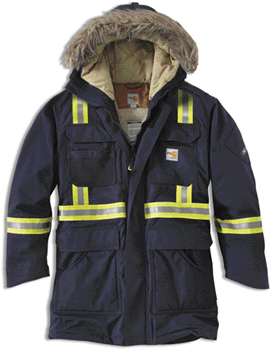
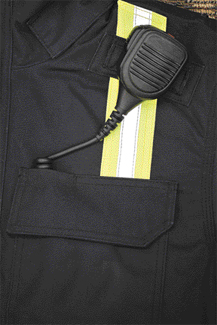

Carhartt’s Extremes® Arctic parka and coat feature special pockets inside and outside to hold tools, and an innovative pass-through port for a radio microphone and cord.

“We did some research with end users in Alaska and determined that their outerwear needed to be warm, comfortable, nonrestrictive and lighter-weight than what’s currently on the market,” Schmidt said. “It also needed to have a great amount of functionality, with pockets to hold tools — specifically, a gas monitor and a radio including microphone and cord.

“The combination of the Amtex Plus canvas with our Windshield technology makes for a really good outerwear fabric,” Schmidt said. “It has a nice drape, moves easily, is not as stiff as comparable fabrics, and yet still feels and looks like what you would expect from Carhartt.”

The FR performance of Amtex Plus is guaranteed for the life of garment. “We use an FR process, not a finish,” explained Craig Tutterow, FR technical director, Mount Vernon FR,. “We saturate the fabric with a monomer that will be polymerized when treated with nitrogen delivered in an ammonia gas, so you get a 3-D polymer chain formed within the fabric. It can’t be washed off, scraped off or blown off — it’s inside, outside and within the fabric.”

The quilted lining in the garments is comprised of lightweight 3M™ FR Thinsulate™ 200-gram platinum insulation and a 6-ounce Amtex Plus twill. There is moisture-wicking Polartec® FR grid fleece on the inside of the coat collar. To further keep the core of the body warm, Carhartt’s FR Sherpa lining helps insulate the wearer’s back.

“A lot of heat is exhausted across the shoulders and down the back,’ Schmidt said, noting that keeping the core of the body warm will help keep the extremities warm. “The Sherpa lining on top of the quilt package provides an additional layer that keeps the back warmer.”

The Carhartt Extremes Arctic line is produced for the North American market in Carhartt’s factory in Mexico.


For more information about Carhartt’s Extremes® Arctic outerwear, contact carhartt.com or mvmfr.com


July/August 2014

Bulletin Board

The Association of Italian Textile Machinery Manufacturers (ACIMIT), Milan, has released a video on its Sustainable Technologies project. The video may be viewed on YouTube.

The Association of the Nonwoven Fabrics Industry (INDA), Cary, N.C., has published “INDA Impact 2014,” its inaugural annual report analyzing industry-wide events that impact the nonwovens industry.

AATCC, the Association of Textile,  Apparel & Materials Professionals, Research Triangle Park, N.C., has released four AATCC Test Method Online Training Videos including Color Evaluation, Colorfastness to Crocking, Colorfastness to Perspiration & Water, and Water Resistance and Repellency.

SGS Consumer Testing Services, Geneva, has released its RAPEX Annual Report 2013 covering notifications on dangerous products in Europe.

Textile Rental Services Association of America (TRSA), Alexandria, Va., has certified 11 textile services plants Hygienically Clean in the quarter ending May 31, 2014.

GSD (Corporate) Ltd., United Kingdom, is offering free practitioner card replacement to GSD Practitioners who have previously been GSD certified and lost their certification credentials. Card holders may initiate a card replacement request by contacting gsdhq.com/contact-us/.

Midland, Mich.-based The Dow Chemical Company’s Dow Microbial Control business unit has launched a Certified Mill Program to recognize textile manufacturers who have successfully completed a training program and demonstrated their proficiency in applying  SILVADUR™ Antimicrobial in their production processes.

The International Oeko-Tex Association, Switzerland, has developed an Application Programming Interface (API) that enables verification of certification data via external online portals and company databases/software.

The Technical Association for the Pulp, Paper, Packaging and Converting Industries (TAPPI), Peachtree Corners, Ga., is accepting nominations through August 1 for the TAPPI 2015 awards.

July/August 2014

Alvanon Launches Virtual AlvaForms

Alvanon Inc., New York City, is introducing a virtual fit form avatar based on its AlvaForm technical fit mannequins.

Garment designs may be fitted on the new Virtual AlvaForms and then manipulated and designed in 3-D environments and shared across the supply chain. The new avatars are designed to help garment suppliers apply an accurate fit and size standard consistently across an entire supply chain; and increase speed of the design-to-market process while offering significant savings in physical fittings and sampling, according to Alvanon.

Virtual AlvaForms are compatible with multiple 3-D fashion design and prototype development systems.

July/August 2014

AATCC Seeks to Revise Dry Cleaning Test Methods

RESEARCH TRIANGLE PARK, N.C. — July 21, 2014 — AATCC, the Association of Textile, Apparel & Materials Professionals, is seeking participation in the revision of AATCC test methods related to dry cleaning.
 
The current perchloroethylene solvent used in several AATCC test methods has been identified as potentially dangerous and is being phased out of use in some regions. AATCC research committee RA43 plans to update the following test methods to include more environmentally friendly solvents:
 

  • Test Method 86-2011 Drycleaning: Durability of Applied Designs and Finishes
  • Test Method 132-2013 Colorfastness to Drycleaning
  • Test Method 158-2011 Dimensional Changes on Drycleaning in Perchloroethylene

 
To participate in these activities, contact Committee Chair Joseph J. Nilsen at +1.215.737.2405 by October 1, 2014.

Posted July 22, 2014

Source: AATCC
 

Klüber Lubrication Obtains ISO 21469 Certification For Its Manufacturing Facilities

LONDONDERRY, N.H. — July 21, 2014 — Klüber Lubrication, a worldwide manufacturer of specialty lubricants, has received the National Sanitation Foundation (NSF) ISO 21469 certification at its Londonderry, N.H., facility. The certification from the NSF ensures food-grade lubricants from Klüber Lubrication are manufactured in a hygienic environment, using both best practices and the safest ingredients. Klüber Lubrication leads the industry with five global locations that are NSF ISO 21469 certified.

ISO 21469 specifies hygiene requirements for the formulation, manufacture, use and handling of lubricants which, during manufacture and processing, can come into incidental contact with products and packaging used in the food, food processing, cosmetics, pharmaceutical, tobacco and animal-feeding-stuffs industries.

The certification specifies requirements to ensure ingredients used in lubricant products are safe and product labels are true and accurate. In addition, it ensures the manufacturer has identified and evaluated relevant hazards associated with the use of the certified lubricant. Furthermore, it confirms quality procedures and good manufacturing practices are followed through production facility audits and analytical testing has verified the integrity of the product composition.

With the certification, Klüber Lubrication is in an ideal position to provide better recommendations to customers on best practices within their own facilities.

“It goes beyond the lubricant formulations being recommended,” says Toby Porter, market manager for the food industry at Klüber Lubrication North America L.P. “With the NSF ISO 21469 certification, these products are being manufactured through a hygienic process that works to avoid risks for contamination. We then offer support on best practices to the end user that include the proper storage, handling and use of these lubricants to further mitigate these types of risks and deliver more than food safety.”

Posted July 22, 2014

Source: Kluber Lubrication North America
 

Sponsors