Polyester Fibers® Acquired By Management Team

The management team of Conover, N.C.-based Polyester Fibers® LLC has acquired the company from Empire Investment Holdings, Miami. JPMorgan Chase, New York City, and Winston-Salem, N.C.-based Salem Investment Partners provided financing for the buyout, the terms of which were not disclosed.

Polyester Fibers manufactures and distributes engineered nonwoven polyester materials for use in automotive, craft, filtration, furniture and bedding, and seasonal applications; and markets its materials in North America, Europe and Asia. The company has nine manufacturing facilities and five business divisions including Tupelo Fibers®, Cameo Fibers®, Cumulus Fibres®, Mountain Mist® and Buffalo Batt®.

“Owning a company with high-quality products and long-standing customer relationships gives us a platform to unleash enormous potential,” said Keith White, president and CEO, Polyester Fibers. “That potential will drive increased market share as we focus on continuous innovation and expansion of our line of quality products to better serve our customers’ needs.”

September/October 2014

ITMA Asia + CITME Breaks Records

ITMA Asia + CITME 2014 closed in Shanghai on June 20 on a positive note for most of the nearly 1,600 companies from 28 countries and regions that exhibited at the five-day show. Exhibition owners and organizers report that some 100,000 visitors from 102 countries and regions walked the 150,000-plus square meters of space in 13 halls at the Shanghai New International Exhibition Centre. More than 20 percent of those visitors came from outside of China, mainly from India, Japan, Taiwan, South Korea, Indonesia and Turkey.

The numbers represent a 7-percent increase over visitorship for the previous show in 2012, and also a higher percentage of international visitors.

In terms of exhibitor numbers at the 2014 show, China was followed by Italy, Germany, Taiwan and Japan. In terms of exhibit space occupied, the country was followed by Germany, Japan, Italy and Switzerland.

As for technologies, the spinning sector led in the amount of exhibit space occupied, followed by washing/dyeing/bleaching/printing/finishing, knitting and weaving.

ITMA Asia + CITME is owned by CEMATEX, the European Committee of Textile Machinery Manufacturers, in partnership with the Sub-Council of Textile Industry, CCPIT (CCPIT-TEX); China Textile Machinery Association (CTMA); and China International Exhibition Centre Group Corp. (CIEC). Organizers include Beijing Textile Machinery International Exhibition Co. Ltd. (BJITME) and Singapore-based MP Expositions Pte Ltd.
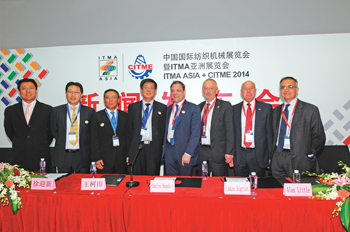
 

ITMA Asia + CITME officials addressed the press at the beginning of the show Left to right: Liang Pengcheng, general manager, BJITME, and secretary general, CCPIT-TEX; Zheng Shijun, vice president, CIEC; Xu Yingxin, executive vice president, CCPIT-TEX; Wang Shutian, president, CTMA; Charles Beauduin, president, CEMATEX; Lukas Sigrist, Ph.D., retired secretary general, Swissmem; Alan Little, director, BTMA; Federico Pellegata, Ph.D., director, ACIMIT.

IPR: Growing Importance Among Chinese Exhibitors
Intellectual property rights (IPR), long an issue among Western textile technology providers and machinery manufacturers, has become increasingly important within the Chinese textile machinery sector as well. During the opening press conference for ITMA Asia + CITME, the show’s organizers stressed that IPR were being rigorously protected and enforced.

“The Chinese manufacturers have developed technology that they want to protect,” remarked CEMATEX President Charles Beauduin when asked about IPR enforcement progress at the 2014 show. “We have received far fewer complaints of IP infractions than before, and we have a good platform to enable resolution of complaints.”

Visitor Mix More Global, But China Still Top Market
European exhibitors interviewed by Textile World noted an increase in international visitors at this year’s show, and also a high visitor quality. In addition to visitors from the countries named above, visitors from Malaysia, Pakistan, Bangladesh, Vietnam, Egypt, Iran, South Africa, Brazil, Argentina, other Latin American countries and Eastern Europe were mentioned.

Many European exhibitors count China as their most important market, and many have built manufacturing plants in China to serve the Asian market. More sophisticated versions of the machines are made in Europe, and even the machines made in Asia may contain components and electronics made in Europe.

Itema S.p.A., Italy, for example, showed two versions of its A9500 air-jet loom: the A9500p premium, which runs at 1,450 to 1,500 revolutions per minute; and the A9500e easy, designed for the Asian market. Itema opened an assembly plant in China in March, and China accounts for 65 percent of A9500 sales, said Marketing & Communications Manager Diana Profir. She also pointed out that Itema produces a lean version of the R9500 rapier loom — the R9000 — in China.

Chinese Market Faces Competition
Although China is still the top market for textile machinery, that business is slowing, several exhibitors said. Switzerland-based Saurer AG CEO Daniel Lippuner said high cotton prices set by China’s government and higher costs are affecting that market, and that India and the United States are strong markets for Saurer’s spinning, winding, twisting and embroidery machinery and components.

Trützschler GmbH & Co. KG, Germany, maker of spinning, nonwovens and man-made fiber machinery as well as card clothing, has a large manufacturing operation in Shanghai that serves mainly customers in China and India, said Jutta Stehr, senior marketing manager, Trützschler Nonwovens & Man-Made Fibers GmbH. At ITMA Asia + CITME, the company showed mainly spinning machinery and also an interactive model showing the various options for a nonwovens line.

To address competition from lower-cost Asian countries, China is shifting to more automation, noted Eva Babbo, sales and marketing representative, Savio Macchine Tessili S.p.A., Italy. All of Savio’s regional sales representatives were on hand at its booth to show the company’s full range of spinning and winding machinery.  

At spinning machinery maker Rieter Group, Switzerland, Edda Walraf, vice president marketing, Spun Yarn Systems, remarked that the Chinese textile industry is facing challenges, noting that larger companies can get financing, while the smaller companies are relying on China’s cotton policy to help them stay afloat. Still, she said Rieter is satisfied with the current business activity.

Oerlikon Manmade Fibers, Germany, was celebrating 50 years of activity in China by its Barmag and Neumag units. The company now has plants in five locations in China and employs some 840 people there.

Carlos Klöti, marketing manager at Jakob Müller AG, Switzerland, was very happy with the show results, noting a good response to the company’s new Müjet® MBJL6 120-centimeter-wide air-jet label weaving machine. Müller has plants in India and China in addition to its European plants.

 

Half of the looms made by Dornier are used for technical textile applications, such as those shown in this diorama in Dornier’s booth, and for protective clothing.

Peter Dornier, CEO, Lindauer Dornier GmbH, Germany, said there is demand for technical textiles in Asia. Half of the weaving machines his company manufactures are used for such applications. Dornier stressed its sustainable technologies and showed technical textiles applications in its booth, and partnered with Stäubli and Bonas to show systems for weaving home textiles and automotive fabrics in their respective booths.

Stäubli, with Jacquard systems headquarters in France and weaving preparation systems headquarters in Switzerland, was present all over the exhibition, as many loom manufacturers included Stäubli systems on their demonstration looms. In its own booth, the company demonstrated its SX Jacquard machine on a Tsudakoma water-jet loom and had several other looms fitted with its Jacquard and dobby systems. Stäubli has been manufacturing in China since 1997.
 
Exhibit Halls More Mixed
There appeared to be a greater mix of European and Chinese exhibitors within the halls than before, perhaps in an effort to attract more visitors to see the Chinese machinery. It was noted that in the past, the European halls were more crowded because buyers prefer the European machinery, which has been perceived to be of higher quality and to offer more innovations than Chinese machinery.

In some halls, machinery sectors were intermingled. For example, some spinning machinery exhibitors found themselves next to weaving machinery exhibitors who didn’t follow expo rules stipulating that the machinery be turned off for part of each hour to allow for some relatively quiet time during which one could conduct business without yelling.

New Venue, Time For 2016
It was announced that ITMA Asia + CITME 2016 will move to a new venue and time of year. The venue, the National Convention and Exhibition Centre in Shanghai’s Hongqiau business district, is under construction and when finished will offer 400,000 square meters of exhibit space. It also will have direct links to both of Shanghai’s airports and its downtown. The 2016 show will be held October 24-28 instead of in June. Organizers noted that Shanghai is cooler in October, but some exhibitors complained that the timing causes logistical problems.

“The late October date is too close to ITME [India Textile Machinery Exhibition], which is held in early December,” said  Erwin Devloo,  marketing communications manager of Belgium-based weaving machinery manufacturer Picanol NV. “This means that we must ship two separate booths because there isn’t enough time to ship from one show to the next.” Other European exhibitors echoed Devloo’s concern.

September/October 2014

RevoLaze Expands Laser Technology Center

RevoLaze LLC, Westlake, Ohio, is expanding its Laser Technology Center with the installation of its newest Linear Processing machine, which offers 5,000 watts of laser power; and a new delivery system for finished garments. The center will enable RevoLaze and its customers to collaborate on product design and process improvements for denim apparel production.

RevoLaze has developed laser technology for denim applications for more than 20 years and holds 29 patents for laser scribing methods used in textile and denim processing.

“Our technologies help denim mills, denim laundries, denim manufacturers and apparel brands realize significant cost reductions, throughput enhancement and design flexibility,” said Darryl Costin, Ph.D., CEO, RevoLaze. He added that in addition to its reduced water and chemical usage, laser technology also replaces sandblasting and hand-sanding processes for finishing denim.

September/October 2014

Brawer Bros. Expands In North Carolina

Brawer Bros. Inc., Hawthorne, N.J., is establishing a new warping, warehousing and distribution facility in Whiteville, N.C., where it is converting an existing building and installing eight or nine conventional warpers to prepare warps for knitters and weavers. Operations at the facility are already underway, with completion of the conversion and installation expected by the end of 2014.

In addition to the Whiteville facility, which is operating under the name Brawer Bros. Inc., the company has two independent affiliated businesses in North Carolina — Warp Technologies Inc. in Holly Springs and New Generation Yarn Corp. in Gibsonville — as well as two affiliates in Pennsylvania — Warp Processing Co. Inc. in Exeter and Middleburg Yarn Processing Co. Inc. in Selinsgrove. Altogether, Brawer Bros. and its affiliates employ some 400 workers. Customers include domestic and overseas knitters and weavers serving both conventional and technical textile sectors.

According to Brawer Bros. CEO Shartel “Skip” Smith, the new facility offers opportunities for further expansion as called for. “This expansion will give Brawer added flexibility and capacity to service and react to its southern-based customers’ needs more quickly and efficiently,” he said.

September/October 2014
 

Yarn Market: Cotton Prices, Consumer Confidence Create Concern

By Jim Phillips, Yarn Market Editor
“The only thing that is constant is change.”
— Heraclitus
6th century BCE

Just when it seemed the yarn industry was in the midst of a sustained period of stability, something changed. In this instance, the change entails a dramatic decrease over the past several months in the price of cotton, which dropped from around 80 cents per pound at the first of June to less than 65 cents per pound on August 20.

To put this in perspective, during the same period last year, the price hovered at about 87 cents per pound.

Coupled with recent reports of declining consumer confidence, industry executives are hedging somewhat on earlier predictions of robust business conditions through the end of the year. “Our business, in general, remains very strong,” said one multinational spinner. “But it’s not a warm and fuzzy feeling because we just don’t know what’s next. Our customers don’t seem to be giving us a lot of confidence about what’s coming up. We’re staying busy, but it is more on a day-to-day, order-to-order basis than it has been in recent times.”

“We have plenty of orders in-house, but they are, for the most part, very short,” added a specialty spinner. “We have the next few weeks booked out but don’t really have a handle on what’s coming in afterwards.”

Consumer confidence in the economy is bouncing around, with surges some months and precipitous drops in others. The Bloomberg Consumer Comfort Index fell to 36.3 in the period ended July 27, the lowest since June 8. Bloomberg reports that a gauge of households’ financial wellbeing dropped by the most since mid-May after reaching an 11-week high. Consumers were also less enthusiastic about the buying climate, a reflection of stagnant paychecks.

And, generally, when consumers become concerned about take-home pay, the first thing to go is discretionary spending on such items as clothing. “We are not ready to push the panic button at all,” said one industry insider. “But we are in a situation that makes caution a prudent approach. With the economic concerns and the issue with cotton prices, now is not the time for us to be aggressive in buying.”

Record Cotton Crop Pushes Prices Down
The U.S. cotton crop is estimated to peak at 17.5 million bales. Even though domestic mill use has remained constant and exports are projected to be up by 500,000 bales, ending stocks are projected to be around 5.6 million bales, or 39 percent of total use. This is the largest stocks-to-use ratio since 2007-08. And while, on the surface, a drop in cotton prices would seem to be favorable for cotton spinners, concern exists about how customers will view the current situation. “Cotton has been artificially overpriced for some time,” said one spinner. “It is not worth 90 cents per pound or more, but China’s cotton policy has kept the price higher than it should have been. At the same time, it is worth, historically, more than 60 cents per pound. But customers are likely to look at prices now and wonder whether, given the huge crop, they will drop even further. We need to be cautious until we see where this will bottom out.”

In the long run, if prices hold below 80 cents, spinners say cotton market share could rebound. “Over the past few years, since the market went crazy in 2010, more and more customers have turned to blends to protect against the volatility of cotton prices and the potential lack of supply,” said one spinner. “T-shirts that have always been 100-percent cotton, for example, are now cotton-poly blends. And consumers seem to prefer — or at least accept — this change. A permanent correction in the cotton market could be good for all involved. But, again, we are just going to have to wait and see how things ultimately shake out.”

Another concern is that, with end stocks so large, farmers will turn to other crops, such as corn and soybeans. “If cotton farmers can’t make money, they won’t plant cotton. And that, in turn, could create yet another topsy-turvy market situation,” said another spinner.

The pertinent question is whether new market dynamics will bring the recent period of stability to a screeching halt — or will they herald the onset of an even more prosperous period? The answers from most spinners are similar, as summed up by this industry expert: “My crystal ball is a little cloudy at the moment. Ask me again in three months.”

September/October 2014

Freudenberg Acquires Hänsel Textil’s Interlinings Business

Freudenberg Nonwovens, Germany, has purchased Germany-based Hänsel Textil GmbH’s Hänsel brand interlinings business, including related brands and patents, as well as knit fabric production plants and distribution companies in Italy, Romania, Bulgaria, Sri Lanka and Germany. Freudenberg will retain some 90 Hänsel production and sales associates.

Hänsel’s specialty interlinings include horsehair canvas, multi-zone interlinings, and ultralightweight woven and knitted apparel interlinings. Hänsel also develops textiles with special characteristics suited to withstand the rigors of specific manufacturing processes such as garment dyeing, enzyme washing and low-melting-point coating processes.

 “With the textile interlinings used throughout the fashion industry, we are extending our comprehensive portfolio and our know-how in the field of knitted fabrics in a future-oriented manner,” said Bruce Olsen, spokesman for Freudenberg Nonwovens’ Management Board. Olsen added that he sees benefits in logistics and purchasing synergies.

September/October 2014

People

Picanol NV, Belgium, has appointed Tom Johnston sales manager, Picanol of America.

The Secretariat of the Washington-based International Cotton Advisory Committee (ICAC) has named Lorena Ruiz economist.

Westerly, R.I.-based Darlington Fabrics, a division of The Moore Company, has added David Turk to its sales team.

Italy-based Itema S.p.A. has named Steve Brown sales manager of Itema America Inc.; and Lorenzo Minelli research & innovation director, ItemaLab.

Culp Inc., High Point, N.C., has named Boyd Chumbley executive vice president, Upholstery Fabrics Division.

Safe Reflections, St. Paul, Minn., has named Cedra Garcia global account manager.

Switzerland-based Santex Group has named Marco Tecchio CEO, Santex Group and Santex AG; and Heinz Michel president, Santex AG.

The Research Triangle Park, N.C.-based American Association of Textile Chemists and Colorists (AATCC) has awarded scholarships to the following students: Charles H. Stone Scholarship — Alyx Kahn, Kristin Smithgall, Nicholas Cone and Devin Harkins, Clemson University, and Chase Pfendler, North Carolina State University (NCSU); Charles E. Gavin III Family Scholarship — Brittany Sipin and Matthew Lopez, Auburn University; Color Solutions International Textile and Apparel Design Scholarship — Cierra Hoover, NCSU, and Christine Petroni, Bucks County Community College; and Metro Scholarship — Jasmine Sousa, University of  Rhode Island, and Blaze Javier Mendela, Fashion Institute of Technology (FIT).

Aurora Specialty Textiles Group Inc., Aurora, Ill., has promoted Marcia Ayala to vice president, research and development.

Finland-based Suominen Corp. has named Dan Dunbar vice president, sourcing.

September/October 2014

TTU Researchers Develop Super-absorbent Cotton Mat

Researchers at Texas Tech University (TTU), Lubbock, Texas, have engineered an absorbent mat using low-grade cotton that can collect up to 50 times its weight in oil. Seshadri Ramkumar, Ph.D., Department of Environmental Toxicology, TTU, led the research project, assisted by doctoral student Vinitkumar Singh. Scientists from Cotton Incorporated, Cary, N.C., as well as researchers from TTU’s departments of Mechanical Engineering and Environmental Toxicology also participated. The team tried to develop a fundamental understanding behind the effect of fiber structure and basic cotton characteristics on oil sorption capacity of unprocessed raw cotton, as well as examine the basic mechanisms behind oil sorption by nonwoven cotton webs.

The project was initiated following the 4.9 million-barrel crude oil spill in the Gulf of Mexico in 2010. “This incident triggered our interest in developing environmentally sustainable materials for environmental remediation,” Ramkumar said. “In this study, we have used low-grade cotton as well as mature cotton, and it was observed that low-grade cotton performs better than regular mature cotton in the oil sorption capacity.”

The research team hopes to bring the cotton batts to market within 12 months.

September/October 2014

TENCEL® Jumbo Plant Comes On-Line

Lenzing Group, Austria, has begun production at its TENCEL® jumbo manufacturing facility in Lenzing, Austria. The 150 million-euro facility, the largest worldwide, is now ramping up production, which is expected to be fully implemented within the originally planned 24-month timeframe.

“We are optimistic that we will be able to achieve the planned production target of 30,000 tons by the end of 2014,” said Lenzing COO Friedrich Weninger. “This new TENCEL® facility is decisive to ensure the long-term viability of fiber production at the Lenzing site and the basis for future investments in all markets.”

The production line at the new facility, which employs 140 workers, has an annual nominal production capacity of 67,000 tons and enables Lenzing to raise total annual Tencel production capacity from 155,000 tons to some 220,000 tons. The company reports that the startup of the facility provides expansion opportunities for its customers in the textile and nonwovens segments alike, in addition to enabling development of new applications including technical applications.

September/October 2014

Bayer MaterialScience Debuts INSQIN™ Coating Solution

Bayer MaterialScience, Germany, now offers INSQIN™ technology for solvent-free production of polyurethane (PU) leather and other PU coated fabrics, which are used to make shoes, bags and apparel. Brand owners may work with Bayer technicians on the company’s pilot lines in China and Germany and use the INSQIN technology in the design and development of products with improved environmental performance.

Bayer expects INSQIN particularly will benefit Chinese PU fabric makers, which produce 90 percent of the 4 billion-plus square meters of PU leather produced annually. The solvent-free technology reduces coating process water usage by up to 95 percent and energy usage by up to 50 percent.

Bayer’s INSQIN Partner Manufacturer Program includes a list of manufacturers that comply with its  technology application standards.

September/October 2014

Sponsors