Buhler Quality Yarns Corp. Taps PJ McCord As New Sales Executive

JEFFERSON, Ga. — September 3, 2014 — Buhler Quality Yarns Corp. has brought on PJ McCord as the newest addition to its renowned sales team. McCord brings his experience to Buhler after several successful years as the Global Sales Manager for Coats Plc, where he was directly responsible for sales to U.S. Brands who source, manufacture and contract business worldwide.

McCord is responsible for significant success in growing textile business between the U.S. and Latin American countries, developing key contacts and building strong partnerships with garment producers across international borders. His work with sourcing and product development managers has delivered bills of materials which assure his clients’ products have been manufactured with the highest quality standards.

“We are very excited to have someone with PJ’s background and experience join the Buhler team,” said David Sasso, vice president of sales, Buhler. “His contacts within the garment manufacturing business are a strong addition and compliment to the total supply chain knowledge Buhler Quality Yarns has established. We look forward to introducing PJ to our loyal partners throughout the industry.”

Posted September 9, 2014

Source: Buhler Quality Yarns
 

Looking Ahead: Preparing For A Global Economy

The economy of the last several decades can be described in a single word: global. With the development of the European Union and enhanced trade agreements around the world, the market can be easily described as moving in the direction of international coordination. Rooted in the history of Royal Ten Cate NV as an international company, TenCate Protective Fabrics of North America has recognized this trend and strategically focused a portion of its efforts on growing its global business development.

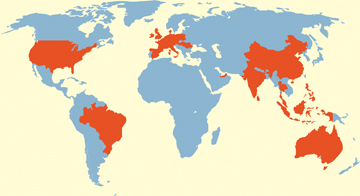
Supported by still rapidly growing success in the domestic market, TenCate Protective Fabrics confidently introduces its proven products along with specialized products to the global market through representatives and sales offices in the Americas, Europe, the Middle East and the Asia Pacific region.


TenCate Protective Fabrics serves a global market with manufacturing facilities, sales offices and representatives in the Americas, Europe and Asia.

TenCate’s Team
While promoting the advantages of TenCate products, the international business development team also places priority on learning about the various international environments and the specific needs for protective materials in each territory. With a deep understanding of the motivations and true needs of the end-users in a particular region, TenCate Protective Fabrics works to provide specific innovative solutions that address the environmental conditions and cultural preferences for the region. A solution may sometimes be a current offering of the company or, in other cases, an adaptive solution suited to the particular requirement.

Tailoring Comfort And Protection And Performance
Australian Fire Service brigades presented an interesting challenge with regards to desired attributes in an outer shell to address high temperatures of the environment and a need for optimal flexibility. After discussions with end-users and turnout manufacturers in the region, TenCate developed Gemini® XTL to satisfy this demanding requirement. The fabric is a lighter-weight alternative turnout fabric for markets that face hot and/or humid conditions that make comfort a more serious issue Firefighting brigades in Australia and New Zealand now have an outer shell specifically engineered to ensure their protection and comfort while they safeguard their communities.

In developing regions, there have been a number of requests for an antistatic fabric to combat local risks in daily activities. End-users in those areas displayed a great deal of interest in TenCate Tecasafe® Plus; however, they expressed the need for an antistatic component. Internal conversations then led the way to the introduction of TenCate Tecasafe Plus StaticSHIELD, which was geared toward the new end-users and furthered the mission of creating a global brand.

Living Up to the Standard
International expansion brings new opportunities every day to exercise inventive problem-solving as TenCate Protective Fabrics advances into unfamiliar markets and grows with emerging markets. For example, as a country or region develops a unique set of standards, TenCate responds by dedicating resources to certify its own product line to the specifications in support of the individualized safety standard. These activities result in an internationally certified product line equipped to protect end-users around the world. Additionally, as a well-known market leader, TenCate Protective Fabrics is looked upon by companies in new safety markets as a source of the most up-to-date information and resources in personal safety.

The support of in-house research on test methods, investigation of new technologies and innovation of creative solutions make international growth possible at TenCate Protective Fabrics. “Teamwork is a crucial component to international growth,” said Chris Corner, senior director of international business development. “Without the strong network of finance, technical, operations, human resources, customer service and marketing departments, efforts aimed at international development would fall short.”

Leading The Way
As the world is constantly developing and the flame-resistant fabric community is becoming stronger through global initiatives and enhanced communication, TenCate Protective Fabrics is demonstrating leadership and commitment to innovation through facilitating adaptive growth and promoting its specialized products on an international forum.

September/October 2014

Focusing On Innovation

In any technological industry where innovation carries real weight, companies have to be careful not to get bogged down in clichés and buzzwords at the expense of real achievements. TenCate Protective Fabrics of North America puts achievement first. It would be all too easy to talk about thinking outside the box or exploring a new paradigm shift, but real innovation isn’t borne out of a need to enhance or embellish a corporate image, it’s borne out of the needs of the market. The technical textiles market brooks little embellishment and looks down on unkept promises about performance and protection.

“When someone’s safety is at stake, there’s no room for smoke and mirrors or snake oil. Results speak louder than promises and sales pitches,” said Mike Allen, senior director of marketing. “Protecting people is what TenCate Protective Fabrics does, and the company has the experience to do it right.”


Seventy percent of all firefighters in the United States wear turnout gear made with TenCate’s inherently flame-resistant outer-shell fabrics.

Southern Mills Heritage
Originally founded in 1925 as Southern Mills, based in Union City, Ga., the company was privately owned. Southern Mills had worked closely with Ten Cate Protect, the industrial fabric business of Royal Ten Cate NV, on several joint projects through the years, until it was decided that Royal Ten Cate would acquire Southern Mills. The sale was completed in 2004, and Southern Mills became TenCate Protective Fabrics of North America.

As a division of Royal Ten Cate, which is headquartered in Almelo, the Netherlands, TenCate Protective Fabrics can tap a well of textile technological knowledge that remains virtually unmatched in a worldwide market. TenCate Protective Fabrics holds more than two dozen patents and has a long history of cutting-edge achievement. The company maintains four manufacturing facilities, all within an hour of the corporate office in Union City.

TenCate Protective Fabrics has a history that reaches back 90 years in textile manufacturing. From its founding in 1925, the company began to make new advances and establish a foothold in the textile market. Starting with fabric for automotive seat covers, TenCate then provided fabrics for the dry-cleaning industry for use in ironing pad covers and presses. By using heat-resistant fabrics for these applications, the company began moving toward the more technically advanced flame-resistant (FR) fabrics that were yet to come.

“For 45 years, TenCate Protective Fabrics has been in the business of engineering, testing and manufacturing FR fabrics for firefighters, industrial workers, military personnel and other first responders,” said Daniel Hauert, president, TenCate Protective Fabrics. “Over those years, the company has gained the knowledge and honed the skills required to become the world’s leading supplier of inherently FR fabrics.”


TenCate Defender® M fabrics have provided the U.S. military with a viable FR solution to protect combat troops from serious burn injuries in the field.

Markets Served
TenCate Protective Fabrics serves the emergency-response, industrial, and military markets. The Commercial division handles the emergency-response and industrial markets, while TenCate Defense and Tactical handles military sales.

Fire service FR fabrics are the backbone of commercial sales for TenCate. In the industrial market, new fabrics like TenCate Tecasafe® Plus have made huge headway in challenging the stagnation and complacency of an industry that still relies on old textile technology for protection. For the military market, TenCate Defender® M has provided a unique solution combining FR protection with comfort.

A First In Turnout Gear
Today, 70 percent of all firefighters in the United States wear turnout gear made with TenCate outer-shell fabrics. The company works hard to make sure that firefighters are well-protected in the harsh conditions they must face.

It was in 1969 that TenCate became the first company to make protective aramid fabrics for the fire service, and the focus on FR began in earnest. The next year, the company became the first manufacturer to supply outer-shell FR fabric, to a fire department in Cleveland. After great success with outer shells for the fire service, TenCate began to quilt and sell spunlaced aramid thermal barriers for use in firefighter turnout gear. In 1982, it began supplying flame-resistant, protective fabric for U.S. Forest Service garments to be used by wildland firefighters.

TenCate continued to develop new and exciting fabrics for turnout gear, including such well-known and trusted fabrics as Kombat™, comprising a blend of DuPont™ Kevlar® and PBI®; and Advance™, a blend of Kevlar and DuPont Nomex®. More traditional fiber blends gave way to newer and more inventive combinations that set the bar a bit higher with each new product. Names like TenCate Ultra™ blend with Kevlar, Gemini™ XT with PBI and Kevlar, and Millenia™ XT Kevlar and polybenzobisoxazole (PBO) became synonymous with protection.

TenCate has always had a firm hold in the fire service market, but other avenues of exploration have been open as well. Taking advantage of a state-of-the-art laboratory and testing facility, the company has made a habit of innovation. By continually seeking out new and better fiber blends that would satisfy the needs of the market, fabrics have been developed that could be very highly specialized for specific end-uses.

Flash Protection
The industrial market demanded FR fabrics that were lighter and cooler but would still provide protection. TenCate responded with the development of Tecasafe Plus, a truly smart and innovative textile that provided FR protection from flash fire and arc flash hazards. By using natural fibers from a completely sustainable source and creating a unique blend, Tecasafe Plus became a one-of-a-kind FR solution that gave linemen, oil and gas workers, and electrical technicians the protection they needed and the comfort they demanded.

“Tecasafe Plus was a giant leap forward in the design and manufacture of inherently FR textiles, said Charles Dunn, Ph.D., senior director of product innovation. “By opening the door to new ideas and fresh approaches, TenCate showed the market that there is more than one way to skin a cat.”

DefendingTroops With Defender® M
For the military market, expansion is survival. Fabric developments that result from input straight from the end-users ensure that the products TenCate makes will answer definite needs in the marketplace. When U.S. forces in Iraq and Afghanistan began encountering improvised explosive devices, the Department of Defense realized there was a problem. The U.S. armed forces had no experience in dealing with serious burn injuries in the field and needed a viable FR solution. TenCate Defender M, a blend comprising predominantly Lenzing FR® cellulosic fiber reinforced with para-aramid and nylon, has been shown to reduce second- and third-degree burns by 30 to 45 percent when compared with FR fabrics containing modacrylic or cotton/nylon blends.

“Most importantly, the Defender M FR ACU is saving soldiers’ lives,” said Lt. Col. John Lemondes, U.S. Army Product Manager, Clothing and Individual Equipment. “I am proud to consider TenCate a partner in our efforts to provide soldiers with the best clothing and individual equipment possible.”

Gains In Comfort
Tecasafe Plus, Defender M and other TenCate FR fabrics now offer Coolderm Technology. “Fabrics with TenCate Coolderm Technology contain the right balance of hydrophilic and hydrophobic fibers, making moisture management easier on the wearer and keeping them cooler and drier,” said TenCate Performance Fabrics Group Director Don Olsen. “It has become a cross-market innovation that is used in all three segments: fire service; industrial; and military.

“TenCate will continue to focus on producing technical textiles that make protection and comfort inseparable,” Olsen added. “The goal is to create a concept in the market that TenCate is synonymous with all these key attributes in FR fabrics.”

September/October 2014

Brawer Bros. Expands In North Carolina

Brawer Bros. Inc., Hawthorne, N.J., is establishing a new warping, warehousing and distribution facility in Whiteville, N.C., where it is converting an existing building and installing eight or nine conventional warpers to prepare warps for knitters and weavers. Operations at the facility are already underway, with completion of the conversion and installation expected by the end of 2014.

In addition to the Whiteville facility, which is operating under the name Brawer Bros. Inc., the company has two independent affiliated businesses in North Carolina — Warp Technologies Inc. in Holly Springs and New Generation Yarn Corp. in Gibsonville — as well as two affiliates in Pennsylvania — Warp Processing Co. Inc. in Exeter and Middleburg Yarn Processing Co. Inc. in Selinsgrove. Altogether, Brawer Bros. and its affiliates employ some 400 workers. Customers include domestic and overseas knitters and weavers serving both conventional and technical textile sectors.

According to Brawer Bros. CEO Shartel “Skip” Smith, the new facility offers opportunities for further expansion as called for. “This expansion will give Brawer added flexibility and capacity to service and react to its southern-based customers’ needs more quickly and efficiently,” he said.

September/October 2014
 

Yarn Market: Cotton Prices, Consumer Confidence Create Concern

By Jim Phillips, Yarn Market Editor
“The only thing that is constant is change.”
— Heraclitus
6th century BCE

Just when it seemed the yarn industry was in the midst of a sustained period of stability, something changed. In this instance, the change entails a dramatic decrease over the past several months in the price of cotton, which dropped from around 80 cents per pound at the first of June to less than 65 cents per pound on August 20.

To put this in perspective, during the same period last year, the price hovered at about 87 cents per pound.

Coupled with recent reports of declining consumer confidence, industry executives are hedging somewhat on earlier predictions of robust business conditions through the end of the year. “Our business, in general, remains very strong,” said one multinational spinner. “But it’s not a warm and fuzzy feeling because we just don’t know what’s next. Our customers don’t seem to be giving us a lot of confidence about what’s coming up. We’re staying busy, but it is more on a day-to-day, order-to-order basis than it has been in recent times.”

“We have plenty of orders in-house, but they are, for the most part, very short,” added a specialty spinner. “We have the next few weeks booked out but don’t really have a handle on what’s coming in afterwards.”

Consumer confidence in the economy is bouncing around, with surges some months and precipitous drops in others. The Bloomberg Consumer Comfort Index fell to 36.3 in the period ended July 27, the lowest since June 8. Bloomberg reports that a gauge of households’ financial wellbeing dropped by the most since mid-May after reaching an 11-week high. Consumers were also less enthusiastic about the buying climate, a reflection of stagnant paychecks.

And, generally, when consumers become concerned about take-home pay, the first thing to go is discretionary spending on such items as clothing. “We are not ready to push the panic button at all,” said one industry insider. “But we are in a situation that makes caution a prudent approach. With the economic concerns and the issue with cotton prices, now is not the time for us to be aggressive in buying.”

Record Cotton Crop Pushes Prices Down
The U.S. cotton crop is estimated to peak at 17.5 million bales. Even though domestic mill use has remained constant and exports are projected to be up by 500,000 bales, ending stocks are projected to be around 5.6 million bales, or 39 percent of total use. This is the largest stocks-to-use ratio since 2007-08. And while, on the surface, a drop in cotton prices would seem to be favorable for cotton spinners, concern exists about how customers will view the current situation. “Cotton has been artificially overpriced for some time,” said one spinner. “It is not worth 90 cents per pound or more, but China’s cotton policy has kept the price higher than it should have been. At the same time, it is worth, historically, more than 60 cents per pound. But customers are likely to look at prices now and wonder whether, given the huge crop, they will drop even further. We need to be cautious until we see where this will bottom out.”

In the long run, if prices hold below 80 cents, spinners say cotton market share could rebound. “Over the past few years, since the market went crazy in 2010, more and more customers have turned to blends to protect against the volatility of cotton prices and the potential lack of supply,” said one spinner. “T-shirts that have always been 100-percent cotton, for example, are now cotton-poly blends. And consumers seem to prefer — or at least accept — this change. A permanent correction in the cotton market could be good for all involved. But, again, we are just going to have to wait and see how things ultimately shake out.”

Another concern is that, with end stocks so large, farmers will turn to other crops, such as corn and soybeans. “If cotton farmers can’t make money, they won’t plant cotton. And that, in turn, could create yet another topsy-turvy market situation,” said another spinner.

The pertinent question is whether new market dynamics will bring the recent period of stability to a screeching halt — or will they herald the onset of an even more prosperous period? The answers from most spinners are similar, as summed up by this industry expert: “My crystal ball is a little cloudy at the moment. Ask me again in three months.”

September/October 2014

Freudenberg Acquires Hänsel Textil’s Interlinings Business

Freudenberg Nonwovens, Germany, has purchased Germany-based Hänsel Textil GmbH’s Hänsel brand interlinings business, including related brands and patents, as well as knit fabric production plants and distribution companies in Italy, Romania, Bulgaria, Sri Lanka and Germany. Freudenberg will retain some 90 Hänsel production and sales associates.

Hänsel’s specialty interlinings include horsehair canvas, multi-zone interlinings, and ultralightweight woven and knitted apparel interlinings. Hänsel also develops textiles with special characteristics suited to withstand the rigors of specific manufacturing processes such as garment dyeing, enzyme washing and low-melting-point coating processes.

 “With the textile interlinings used throughout the fashion industry, we are extending our comprehensive portfolio and our know-how in the field of knitted fabrics in a future-oriented manner,” said Bruce Olsen, spokesman for Freudenberg Nonwovens’ Management Board. Olsen added that he sees benefits in logistics and purchasing synergies.

September/October 2014

People

Picanol NV, Belgium, has appointed Tom Johnston sales manager, Picanol of America.

The Secretariat of the Washington-based International Cotton Advisory Committee (ICAC) has named Lorena Ruiz economist.

Westerly, R.I.-based Darlington Fabrics, a division of The Moore Company, has added David Turk to its sales team.

Italy-based Itema S.p.A. has named Steve Brown sales manager of Itema America Inc.; and Lorenzo Minelli research & innovation director, ItemaLab.

Culp Inc., High Point, N.C., has named Boyd Chumbley executive vice president, Upholstery Fabrics Division.

Safe Reflections, St. Paul, Minn., has named Cedra Garcia global account manager.

Switzerland-based Santex Group has named Marco Tecchio CEO, Santex Group and Santex AG; and Heinz Michel president, Santex AG.

The Research Triangle Park, N.C.-based American Association of Textile Chemists and Colorists (AATCC) has awarded scholarships to the following students: Charles H. Stone Scholarship — Alyx Kahn, Kristin Smithgall, Nicholas Cone and Devin Harkins, Clemson University, and Chase Pfendler, North Carolina State University (NCSU); Charles E. Gavin III Family Scholarship — Brittany Sipin and Matthew Lopez, Auburn University; Color Solutions International Textile and Apparel Design Scholarship — Cierra Hoover, NCSU, and Christine Petroni, Bucks County Community College; and Metro Scholarship — Jasmine Sousa, University of  Rhode Island, and Blaze Javier Mendela, Fashion Institute of Technology (FIT).

Aurora Specialty Textiles Group Inc., Aurora, Ill., has promoted Marcia Ayala to vice president, research and development.

Finland-based Suominen Corp. has named Dan Dunbar vice president, sourcing.

September/October 2014

TTU Researchers Develop Super-absorbent Cotton Mat

Researchers at Texas Tech University (TTU), Lubbock, Texas, have engineered an absorbent mat using low-grade cotton that can collect up to 50 times its weight in oil. Seshadri Ramkumar, Ph.D., Department of Environmental Toxicology, TTU, led the research project, assisted by doctoral student Vinitkumar Singh. Scientists from Cotton Incorporated, Cary, N.C., as well as researchers from TTU’s departments of Mechanical Engineering and Environmental Toxicology also participated. The team tried to develop a fundamental understanding behind the effect of fiber structure and basic cotton characteristics on oil sorption capacity of unprocessed raw cotton, as well as examine the basic mechanisms behind oil sorption by nonwoven cotton webs.

The project was initiated following the 4.9 million-barrel crude oil spill in the Gulf of Mexico in 2010. “This incident triggered our interest in developing environmentally sustainable materials for environmental remediation,” Ramkumar said. “In this study, we have used low-grade cotton as well as mature cotton, and it was observed that low-grade cotton performs better than regular mature cotton in the oil sorption capacity.”

The research team hopes to bring the cotton batts to market within 12 months.

September/October 2014

TENCEL® Jumbo Plant Comes On-Line

Lenzing Group, Austria, has begun production at its TENCEL® jumbo manufacturing facility in Lenzing, Austria. The 150 million-euro facility, the largest worldwide, is now ramping up production, which is expected to be fully implemented within the originally planned 24-month timeframe.

“We are optimistic that we will be able to achieve the planned production target of 30,000 tons by the end of 2014,” said Lenzing COO Friedrich Weninger. “This new TENCEL® facility is decisive to ensure the long-term viability of fiber production at the Lenzing site and the basis for future investments in all markets.”

The production line at the new facility, which employs 140 workers, has an annual nominal production capacity of 67,000 tons and enables Lenzing to raise total annual Tencel production capacity from 155,000 tons to some 220,000 tons. The company reports that the startup of the facility provides expansion opportunities for its customers in the textile and nonwovens segments alike, in addition to enabling development of new applications including technical applications.

September/October 2014

Bayer MaterialScience Debuts INSQIN™ Coating Solution

Bayer MaterialScience, Germany, now offers INSQIN™ technology for solvent-free production of polyurethane (PU) leather and other PU coated fabrics, which are used to make shoes, bags and apparel. Brand owners may work with Bayer technicians on the company’s pilot lines in China and Germany and use the INSQIN technology in the design and development of products with improved environmental performance.

Bayer expects INSQIN particularly will benefit Chinese PU fabric makers, which produce 90 percent of the 4 billion-plus square meters of PU leather produced annually. The solvent-free technology reduces coating process water usage by up to 95 percent and energy usage by up to 50 percent.

Bayer’s INSQIN Partner Manufacturer Program includes a list of manufacturers that comply with its  technology application standards.

September/October 2014

Sponsors