
May/June 2017
May/June 2017
 By Jim Phillips, Yarn Market Editor
Spinners report orders continued to improve in May, with some yarns in particularly high demand.
“We are seeing demand for ring-spun and air-jet yarns pick up significantly,” said one spinner. “Inquiries and orders have been on the rise since March, and we are optimistic that the slump we experienced is over.”
Another spinner reported high interest in some specialty yarns. “Business has been increasing across the board,” said one specialty spinner. “If there is one area we continue to be disappointed in, it would be in yarns for home furnishings, which have not come back as strong as we expected.”
A yarn broker noted interest in blends continues to be high among some of his customers. “These folks went to blends a few years ago when the price of cotton got so high. They liked what we gave them and have had, to this point, no desire to go back.”
Despite the uptick in business, orders for some spinners remain smaller than they would like. “It has been this way for some time,” said one spinner. “Orders are smaller than they used to be. Volatility of pricing and demand, and fear of a sudden economic downturn, makes customers afraid to order any more than they absolutely have to have.”
“Business is stronger at this point than we expected,” said another spinner. “But most of the orders we have are in relatively small volumes. We keep hearing that a lot of program business that left in anticipation of a completed TPP (Trans-Pacific Partnership) is coming back to this hemisphere now that TPP is off the table. But we have yet to see it to any significant degree.”
For the most part, spinners are satisfied with where they are at this point in the year. “We got off to a slow start this year, but business is now in line with our expectations. It’s not the best it’s ever been, but it is better than it was. Last year was disappointing, and so was the beginning of this year. But things seem to be getting back to normal.”
One reason for optimism is the continued high consumer confidence in the future of the U.S. economy. The Consumer Confidence Index, published by the Confidence Board, reached its highest level in March since December 2000. Despite a slight decline in April, the Board reports that consumer confidence remains high.
“Consumer confidence declined in April after increasing sharply over the past two months, but still remains at strong levels,” said Lynn Franco, Director of Economic Indicators at The Conference Board. “Consumers assessed current business conditions and, to a lesser extent, the labor market less favorably than in March. Looking ahead, consumers were somewhat less optimistic about the short-term outlook for business conditions, employment and income prospects. Despite April’s decline, consumers remain confident that the economy will continue to expand in the months ahead.”
“Consumer confidence is a critical factor is our business,” said one yarn executive. “Most textile products are discretionary buys, and when consumers are scared or uncertain, they buy only what is absolutely necessary. So when consumer confidence is high for an extended period, it generally means good things for our business.”
Average quotations for the base quality of cotton (color 41, leaf 4, staple 34, mike 35-36 and 43-49, strength 27.0-28.9, uniformity 81.0-81.9) in the seven designated markets measured by the USDA averaged 74.33 cents per pound for the week ending May 11, 2017. The weekly average was down from 75.69 the previous week, but up from 59.26 cents reported for the corresponding period a year ago. Spot transactions reported in the Daily Spot Cotton Quotations for the week ended May 11 totaled 3,507 bales. This compares to 838 bales reported the previous week and 7,555 spot transactions reported for the corresponding week a year ago. Total spot transactions for the season were 1,556,676 bales compared to 1,432,122 bales for the corresponding week a year ago. The ICE July settlement prices ended the week at 79.18 cents, compared to 78.91 cents the previous week.

May/June 2017

Encouraged by exhibitor and visitor feedback, Techtextil North America locates in the Midwest for the first time.
TW Special Report
Registration is open for the 14th edition of Techtextil North America, which will be held June 20-22, 2017, at McCormick Place, Lakeside Center in Chicago. The show is produced by Atlanta-based Messe Frankfurt and focuses on all vertical aspects of the technical textiles industry.
The 2015 edition of the show held in Houston attracted 145 exhibitors from 18 countries and more than 2,800 visitors. As of Textile World’s press time, show organizers reported 151 exhibitors had committed to participate in 2017, which confirms Chicago as the largest Techtextil event to be held in North America outside of Atlanta, where the show is located every other year.
When announcing the location for the 2017 show, Messe Frankfurt cited the proximity of McCormick Place to two major airports as well as its easy access by car. According to Messe Frankfurt, Chicago is home to more than 270,000 businesses, more than 400 corporate headquarters and 300 corporate research and development locations, 31 Fortune 500 companies, and offers a private sector workforce of 4 million people. “Our exhibitors and attendees have both requested this location and we delivered with a venue that has new approach to inviting exhibitors and visitors to this center of the Midwest,” said Dennis Smith, president, Messe Frankfurt North America.
Techtextil North America, like its sister show Techtextil held in Frankfurt, assembles the technical textiles industry from research and development through raw materials and production processes and ending with conversion, further treatment and recycling. Product groups for exhibitors include fibers, yarns, woven fabrics, laid webs, braiding, knitted fabrics, nonwovens, coated textiles, canvas products, composites, adhesives/bonding, research, development, planning, consultation, technology, machinery, accessories, and publishers and associations.
 So that show attendees may efficiently find the suppliers they are looking for, Techtextil classifies exhibits according to 12 application areas: Agrotech; Buildtech; Clothtech; Geotech; Hometech; Indutech; Medtech; Mobiltech; Oekotech; Packtech; Protech; and Sporttech. Each application area is represented by a graphic icon displayed on exhibitor booths.
Visitors to Techtextil North America may also participate in the three-day Techtextil North America Symposium. A team of five Advisory Council Members — comprised of Dr. Jesse Jur, assistant professor, Textile Engineering, Chemistry & Science, North Carolina State University; Sam Buff, director, Textile Technology Center at Gaston College; Genevieve Dion, associate professor, Design Department at Westphal College of Media Arts, Drexel University, and director, Shima Seiki Haute Technology Laboratory, Drexel’s Expressive and Creative Interaction Technologies (ExCITe) Center; Dr. Sundaresan Jayaraman, Kolon professor, School of Materials Science and Engineering at Georgia Institute of Technology; and Advisory Board observer Gordon Gillerman, director, Standards Coordination Office, National Institute of Standards and Technology — worked with Messe Frankfurt to craft and develop the 2017 symposium. Titles on the agenda in Chicago include: Smart Textiles in the Connected Car Ecosystem; Optimizing the Design and Fabrication of Functional Fabrics; Smart Textile Product Design; The Technical Textile Industry Talent Challenge; as well as a two-part session on standards. Part 1 is titled Standards and Certification — Trade Facilitators; while part 2 is titled, From Lifestyle Equipment to Medical Devices — Standards and Regulatory Expectations.
Techtextil North America will host Tech Talks powered by the Nonwovens Institute (NWI) for the first time in 2017. The Tech Talks will take place each day on the show floor and will be moderated by Dave Nelson, NWI director, Industry Education and Engagement. The topics to be covered are Nonwovens In Filtration, Nonwovens In Transportation and Nonwovens In Safety.
Research performed by students will be shared as part of the annual Graduate Student Poster Program. Posters showing the students’ work will be on display on the show floor, and the graduate students will have the chance to present their research to live audiences throughout the event.
France-based JEC Group is collocating its Future of Composites in Construction trade fair — formerly known as JEC Americas with Techtextil in Chicago.
“Techtextil North America and The Future of Composites in Construction, powered by JEC Group, will again collocate in 2017,” said Kristy Meade, show director, Technical Shows: Textiles, Sewn Products, Equipment and Technology, Messe Frankfurt Inc. “We’re excited to bring the platform that connects the technical textile and composite industries to the city of Chicago.”
The show floor open Tuesday, June 20 and Wednesday, June 21 from 10:00 a.m. until 5:00 p.m. On Thursday, June 22, the show is open from 10:00 a.m. until 3:00 p.m.
For more information about Techtextil North America 2017, visit techtextilna.com.
May/June 2017

New digital printing show Avanprint USA joins the summer lineup of collocated shows in New York City targeted to the apparel industry.
TW Special Report
The Texworld USA sourcing show will take place July 17-19, 2017, at the Javits Convention Center, New York City. The show — produced by Atlanta-based Messe Frankfurt Inc. in partnership with Austria-based Lenzing AG — is based on sister show Texworld held in Paris, and is designed to connect fabric manufacturers with top buyers. As usual this summer, Texworld USA will be collocated with Apparel Sourcing USA and the Home Textiles Sourcing Expo. In addition, Messe Frankfurt will debut a new show to the lineup called Avanprint USA — a digital textile printing-focused event. According to organizers, the four collocated events are sure to offer a one-stop shop for textile buyers, independent designers, fabric sourcing professionals and other industry professional who have an interest in apparel fabric sourcing, apparel design, trends, industry education, manufacturing/private label development services or digital printing.
Visitors to Texworld USA will find a huge selection of quality and affordable fabrics, trims and accessories from trusted suppliers from all over the globe. In addition to on-trend fabrics and quality textiles in more than 16 categories, visitors also will find sustainable and eco-friendly fabrics, innovative performance fabrics and more on the show floor.
More than 450 exhibitors from more than 13 countries are expected to display their products in July. Exhibitors from Israel, Haiti and Egypt will participate in the show for the first time. The show floor will feature dedicated pavilions showcasing products from Turkey, Colombia, Korea, Taiwan and Pakistan, as well as a Lenzing Innovation pavilion. Messe Frankfurt reports the July show is set to be the largest show in Texworld USA history.
Organizers have revamped the Showcase display area — formerly known as the Trend Forum — which will highlight some of the fabrics that may be found on the show floor including silks, laces, jacquards, shirtings, polyesters, faux furs, findings and trims, and denims. In addition, Messe Frankfurt is adding a new Resource Row section to the show that is dedicated to industry resources including trend forecasts, ethical factory sourcing services, local fashion incubators and more.
Texworld USA also will feature an educational program organized by Lenzing Innovation. Visitors have the opportunity to attend more than 30 complimentary sessions and panel discussions all led by industry experts. Also, a new Texworld USA Floor Sessions program will bring education on to the show floor.

Apparel Sourcing USA is a marketplace dedicated to sourcing international manufacturing services. In July, the show will highlight shirting and suiting trends with fabrics and apparel from exhibitors in the Spotlight display area on the Apparel Sourcing show floor. More than 200 exhibitors are expected to participate in the show, and the floor will feature dedicated pavilions from Egypt; Colombia; Guatemala; Suzhou, China; and Pakistan.
The Home Textiles Sourcing Expo — produced by Messe Frankfurt in partnership with the China Council for the Promotion of International Trade (CCPIT-TEX) — offers manufacturers, retailers, jobbers, converters, contract specifiers and designers a venue to source fabrics and finished soft goods for home applications. Visitors to this show can see the full spectrum of fabrics and finished soft goods in six categories: window; table; bed; bath; upholstery; and floor.
Messe Frankfurt’s newest offering to the lineup of July shows is Avanprint USA. According to the organizer, the show is a “meeting of fashion and technology and aims to bring together digital printing pioneers and North America’s top apparel design and sourcing professionals over the course of three days in New York City.” The platform will showcase digital textile printing innovations and technologies from machinery to inks, software, and products and services. A trend area at Avanprint USA will showcase digital prints from the exhibitors, as well as house textile printing and design demonstrations. Exhibitors so far confirmed to participate in this inaugural event include Italy-based MS Printing Solutions S.r.l., Danbury, Conn.-based J-Teck USA, Italy-based EFI Reggiani and Kennesaw, Ga.-based Expand Systems LLC
“We are laser focused on creating a comprehensive industry event that can help our visitors save time and efficiently source their fabrics and services,” said Jennifer Bacon, show director — Fashion & Apparel, Messe Frankfurt. “Fashion seasons are moving faster than ever and more collections are being produced each year, so we understand how strapped for time our buyers really are. With the addition of Avanprint USA to the line-up, we are creating one of the largest sourcing destinations in the country — a true one-stop-shop for the industry.”
Admission to the collocated events is free for qualifying trade show visitors. Guests may register online prior to the event, or on-site using photo identification and a business card. Exhibit halls are open on July 17 and 18 from 10 a.m. until 6 p.m., and on July 19 from 10 a.m. until 4 p.m.
For more information about Texworld USA, Apparel Sourcing USA, the Home Textiles Sourcing Expo and Avanprint USA, visit texworldusa.com, apparelsourcingshow.com and hometextilessourcing.com.
May/June 2017
 Inaugural InPrint USA show highlighted industrial printing technologies to an innovation-responsive U.S. market.
By Rachael S. Davis, Executive Editor
InPrint USA closed the doors on its first edition with optimism, having fully met the expectations of the organizers and satisfying both exhibitors and visitors. The show was held recently at the Orange County Convention Center in Orlando, Fla., and was collocated with the International Converting Exhibition (ICE) USA. More than 3,400 attendees visited the collocated shows.
“We are very excited about how well InPrint USA has been received,” said Marcus Timson, cofounder, InPrint. “There is definitely a need in the largest manufacturing market in the world for a show dedicated to educating and offering solutions for industrial print applications.”
According to InPrint cofounder Frazer Chesterman, InPrint’s mission is to show printing technologies for the industrial environment that help manufacture end products. Typically, these technologies print or deposit ink onto a product for either functional or decorative purposes, particularly using inkjet technology.
After successful shows in Europe — Hannover, Munich and Milan — the InPrint founders polled the marketplace to determine where growth was occurring in the industrial printing area and where it would make the most sense to host the next InPrint show. The most common response was the United States. Chesterman said he was excited to bring a concept developed in Europe to the United States because the United States is open to innovating.
Industrial printing covers a wide gamut of applications including graphics, ceramics, direct-to-shape and 3-D printing, in addition to textile and apparel printing. The number of exhibitors at the show presenting technologies for digital textile printing was small, but there certainly is room for much growth in this segment, which is in its infancy. Chesterman shared a bell curve graphic comparing digital printing technologies (See Figure 1) that illustrates how graphics and ceramics are maturing industries, while textiles for apparel and interiors as well as furnishings are young industries with much potential. “At the moment, the U.S. market for digital printing is mostly for the sports and T-shirt market,” said Chesterman. “But I see the biggest opportunities in the United States in home furnishings, including textile wall coverings where there is growth in fabric substrates.”
According to Chesterman, a push and pull scenario between industry and consumers is driving growth in digital printing. Industry is constantly improving the technological supply — increasing speeds, developing new inks and coatings, and offering a greater range of substrates — and pushes this technology into the marketplace. On the other side, consumers pull with demand for speed, efficiency, local production, flexibility and reshoring.
“Our company sold three machines right off the show floor,” said Bill Lydick, founder, PDS Equipment, Nashville, Tenn. “We were thrilled with the visitors’ response, considering InPrint is a brand new show in the U.S. market.”
“We didn’t know what to expect, but measuring success of the show based on the quality, not quantity, of the visitors the event has surpassed our expectations,” said Ken VanHorn, vice president, marketing and operations, Mimaki USA, Suwanee, Ga. “I received a lot of inquiries about our digital textile printing equipment, which I wasn’t expecting. We think a lot of momentum has been established over the past few days, and it would be great to host the show in the United States again next year and build on this momentum!”
Currently, InPrint USA is scheduled to again collocate with ICE USA in Louisville, Ky., April 9-11.


May/June 2017
At the 14th annual NCTO meeting, outgoing Chairman Robert H. Chapman III painted a picture of the U.S. textile industry, and the association’s achievements and upcoming goals.
By Robert H. Chapman, III
Editor’s Note: The North American Industry Classification System (NAICS) is the standard used by Federal statistical agencies in classifying business establishments for the purpose of collecting, analyzing, and publishing statistical data related to the U.S. business economy. NAICS Subsector 313 covers Textile Mills, subsector 314 covers Textile Product Mills and subsector 315 covers Apparel.
 What a difference one year can make. Consider the following. In March 2016:
How history went on to unfold reminds us of just how much change can occur in 12 months. And nowhere has change been more dramatic than in Washington. Unforeseen by most pollsters and pundits, the election of President Trump turned conventional political wisdom on its head and reignited debate on largely stagnant policy issues ranging from trade to tax and immigration reform.
Consequently, if there was ever a time for the U.S. textile industry to fully marshal its resources and decisively engage in Washington, it is now. Thanks to the new Trump policy dynamic, the next 12 months represent the best opportunity in a generation to reorient U.S. manufacturing policy, level the playing field, and usher in a new era of growth for U.S. textile makers.
Before delving into policy matters, however, a statistical recap of how the industry fared in 2016 is in order.
Thanks to a laser-like focus on boosting productivity, flexibility, and innovation, the U.S. textile industry has cemented its position in the global market.
In 2016, the value of U.S. man-made fiber and filament, textile, and apparel shipments totaled an estimated $74.4 billion, an increase of 11 percent since 20091.
The breakdown of 2016 shipments by industry sector is2:
Capital expenditures also are healthy. Investment in fiber, yarn, fabric, and other non-apparel textile product manufacturing has climbed from $960 million in 2009 to $1.7 billion in 2015 — an increase of 75 percent3.
The textile industry’s supply chain employs 565,000 workers4. The 2016 figures include:
When examining these employment figures, it is important to note that the heavy job losses incurred because of massive import surges in the 1995-2008 timeframe, virtually have stopped5. Today, like most other U.S. manufacturing sectors, fluctuations in employment figures are generally due to normal business cycles, new investment, or productivity increases.
U.S. exports of fiber, yarns, fabrics, made-ups, and apparel were $26.3 billion in 20166. Shipments to NAFTA and CAFTA-DR countries accounted for 56 percent of all U.S. textile supply chain exports.
The breakdown of exports by sector is as follows:
The United States is especially well-positioned globally in fiber, yarn, fabric, and non-apparel sewn products markets; it was the world’s third largest individual country exporter of those products in 20157.
The most important U.S. export markets by region are8:
Focusing solely on America’s $13 billion in man-made fiber, yarn and fabric exports, the countries buying the most product are9:
(See footnote 10 for top four export markets by country for entire textile supply chain)10
Wrapping up the numbers, the fundamentals for the U.S. textile industry remain sound. This is true even though the U.S. market for textiles and apparel was soft in 2016. For the most part, the sluggishness was due to factors beyond the industry’s control: an underperforming U.S. economy, a weak global economy, and disruption within the retail sector as sales shift from brick and mortar outlets to the internet. With that said, the U.S. textile industry’s commitment to capital reinvestment and a continued emphasis on quality and innovation make it well-positioned to adapt to market changes and take advantage of opportunities as 2017 moves along.
 Policy Issues
Another cause for optimism is President Trump’s forceful call to reinvigorate domestic manufacturing. For decades, U.S. policy has undervalued domestic manufacturing’s importance to America, and President Trump is right to question whether this has been good for the country.
Precisely because they will stimulate manufacturing and kick start job creation, NCTO enthusiastically endorses President Trump’s macro policy objectives of fighting for free, but fair trade, enforcing U.S. trade laws, making the U.S. tax code more internationally competitive, cutting unnecessary regulation, revitalizing infrastructure, buying American, ensuring cheap energy, and fixing health care.
Drilling down to the details, NCTO agrees with President Trump that U.S. trade policy must be changed to reflect the reality of the twenty-first century economy for it to truly benefit a broad swath of American society.
That is why NCTO supported President Trump’s executive action to withdraw the United States from the 12-country Trans-Pacific Partnership (TPP) even though NCTO had endorsed the agreement just one year earlier.
To better understand the rationale behind this strategic repositioning, please recall that NCTO worked tirelessly to persuade the previous administration that TPP should include all provisions necessary to prevent any sudden surge of imports from Vietnam that would be capable of disrupting the U.S.-Western Hemisphere textile and apparel supply chain. Indeed, NCTO is grateful to the Obama administration for partnering with the U.S. textile industry on TPP to negotiate:
Noting that NCTO had leveraged its prospective support for TPP in return for the Obama administration securing these vital objectives, it was incumbent upon NCTO to be true its word and endorse TPP when the Obama administration kept its end of the bargain.
The 2016 election of President Trump, however, brought about a dramatic change on trade. President Trump’s fundamental opposition to TPP allowed NCTO to revisit its position and communicate to his transition team soon after the election that NCTO supported withdrawal from TPP.
Mindful that President Trump also had signaled interest in pursuing individual bilateral free trade agreements with TPP countries, NCTO further communicated opposition to any bilateral free trade agreement with Vietnam because of that country’s non-market economy and its demonstrated ability to disrupt the U.S. textile market.
Unlike TPP, NCTO strongly supports NAFTA because it is a pillar upon which the U.S.-Western Hemisphere supply chain is built. At $11.5 billion combined, Mexico and Canada are the U.S. textile industry’s largest export markets. Moreover, Mexico provides a vital garment assembly capacity the United States largely lacks.
That said, NCTO agrees with President Trump that NAFTA should be reviewed and can be improved. For example, NAFTA’s yarn-forward rule of origin contains loopholes like tariff preference levels (TPLs) that benefit third-party countries, such as China at the expense of U.S. industry. Closing them would boost U.S. textile production and employment.
NCTO also strongly endorses President Trump’s call for much tougher trade enforcement. Trade deals grant lucrative duty-free preferences to importers, thereby creating significant enticements for would-be wrongdoers. Stopping customs fraud has the twofold benefit of filling Treasury Department coffers and encouraging more production in the NAFTA and DR-CAFTA regions.
Without hesitation, the United States should focus more resources on customs enforcement to aggressively investigate those who purposely undervalue U.S. imports to avoid duties or who illegally circumvent U.S. free trade agreement rules of origin via third-country transshipment or through other fraudulent means. In addition, penalties for customs fraud must be certain, swift, and sufficient to deter this harmful, illegal activity.
 Also within the trade enforcement realm, NCTO supports U.S. Commerce Secretary Wilbur Ross’s proposal for the U.S. government to self-initiate anti-dumping and countervailing duty cases. Other helpful actions the U.S. government should take include continued rejection of China’s demand to be recognized as a market economy and cracking down on illegal currency undervaluation.
One final trade priority is the enactment of a Miscellaneous Tariff Bill (MTB). NCTO strongly supports duty relief on manufacturing inputs that are unavailable domestically and do not compete with other U.S.-made products.
That said, NCTO is concerned that the MTB process is being abused through the filing of hundreds of petitions on finished goods, particularly apparel. On principle, NCTO opposes MTBs on finished goods because they often compete with like products made with U.S. inputs. Duty reductions on finished textile items from any source can also undermine U.S. free trade agreements that grant duty relief through a yarn forward rule of origin.
Moving on to tax policy, NCTO wholeheartedly agrees that the U.S. tax code is in dire need of reform to make it more competitive internationally. Lowering the corporate rate and allowing the immediate expensing of capital investment would be a significant benefit to NCTO members. NCTO is also carefully studying the border adjustable taxation issue. As a trade association representing U.S manufacturers and exporters, NCTO is keenly aware that foreign border tax schemes, including tax rebates to offshore competitors who export goods to our market, disadvantage U.S. producers. As such, NCTO is poised to engage congressional leadership when any detailed border adjustable taxation legislation is put forth to thoroughly understand how that proposal may impact the textile industry.
NCTO is also pleased with President Trump’s initiative to cut unnecessary regulation and is encouraging its members to take advantage of the public comment period that closes on March 31 to submit ideas to improve the federal regulatory regime.
Rebuilding America’s infrastructure is another NCTO priority. Besides boosting U.S. productivity and facilitating commerce, infrastructure is a growing market for textile products such as workwear, geomembranes, filtration systems, and composites for load-bearing systems.
Fostering a national culture of innovation is important too. In that regard, NCTO urges President Trump to nurture the Advanced Functional Fabrics of America (AFFOA) project. This defense department program is matched three to one with private dollars and tasked with making it easier to develop and commercialize the next generation of high-performance textiles.
With respect to government procurement policy, NCTO is proud of its steadfast efforts to defend and strengthen the Berry Amendment. This “buy American” provision for the military is an excellent example of how the government and the private sector can work together to the benefit of one another. The U.S. military benefits from guaranteed access to a secure U.S. supply line for thousands of superior, highly-advanced products. In return, the domestic textile sector receives $1.5 to $2 billion in annual Defense Department sales that boost U.S. investment and employment.
Noting that the Trump administration and Congress appear serious about wanting to buy more American, NCTO would aggressively work to make sure textiles are included in any effort to enact common sense laws or regulations that would strengthen “buy American” requirements applying to infrastructure or other federal spending. As demonstrated by Berry, when the federal government buys American, it is good for the U.S. textile industry and even better for America.
Another NCTO priority is ensuring that the U.S. textile industry has uninterrupted access to reasonably priced energy. Most man-made fibers are derivatives of petroleum products. In addition, many textile producers are reliant on natural gas to power manufacturing operations. Noting this, NCTO strongly supports construction of expanded oil and gas pipeline capacity to keep energy prices low.
Finally, the U.S. textile industry must acknowledge that its most valuable resource, its workforce, is aging. To keep thriving long term, American textile manufacturing must recruit a new generation of talented chemists, designers, engineers, skilled technicians and semi-skilled labor. To this end, U.S. companies must continue to forge links with local leaders, schools, and government, vocational programs, community colleges, universities, and state business lobbies to make sure that state and federal policy produces a labor pool both adequate in size and well prepared to succeed in a hyper-competitive global economy.
The industry’s need to attract America’s best and brightest is one reason why NCTO embarked upon the “American Textiles: We Make Amazing” rebranding campaign two years ago.
NCTO is pleased to report the campaign is slowly, but surely, challenging outdated perceptions of the U.S. textile sector thanks to the fact that American textile manufacturers have a great story to tell. America’s textile industry is world class thanks to leveraging the most cutting-edge production processes, investing in the best machinery, and leading in sustainability and innovation.
Judging by the earned media and social engagement generated by “American Textiles: We Make Amazing” marketing efforts, more and more people are hearing the good news and viewing the U.S. textile industry in a new light.
Although the U.S. textile industry has stabilized its position in the global economy, it cannot afford to rest on its laurels. There will always be intense and sometimes unfair competition from abroad, changing consumer demands and inevitable economic downturns.
Again, that is why it is so important for the U.S. textile industry to seize this generational moment to influence federal policies if it wants to usher in a new era of growth. With so much at stake in the next twelve months, members of NCTO and other textile trade associations must stay actively involved in their respective organizations. Moreover, all domestic textile manufacturers who have not been active in Washington, but are serious about wanting a seat at the table to change textile policy for the better, are invited to join NCTO. Good policy does not materialize from thin air, and NCTO must be well financed to affect the changes that will give our sector the best chance to build a stable and prosperous future for U.S. textile companies. That’s a long way of saying the U.S. textile sector’s great workers and their families and communities are depending on the leadership of the industry’s leaders.
Footnotes:
[1] Source: U.S. Census Bureau Annual Survey of Manufactures (ASM). Data covers NAICS categories 313 (Textile Mills), 314 (Textile Product Mills), 315 (Apparel), and 32522 (Artificial and Synthetic Fibers and Filaments). 2016 Data for NAICS 32522 is not yet available. Our 2016 estimate for the value of shipments in that category is $7.4 billion.
[2] Source: U.S. Census Bureau Annual Survey of Manufactures (ASM). Data covers NAICS categories 313 (Textile Mills), 314 (Textile Product Mills), 315 (Apparel), and 32522 (Artificial and Synthetic Fibers and Filaments). 2016 Data for NAICS 32522 is not yet available. Our estimate for the value of shipments in that category is based on data from 2015.
[3] Source: U.S. Census Bureau, Annual Capital Expenses Survey (ACES). Data covers NAICS categories 313 (Textile Mills), 314 (Textile Product Mills), and 315 (Apparel).
[4] Sources: U.S. Bureau of Labor Statistics, U.S. Department of Agriculture, National Cotton Council, and the American Sheep Industry Association.
[5] Source: U.S. Bureau of Labor Statistics
[6] Source: Data for textiles and apparel is from The Export Market Report produced by the U.S. Department of Commerce, Office of Textiles and Apparel (OTEXA). U.S. export data for cotton, wool, and fine animal hair is calculated from the U.S. International Trade Commission Interactive Tariff and Trade DataWeb using HTS Codes 5101, 5102, 5103 (wool), 5201, 5202, and 5203 (cotton).
[7] Source: U.N. COMTRADE Database
[8] Source: U.S. Commerce Department and U.S. International Trade Commission
[9] Id.
[10] The top 4 exports markets by country for the entire textile supply chain are (1) Mexico – $6.3 billion, (2) Canada – $5.2 billion, (3) China, Hong Kong and Macau – $1.8 billion, and (4) Honduras – $1.5 billion respectively.
Editor’s Note: Robert H. Chapman III is chairman and CEO of Inman, S.C.-based Inman Mills. He served as the 2016-17 NCTO chairman. At the recent annual meeting in Washington, William V.McCrary Jr., chairman and CEO of Spartanburg-based William Barnet and Son LLC, succeeded Chapman as NCTO chairman for 2017-18.
May/June 2017

Researchers at NC State’s College of Textiles have teamed up to develop mosquito bite resistant solutions for the consumer market.
By Dr. Andre West, Technical Editor; and Sarah Corica
At North Carolina State University (NC State) in Raleigh, N.C., there are cages filled with hundreds of buzzing, hungry mosquitoes ready to take their first ever blood meal. A researcher walks into a cage expecting the worst-case scenario. However, when emerging after 20 minutes of intense mosquito activity, amazingly the researcher has sustained only a few bites. The question is: How was the researcher protected from the hungry mosquitoes? The answer is by wearing garments made of a sleek, comfortable novel fabric. The mosquito test is part of NC State’s research to develop a highly engineered, comfortable fabric that is mosquito bite resistant to a very high level, but also free of unwanted pesticides.
According to the World Health Organization (WHO), mosquito bites cause more deaths — 725,000 people every year — than any other organism on the planet. The majority of these deaths are caused by malaria, which is a disease caused by a one-cell animal parasite transmitted through mosquito bites. WHO estimates that between 300 million and 500 million cases of malaria occur each year and a child dies from malaria every 30 seconds.
Over the past several years, chikungunya and Zika viruses have emerged on a global scale as major human threats, causing epidemics in tropical countries with confirmed cases also reported in the United States. Current statistics provided by the Zika Foundation affirm that Latin America has experienced the highest number of Zika cases. However, the virus is spreading worldwide. According to the Centers for Disease Control and Prevention, 1,700 pregnant women across the United States have tested positive for Zika virus infection. In Florida alone, laboratory tests showed that 82 pregnant women were exposed to Zika virus. While the vast majority of infections occurred outside of the United States, some women were bitten and infected by mosquitoes from local populations. Zika virus likely will spread to other areas of the southern United States this mosquito season.
The Zika virus is transmitted through the bite of the mosquito Aedes aegypti; however, the virus is also sexually transmitted. If a pregnant woman is infected, the virus is transmitted to her fetus causing a severe congenital birth defect called microcephaly, which is associated with incomplete brain development. There are other health effects likely caused by Zika that scientists are working hard to identify.
The current WHO recommendation for preventing Zika transmission is to apply N, N-Diethyl-meta-toluamide (DEET) or other chemical repellents multiple times throughout the day, or to wear clothing impregnated with a man-made insecticide. Exposure to such chemicals is highly undesirable to large segments of the population, especially pregnant women and children. Therefore, these individuals may be choosing to risk virus infection in order to limit exposure to chemicals. Additionally, the growing mosquito resistance to insecticides may significantly reduce the effectiveness of chemically impregnated textiles, placing the wearer unknowingly at risk.

Regular clothing can provide some level of protection, but a mosquito that is looking to feed on blood can easily probe through most consumer materials including T-shirts and jeans. “It would be easy to make a fabric bite proof by just laminating the surface, but then the fabric would lose its breathability and comfort,” said Dr. Emiel DenHartog, associate director, Textile Protection and Comfort Center at NC State’s College of Textiles. Currently available non-chemical vector protective textiles offer nearly continuous or monolithic barrier layers that trap heat and moisture within the garment and can be bulky and inflexible. This type of clothing is uncomfortable in hot, humid climates where the disease carrying mosquitoes thrive. Subsequently, such protective clothing’s primary market is for hunting, fishing, other outdoor sports and military use. For the everyday consumer, this is uncomfortably impractical and lacks fashion appeal. Camouflage may be popular in the woods, but it is not appropriate for routine, everyday wear and especially not for expectant mothers. There is an urgent, unmet need for novel chemical-free garments that provide safe protection from mosquitoes while providing outstanding comfort. Non-chemical bite-resistant clothing offers a safe, sustainable and accessible solution for protection from mosquito bites.
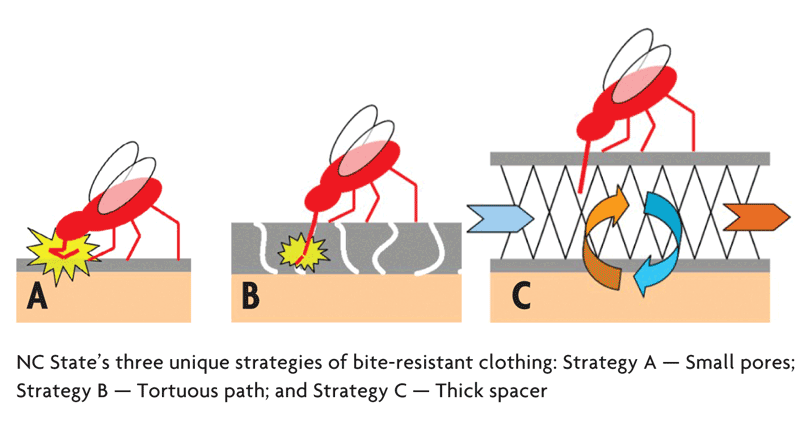
As part of a five-year collaboration between NC State’s College of Textiles, the College of Natural Resources and the College of Agriculture and Life Sciences, researchers are aggressively investigating textile-based solutions to protect people living and working in locations where mosquitoes and mosquito-borne illnesses are of concern. A multidisciplinary team consisting of entomologists, textile engineers, textile designers, comfort analysts and protection specialists is uniquely positioned for this challenge. The team has been collaborating on the development of a new generation of non-chemical vector protection, and has cultivated relationships with military and industry partners who are rapidly scaling up their technologies to move these critically needed garments to market.
Dr. Marian McCord, associate dean for Research in the College of Natural Resources, is leading the effort to develop these innovative protective fabrics and clothing. “Our research has brought together a unique group to study how mosquitoes interact with textile structures and humans,” said McCord. “We use our combined knowledge to design, model and prototype chemical-free fabrics that provide exceptional comfort and protection from mosquito bites.”
As part of the collaboration, Dr. Michael Roe and Dr. Charles Apperson raise and maintain colonies of mosquitoes and conduct four tiers of textile testing covering the range from small fabric swatches to whole garments tested in walk-in cages and under real-world field conditions. Along with their postgraduate students and technicians, they have developed a new laboratory assay system that facilitates rapid screening of prototype textiles and garments.
The fabrics are designed, developed and tested through collaboration with international fabric manufacturers and the textile and entomology labs at NC State. The goal is to find the delicate balance between offering a breathable, comfortable fabric at the same time as providing a defense against mosquitoes. Using CAD software and measurements of the mosquito’s needle-like mouthparts, known as the proboscis, the fabrics first are virtually modeled to prevent the mosquito’s proboscis from penetrating through the fabric to the skin. Fabric prototypes are constructed and then tested for bite resistance. The testing was designed determine the mosquito’s ability to penetrate the fabric after landing on its surface. Fabric color and the wearer’s body odor guide the mosquito to a potential victim. Mosquitoes are typically attracted to dark-colored fabrics. An open and breathable fabric allows more odor to permeate the fabric; however, after landing, mosquitoes get frustrated if they are unable to pierce the fabric. Repeated landings and probings indicate that mosquitoes are trying to find an area of the fabric that is vulnerable to penetration. The researchers used objective video analysis to study the interaction of mosquitoes with the textile surface. An examination of the mosquitoes for evidence of successful blood feeding coupled with the number of landings allows the research team to comparatively evaluate each fabric prototype. Fabrics found to have a high level of bite-resistance are then evaluated for comfort, including air and heat permeability, and moisture wicking. This information along with the bite-resistance data has allowed Dr. Kun Luan, a post-doctoral researcher assigned to the project, to develop a model that predicts the bite-resistance and comfort of varying fabric designs. The goal is to develop a multitude of fabrics including undergarments and outer garments that will suit a multitude of conditions.
The research has led to the development of a design system that can be used to produce a variety of fabrics that provide protection from insect bites for a wide consumer market. The design system can utilize a variety of fabric structures, including woven, knitted, and nonwoven materials, and may incorporate other non-textile materials or substances. Evaluation of fabric comfort is performed based on its end function. “These fabrics are designed to prevent the mosquito from penetrating all the way to the skin, but are porous enough to allow air permeability and moisture management,” DenHartog said. Garments are then made from these fabrics and constructed in such a way as to allow unhampered movement and a high range of motion. Areas of the body that may be more attractive to a mosquito — for example the ankles and behind the knees — as well as areas over which the fabric may deform — including elbows, knees, and a pregnant woman’s abdomen — can be provided additional protection based on the garment’s construction. Additional protection can be achieved with a double layer of fabric or by further increasing the density of the material in those areas of the garment.
Apperson said: “Women, especially expectant mothers, are looking for reliable and safe products that can protect them and their babies before, during and after pregnancy against the Zika virus, as well as other viruses transmitted by mosquitoes.”
“Now that we know the Zika virus causes severe birth defects and is associated with other adverse health effects, there is even greater need to protect people,” McCord said. “This is not just an issue for pregnant women. We need to protect women’s partners who can sexually transmit the virus as well. It’s also a security issue for our military troops being sent into disease endemic countries, and it is a workforce issue for employees who are outside in these areas. Economical, accessible and sustainable vector protective clothing that does not use chemical repellents may be much more appealing to many and would limit the need for application of repellents to exposed skin.”
As the testing and design continues, researchers have been developing bite-resistant fabrics and garments for commercial use within the parameters associated with specific target end users. “Because of the strength of our diverse team, we have been able to build a product line with innovative attributes and functionality that is ready for commercialization in a market that we believe is in dire need of a solution for preventing mosquito-transmitted diseases, such as Zika,” McCord said. According to Roe, the textile and garment products have been stringently tested in NC State’s entomology labs and proven better than 98-percent effective under extreme worst-case scenario mosquito exposure.
To take this ground-breaking research from the lab to market, the team has worked closely with the Office of Technology Commercialization and New Ventures (OTCNV) at NC State to identify opportunities and file patent applications. The OTCNV is continuing discussions with industry partners to maximize the commercial potential of the technology and to provide new options for protection against the Zika virus for millions of individuals in high-risk areas.
Presently NC State has a limited licensed commercial partner in Har-Son Inc., Midwest City, Okla. Its RynoSkin™ brand has a national reputation for providing bite-resistant clothing for the hunting, fishing, military, and police clothing markets. The company’s previous product could not protect against mosquito bites, but guided by mosquito and comfort testing at NC State, Har-Son has produced an undergarment that is 98-percent bite-resistant in walk-in cage tests. The product now is sold to national retailers under the name RynoSkin Total.
The NC State research team believes there are many markets available for mosquito protection garments, but feel maternity is the highest priority market. Currently, no companies are focusing solely on the production and marketing of mosquito bite resistant clothing for protecting expectant mothers from Zika virus without the use of chemical repellents. Consequently, the researchers have formed a company called Vector Textiles Inc., Raleigh, N.C. Vector Textiles will engage in research, product design and development, and real world testing of a multitude of fabrics that act as barriers for protection of people, animals and even plants from insect infestation. “At this point, with Zika virus of predominant public concern, we feel compelled to develop a maternity brand,” said Dr. Andre West. “Furthermore, we will have our product on the market shortly under the brand name Pro-Tex Maternity. We are using the crowd funding source Indigogo not only to raise funds to purchase materials and provide cash flow for manufacturing, but as a way to inform and notify the general public that there are alternative, safe and sustainable methods available for their personal protection from mosquitoes.”
The first maternity clothing line will be targeted at consumers in Latin America and the southern United States. The target consumers are women between the ages of 15 to 49 years of age, which represent approximately 170 million potential consumers. “Our products contain no insecticides and are comfortable for indoor and outdoor wear in hot, humid climates,” West said. “The first garments will come in two levels of protection, the first being innerwear that can be worn as an undergarment or a base-layer and will include leggings — some under the belly, some over the belly — perfect for comfort while pregnant, as well as fitted tops of different lengths. These can be worn underneath regular clothing to provide a high level of protection at the same time as allowing the consumer to wear their regular clothes, be protected and still feel comfortable.”
The second garment group will be a specifically designed outerwear maternity line that will offer effective protection against biting insects. In the future, Vector Textiles wants to integrate digital printing technologies to enhance the line with protective yet fashionable apparel products to meet consumers’ demands. The design of the products also will consider population diversity and consumer aesthetic demands following the latest fashion trends. Subsequent future design efforts will be oriented to daily wear and casual business apparel products.
Bite-resistant garments will be affordable in the U.S. market. According to West, predicted retail prices will be in line with currently available specialized maternity wear. Vector Textiles is exploring the Toms concept of improving lives and would also like part of the proceeds from retail sales to subsidize a basic product line of protective apparel for low-income women in the countries hardest hit by the Zika virus. “We hope in the near future that humanitarian organizations will be able to purchase in bulk for distribution to displaced populations at risk of mosquito-borne illnesses,” Roe said. “Doctors and midwives will be able to sell products through their clinics; governments could subsidize the clothing for lower-income women at risk. We are also working on reusable garments deployed for health workers.”
“We will continue to improve on the fabric and garment construction as well as the style of garments to make products not only for a greater good but for a multitude of different end uses,” McCord said. “Certain segments of the world population are more at risk right now, so that is where the focus is.”
Editor’s Note: Sarah Corica is the director of marketing and communications for NC State’s College of Natural Resources.
For more information about the research, contact Dr. Andre West at 919-515-6650; ajwest2@ncsu.edu.
May/June 2017
 The 1,3-propanediol-producing joint venture between DuPont and Tate & Lyle recently celebrated its 10th anniversary.
By Rachael S. Davis, Executive Editor
DuPont Tate & Lyle Bio Products Co. LLC was founded 10 years ago as a joint venture between Wilmington, Del.-based DuPont and London-based Tate & Lyle. The two companies opened a facility in Loudon, Tenn., to manufacture a breakthrough bio-based version of 1,3-propanediol. DuPont’s research and development experience paired perfectly with Tate & Lyle’s fermentation expertise in the joint venture and the company developed a proprietary process to produce 1,3-propanediol using plant-based feedstocks. This petroleum-free, sustainable and renewable source of 1,3-propanediol is used as an eco-friendly building block in a wide variety of consumer products. According to the company, “from ‘cradle-to-gate,’ its bio-based 1,3-propanediol produces 56-percent less greenhouse gas emissions and consumes 42-percent less nonrenewable energy” compared to its petroleum-based counterpart. In addition, the U.S. Department of Agriculture (USDA) has certified its products as 100-percent bio-based under its BioPreferred™ program.
“This joint venture started as a revolutionary innovation project that applied the tools of modern biotechnology to make high-performance biomaterials in a much more sustainable way than traditional petro-chemistry,” stated Michael Saltzberg, global business director, biomaterials, DuPont Industrial Biosciences. “Its track record of success has inspired the academic and industrial science community around the world to invest in industrial biotech and is a case study of how to successfully innovate in this space.”
Bio-PDO™ is a key ingredient in DuPont™ Sorona® high-performance polymers, which find applications in apparel, carpet and automotive textiles. The company also markets the 1,3-propanediol under two brand names: Susterra®, which is used in polyurethanes, unsaturated polyester resins and heat-transfer fluids; and the preservative-boosting humectant Zemea®, which is found in cosmetics and personal care items, foods and flavors, pharmaceutical and dietary supplements, and laundry and household cleaning products.
“We’ve grown past what was previously imagined,” said Todd Sutton, president, DuPont Tate & Lyle. “The versatility of the product allows us to support the DuPont Sorona business as well as grow organically with Zemea and Susterra propanediol. The benefits of creating high-performing solutions in combination with renewability allows us to continue to expand our reach in the personal care, food, polyurethanes and heat transfer fluids markets as well as many other applications.”

To mark the 10-year anniversary, the company recently gathered customers and partners in Loudon. Guests heard from DuPont Tate & Lyle executives as well as partners who shared their stories and spoke about their partnerships with the company. Todd Sutton was the emcee during the presentations. Speakers included Michael Saltzberg; Steve Hurff, vice president, marketing and sales, DuPont Tate & Lyle; Marie Wheat, industry economist, USDA, BioPreferred Program; Jeff Meadows, senior vice president, Residential Carpet Sales, Mohawk Industries; Jeff Heverley, regional vice president, Interstate Chemical Co.; Steve Schnittger, global vice president, Microbiology, Estée Lauder; and Gerry Schlueter, plant manager, Tate & Lyle facility, Loudon. Attendees also toured the facility to see first-hand how the bio-based product is made.
During the event, the company also announced several new developments — a new hang tag program for the Susterra brand, a collaboration with Wichita, Kan.-based Invista’s CORDURA® brand and a new sunscreen product featuring Zemea.

The hang tag is first in a planned series of hang tags to help educate consumers about the components used in the products they buy. Three advantages of Susterra are noted on the hang tag. “With this first hang tag, companies using Susterra propanediol to manufacture high-performing, bio-based films, coatings or adhesives for the apparel and footwear industries will have a convenient and effective way to differentiate their products and address consumers’ traceability concerns,” said Laurie Kronenberg, global marketing director, DuPont Tate & Lyle Bio Products.
The Cordura brand is celebrating its 50th anniversary in 2017 and it was announced DuPont Tate & Lyle has paired with Cordura to develop performance fabrics featuring sustainable, bio-based materials. “We are thrilled to be working together with the Cordura brand, combining our unique capabilities and expertise, and building on our track records of delivering innovation to the marketplace,” said Kronenberg. “Together, we can revolutionize the future use of sustainable textiles by delivering innovative solutions that marry the legendary long-lasting durability of Cordura fabrics with the bio-based performance of Susterra propanediol-based membranes and coatings.”
“Our partnership with DuPont is a great example of bringing the best of two organizations together to create a first to market product and process that continues to demonstrate versatility and functionality in the global marketplace,” said Greg Wenndt, vice president and general manager, industrial starch and bioventures, Tate & Lyle. “We are proud of the success we’ve built together and share our congratulations with our DuPont partners and the DuPont Tate & Lyle teams around the world for achieving a decade of great work and continued innovation.”
May/June 2017

Textiles are the unsung heroes of our everyday lives
TW Special Report
Textiles are the unsung heroes of our everyday lives. Innovative problem-solvers — experts tackling some of the world’s biggest challenges to provide comfort, convenience, protection and utility — personify the industry. From aircraft engines to automotive fabrics and athletic wear, American textile industry ingenuity is improving the performance of a wide array of products.
When you think of fibers, you might initially think of natural options like wool or cotton. You might also think of man-made fibers like polyester or nylon. But what about carbon fiber? Carbon fiber is tightly woven throughout our daily lives but often goes unnoticed except to trained eyes.
Stamford, Conn.-based Hexcel Corp. is a leading carbon fiber manufacturer. Beginning with its polyacrylonitrile (PAN) precursor production site in Alabama, Hexcel manufactures carbon fiber with a focus on composite materials that reinforce plastics to help build structures.
“Hexcel is continuing to develop fiber and technology in product forms that meet the needs of those wanting to go faster, stronger and lighter,” said Tom Haulik, sales director of carbon fibers.
Rockets, airplanes and Formula One race cars are just some of the high-tech structures supported by Hexcel’s miraculous fiber. Carbon fibers can either be woven into broad goods and then used to reinforce plastics, like in a car panel, or braided and compressed into a tube to form objects like hockey sticks and golf club shafts.
Another amazing application involves the aircraft industry. While most air passengers would assume their seats are made from textiles, they may not realize an engine made from textile parts is propelling them to their destination, thousands of feet in the air. Aircraft engine components using carbon fiber are woven into 3-D structures and then infused with resin. These high-strength carbon fibers create a remarkably lightweight, durable and reliable engine that is also fuel-efficient.
Frequent fliers rely on a powerful engine to take off but need reliable brake discs to make a safe landing. For example, the carbon brake pads that bring your plane to a stop on the runway are created with Pyromex®, a textile from Toho Tenax manufactured in Tennessee. Instead of a metal-based disc, these highly efficient and durable brakes start as a carbon fiber-based felt fabric, which the manufacturing process transforms into a black, brick-shaped brake for aircrafts.
This incredible textile is produced without additional Bromine/haline compounds, making Pyromex® ideal to meet regulatory requirements for flame resistance on one hand and environmental health on the other. The Limiting Oxygen Index (LOI) of Pyromex also is much higher than other organic flame-resistant fibers, making it a durable alternative. Pyromex is widely used in welding blankets, fleece insulation and carbon brake applications to help keep passengers safe.
In today’s world, phones double as a personal assistant, personal trainer, grocery list and talking watch. Convenience is king, and smart products are becoming more deeply immersed in our culture and everyday lives. Groundbreaking smart textiles are no exception.
We intuitively know apparel serves many purposes: It shields us from the elements and serves as a form of personal expression. But some clothing is engineered to deliver even more user benefits.
Pulcra Chemicals, a Rock Hill, S.C.-based global manufacturer of specialty chemicals for fiber, textiles and leather, makes sure clothes do more than simply provide function or fashion. The company’s Skintex® technology embeds microcapsules filled with high-grade ingredients into fabric during the chemical finishing stage of production. The contents of those microcapsules then are slowly released onto the wearer’s skin.
For example, yoga pants are popular activewear. Yoga pants made with Skintex micro-encapsulated, high-grade lotions and vitamins applied to the fabric provide moisturizing effects throughout the day. Looking forward to a relaxing evening? Pajama pants enhanced with Skintex release a micro-encapsulated aromatherapy with the light scent of lavender to create a calming effect before the start of a hectic week.
Besides making consumer products more luxurious, Pulcra’s Skintex line is also having a humanitarian impact.
“The Skintex MRIII blanket is a special, non-woven fabric that we treat with insect repellent,” said Troy Massey, Skintex business manager. “This is not your typical, cozy blanket, but a product that is used outdoors. Hunters often use it as ground cover. With the recent Zika outbreak and the ongoing malaria battle in Sub-Saharan Africa, we used our Environmental Protection Agency-registered Skintex MRIII blankets to make an impact. We donated 11,000 blankets to school children in Tanzania to help fight malaria. We also sent Skintex MRIII blankets to Rio with some U.S. Olympic athletes including members of the swim, taekwondo and water polo teams. We’re continuing our efforts to help with this outbreak because it is still a big issue.”
Schoolchildren learn about three states of matter: solid, liquid and gas. But what about the fourth state of matter, plasma?
If energy is applied to a gas, it becomes ionized and goes into an energy-rich plasma state. Plasma is all around us; for example, polar lights in the Arctic and Antarctic skies show plasma in its natural form.
APJeT, a Morrisville, N.C.-based textile technology company, is using plasma to revolutionize the way fabrics are finished, the point in production when chemicals are applied to improve a fabric’s look, performance and feel.
Called the “wet process” because of its water-based nature, the worldwide textile industry uses trillions of gallons of water to finish fabrics each year. Water scarcity and quality degradation are major global concerns, but APJeT’s plasma technology is eliminating the need for water in the fabric finishing process. Compared to the wet process, the company’s sustainable plasma solution also significantly reduces chemical consumption.
Innovators at APJeT are harnessing the power of plasma to create engineered solutions for a variety of applications:
“Our process is a complete paradigm shift in how textiles are produced and finished,” said President and CEO John Emrich. “Our post-finishing process solution eliminates the need for water, ovens and high energy. This technology allows APJeT to apply durable, performance-enhancing finishes to anything including films, silks, polyesters, cotton and polypropylene, and it’s changing the way we think about the finishing process in our industry.”
Today, American textiles are transforming countless products from massive aircrafts to needle-thin fibers to create smarter, more durable solutions. By devoting itself to the relentless hunt for engineered solutions and seamless processes, the U.S. textile industry is solving problems worldwide.
Editor’s Note: This article appears in Textile World courtesy of the National Council of Textile Organizations (NCTO) as part of the “American Textiles: We Make Amazing™” campaign. NCTO is a trade association representing U.S. textile manufacturing. Please visit ncto.org to learn more about NCTO, the industry and the campaign.
May/June 2017

Committed to Industry 4.0, Lectra offers customers finely tuned integration between equipment, software and services.
By Rachael S. Davis, Executive Editor
Paris-based Lectra intends to hold its status as a world leader in integrated technology solutions — software, CAD/CAM equipment and associated services — and to that end, has embraced the concept of Industry 4.0, a term first coined by the German government as part of an initiative to enhance the country’s manufacturing competitiveness. In German-speaking areas, this revolution continues to be known as Industry 4.0 although other countries have given their own names to the concept.

Industry 4.0 refers to a current manufacturing trend of automation and data exchange, a fourth revolution in manufacturing. It builds on the third industrial revolution in computing and automation (See Figure 1) and includes cyber-physical systems, the Internet of things and cloud computing to create — in Industry 4.0 lingo — smart factories.
According to Wikipedia:
Over the Internet of Things, cyber-physical systems communicate and cooperate with each other and with humans in real time, and via the Internet of Services, both internal and cross-organizational services are offered and used by participants of the value chain.1
In his “Industry 4.0: Definition, Design Principles, Challenges, and the Future of Employment” article on Cleverism.com, Martin Lünendonk states:
Machines will operate independently, or cooperate with humans in creating a customer-oriented production field that constantly works on maintaining itself. The machine rather becomes an independent entity that is able to collect data, analyze it and advise upon it. This becomes possible by introducing self-optimization, self-cognition, and self-customization into the industry. The manufacturers will be able to communicate with computers rather than operate them.2
Lectra CEO Daniel Harari said the company decided to embrace Industry 4.0 and invest heavily in research and development several years ago during a time when the company was on the cusp of moving manufacturing to Asia. Harari stated he felt there had to be a way to make manufacturing in France profitable and keep jobs in France, and the company set about rethinking the way forward.
During the four-year period from 2013-2016, Lectra invested 86 million euros ($92 million) in research and development, which represents 9.4 percent of the company’s revenues. The company enriched its software offerings and developed leading-edge innovations for its technology.
In 2016, Lectra posted record financial results with revenues of 260 million euros ($277 million) — a 10-percent increase over 2015. Income from operations increased 18 percent, and net income was up 14 percent in 2016. So far, Harari feels very happy about the decision to keep manufacturing in France.
By deciding to embrace the idea of Industry 4.0 in its infancy, Harari believes Lectra is well positioned to help its customers be successful. The company spent three years gathering data from its more than 3,000 Industry 4.0 compatible machines in operation at some 2,000 production sites plus a further three years analyzing the data. The company has 40 years of experience in electronics; 10-years of experience in the industrial Internet of Things; a strong business expertise and a finely-tuned combination of machines, software and services — all components Harari believes are need to build an effective Industry 4.0 strategy.

“To meet these new challenges, our customers can depend on our software and equipment offer, already compatible with Industry 4.0 principles, our deep knowledge of the industrial Internet of Things since 2007, and our team’s expertise in specific industries,” Harari said. “Thanks to these strong fundamentals, we are massively enriching our offer, leveraging the latest technologies and integrating best practices to entrench Lectra’s position as an Industry 4.0 visionary.
“There is much debate around the world about exactly how big this industrial revolution will be,” Harari said. “I am on the same side as those who think it will be significant. It’s a real shake up of what we believe about industry. It enables new possibilities, new business models and new opportunities.”
Lectra manufactures three types of cutting machines — the Vector® aimed at the fashion and apparel industries, the FocusQuantum® for airbag manufacturing, and the Versalis® for leather cutting. These technologies are paired with Lectra’s integrated software offerings — Kaledo for design, Modaris pattern cutting software for product development, Diamino for optimized materials use in marker making, and Lectra Fashion PLM (product lifecycle management) — to provide customers with a complete smart factory concept.
Lectra’s Vector machine has been connected to the internet since 2007. Today, the machine has 180 sensors that are capable of implementing preventative and predictive maintenance. The sensors have led to a high 98-percent availability rate for the machine, according to Lectra.
The Vector machines installed around the globe are set up to communicate in real time with Lectra’s international call centers located in Bordeaux, Shanghai, Atlanta, Milan and Madrid. There, experts can immediately intervene to prevent machine downtime and production disruptions, which translates into cost and time savings for the manufacturer. “As we step into Industry 4.0, full integration between machines, software and services will translate into greater access to data in real time, which in turn will increase Lectra’s ability to provide greater insights from all points of production, from concept to design, sourcing, production and manufacturing to the final product,” said Daniella Ambrogi, vice president, marketing.
Lectra has put together a roadmap for the next three years, which will drive the company’s development over the next decade.
To develop a long-term vision for the company and create this roadmap, Lectra studied the market and identified four major trends: millennials, who will transform the global economy; the digitalization of business, which will force companies to reinvent themselves; the emergence of industry 4.0; and China’s evolving economy anchored in consumption, added-value and productivity.
Lectra’s five objectives for 2017-19 are:
To push forward the Industry 4.0 concept, Lectra plans to progressively roll out its first SaaS and cloud services to customers beginning in 2018 to optimize customers’ cutting room performance for each type of manufacturing and material.
“I would say data analysis and insights in real time are an integral part of Industry 4.0 and its automation breakthrough,” said Ambrogi. “Data analysis connects insights from various points in the system, speeding the decision-making process along the production chain. Lectra’s new Software as a Service offer is a key step in this direction. Capitalizing on a deeper level of data mining and insight, the new system will translate into even smarter and finely tuned integration between equipment, software and services. This combination converts into a steadier data flow, which no doubt will expand the company’s capabilities to help clients monitor and analyze the entire production process.”
Lectra will continue to invest heavily in technology with 10-percent of annual revenues earmarked for R&D over the next three years.
“Bringing increasing value to our customers, Lectra will increase the share of revenues dedicated to R&D to 10 percent for the period from 2017 to 2019, representing a rise of about 50 percent between 2016 and 2019,” said Harari. “This way, we can support our customers on their path towards operational excellence, indispensable if they are to succeed in the context of the fourth industrial revolution.”

Lectra recently held a seminar at its Atlanta facility titled, “A Cut Above: Achieve Excellence in the Cutting Room and Beyond.” The event featured presentations and a discussion with industry veterans to address current issues facing the apparel industry.
Daniella Ambrogi, vice president, Marketing, Lectra, gave a presentation entitled, “Four Mega Trends Influencing the Industry.” Highlighting the trends within technology, China, millennials and Industry 4.0, Ambrogi brought into focus Lectra’s strategy to leverage these trends as opportunities rather then reacting to them as threats. Ambrogi explained Lectra’s commitment to Industry 4.0 linking Lectra’s technology to the cloud and how this leads to enhanced visibility as “fashion enters the digital, integrated manufacturing era.”

The seminar included demonstrations of the Vector series cutting tables and their advanced interfaces in the context of “The 4.0 Cutting Room.”
— Jim Borneman
References:
1 Retrieved from https://en.wikipedia.org/ wiki/Industry_4.0
2 Lünendonk, Martin (2017, January 16). Industry 4.0: Definition, Design Principles, Challenges, and the Future of Employment. Retrieved from: https://www.cleverism.com/ industry-4-0/
May/June 2017