JEFFERSON, Ga. — March 22, 2017 — Switzerland-based Hermann Bühler AG has successfully completed the sale of its US subsidiary, Buhler Quality Yarns Corp., to South Korean Samil Spinning Co. Ltd., as of March 20, 2017. The transaction is structured as an 100-percent all-cash share-deal, with a final closing expected by the end of April 2017. Both companies have agreed not to disclose further details of the transaction.
As a key player in the North American yarn market, and with a well-established international distribution network, Buhler Quality Yarns will provide Samil Spinning a Western Hemisphere manufacturing base via Buhler’s spinning facility in Jefferson, Ga. This highly valuable strategic addition broadens Samil Spinning’s global footprint, further establishing its business in the U.S. market and increasing its client portfolio. Samil will build on Buhler’s full product portfolio through targeted investments in the Jefferson facility.
This issue, Textile World is focused on technical textiles with a tip-of-the-hat to the excitement swirling around the upcoming Techtextils. The industry has two opportunities to experience technical textiles with Techtextil 2017 in Frankfurt, Germany — to be held May 9-12 — and Techtextil North America — to be held June 20-22 in Chicago. This issue includes a preview of the Frankfurt event and the North American event will be previewed in TW’s May/June issue.
TW editors focused on preparing articles that would profile the more technical sectors of the industry — composites, filtration, wearable electronics, an interview with Kimberly Clark’s Robert Martin, and more.
Even if your career is more traditional textiles focused, attending Techtextil might be worth consideration. Over the years, traditional textile manufacturers have taken the plunge into these new markets and actually innovated with their knowledge on tradition textile manufacturing. Denim companies have addressed more technical applications, spinners have expanded into nonwovens, knitters have pursued medical and other applications — examples abound.
“Technical textiles rank among the most important forces of growth in the textile sector,”stated Olaf Schmidt, vice president, Textile and Textile Technologies, Techtextil organizer Messe Frankfurt.
An early look at show registration supports that view.
On another front, TW‘s editors would like to thank the National Council of Textile Organizations for sharing Inman Mills Chairman and CEO Robert “Rob” H. Chapman’s view on the future of U.S. textiles. He presents an interesting thesis on how the industry survived tough times through innovation and, in his words, “has a bright future.”
Chapman is the fourth generation of the Chapman family to operate Inman Mills, which was founded in 1901 — his opinion has a strong frame of reference.
To that end, it appears there is optimism in the textile industry. This optimism seems to be in response to the promises of the new administration in Washington. Although, privately, there is confusion over the unintended consequences of change — whether that is changes in trade law, taxes or regulation. But the confidence seems rooted in the president’s commitment to domestic manufacturing. That recognition, and having an ex-textile executive Wilbur Ross confirmed as Secretary of Commerce, is well received.
In a televised Bloomberg interview cited in “Business Insider,” Ross stated, ”We are in a trade war, we’ve been in one for decades. That’s why we have the deficit.”
For those who have invested to leverage existing trade agreements like NAFTA and CAFTA-DR, renegotiations of these agreements will impact those investments. It is hard currently to get a sense of positive verses negative effects any renegotiations may cause.
A focus on bilateral trade agreements will demand study, and ideas like border taxes and addressing currency manipulation also will change the game. For some manufacturers, change may call for adjustments, but in the longer term, playing on more level playing is a new and novel factor for the industry to deal with … imagine that!
Springs Window Fashions LLC, Middleton, Wis., has acquired window covering product manufacturers Mariak Industries Inc., Rancho Dominguez, Calif., and its affiliated company Houston-based Patrician Window Coverings. The newly-acquired companies will continue to be led by president Leo Elinson. Mariak will maintain its Rancho Dominguez, Calif., location, while Patrician recently moved to a new Webster, Texas, address.
“Leo Elinson and the Mariak team have built a tremendous business, with a 30-year track record of high-quality craftsmanship, extensive product selection and competitive pricing,” said Scott Fawcett, president and CEO, Springs. “We look forward to building on Mariak’s successful go-to market strategy over the long-term and are excited to welcome Mariak and Patrician to the Springs family.”
“The natural synergy, collaboration, and support that will be created from a partnership with Springs will allow Mariak and Patrician to grow exponentially, while maintaining our successful business model of providing the highest quality of product craftsmanship, competitive pricing, and prompt delivery,” said Leo Elinson. “We look forward to this new partnership with great enthusiasm and excitement.”
Duquesne, Pa.-based bedding producer American Textile Co. reports it will open a state-of-the-art warehouse and distribution facility in Tifton, Ga., later this year. The company has experienced high growth this past year, and the new facility will more than double shipping capacity in order to keep up with customer demand from both e-commerce and
traditional retail areas.
The company also recently expanded capacity at its Dallas and Salt Lake City locations, and currently employs more than 1,100 people globally.
“Demand for sleep products has climbed steadily over the past decade, but what’s shifted even more rapidly is the growth in e-commerce sales, which drove over 40 percent of all retail sales growth in 2016,” said Lance Ruttenberg, president and CEO. “We have strategically expanded our physical footprint and logistics capabilities to keep pace with the on-demand, online economy that requires new capabilities, while also expanding infrastructure to support the significant growth in our traditional retail channels.
Wichita, Kan.-based Invista has retained the services of Goldman Sachs & Co. to help the company explore strategic alternatives for its Apparel & Advanced Textiles business. Details about the process will be kept confidential, but Invista reports options include selling the business, or keeping the business as part of the Invista portfolio. The business includes such brands as Lycra® and Coolmax® fiber.
“A key element of our Market-Based Management® business philosophy is to continuously assess the external value of our assets against our internal value to make sure that the asset is owned by the company that values it most highly,” said Jeff Gentry, Invista chairman and CEO. “The apparel business is a strategic part of our portfolio — we are extremely pleased with the results of the business and remain confident in its continued and future success. We are simply considering all available options. In the event that no other company values the business more than we do, we will gladly hold the business and continue to invest for the future.”
The stance of yarn spinners and fabric knitters and weavers has changed on trade issues over the past several decades. “Our industry was dismantled piece-by-piece for many years by unfavorable trade agreements that created a flood of cheap imports that we just couldn’t compete with,” said one spinner. However, he said, the industry responded by increasing production efficiency, focusing on customer service and fast delivery, and developing aggressive export strategies of its own. “Our primary domestic customers at the time were cut-and-sew shops, and they were closing at a rapid rate — to the point where, today, they have all but disappeared. We had to reinvent ourselves or close up shop.”
Today, however, it is not the trade agreements themselves that draw the most ire from U.S. textile leaders, but rather their enforcement. “As our reach has become more global, the view many of us have about trade has changed,” said one spinner. “We have the capability to compete favorably with just about anyone, as long as everyone plays by the rules. The problem is that, in many instances, we are the only ones playing fair.” He cited, as an example, a report from the National Council of Textile Organizations (NCTO) that indicated up to a third of denim jeans that claim NAFTA origin actually may be made using Chinese fabric.
In response, Congress in early 2016 passed “The Trade Facilitation and Trade Enforcement Act of 2015,” which increases enforcement activities across multiple fronts. “This is a big step in the right direction,” said one spinner. “Now let’s see how aggressively it is applied.”
Trade Wars Looming?
A cornerstone of U.S. President Donald Trump’s “America First” agenda is the review and possible reconstruction of how the United States trades with other nations. Trump has made no secret of his preference for bilateral agreements over those such as the North America Free Trade Agreement (NAFTA), which he has promised to renegotiate to provide a more competitive advantage for U.S. companies.
He has threatened, for example, to impose heavy tariffs on Mexican products. And Mexico has promised to retaliate, placing higher tariffs on U.S. goods or replacing them with products from other countries.
NAFTA isn’t the only target of the administration. China has been called out as well, and Chinese officials, like those in Mexico, have promised retribution if action is taken.
“It is possible, if we don’t tread lightly, that we are looking at a potential trade war,” said a general business analyst. “If that happens, virtually everyone loses, especially the U.S. consumer, who will end up paying higher prices for both imported products and those produced at home. We certainly want agreements that enhance the competitive position of U.S. companies, but those agreements must be fair across the board.”
Currency Manipulation
Trade disparity is, however, no longer the primary impediment to the prosperity of the U.S. industry, according to many industry experts. From an NCTO report: “Countries that trade with the U.S. and manipulate currency cause trade deficits that interrupt trade flows by inflating the cost of U.S. exports, deflating the cost of U.S. imports and in turn displace U.S. jobs.”
“Currency manipulation has a significant detrimental effect,” said one industry expert.” Indeed, according to data from the Economic Policy Institute, an estimated 2.4 million U.S. jobs were lost between 2001 and 2008 because of currency manipulation by China. From the NCTO report: “While the Chinese government is the most widely known government to manipulate its currency, many countries wishing to engage in international trade with the U.S. maintain artificially low currencies.” The report noted that Japan, Vietnam, Singapore and Malaysia also are known currency manipulators.
“When you look at how strong the dollar has been over the past few years, and then take into consideration that the currencies of some countries are artificially deflated, it makes U.S. goods incredibly expensive in comparison,” said one yarn seller. “A significant portion of our production is now exported, so it has a profound effect. But it has an effect at home, too, because imported goods, in relation, are cheaper than ever.”
Whether the issue is trade or currency manipulation, U.S. producers seem to always be fighting an uphill battle. Said one spinner: “We are looking for that one thing we never seem to have — a level playing field.”
Trade shows return to Frankfurt for the fourth concurrent event
TW Special Report
Germany-based show organizer Messe Frankfurt GmbH reported some four months before collocated shows Techtextil 2017 and Texprocess 2017 were scheduled to open their doors that exhibitors had booked more space than in previous editions. The fourth combined event will be held May 9-12, 2017, at the Messe Frankfurt fairgrounds in Frankfurt. The steady growth of both shows, but especially the newer Texprocess show, confirms the importance of these events to the global textile community.
“Technical textiles rank among the most important driving forces of growth in the textile sector,” said Olaf Schmidt, vice president, Textiles and Textile Technologies, Messe Frankfurt. “The fact that so many companies have already registered for Techtextil 2017 is an indication of how dynamically the sector is developing.
“The large number of registrations shows that Texprocess has successfully carved out a place for itself in the market as the leading international platform of its kind,” Schmidt added. “Texprocess offers the full spectrum of new software solutions, as well as processes and technologies for garment and leather manufacturing. Moreover, the 2017 edition will cover more themes than ever before.”
Techtextil
In 2017, Messe Frankfurt has partnered with the European Space Agency (ESA) and German Aerospace Centre — Deutsches Zentrum für Luft- und Raumfahrt (DLR). Under the theme, “Living in Space,” Techtextil will illustrate the wide range of technical textiles applicable to the aerospace industry.
“We are branching out in completely new directions with this year’s Techtextil and are, therefore, all the more delighted about the outstanding resonance of our exhibitors,” Schmidt said. “Furthermore, the fact that we have gained strong new partners, ESA and DLR, from one of the main areas of application for technical textiles represents solid evidence of the application relevance of the products and technologies shown at Techtextil.”
Hall 6.1 will house a “Living in Space” exhibition featuring a wide range of technical textile and functional apparel products used in the aerospace industry manufactured by both Techtextil and Texprocess exhibitors. In addition, visitors will be able to participate in a virtual reality journey through space to Mars to learn how technical textiles will aid in the future development of space travel and colonization of nearby planets.
“The technical-textile sector offers the textile solutions needed to move around and survive in space,” said Michael Jänecke, director, Brand Management Technical Textiles & Textile Processing, Messe Frankfurt. “This is what we will show in a professional, and at the same time, entertaining way on a dedicated area at the trade fair. For visitors, the area will offer inspiration and orientation.”
In addition, Hall 6.1 will have an “Innovation Made in Germany” area hosted by the Federal Ministry of Economics and Energy that will highlight young and innovative companies based in Germany.
In 2017, show organizers have decided to concentrate bonding and separating technology; cutting, making and trimming (CMT); CAD/CAM; and printing product segments together in Texprocess Hall 4.0. Techtextil exhibitors participating in these areas now will be found in the Texprocess hall and the product groups will be removed from the Techtextil offerings.
Traditionally, Techtextil organizes the exhibits into 11 different product groups: research, development, planning and consultancy; technology, processes and accessories; fibers and yarns; woven fabrics, laid webs, braids and knitted fabrics; nonwovens; coated textiles; composites; Bondtec; functional apparel textiles; associations; and publishers.
In addition, past show participants are familiar with Techtextil’s classification system for the exhibits, which are organized according to 12 application areas:
Agrotech — horticulture and landscape, gardening, agriculture, forestry and animal husbandry;
Buildtech — membrane construction, lightweight and solid structures, civil engineering, industrial construction, temporary constructions, interior construction, earthworks, hydraulic engineering and road construction, and agriculture construction;
Clothtech — functional apparel, clothing and shoes;
Geotech — road construction, civil engineering, and dam and waste site construction;
Mobiltech — cars, ships, aircraft, railway and space travel;
Oekotech — environmental protection, recycling and waste disposal;
Packtech — packaging, protective covering systems, sacks, big bags and container systems;
Protech — personal safety and property protections; and
Sporttech — sport and leisure, activewear, outdoor equipment, sports equipment and outfits, and sports footwear.
The application areas are illustrated by graphic icons displayed on exhibitor booths. Show organizers report the icons help visitors find the suppliers they need in an efficient manner.
Events associated with Techtextil include the 19th Techtextil Symposium, the Techtextil Innovation Award 2017 and the Student Competition.
The symposium will be held in Hall 4.0 in the Saal Europa. Messe Frankfurt has put together a comprehensive group of experts who will focus their presentations on new developments, trends and potential areas of application for technical textiles and nonwovens. Topics include new fibers and textiles, circular economy and sustainability, health and protection, smart textiles, and composites. For the first time, the symposium also will offer a discussion period following the lectures to allow for an active exchange of ideas.
An awards ceremony will be held on May 9 at 10 a.m. to recognize winners of the Techtextil Innovation Award 2017, which “honors outstanding ideas and future-oriented developments in the field of technical textiles, nonwovens and functional apparel textiles,” according to Messe Frankfurt. The recipients are selected by an international jury of experts, and all award-winning projects will be displayed in a special exhibit area of the show.
The 14th Student Competition, “Textile Structures for New Building 2017,” asked students from civil engineering, product design and related disciplines to submit building designs featuring textiles or textile-reinforced materials. The competition is supported by Architonic, Tenisnet and University of Stuttgart (ILEK). Prize money totaling 8,000 euros will be awarded to winners during an official ceremony during the first day of the show.
Innovative Apparel Show Returns
After its successful debut in 2015, the Innovative Apparel Show will return to showcase the synergies between Techtextil and Texprocess. Each day of the show, international colleges of fashion and design will present their creations live on stage. The designs — presented in Textile Effects, Creative Engineering and Smart Fashion categories — will highlight the possibilities for technical textiles created using modern processing techniques. Four schools were selected for the Apparel Show in 2017 — Paris-based Esmod, Portugal-based ESAD College of Art and Design, Italy-based Accademia Italiana and Germany-based Hochschule Trier.
Texprocess 2015
Texprocess, the International Trade Show for Processing Textile and Flexible Materials, will showcase the latest machines, plants, processes and services for the garments manufacturing and textile processing industry. This year, digital printing will play a predominant role in Texprocess. In conjunction with well-known industry representatives, Messe Frankfurt will present a Digital Textile Micro Factory exhibit that will demonstrate the digital production chain from design and digital printing to cutting and garment production — all live and on site.
In addition, a dedicated series of presentations at the Texprocess Forum will focus on digital printing. Visitors to Texprocess also will have the opportunity to participate in the first European Digital Textile Conference, a complementary program that will be held on Wednesday. As of TW’s press time, the digital printing agenda was still in the planning stages. More up-to-date information is available at the show’s website.
Texprocess covers 20 product groups that encompass the entire value creation chain: CAD/CAM and product development; production preparation and organization; cutting, making and trimming (CMT); fusing, setting and manufacturing preparation; textile machinery; textile finishing; knitting technology; embroidery technology; stitching, joining and fastening technology, automation technology; stitching, joining and fastening materials, technical accessories for garment, house and home textiles; product processing and finishing; energy, air conditioning, disposal and recycling; quality control; internal material flow; textile logistics; information technology; services, consultancy and training; and media; research, development and training; and sourcing.
In addition to the Texprocess Forum, special events associated with the show include IT@Texprocess and Texprocess Innovation Award.
Both shows are open from 9 a.m. until 6 p.m. May 9-11, and from 9 a.m. to 5 p.m. on May 12.
For more information about Techtextil 2017 and Texprocess 2017, please visit techtextil.com and texprocess.com.
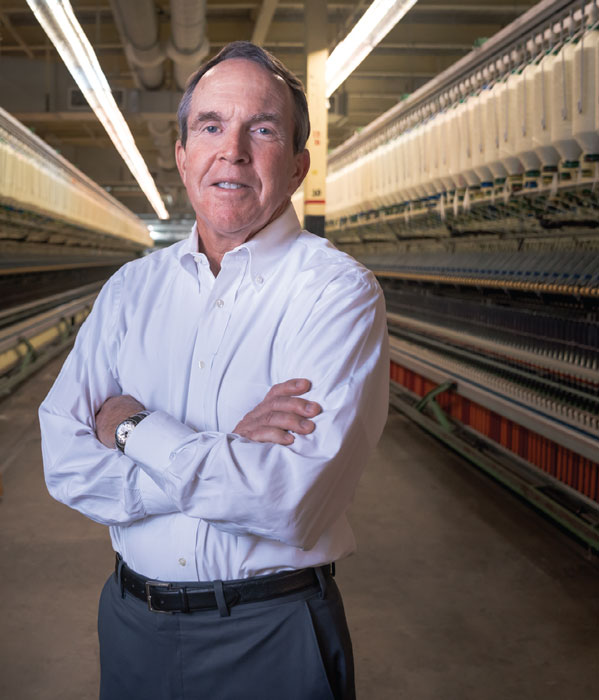
Robert H. Chapman, III, chairman and CEO of Inman Mills and 2016-17 NCTO Chairman
By Robert H. Chapman, III
Innovation. It’s a new method, idea or product. It’s a strategic stimulus for change. It’s a movement that empowers industry breakthroughs and enables people to live better, healthier, more fulfilling lives. And in American textiles, it’s the driving force behind an ongoing sea change in what we make and how we make it.
Across the nation, textile companies are continually evolving into more productive, profitable businesses. Substantial investments of capital resources are brightening the landscape of our industry and the American economy.
Today, we’re making things that challenge the notion of a textile as simply a fiber, yarn or fabric. American textiles give the world not only comfortable, stylish apparel and beautiful home furnishings, but also other innovative products such as lightweight, durable bicycles for exploring urban and mountain
landscapes; bandages with imbedded medicines that help wounds heal; aircraft brakes for more energy-efficient flights; and anti-ballistic protective apparel to shield our soldiers on the field of battle. But as with life, success in the textile business rarely comes easily.
The Chapman family founded Inman Mills in South Carolina in 1901. Today, a fourth generation of Chapmans owns and operates the company, which has navigated an ever-changing and increasingly challenging business landscape. In the early decades of our existence, there was intense but fair competition as literally hundreds of U.S. textile companies vied for market share. Because nearly all of these competitors were American operations, they had to pay similar wages and abide by the same tax code and regulations as we did. The playing field was level, and the best-run businesses won fair and square.
But that changed in the latter half of the past century as foreign competition grew exponentially, especially
in Asia. These offshore manufacturers often benefited from production subsidies and tax breaks provided by their governments. They were also willing to pay their workers pennies per hour and bore virtually no regulatory burdens associated with environmental protection and workplace safety.
What followed was the darkest period in the history of the U.S. textile industry, marked by soaring imports, plant closings and the loss of thousands of well-paying manufacturing jobs.
Facing seemingly insurmountable disadvantages, companies like Inman Mills and many others in the domestic textile industry refused to go quietly into the night. American manufacturers fought back with a threefold strategy to save our businesses along with the jobs and communities that are dependent on our industry.
First, U.S. textile producers placed a greater emphasis on product innovation, developing yarns and fabrics for new and varied markets such as those with industrial, technical and military applications.
Second, the industry renewed its commitment to manufacturing efficiency to reduce production costs.
Finally, the U.S. industry committed to remaining an unequaled quality leader, with the goal of providing the best performing, most durable and most technically advanced products in the marketplace.
This combination of innovation, efficiency and quality has allowed our industry to not only survive but to prosper once again. Today, American textiles have experienced double-digit growth in output since mid-2009. The industry is enjoying near record-setting export performance and, most importantly, is providing 565,000 American jobs in our production chain from fiber to finished product.
Despite this amazing rebound, we cannot afford to rest on our recent success. There will always be intense and in some cases unfair competition from abroad. Like all industries, we must adjust to changing consumer demands and deal with inevitable economic downturns. In addition, we need to acknowledge that our workforce is aging, not just at Inman Mills, but industry wide. We’re creating jobs, but we need to continue to attract young talent. We need the next generation of chemists, designers, engineers and skilled technicians — professionals who want to help write the next chapter of an industry that is as pioneering as it is fundamental to everyday life.
Certainly, the lessons learned during our past trials will help us address our new challenges. That attitude of resiliency makes me proud to be part of a community that survived because it wasn’t afraid of change; that didn’t back down from an opportunity to innovate; that stayed true to its roots even as it gave birth to creative and technical solutions beyond our forebears’ wildest dreams.
That’s the modern, innovative American textile industry of today.
Editor’s Note: Robert “Rob” H. Chapman, III is Chairman & CEO, Inman, S.C.-based Inman Mills. He served as the 2016-17 chairman of the National Council of Textile Organizations (NCTO). This opinion editorial also appears in NCTO’s 2017 Textures magazine.
Kimberly-Clark executive Robert Martin offers some insight into the air filtration market.
By Steve Warner, Contributing Editor
Robert Martin is a certified air filtration specialist and the category marketing manager for Kimberly-Clark filtration products.
In addition to serving as a filter media supplier, Martin supports the National Air Filtration Association as both the chair of the Marketing & Membership Committee and member of the Board of Directors.
Textile World: Please provide a brief description of Kimberly-Clark Professional Filtration.
Rob Martin: Kimberly-Clark produces a wide variety of nonwoven products that power our own brands as well as other brands in the wipes, industrial, car cover, hygiene, and of course filtration markets. Within Filtration, we primarily make man-made nonwovens, and our products serve both the liquid and air filtration categories.
In liquid filtration, we produce a variety of spunmelt and composite materials that are used in industrial settings, primarily to filter coolants in metal working and other machining processes, often in the automotive manufacturing space.
However, the bulk of our focus is the air filtration segment. For that market, we offer a broad portfolio of electret charged media that are used in a wide array of applications. Those applications include residential and commercial HVAC, car cabin air, and air purifier applications. Each area is seeing steady growth as end-users become more aware of their ability to improve the air they breathe at work, in their cars, and in their homes. In each segment, our customers value our media’s ability to filter fine particles, which are the ones that are most likely to be inhaled and therefore the most critical to human health. Our media’s electret treatment enhances the underlying mechanical structure’s ability to capture those particles. By balancing the charged treatment with the media’s mechanical structure, our products can deliver strong particle capture while delivering low airflow resistance, which helps save energy and deliver better cost-in-use to end-users.
TW: What type of industry needs impact your business?
Martin: Kimberly-Clark Professional customers typically are looking for two things: Unsurprisingly, the first is to get the right particle filtration for their application. Getting the correct air quality is key.
The second driver is cost-in-use. Changing out filters can be a significant budget line-item, so a longer-lasting filter can help justify a higher unit price by reducing change outs. That saves on individual unit purchase and the labor expense that comes with having people perform the changes.
Martin
TW: What are customers looking for in filter media?
Martin: Filter media is a big driver of the industry needs, particularly cost-in-use since it’s the media that does the actual filtering.
There are two drivers of cost-in-use that the air filtration industry really focuses on. The first is dust holding capacity, which refers to how much particulate the filter can handle before it starts to plug up and cut off the airflow.
The second is pressure drop or the airflow resistance of the filter, which indicates how hard a system must push air to get it through the face of the filter and can have an effect on energy consumption. Airflow resistance can be helped by constructing filters using electret-treated media.
Both attributes are driven by the choice of media and the filter construction, and they can give a sense of which filters have the potential to put more strain on a system, whether they’ll need fewer change outs than other filters on the market, and whether or not the filter might result in higher energy consumption.
TW: What is the rough size of the filtration market?
Martin: We mostly track the size of the filter media market. Globally, it is a multi-billion-dollar market that includes both air and liquid filtration across a wide variety of end-use applications, including automotive, HVAC, industrial, and food and beverage among other applications. The split between air and liquid filtration is about 50/50, with a little skew towards air filtration. There are a pretty wide variety of nonwovens, ranging from spunbond, meltblown, nanofibers, fiberglass, carded and needle punched materials.
TW: Where is the geographic growth in the filtration media industry?
Martin: What’s interesting about this market is that we see balanced growth globally. While markets like China get a lot of attention, it may surprise some people that we also see continued solid growth in North America. Different regions have somewhat different market drivers. In particular, there are different regulations and building requirements that require different levels of performance and product formats. For instance, European building regulations tend to require a higher level of filtration than would be standard in the United States. We see most of these markets growing steadily in the mid-to-high digits or low double digits.
TW: What are industry market segments that are considered hot markets for air filtration?
Martin: Actually, I expect growth in most segments of the air filtration industry. If I had to pick a couple areas that stand out, I’d say that higher filtration efficiency products continue to be a big driver. There’s a slow but steady migration towards improved filtration, particularly in places like hospitals and cleanrooms as air quality becomes more and more top of mind in the market.
Another is car cabin air filters. A couple of decades ago, car cabin air filters were not a standard feature. Now they are included to benefit the air quality of the people in the car. As a result, the market is only going to pick up as consumers begin to expect air filtration as a standard feature in new vehicles.
TW: What are some of the key challenges in the industry?
Martin: It continues to revolve around education. Most consumers and even business users aren’t familiar with the air filters they use. They often don’t think about filters having to be changed which may have larger implications such as equipment failure. This lack of education has a secondary effect of making it tough for some filter manufacturers to capture full value for their products. After all, it’s hard to get people to pay more for a better filter product when much of the market is still trying to understand exactly what it is they are buying.
Fortunately, there’s been a lot done by companies in the industry. In addition, I am a board member for the National Air Filtration Association, which has been working hard to raise understanding and help end-users understand the value of benefits that filters are generating.
TW: What are the major trade shows for the filter media suppliers?
Martin: In the United States, the key trade show is the annual Association of the Nonwoven Fabrics Industry’s (INDA’s) Filtration show. Filtech is held every 18 months in Germany and has more of an emphasis on the European market. Both shows give media suppliers and filter manufacturers a great forum to interact, learn more about the filtration industry as a whole, helping to drive the market forward.
Editor’s note: Stephen M. Warner, Blaine, Minn., is publisher of BeaverLake6 Report, beaverlake6.com, a Web-based newsletter reporting on trends, data and issues that he feels influence the technical textiles industry. He also is former president and CEO of Industrial Fabrics Association International.