REMSCHEID, Germany— May 14, 2026 — With the new Type 2777 ceramic oiler, Barmag has added a solution for fine titers and microfilaments to its portfolio of original parts.
Barmag Original Parts ensure cost-effective production of high-quality yarns
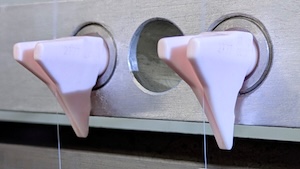
Serving the market for fine titers below 100 denier: The new Barmag ceramic oiling device, type 2777.
The new design, based on the proven model 2888, is significantly slimmer and has been specifically optimized for fine titers and sensitive filament counts. While the type 2888, as an all-rounder, demonstrates its strengths in the high denier range and up to 288 filaments, the type 2777 offers the long-awaited solution for the lower fineness range. This is where standard oilers often reach their physical limits, leading to uneven deposits in the corners or instability in the yarn path when processing finer titers. Here, the narrower variant excels with maximum precision in the process.
Both oiler types are designed for reduced spray-off thanks to their special geometry. In the fine-titer range, the new design reduces spray-off by a further 50% compared to the use of standard oilers. Extremely easy to adjust, the oiler impresses with its tolerance for installation deviations of ±2°. This largely prevents uneven oil application. The integrated ceramic shaft eliminates the typical errors that occur during the labor-intensive process of bonding metal shafts, thereby ensuring greater process stability.
Ceramic quality has a direct impact on yarn quality
The quality of yarn-guiding components in the spinning process is also a decisive factor for downstream processing. Inferior ceramics have a negative impact on yarn quality, which manifests itself in the downstream processing. Initial market deployments of the new oiler confirm the yarn’s improved downstream performance—a result shared by other ceramics from Barmag.
For yarn manufacturers, the ability to schedule the replacement of wear parts is particularly important: Thanks to consistently high manufacturing quality, components wear out in a controlled and synchronized manner—rather than unpredictably, as is the case with inferior components. This enables greater process stability and predictive maintenance.
SHANGHAI — May 14, 2026 — Intertextile Shanghai Apparel Fabrics – Autumn Edition will return from 25 – 27 August 2026 at the National Exhibition and Convention Center (Shanghai), set to reinforce its position as a leading global sourcing platform for the ever-changing apparel textile industry. Building on the success of the 2025 edition, where more than 3,700 exhibitors from 26 countries and regions welcomed over 100,000 buyers from 123 countries and regions, the upcoming fair will place special emphasis on high-growth segments – including advanced functionality, sustainability solutions, and digital transformation.
“In today’s evolving market landscape, buyers are looking for more than materials – they are looking for direction, innovation, and long-term partners,” said Ms Wilmet Shea, General Manager of Messe Frankfurt (HK) Ltd. “Intertextile Apparel continues to evolve alongside the industry, expanding its showcase to address functional performance, sustainability priorities, and emerging product categories, catering to a wide range of buyer preferences – from the traditional to the unconventional.”
Responding to these priorities, the 2026 edition is guided by four overarching themes reflecting the industry’s most compelling opportunities. Fashion Forward inspires creative direction through curated fabric displays and the Intertextile Directions Trend Forum, offering buyers and designers early insight into upcoming seasonal trends. Performance Textiles highlights advanced functional fabrics engineered for sportswear, outdoor, and lifestyle applications, addressing growing demand for comfort, durability, and technical enhancement. Under Sustainability, exhibitors present eco-conscious materials, solutions, and innovations aligned with international standards, centred around the Econogy Hub’s variety of sustainable textiles and certifications. Meanwhile, Textile Future spotlights smart textiles, AI-driven design tools, and next-gen manufacturing technologies shaping the digital transformation of the apparel supply chain.
Pet Boutique makes its autumn debut
Among this year’s notable highlights is the Autumn Edition debut of the Pet Boutique. First introduced at this year’s Spring Edition, the dedicated showcase will expand to leverage demand at the larger autumn platform. Globally, the pet textile market is forecast to compound yearly by 5.6% up to 2031, with Asia-Pacific set for the highest growth[1].
By bringing together relevant suppliers into a clearly defined showcase, the Pet Boutique enables buyers to efficiently explore fabrics and materials suitable for pet clothing, accessories, and related applications – an increasingly attractive segment within the broader apparel ecosystem. “Applying natural textile materials in the pet sector is still an emerging avenue. The primary role of this display area is to help the industry understand these materials and master their application methods,” said Mr Fred Wang, BD Manager for Functional Wear at Lenzing, who participated in the Spring Edition. “We aim to leverage Intertextile Apparel’s strong influence to attract more pet sector players through the Pet Boutique, while in the related Pet Forum I was honoured to discuss the applications of our natural fibres in the sector.”
Functional Lab expands with climate-adaptive textiles and more
The enhanced Functional Lab will continue to offer an integrated booth, display area, and seminar model designed to foster deeper exchange between exhibitors and sourcing professionals. At the centre of the zone, The CUBE is a high-visibility display area showcasing standout functional fabrics and accessories. New to this edition, The CUBE will introduce a Product Presentation Series, providing brands with a structured opportunity to present their latest innovations directly to an engaged audience.
Beyond its expanded presentation format, this edition’s Functional Lab will extend its spotlight to fast-emerging markets, including climate-adaptive textiles and silver-age applications, among others. Innovations in temperature and humidity regulation are driving the development of fabrics that support comfort across diverse environmental conditions, while the response to ageing demographics ushers in textiles that prioritise comfort, ease of care, lightweight performance, and everyday practicality. Together, these focus areas illustrate how functional textiles are expanding beyond traditional performance categories, opening new avenues for product development and cross-sector collaboration.
Reflecting on her experience at the last Autumn Edition, Ms Zoe Zhang, Engineer at the Hong Kong Research Institute of Textiles and Apparel (HKRITA), commented: “At the forum (Weaving the Future: Advancing Functional Textiles with Innovative Technologies), we joined forces with partners including Lenzing and Highsun to exchange our latest insights on functional textiles. The conversations continued well beyond the show floor – with several domestic manufacturers reaching out to us to explore collaboration on nanomaterial applications. Intertextile Apparel is a springboard for meaningful dialogue and cross-disciplinary innovation in the intelligent and sustainable development of functional textiles.”
To enhance sourcing efficiency across the entire apparel value chain, the fair will also feature a broad offering at its other specialized zones:
Accessories Vision: bringing together the full spectrum of trims, zippers, and finishing components essential to garment creation.
Beyond Denim: exploring fabrics at the cutting-edge of denim innovation, sustainable finishing processes, and evolving fashion applications.
Essential Suits & Shirts: a dedicated zone responding to the rising global demand for accessible, ready-to-wear suiting and shirting fabrics.
Innovation & Digital Solutions Zone: presenting AI-driven tools, digital production systems, and advanced manufacturing technologies.
Premium Wool Zone: highlighting the performance and versatility of wool, especially for its applications in top-quality suiting.
SalonEurope: offering a curated window into the finest, high-end European fabric collections, from fashion to function.
Verve for Design: dedicated to creative studios, trend-led patterns, and original textile design.
Aligned with the four pillars of Intertextile Apparel, these zones combine to create a comprehensive sourcing environment spanning trend-led inspiration, functional innovation, sustainability, and digital transformation.
The fair is co-organised by Messe Frankfurt (HK) Ltd; the Sub-Council of Textile Industry, CCPIT; and the China Textile Information Center. It will take place alongside Yarn Expo Autumn, CHIC and PH Value at the National Exhibition and Convention Center (Shanghai), with the venue playing host to the entire apparel textile value chain. For more details on this fair, please visit: www.intertextileapparel.com.
Intertextile Shanghai Apparel Fabrics – Autumn Edition will be held from 25 – 27 August 2026.
BLACKBURN, UK — May 14, 2026 — Airtech Nonwovens will exhibit at INDEX™ 2026 for the first time, marking an important milestone following its integration into the Airtech Advanced Materials Group. As a long-established UK nonwovens manufacturer, Airtech Nonwovens is using its debut at the world’s leading nonwovens exhibition to actively engage with the global industry and showcase its capabilities to a wider international audience.
With decades of experience in mechanically and thermally bonded nonwoven materials, Airtech Nonwovens has built a strong reputation for quality, flexibility, and collaboration. Using needlepunch and thermal bonding technologies, the company supplies high-performance materials to a wide range of industries, supported by highly adaptable manufacturing facilities.
More than a materials supplier, Airtech Nonwovens positions itself as a true manufacturing partner. The team works closely with customers from concept through to production, developing bespoke solutions that meet precise technical and commercial requirements. Short manufacturing lead times and quick delivery enable customers to operate with lower stock levels while maintaining confidence in supply.
Now part of the Airtech Advanced Materials Group, Airtech Nonwovens benefits from access to broader technical expertise, shared innovation, and an expanded global network. The move reflects a continued commitment to investment, collaboration, and long-term growth, while retaining the flexibility and customer focus for which the company is known.
At INDEX™ 2026, visitors are invited to meet the Airtech Nonwovens team to discuss bespoke nonwoven solutions, new opportunities, and how collaborative development can support evolving application requirements across sectors.
U.S. Senator Lindsey Graham (R-South Carolina) Photo Courtesy U.S. Senate Historical Office
WASHINGTON, D.C. — May 14, 2026 — U.S. Senator Lindsey Graham (R-South Carolina) today introduced the Coast Guard Personnel Equipment Act, which would require all U.S. Coast Guard uniforms to be produced in the United States. Graham has long championed legislation that supports a secure and reliable domestic supply chain for the textile industry, and cracks down on foreign actors that try to exploit U.S. trade laws.
“For too long, America-last policies have led to an over-reliance on other nations for essentials, including military clothing, putting our national security in jeopardy. My legislation would end this practice by ensuring uniforms for all branches of the armed forces are made in the USA,” said Senator Graham. “I’m proud to stand with President Trump in support of American workers and consumers. A secure and reliable domestic supply chain for the textile industry not only impacts readiness but also our economy. The Coast Guard Personnel Equipment Act would greatly benefit South Carolina’s textile producers and workers, who have been gravely undercut by unfair trade practices for decades.”
“We sincerely thank Senator Graham for his leadership in extending the Berry Amendment’s domestic sourcing requirements to the U.S. Coast Guard. Under this important bill, the men and women of our United States Coast Guard will be guaranteed access to the same high quality, American-made uniforms and personal gear that are provided to all other members of our armed forces,” said National Council of Textile Organizations (NCTO) President and CEO Kim Glas. “This is also an important step in strengthening our nation’s warm industrial base for the production of mission critical U.S.-made textiles, uniforms, and gear to meet our national security needs.”
In February, Graham encouraged President Trump to take executive action to ensure that all federal law enforcement uniforms are made in the United States, following reports that U.S. federal law enforcement uniforms are made in foreign countries. In March, President Trump signed an executive order to increase scrutiny on fake “Made in USA” claims, and this week echoed calls for federal agencies to buy American.
Background on Graham’s Coast Guard Personnel Equipment Act:
Under current law, all branches of the U.S. Armed Forces – except the U.S. Coast Guard – are barred from purchasing clothes, fabrics, fibers, yarns, and other materials that are produced overseas. Graham’s bill would extend this prohibition to include the Coast Guard, ensuring no branch of the U.S. Armed Forces relies on a foreign country for personal equipment.
This legislation also seeks to support America’s domestic textile industry. As a major contributor to the South Carolina economy, Graham has fought to protect the textile industry and its workers from unfair foreign competition.
WASHINGTON, D.C. — May 14, 2026 — The Plastics Industry Association (PLASTICS) applauds the bipartisan leadership of the House Energy and Commerce Committee’s Subcommittee on Environment for advancing two key recycling bills during today’s markup: H.R. 2145, the Recycling Infrastructure and Accessibility Act (RIAA), and H.R. 4109, the Recycling and Composting Accountability Act (RCAA).
“Today’s actions represent an important step toward improving recycling accessibility, enhancing data collection and reporting, and strengthening the effectiveness of the nation’s recycling system,” said Chris Rager, Vice President of Government Affairs at PLASTICS. “We commend the committee for advancing commonsense legislation that supports American manufacturing and helps keep valuable materials in productive use and out of the environment.”
PLASTICS recognized House Energy and Commerce Committee Chairman Brett Guthrie, Ranking Member Frank Pallone, Jr., Subcommittee on Environment Chairman Gary Palmer, Ranking Member Paul Tonko, and other members of the subcommittee for their bipartisan support of the legislation.
PLASTICS also commends bill sponsors U.S. Reps. Mariannette Miller-Meeks and Joe Neguse for their leadership on the legislation. The two bills were combined during the markup to align with the bipartisan STEWARD Act framework previously passed by the Senate.
Rager added that today’s markup reflects continued bipartisan momentum around policies that support recycling innovation, infrastructure expansion, and circular manufacturing solutions.
“We are encouraged by the strong bipartisan support demonstrated during today’s markup and look forward to consideration by the full committee,” Rager said. “Today’s action also helps build momentum around additional proposals, including the Recycled Materials Attribution Act (RMAA), the Recycling Technology Innovation Act (RTIA), and the Packaging and Claims Knowledge (PACK) Act, that support all recycling technologies, strengthen U.S. manufacturing, and advance a more circular economy.”
Posted: May 15, 2026
Source: The Plastics Industry Association (PLASTICS)
SYDNEY — May 15, 2026 — Oritain, global supplier of forensic origin verification, has announced the release of its inaugural 2026 Global Supply Chain Intelligence Report. Drawing on multiple global datasets, the report reflects a critical inflection point for global trade: as regulatory scrutiny, economic pressure and consumer skepticism intensify, visibility alone is no longer enough to operate with confidence.
The findings point not to a single-issue risk spike, but to a wider structural gap between supply chain documentation and supply chain truth, with implications for markets, consumers, investors and regulators alike. Using cotton as a spotlight commodity to examine how one of the world’s most traded materials moves under overlapping regulatory, trade and cost pressures, the report shows that after three years of steady progress, exposure to cotton prohibited by legislation has surged back to pre 2021 levels.
The report draws on a multi-year forensic sampling programme analysing approximately 1,000 garments across 40 brands annually, alongside large-scale consumer research, industry professional and supplier intelligence spanning key global manufacturing hubs. While nearly 94% of UK companies and 87% of US companies surveyed now trace their cotton supply chains, Oritain’s Market Insights data shows that 90% of brands analysed in 2025 recorded at least one risk consistent result, up sharply from 64% the previous year. The data suggests that while transparency initiatives have scaled, assurance has not kept pace.
The “Verification Gap”: Moving Beyond Procedural Compliance
Oritain’s 2026 Global Supply Chain Intelligence Report highlights a fundamental shift facing corporate leadership: while traceability demonstrates intent and process, only verification provides a defensible
source of truth in an increasingly enforcement-led environment. As supply chains evolve and sourcing strategies adjust under economic and geopolitical pressure, periodic assurance models are proving insufficient.
“The data tells a clear story: risk isn’t disappearing, it is re-emerging,” said Alyn Franklin, CEO at Oritain.
“As brands pivot manufacturing regions they’re finding that upstream material exposure hasn’t gone away – it is increasingly appearing in other key manufacturing hubs. Without independent verification, that risk travels quietly through complex trade routes and only surfaces at the end of the supply chain, when goods are stopped, costs escalate and production timelines are already missed.”
Key Insights from Oritain’s 2026 Global Supply Chain Intelligence Report
Risk Re-emergence: As sourcing patterns shift under tariff, trade and policy pressure, global manufacturing capacity is expanding faster than internal controls and traditional compliance models can adapt.
Systemic Exposure: With 90% of brands analysed impacted by exposure to prohibited cotton, exposure is no longer an isolated issue. It reflects a system wide challenge requiring a programmatic, scientific approach rather than ad hoc checks or reliance purely on paper trails
The Trust Deficit: Consumer scepticism is at record levels. 60% of consumers actively avoid products linked to untrustworthy origins, while only 3% trust marketing claims. Instead, trust is anchored in credible, independent evidence, with government regulation (27%) and scientific traceability to origin (23%) sitting at the top of the hierarchy of consumer trust.
Transparency expectations are rising across materials: focussing on leather alone, 69% of consumers support mandatory ethical sourcing proof, reinforcing the need for the inclusion of leather within the EUDR scope.
The Cost of Failure: The consequences are no longer theoretical. 80% of UK brands and 37% of US brands surveyed have already experienced material impact, including border delays, financial penalties, disrupted production cycles and lost commercial relationships.
A New Standard for Global Intelligence
The report demonstrates that reliance on declarations alone is no longer sufficient to support market access, investor confidence or brand resilience.
The future of resilient supply chains lies in programmatic forensic verification: a continuous, independent and repeatable model that enables proactive management rather than late-stage remediation. By operating as a connected network, spanning brands, suppliers and regulators, this approach allows businesses to detect issues earlier, substantiate claims credibly and navigate complexity with confidence.
“As regulatory and economic pressures intensify, visibility without verification no longer holds,” said Alyn.
“What matters now is evidence that stands up. Oritain’s role is to provide the science, intelligence and networked approach that allows organisations to move from reactive compliance to proactive supply chain management – building trust that is measurable, defensible and scalable over time.
BRUSSELS, Belgium — May 15, 2026 — On 13 May 2026, after eight months of investigation, the European Commission imposed provisional anti-dumping duties of 45.6-50.0% on imports of PET spunbond from China.
EDANA welcomes this expression of the Commission’s clear determination to protect EU industries from the unfair trade practices of Chinese producers.
According to the Commission’s findings, Chinese producers of PET spunbond have engaged in dumping practices on the EU market that have caused material injury to the EU industry, including declines in production, sales, and profitability. The imposition of provisional AD measures is therefore essential to re-establish a level playing field, to preserve European jobs, and to foster growth and innovation in the EU.
“It is encouraging to see the EU institutions are determined to support EU industries during these globally difficult times. EU production creates a lot of added value to our economy, and it is essential for the stability and prosperity of our continent that EU industrial value chains are not exposed to unfair, state-supported market behaviours on their home markets”, said Jacques Prigneaux, Market Analysis & Economic Affairs Director at EDANA.
The provisional anti-dumping duties will apply until 13 November 2026, by when the Commission must make a final decision in the case on whether to impose definitive anti-dumping duties for a 5-year period. At that time, the Commission may also decide to impose the definitive AD measures retroactively up to 90 days prior to the date of application of the provisional measures.
Jacques Prigneaux added: “EDANA and the EU industry will continue to cooperate fully with the Commission during the remainder of the proceedings. We look forward to final measures which maintain a level playing field on the EU market. We also want to remind all parties of the legal requirement to declare imports under the correct customs code. Accurate use of TARIC codes is fundamental to ensuring the proper application of trade measures and avoiding material risks in customs compliance and import processing.”
The products concerned are defined as certain non-woven needle-punched sheets of polyester filaments, whether or not reinforced by glass fibers, weighing more than 70 g/m², of a thickness exceeding 0.5 mm but not exceeding 1.8 mm, impregnated with one or more binders, containing less than 30 % of glass fibers by weight, not coated or covered, and are to be classified under CN codes ex 5603 13 90, 5603 14 20 and ex 5603 14 80 (TARIC codes 5603 13 90 70 and 5603 14 80 70).
GRAZ, Austria — April 14, 2026 — International technology Group ANDRITZ will be presenting its innovative nonwovens production and textile solutions at INDEX26 in Geneva, Switzerland, from May 19-22, 2026 (Hall 2, booth 2114). ANDRITZ will focus on technologies for sustainable and durable nonwovens, converting, sustainable fiber processes, textile recycling, and life-cycle services.
Redefining Hygiene Production Through Innovation And Circularity
ANDRITZ will showcase its full range of advanced absorbent hygiene products (AHP) converting and recycling solutions – from high‑quality converting processes for adult, feminine and baby care, to recycling systems that transform diaper production waste into valuable raw materials, to next‑generation adult care lines delivering high efficiency, superior super absorbent polymers (SAP) management, and operator‑friendly performance.
The diaper recycling system leverages the combined expertise of ANDRITZ Diatec in hygiene converting and ANDRITZ Laroche in recycling processes. This AHP recycling line ensures efficient separation of SAP, fluff pulp, and plastics, enabling closed‑loop reuse for more sustainable manufacturing.
Alongside these solutions, ANDRITZ will also highlight its high‑precision ultrasonic lamination technologies, featuring modular full‑servo systems designed for stability, low waste, and easy customization. These innovations underline ANDRITZ’s commitment to delivering sustainable, flexible, and high‑performance technologies for the hygiene industry.
Comprehensive Solutions For Sustainable Wipes Production
ANDRITZ neXline wetlace hybrid pro line for the production of wipes
ANDRITZ is advancing sustainable nonwoven solutions with economically viable solutions that meet the global demand for eco-friendly, high-performance wipes. The portfolio includes spunlace technologies using natural and renewable fibers, enabling high‑performance nonwovens for wipes and hygiene applications, as well as all varieties of Wetlace™ technologies designed for efficient production of pulp‑based and blended structures.
In addition, ANDRITZ will highlight its Wetlace™ solutions for flushable and dispersible wipes, addressing increasing regulatory and market expectations. The offering is complemented by fully integrated carded pulp and airlaid technologies, providing a flexible alternative to wetlaid processes, including upgrades of existing, conventional spunlace lines.
Complete MMCFProduction Solutions For Lyocell
ANDRITZ introduces its competences in production plants for MMCF, namely lyocell – a rapidly growing market driven by demand for sustainable materials. The solutions cover the full scope, from engineering to specialized equipment like flash dryers and pulp preparation systems. With decades of expertise in pulp and paper, ANDRITZ also provides audits and upgrades for existing plants. The lyocell process stands out for its environmental benefits and high-quality output, making it a key technology for the future of textiles and nonwovens.
High‑Speed Crosslapping: New Performance Benchmark With The Andritz X‑Pro™ Crosslapper
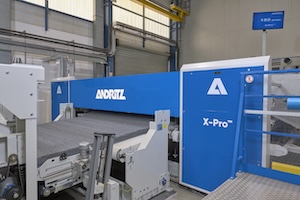
ANDRITZ X-ProTM crosslapper for high-speed production for needlepunch and spunlace lines
With the X‑Pro™ crosslapper, ANDRITZ sets new standards in high‑speed crosslapping for spunlace and needlepunch applications. Designed to combine higher productivity with great web uniformity, the X‑Pro™ crosslapper enables producers to push performance limits while maintaining consistent fabric quality. Its innovative design supports optimized batt formation at high inlet speeds and integrates seamlessly with the ANDRITZ ProWin™ web weight regulation system. Available both for new lines and as a retrofit solution, the X‑Pro™ crosslapper allows existing installations to be upgraded efficiently, backed by ANDRITZ service expertise.
Life‑Cycle Management: Andritz Synergy™ Service Agreements
ANDRITZ SYNERGY™ service agreements offer structured and cost‑effective life‑cycle management solutions designed to support reliable and uninterrupted production. Tailored to complement customers’ in‑house capabilities, the agreements cover the entire equipment life cycle, including regular expert visits, preventive maintenance, retrofits, and upgrades. With this approach, ANDRITZ helps ensure stable operations, long‑term performance, and sustained asset value.
Digitalization And Smart Plant Solutions With Metris
Digitalization will again be a key highlight of ANDRITZ’s presence at INDEX26. Under the Metris brand, ANDRITZ presents its continuously expanding portfolio of digital products and services. A central element is the Metris digitalization platform, which supports nonwoven production plants throughout their entire life cycle. The platform integrates advanced functionalities for production management, process simulation and optimization based on state‑of‑the‑art AI, as well as Advanced Control Expert (ACETM) solutions and condition monitoring using smart sensors. At INDEX26, ANDRITZ will demonstrate live at its booth how these digital solutions help improve efficiency, transparency, and long-term operational reliability.
Spunlace & Wetlace™ Trials At Our Montbonnot Technical Center
Visitors to INDEX26 can take the next step beyond the show floor. From May 11 to May 29 ANDRITZ FRANCE offers the opportunity to book spunlace, Airlace™ and Wetlace™ trials at its technical center located in Montbonnot, France, two hours drive away from Geneva. In a dedicatsettings anding environment, customers can run their own raw materials, compare structures and softness, validate key process settings, and assess dispersibility/flushability concepts in the lab with ANDRITZ specialists – supporting faster decision-making and smoother project implementation.
The entire ANDRITZ Nonwoven & Textile team is looking forward to welcoming customers and partners at booth 2114 in hall 2.
DÜLMEN, Germany — April 13, 2026 — From 19 to 22 May, Trützschler Nonwovens will present itself at booth 1641 as a long-term partner to its customers.
The focus will be on new products for all nonwoven processes, further developments of the digital working environment T‑ONE, and an expanded service portfolio.
The new, compact AquaJet TWB‑AJ‑X: efficiency meets an anniversary
In the field of hydroentangling technology, Trützschler will introduce the new, compact AquaJet – a space-saving and energy-efficient machine for the production of nonwovens for dry and wet wipes. The market launch coincides with the 30th anniversary of AquaJet technology: since 1996, more than 200 AquaJet systems have been installed worldwide. The new jet is aimed at customers looking to efficiently produce proven product qualities.
ATB technology for super-soft hygiene nonwovens
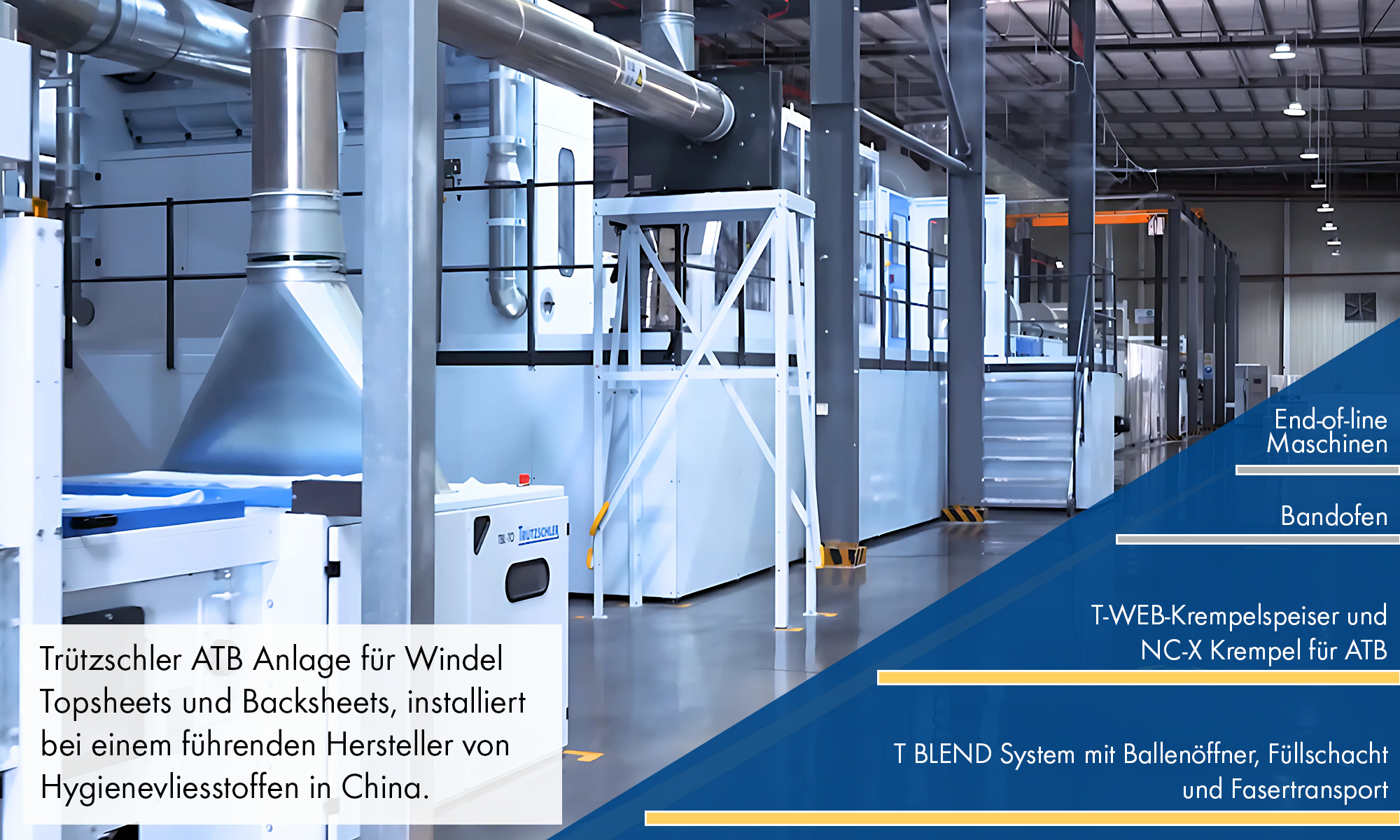
With specially designed components and machines, Trützschler enables its customers to process extremely fine microfibers down to 0.4 dtex. These fibers allow the production of through‑air bonded, super‑soft hygiene nonwovens, for example for diaper backsheet applications. This technology has already proven itself in demanding Asian markets and underlines Trützschler’s expertise in the growing hygiene segment.
Carding technology as a driver of innovation
NC-X card in a T-SUPREMA customer installation
At the heart of fiber‑based processes lies Trützschler’s innovative carding technology. With more than 350 cards supplied in through‑air bonding, needle-punching and hydroentangling processes, Trützschler Nonwovens has extensive know‑how in meeting product requirements for hygiene, wipes and technical end uses. The card is also a key element of the T‑SUPREMA needle-punching concept, whose first installations are now successfully operating at customer sites. With the new compact NC‑Xe card, the company will present an economical solution for standard needle-punching and ATB processes at INDEX.
T‑ONE: digital intelligence for greater efficiency and performance
The digital working environment will be expanded by two key features. The new Energy Management function enables real‑time monitoring of electricity and gas consumption and calculates the CO₂ footprint per unit of time, nonwoven roll or order. Camera‑based anomaly detection identifies issues such as fiber migration and fiber build‑ups at an early stage and alerts the production team. This helps prevent production downtime and equipment damage while significantly reducing inspection effort, especially in hard‑to‑access or poorly visible areas of the line.
Rethinking Service
Trützschler Nonwovens is strategically expanding its service portfolio. In addition to classic services such as spare parts supply and maintenance, the company is increasingly offering strategic consulting, machine upgrades, refurbishments and retrofits.
Trützschler Nonwovens sees itself as a partner along the customer journey, supporting customers with tailored solutions in their current operations as well as in their future development.
Posted: May 12, 2026
Source: Trützschler Nonwovens / The Trützschler Group SE
CHEMNITZ, Germany — May 11, 2026 — From 19 to 22 May 2026, INDEX™ will invite visitors to Lake Geneva for the world’s leading nonwovens trade fair. The Centre of Excellence in Nonwovens at the Sächsisches Textilforschungsinstitut e.V. (STFI) will be in attendance to present the latest developments in nonwovens research.
In the field of the textile circular economy, the STFI will present acoustically effective nonwovens made from chemical recycling residues. The range also includes innovations aimed at replacing conventional raw materials, such as the biobased and biodegradable polymer polybutylene succinate (PBS) and Kendyr as an alternative to cotton. One of the highlights will be the ring-spun yarn produced from the straw of the Kendyr plant. The advantage of Kendyr is that it thrives on soils that have become salinated due to long- term cotton cultivation. Meet our exhibition team at Stand 1369 in Geneva.
Textile circular economy: Acoustically effective non-woven fabrics from chemical recycling residues
Chemical recycling of mixed textile fractions produces textile residues that are currently mostly not reused as material, but instead thermally recovered or disposed of. To facilitate further recycling, the STFI, in cooperation with the company Refresh Global, is investigating efficient processing and treatment methods to enable these textile residues to be reused. They can be used in sound-absorbing design products, such as acoustic walls or furniture. Nonwoven formation processes are particularly suitable for processing these textile residues. At STFI, the recycled materials are mechanically processed on pilot-scale plants at laboratory or semi-industrial scale before being formed into a nonwoven fabric and consolidated. Through appropriate finishing, a visually suitable top layer can also be integrated directly onto the nonwoven fabric. Under
the use of samples on our booth, possible applications as acoustic pictures and a miniature sound box are shown.
Bulletproof: Ballistic composite textile
Shown here is a ballistic composite textile based on nonwoven fabrics, which, through shaping and design, can be used to equip structural elements, particularly the interior areas of buildings, especially shooting ranges. The research resulted in a three-dimensional, pressure-stable and rigid nonwoven composite that is not only able to catch shrapnels and meets fire class B1 according to DIN 4102-1, but is also extremely sound-absorbing and provides excellent damping in critical frequency ranges. The nonwoven composite was processed and tested in practical panels suitable for the refurbishment of bulletproof floors, walls and ceilings in enclosed shooting ranges.
Rubio: Central German alliance for bioplastics
The development of sustainable plastic solutions is rapidly gaining importance in the face of global environmental pressures, dwindling fossil resources and ambitious climate protection targets. As part of the regional RUBIO alliance, which brings together 18 partners from Central Germany and the Berlin-Brandenburg
Posted: May 12, 2026
Source The Sächsisches Textilforschungsinstitut e.V. (STFI)

 REMSCHEID, Germany— May 14, 2026 — With the new Type 2777 ceramic oiler, Barmag has added a solution for fine titers and microfilaments to its portfolio of original parts.