Polartec, Andover, Mass., recently introduced a Ready to Roll program — featuring in stock, first-quality Polartec fabrics that are ready to be shipped. “Customers have long asked for in-stock inventory without the standard production lead times, and this announcement enables rapid order fulfillment in time for fall/winter 2019 production to meet increased demand,” said Gary Smith, Polartec CEO.
According to the company, Ready to Roll includes premium Polartec fabrics in most of the
popular styles as well as more rare styles — such as cooling, insulating and flame resistant technologies — and hard-to-find colors.
The Ready to Roll program is an extension of Polartec Eco-Engineering™, the company’s process for deploying recycled and biodegradable inputs, advanced production techniques, efficient logistics and rigorous testing and certifications.
The company also recently upgraded its production capacity to meet high demand for shearling and Sherpa fleece fabrics.
Speedo has issued the latest technology in its Fastskin range designed to allow a swimmer to achieve maximum speed in the water. Developed in partnership with Switzerland-based HeiQ, the new Fastskin LZR styles — Pure Intent and Pure Valor — are the latest generation of the technology, which was originally introduced in 2008. According to Speedo, LZR Pure Intent features the shark skin inspired technology developed with HeiQ, as well as a unique triple fabric construction that enhances compression and flexibility. LZR Pure Valor, codeveloped with HeiQ, was engineered to be light and flexible so swimmerscan reduce drag and increase power in the water.
“With almost two decades of improvements in our Fastskin technology, we are excited to partner with HeiQ to give our racers the ultimate advantage with drag reduction technology to improve their speed,” said Rebecca Bennett, materials specialist at Speedo. “We’ve worked very closely with our athletes and taken all their feedback on board to help them get the suit they need to perform at their absolute best.”
“We are proud to combine our in-depth knowledge in textiles with Speedo’s expertise in swimwear to develop a differentiating innovation,” said Carlo Centonze, HeiQ CEO. “This is the outcome of the close collaboration between Speedo and HeiQ’s research hubs in Australia and Switzerland.”
The New York City-based Fashion Institute of Technology (FIT) has announced that its FIT/Infor Design and Technology Lab (DTech Lab) has partnered with IBM Corp. to leverage IBM’s artificial intelligence (AI) for fashion capabilities. IBM’s AI for Fashion application programming interfaces (API’s) were developed to help fashion companies improve customer service, product design, development and merchandising by leveraging deep learning, natural language processing and computer vision. The suite of API’s can be used individually or be incorporated into existing applications.
The DTech Lab partnered with IBM and Tommy Hilfiger in 2018 on the “Reimagine Retail” project, which was designed to show how AI can offer a brand a competitive edge. The project was successful to the point that FIT and IBM are continuing their partnership with innovative research and partner projects that will address challenges in product design, development, merchandising, planning and allocation, and customer sales and service. FIT also plans to integrate IBM’s AI tools into coursework for students.
“Reimagine Retail was a powerful example of what happens when fashion partners with a global tech leader to advance challenging innovations,” said Michael Ferraro, director of the FIT/Infor DTech Lab. “Embedding emerging technology into our lab where faculty and students are solving industry problems is the next step in our evolving relationship with IBM. We’re leveraging the fresh perspectives and new ideas of talented creative students in an agile research environment.”
New York City-based PVH Corp. has entered into a licensing agreement — that includes design, sourcing, marketing and worldwide distribution — with Portland-based Nike Inc. for Nike-branded men’s underwear. PVH reports it will use its innovative underwear platform while adhering to quality standards and corporate responsibility. The agreement expands The Underwear Group at PVH and adds Nike to its existing brands: Calvin Klein; Tommy Hilfiger; Olga; Warner’s; and True & Co.
“We are incredibly proud to be working with NIKE, as this is an opportunity for two great companies to build on each other’s strengths, making it a win-win for everyone, especially consumers,” said PVH’s Cheryl Abel-Hodges, President of Calvin Klein North America and The Underwear Group.
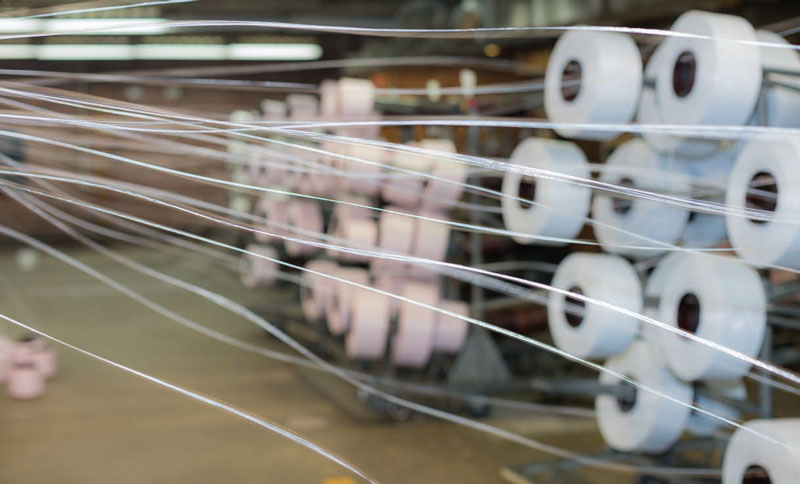
Ascend Performance Materials’ Fiber Center of Excellence in Greenwood, S.C., produces nylon 6,6 staple fiber.
Nylon 6,6 producer Ascend Performance Materials is solving problems with its antistatic, anticling ENDUR by Ascend™ yarn.
TW Special Report
Nylon is a material that plays a significant role in daily life, but its performance attributes and extensive applications are rarely recognized by the average consumer. This man-made polymer, first synthesized in 1937, is formed when specific chemical building blocks called monomers are brought together to create long chains known as polymers. Because of its versatility, nylon has traditionally been used to create products ranging from women’s stockings to Army parachutes and cording.
Nylon 6,6 is just one type of polymer used in textiles — other common textile polymers include nylon 6, polyester, rayon and polypropylene. Today, the uses for nylon 6,6 have grown to include all types of apparel, tires, automotive airbags and carpet, among other applications.
Houston-based Ascend Performance Materials is a privately owned, fully vertical nylon 6,6 producer, with roots going back more than 60 years. Ascend specializes in nylon 6,6 resins, fibers and compounds as well as specialty and intermediate chemicals used throughout the polymer value chain. In recent years, the company has expanded facilities including capacity increases across its intermediate chemicals and polymers portfolio. Today, Ascend has sales and technology offices throughout the world and six manufacturing facilities and a technology center in the United States. Globally, the company employs approximately 3,500 associates and contractors. In addition, Ascend has announced a $35.2 million investment in Greenwood County, S.C., that will create 30 new jobs.
ENDUR by Ascend™ is a unique antistatic fiber technology that adds value to yoga and performance gear, loungewear, and childrenswear among other garments. The company also offers a hangtag program for customers using the fiber.
Adding Performance Beyond The Basic
Amongst Ascend’s line of products is ENDUR by Ascend™, a fiber product differentiated by its unique antistatic technology. It is a filament- or staple-fiber product that can be blended with other fibers and yarns to provide fabrics with permanent antistatic functionality because it is neither a garment treatment nor a coating that can wear off over time. The yarn has a bicomponent structure featuring one-part nylon 6,6, and one-part conductive carbon. These two components are joined together during the high-temperature yarn extrusion process to produce a fiber that, among other attributes, eliminates static electricity.
In Endur, the conductive carbon component of the fiber grounds and harmlessly moves electricity through the garment, preventing a build-up of static electricity and removing the possibility of an electric shock.
“Endur is a speciality fiber product and the furthest down the value chain that Ascend sells,” said Harrie Schoots, Ascend’s Specialty Fibers Segment Manager. “It’s been exciting for me to take the product out to the brands, retailers and design folks and explain it to them and show them what it can do for their apparel products.”
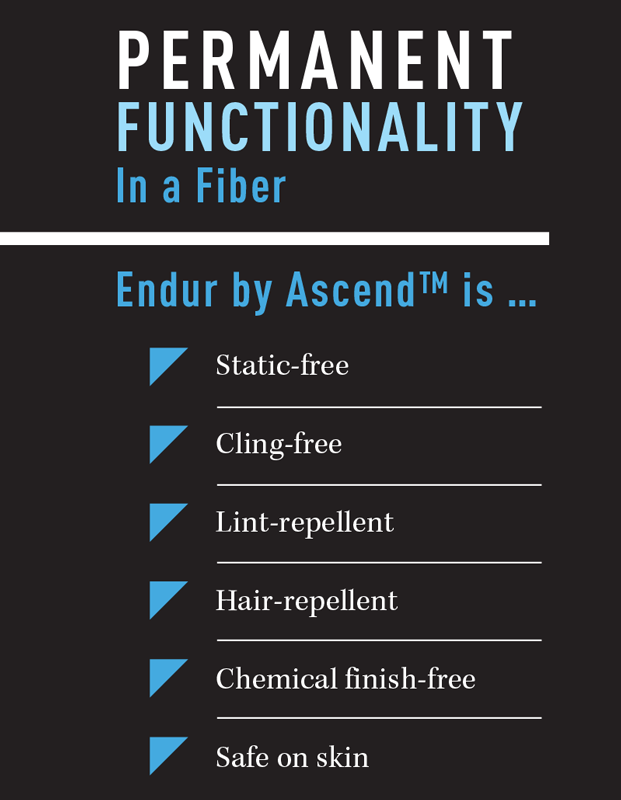
Beyond reducing static within a garment, Endur imparts other desired attributes to a finished product (see box).
These important properties help designers improve yoga and performance gear, loungewear, shapewear, eveningwear, childrenswear and medical garments. For example, Endur can help reduce bothersome and potentially harmful qualities in fabrics such as clinginess and lint and allergenic debris accumulation, while providing comfort in chemical-free, next-to-skin applications.
Futhermore, as a unique bicomponent fiber, Endur offers permanent value. As Schoots explained: “Because of the high temperature at which nylon 6,6 is melted and combined with the carbon, the fiber becomes very abrasion resistant and the carbon does not break off or flake away from the fiber, which is a very important property. In the past people have tried to weave or knit with a yarn that has been coated with carbon at a much lower temperature and the coating flaked off. If you have black specks of carbon on the machinery and then you run white fabric behind it, you can imagine what a problem that is.”
Proof In The Testing
To demonstrate that static does not build up in fabrics developed with Endur, Ascend employed the American Association of Textile Chemists and Colorists’ (AATCC) Test Method 115 — Electrostatic Clinging of Fabrics: Fabric-to-Metal Test.
“AATCC’s cling test is a test I think I pulled out of the basement from the polyester leisure suit days — it tests the static cling of fabrics,” Schoots said. “But we also had to show that the static is not in the fabric, and that’s why our lab offers the static decay test for customers.”
Ascend’s static decay test charges a fabric to 5,000 volts, then measures the time it takes for 90 percent of that charge to dissipate. “In many cases, fabrics will take more than a minute,” Schoots said. “But in order to show that a material offers static reduction, the time measured has to be less than half a second. Typically, fabrics featuring Endur take 0.01 seconds to reduce the charge. Essentially, if you wear a dress or yoga pants with Endur on a very dry winter day, you would not generate any static electricity when walking or sitting for example.”
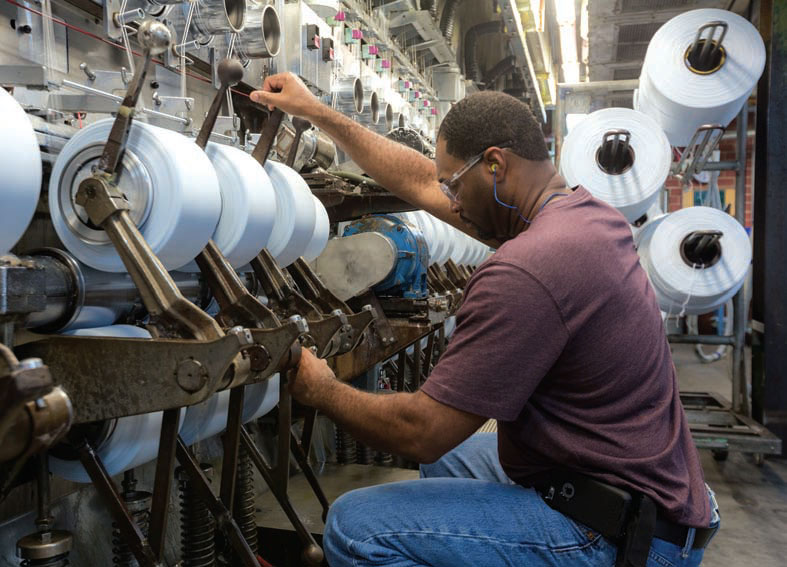
Ascend is openly committed to its employees and is dedicated to a safe, healthy and sustainable workplace.
Ascend: Making A Difference
Ascend, whose operations are based in the United States, has weathered the storm and resisted moving production to other countries. U.S.-based manufacturing has remained profitable for the company, and Ascend has never been more successful than it is today.
At the core of this success is Ascend’s open commitment to its employees. “The company values the communities and individual employees who are the lifeblood of Ascend,” Schoots said. “Our president and CEO, Phil McDivitt, is dedicated to a safe, healthy and sustainable workplace. Well beyond manufacturing a quality product, his goal is to have no incidents and zero accidents throughout the entire corporation, and he’s taken steps to ensure we all know that.”
The company also created the Ascend Cares Foundation in 2011 after employees of its Decatur, Alabama, facility were impacted by a tornado. According to the company: “The Ascend Cares Foundation is about making a difference in the lives of others. It is led by Ascend employees and supports Ascend families in their time of need, provides inspiring opportunities for community engagement and facilitates community leadership. Funded entirely by donations and company match, every dollar donated to the foundation supports the work of the foundation.”
Since its inception in 2011, Ascend reports the following tangible accomplishments made by the foundation:
Volunteers cleaned and repaired 55 homes and served more than 1,000 meals to employees impacted by Hurricane Harvey in Texas;
Volunteers have built five Habitat for Humanity homes on-site at Ascend’s Chocolate Bayou, Texas; Greenwood, South Carolina; and Decatur, Alabama, facilities;
Some 135 college scholarships totaling $205,000 have been awarded to team members’ children;
Children at Escambia Westgate School in Florida play on a new sensory playground that is the foundation’s largest project to date;
Volunteer events at Ascend sites help local organizations such as food banks, animal shelters and schools; and
A total of 206 families have received financial hardship support.
Ascend accounts for approximately one quarter of global nylon 6,6 production. According to the company, its “… vision is to be [a] recognized leader in the nylon 6,6 value chain, creating new possibilities with nylon 6,6 for everyone, everywhere, every day.”
Editor’s Note: This article appears in Textile World courtesy of the National Council of Textile Organizations (NCTO) as part of the “American Textiles: We Make Amazing™” campaign. NCTO is a trade association representing U.S. textile manufacturing. Please visit ncto.org to learn more about NCTO, the industry and the campaign.
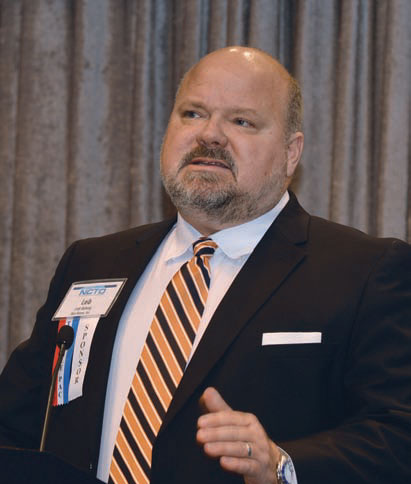
Leib Oehmig, president and CEO, Glen Raven Inc., was recently named chairman of the National Council of Textile Organizations.
Glen Raven CEO brings global textile business experience, hands-on approach to NCTO leadership.
TW Special Report
With a vibrant 30-year career at Glen Raven, N.C.-based Glen Raven Inc., Leib Oehmig is known for a leadership style that “… ensures a culture of integrity and innovation while maintaining the high standards of quality and service for which Glen Raven is known.”
Oehmig joined Glen Raven in 1989. During his career, he oversaw the construction and management of Glen Raven’s 1-million-square-foot Sunbrella® fabrics manufacturing center, served as president of Glen Raven Custom Fabrics LLC, and was named president and COO of Glen Raven Inc. In 2017, Oehmig was appointed president and CEO of Glen Raven upon Allen Gant’s retirement. Oehmig is the first non-family member to serve as CEO of the company.
At the 16th annual meeting of the National Council of Textile Organizations (NCTO) in Washington, Oehmig was elected NCTO chairman. Textile World recently had the opportunity to talk to Oehmig about the state of the U.S. textile industry, and the role NCTO plays in the industry’s future.
Textile World: Congratulations on the NCTO chairmanship. Your words during your acceptance speech were characterized by many as heartfelt. You called for continued support of NCTO during its time of transition, as well as support for incoming NCTO President and CEO Kim Glas. Can you comment on your remarks for TW readers?
Leib Oehmig: Auggie Tantillo and his NCTO team, working hand-in-hand with industry leaders, have changed the perception of the U.S. textile industry, gained credibility as thought leaders in global trade, and earned our industry a seat at the table during trade negotiations. Therefore, we must remain fully engaged as we transition the leadership of many of our member companies and the organization that represents our interests in Washington, D.C. We are incredibly fortunate to have Kim Glas leading this team of talented associates and I look forward to building on the momentum that our industry has gained through active participation and strong financial support. Regardless of your position in the value chain, if your company benefits from a strong U.S. textile industry, then membership in NCTO is among the most important investments you can make.
TW: Glen Raven leadership and associates have served the industry through commitment to NCTO lending both time and financial support. How do you see the role of NCTO, and what does the organization mean to the U.S. textile industry?
Oehmig: My predecessor as CEO of Glen Raven, Allen Gant, along with other iconic leaders in our industry, understood very well the benefits of strong advocacy in the executive and legislative branches of government. In addition, they recognized that our industry must align around common goals and approach advocacy with “unity in purpose and vision,” to quote Gant from a 2005 article that was published in Textile World. Since 2004, NCTO has served as the voice of the U.S. textile industry in Washington, D.C., representing all sectors from fiber through fabric formation and finishing. Fifteen years later, with rapidly changing industry dynamics and globalization, there has never been a more important time for our industry to advocate with clear purpose and vision.
TW: As the leader of a global textile business, how do you see the current state of the industry, including current and/or future challenges and opportunities?
Oehmig: Although I am certainly not naïve to the global economic and geopolitical challenges that confront our industry, I am very optimistic about the future of the U.S. textile industry. Innovation, creativity and courageous leadership are alive and well. Therefore, I am excited to work with NCTO and industry leaders to produce a positive influence on key policy matters that affect our industry. That means developing strategies to proactively engage in the Trump administration’s trade agenda. Negotiations with China, Japan and the European Union will require diligence as we work to create opportunity, while defending against adverse legislative proposals.
TW: Trade has been a significant issue for the current administration. What are your thoughts as NCTO chairman as well as a CEO of a company with global business interests?
Oehmig: In my view, accelerated globalization will continue to shape strategies for both governments and the businesses who operate within their borders. Therefore, it is no longer a question of how to slow this momentum, but how does the U.S. textile industry further engage the Trump administration in the process of developing business-friendly trade policies? Further, how do we anticipate U.S. textile policy needs prior to a crisis so that we can best position the industry to take advantage of opportunities that may be available?
TW: What are your thoughts on the NCTO leadership transition as Augustine D. “Auggie” Tantillo retires and Kimberly Glas joins the organization as president and CEO?
Oehmig: The U.S. textile industry owes a tremendous debt of gratitude to Auggie Tantillo for investing so much of himself into pushing our industry forward. In addition to his exemplary technical knowledge, the thing you hear most about Auggie are compliments regarding his character and integrity. Our industry has benefited greatly from the immense respect Auggie has earned from his peers, members of Congress and their staffs.
Kim Glas is bringing her own experiences, perspective and ideas to NCTO. Throughout the interview process, Kim clearly demonstrated her desire to lead an organization that is willing to embrace change and affect policy decisions as opposed to reacting.
I feel that NCTO has a history of adapting to the rapidly changing dynamics in global trade and will be receptive to new ideas and strategies from Kim and her team. We are excited for both Auggie and Kim, and very optimistic regarding the future of NCTO.
TW: Imagine it’s April 2020 and you are looking back on your year as chairman. Where is NCTO, and what contributions did you make to the organization?
Oehmig: I am confident that, throughout this next year, NCTO members will actively engage in policy debate and offer strong support to this NCTO team who is investing so much of themselves in the overall betterment of the domestic textile industry. From what I have read in Glas’ plan for her first 100 days, NCTO is going to have an incredibly productive year. When we look back on this year, I am confident that we will conclude that NCTO is well on its way to becoming the most effective and impactful trade association in Washington. For me, I just want to do all that I can to support NCTO, its leadership and its members in reaching our industry goals.
Lydall Performance Materials’ TechniMat is suitable for high-conductivity substrate applications, among other applications.
By Rachael S. Davis, Executive Editor
Imagine a nonwoven fabric lighter than a piece of paper that can help protect a composite airplane wing from a lightning strike. Sounds incredible maybe, but such products exist and Rochester, N.H.-based Lydall Performance Materials Inc. specializes in such nonwoven veils as well as filtration and insulation technical nonwoven, membrane and composite products.
Nonwoven veils are used in composites manufacturing to improve surface aesthetics and impart properties to the finished product. Lydall’s TechniMat nonwoven veil helps to conduct the approximately 1 billion joules of energy generated by a lightning strike over the skin of the aircraft acting like a faraday cage to protect the plane’s occupants and sensitive electronic equipment contained inside. The veil is designed to impart a resin-rich surface that creates a smooth, paintable finish that masks the weave pattern of the underlaying carbon fiber that makes up the structural components used in the wings and fuselage of a plane. According to the company, TechniMat also offers excellent electromagnetic interference (EFI)/radio frequency interference (RFI) shielding when incorporated into advanced composites.
TechniMat is a PAN or pitch-based carbon fiber nonwoven currently offered in versions ranging from 8.5 grams per square meter (gsm) up to 102 gsm. The company also is launching versions of TechniMat made using other fiber types including glass, polyester and aramids.
Each veil Lydall makes is customizable depending on the customer’s requirements. Specialty fillers, sizing or binder components that are compatible with epoxy resins all are available.
“For example, one customer may be looking for something that is lightweight and strong, whereas a different customer may be looking for a product that offers lightning strike diffusion,” said Michael O’Laughlin, vice president, Advanced Solutions, Lydall Performance Materials. “Customers can also specify the type of carbon fiber used to make the nonwoven veil depending on the desired end product properties.”
According to Lydall, TechniMat has excellent random fiber dispersion, uniformity and strength that ensure the veil is easy to process in pre-preg operations.
TechniMat is made using a controlled porosity process. “We have the ability to control porosity and other specifications during production through the use of online controls,” O’Laughlin said. “This ensures the porosity of the product is consistent. Controlled porosity can have various benefits depending on the application and can be used as an indication of uniformity of the sheet, or to predict the flow of air or liquid.”
“Lydall has invested in capabilities that allow us to produce materials with weights ranging from 6 gsm up to 2,500 gsm across the global network of production assets,” O’Laughlin added. “Lydall Performance Materials’ Advanced Solutions business unit offers small batch, superior quality and flexible manufacturing options. TechniMat is a great example of the company’s capabilities!”
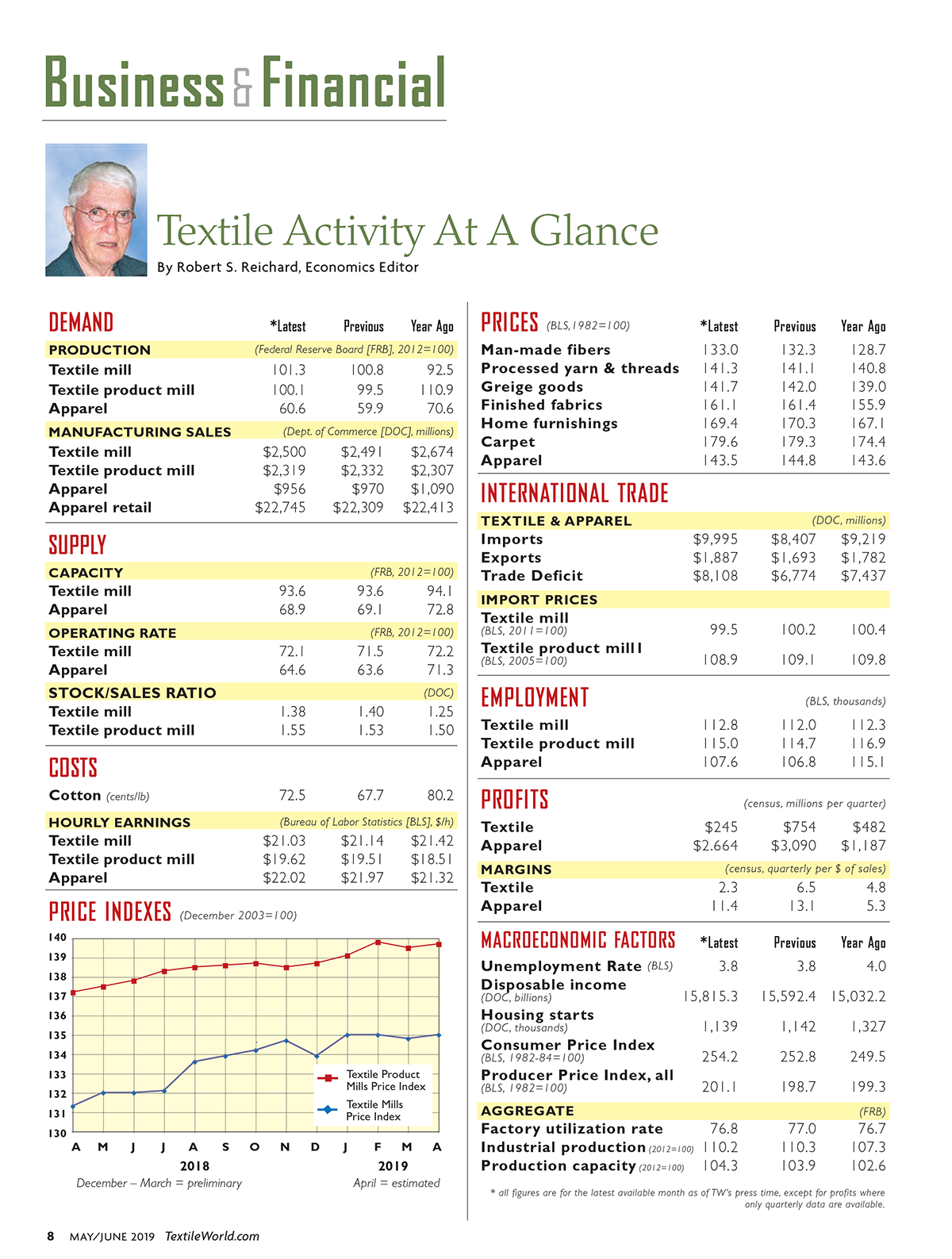
Many spinners reported excellent results for the first quarter of the year. “We have some limited capacity in some areas, but, overall, things have been very good,” said one spinner. “We have a healthy backlog, so we don’t anticipate slowing any time soon.”
Other spinners also said they had a solid first quarter. “This has been the best start of the year we’ve had in some time,” noted one diversified spinner. “With the continued growth of the economy, at least for the short term, we expect the positive results will continue.”
Indeed, according to the Consumer Confidence Index, published by The Conference Board, consumers expect the economy to continue growing in the near term. “Consumers’ assessment of current conditions improved in April,” the board reported. “Those stating business conditions are “good” increased from 34.7 percent to 37.3 percent, while those saying business conditions are “bad” decreased from 12.4 percent to 11.7 percent. Consumers’ assessment of the labor market was also more upbeat. Those stating jobs are “plentiful” increased from 42.5 percent to 46.8 percent, while those claiming jobs are “hard to get” decreased from 13.8 percent to 13.3 percent. Consumers’ short-term outlook also improved in April. The percentage of consumers expecting business conditions will be better six months from now increased from 17.2 percent to 19.9 percent, while those expecting business conditions will worsen declined from 10.0 percent to 9.1 percent.”
USMCA Deal Still Has A Long Way To Go
Advocates of the United States-Mexico-Canada Agreement (USMCA) are hoping that Congress will take action on the trade deal in the next three months. “I think the timeline for the vote is that the bill is going to come to the Congress pretty soon,” Senator Roy Blunt, R-Mo., said in a recent interview. Once there, however, USMCA is likely to face lively debate.
“Passing trade legislation is often difficult, but the U.S.-Mexico-Canada Agreement, as the updated NAFTA is now known, faces an especially uncertain path,” according to a recent report by Minnesota Public Radio’s Marketplace.
“The dynamic has typically been, presidents [from either party] negotiate agreements, Republicans overwhelmingly support it, and enough Democrats get dragged along to make it possible,” said Senator Pat Toomey, R-Pa., in an interview. Toomey is a member of the Senate Finance Committee, which has jurisdiction over trade agreements. “Now we’re in a dynamic where it’s very different. We have a president who’s much less pro-trade than the Republican consensus has been historically, and Democrats do not appear as enthusiastic about working with this president as they might have been with others.”
While the current U.S. administration has touted USMCA as landmark agreement that will have a tremendous impact on U.S. exports and imports, impartial observers are uncertain whether it will generate significant results. Recently, the International Trade Commission issued its view of the cumulative impact of the agreement. The commission’s conclusion is that the overall positive impact to the U.S. economy will be in the neighborhood of 0.35 percent.
Sustainability Efforts Continue
Sustainability will be the featured topic at the Techtextil and Texprocess trade fairs, which will be explicitly turning their focus for the first time onto their exhibitors’ approaches to sustainability. From fibers, to garments, to technical textiles, companies are working to conserve water and using little or no solvents in their manufacturing processes, according to news sources.
Indeed, sustainability has been hot topic across the industry. One of the pioneers in sustainable manufacturing, American & Efird, recently released its ninth annual Corporate Sustainability Report. Just a few highlights, according to the report, are: Recycled and reused more than 2 billion liters of wastewater at global operations since 2013; 41-percent reduction in global water consumption (liters per kg of thread) since 2006; 100 percent Zero-Waste-to-Landfill status at 16 global manufacturing operations and support facilities in 2018, with five other operations recycling more than 90 percent; and 45 percent of A&E’s global energy portfolio for steam production consisted of renewable fuels in 2018.
Kristi Ellis is the new vice president of communications for the Washington-based NationalCouncil of Textile Organizations (NCTO). Don Vavala was also named director of regulatory and technical affairs. Vavala replaces Hardy Poole who has retired.
Charles Jolly has joined the team at Fi-Tech Inc., Midlothian, Va. He will support the company’s field technical services resources in support of Fi-Tech principal Mayer & Cie., a Germany-based manufacturing of knitting machinery.
Rochester, N.H.-based Albany International Corp. has appointed Stephen M. Nolan
CEO and treasurer.
Saxena
Pittsburgh-based PPG named Devashish Saxena vice president and chief digital officer. Saxena is tasked with leading the company’s digital transformation, creating a sustainable digital organization to unlock customer value.
Greensboro, N.C.-based Unifi Inc.’s board of directors has elected Albert P. “Al” Carey executive chairman and named Thomas H. Caudle Jr. principal executive officer. Caudle will also continue in his roles as a director and president and COO of the company.
Kasey Jarvis was named chief design officer for Baltimore-based Under Armour Inc. He reports directly to Chief Product Officer Kevin Eskridge.
Witkowski
The Netherlands-based Royal DSM has appointed John Witkowski president of DSM Biomedical where he will oversee the strategic development and execution of DSM Biomedical’s global activities.
The board of the Bureau of International Recycling (BIR) Textiles Division has named Martin Böschen divisional president. Böschen is the CEO of Texaid AG, a Switzerland-based charity-private partnership focused on collecting, sorting and recycling used textiles.
Elevate Textiles, the newly formed company that integrates the International Textile Group and American & Efird under the leadership of Platinum Equity — has named Per-Olof Loof president and CEO.
The board of directors at Montreal-based Gildan Activewear Inc. approved the appointment of Donald C. Berg as chairman of the board. He succeeds William D. Anderson who is retiring, but was reelected to the board to support a seamless transition.
Stephen Nigro was named a strategic advisor to Israel-based Kornit Digital Ltd. and its board of directors. Nigro will be nominated for election to the board at the company’s August 2019 Shareholder Meeting.
Glenda E. Hood has joined the board of directors at Delta Apparel Inc., Greenville, S.C.
Whitlock
Gelest Inc., Morrisville, Pa., named Jim Whitlock to the newly created position of COO.
Israel-based My Size Inc. has announced the following executive level personnel changes: Billy Pardo was approved by the board of directors as COO; and Eli Turchinsky was named chief technology officer. Emily Tene also joined the company as sales manager, U.S., for the west coast.
Bridget Ryan Berman has joined the board of directors that oversees expansion and development for Atlanta-based Tegra, an apparel manufacturer and supply chain provider.
Baucom
Dalton, Ga.-based Shaw Industries Group Inc. has promoted Tim Baucom to president.
Denver-based Johns Manville has named John Vasuta president of the company’s engineered products business.
At its recent international conference, the Research Triangle Park, N.C.-based American Association of Textile Chemists and Colorists (AATCC) presented Dr. Patrick Gruber the Henry E. Millson award for invention. He was recognized for his development of polylactic acid (PLA) fibers. AATCC also honored the following people with Future Leaders Awards: Meredith L. McQuerry; Ryan Stanley; Apurba Banerjee; Klarash Arangdad; Krystle Moody; and Heather Shields.
Eriez, Erie, Pa., promoted Ezio Viti to regional sales director for the Asia-Pacific Region.
NSF International, Ann Arbor, Mich., named Christine York program manager for its textile sustainability program.