LOS ANGELES — March 27, 2020 — Barco® Uniforms today announced its pledge to donate 10,000 scrubs each month for the duration of the coronavirus pandemic to Healthcare professionals on the front line treating patients who have been infected. Donations will be prioritized and distributed based on requests made by Healthcare teams who submit a scrub donation request on Barco’s website: https://www.barcouniforms.com/.
Scrub donations include all seven of Barco’s brand collections, including Barco One™, Grey’s Anatomy™ and Skechers™ by Barco.
“We are launching our scrub donation program to show our sincere thanks and demonstrate our immense gratitude to Healthcare professionals all over the country, all of whom have been so heroic in the fight against this pandemic,” said Barco president and CEO David Murphy. “We are here to support the Healthcare workers as they take care of all of us.”
Barco Uniforms has served Healthcare professionals for over 90 years and has been built on the belief that those in the Healthcare and services industries are multidimensional individuals with their own experiences of risk, vulnerability and struggle. The company’s Made to Matter philosophy, was created to give back and honor the spirit of healthcare professionals around the world. “Serving those who serve others has been a pillar of our legacy for over 90 years and at the forefront of everything we do, but these words have never had greater strength and deeper meaning than they do today during these unprecedented times,” added Murphy.
For more information about Barco’s COVID-19 donation program, visit https://www.barcouniforms.com/
SINGAPORE — March 27, 2020 — Amid the rapid spread of COVID-19 around the world, DyStar’s global operations continue to adapt to the development of the situation and to mitigate potential risks or impacts across the business. While the trajectory is unknown, DyStar is guided by recommendations from the World Health Organization and the local government authorities, to proactively address situations that could possibly affect our people and customers. This is to ensure that we have effective plans and standard procedures to minimize the disruption of our global operations.
Business Continuity Plan (BCP)
As a globally operating company, each of our operating sites, manufacturing plants, offices have a Business Continuity Plan (BCP) in place to sustain our operations and the supply chains we serve. The BCP, owned by our Business Continuity Management Team, provides clear guidance for all local operations, such as Administration, Customer Services, Finance, Logistics Services, Sales and Technical Support as well as Procurement, to enable all functions to continue operating effectively to serve our customers, distributors and agents.
Emergency Response Plan (ERP)
DyStar’s manufacturing sites are also installed with an Emergency Response Procedure to cover all emergency circumstances, including the COVID-19 pandemic disease. The goal of the emergency response procedure is to mitigate the impact of such events on people and the environment, ensuring operational readiness of the site during an emergency.
As the world adjusts to the impact of the COVID-19 pandemic, DyStar will continue to monitor the situation very closely and will provide updates that adapt to the changing situation. We remain committed to provide our customers with excellent service and to work closely with all our partners throughout this difficult period
The spread of COVID-19 continues and fear and uncertainty abound for most businesses, associations and families. Textile World, not insulated from the coronavirus impact, was sent scrambling as editors were finalizing March/April issue files for print. The issue was planned as the Techtextil North America and Texprocess Americas preview issue, but four days prior to press time, show organizer Messe Frankfurt, in conjunction with event partners ATME-I and SPESA, decided to postpone the event in light of the worldwide spread of COVID-19.
“Up until this point, we were optimistic that May was far enough away to proceed with the events as planned,” said Kristi Meade, show director – Technical Shows: Textiles, Sewn Products, Equipment and Technology. “However, as the situation has evolved, we
feel that we must act in the best interest of our exhibitors, visitors, and the industry overall.”
The combined event at the Georgia World Congress Center in Atlanta was one
of the largest North American textile events scheduled in 2020, but the good news is that the show will go on. It has been rescheduled for December 15-17, 2020 — same venue, different date.
In a sense, the swift rescheduling by Messe Frankfurt adds some certainty to a very uncertain situation, as well as gives the industry something to be optimistic about later in the year.
One would hope that as businesses move into the third and fourth quarters of 2020,
as the shock to the economy begins to normalize and the country gets past the
election, mid-December might be a great time to reboot the U.S. textile industry.
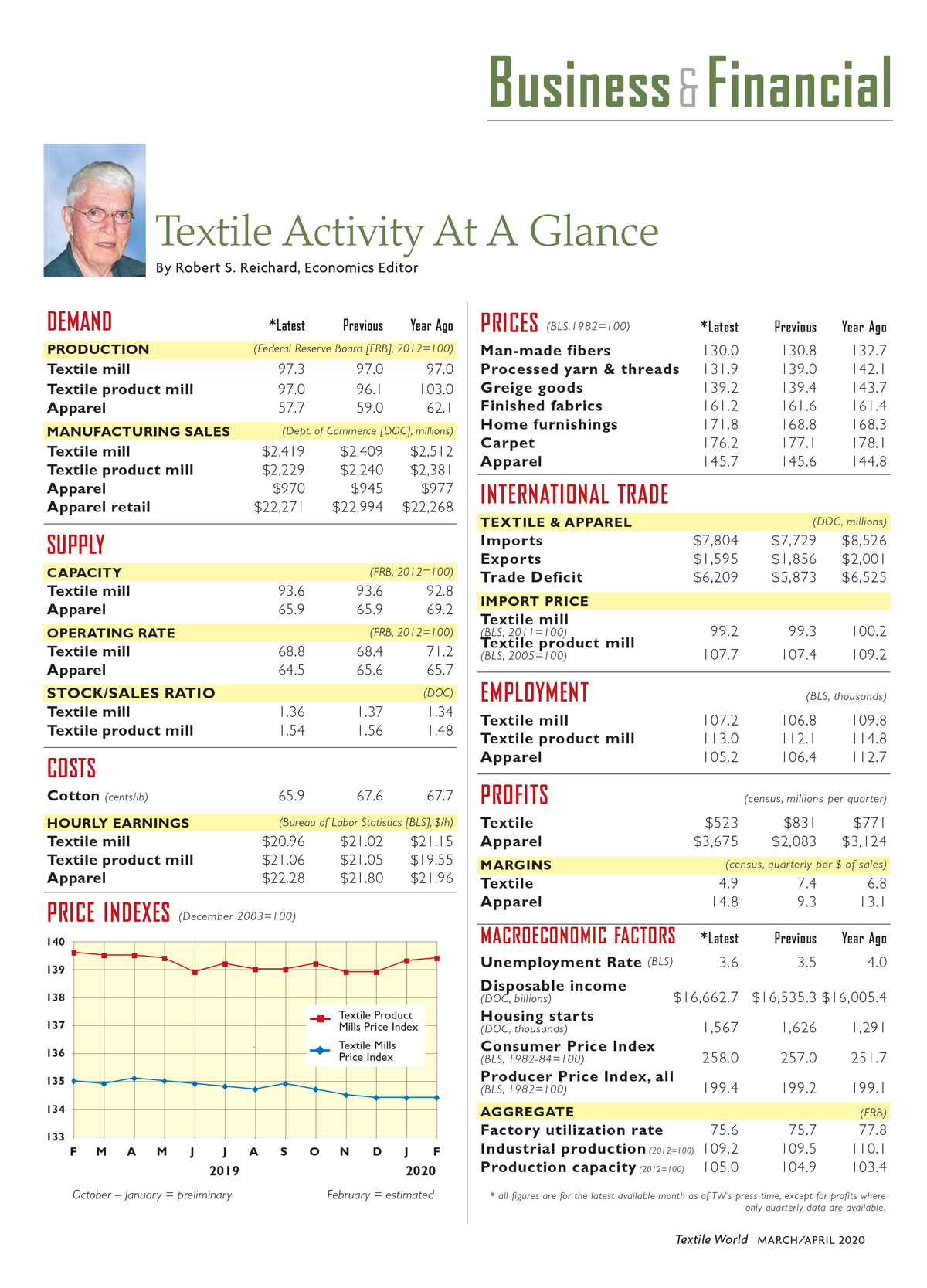
As of TW’s press time, few of the effects of the virus have shown up in the United States’ underlying economic data. Half of the economists in the Wall Street Journal Survey are not predicting a recession — two or more concurrent quarters of negative gross domestic product growth. Extremely low oil and gasoline prices, mortgage interest rates and bond yields may act as a buffer against lower profits caused by the economic effects of the virus.
Oil companies may struggle as OPEC and Russia feud over prices and production levels. The side effect is positive for oil consumers and producers of petroleum-based products, but tough on domestic oil frackers that have made the U.S. energy independent. But gasoline prices have a big effect on U.S. consumers — the very people that will set the tone of the depth and speed of a recovery.
One of the few saving graces is the shape the economy was in prior to the pandemic. As stated in this very column in the January/ February 2020 issue of TW, “Positive jobs data, low unemployment, low inflation, reduced regulation, the new USMCA in place, energy independence, low oil prices, completion of the phase one U.S.-China trade agreement …” may blunt the economic effects of the virus.
With employment so tight, it will be interesting to see how employers react. Will they proceed with layoffs, risking the ability to hire workers should they need to ramp-up production in snap-back recovery? Will layoffs be prudent given the unknown depth and duration of the virus’s effects?
It is really a lot of crystal ball work at this point in time. Some say it’s time to invest — stocks are on sale. Others say that this is a historic event with long-lasting negative impacts on the global economy — where airlines, cruise lines, hotels and professional sports will never be the same.
The reality probably falls somewhere in between these views. America is resilient
and will move forward.
The American Association of Textile Chemists and Colorists (AATCC) managed to host its annual International Conference & Exhibition as scheduled recently. But that event snuck in under the wire before it became clear that the threat posed by the spread of COVID-19 was one to take seriously. Some global events already had been postponed, and now U.S. show organizers and associations are following suit, by either postponing, cancelling or moving spring events to an online format. Some organizations are waiting to see how the second half of the year shakes out before committing to new dates, while others have gone ahead and rescheduled.
One of the largest shows for the U.S. industry in 2020, Techtextil North America and Texprocess Americas, has been moved from May 12-14 to December 15-17, 2020. In a statement about the decision to move the show, Kristi Meade, show director – Technical Shows: Textiles, Sewn Products, Equipment and Technology, Messe Frankfurt, said: “Up until this point, we were optimistic that May was far enough away to proceed with the events as planned. However, as the situation has evolved, we feel that we must act in the best interest of our exhibitors, visitors and the industry overall.”
Here are just some of the other impacted industry events this spring:
• The Synthetic Yarn and Fabrics Association (SYFA) has cancelled its spring meeting. The fall meeting is scheduled for November 5-6, 2020;
• The Americas Apparel Producers’ Network (AAPN) has rescheduled the Carolina Mill Tour for September 29-October 2, 2020. The Charlotte Regional Conference will also move to the same week. AAPN also has postponed its annual meeting in Miami with a new date to be determined;
• The Southern Textile Association (STA) has cancelled its Northern and Southern Division spring meetings. Dates for its fall meetings have yet to be announced;
• The Association of the Nonwoven Fabrics Industry (INDA) has announced events in May and through the end of the year, including the World of Wipes® Conference in Minneapolis June 22-25, currently will move ahead as scheduled. However, INDA has cancelled training courses previously scheduled in March and April;
• The Industrial Fabrics Association International (IFAI) has postponed the upcoming Fabricators Conference and Showcase and is looking at transitioning other events including the Smart Fabrics Summit and the Outlook Conference to virtual events. IFAI currently plans to host IFAI Expo 2020 as scheduled November 4-6, 2020;
• Global Nonwovens event INDEX™20 in Geneva, Switzerland, was postponed until October 20-23, 2020;
• The Sewn Products Equipment & Suppliers of the Americas (SPESA) has postponed its Advancements in Manufacturing Technologies Conference indefinitely;
• The National Council of Textile Organizations (NCTO) has postponed its annual meeting until next year;
• ITM 2020 and Hightex 2020 in Turkey have been moved from June dates to July 14-18, 2020; and
• FESPA Global Print Expo 2020, European Sign Expo 2020, Sportswear Pro and FESPA Brasil 2020 have all been postponed with new dates yet to be announced.
Asahi Kasei company Sage Automotive Interiors, Greenville, S.C., has signed an agreement to purchase the automotive fabric business including lamination of Plymouth, Mich.-based Adient for $175 million. The agreement, expected to be complete by the end of FY 2020, is subject to the regulatory approvals and customary closing conditions.
Adient operates a number of facilities in Europe, and Sage hopes the acquisition — which includes 11 facilities and approximately 1,300 employees — will help in its goal to expand capacity and capability for automotive interior products for the European market. Adient’s automotive business is expected to generate approximately $240 million in revenue in FY 2020.
“Europe continues to be a key growth area for Sage Automotive interiors,” said Dirk Pieper, CEO, Sage. “In addition, the technology and capabilities that will now be part of Sage
Automotive Interiors will strengthen our ability to serve customers from our current locations in Europe and the rest of the world.”
“As Adient continues to focus on its core business, we believe that the sale of our fabrics operation to Sage better positions that business for growth and long-term successful
performance,” said Doug Del Grosso, president and CEO, Adient.
The market disruption caused by the global novel coronavirus pandemic is beginning to affect virtually all aspects of the U.S. economy, including the entire textile/apparel supply chain.
For spinners, this means a likely precipitous — hopefully temporary — drop in demand. With retail stores around the world reducing hours, or closing altogether, sales of apparel, home fashions, home furnishings and other products are expected to decrease sharply over the near term.
“Right now, it’s just wait and see,” said one industry expert. “With retailers like Abercrombie, Levi’s and Nordstrom closing at least through the end of March, we expect to see a general slowdown in orders across the entire supply chain. How deeply it will affect individual companies — and the industry as a whole — will depend on how long the epidemic lasts.”
“What we are really concerned about, from a business perspective, is how long this is going to last,” said one executive. “If it lasts long enough to affect back-to-school and holiday orders, it could turn into a bad year for the industry as whole.”
Already, with retailers, restaurants and others closing their doors, economists are projecting a global recession. “It’s hard to say how long it will take the economy to recover,” noted one economist.
“So much depends on how much containment we are able to achieve through such measures as social distancing. Worst-case projections show that up to 20 percent of Americans could be unemployed at some point during this crisis.”
Most spinners are still operating a full schedule, but are taking precautions to protect employees.
“We are sheltering in place,” said one spinner. “Right now, none of our plants are in the virus hotspots. But we have restricted visitation to all of our facilities to try to keep our folks from getting the coronavirus.”
He continued: “Obviously, our first concern is our people. But we are closely monitoring retail sales to see how our business might be affected. In times like these, some products will be difficult to move. But opportunities open for others.”
An industry analyst predicts high demand for medical textiles. “The issue is whether a huge demand increase can be satisfied before the need passes. Masks, gowns and such should move very well in the next few months.”
Sustainability Continues To Build Momentum
While the coronavirus epidemic dominates the news, other events of note are occurring. The Secondary Materials and Recycled Textiles (SMART) Association celebrated Global Recycling Day on March 18, 2020. This annual awareness day is organized by the Global Recycling Foundation and is designed to promote the role recycling plays in preserving the earth’s primary resources. The event’s 2020 theme is “recycling heroes” — a salute to unsung recycling heroes across the globe, including people, groups, organizations, and businesses who champion recycling practices and habits.
For SMART, increasing awareness of textile reuses and recycling is of utmost importance on Global Recycling Day. Textile waste has a dramatic global impact; the average U.S. adult discards 81 pounds of clothing each year. Of this, only 15 percent actually gets donated or recycled, with a staggering 85 percent of textile waste directed to landfills.
“What many don’t realize is that through the work of our members, nearly 1 billion pounds of textiles are diverted from landfills annually, which saves our environment from tons of harsh chemicals, waste products, wastewater and greenhouse gas emissions,” said Jackie King, SMART’s executive director.
Numerous spinners have well-entrenched sustainability programs in place, such as Unifi’s REPREVE® yarns and American & Efird’s Ten Threads of Sustainability. A&E’s parent, Elevate Textiles, also is committed across all of its business units to achieve sustainability milestones by 2025. Commitments include using responsibly sourced fibers, as well as reducing water consumption and greenhouse gas emissions.
INDA’s inaugural FiltXPO™ event attracted more than 1,300 people to Chicago.
TW Special Report
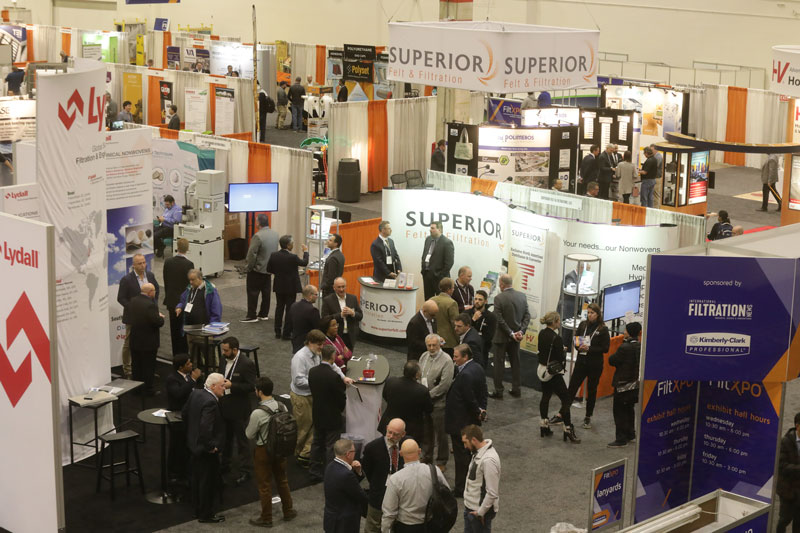
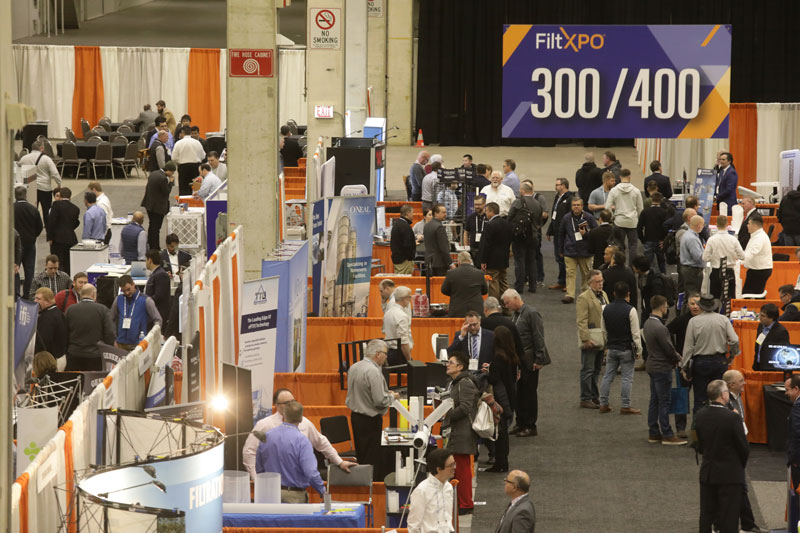
FiltXPO™, an exhibition and technical conference dedicated to filtration and separation products and processes, recently closed the doors on its three-day inaugural edition. Organized by the Cary, N.C.-based Association of the Nonwoven Fabrics Industry (INDA) and hosted in Chicago at Navy Pier, the event attracted more than 1,300 visitors. FiltXPO replaces INDA’s International Filtration Expo and Conference that ran for 27 years. The new event was created to be broader in scope covering separation and membrane technologies, processes and equipment.
INDA noted more than 100 exhibitors participated in the trade show, although more had originally booked space. Exhibitors coming from China were forced to cancel because of the COVID-19 outbreak. Show exhibitors reported high-quality interactions with senior-level decision makers who were looking for new materials and solutions to design challenges. “The ability to forge new connections with first-time attendees in new business areas provided strong value that will generate high returns,” said Doug Brown, president, Greenville, Wis.-based Biax-Fiberfilm Corp.
Seven separate sessions were featured at the concurrent Technical Conference — Biopharmaceutical Filtration, Membrane Filtration, Air & Gas Filtration, Nanofiber Filter Media, Water Filtration, Macro/Nano Modeling, and Separation & Filter Media Technology — with 31 experts presenting. The conference portion of FiltXPO was chaired by Dr. Behnam Pourdeyhimi, associate dean at North Carolina State University and executive director of the Nonwovens Institute, Raleigh, N.C. According to INDA, “conference attendees were impressed with the caliber and content of the speaking professionals.”
The event also featured a two-day Filter Media Training Course led by INDA’s Director of Education & Technical Affairs Chris Plotz.
FiltXPO is scheduled to take place every 18 months with the next edition line-up for October 12-14, 2021.
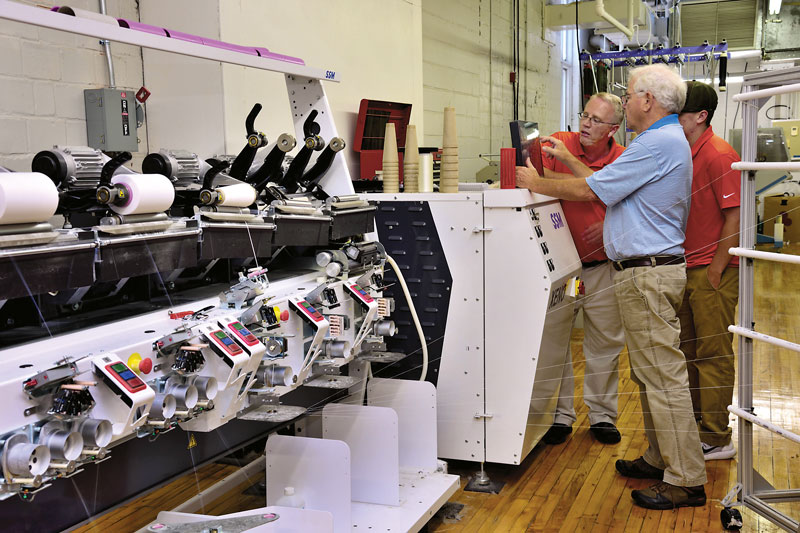
TTC’s Don Rusch and Dan Rhodes training summer intern Boone Owenby (right). Boone spent the summer immersed in a hands-on educational experience at TTC.
Textile Technology Center at Gaston College — a well-kept secret few have heard of — is a non-profit entity focused on technical support for the textile industry.
By Jim Kaufmann, Contributing Editor
Most dictionaries define evolution as “the change in characteristics of a species over several generations.” Change the word species to organization in that definition and it describes how the Textile Technology Center (TTC) at Gaston College, Belmont, N.C., has managed to service the textile industry for 77 years and is still going strong. Originally established as the North Carolina Vocational Textile School, the organization began offering classes in 1943, roughly midway through the southern U.S. textile industry’s boom years. Fueled by increasing demand for textiles throughout the World War II and Korean war eras, then later to clothe baby boomers through the 60s and 70s, the industry expanded. And so did the vocational school as it trained and educated people in textiles to support that burgeoning growth.
New technology developments led to more diverse applications for textiles beyond clothing and bedding, and further industry expansion enhanced TTC’s offerings. Then came the transitional years of the 1980s and 1990s when drastic shifts occurred in the industry — a result of breaking up several larger textile companies by venture capitalists as well as moving a high percentage of textile production to low cost producers in the Far East. The introduction of the North American Free Trade Agreement (NAFTA) and persistent downsizing of the U.S. textile industry that continued into the 2000s led most people to conclude that the industry was dead. Yet, to borrow a famous quote, “reports of the textile industry’s death were greatly exaggerated.”
Enter present day, and: “Though many still think of the U.S. textile industry as being dead, we see it much differently,” said Sam Buff, TTC director. “We’ve managed to evolve with the highs and lows of the textile industry over the years. In the early years, TTC was a little standalone community college teaching textiles and adding additional programs and services along the way. Then the industry started moving off-shore, NAFTA was created and business in this region changed drastically because textiles were no longer prominent.”
Buff noted that from 1999 until 2005, TTC spent time trying to figure out what it could do and where it might create value. “During the lean years, we still did some training, but also started assisting companies to succeed within the changing textiles environment by offering outsourced R&D and testing services. In 2005, we were absorbed into Gaston College and rebranded as the Textile Technology Center.”
As part of Gaston College, TTC is strictly a non-profit entity with four primary areas of technical support including sample production, product testing, problem solving and customized training. “Our prices are reasonable because we are non-profit and not driven by any type of share-holder expectations,” Buff said. “Roughly 70 percent of our income is generated by sales, while the remainder comes largely from the state.”
TTC’s customers include everything from entrepreneurs to multi-national corporations and it currently has approximately 600 active customers from across the globe. Projects have come from 35 different states and countries including Germany, Brazil, Australia, Israel, Portugal, Honduras and Mexico.
“We’ve pretty much come full circle with the increased demand for improved textile education and training as the industry comes back and continues to diversify into more exotic areas,” Buff offered. “We do sense a change in the industry with reshoring. People are investing in textiles in the United States again and TTC is benefiting from that. There are many diverse pockets of not just fashion inspired textiles, but also industrial, performance and technical textiles that continue to evolve creating so much more to this industry than just those old perceptions. Textiles have evolved and expanded and continue to do so and we need to continue evolving and adapting quickly as well to meet the industry’s needs before someone else does.”
Over the past several years, Buff and TTC have reassessed its strengths, weaknesses and capabilities to more clearly define what TTC essentially is today — a one stop shop for textile product and process development needs. Businesses, entrepreneurs and others now use TTC as a research and development (R&D) resource to help reduce internal development costs. As a result, TTC customers do not have to invest in a fully capable testing lab, R&D equipment, facilities, or — more importantly — the talent required to operate those areas.
Sam Buff, director, Textile Technology Center at Gaston College
It’s Really About The People
“The real key is people and we certainly have some good ones here,” Buff exclaimed. “We have a good mix of the grey hairs, young kids and the in-betweens. It’s great to see how their different perspectives work together to help each other out and solve the problems at hand. Our older folks love to help, mentor and educate the younger ones. And that’s not always one sided either — the younger ones also tend to bring a new-age perspective to the issue at hand that often will cause the older folks to stop and rethink things in a different light.”
Talented staff is one of Buff’s biggest concerns when it comes to TTC’s and possibly the textile industry’s future sustainability. “Talent that understands textiles and soft goods is really difficult to find,” Buff lamented. “It’s tough to replace someone with 45 years of experience! You can teach new people to run a machine, but it takes years to teach them how to make fabric. It’s hard to beat that high level of experience that only comes from years of knowing what or where to make an adjustment, how to compensate for material variations or when the machine just happens to be having a bad day.
As experienced people reach retirement age, the smaller pool of talent to draw from is impacting the industry negatively, according to Buff. “I truly think the textile industry has done a poor job at developing people and that’s hurting us now,” he noted. “Look around, there used to be several textile schools feeding the industry, and now NC State might be the last one in the United States to offer a true textile curriculum. Because of this, TTC is striving to become a talent incubator by helping industry to hire people out of high school or elsewhere and then providing them with unique opportunities to work with our experienced staff who can mentor and pass along industry knowledge.”
Much of TTC’s staff comes from the textile industry and still maintains strong connections throughout the fiber, yarn and fabric manufacturing arenas as well as with different and related industries. Those staff connections help TTC grow its list of resources that includes people, technologies and general knowledge of how to get things done. “We really do know a lot of people,” Buff sad. “This industry at times can feel really big and spread out, but at other times it can be small and intimate. We do a lot of networking, sourcing, servicing and putting people together. For us, it’s all about helping everyone in this industry to succeed. We keep trying to get more people to see the textile industry for its opportunities and possibilities to help us build our connections and resources, which in turn helps our customers.”
While Gaston College does not have a specific textile curriculum to draw from, TTC maintains connections with other textile universities and related institutions in the area. “We’re a good team player!” Buff emphasized. “We do work with other universities where we can. We’re in constant contact with the Manufacturing Solutions Center (MSC) in Hickory, N.C., as well NC State in Raleigh, N.C. Also, there’s companies in the area like Southeast Nonwovens (SENW) and of course many others throughout the industry.”
Buff said TTC looks at the nature of the project along with the resources and technology it requires and then shares its customers either leading the charge or by assisting as appropriate. “MSC has better knitting capabilities, SENW has nonwovens covered, NCSU has its textiles curriculum and all their resources and we are strong in fiber, yarn and weaving — so there’s a good mix of talent and technologies to work with,” Buff noted.
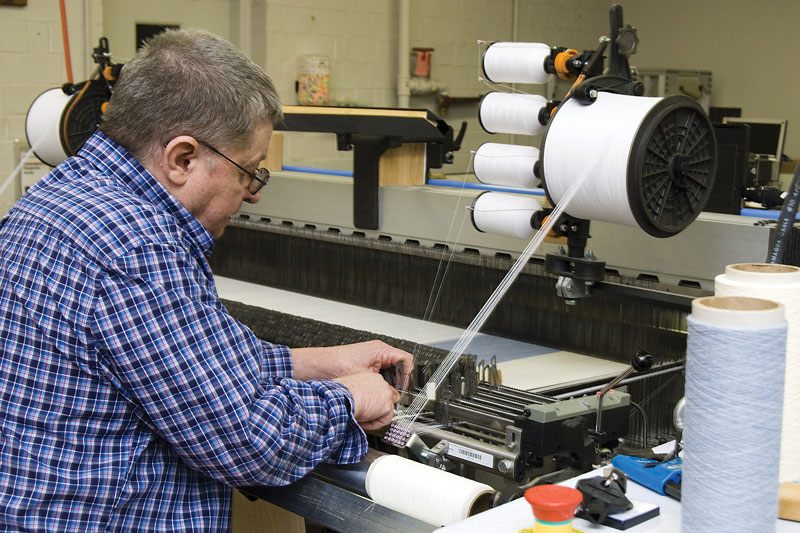
TTC’s John Fowler fine tuning a product development project in the weaving lab.
Access To Technology Helps
TTC aims to be a great place for the industry to come play, and it makes every effort to be easy to work with. It does not ask for a position in any intellectual property. “We want to help you develop your product in the hope that you’ll come back again the next time,” Buff said. “Most do!”
Buff has been with TTC since 2005 serving as director since 2012. TTC does R&D, but it’s more like a small r and a big D, according to Buff. “I see research as the process of learning all you can about your idea, basically understanding everything you can no matter how big or small an idea it is,” Buff said. “That’s where a research university may be better than us. On the other hand, development is mostly about achieving commercialization. Your idea looks great on paper, now what? TTC excels at taking ideas to commercialization.”
TTC will take the idea and push it through its processing areas to determine if it can be run or not. Buff said the center maintains honesty with the customer throughout the process because if the idea will not run on its processing equipment, a manufacturer likely will not be interested in the product. “They want to know that your product can run, it’s ready to process and commercially viable,” Buff reported. “We get you to that point.”
TTC’s labs include fiber extrusion, yarn development, fabric formation — including weaving and knitting — and dyeing and finishing. It also has well-equipped physical testing and analytical labs to assess and validate products each step of the way. “We try to start with the fiber technology because that drives everything else downstream,” Buff said. “The black magic and pixy dust found in fiber and yarn technology these days is where much of the real value originates and we’ve been working to upgrade these areas at TTC to be more in line with industry technologies. We’ve also found the industry is realizing this value and is willing to invest in TTC, which helps them, and our customers, in the long run.”
Current upgrades include new Murata Vortex spinning technology with additional upgrades planned in the near future. The upgrades also will help TTC with product scalability, which has on occasion been a challenge.
“Sometimes customers come in with literally a handful of fiber and ask us if we can make a fabric out of it?” Buff said. “The answer is usually yes, by the way. Then we have the ‘tweeners’ who want to produce, test and validate a concept which we can certainly help with. But occasionally, there are clients who we just cannot accommodate because the sample size was too big for us, even though it was too small for them to produce in-house. We’re hoping that the planned equipment upgrade efforts will position TTC better to assist with these types of projects.”
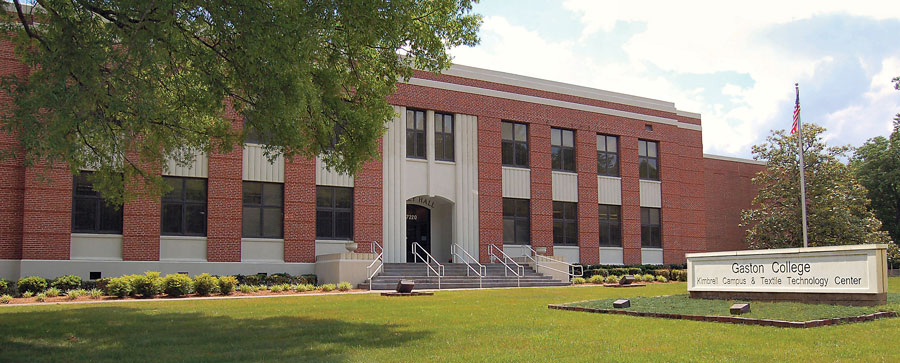
TTC is housed in Harney Hall on Gaston College’s Kimbrell campus in Belmont, N.C.
TTC Will Continue To Evolve
While TTC is a “great place for the industry to come and play,” it plans to continue to evolve and adapt to the textile industry’s needs. “Part of our challenge now, is in identifying what areas we should be going after as textiles continue to expand into other areas,” Buff offered. “We’re investigating composites, medical, recycling and renewable technologies and other areas. There’s just all kinds of untapped opportunities for textile technology and we need to be ready to support whatever the future brings our way.”
Buff also pointed out that the textile industry still has an image problem that TTC is fighting to overcome. “We need to keep attracting and developing strong minds to merge the old and new as new technologies and applications keep pushing us forward,” Buff said. “We attend tradeshows and conferences where we can conduct demonstrations, speak or even create complete programs on textiles. Gaston College has also recently hired a new marketing person who we plan to work with to get TTC more visibility.”
Throughout its 77 years of existence, TTC has adapted to a fickle industry’s needs and there’s every indication that it will continue to do so. Not bad for a “well-kept secret few have ever heard of.”
Sportswear manufacturer Macron selected a solution from EFI™ Optitex® when it was time to upgrade its CAD system.
TW Special Report
Italy-based Macron is a manufacturer of sportswear dedicated to four main business areas — teamwear, merchandising, run and train, and athleisure. Established in 1971, the company began its journey as a popular sports shop supplying quality sportswear for basketball, golf and baseball. In 2001, Macron signed its first sponsorship with agreement with the Bologna Football Club to outfit the whole team. And in 2010, the company launched the Macron Store project, which provided direct access to its end-customers and gave rise to its full sportswear kits.
Today, Macron has more than 150 mono-brand retail locations backed by its unique customization concept.
The company strongly believes in the values of hard work and constant improvement and its company motto is “Word Hard. Play Harder.”
Beginning with a customer base located entirely in Italy, today the company distributes approximately 30 percent of its products in Italy, with the remaining 70 percent distributed worldwide. According to the company, turnover has grown significantly year after year, and Macron now is one of the most rapidly growing sportswear brands in Europe.
The company’s catalog counts more than 650 articles in numerous color combinations including track suits, sweatshirts, polo shirts, socks, caps, winter jackets, underwear, bags, balls, and accessories of all kinds.
Macron also is a leader in the production and sale of technical sportswear for professional, semi-professional and amateur teams in a variety of sports. Today, the company designs and produces official kits and technical gear for more than 80 professional clubs as well as develops official apparel and accessory collections for club fans.
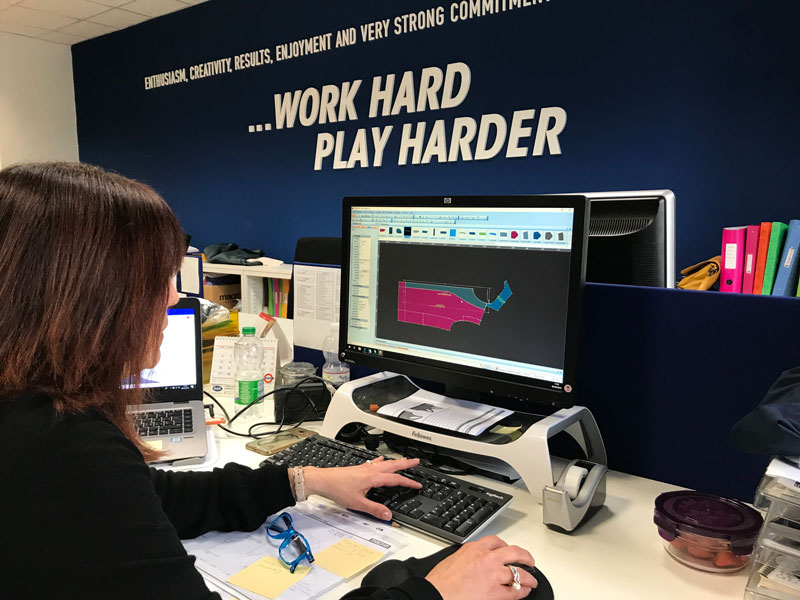
To fully accomplish its global expansion and deliver on-demand, on-time and within budget, the team at Macron recognized it was time to replace its legacy computer-aided design (CAD) software and transform its entire operation. This meant transitioning to a strong and reliable digital CAD solution.
After a short implementation and training process led by the CAD experts at EFI™ Optitex® — a division of Fremont, Calif.-based Electronics For Imaging Inc. (EFI) — the Macron team was ready to get on board. In just a few months, Macron’s CAD operators were raving about the system’s incredible speed and ease-of-use.
“With our new CAD workstations, our ability to view multiple screens at the same time has significantly increased the speed and the interaction between various graphics software,” said Amedeo Iossa, Macron’s product development manager. “For Macron, creativity is key. Our CAD operators have discovered many more design features and functionalities in the system, and are using them to enhance their creative process. The design phase is notably more efficient.”
“It’s important for us to preserve our in-house design knowledge,” said Paolo Guizzardi, CEO, Macron. “Today, with EFI Optitex CAD, we can include our global staff in our design work-flow, making them part of the process and benefiting from their design expertise.”
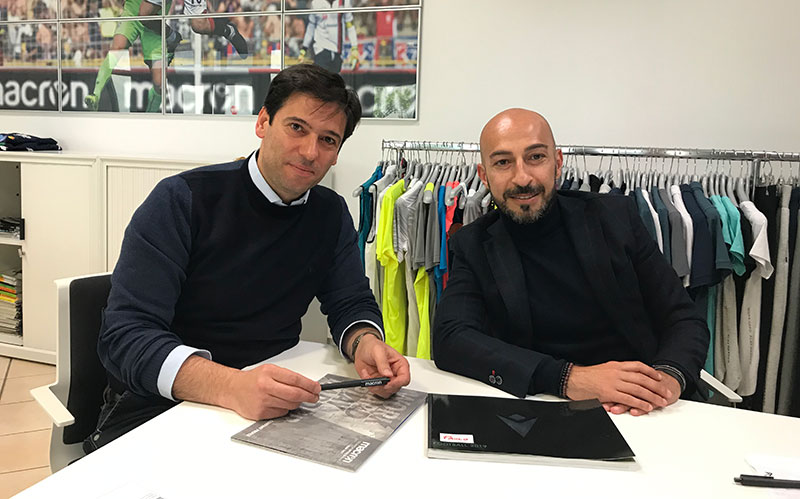
Macron COO Paolo Guizzardi (left) and Product Development Manager Amedeo Iossa
When System Openness, Collaboration Are Key
For the Macron team, every sports club is like an entirely new collection, where time-to-market can be anywhere from six to eight months to complete a customized product line.
“Today, we use CorelDRAW and Adobe Illustrator for design,” Iossa said. “Our designs must adhere to the technical guidelines of each club, such as leaving specific areas on the garment for sponsors.”
To continue to meet growing customer demands, Macron replaced its legacy CAD system with a system from EFI Optitex in 2018. This enabled the company to expand its pattern design capabilities and to add a new design facility in Tianjin, China. “Now we’re able to exchange data with our production partners around the globe and across all market standards, and even with other Italian service providers who use different CAD systems,” Iossa noted. “EFI Optitex’s system openness was fundamental in our decision to change vendors.”
What The Future Holds
Sportswear design and manufacturing is a growing industry worldwide. “We want to gain every possible technical advantage in our sector,” Iossa said. “EFI Optitex’s 3D digital design solution is a good option to help us make this vision into a reality. To see a true-to-life model of a garment on an avatar customized according to the physical characteristics of the athletes we dress would undoubtedly boost our development process.”
Macron’s first objective is to increase its product line for the current 80-plus professional clubs and then look towards launching new global markets with an emphasis on North America. Recently, Macron signed a partnership agreement with the new soccer Canadian Premier League (CPL), and is a sponsor for the Phoenix-based Phoenix Rising FC soccer team as well as the newly launched Major League Soccer team Inter Miami CF.