Second-Annual World Cotton Day Offers Virtual Events Across The Globe

WASHINGTON — October 7, 2020 — The second-annual celebration of World Cotton Day on October 7 is set to once again pay tribute to what’s often called the “most important natural fiber in the world.” This year, the observance will come to life through virtual events covering an array of topics surrounding cotton, hosted by key global cotton stakeholders and available to consumers, brands, supply chain players and government organizations and leaders worldwide.

The International Cotton Advisory Committee (ICAC) co-established the global day in 2019 alongside four other organizations — the World Trade Organization (WTO), International Trade Centre (ITC), United Nations Conference on Trade and Development (UNCTAD) and the Food and Agriculture Organization (FAO) — as a formal recognition of the countless benefits that cotton brings to communities worldwide. World Cotton Day provides cotton organizations, advocacy groups, investors and beneficiaries a platform to educate peers and consumers on the positive impact that cotton can have on transforming consumption, production, development and trade.

“We are honored to help support this much-deserved celebration for a second year, for it is an exceptional opportunity to unite our industry with the intention of driving mass awareness around the significant role cotton plays in the world economy and our everyday lives,” said Kai Hughes, executive director of the International Cotton Advisory Committee (ICAC). “While this year is certainly different than last, it’s more important than ever to recognize this natural fiber’s many contributions to today’s society and the contributions it will undoubtedly continue to make in the future.”

While World Cotton Day’s inaugural celebration in 2019 consisted of an in-person event at the WTO headquarters in Geneva, Switzerland, the event this year will be held virtually to adapt to the unprecedented times of the COVID-19 pandemic. More than 15 organizations will host complimentary sessions online, featuring a range of experts who will highlight the many advantages of cotton.

Some of the celebration’s events include:

  • Virtual Sustainability Seminar by COTTON USA (Latin America);
  • LinkedIn Photo Challenge by Women in Cotton;
  • Youth Cotton Video by Bremen Cotton Exchange (Germany);
  • Cotton Seminar by TexTalks (Pakistan); and
  • Brand/Retailer Promo Partnerships & Videos by Cotton Incorporated.

All of these virtual sessions encourage participants — from consumers to brands to public service organizations — to show their pride for cotton by wearing cotton and sharing on social media with the hashtag, #WorldCottonDay.

To learn more about World Cotton Day or sign up for a virtual event, visit WorldCottonDay.com for an event listing and additional information and follow the #WorldCottonDay hashtag on social media throughout the day (and after) for highlights and other content about cotton across the globe.

Posted October 7, 2020

Source: The International Cotton Advisory Committee (ICAC)

When Less Is More: No Additive Vinyl Hits The Market

HIGH POINT, N.C. — October 7, 2020 — Without, sans, free. However, you phrase it, the fewer the ingredients these days, the better, whether for regulatory reasons or personal preference. That’s why Morbern developed Allante Free®, a luxury hand, leather-like vinyl without additives designed for the hospitality, contract and public seating markets.

Having products that are additive-free is a necessary characteristic in places like California, which recently banned flame retardants from upholstered furnishings with Assembly Bill 2998. As of January 1, 2020, the state no longer allows the sale or distribution of upholstered furniture (or its components) which contains flame retardants.

But Allante FRee has let go of more than just flame retardants. This soft and buttery vinyl is formulated phthalate free and void of antimicrobial additives, but filled with performance features. A luxury grain vinyl with the look and feel of soft, supple leather, Allante Free is highly cleanable, with best-in-class denim dye and oil resistance (from cosmetics, cooking oils and fatty foods). In addition Allante FReeâ stands up to high traffic, most stains and sun. It’s available in a range of 25 solid colorways from neutrals to saturated reds, greens and blues. Allante FReeâ passes the CA TB-117, NFPA 260, CA AB-2998 and UFAC class 1 flammability tests.

In addition to creating products like Allante Free, Morbern has long looked for ways to reduce environmental impact as part of its commitment to protect and preserve our children’s tomorrow while meeting client needs today. It was among the first manufacturers of coated fabrics to completely eliminate heavy metals such as lead and cadmium. And the company ensures that the water flowing out at the end of the manufacturing process is clean enough to drink. Most recently, that commitment means reducing the additives in several of its products.

Posted October 7, 2020

Source: Morbern

Multi-Association Response To New York Times Report On DLA Contract Awards

WASHINGTON — October 7, 2020 — The National Council of Textile Organizations (NCTO), Warrior Protection & Readiness Coalition (WPRC), American Apparel & Footwear Association (AAFA), U.S. Industrial Fabrics Institute and the Narrow Fabrics Institute of the Industrial Fabrics Association International (USIFI/NFI), Association of the Nonwoven Fabrics Industry (INDA), and The Association & Voice of the U.S. Sewn Products Industry (SEAMS) — representing the full spectrum of the domestic textile, nonwovens, and sewn products industries — issued the following joint statement in response to the New York Times investigative report on the Department of Defense Logistics Agency’s (DLA) awarding of more than $1 billion in contracts for some 83 million disposable and reusable medical gowns for the Strategic National Stockpile replenishment.

We are concerned by the report published today by the New York Times indicating that certain medical gown awardees who received multi-million dollar contracts may not have the capabilities and proficiencies to manufacture U.S.-made, Berry-compliant products to support the Personal Protective Equipment (PPE) needs of the Strategic National Stockpile.  While we have a strong historic working relationship with Defense Logistics Agency (DLA), a relationship we value as an industry, this report raises serious questions about the vetting procedures and purchase criteria utilized by DLA in this process.

With this in mind, we respectfully request that the administration move forward and conduct a full and transparent independent review. Specifically, we have requested the following:

  • Request onsite verification for all awardees and verification of their production chains to help ensure integrity in the process. This verification will help ensure that this essential PPE needed by front-line workers is using 100-percent American materials and workmanship, one of the critical requirements that was established by DLA as it awarded these for these products.
  • Request DLA test the gowns independently to ensure compliance with required performance standards and other specifications and to ensure the health and safety of our front-line workers who will rely upon these items years from now.
  • Review the utility of the “Lowest Price Technically Acceptable” criteria associated with these awards and urge the government to move forward with a purchase mechanism for “Best Value” that ensures quality products are procured at competitive pricing.

It is important to state that we are aware that some of the awardees are very legitimate and capable suppliers. We want to ensure all verified legitimate producers are allowed to move their production forward for these essential PPE items. These companies and their workforce should not be hindered in this process. For those who are not compliant, we request the government take the necessary appropriate action and give compliant and capable producers an opportunity to supply these critically needed items.

Since the beginning of the pandemic, the entire U.S. industry, from fiber to apparel producers, has played an enormous role in helping address America’s PPE crisis, retooling production lines overnight.  The work of our industry has been noted at the highest levels of government and our domestic supply chain is extremely proud to provide this critical service to the nation. We have jointly been calling on the administration to fully maximize U.S. manufacturing assets to put our industry to work making quality, compliant PPE. We are strong supporters of the Berry Amendment and were very pleased that DLA expressed an intention to maximize the industrial base with this purchase. We also are very aware that there are winners and losers in any competitive bid process.

However, when DLA announced the awards in mid-September, our industry associations immediately raised cautionary flags, as to the domestic manufacturing capacity, technical proficiency and capabilities of certain awardees and their overall compliance. The Berry Amendment, a cornerstone of our defense industrial base, requires the use of complying fiber, yarn, fabric, and assembly be performed in the United States.  Further magnifying that concern, DLA stated it had awarded over 83 million gowns to the “domestic industrial base.” However, with the exception of a few awardees there were questions that were raised about the places of performance (location for product final assembly), whether the materials being utilized are Berry compliant, and whether the gowns meet the technical specifications. Certain places of performance appeared to lack the workforce necessary for these larger orders or the equipment or space required.  This is why an immediate and independent review is required.

Many of these strong concerns were raised directly with DLA in a multi-association letter on September 18, 2020.  Given our strong working relationship with the DLA over several decades, we felt it was important to reach out to them directly with our concerns. The response we received from DLA is that the government simply requires awardees to self-certify domestic production and Berry compliance.  Self-certification of such sizable awards to non-traditional suppliers appears to be a serious flaw in the process that must be re-examined.

The domestic supply chain, representing nearly 600,000 American workers, wants nothing more than to be a resource for the federal government. We can help the U.S. government better understand production chains and manufacturing capabilities.  We stand absolutely ready, willing, and able to manufacture the products the U.S. government needs for the Strategic National Stockpile and at the same time put our idle capacity and workforce to work.  We are strong supporters of onshoring the domestic production chain and believe the federal government is a critical partner in that effort.

We ask the U.S. government to immediately address this matter and take necessary actions regarding any non-compliant awardees. Simultaneously, we urge the administration to move forward with legitimate, compliant, and capable awardees — these companies and their workforce should not be punished, they should be maximized.  It is critical that the Strategic National Stockpile is replenished immediately, and we stand ready to be part of that solution. Our American health care workers deserve no less.

Posted October 7, 2020

Source: The National Council of Textile Organizations (NCTO)

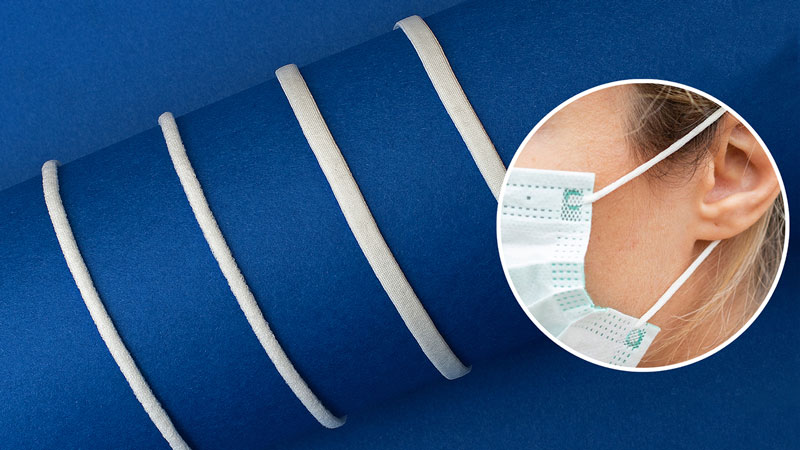
Comez International Presents High Performance Machine For The Production Of All Types Of Chainette Cords, To Be Used In Passementerie As Well As Ear Loops For Surgical Face Masks

CILAVEGNA, Italy — October 6, 2020 — The 1700/20 machine from Comez International S.r.l. is suitable for the production of any kind of tripolino, whether for passementerie, knitwear production, accessories and in many other sectors including the medical field. This machine is especially designed for the production of elastic, resistant and soft to the touch chainette cords. The specifications of these elastic cords enable easy connection to the fabric and make them ideal as ear loops for protective face masks, both disposable and reusable.

Main benefits for users:

  • Wide number of applications.
    • Hole diameter and quantity of needles can be defined according to each sample
  • Easily interchangeable knitting heads.
    • Needle cylinders are available with 4, 6, 8, 12, 16 and 24 needles each, with unloading holes of various diameters
  • Possibility of processing all yarn types.
    • Latch needles allow natural, man-made and synthetic yarns to be employed
  • Electronic stop motion.
    • The machine stops automatically, with a red warning lamp signalling empty bobbins or thread breaks

The machine is equipped with:

  • 20 operating heads;
  • Single take-down;
  • 20 cylinders with 12 needles – diameter 6 mm each (interchangeable according to each sample);
  • Electronic speed variator INVERTER; and
  • Standard supply package of consumables and accessories.

As optional 1700/20 can be equipped with a bobbin creel with 40 positions and a finished product collector with 2 rollers for high boxes.

Posted October 6, 2020

Source: Comez International s.r.l.

Quality Assurance From Mahlo — In The Service Of Health: Control Of Basis Weight And Material Thickness

DONAU, Germany — October 6, 2020 — Manufacturers of medical goods are currently under pressure to deliver their products as quickly as possible, but still with high quality. Weight and thickness greatly influence the functionality of nonwoven goods such as masks or protective gowns. With process control systems from Mahlo GmbH + Co KG, this balancing act is not only easier to master — production costs are also further reduced.

Thanks to decades of experience and a wide range of measurement and control technology, the Bavarian machine manufacturers are able to support manufacturers in monitoring and controlling important parameters during the production process. Different sensors are available depending on the application.

Matthias Wulbeck, expert for quality measurement at Mahlo, explained the differences: “Our Gravimat DFI sensor is part of the modular system Qualiscan QMS and measures the basis weight with the help of isotope radiation.” The measurement is based on the attenuation of radioactive radiation by the substrate in the measuring gap. This attenuation in intensity is an indication of the basis weight of the product. If the density is uniform, the basis weight measurement can also be used to draw direct conclusions about the thickness of the nonwoven fabric. In order to do justice to different material properties, Mahlo works with different isotope variants.

“For products with a weight between 10 and 1400 g/m² [grams per square meter] we use Krypton-85, for 100 to 6000 g/m² we use Strontium-90,” Wulbeck said.

No measurement inaccuracies due to fabric flutter

The transmitter in the traversing sensor radiates onto the running web. Due to their mass, the radiation reaches the receiver in a damped manner. Mahlo uses a multichannel receiver where the incoming measurement radiation is distributed to different areas of the product surface. Precise values are obtained this way, regardless of the current position of the web. This method also solves one of the major problems of manufacturers of web-shaped products such as hygiene fleece: Measurement inaccuracies due to fabric flutter.

Measurement with X-rays

As an alternative to the measuring technique with isotopes, Mahlo uses a measuring method with X-rays. “The Gravimat FMX-T sensor is ideal for products that consist of only one component and determines basis weight and thickness just as reliably as the models with beta radiation,” said Wulbeck. It measures thin film, nonwovens and other fabric with high resolution, measuring accuracy and absence of flaws. The sensor variant <5 kV is completely exempt from radiation safety requirements in Europe and many other countries. “A plus for many manufacturers.”

The Gravimat FMX measuring head consists of a compact X-ray tube and its highvoltage power supply as well as special, modern X-ray detectors with the electronics for data acquisition. Thanks to the optimized sensor design, it is completely insensitive to environmental impact such as temperature and relative humidity.

Another very interesting alternative is infrared absorption measurement, which measures the individual fiber components and can thus determine not only the basis weight but also the fiber content. This version is also exempt from safety requirements, as only infrared light is used for measurement.

No matter which method is used to suit the application — both have one thing in common: The automatic basic weight control significantly reduces the spread of the basis weight and thereby ensure a more consistent end product. Suitable defined setpoints with minimum tolerance ranges save material and energy costs to a significant degree, in addition to safeguarding product quality. In addition, a safety margin is eliminated, which otherwise means loss of goods and time.

Posted October 6, 2020

Source: Mahlo GmbH + Co. KG

Fifth ITMF Corona Survey: Sixty-Nine Percent Of Participants Have Reduced Their Production Capacity During The Corona Pandemic

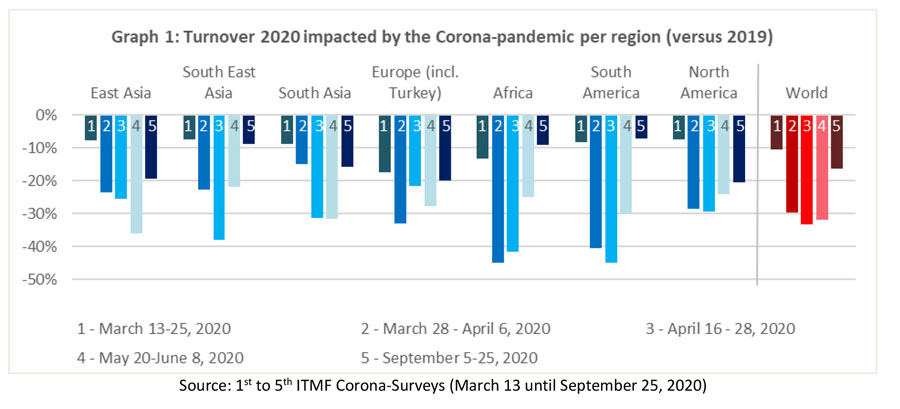
ZURICH, Switzerland — October 2, 2020 — Between September 5 and 25, 2020, ITMF has conducted its 5th ITMF Corona-Survey among ITMF members and affiliated companies and associations about the impact the Corona-pandemic has on the global textile value chain. In total, 216 companies from around the world participated. They report that the Corona-pandemic led to a significant reduction of production capacities. Twenty-three percent of the respondents reduced production by more than 30 percent and another nineteen percent of respondents by 20-30 percent. On the other side of the spectrum — and unsurprisingly — only 9 percent of companies have increased their production capacity during the pandemic. Twenty-one percent did not make any change (See Graph 1).

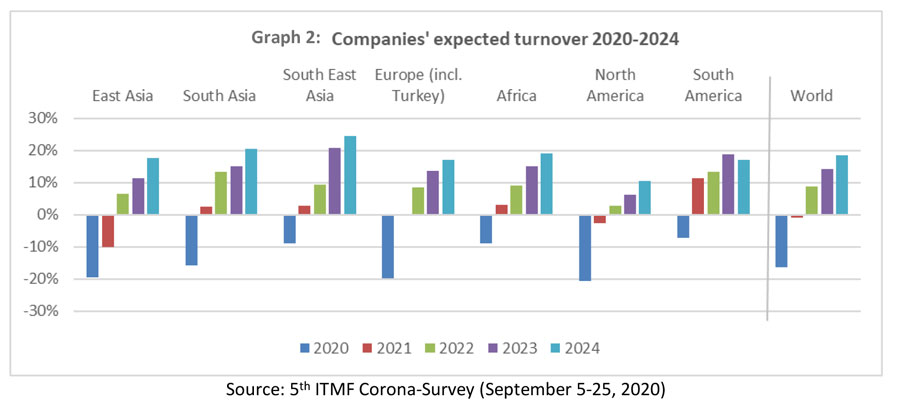
Furthermore, twenty-one percent of all surveyed companies are expecting turnover to be back to pre-crisis level in 2020. Eleven percent of companies think it is more likely to happen in the 1st quarter of 2021, 15 percent in the 2nd quarter of 2021, and 17 percent in the third quarter of 2021. It is important to note that 25 percent of all companies are expecting turnover to reach pre-crisis levels in 2022 and 2023 (See Graph 2).

Posted October 6, 2020

Source: ITMF

Freudenberg Expands Meltblown Nonwovens Capacity At Kaiserslautern Site

WEINHEIM, Germany — October 5, 2020 — Freudenberg Performance Materials is expanding its production capacity for nonwoven media used exclusively to manufacture certified face masks of the mouth-nose protection type pursuant to the EN14683 standard, as well as FFP1, 2 and 3 masks pursuant to the EN149 standard. The media are specially developed for and sold to the medical technology processing industry. To that end, Freudenberg is investing in the construction of a new state-of-the-art meltblown production line at the Kaiserslautern site. Commissioning of the new plant is slated for the first quarter of 2021.

“As a world-leading manufacturer of technical textiles and filtration media, Freudenberg Performance Materials has deep expertise in materials for certified face masks. By expanding our production capacity in Kaiserslautern, we are making a contribution to mastering the challenges presented by Covid-19 and supplying certified type face masks as well as FFP1, FFP2 and FFP3 masks in Germany and Europe”, the CEO of Freudenberg Performance Materials, Dr. Frank Heislitz, said.

With the new line, Freudenberg is significantly expanding production capacity for meltblown nonwovens in Kaiserslautern. The world-leading technical textiles manufacturer produces these materials from extremely fine meltspun polypropylene microfibers that are several times thinner than a human hair. Masks made of these nonwovens can filter very small particles such as viruses thanks to the superfine structure of the material and its electrostatic charge.

Posted October 6, 2020

Source: Freudenberg Performance Materials

Allertex Of America Names Jason Johnson Technical Sales & Business Development Director

CORNELIUS, N.C. — October 6, 2020 — Allertex of America Ltd. CEO Alistair Deas is pleased to announce the appointment of Jason Johnson as technical sales & business development director.

Jason has been with Allertex for two years in which he has achieved record machinery sales in new markets. Allertex recognizes the U.S. nonwovens and technical textile industry continues to grow and evolve generating new, exciting opportunities. This appointment will play a major role in Allertex’s aggressive approach to new opportunities.

Johnson’s vast experience in the nonwovens industry will be an asset to the position and will provide support to the CEO in focusing Allertex sales and marketing strategy.

Posted October 6, 2020

Source: Allertex of America Ltd.

Jenoptik Announces The Appointment Of Steve Green As President For Smart Manufacturing Solutions

ROCHESTER HILLS, Mich. — October 6, 2020 — Jenoptik has announced the appointment of Steve Green as president of JENOPTIK Automotive North America.

North America is a key market for smart manufacturing technologies in the fields of automation, laser processing, and metrology. Green’s experience in manufacturing and automation will help lead the way towards executing key market strategies for growth in the region, continuing to expand the company’s product offerings into different industries and magnify customer service efforts.

“We welcome Steve’s extensive management and industry experience to the team as we continue to expand our North American operations and establish ourselves as a global supplier of integrated manufacturing solutions,” said Martin Kuhnhen, head of the Light & Production division. “Steve brings a wealth of industry know-how to the team that includes a valuable mix of product, systems, customer service, sales and business leadership experience within a broad range of manufacturing markets.”

Green has more than 25 years of manufacturing, automation and specialty tooling experience, supporting North American energy and automotive markets. Prior to Jenoptik, Steve worked in several roles at KUKA Robotics including Operations & Customer Services manager, president KUKA Canada, and president KUKA Robotics USA.

Posted October 6, 2020

Source: Jenoptik

Eurofins Launches Europe’s First Validated Test Method To Evaluate Filtration Capacity Of Masks For SARS-Cov-2

LUXEMBOURG — October 6, 2020 — Eurofins Scientific SE: Eurofins Textile Testing Spain announces the launch and validation of a new test method to evaluate the filtration capacity of masks with 100 nanometre particles, the estimated mean size of the SARS-CoV-2 virus. Eurofins Textile Testing Spain is currently the only laboratory in Europe and one of only three laboratories in the world to offer such a test, which is mandatory for all masks sold in the North American market.

The test can be used to evaluate the efficacy and safety of surgical masks and hygienic masks. The evaluation method is based on Particle Filtration Efficiency (PFE), which measures the filtration capacity of masks with 0.1 micron droplets, equivalent to the size of the SARS-CoV-2 virus. As this new test method is carried out using particles comparable to the real size of the virus, it allows Eurofins to offer greater security in evaluating the effectiveness of masks against COVID-19.

In addition, since the start of the COVID-19 pandemic, Eurofins Textile Testing Spain has received ENAC (Entidad Nacional de Acreditación / Spanish National Accreditation Body) accreditation to carry out tests on surgical masks and has already certified more than 1,000 models of surgical and hygienic masks being used throughout the world.

Eurofins is one of the reference laboratories globally in the certification of masks, offering a comprehensive suite of tests and certifications (e.g. CE marking) for hygienic, surgical and FFP1/FFP2/FFP3 masks for markets such as Europe, the United States, South America and various Asian countries.

Posted October 6, 2020

Source: Eurofins Scientific SE

Sponsors